Make Local for Global Logo

READY TO SELL Anti-aging creams ONLINE?

Get a store built for you in 5 days, plus training and support to help you start, run, and grow your Alternative business.

Sell anti-aging creams online: a UK guide to building a trusted skincare shop

A practical guide to selling anti-aging creams, from picking a focused range and avoiding risky claims to product pages, bundles, and launching an ecommerce shop customers trust.

Make Local for Global

Table of content

Selling anti-aging creams can be a great business.

People buy them on repeat, they’re easy to ship, and customers tend to stick with a product once it becomes part of their routine.

But it’s also a category where trust is everything.

Customers are sceptical (fairly), competition is intense, and one over-the-top claim can make your brand feel dodgy.

If you want to Sell anti-aging creams successfully, your advantage is being the calm, clear seller in a noisy market.

Simple ranges, honest expectations, and product pages that feel like they were written by a human who actually uses skincare.

This guide covers how to sell anti-aging creams online in the UK: choosing a niche, building a range that sells, sourcing and quality basics, pricing, product pages and claims, packaging and fulfilment, marketing, and how to set up a professional shop without wrestling with tech.

Start with a niche: “anti-aging” is not one customer

Anti-aging is a bucket term.

People actually shop by problems and skin behaviour: dryness, sensitivity, uneven tone, fine lines, loss of firmness, dullness, or “everything feels tighter after cleansing”.

If you sell to everyone, your shop sounds generic and your marketing becomes vague.

Niche angles that work well for small sellers

  • Barrier-first anti-aging: moisturisers focused on comfort, hydration, and supporting the skin barrier.
  • Anti-aging for sensitive skin: fragrance-free, simple formulas, gentle actives (with realistic expectations).
  • Men’s anti-aging basics: uncomplicated routines and straightforward textures.
  • Perimenopause and mature skin comfort: richer creams, soothing ingredients, “less sting, more comfort”.
  • Night cream specialists: nourishing textures and bedtime routines (great for bundles).
  • Budget-friendly “smart skincare”: clear active ingredients, no fluff, strong value positioning.

Write your one-sentence shop promise

  • “Comfort-first anti-aging creams that help skin feel hydrated and supported.”
  • “Simple anti-aging skincare for sensitive skin – no hype, just consistency.”
  • “Straightforward creams and routines for people who want results without a 12-step routine.”
Tip: The best niche is the one where you can explain the routine in under 60 seconds. If it takes a lecture, it won’t convert.

Build a small range that feels complete (not overwhelming)

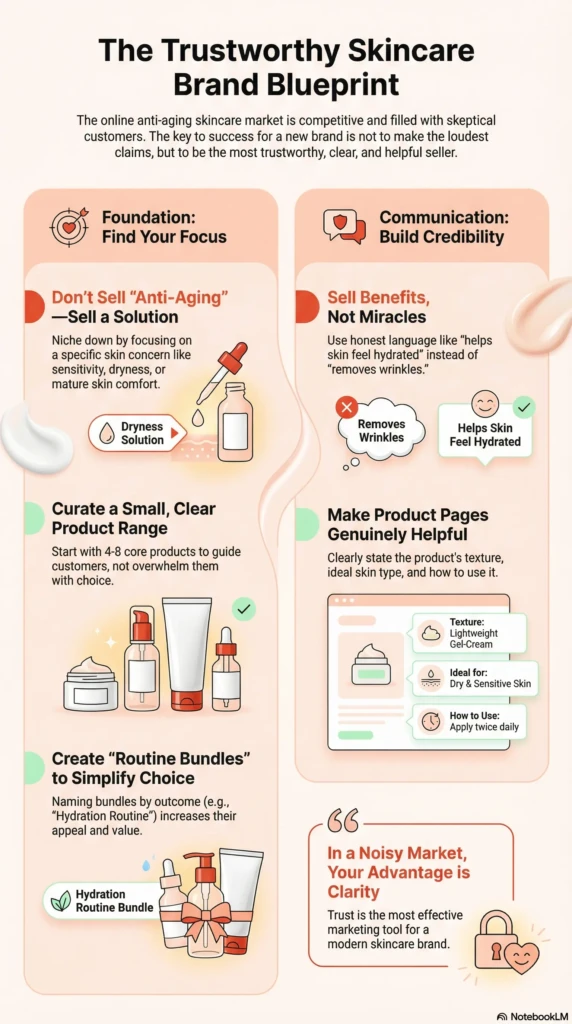
Skincare shoppers want guidance.

If you launch with 25 anti-aging creams, customers won’t know what to choose.

Start with a tight line-up and make each product’s role obvious.

A sensible starter range (4 to 8 products)

  • Daily moisturiser: the dependable “every morning” cream.
  • Richer night cream: more nourishment for overnight comfort.
  • Light gel-cream option: for oily or combination skin, or for summer.
  • Eye cream (optional): only if it’s genuinely distinct, not just a tiny moisturiser.
  • Neck and chest cream (optional): good for mature-skin niche positioning.
  • Hand cream: underrated repeat-buy item that fits the “ageing” story naturally.
  • Travel minis: lower-risk first purchase and great for gift sets.

If you’re going to include actives in creams, keep it coherent.

Don’t throw every trendy ingredient into one jar and hope for the best.

Bundles that make choosing easy (and lift order value)

  • Simple routine set: daily moisturiser + night cream
  • Comfort set: rich cream + hand cream
  • Starter set: minis + routine guide card
  • Sensitive skin set: fragrance-free day + fragrance-free night
Tip: Name bundles by outcome: “Hydration routine” sells better than “2-piece set”.

Sourcing and formulation: what matters in anti-aging creams

You can sell anti-aging creams as a curator (wholesale) or as your own brand (private label / contract manufacturing).

Either way, your credibility comes from understanding what you’re selling and describing it clearly.

What customers expect from a good anti-aging cream

  • Comfort: no stinging, no tightness, pleasant daily use.
  • Hydration: skin feels less dry and looks less dull.
  • Texture: absorbs well, doesn’t pill under makeup, feels “nice”.
  • Consistency: the product feels the same jar to jar.

Ingredients that fit anti-aging positioning (without overpromising)

Anti-aging is often shorthand for hydration, plumping, and smoother-looking skin.

Ingredient families customers recognise:

  • Humectants: help skin feel hydrated (for example, glycerin-style hydration feel).
  • Emollients: improve softness and comfort.
  • Occlusives: reduce moisture loss for drier skin types.
  • Skin-supporting ingredients: used in many barrier-friendly formulas.

If you include stronger actives, be careful with messaging and usage guidance.

Many customers want “anti-aging” benefits but have sensitive skin and low tolerance for irritation.

Questions to ask suppliers or manufacturers

  • What skin type is this designed for?
  • Is it fragrance-free? If scented, how strong is it?
  • What is the texture and finish (dewy, matte, rich, lightweight)?
  • What’s the shelf life and best storage advice?
  • Do you have stability and safety documentation for the finished product?
  • What packaging is used and why (airless pump, jar, tube)?

Claims and copy: sell benefits, not miracles

This is where anti-aging brands get into trouble.

Customers are tired of “10 years younger in 7 days” nonsense.

And a lot of people don’t even like the phrase “anti-aging” – they just want healthy-looking skin.

Use language that feels credible

  • “helps skin feel hydrated and comfortable”
  • “supports a smoother-looking appearance”
  • “designed to reduce the look of dryness and dullness”
  • “rich texture for overnight comfort”
  • “lightweight moisturiser that layers well under makeup”

Avoid risky promises

Steer clear of anything that sounds like medical treatment or guaranteed results.

  • “removes wrinkles”
  • “repairs collagen”
  • “reverses ageing”
  • “clinically proven” (unless you can genuinely back it up)
  • “treats eczema / rosacea / acne”

Set expectation timelines realistically

Moisturisers can make skin feel better quickly.

But longer-term “look” changes take consistency.

It’s okay to say something like:

  • “You may notice comfort and hydration quickly. For a smoother-looking appearance, give it a few weeks of regular use.”
Tip: One honest sentence about what a cream can and can’t do will build more trust than ten “miracle” phrases.

Pricing: make it profitable and believable

Skincare pricing is about perception as much as maths.

If you price too low, customers assume it’s cheap and ineffective.

If you price too high without brand trust, they won’t take the risk.

Know your true costs

  • product cost (or manufacturing cost)
  • packaging (jars, pumps, labels, boxes)
  • outer packaging for shipping
  • payment fees
  • returns and replacements allowance
  • your time and customer support

Use a simple tier structure

  • Entry: travel sizes, hand cream, lighter day moisturiser.
  • Core: your best-selling day and night creams.
  • Premium: richer formulas, bigger sizes, gift sets.

Bundles reduce “first purchase risk”

Bundles can feel like better value while protecting your margin.

They also encourage routine use, which leads to better results and better reviews.

Packaging and fulfilment: prevent leaks and protect the “premium” feel

Creams are easy to ship, but they can leak and they can look cheap if packaging is sloppy.

Packaging choices that work

  • Airless pumps: premium, hygienic, great for sensitive-skin positioning.
  • Tubes: practical and travel-friendly, lower breakage risk.
  • Jars: classic skincare feel, but needs good sealing for shipping.

Shipping habits that save you headaches

  • seal and bag products that could leak
  • pack snugly so items don’t rattle
  • include a small routine card and a thank you note
  • test-ship an order to yourself before launch

Product pages that convert: what shoppers actually want to know

Most skincare product pages are either too vague or too technical.

You want the middle: clear, practical, reassuring.

Must-have sections on each product page

  • Best for: dry, normal, oily, sensitive, mature, or combination skin.
  • Texture and finish: rich, lightweight, dewy, matte, non-greasy.
  • How to use: morning, night, how much, where it fits in routine.
  • Key benefits: hydration, comfort, smoother-looking skin, glow.
  • Ingredients: full list, plus highlights in plain English.
  • What to expect: scent level, absorption time, layering under SPF/makeup.
  • Patch test note: normal and calm, not scary.

Create a “choose your cream” guide page

This is an SEO and conversion booster.

Include:

  • day cream vs night cream
  • gel-cream vs rich cream
  • anti-aging for sensitive skin: what to prioritise
  • how to build a simple routine that people will actually stick to
Tip: Add “Does it pill under makeup?” and “Is it scented?” to your FAQs on the product page. Those two questions cause a surprising amount of hesitation.

Marketing: how to sell anti-aging creams without sounding like a late-night advert

Skincare marketing works when you show routines, texture, and real-life use.

Not miracles.

Choose one main channel and one support channel

  • SEO through your website: people search for “best moisturiser for…” constantly.
  • Instagram or TikTok: texture videos, routine demos, “day vs night” comparisons.
  • Email: routine tips, restocks, seasonal skin changes, bundle offers.

Content ideas that lead to sales

  • “Best anti-aging moisturiser for dry skin (without the hype)”
  • “Day cream vs night cream: do you really need both?”
  • “How to layer moisturiser, SPF, and makeup without pilling”
  • “Barrier support for mature skin: a simple routine”
  • “How to choose a moisturiser for sensitive skin”

SEO topics people search for (great for headings and FAQs)

  • “best anti-aging cream for sensitive skin”
  • “anti-aging moisturiser for dry skin”
  • “does anti-aging cream work”
  • “what age should you start using anti-aging cream”
  • “day cream vs night cream”
  • “retinol moisturiser vs retinol serum”
  • “how to reduce fine lines without irritation”

Write helpful guides around these and link naturally to your products and bundles.

That’s how you build trust and traffic at the same time.

Build a shop that feels trustworthy (without you doing the tech)

Skincare ecommerce is sensitive.

Customers are putting products on their face and expecting you to be responsible.

Your shop needs to look clean, clear, and professional.

What your anti-aging cream website should include

  • collections by skin type (dry, sensitive, combination)
  • collections by routine step (day, night)
  • a “choose your cream” guide page
  • clear delivery and returns pages
  • an ingredients and “what to expect” approach that feels honest

Want a done-for-you ecommerce setup?

If you’d rather focus on products and customers than site setup, Make Local for Global can build your ecommerce shop for you.

You can book a free consultation to talk through your niche, product pages, and content plan.

Or you can Get your website for £99/year and get a simple, affordable shop set up without the tech stress.

FAQ: selling anti-aging creams online

Is it worth selling anti-aging creams online?

It can be, because moisturisers are repeat-buy products and customers often stay loyal once they find one they like. The key is building trust with honest product pages and a focused range.

What anti-aging creams sell best?

Daily moisturisers and night creams tend to sell best because they fit into simple routines. Fragrance-free options also sell strongly, especially for sensitive-skin shoppers.

How do I make my anti-aging cream brand stand out?

Pick a niche, keep your range small, and explain texture, skin type fit, and expectations clearly. Being the brand that “makes it easy” is a real advantage.

Can I claim my cream removes wrinkles or reverses ageing?

Avoid extreme or guaranteed claims. It’s safer and more credible to focus on hydration, comfort, and helping skin look smoother and more radiant with consistent use.

Do I need my own website to sell anti-aging creams?

A website helps you present ingredients and routines properly, publish guides for SEO, and build customer trust. If you don’t want to build it yourself, you can book a free consultation or Get your website for £99/year with Make Local for Global.

A practical checklist to launch

  • Pick a niche (barrier-first, sensitive skin, mature comfort, men’s basics).
  • Start with 4 to 8 products and create 2 to 4 routine bundles.
  • Write product pages with texture, skin type, and “what to expect” clarity.
  • Be careful with claims – focus on hydration, comfort, and smoother-looking skin.
  • Choose packaging that prevents leaks and feels premium.
  • Create a “choose your cream” guide page and 3 SEO blog posts targeting real searches.
  • Plan simple shipping options and a calm returns process.
  • Collect emails early for routine tips and restocks.

If you want to Sell anti-aging creams and build a real business, don’t try to be the loudest brand.

Be the most trustworthy one.

In skincare, trust is the best marketing you’ll ever have.

PREFERRED SOURCE

Keep finding us on Google

Like what you’re reading? Add Make Local for Global as a preferred source on Google to see more of our articles when you search.

Newsletter Form in Blog

Sign up for our
FREE ecommerce newsletters!


By providing your email, you agree to our Privacy and Cookie Policy, as well as our Terms and Conditions.


DOWNLOAD FREE GUIDE
ebookmockup 1

How to sell Anti-aging creams Online

Join 5,000+ others who downloaded
Blog to PDF Form
No spam, Unsubscribe any time.

Ready to Start Your Online Business?

Build your online presence without having to figure out everything yourself.

DOWNLOAD FREE GUIDE

How to sell Anti-aging creams online

A simple plan to get your first steady online orders
ebookmockup 1
  • What to do first (so you don't waste time)
  • How to price and present your Anti-aging creams
  • How to get traffic and turn it into orders
  • Join 5,000+ others who downloaded this
Blog to PDF Form
No spam, Unsubscribe any time.

Start Selling

Anti-aging creams

Withing 5 days

You’ve read the guide. Now see if you qualify for a done-for-you online store for Anti-aging creams sellers.
Find out if this is right for you in under 60 seconds.
  • No tech skills neeed
  • Store ready in 5 days
Qualifying / Questionnaire Form
  • Step 1
  • Step 2
  • Step 3
  • Step 4
  • Step 5

Answer a few quick questions and I’ll point you in the right direction.