


Make Local for Global Logo

READY TO SELL architectural lighting ONLINE?

Get a store built for you in 5 days, plus training and support to help you start, run, and grow your Alternative business.

How to sell architectural lighting online and build a premium design business

A practical guide to selling architectural lighting online – curate a small range, explain lumens, colour temperature and IP ratings clearly, reduce returns with better specs, and grow sales with room packs and transformation content.

Make Local for Global

Table of content

Architectural lighting is one of the best “high value” product categories you can sell online.

People aren’t just buying a light. They’re buying a feeling: calmer rooms, better focus, a more expensive-looking space, and lighting that finally makes sense.

But it’s also a category where buyers get nervous. They worry about installation, compatibility, and whether the light will look right once it’s up.

If you want to sell architectural lighting online, you win by doing two things brilliantly: clear specifications and confident guidance.

This guide shows you how to sell architectural lighting in the UK, whether you’re curating fixtures, selling trade-style products to homeowners, or building a design-led lighting brand.

Pick your niche: what kind of architectural lighting seller are you?

“Architectural lighting” can mean everything from recessed downlights to statement wall washers.

If you try to sell it all at once, your shop becomes a catalogue with no identity.

Pick a lane and build trust in that lane first.

Architectural lighting niches that sell well

  • Modern residential: recessed downlights, wall lights, clean lines.
  • Kitchen and living zones: task lighting and warm ambient setups.
  • Outdoor architectural: up/down lights, path lights, entrance lighting (needs clear IP ratings).
  • Commercial and office: reliable specs, bulk ordering, consistent models.
  • Design-led statement: premium fixtures, fewer products, higher margins.
  • Smart-ready lighting: compatible with common smart systems (be careful with claims).

If you’re starting out, modern residential and kitchen/living zones are often easiest because the buyer use case is clear and the styling content writes itself.
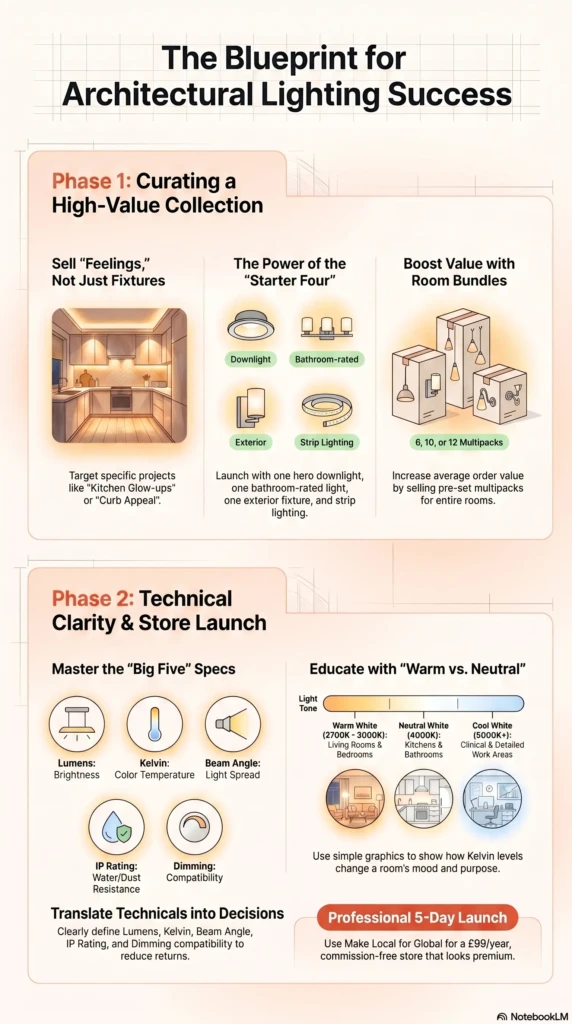
Tip: Lighting buyers don’t want “options”. They want reassurance. Your biggest sales tool is a simple guide that helps them choose colour temperature, beam angle, and brightness.

What to sell: architectural lighting products that actually move

Architectural lighting sells when it solves common room problems.

So start with products tied to obvious projects: kitchens, hallways, bathrooms, and exterior entrances.

Fast-selling architectural lighting categories

  • Recessed downlights: kitchens, hallways, renovations.
  • Surface-mounted downlights: modern look without cutting ceilings.
  • Wall up/down lights: exterior and hallway features, big visual impact.
  • Under-cabinet lighting: kitchen task lighting, easy upsell.
  • Track lighting: flexible rooms, studios, kitchens, retail.
  • Linear lights: modern kitchens and feature walls.

Start with a small range, not everything

Most new sellers overstock and overwhelm buyers.

A curated range sells better because it feels like you’ve chosen good options on purpose.

A simple starter range

  • One hero downlight: your best all-rounder, in 2 finishes.
  • One bathroom-rated downlight: clearly labelled for wet areas.
  • One wall up/down light: exterior hero product.
  • One under-cabinet strip option: kitchen add-on.
OfferBest forWhy customers buy itWhy it helps you
All-round recessed downlightRenovations and kitchensClean look, modern upgradeRepeat sales and multipacks
Bathroom-rated downlightBathrooms and wet zonesSafety and complianceClear niche, less price shopping
Exterior up/down wall lightEntrances and patiosInstant curb appealHigh visual marketing content
Under-cabinet strip lightingKitchensBetter task lightingAdd-on sales and bundles

Specs that sell: what buyers need to know, in plain English

Lighting buyers get stuck because product pages are either too vague or too technical.

Your advantage is translating specs into decisions.

The “big five” specs to show clearly

  • Brightness (lumens): how much light it actually puts out.
  • Colour temperature (Kelvin): warm vs neutral vs cool.
  • Beam angle: narrow spotlight vs wide wash.
  • IP rating: especially for bathrooms and outdoors.
  • Dimmable compatibility: if dimmable, state what it supports clearly.

Explain colour temperature like a human

  • Warm white: cosy living spaces and bedrooms.
  • Neutral white: kitchens and bathrooms where clarity matters.
  • Cool white: more clinical, best for specific work areas.

Beam angle guidance that reduces returns

  • Narrow beam: highlights art or features.
  • Medium beam: general room lighting with some focus.
  • Wide beam: even, general illumination for rooms.
Tip: Put a simple “Best for room” section on every product page: kitchen, hallway, bathroom, exterior. That one line helps buyers choose quickly.

Product pages that convert: reduce installation anxiety

Most people are not lighting experts.

They want to know: will this fit, will it work, and will it look good?

What to include on every architectural lighting listing

  • Dimensions: including cut-out size for recessed lights.
  • Wattage and lumens: so buyers understand brightness.
  • Colour temperature: and what rooms it suits.
  • Beam angle: with a simple explanation.
  • IP rating: clearly stated, especially for bathrooms/outdoors.
  • Installation notes: recessed depth, driver included, what’s needed.
  • What’s in the box: fitting, driver, accessories.
  • Compliance info: only factual, avoid vague “certified” claims unless you can back them up.

Add a clear safety note

Keep it calm and responsible:

  • “Installation should be carried out by a qualified electrician.”

Create “project bundles”

Architectural lighting sells well in multipacks and bundles because people buy for rooms.

Bundle ideas:

  • Kitchen downlight pack (6 or 10)
  • Bathroom pack (IP-rated) plus mirror light
  • Outdoor entrance set: two wall lights plus a porch light
  • Under-cabinet strip kit plus driver and connectors

Pricing architectural lighting so you can profit

This category can support strong margins, but only if you sell trust and quality.

Competing on price alone turns you into a generic electrical supply shop.

What affects pricing most

  • Build quality and finish
  • Driver quality and reliability
  • IP rating and outdoor suitability
  • Beam angle options and light quality
  • Dimming compatibility
  • Warranty support (if you offer it)

Create a price ladder

  • Entry: standard indoor downlight in a basic finish.
  • Main: better finish, better light quality, dimmable.
  • Premium: architectural wall lights, outdoor-rated, higher build quality.
  • Bundle: room packs that simplify buying.

Bundles protect your margin and make buying feel easier.

Photography that sells architectural lighting

Lighting is hard to photograph because the product is the effect, not the object.

You need both: clear product photos and real “lit” scenes.

Photo checklist

  • Clean product photo on white background
  • Close-up of finish and texture
  • Installed lifestyle photo in a real room
  • Beam effect photo on a wall (especially for up/down lights)
  • Diagram image showing dimensions and cut-out size
  • Pack shot for bundles (6-pack, 10-pack)

Show warm vs neutral when possible

Buyers struggle with colour temperature.

If you can show two photos of the same room with different warmth options, you’ll sell more and get fewer complaints.

Tip: Include one simple graphic: “Warm (cosy) – Neutral (clean) – Cool (bright)”. It’s basic, but it stops decision paralysis.

Shipping, returns, and customer experience

Lighting is relatively easy to ship, but returns can happen due to compatibility mistakes.

Your goal is to reduce “I bought the wrong thing” returns through better guidance.

Reduce returns with these tactics

  • Put cut-out size and recess depth near the top of the page
  • State IP rating clearly for bathrooms and outdoors
  • Explain dimming compatibility in plain language
  • Offer a “project checklist” download for each room type

Packaging that protects finishes

  • Protect finishes from scratching
  • Keep drivers and parts organised
  • Include a simple “what’s in the box” card

Marketing architectural lighting without sounding like a trade catalogue

Market outcomes: better rooms, better mood, better curb appeal.

People buy lighting because they want their home to feel different.

Marketing angles that work

  • Kitchen glow-up: better task lighting and warmer evenings.
  • Hallway upgrade: clean modern look, no dark corners.
  • Bathroom clarity: practical light without harshness (choose carefully).
  • Curb appeal: exterior up/down lights that make a house look premium.
  • Gallery feel: beam angles that highlight art and features.

Content ideas that drive sales

  • Before/after: same room with bad vs good lighting
  • Short guide: “Warm vs neutral white – which should you pick?”
  • Beam angle demo videos on a wall
  • Kitchen pack: “how many downlights do I need?” (keep it as guidance, not a guarantee)
  • Outdoor entrance styling with two wall lights

SEO searches to include naturally

  • “Architectural downlights”
  • “Bathroom downlights IP rated”
  • “Outdoor up down wall lights”
  • “Warm white vs neutral white lighting”
  • “Kitchen downlight spacing guide”

Build an online shop that makes lighting easy to buy

Lighting websites fail when they overwhelm customers with jargon and endless options.

Your shop should guide people by room and project.

What your shop needs on day one

  • Categories by room: kitchen, bathroom, hallway, outdoor
  • Filters by colour temperature, beam angle, and finish
  • Clear size info and cut-out diagrams
  • Bundles and multipacks
  • A “Start here” buyer guide page

Done-for-you ecommerce can save you weeks

Lighting stores need good structure: filters, specs, bundle packs, and clean product pages.

Make Local for Global sets up your ecommerce shop for you, so you can launch without wrestling with tech.

You can book a free consultation to plan your niche, room categories, and buyer guide pages.

Or choose the quick option to Get your website for £99/year.

Tip: Add “Room packs” as your main offer. People don’t buy one downlight. They buy 6, 10, or 12. Make that easy.

How to get your first 80 architectural lighting customers

This is a higher-ticket category. You don’t need thousands of customers to build a strong business.

Step 1: Start with one hero downlight and one hero wall light

Build marketing around these two products and make the product pages flawless.

Step 2: Create one simple buyer guide

Warm vs neutral. Beam angle basics. Bathroom IP basics. Keep it short and helpful.

Step 3: Sell room packs

Multipacks make buying easy and increase average order value.

Step 4: Use before/after content

Lighting sells through transformation. Show it.

Step 5: Collect reviews that mention clarity and quality

Lighting buyers trust reviews that say “exactly as described” and “easy to choose”.

Common mistakes when selling architectural lighting online

These mistakes cause returns and slow growth.

Missing cut-out size and depth info

This is the biggest return trigger for downlights. Put it near the top.

Vague dimming claims

Dimming compatibility can be tricky. Be factual and clear.

Ignoring colour temperature education

Customers get overwhelmed. Teach them simply and you’ll sell more.

Not showing the light effect

Architectural lighting is the effect. Show beam photos and installed shots.

Too many options at launch

Curated ranges convert better than giant catalogues.

FAQ: selling architectural lighting

Does architectural lighting sell well online?

Yes, especially for renovations and home upgrades. It sells best when you provide clear specs, size diagrams, and room-based guidance so customers can choose confidently.

What lighting products should I sell first?

Start with one reliable recessed downlight, one bathroom-rated option, and one exterior up/down wall light. Add under-cabinet lighting as an easy kitchen upsell.

How do I reduce returns?

Clearly show cut-out size, fitting depth, IP rating, beam angle, and dimmable compatibility. Most returns happen because buyers chose the wrong specification.

How do I market architectural lighting?

Market room transformations: kitchen glow-ups, hallway upgrades, bathroom clarity, and curb appeal. Before/after visuals and simple guides convert well.

Do I need a website to sell architectural lighting?

You can sell on marketplaces, but a website helps you organise by room, offer packs, and present specs clearly. A done-for-you ecommerce setup can help you launch faster and look more premium.

A sensible next step

If you want to sell architectural lighting properly, start with a small curated range, build room packs, and create simple buyer guides that remove confusion.

If you want a professional ecommerce shop without the setup headache, Get your website for £99/year.

And if you want help structuring your categories, filters, and product pages to reduce returns and increase conversion, book a free consultation.

In lighting, clarity is premium. Make choosing easy, and you’ll build a high-value business that lasts.

PREFERRED SOURCE

Keep finding us on Google

Like what you’re reading? Add Make Local for Global as a preferred source on Google to see more of our articles when you search.

Newsletter Form in Blog

Sign up for our
FREE ecommerce newsletters!


By providing your email, you agree to our Privacy and Cookie Policy, as well as our Terms and Conditions.


DOWNLOAD FREE GUIDE
ebookmockup 1

How to sell architectural lighting Online

Join 5,000+ others who downloaded
Blog to PDF Form
No spam, Unsubscribe any time.

Ready to Start Your Online Business?

Build your online presence without having to figure out everything yourself.
DOWNLOAD FREE GUIDE

How to sell architectural lighting online

A simple plan to get your first steady online orders
ebookmockup 1
  • What to do first (so you don't waste time)
  • How to price and present your architectural lighting
  • How to get traffic and turn it into orders
  • Join 5,000+ others who downloaded this
Blog to PDF Form
No spam, Unsubscribe any time.

Start Selling

architectural lighting

Withing 5 days

You’ve read the guide. Now see if you qualify for a done-for-you online store for architectural lighting sellers.
Find out if this is right for you in under 60 seconds.
  • No tech skills neeed
  • Store ready in 5 days
Qualifying / Questionnaire Form
  • Step 1
  • Step 2
  • Step 3
  • Step 4
  • Step 5

Answer a few quick questions and I’ll point you in the right direction.