

READY TO SELL Cat Collars ONLINE?
Get a store built for you in 5 days, plus training and support to help you start, run, and grow your Alternative business.

Learn how to sell cat collars online: choose a buyer, compare quick-release designs, test samples, write size guidance and price each order.


A cat collar looks like a small purchase, yet an unclear size chart or unreliable quick-release fitting can turn a first order into an unhappy customer and a welfare concern. Sellers need to make the collar’s purpose, fit range, material, care and hardware easy to assess before checkout.
You can sell cat collars online by choosing a clear buyer group, starting with a focused range of cat-specific quick-release designs, testing each sample and showing buyers how to measure and check fit. Price the complete order, including packaging, postage, marketplace charges, returns and time spent answering questions.
A small store can start with three or four well-differentiated collars: a plain everyday option, a reflective design, a softer fabric choice and a personalised version if you can manage name and address details accurately. Do not compete on colour count alone. Explain what each version is made from, how its buckle works, which neck measurements it covers and what the buyer should inspect after fitting.
Keep the product promise modest and evidence-led. A collar is not a substitute for a microchip, supervision or veterinary advice. Do not describe any design as escape-proof or guarantee that it prevents injury. Your selling advantage can come from clear fit information, useful photographs, honest material descriptions and reliable order handling.
Use buyer conversations and a small cost model to see whether your first cat collar range is worth testing. The B2C Launch Assessment can help organise your early decisions.
Cat owners do not all shop for the same reason. Some want a simple collar with space for an identification tag. Others want a reflective strip for visibility, an adjustable design for a growing kitten, a colour that suits their home, or a gift that can be personalised. A rescue organisation may need repeatable sizes, low unit costs and dependable delivery. A small independent pet shop may prefer a compact wholesale pack with clear barcodes and reorder terms.
Choose one primary customer for your opening range. A first-time seller might focus on owners of adult cats who want a practical everyday collar, then add a kitten size after checking demand and supplier consistency. Another route is a design-led gift range for owners who want a colour or print that is hard to find nearby. Each path needs different photographs, copy, stock planning and service.
Write a buyer profile before requesting supplier quotes. Describe the cat’s age and likely neck range, the owner’s reason for buying, a price they can accept, material preferences, order occasion and the concern that could stop a purchase. A buyer who wants a quick replacement may value dispatch speed. A gift buyer may care more about packaging and whether personalisation arrives correctly.
Talk to people who match the profile. Ask what collar they use today, what they dislike, which details they check on a product page and whether they would pay more for a tested clasp, soft lining or custom tag. Ask them to compare two real samples. A specific preference is more useful than a general compliment.
Look for actions that show purchase intent. A person who asks to see the size chart, joins a launch list, requests a wholesale sheet or pays for a sample has taken a measurable step. Social likes and survey answers can help you find a theme, but do not treat them as sales. Record what people do and what they still need to know before ordering.
Start with one customer group and a small set of samples. Photograph the options, publish a simple landing page or marketplace listing and invite people to join a restock notice or request a launch offer. If your supplier permits it, take pre-orders only when you can state the delivery date, refund terms and what happens if a sample or shipment fails your checks. Do not take money on a delivery promise you cannot support.
Run separate tests for practical and design-led demand. For a practical collar, show the clasp, adjustment range, stitching and reflective detail close up. For a gift design, show the finish, personalisation choices and packaging. Ask a small group of potential buyers which question remains unanswered. Their answers can reveal a missing photograph or unclear size statement.
Set a modest test budget that covers samples, photography, postage and a short promotional run. Define what would count as a useful outcome before spending: a target number of qualified size enquiries, sample requests or paid orders from people outside your household. If visits arrive but product-page actions do not, review the offer and evidence before increasing advertising.
Keep a note of each conversation: customer type, cat age, size question, preferred material, purchase timing, objection and next step. After ten to fifteen useful conversations, group repeated questions. If owners ask whether a clasp is quick-release, make that information prominent. If people ask for the same missing neck size, ask the maker whether it can be supplied consistently.
Collars can look similar in a catalogue and behave quite differently in use. Begin with fit and function, then select material and pattern. Each listing should identify whether it is intended for cats, the neck measurement range, adjustment method, closure type, width, material and care instructions. A fashion photograph cannot replace those details.
| Product type | Buyer need | Evidence to collect | Watch point |
|---|---|---|---|
| Plain quick-release webbing | An everyday collar with simple adjustment | Webbing width, adjustment range, buckle function and wash guidance | Check the clasp on samples and avoid unsupported safety promises |
| Reflective quick-release | A visible detail for low-light conditions | Reflective area, placement, care method and performance after cleaning | Do not claim visibility prevents accidents |
| Soft fabric or padded style | A softer feel or distinctive design | Lining, seam finish, colourfastness and drying instructions | Check whether layers hold moisture or fray at the edge |
| Leather or coated material | A particular finish and surface feel | Material source, coating, edge treatment and cleaning method | Describe actual materials precisely and check supplier records |
| Personalised collar or tag set | An identity detail or gift-ready item | Character limit, engraving legibility, order proof and dispatch lead time | Protect customer information and verify each custom order |
Compare actual samples and supplier documents. The rows describe possible range choices, not test certification.
Nylon and polyester webbing are common options for lightweight collars. Ask the supplier for exact fibre content, width, thickness, colourfastness information and cleaning guidance. A printed pattern may fade or rub at a different rate from a woven design. Inspect the underside and cut edges, since loose fibres or rough seams can affect comfort and appearance.
Soft cotton or blended fabric can support a natural look, though the feel alone does not tell you how the collar will wear. Check whether the fabric shrinks, loses colour when damp or takes longer to dry. Request care instructions that reflect the tested material rather than copying a generic supplier description.
Leather and coated webbing can create a different style and price point. Ask the maker to state whether the item is full-grain leather, split leather, bonded material or a synthetic lookalike. Confirm the lining, edge finish, hardware and cleaning directions. Avoid calling a surface “waterproof” without evidence for that exact claim and use condition.
Reflective tape, printed patterns and decorative stitching can add distinction. Treat each as a feature to verify. Compare new and cleaned samples under the same light, photograph the reflective panel under a repeatable setup and check whether stitching loosens after flexing. Use a description such as “reflective panel” when that is what you can verify; avoid suggesting the collar makes night travel safe.
Personalisation can raise perceived value, though it adds processing steps and error risk. Decide whether customers can choose a printed name, an engraved tag or an add-on charm. For safety-led products, keep extra parts small, secure and clearly described. Offer a plain collar as the core option. If you sell a tag, check its attachment method and provide care guidance.
Do not add flea-treatment claims to an ordinary fashion collar. Cats Protection’s cat collar advice notes that many flea collars are not very effective and advises owners to speak with a vet about treatment. Products containing active substances may have separate classification and legal requirements. If you plan to sell a treated collar, obtain specialist regulatory advice for the exact product before listing it.
Three to five options can be enough to test a first offer. You might choose one plain adjustable quick-release collar, one reflective version, one softer printed style and a personalised option that shares the same core hardware. Each should meet a different buyer preference or use case. Adding twenty colours of the same product before you know demand spreads cash across stock without proving the range is more useful.
Make the distinctions easy to compare. Use one consistent specification table for width, neck range, material, buckle type, colour, care, included tag and dispatch time. If two variants differ only in pattern, keep functional details identical and let the buyer filter by colour. If one has a different closure or measurement range, describe that distinction directly.
Think about the whole first basket. A collar and an identification tag may make a useful set if the parts fit together and the buyer understands what is included. A spare collar can be offered as a second purchase, but avoid framing multiple collars as a need for every pet. Gift packaging can suit birthdays or adoption occasions, provided its cost and dispatch time are included in the order model.
When deciding what to add, inspect search queries, customer questions and repeat purchases. If owners ask about matching beds or carriers, link to relevant product advice such as our article on selling cat beds and consider whether a related range makes sense for your store. A cross-sell should solve a real shopping need and use relevant photos, not simply increase the number of items on the page.
Fit questions are one of the biggest sources of hesitation for a small wearable product. A collar that is too tight can be uncomfortable; one that is too loose can catch on the cat or allow a leg or jaw to become trapped. Cats Protection recommends a cat-specific quick-release or snap-opening collar and says two fingers should fit comfortably beneath it. Link that advice to your own instructions and tell buyers to follow the maker’s guidance for the exact product.
Give a simple measuring method. Ask the buyer to use a flexible tape around the base of the cat’s neck without pulling it tight. State whether your chart shows neck circumference or collar length, and explain how much adjustment the product provides. Show a diagram or short step sequence. Never label a product “small” or “medium” without publishing actual measurements.
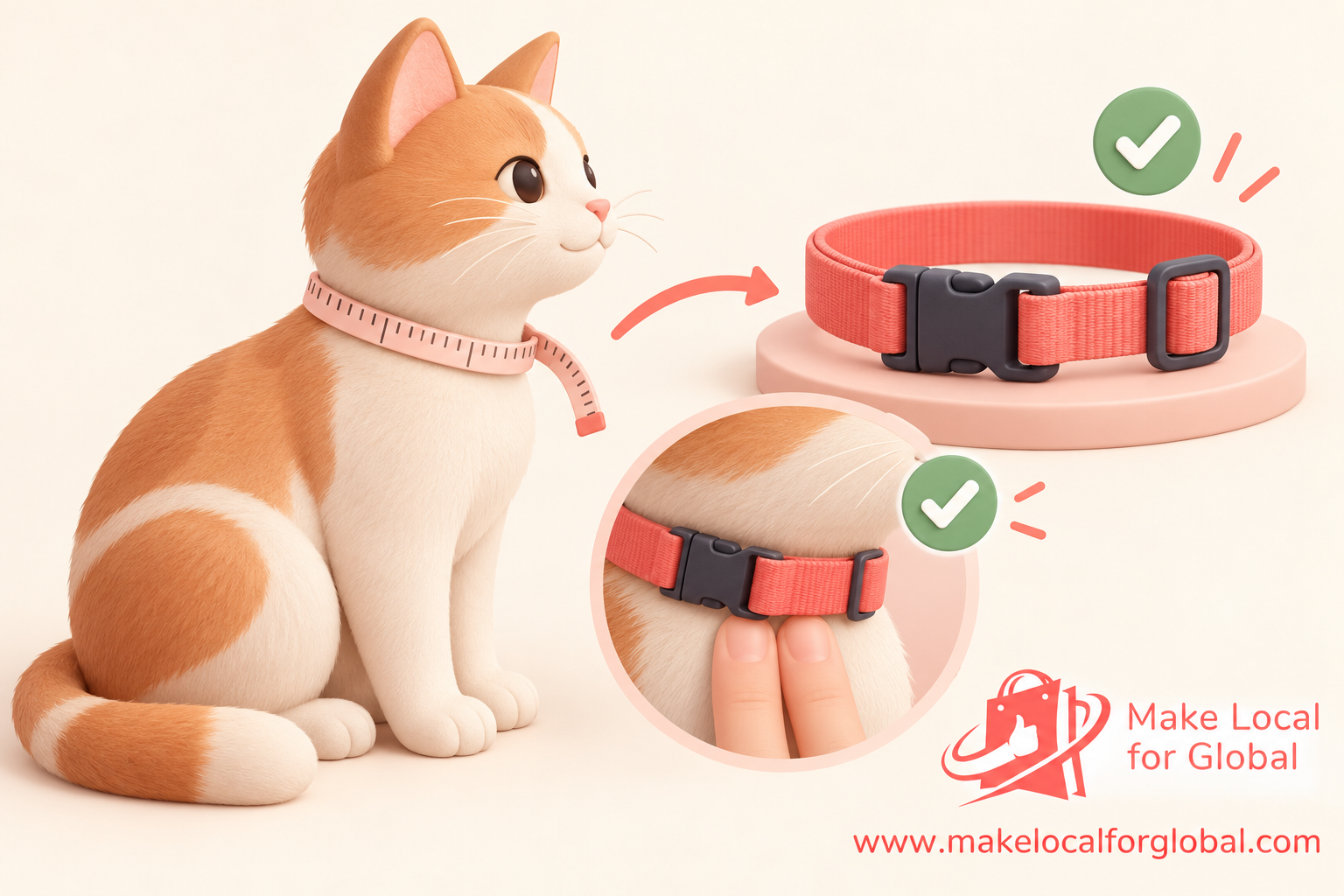
Show how to measure on the page, then repeat the range beside every size option. If the collar can be trimmed, say how much material should remain beyond the slider and whether the end needs sealing. Do not ask buyers to cut a collar if the maker has not confirmed that the design supports it. If a style is one-size adjustable, give the minimum and maximum neck measurements you have checked.
Quick-release buckles need more attention than a photograph of a closed clasp. Ask the maker for an explanation of how the release is designed to work, any approved inspection procedure and the product’s limitations. Test samples using a controlled method agreed with the manufacturer. Record the results and avoid improvised force tests that could damage a sample or produce a misleading pass.
Do not test a release buckle by placing it on a live cat and pulling it until it opens. Use the maker’s test method or a competent product testing service. Inspect the buckle for cracks, warped parts, sharp edges, inconsistent release and poor webbing retention. Keep a sample log with product code, batch or lot reference, date, tester, method, result and photographs.
Review each component as part of the finished product. Flex the webbing, look for frayed edges, check that the adjustment slider grips, inspect stitching where the D-ring joins the strap and examine whether metal parts have burrs or corrosion. If a collar includes a reflective panel, follow the supplier’s cleaning guidance and record what changed after washing. Do not turn a home inspection into a formal certification claim.
Accessories can create a product-specific risk. Bells, charms, studs and loose decorative parts may detach, make noise or catch on things. Cats Protection warns against loose adornments that could become a choking hazard. A restrained first range can focus on a secure quick-release collar with neat surface decoration and no hanging extras. If you offer an add-on, assess its attachment and explain its limits.
Put fit instructions in three places: the product page, a small package insert and the post-purchase message. Keep wording consistent. Tell the buyer to check the collar regularly, especially after washing, a change in weight, coat growth or a move from kitten to adult size. If the cat shows irritation or discomfort, advise the owner to remove the item and seek suitable guidance rather than continuing to wear it.
Write instructions in plain language. Include how to measure, how to adjust, how to check the clasp, how to clean the material and where to contact you about a fault. If the product is not intended to attach a lead, state that directly. Do not describe a standard cat collar as equipment for restraint or lead attachment.
Keep instructions specific to each model. A leather style may need a different cleaner from a washable webbing design. A reflective panel may have a care limit. A custom tag might not be replaceable. A single generic insert can create a mismatch between the advice and the product in the box.
Compare at least two suppliers before choosing a first production order. Ask for a sample of the exact material, width, colour and buckle you plan to list. A sample from one model does not prove the clasp or stitching is consistent across a different model. Ask for current specifications, batch identification, manufacturing location, packaging details, minimum order, lead time, replacement policy and how safety complaints are handled.
Ask who manufactures the collar and who can answer a technical question. If you buy through a wholesaler, confirm whether the wholesaler is authorised and whether warranty claims go through them or the maker. Request a written answer about product changes: buckle material, strap construction and dimensions can change between production runs. Keep a dated copy of the information you relied on.
Request a specification sheet that separates fact from sales description. Useful details include material composition, collar width, neck range, total length, clasp type, hardware material, wash method, accessory contents, country of origin and product or batch reference. If the supplier cannot confirm an important detail, leave it off the listing until you have reliable evidence.
Confirm whether a supplier can support small batches or mixed-colour orders. A low minimum can reduce early stock risk, though mixing colours can hide a shortage of one popular size. Ask about repeat-order minimums, price validity, payment timing, delivery terms, damaged-goods process and the fee for a replacement sample. Put accepted changes in writing.
Build a supplier scorecard using criteria that matter for this product: sample quality, reliable measurements, clasp consistency, batch traceability, documentation, response time, order minimum, lead time, packaging, defect handling and willingness to discuss testing. Score each supplier from one to five, then attach evidence for each score. A high score based only on a friendly call is not enough to place a large order.

Inspect the collar under the same conditions each time. Lay it flat and measure strap width, minimum and maximum usable length. Compare the reading with the supplier sheet and your size chart. Check the buckle closes cleanly, opens according to its stated design, has no visible damage and remains attached to the strap. Photograph any defect with a ruler or reference card in view.
Inspect stitched joints at the D-ring, buckle and adjustment fold. Look for skipped stitches, exposed sharp edges, loose threads, uneven seams, weak bonding or a slider that moves too freely. Compare pieces from different packs. If construction varies, ask the supplier whether the variation falls within its specification. Hold back the product until you understand a defect that could affect use.
Test colour and cleaning only with the supplier’s recommended method. Use a lightly damp cloth on a small area, allow it to dry and note whether colour transfers or fabric changes. If the maker says machine washing is permitted, follow its cycle and drying instructions. Do not claim that a collar is machine washable after one unapproved wash.
Test how the product is packed. Check whether the buckle can crack in transit, whether metal hardware rubs through packaging and whether a personalised tag can be matched to the right collar. Repack the sample and compare parcel dimensions with your carrier estimate. An appealing product that arrives damaged or with the wrong tag still creates an avoidable support cost.
Ask a qualified laboratory or product safety specialist when a claim, material or test result exceeds your expertise. Keep the supplier’s report, but check that it names the exact product and batch. A report for a similar-looking collar may not support a claim for your stock. If you change materials or makers, review the evidence again.
A low wholesale price can make a collar appear profitable until postage, marketplace charges and customer service are included. Make a per-order cost sheet before setting the retail price. Use actual supplier and carrier quotations where available. The example below is illustrative only and uses pounds sterling. Replace every value with the amount in your quotes and account statements.
| Cost item | Illustrative cost | What to record |
|---|---|---|
| Collar purchase cost | £3.20 | Unit price for the exact style and supplier order terms |
| Inbound freight allocation | £0.55 | Shipment charge divided by units received, plus import costs if relevant |
| Packaging and insert | £0.40 | Mailer, label, fit card and protective sleeve |
| Pick and pack time | £0.30 | A realistic labour allowance per parcel |
| Postage paid by seller | £2.45 | The service actually offered, including any tracked option |
| Marketplace and payment fees | £1.45 | Current channel rates applied to the order amount |
| Customer acquisition | £1.20 | Promotion spend divided by acquired orders |
| Returns and defect allowance | £0.65 | A reserve informed by actual fit, defect and refund data |
| Total variable cost | £10.20 | Sum of listed per-order costs |
| Customer price | £22.95 | Amount shown at checkout for the example offer |
| Contribution before overhead | £12.75 | £22.95 less £10.20; not net profit |
Illustration only. It excludes fixed overhead, income or corporation tax and the value of unsold stock. Confirm VAT treatment with an accountant and apply current channel fees.
The arithmetic is £3.20 + £0.55 + £0.40 + £0.30 + £2.45 + £1.45 + £1.20 + £0.65 = £10.20 variable cost. A £22.95 customer price leaves £12.75 before rent, software, insurance, bookkeeping, unpaid time, tax and stock write-offs. That remainder is contribution, not profit in the owner’s bank account.
Check how your channel calculates fees. Etsy’s published policy says its transaction fee applies to the listing price plus delivery and gift wrapping; payment processing and other charges can apply too. Rates can change, so read the current Etsy Fees & Payments Policy and your own payment account before using a percentage in a forecast.
Run at least three price cases: a direct shop order with standard post, an Etsy order with paid promotion and a wholesale order. In a wholesale case, include carton quantities, delivery to the retailer, payment terms, samples and the cost of handling a small account. A wholesale price can be lower per unit and still require more cash tied up in stock and credit.
Model a return before you commit to a price. Suppose one collar in every twenty orders comes back after a size choice or customer change of mind. Work out postage, inspection, repacking and resale value for a clean return. If the item is personalised, estimate the amount that cannot be resold. Use real return reasons as your business grows; do not hide statutory rights in an allowance.
For each style, compare contribution after variable costs with the time needed to make, list and support it. A custom colour might have a higher price but require manual order checks and slower dispatch. A plain design could create lower revenue per order yet be easier to restock. Choose products that fit your capacity, not only the highest displayed margin.
Use a specific product title that includes product type and one verified distinction. For example: “Coral Reflective Cat Collar with Quick-Release Buckle, Adjustable 19–30 cm”. Replace the measurements, colour and features with exact values for the item you sell. Do not add “safe”, “unbreakable” or other absolute claims to a title.
Open the description with who the collar is for and what the buyer receives. State that it is a cat collar and list the number of units, size range, width, material, closure, hardware, tag or charm included, care method and dispatch estimate. Use “quick-release” only if the exact clasp has that design and your supplier confirms it.
Build a size section that explains the tape measurement in plain language. Give minimum and maximum neck circumference, the collar’s usable adjustment range and a small illustration. Tell customers to check fit after adjustment and follow the maker’s instructions. A size chart should not suggest that an owner can safely choose by breed or weight alone.
List limitations near the feature description. For example: “Reflective panel is a visibility feature; it does not prevent road incidents.” “This collar is not a lead attachment.” “Colours may look different across screens.” “Personalised tags are engraved from the spelling entered at checkout; review the order summary before payment.” These details can reduce confusion before purchase.
Use photographs to show the product from several angles: front, inside, clasp open, clasp closed, strap adjustment, stitching, reflective detail and packaging. Add one real-life scale reference, such as a ruler beside the unfastened collar. Do not use a photo of a different size or substitute an AI rendering for a product feature buyers need to inspect.
Write useful image alternative text for screen reader access and image search. Describe what is visible, such as “Coral cat collar with black quick-release clasp and adjustable slider laid flat beside a ruler.” Do not repeat the same phrase in every image field. A caption can explain the measurement, material or tested feature shown.
Answer common questions on the page: Does the order include a tag? Can it be personalised? Is it adjustable? How should it be cleaned? Which neck measurement does the chart use? How long does custom engraving add to dispatch? What happens if the selected size does not fit? Clear answers help a customer choose without relying on a long message exchange.
Use one primary search phrase naturally in the page title, introduction, URL and a relevant subheading. Related searches might include “quick-release cat collar”, “reflective cat collar” or “adjustable cat collar”. Use a phrase only when the product matches it. Add structured product data through your shop platform and keep price, stock and availability consistent between the page and checkout.
A marketplace can help you test product photographs, price and customer questions with a built-in shopping audience. It brings listing rules, transaction fees, competition and account dependence. Your own store gives you more control over navigation, email capture and repeat purchase, but you must attract visitors and manage the full checkout experience. A small seller can test one marketplace first, then build a branded store after learning which styles and questions convert.
Etsy may suit handmade, personalised or design-led items, subject to its current seller policies. Read the platform’s current rules before listing, particularly if you resell products made by another supplier. A hosted ecommerce site can support a broader range and repeat orders. Local pet shops, groomers, rescue fundraisers and independent makers can be useful wholesale or referral partners if the arrangement is clear and lawful.
Start customer acquisition with a clear test rather than a broad “pet owners” campaign. Try a short photo-led post explaining how you measure the collar, a close-up video of the clasp operation using a sample away from an animal, or an email to a small local buyer list that has consented to receive updates. Track visits, size-chart views, add-to-basket actions, paid orders and customer questions.
Give product photography its own test. Keep the collar prominent, use a neutral background and add close-ups that show actual materials. A photo of a cat wearing the collar can help shoppers picture scale, but do not use that image as evidence that a style fits every cat. Pair the lifestyle image with a flat lay and a clear measurement graphic.
Build search content from genuine customer questions: how to measure a cat’s neck, what quick-release means, how to clean a fabric collar and what to check after a collar has been worn. Link these helpful pieces to the product page and related product advice. Our Product To Sell collection supports readers who are still comparing product categories.
Use a modest advertising test with a daily cap and a defined audience. Try one image and one message at a time, then review its cost per qualified product-page visit and cost per order. Do not judge a test on reach alone. If clicks arrive but buyers leave at the size chart, improve that chart before raising the budget.
For local wholesale, prepare a short line sheet with wholesale price, case quantity, recommended retail price if appropriate, material and size details, lead time, payment terms and reorder contact. Offer a small sample pack only when its cost and postage fit your acquisition plan. Ask shop owners for permission before using their name, photos or feedback in marketing.
Use repeat visits, size enquiries and completed orders to find friction in product pages and checkout. The B2C Store Health Assessment can help you review areas that need attention.
Choose a stocking method you can manage. Holding a small amount of each style lets you inspect orders and dispatch quickly, but ties up cash and shelf space. A supplier-direct model may reduce inventory, but you still need live stock information, clear delivery estimates, a return route and a named person who can resolve a delay. Dropshipping does not remove your customer responsibilities.
Store collars in clean, dry conditions away from direct sunlight, fragrance, damp and pests. Keep each style, colour and neck range in a labelled bin. For personalised orders, separate unprocessed and completed work. A simple SKU can distinguish a coral 19–30 cm collar from a teal 22–35 cm collar without relying on a handwritten colour note.
Pack the collar so the buckle is protected and the product stays clean. Include the correct size or model card, fit instructions, care guidance, seller contact details and a return method. Keep packaging compact to control postage. If the product arrives in a gift box, include that size and weight in the carrier quote rather than treating the box as free.

Set a daily dispatch routine. Match the order to the product label, check the requested size and colour, verify any spelling, inspect the buckle and stitch points, add the correct instruction card, then record the parcel reference. A short checklist can prevent a personalised tag being placed with the wrong collar.
Write a response template for size questions, late parcels, damaged items, engraving errors and return requests. Keep the tone helpful and factual. Ask for a photograph only when it helps investigate a fault; do not make a customer prove a legal right they already hold. Log repeated problems by SKU and supplier batch to spot a pattern.
Separate returns for fit changes from product faults. Explain who pays return postage when the customer changes their mind and what you do if a product is damaged or not as described. For an online consumer order, statutory cancellation and refund rights can apply. A personalised item may fall under an exception in some cases, though a standard choice from your usual colour or size range does not automatically become bespoke. Read the current rules and get advice for a specific setup.
Review the returned product before putting it back into saleable stock. Record whether packaging was opened, whether the collar was worn, whether it was personalised and whether the fault could affect safety. Dispose of or quarantine stock with a damaged buckle, loose seam or unknown history. Do not resell a questionable item solely to recover its unit cost.
General consumer product rules apply to many goods, and the legal route can depend on whether you make, import, distribute or sell the item. The Office for Product Safety and Standards explains that products sold in Great Britain must be safe in normal and reasonably foreseeable use under the General Product Safety Regulations 2005. Northern Ireland has applied the EU General Product Safety Regulation since 13 December 2024. Check current official guidance for the market where you sell and for the role your business takes in the supply chain.
If you make or brand the collar yourself, your responsibilities can differ from those of a retailer buying a finished item from a UK supplier. If you import stock, ask a product safety specialist what records, traceability and information you must hold. The UK government’s product safety advice for businesses, Great Britain guidance and Northern Ireland GPSR factsheet are useful starting points.
Keep records that let you identify the source and version of each collar: supplier, product code, batch or lot reference, purchase date, material description, sample checks, photos, complaints and corrective actions. If a safety concern appears, pause the affected listing, isolate matching stock and contact the supplier. Seek advice from Trading Standards or a qualified product safety professional on the required response and notifications.
Product information and marketing claims must be accurate. The Competition and Markets Authority guidance on unfair commercial practices says factual product claims need evidence and misleading presentations can affect a customer’s decision. Keep evidence for claims such as “reflective”, “washable”, “leather”, “handmade in Britain” or “made from recycled material”. If the supplier cannot support a claim, remove it or describe only what you have verified.
Online sellers must present key information before a customer places an order, including business details, product description, total price, delivery arrangements and cancellation information. GOV.UK explains that distance-selling customers usually have 14 days to cancel after receiving goods, subject to exceptions. See online and distance-selling requirements and guidance on returns and refunds. A customised tag may change cancellation rights in some cases, so do not make a blanket “personalised items are never returnable” statement.
Cat microchipping is separate from selling collars. In England, owners must have most cats microchipped and registered by 20 weeks; rules differ in Scotland, Wales and Northern Ireland. See the current GOV.UK cat and dog microchipping guidance. A collar or identification tag does not replace a microchip. Explain only the feature you sell and direct owners to current government or veterinary information for pet identification decisions.
If you expand into flea or tick treatment collars, stop and check whether the product is classified as a veterinary medicine or biocidal product and what authorisations apply. Do not import or list a treated collar on the assumption that it is a standard textile accessory. Ask the relevant regulator or specialist before selling a product with a pest-control or health claim.
The rules above are a starting point for planning. They do not decide the classification of a particular product, your legal role or your obligations in every UK nation and export market. Obtain advice for the exact materials, treatment, product claim and supply route if any detail is unclear.
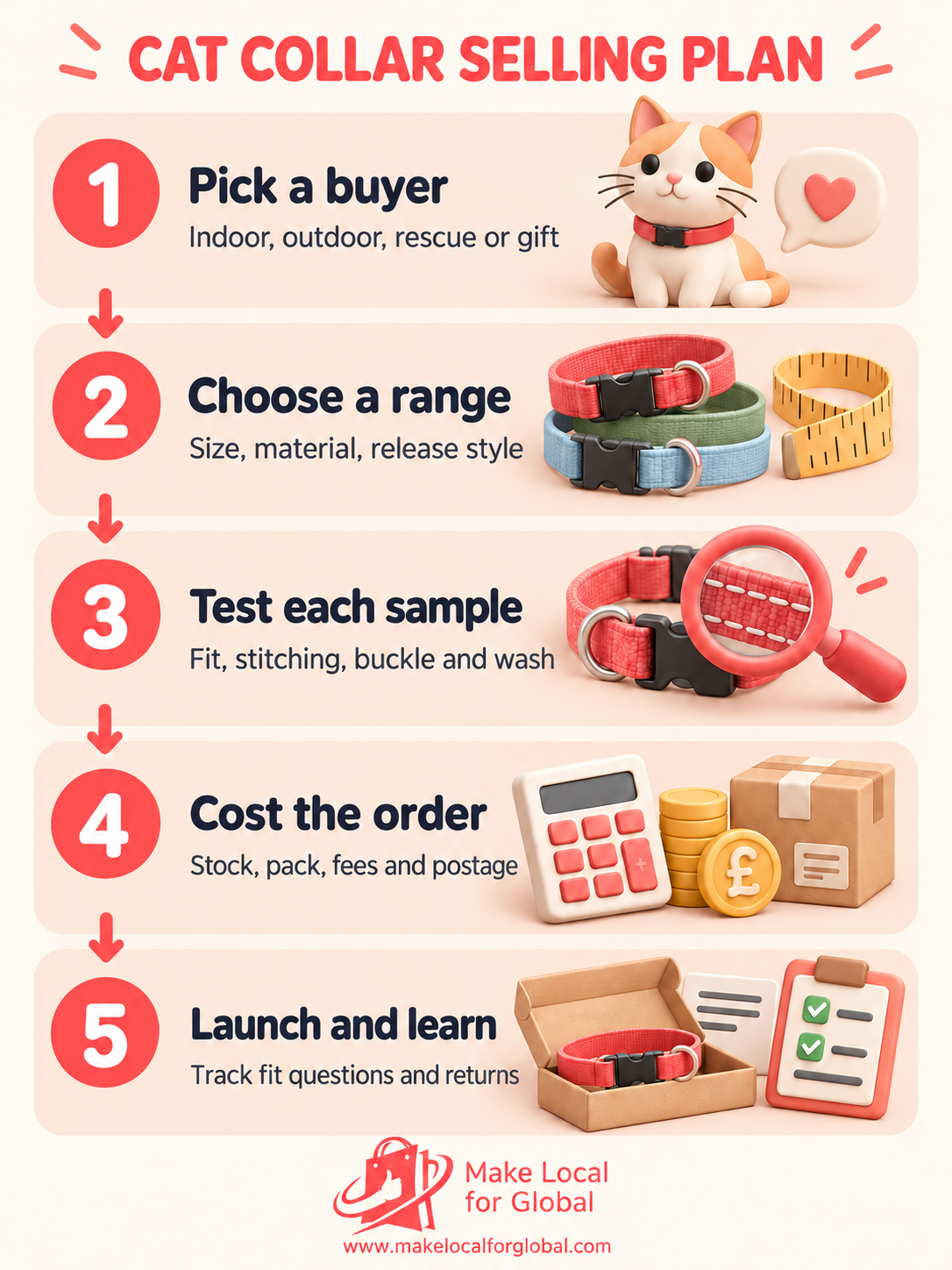
Select one buyer group, such as owners looking for a practical quick-release collar or customers buying personalised cat accessories. Speak with at least five people who match that group. Ask how they measure, what they use today, which feature they seek and how they decide a collar is worth its price. Record their exact questions, not only your interpretation.
At the end of the week, choose the product promise that matches the evidence. If buyers focus on fit, plan a clearer size chart. If they value design, photograph the material and finish. If they want dependable dispatch, check your stock method and carrier before advertising a fast service.
Request exact samples and specifications from two or three suppliers. Compare material, dimensions, quick-release design, stitching, adjustment, packaging, traceability, minimum order and lead time. Use a scorecard to show which supplier evidence is complete and which facts remain unknown.
Choose a small opening range with products that serve distinct buyer preferences. Remove a variant if it has no clear role, poor documentation or a supplier who cannot answer safety questions. Set a maximum first-stock budget that includes sample, freight and packaging.
Inspect each sample with a written process. Measure usable size range, check seams and adjustment, review the buckle under the maker’s method and test care claims only as instructed. If a result is uncertain or the design appears unsafe, do not list it until the supplier or a competent specialist resolves the question.
Build a cost sheet for direct sales and the marketplace you plan to use. Include product cost, freight in, storage, packaging, pick time, postage, fees, promotion, customer support time and a return or defect reserve. Draft product information with measurements, verified materials, care instructions, photos, dispatch expectations and a plain return policy.
Publish the first listings with the smallest range you can fulfil reliably. Use a modest promotion budget or direct outreach to an agreed audience. Track qualified visits, size-chart views, cart additions, paid orders, dispatch time, customer questions, cancellations, returns and contribution after variable costs.
Review the results at day 30. If visitors leave at the size step, improve the chart or photographs. If buyers ask for a feature you cannot verify, return to the supplier before making a claim. If orders arrive but contribution is low, review postage and fees before lowering quality or price. Add stock only when the first results support it.
Start with a cat-specific quick-release collar from a supplier who can provide clear specifications and a consistent sample. Choose one or two sizes or an adjustable range only after you can state usable measurements. A plain core design is easier to test than a large catalogue of unverified variations.
Cats Protection says two fingers should fit comfortably beneath a cat’s collar. Tell buyers to measure the neck, follow the maker’s exact instructions and check the collar regularly. If the cat appears uncomfortable, the owner should remove the collar and seek suitable guidance.
Do not add bells or charms by default. Small loose decorations can detach or catch. Cats Protection cautions against adornments that could become a choking hazard. If you choose to sell an accessory, assess its attachment, wear and care with qualified advice and explain its limitations.
Only after checking the exact product’s classification and authorisation. A collar that contains an active substance may have additional regulatory requirements. Cats Protection says many flea collars are not very effective and advises owners to ask a vet about treatment. Do not make pest-control claims about an untreated fashion collar.
No. You can source finished collars, make them, use a private-label supplier or work with a maker. Each route changes your cost, control and responsibilities. Ask who made the product, which records you receive, who handles defects and whether you are importing or selling under your own brand.
Use a small colour set that supports the buyer profile. Three distinct options can be enough to learn whether buyers prefer neutral, bright or patterned designs. Keep size and function constant across early variants where possible, then expand after you see which combinations sell and which remain in stock.
Avoid that absolute claim. Collar use and release depend on the exact product, fit and circumstances. Describe the verified clasp type and supplier guidance. Keep evidence for factual claims and do not promise that a collar prevents every escape or injury.
No. In England, most pet cats must be microchipped and registered by 20 weeks of age. Rules differ elsewhere in the UK. A collar can carry visible information, but it is not a substitute for identification required by law or advice from a vet.
Set a clear process for spelling approval, production, faults and change-of-mind requests. Some genuinely personalised goods may fall within a cancellation exception, but exact facts matter. A standard size or colour choice is not automatically bespoke. Read current consumer guidance and get advice for your policy.
Compare sales income with product cost, inbound freight, packing, pick time, postage, channel fees, marketing and returns. The remainder is contribution before fixed overhead, tax and owner pay. Review it by style and channel, then compare it with time spent on fulfilment and customer care.
Track visits, product-page actions, paid orders, average order value, delivery time, fit questions, return reasons, defects by batch and contribution after variable costs. Review the figures weekly at first. Use results to change one part of the offer at a time, then watch whether the same measure improves.
Use buyer interviews, supplier evidence and your cost sheet to decide which collar deserves a small launch. MLFG can help you organise the store plan and next business steps.
PREFERRED SOURCE
Like what you’re reading? Add Make Local for Global as a preferred source on Google to see more of our articles when you search.

Build your online presence without having to figure out everything yourself.