READY TO SELL Food Processors ONLINE?
Get a store built for you in 5 days, plus training and support to help you start, run, and grow your Alternative business.

Plan a food processor range for a clear buyer, check suppliers and samples, calculate full order costs and build product pages that answer practical questions.

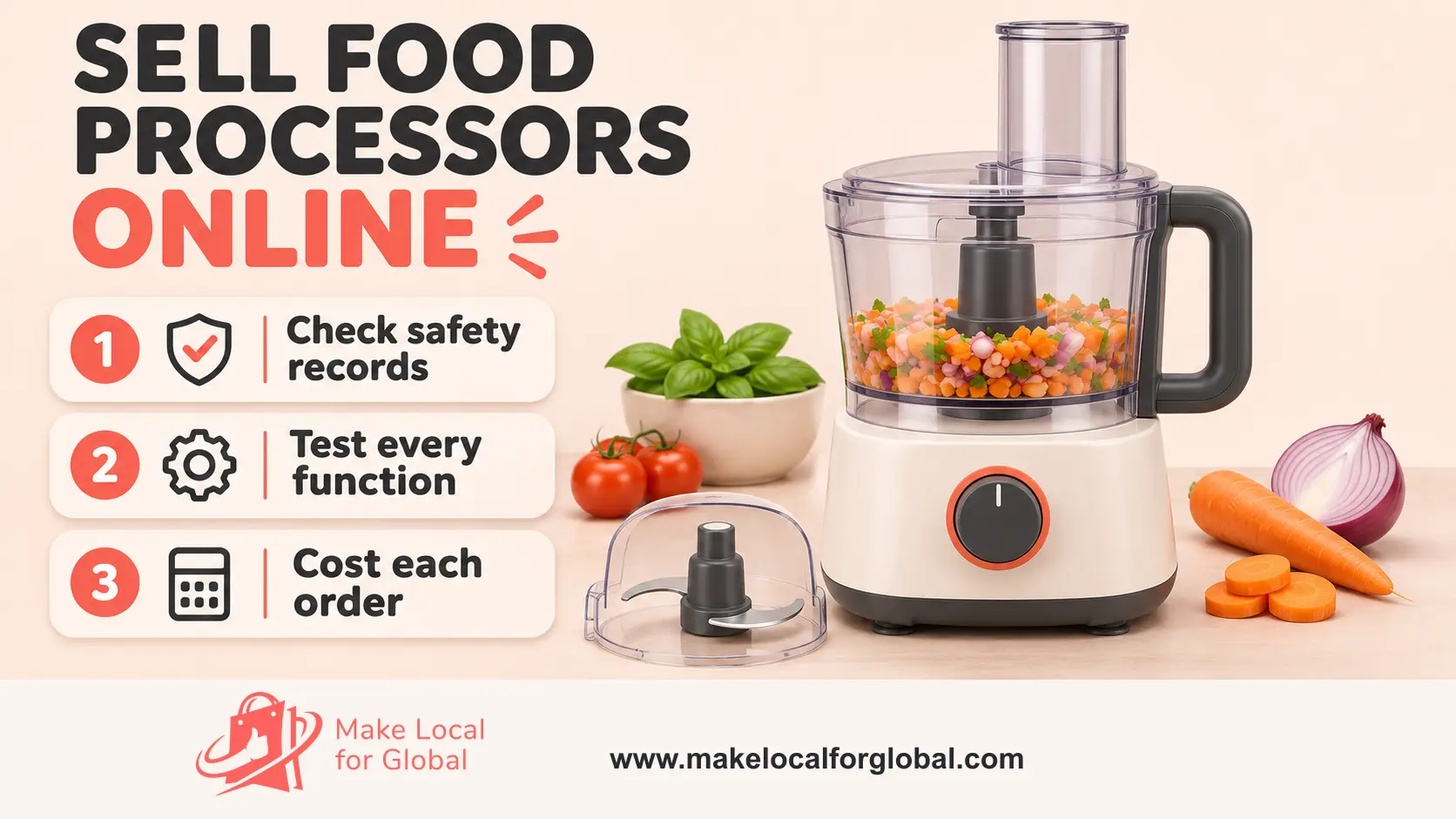
If you want to sell food processors online, start with a specific cooking task and a narrow product range. Buyers need more than a motor wattage or a list of attachments. They want to know what the machine can prepare, how much counter and cupboard space it needs, how the parts fit, what is included and what help is available if something goes wrong.
Food processors can carry higher purchase, shipping and return costs than small kitchen tools. A safe first step is to compare a few models, order samples, test every function and price a complete delivered order before placing a bulk order. This article sets out a practical way to do that for a UK-focused online shop. Treat the figures as planning examples, and check product duties against your role and the places where you plan to sell.
Make Local for Global can help a small seller plan an online store, organise product pages and get ready to manage orders. Review the current store options and decide whether the service fits your launch plan.
A food processor suits several types of buyer, yet one product page rarely speaks clearly to all of them. A student in a small flat may want a compact machine for dips, chopped vegetables and occasional baking. A parent may care about batch size, storage, cleaning time and whether the set includes the disc needed for lunchbox prep. A keen home cook may look for repeatable slicing, dough preparation and spare parts. A gift shopper may need a clear box photograph, delivery date and a simple explanation of what comes in the set.
Write a short buyer profile before speaking to suppliers. Include the room the customer has, the jobs they do each week, how often they cook, the price they can consider and the task that frustrates them today. “People who like cooking” is too broad. “Home cooks who batch chop vegetables on Sundays but have limited worktop space” gives you a clearer product and content brief.
Use that profile to choose what you will explain first. For small kitchens, show the machine beside a familiar object and give its stored dimensions. For a meal-prep buyer, film a short test using the same amount of produce each time. For an occasional baker, make it plain whether a dough blade is supplied, whether the motor is rated for that task and what the maker says about operating time. Avoid claims beyond the supplier’s documentation and the sample you tested.
Food processors are often bought around a practical event: moving home, replacing a broken appliance, planning batch cooking, preparing family meals, starting a baking routine or choosing a useful wedding gift. List three purchase occasions that fit your chosen buyer. Then write one question the shopper may ask at each point. A replacement buyer may ask whether the new model’s accessories fit older versions. A gift buyer may ask how large the box is and whether the recipient needs extra attachments.
Use those questions in interviews, community discussions or a short email survey. Ask what the person does now, which step takes time, what tools they already own and what would stop them ordering. Do not lead with “Would you buy this?” A polite yes does not show purchase intent. A stronger signal is someone asking for a particular price, delivery window or model comparison after seeing a real offer.
Demand research helps you avoid ordering a range built around assumptions. Begin with a small evidence sheet. Record the search phrase, buyer group, product task, questions people ask, competing offer, visible price, delivery promise and date checked. Check search suggestions and results, marketplace listings, review themes, product questions and social discussions. These sources help you find language and objections; they do not prove how many units you will sell.
Look for repeated needs rather than one loud opinion. If several buyers ask whether the bowl can go in a dishwasher, whether the machine can grate cheese or whether the feed tube takes a whole carrot, those questions belong on your product page. If reviews of competing products mention a lid that is difficult to align, check that feature on a sample before making it part of your offer. Do not repeat competitor claims as facts about your own product.
You can test interest before you order a container of stock. Prepare a one-page offer for one model or a clearly labelled sample concept. Show the model type, price range, shipping area, key tasks, included accessories and the expected dispatch period. Ask visitors to register for a stock alert or request a price notification. If you take pre-orders, state the delivery estimate and cancellation terms clearly, and do not accept payment unless you can fulfil the promise.
Set a test window and define what will count as evidence. For example, over two weeks, publish three short demonstrations and direct relevant visitors to a product-interest page. Track product-page visits, email sign-ups, questions about attachments and completed purchases separately. A high view count with no product questions may show curiosity rather than buying intent. A small number of detailed questions about capacity, cleaning or delivery can guide the next sample test.
Keep the test honest. Do not use fake stock counters, false discounts, invented reviews or a made-up “best seller” label. State when a product is still being evaluated. If the responses do not show interest at the price needed to cover costs, change the buyer, product or offer before ordering more.
The term “food processor” covers products that differ in size, attachments, intended tasks and storage needs. Compare the actual parts and manufacturer instructions, rather than relying on a broad category name.
Compact units can suit small worktops, quick chopping and limited cupboards. Their smaller bowls may make them easier to store, though they may require ingredients to be prepared in smaller batches. Confirm the usable bowl capacity, whether the motor needs cooling between runs, what foods the instructions allow and whether the attachments can be replaced. Do not call a compact chopper a full replacement for a larger processor unless its supported functions match that description.
These machines often combine a main bowl, chopping blade, slicing or grating disc and feed tube. Buyers need to compare the usable capacity, feed opening, safe assembly steps, cleaning method, cord length, footprint and included parts. “Large capacity” means little without a stated measurement and a description of whether it is the bowl’s total volume or the practical working capacity recommended for a task.
Combination products can appeal to people who want fewer appliances. The extra parts can increase box size, part count and the chance a buyer misunderstands what is included. Photograph the processor bowl, jug and attachments separately, then show the full set laid out. Check whether the blender jug can be used independently and if the product has separate speed or operating limits for each function.
Some sets add dough tools, citrus presses, julienne discs, mini bowls or storage cases. Every extra component creates a page, inventory and support question: Is it included? What task does it do? Does it fit every model in the range? Can it be bought later? Keep compatibility statements tied to specific model numbers and supplier documents. A clear accessories chart can reduce pre-sale questions and post-sale disappointment.

A new shop does not need every bowl size, colour and attachment bundle. Begin with a small range that lets a buyer see the differences quickly. A simple structure might include one compact option, one core processor and one higher-priced set with a documented accessory bundle. The point is not to imply that the premium model is right for everyone. Explain who each choice suits and which features account for the price gap.
Create a comparison sheet with product code, bowl capacity, usable capacity if documented, motor rating, dimensions, weight, speed settings, pulse control, accessories, cleaning instructions, warranty details, plug type, carton dimensions and supplier lead time. Keep a copy of each maker’s specification sheet. Where two suppliers use different ways of reporting the same measure, do not present the figures as directly comparable until you understand the definitions.
One hero product can make the first test easier to manage. Choose it using buyer evidence, supplier reliability, sample performance, supply terms and landed cost. If a bundle is useful, build it around a verified task. For example, a meal-prep bundle might include a processor plus a spare bowl and the exact discs shown as compatible. Avoid filling a bundle with unrelated low-cost accessories just to raise the ticket value.
Label choices in plain language: “compact for quick prep”, “everyday processor with slicing disc” or “larger set with dough tool”. These phrases describe a use case, not an unsupported quality ranking. Provide a comparison table and a short recommendation path: choose A if storage is the priority, B if you want the listed slicing function, or C if the extra attachment suits a task you regularly do.
Check colour names and model numbers against the item that will ship. Supplier product photos can show a variation that is no longer supplied. If the plug, bowl, blade set or box contents change, treat it as a new stock version. Update photos, compatibility notes, part references and any published safety documents before selling the change.
You may buy from a UK wholesaler, import from a manufacturer, create a private-label product or use a fulfilment supplier. Each route changes your workload and risk. A UK wholesaler may provide a local returns address and ready stock, though it can offer less control over the product and margin. Direct import can open a wider range and more direct supplier conversations, yet it places greater responsibility on you to confirm conformity, traceability, import costs and support arrangements. Private label can add brand control, with extra work on specifications, packaging, records and product changes.
Dropshipping may reduce stock held at home, but the seller still needs accurate stock, delivery and return information. Request the ship-from location, dispatch cut-off, parcel dimensions, returns route, sample policy and process for a safety complaint. Order the product to your own address before offering it. A supplier photograph does not prove the item shown is the item that will reach the buyer.
Use the exact product identifier in every request. Ask who is the legal manufacturer, who is the importer for the intended market, which model and attachments the documents cover, where the units ship from and how you will be told about design changes. Request the declaration of conformity or other records relevant to the applicable rules, product labels, English instructions, electrical ratings, traceability markings, test information, warranty terms, spare-parts plan and complaint escalation route.
Ask for written confirmation of what happens if a safety issue arises: who can stop dispatch, identify affected batches, contact buyers, arrange repairs or refunds and tell relevant authorities. Keep the response with the SKU record. A supplier saying “all certificates available” is not enough. Check that the files are legible, current for the product and issued by a credible party. Seek competent compliance advice if a document or responsibility is unclear.
Record minimum order quantity, sample price, tooling charges, payment timing, freight basis, insurance, customs paperwork, lead time, production tolerance, carton count and defect procedure. Ask whether the quote includes the same attachments, packaging and plug configuration as the sample. Confirm how a replacement part is ordered, who pays freight and what happens if a shipment is delayed.
Build a landed-cost estimate before you accept a quote. Include freight, import duty where due, import VAT cash flow, handling, inspection and any repacking. Check the current classification and customs figures with official sources or an experienced customs adviser; product codes and rates can change. Do not use a supplier’s estimate as a final tax calculation.
Order samples from the supplier and model you plan to sell. Keep one as a retained reference if the budget allows. Photograph the carton, labels, plug, instruction booklet, bowl, lid, blade assembly and each attachment. Record the batch or serial information. This helps you spot a later substitution and gives you a clear comparison point when bulk stock arrives.
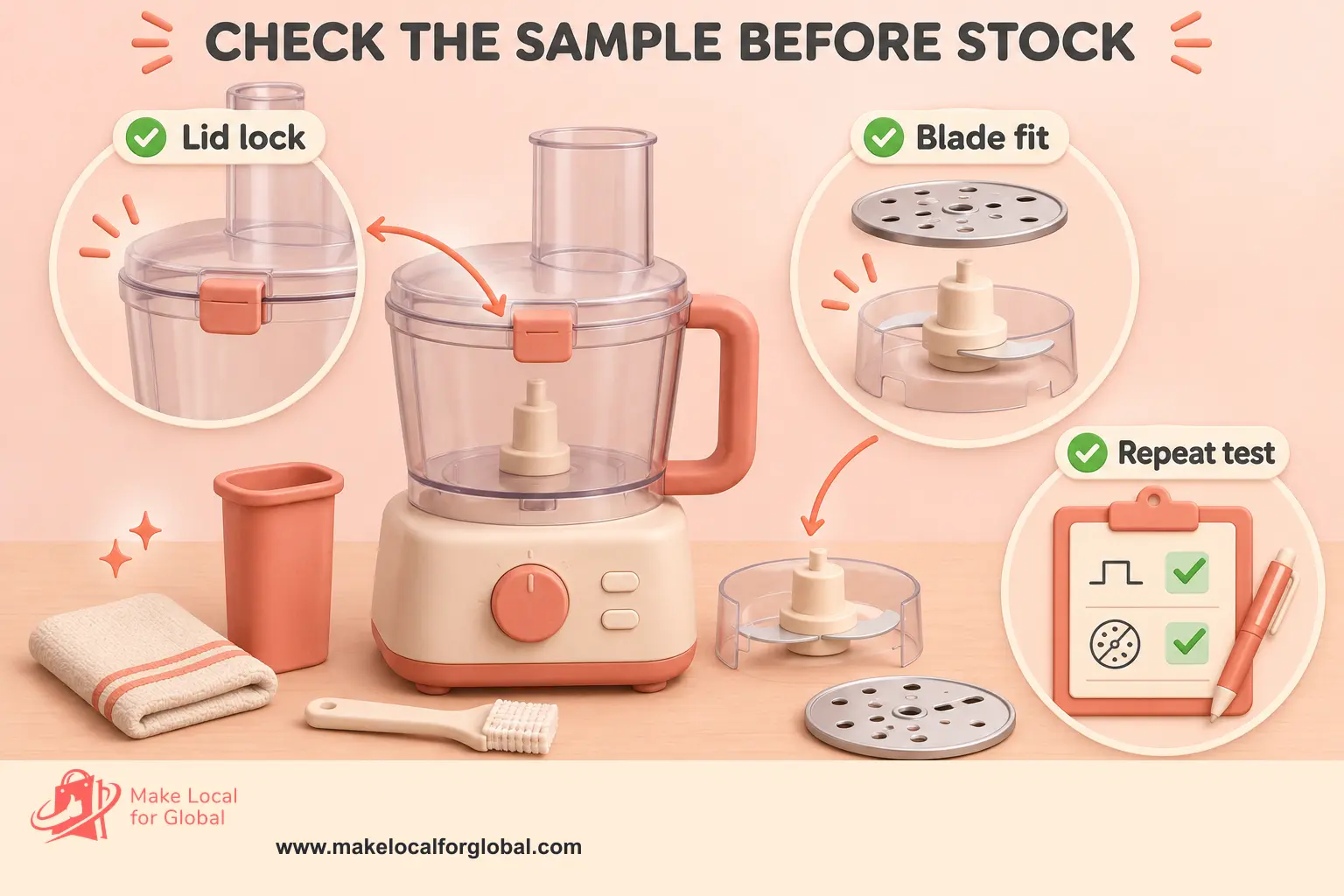
Test a repeatable set of tasks based on the manufacturer’s instructions. Use the same ingredient size, amount, speed and run time for each sample. Check chopping consistency, slicing thickness, grating output, pulse response and dough function only where the manual permits those uses. Note jams, unusual smells, leaks, wobble, excessive movement, overheating warnings, difficult assembly and confusing controls. Do not bypass a safety interlock or run the unit with a damaged part.
Assemble and remove the bowl and lid using the written steps. Check that the interlock engages only as described and that the motor does not operate when the required parts are incorrectly seated. Keep fingers away from cutting edges. Use the supplied pusher rather than hands to guide food. Confirm the base stays stable on a clean worktop, then check whether the bowl, lid, seals and attachments are easy to separate for cleaning.
If the maker says a part is dishwasher safe, check the instructions for limits such as rack position or temperature. Do not infer dishwasher safety from the material or appearance. Look for scratches, cloudiness, warping, staining or water trapped in seams after cleaning in the recommended way. Check whether a brush or careful hand wash is needed around blades and disc openings.
Write down what every unit or sample lot should include. For a higher-risk electrical product, set a sensible inspection approach with a qualified testing or compliance professional. At minimum, check the outer carton, model number, visible damage, required labels, cord, plug, bowl, lid, attachments, instructions and accessories against the approved sample. Keep supplier invoices and batch details so you can identify the source of stock.
Do not sell a unit with an unexplained change, missing instruction booklet, damaged cord, cracked bowl, failed interlock or unexplained performance issue. Isolate it from saleable stock and record the problem. Contact the supplier with photos and model/batch details. Agree the remedy in writing and check whether a wider batch may be affected before returning the unit to stock.
Electrical food processors fall within product-safety rules. The requirements depend on where the item is placed on the market and on your role in the supply chain. A retailer reselling an established UK product has different duties from a business importing, rebranding or manufacturing the machine. Do not assume that a marketplace listing or a supplier’s logo settles who is legally responsible.
For Great Britain, the Office for Product Safety and Standards provides guidance on the Electrical Equipment (Safety) Regulations 2016. It describes duties for manufacturers, authorised representatives, importers and distributors. Importers need to verify conformity, markings, identification and English instructions before placing equipment on the market. Read the official Electrical Equipment (Safety) Regulations guidance and the regulations themselves.
For Northern Ireland, separate guidance applies. The marking and market-access position can differ from Great Britain and can change. Check the current official Northern Ireland route before listing there. The product’s intended market, manufacturer, importer and supply date matter. Do not copy a marking statement from an older product page or another region.
General product-safety requirements apply alongside product-specific rules where relevant. In Great Britain, OPSS guidance says consumer goods must be safe in normal or reasonably foreseeable use, and explains traceability and producer/distributor responsibilities. See General Product Safety Regulations guidance for Great Britain. Northern Ireland has a different general-safety regime since December 2024, as described on that official page.
Online selling has separate consumer information duties. Before checkout, make your business contact details, product description, full price and taxes, delivery arrangements, cancellation rights and other required information easy to find. Most online goods orders can be cancelled within 14 days after delivery, subject to exceptions; explain the process clearly and follow current rules. See GOV.UK distance selling guidance and returns and refunds guidance.
RoHS rules restrict certain hazardous substances in electrical and electronic equipment. Check current RoHS guidance for the market, the product and your role. Some food processors include a battery-powered accessory or integrated battery. If you place batteries on the market for the first time, separate battery-producer duties may apply; start with waste batteries: producer responsibility.
This summary is a starting point, not a compliance decision for a particular model. Ask the responsible supplier for complete records that identify the exact model and market. If you import or sell under your own brand, obtain advice from OPSS, Trading Standards or a qualified product-compliance professional before placing stock on sale.
Bowls, lids, pushers and attachments can touch food. Food-contact rules are a separate consideration from electrical safety. The Food Standards Agency notes that food-contact materials include kitchen equipment and utensils, and that chemicals can migrate from a material into food. Request material-specific declarations and supporting evidence for the exact parts and intended use. Start with the FSA’s food contact materials guidance.
Ask whether the documentation covers repeated use, temperature range, food types and cleaning agents expected for the part. A declaration for a generic plastic sheet does not automatically show that a finished processor bowl or seal is suitable. Confirm whether the supplier’s records identify the product components, not only the base material. Get competent advice if the documents use unfamiliar terms or omit a part that contacts food.
Keep your online claims tied to proof. “BPA-free”, “food safe”, “dishwasher safe”, “shatterproof”, “commercial grade”, “quiet” and “suitable for dough” each need appropriate support. Use the manufacturer’s exact claim only where it applies to the model and configuration you sell. If you test a feature yourself, describe the test in a bounded way, such as the task and sample used, rather than implying a guarantee for every kitchen or ingredient.
Electrical equipment creates end-of-life duties. UK WEEE guidance covers producers and distributors, including retailers selling by internet, mail order or phone. Online retailers must provide customers with information on how they can dispose of electrical equipment, why it should be separated from other waste and the meaning of the crossed-out wheeled-bin symbol. Distributors must provide a free like-for-like take-back route or join the Distributor Take Back Scheme if eligible.
Read the current WEEE guidance and retailer and distributor responsibilities. A business importing products, selling its own brand or selling direct to UK buyers from abroad may count as a producer, with registration and reporting duties. The rules include an annual registration route for smaller producers and a producer compliance scheme route above the stated threshold. Confirm the current thresholds and process with the regulator; do not copy an old threshold from a blog.
If you sell an appliance that includes a battery, check battery duties separately. The weight of batteries and electrical equipment can be reported under different regimes. Your own website should make the relevant customer take-back or recycling information easy to find. Keep a record of the service you provide and how buyers can use it.
Packaging producer responsibility is separate from the appliance itself. Check your obligations if you import or place packaged goods on the UK market, particularly as business size and packaging quantities change. Keep cartons compact but protective, avoid unsupported environmental claims and use supplier packaging data where you report material or recycling information.
Price from the cost of a delivered, supportable order rather than the unit quote alone. Food processors need protective packaging and can cost more to deliver or return than small utensils. Create one sheet per model and one column per cost assumption. For a UK consumer order, record product cost, inbound freight, customs charges where applicable, inspection, packaging, postage, payment fees, expected returns or warranty handling, customer acquisition and any marketplace commission.
Here is an illustrative example for one order. It does not represent a typical supplier quote, current carrier tariff or platform fee. It assumes a £60.00 unit cost, £6.00 inbound freight allocation, £2.50 protective packaging, £4.99 outbound delivery, £2.15 payment fee, £3.00 returns reserve and £8.00 customer acquisition cost. The estimated variable order cost is £86.64 before overhead and tax treatment.

Suppose a shop tests a selling price of £119.00 including VAT at the standard 20% rate, where that rate applies and the business is VAT registered. The VAT-exclusive sale value would be £99.17, calculated as £119.00 ÷ 1.20. If the example costs are VAT-inclusive, deductible input VAT and fee tax treatment need separate accounting; the £86.64 cannot simply be subtracted from £119.00 and called net profit. On this simplified basis, the difference between £99.17 and £86.64 is £12.53 before website costs, insurance, support time, income or corporation tax and any unlisted cost. Ask an accountant to confirm VAT treatment for your circumstances.
Contribution is the amount left from a sale after the variable costs included in your model. It is not net profit. Rent, software, insurance, bookkeeping, damaged stock, support time and taxes can still reduce the final result. Add a sensitivity check: What happens if delivery costs £2 more, customer acquisition rises to £12 or two of every 100 units need a paid replacement part?
Set a minimum viable price from your actual costs, then compare it with real alternatives and buyer feedback. If the market price cannot cover the costs you need to include, change the source, bundle, shipping approach or product focus. Do not hide a weak unit margin with a high assumed repeat-purchase rate. Processors can last for years; repeat sales may come from replacement parts or accessories only if compatibility, stock and buyer demand are real.
VAT registration depends on current taxable turnover rules and a rolling period. Check the latest HMRC VAT registration guidance before basing a price plan on a threshold. Selling through a marketplace may add referral, fulfilment, storage, return or advertising fees. Calculate each one from the current plan and product dimensions. A processor’s parcel size and weight can change fulfilment cost bands, so measure the packed carton, not only the appliance.
Record whether each figure includes VAT, which date it was checked and where it came from. Review the model after the first test orders. When your carrier, gateway, ad account or supplier changes its rate, update the worksheet and make a deliberate pricing decision.
Make Local for Global offers store setup and guidance for small sellers. Compare the current plans, work out what fits your budget and bring your product range, costs and delivery assumptions to a planning conversation.
Measure the fully packed carton before publishing a delivery charge. Check its length, width, height and weight, including inserts and any accessory box. Use those figures to request current quotes from carriers or fulfilment partners. Confirm the price for the postcodes you serve, tracking, signature options, insurance, surcharge rules and what happens when a parcel is delayed or damaged.
Test the packaging by shipping a sample to yourself or a colleague and recording the route. Check corners, seals, internal movement and whether the bowl or attachment can strike the motor housing. Use protective inserts around the appliance, but avoid loose packing that can scratch a glossy surface or bury small parts. Make a simple unboxing video so you can check the instructions and components are easy to find.
Before sealing the carton, confirm the exact model and colour, bowl, lid, blade set, discs, pusher, instruction booklet, warranty information and accessories listed on the page. Fit protective caps or guards to sharp parts. Add the correct customer-service details and the required WEEE information or link. Photograph the packed condition for a new product or changed carton, not every customer parcel unless your process justifies it.
Do not put loose blades into a box where they can move. Ask the supplier for a packing diagram and check it with the real sample. If the manufacturer’s packaging is not adequate for your route, ask the carrier and packaging supplier for a tested solution. Do not market a plain carton as “eco-friendly” without evidence for the claim.
Track on-hand units, units reserved for orders, incoming quantities, supplier lead time, reorder point, and units held for inspection or return assessment. Use separate stock records for each model and accessory. If a supplier changes a part or version, do not merge old and new variants under one product code unless compatibility and customer-facing differences are clear.
When a return arrives, record the reason, date, product version, packaging condition, missing pieces and visible fault. Follow consumer law and your published terms. Do not resell a used or damaged appliance as new. If a report suggests a potential safety defect, take the unit out of sale while you investigate and seek advice on any reporting or customer-contact duty.
A strong food processor page helps a shopper decide if the model fits their tasks and kitchen. Use a title that includes the model or range name and the main use, not a string of repeated keywords. Open with a plain description: who the model suits, the tasks it supports and what comes in the box. Add a short comparison link for shoppers choosing between your options.
Include the maker’s model number, bowl capacity and how it is measured, appliance dimensions, carton dimensions where helpful, weight, rated power, voltage, plug type, speed controls, pulse function, cable length, warranty terms and service route. List each accessory by name and the task it performs. Link the maker’s instructions or care information where licensing and support allow.
Be clear about limits. If the user guide recommends short bursts or rest periods, explain that in plain words and point to the manual. If a model cannot process hot ingredients, frozen foods or a particular dough, do not suggest otherwise in recipe content. Distinguish “included” from “available separately”. State whether attachment compatibility covers only a named generation or model.
Photograph the full set on a clean surface, then separate each included part. Add a scale reference for the worktop footprint, a clear bowl-capacity view, close-ups of the control and lid lock, and a storage view if cupboard space is a buying concern. Use real product photography that matches the model and colour in stock. Do not use a different supplier’s machine or a generated image that suggests an attachment the buyer will not receive.
A short video can show how the bowl and lid lock, how the pusher feeds food, how the processor performs one supported task and how the parts are cleaned. Keep hands away from exposed blades. Show the product used as instructed and state if a result depends on food size or quantity. Captions help viewers follow the demonstration without sound.
Write answers to questions before the buyer reaches checkout. Common queries include whether the bowl and discs are dishwasher safe, which attachments are included, where replacement parts can be bought, whether the plug is UK compatible, and how to claim on the warranty. Verify each answer with the manual or supplier rather than guessing.
People may search for “food processor with slicing disc”, “compact food processor for small kitchen”, “food processor with dough blade” or a model-specific replacement bowl. Those are examples of search language, not a forecast of demand. Use keyword research and your own page-search data to see which phrases fit your products. Keep each page focused on a real buyer need. Avoid publishing several near-identical pages that differ only by one adjective or attachment name.
Build supporting content from questions customers ask. A comparison between chopping and slicing functions can help a buyer decide whether they need a disc. A storage guide can show how to keep parts together. A cleaning article can quote maker instructions and show safe blade handling. A recipe page can demonstrate a function only when the manual supports that task. Link those pages back to the product page with clear anchor text.
For related kitchen product ideas, see how to sell apple slicers online and how to sell baking utensils online. The Product To Sell articles include further product-specific planning examples. Keep these links contextual and point to pages that are live and relevant.
Page title: “Compact Food Processor with Slicing Disc | [Store Name]” is clearer than repeating “best food processor” several times. A meta description can name the intended buyer, a verified feature and the next step. It should sound like a useful summary, not a promise that the product will save a fixed amount of time or deliver a particular health result.
Use headings that reflect the page, such as “What is included”, “Which tasks can it handle?” and “How do I clean the disc?” Add model numbers and capacities in the body, not as hidden text. Give every image concise, accurate alt text. If an image is decorative or repeats nearby text, follow the site’s accessibility convention rather than stuffing a keyword into its description.
Your own online store can present the full range, instructions, support route and brand story in one place. Marketplaces can help buyers compare models and may already have appliance shoppers, but fees, listing rules, competition and return processes can affect your costs. Social platforms can distribute demonstrations and customer education, though a post is not a reliable stock or sales channel by itself.
Pick one primary sales route and one supporting route for the first test. If using a marketplace, read current policies for electrical products, warranties, safety documents, used returns and product recalls. If selling through your own site, make contact, delivery, returns, privacy and recycling information easy to find. Keep product details consistent across channels so the customer does not see a different attachment list or delivery estimate.
Create short demonstrations with a clear purpose: “How the lid lock aligns”, “What is in the box”, “How thin the slicing disc cuts a carrot” or “How much cupboard space the parts use”. Name the model and the attachment. Use the same method when comparing products. A demonstration should show a real limitation or trade-off, not only a polished finished dish.
For search and social content, try one comparison, one setup video, one cleaning demonstration and one buyer checklist. Measure visits to the product page, saved questions, email sign-ups and orders. Track paid advertising separately from organic views. If a video gets views but no one clicks through or asks a question, test a more relevant buyer task before increasing spend.
Send order updates that say what will happen and when. Include clear support details and the model number on the dispatch message, so a customer can ask a precise question. Ask for feedback after delivery, without offering a reward for a positive review. If a buyer reports a fault, respond through the published process and record the issue against the product batch.
Customer feedback can reveal an information gap. Repeated questions about bowl size suggest a better dimension photograph or explanation. Returns for unexpected accessories suggest that the inclusion list needs revision. Delivery damage may point to a packing issue. Use those patterns to improve the page and supplier process before buying more stock.
Bring your buyer profile, sample notes, verified product details and cost sheet to your store plan. Make Local for Global can help small sellers prepare an online shop and learn to manage products and orders.
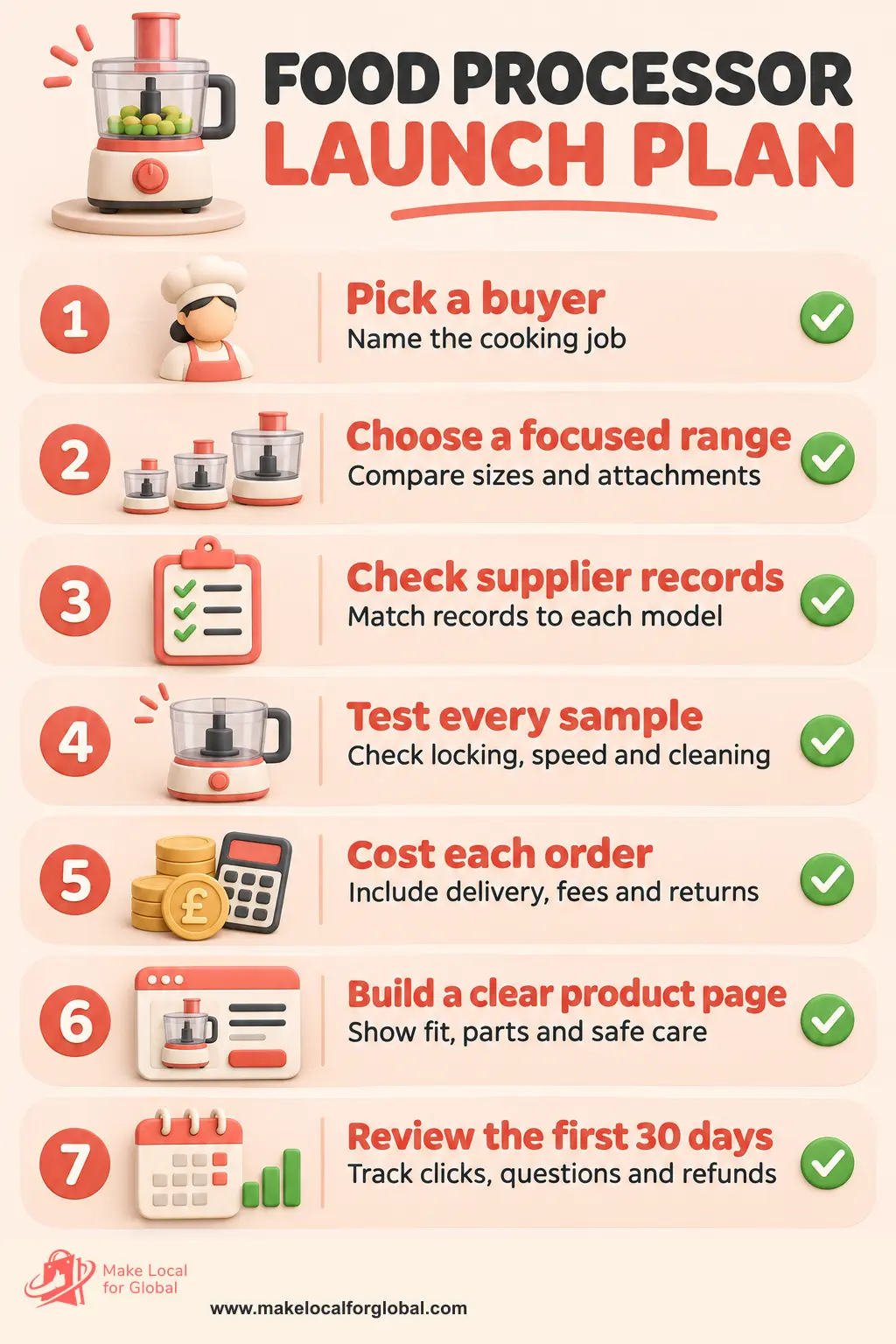
Use the first month to gather evidence and fix weak points, not to chase a launch-day sales target. Keep a simple weekly record of visits, questions, test sign-ups, completed orders, cancellations, returns, support time and cost per order. Record what changed so you can tell whether a result came from a new product image, new price or new audience.
Write one buyer profile and three use cases. Collect questions from search results, customer discussions and competing product reviews. Build a comparison sheet for five candidate models. Record which claims have a source and which items need a supplier answer. Remove models with unclear identity, unavailable documentation, poor parts support or shipping terms that make your estimate unworkable.
Order one or two samples from the supplier and version you intend to list. Save the invoices and product documents. Follow the manual for assembly, chopping, slicing, cleaning and storage tests. Photograph the sample and carton. Log defects or unclear instructions. Ask the supplier to address every open question before you approve a purchase order.
Calculate landed cost, protective packaging, outbound postage, gateway or marketplace fees, returns reserve, customer acquisition and overhead allocation. Check VAT treatment with HMRC or an accountant. Draft the product page with exact dimensions, model number, included attachments, limits, warranty route, dispatch timing and return information. Show real photos and test the page on a phone.
Publish a limited offer only when you can fulfil it and the records are ready. Share one product comparison and two use demonstrations with an audience likely to want the product. Review questions daily and fix factual gaps. At the end of the week, compare page visits with sign-ups, orders, cancellations and support queries. Decide whether to reorder, revise the offer, test another buyer or pause.
Ordering every variation at once. Start with a few products that answer different buyer needs. More colours and bundles mean more stock records, photos, compatibility questions and money tied up in unsold parts.
Treating wattage as a complete quality measure. Buyers need the supported tasks, bowl capacity, disc choice, operating guidance and sample performance. Present the maker’s rating accurately, then explain the practical task it supports.
Relying on supplier certificates without checking model coverage. Match each document to the exact product, accessories and target market. A generic file or a document for another appliance does not settle your duties.
Skipping the sample. A list of specifications cannot tell you whether a lid is awkward, a disc is hard to align, packaging is weak or the instructions make sense. Test before paying for bulk stock.
Using a low unit quote as the selling price. Freight, fees, delivery, returns, advertising and after-sales support can change the economics. Use current figures and keep VAT separate from profit calculations.
Showing parts the customer will not receive. Separate included items from optional accessories in the photograph and written list. State model compatibility and replacement-part availability with evidence.
Overpromising on recipes or results. Do not claim a processor handles every ingredient, cuts every task to a fixed time or replaces several appliances unless the manual and your evidence support the statement.
Making returns difficult to find. State dispatch timing, delivery options, contact details and cancellation/return rights before checkout. Clear information can reduce avoidable support requests and help the buyer choose with confidence.
It may suit a seller who can choose a clear buyer, source verified products, test samples and handle larger parcels and customer questions. The category needs more safety and support preparation than a simple kitchen utensil. Test demand and per-order contribution before committing to a large purchase.
There is no single reliable start-up figure. Your budget depends on sample costs, minimum order quantity, freight, import charges, packaging, insurance, shop costs, payment fees and the customer-acquisition test. Build a written cash plan that includes a return reserve and money for replacing a faulty unit. Treat a supplier’s minimum order as one input, not the whole budget.
A UK wholesaler may offer simpler delivery and a local returns route. Importing can provide a wider choice but can place additional product-safety and producer-responsibility duties on your business. Compare exact model records, sample quality, lead time, support, spare parts and landed cost before choosing a route.
Follow the manual and test the actual functions you plan to advertise. Check bowl and lid fit, interlock behaviour, pulse and speed controls, supported chopping or slicing tasks, leaks, movement, noise, cleaning and storage. Keep fingers away from blades, do not bypass safety features and stop if the unit smells unusual, overheats or behaves unexpectedly.
Show model number, bowl capacity and measurement basis, dimensions, weight, rated power, speed settings, pulse control, included attachments, supported tasks, cleaning directions, operating limits, warranty route, spare parts, delivery and returns. Use real images of the exact configuration in stock.
WEEE rules apply to electrical products sold online. Distributor responsibilities include a free like-for-like take-back route or a scheme route where eligible, and online retailers must make required recycling information available. Importers, own-brand sellers and some overseas sellers can have producer duties. Check current official WEEE guidance for your role.
Set expectations before checkout. Show the machine’s full footprint, bowl measurement, accessory list, supported tasks and care instructions. Test packaging and sample function. Use a comparison page to help buyers choose a model that fits their cooking routine and storage space.
Marketplaces can provide a sales route, but each has rules, fees and product-document requirements that can change. Check current policies for electrical goods, product claims, warranties, returns and recalls. Add every marketplace fee and fulfilment charge to the order cost sheet.
Choose enough models to show meaningful differences, but few enough to inspect and explain. One compact option and one core model may be easier to test than a large assortment. Add a premium bundle only if a clear buyer need and verified accessory set justify it.
Do not assume that one document covers every model or accessory. Ask the responsible supplier for records that identify the exact model, configuration and target market. If you cannot verify coverage, pause that listing and seek competent advice.
Start with a buyer group you can reach and a product task you can demonstrate. Publish a clear comparison page, share a real sample demonstration and ask interested people to join a stock alert or enquire. Measure page visits, questions and completed purchases before raising advertising spend.
Before you pay a deposit, can you name the buyer and the task this model solves? Have you checked the sample, exact model records, English instructions, food-contact evidence and spare-parts route? Have you measured the packed carton and priced delivery, fees, returns and support? Does your page say exactly what is included and what the buyer should not expect?
If an answer is unclear, keep the order small or wait for the supplier to provide the missing evidence. A focused first range, tested sample and honest product page give you a better basis for learning than a large catalogue with unknown costs. Review your numbers and customer questions after the first test, then make the next stock decision from what buyers did and said.
Rules and thresholds can change. Confirm current requirements with the relevant regulator or a qualified adviser before importing or selling electrical appliances.
PREFERRED SOURCE
Like what you’re reading? Add Make Local for Global as a preferred source on Google to see more of our articles when you search.

Build your online presence without having to figure out everything yourself.