READY TO SELL Garden Furniture ONLINE?
Get a store built for you in 5 days, plus training and support to help you start, run, and grow your Alternative business.

Learn how to sell garden furniture online with a focused range, tested samples, realistic delivery costs and clear product pages. This practical UK guide covers materials, suppliers, pricing, safety, packaging and launch planning.


Garden furniture can look simple in a photograph. A buyer deciding whether to order it needs much more: the real footprint, the materials, the care routine, what arrives in the carton and how a large parcel reaches the garden. If those details are missing, a good-looking set can turn into an expensive return.
You can start with a small range. Pick one buyer and one outdoor space, order samples, check the construction, calculate delivery for the packed item and write a product page that answers practical questions before checkout. Treat comfort, colour and weather resistance as claims to verify, not words to copy from a supplier.
This plan is for a UK seller preparing a first garden furniture range. The figures below are illustrative, and product duties depend on the materials, design, supply chain and market. Get product-specific advice when the documents or rules do not clearly match the item you intend to sell.
Plan a garden furniture range that fits
Compare outdoor spaces, product sizes and delivery needs before choosing stock.
“Garden furniture” can mean a folding balcony chair, a two-seat bistro set, a family dining table, a deep-cushion lounge sofa, a garden bench or a compact outdoor side table. Each serves a different space and creates different delivery and support work. A shop that tries to serve every buyer with a broad catalogue can end up with many slow-moving sizes, colours and spare parts.
Start by writing down one customer and one use. For example: a renter with a narrow balcony who wants a two-seat set that can be folded and stored; a family looking for a six-seat dining set for weekend meals; or a homeowner replacing a small patio sofa and needing washable cushion covers. These descriptions help you choose what to test and what information to put on each page.
Ask potential buyers how they use the area, then get measurements rather than relying on statements such as “small garden”. A balcony may have a narrow door, a step, glass balustrades or a weight limit. A patio may have a sloped surface, drainage channel or access path that changes the useful footprint.
For each person you speak with, record the space dimensions, number of regular users, storage options, preferred material, budget and biggest concern. Ask whether the furniture can remain outside all year or needs to be brought indoors. Ask how it will be carried through the home and whether someone can assemble it.
Try to speak with five to ten people who match the same customer profile. Show them two or three product concepts with measurements, care details and a realistic delivered price. Ask which option they would choose and why. A request for a particular footprint or clear answer about winter storage tells you more than a general compliment about the appearance.
Some customers buy before spring, ahead of a house move, after extending a patio, or when an old set fails. Others want a bench for a quiet corner or extra chairs before a gathering. The buying occasion affects the range, delivery promise and content they need.
Keep seasonal patterns as a hypothesis until your own data supports it. Review supplier lead times, weather-related delivery limits, stock availability and search activity before ordering a large amount for a particular month. A spring campaign is of little value if a table has a long production delay or your carrier cannot deliver the set on time.
Choose one main product family and a limited number of related options. A compact dining set might include a two-seat bistro set, a four-seat dining set, a matching parasol only if the table supports it, and replacement covers that fit a confirmed model. Do not add a sofa, fire pit, outdoor heater and storage box just to make a catalogue look large. Each product brings its own testing, storage, delivery and support requirements.
| Product family | Typical buyer need | Product facts to confirm | Delivery question |
|---|---|---|---|
| Bistro set | Two seats for a balcony or small patio | Table footprint, chair width, fold mechanism, surface finish | Can every carton pass through the doorway? |
| Dining set | Meals with family or guests | Table dimensions, seat count, chair clearance, assembly | Is delivery kerbside or to a room chosen by the buyer? |
| Lounge chairs or sofa | Relaxing outdoors | Cushion thickness, fabric care, seat height, frame material | Are cushions packed with the frame or shipped separately? |
| Bench | Fixed seating or a garden feature | Seat length, weight capacity, fixing points, ground clearance | How long is the longest box? |
| Folding chair or table | Occasional seating or storage | Locking parts, folded size, setup steps, stability | Is the packed item suitable for parcel delivery? |
| Side table | Small surface near a chair or sofa | Height, top material, edges, weather care | Does glass or stone need special handling? |
An entry option can serve a buyer who needs simple seating and limited storage space. A core option might add a larger table, removable cushions or a matching bench. A higher-priced set should offer a verifiable improvement, such as a wider seat, more durable finish, replaceable parts or a clear warranty. A higher price alone does not explain why a shopper should choose it.
State the real number of seats. A set described as seating six may need enough clearance around the table for each chair to move. Check the table size and chair dimensions together. If the shop image shows six chairs but the set includes four, say so beside the image and in the box contents.
Offer accessories only when fit and compatibility are known. A parasol needs a compatible hole or base, and a furniture cover needs the exact dimensions and shape. A cushion needs to fit the stated chair model. If you cannot confirm fit, sell it as a separate item with a measurement guide rather than attaching it as a default bundle.
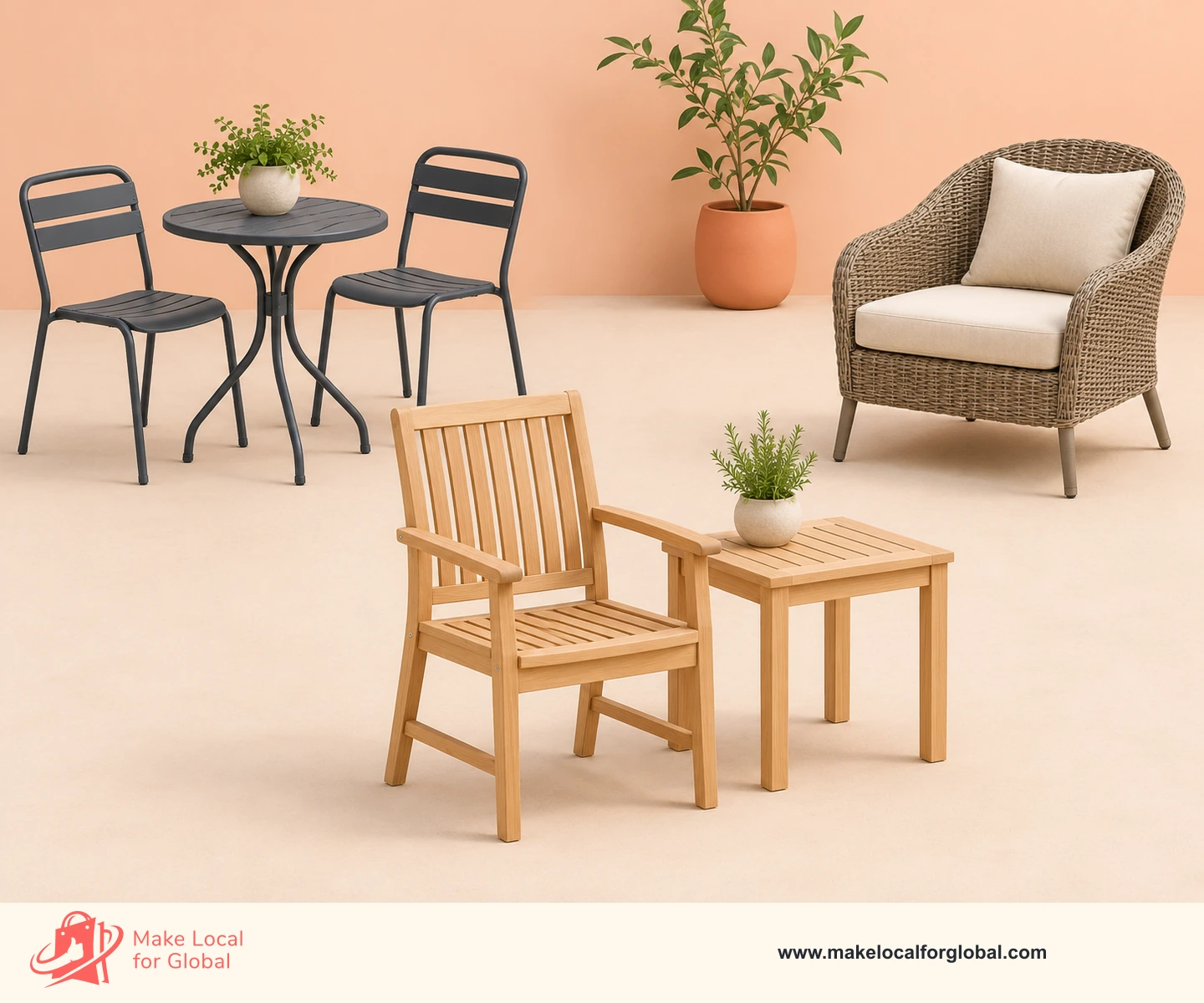
A material name does not tell a customer how a product will perform. Teak, acacia, eucalyptus, steel, aluminium, synthetic weave and outdoor fabric each depend on construction, finish and maintenance. Do not promise that an item is “weatherproof” or “maintenance-free” based on a category label.
| Material or component | What to ask the supplier | What to show the customer |
|---|---|---|
| Hardwood | Exact species, origin, finish, care instructions and replacement-part support | Grain, knots, finish variation, care routine and whether the timber is untreated or coated |
| Aluminium frame | Alloy or product specification, coating, joint design and repair guidance | Frame thickness where documented, welds or fixings, finish and care instructions |
| Steel frame | Corrosion protection, coating process, drainage and touch-up advice | Coating condition, exposed edges, feet and storage guidance |
| Synthetic woven material | Polymer type, frame underneath, UV evidence and weave repair options | Weave close-up, frame material, underside construction and cleaning method |
| Outdoor cushion fabric | Fibre content, colour-fastness evidence, filling, removable covers and cleaning label | Cover dimensions, closure, drying guidance and whether cushions must be stored indoors |
| Glass or stone tabletop | Material specification, edge finish, weight and safe packing method | Thickness where supplied, edge detail, base attachment and handling guidance |
A label such as “rattan” may describe a natural fibre, a synthetic weave or a mixed construction. State which one applies to the product. For a woven chair, ask what material forms the visible weave and what lies underneath it. A synthetic weave can still be attached to a steel frame that needs different care from an aluminium frame.
Wood needs a precise description. Ask for the species and country of harvest, the finish, any treatment, and the manufacturer’s care instructions. Some buyers prefer natural colour variation and are comfortable applying oil; others want a coated finish and a simpler cleaning routine. State whether a change in colour over time is expected under the supplier’s care guidance. Do not imply a particular lifespan without evidence for that product and use.
For metal furniture, inspect coatings, welds, feet and drainage holes. A powder-coated surface may be damaged by impact or harsh cleaning. A steel frame and aluminium frame do not have identical corrosion behaviour. Use the supplier’s instructions for the actual finish, and provide care steps that match the product rather than a generic statement for all metal furniture.
For cushions, check whether the cover removes, whether it can be machine-washed, what the filling is, and how it should dry. “Water-resistant” does not mean that a cushion can be left outdoors through rain or stored wet. Ask for test evidence and the stated conditions behind the claim. A picture of a cushion in sunshine does not prove colour-fastness or water resistance.
Choose products that let you answer a shared set of customer questions. A shop centred on compact balcony furniture might compare two-seat folding metal sets, stackable chairs and narrow tables. A dining range might compare four-seat and six-seat layouts with the same chair style. The buyer can see the trade-off between footprint, seat count and delivered cost without facing dozens of near-identical choices.
Set an opening limit for stock, sample spend and storage. Write down the reasons a product earns a place: people asked for it, the supplier can document it, the sample passed checks, and the delivered economics meet your target. Remove a product if it fails one of those conditions. A discounted wholesale price is not a reason to carry a set that you cannot ship safely.
Think about colour only after the range works. A black frame and a charcoal frame can photograph similarly but look different in daylight. Request physical swatches or a sample where colour matters. If a supplier changes fabric or coating batches, record the batch and update the product photos when the difference is visible.
Group products in a way that helps a buyer compare them. Useful categories might be bistro sets, dining sets, lounge seating, benches and folding furniture. Avoid category names that hide size or use. Put the seat count and approximate footprint in the listing, not in a filter alone.
Possible routes include buying finished stock from a UK wholesaler, ordering from a manufacturer, using a dropship supplier or developing a private-label range. Each route changes the amount of stock, documentation and customer service you must manage. A local wholesaler can shorten replenishment time, but the wholesale price may leave less room for delivery and returns. Importing may offer a broader selection, but it can add customs, quality-control and compliance work.
Ask suppliers to provide a quote for the exact model, finish, quantity, packaging and delivery location. Request written details for:
Get a sample from the product batch or revision you plan to sell. A sample from an older design may not match the production run. Keep the supplier’s answer alongside the sample record. If the supplier cannot say which frame, fabric or fixings the report covers, do not use the report as proof for a different item.
Ask how long it takes to receive replacement feet, bolts, cushions or slats. A missing small part can stop a customer from assembling a large product. Find out whether replacements come from the UK or must be shipped internationally and how the seller handles a part that is out of stock.
For garden furniture with timber, check whether the item falls within the applicable timber rules and what your role is in the supply chain. GOV.UK explains that the UK Timber Regulations cover a broad range of timber products, including furniture. In Great Britain, operators placing covered timber on the market for the first time need a due-diligence system; traders must keep traceability records. Northern Ireland follows a different timber regime. Read the current timber and FLEGT guidance and ask a competent adviser if the product code or your role is unclear.
Assemble the item using the supplied instructions and tools. Record how long the process takes, which parts need another person to hold, whether the holes align and whether the instructions identify each fixing clearly. A seller who has built the sample can explain the process more accurately and can spot missing parts before dispatch.
Check the item on the surface where a customer might use it. Look for wobble on level paving, sharp corners, exposed screws, snagging edges, loose joints and points where a finger could become trapped during folding. Test the locking mechanism several times. Do not exceed the manufacturer’s stated loading or use the furniture in a way outside its instructions.
Measure every assembled piece yourself. Verify the top dimensions, chair width, seat height, total height, folded size and clearances required for assembly. Compare your numbers with the supplier’s sheet. If the difference could affect fit in a balcony, doorway or garden room, resolve it before the listing goes live.
Check the finish under bright natural light. Look for chipped coating, uneven stain, sharp splinters, exposed metal, cracked welds, loose weave, glass-edge damage and cushion stitching faults. Photograph any issue and record whether the supplier accepted or rejected the sample. Do not conceal a defect by staging the product in shade.
For fabric and cushions, check zips, seams, fastenings and labels. Confirm the cover can be reattached after cleaning. Ask the supplier what to do after rain, how long a cushion should dry, and whether it can be stored outdoors under a cover. Follow the manufacturer’s procedure for tests. Avoid improvised soaking, pressure washing or prolonged sun exposure that could damage the sample or give an unreliable result.
The BS EN 581 family covers outdoor seating and tables for camping, domestic and contract use. BSI lists separate parts for general safety and mechanical requirements for seating and tables. Ask the manufacturer which current standard or test method applies to the exact item and request the report. A standard reference does not replace the seller’s duties to check product safety, documentation and claims.
Keep a sample record for each product code. Include the date received, model revision, assembly time, measurements, finish observations, stability notes, hardware count, photos, supplier response and decision. Repeat the check when a supplier changes the materials, fasteners, instructions or production location.

Furniture economics can change when a carton is long, heavy or fragile. A product that looks profitable at wholesale may leave little contribution after packing, delivery, payment fees, customer acquisition, damage and returns. Build the calculation around the full order and replace every example with your own quotes.
Here is an illustrative direct-to-customer sale for a four-seat dining set at £399 including VAT. It assumes a VAT-registered business using a 20% VAT calculation. The net sale before costs is £332.50. These are example figures, not current quotes:
| Cost or calculation | Illustrative amount |
|---|---|
| Customer price including VAT | £399.00 |
| Net sale after 20% VAT allowance | £332.50 |
| Set purchase cost | £145.00 |
| Inbound freight and import allocation | £22.00 |
| Storage allocation | £8.00 |
| Protective packaging and packing labour | £13.00 |
| Delivery to customer | £35.00 |
| Payment fee allowance | £11.99 |
| Advertising cost per order | £35.00 |
| Damage, return and support reserve | £18.00 |
| Total illustrative variable costs | £287.99 |
| Contribution before overhead and tax | £44.51 |
The calculation is £332.50 net sale minus £287.99 variable costs, leaving £44.51 contribution. It is not net profit. It leaves out fixed expenses such as insurance, software, accountancy, rent and the owner’s time. A higher delivery quote or one damaged carton can reduce the result quickly.
Ask carriers for quotes using the finished carton size and weight, not the assembled dimensions or supplier estimate. Check postcode coverage, remote-area fees, delivery slot options, damage evidence requirements, failed-delivery charges, return collection cost and compensation limits. Confirm whether the carrier will deliver to the property entrance, a room chosen by the buyer or a safe place.
Show delivery charges before checkout. If a long set requires two-person delivery or a restricted service, state that near the price and delivery selector. Do not hide the cost until after a buyer has entered personal details. Offer a smaller product only if its packed size and price genuinely make delivery easier.
Decide how you will handle payment fees, discounts and delivery promotions. A £30 delivery subsidy is still a cost to the business. If you offer free delivery, include the carrier charge in the price and test the contribution after marketing and returns. Do not use margin and markup as interchangeable terms.
Build a return reserve from your own data when sales start. Until then, use a cautious assumption based on sample quality, carrier handling and the return collection quote. Keep the reserve separate from the product cost. After each order, update the model with actual packing time, delivery invoice, customer contact and any damage or return.
Use a title that names the furniture type, key size or material and seat count where relevant. For example: “Four-seat garden dining set with charcoal aluminium chairs and pale wood-look table” is clearer than “Luxury outdoor set”. Use that example only when every detail matches the product.
Give the buyer the assembled and packed measurements. Show a diagram with the table width and depth, chair width, seat height and clearance needed to sit down. Add the size of each carton and the number of cartons. A customer checking a balcony or side gate needs the actual footprint, not just a broad label such as “compact”.
Show the item from more than one angle. Useful photographs include the complete set, a side view, the underside, close-ups of joints and finish, cushion details, folded position, package contents and a person or familiar object for scale. The photograph should reflect the actual finish and included parts. If you use a staged setting, state if the parasol, planter or accessories are sold separately.
Use a short specification table:
Write care instructions in practical language: how to clean the material, where to store cushions, whether the frame needs cover or shelter, and which cleaning products to avoid. If the supplier’s guidance is not specific, ask before publishing. Do not make a broad claim such as “all-weather” when the supplier’s instructions say cushions must be stored inside.
Describe what happens after checkout. State how many cartons arrive, whether assembly is required, who can receive the delivery, and what the buyer should do if a carton is visibly damaged. Link to the return policy and explain how to contact the seller. Delivery and returns need to be easy to find, not buried in a long description.
Large furniture requires a different dispatch process from a small parcel. Some products arrive flat-packed; others ship assembled or in several cartons. Measure the route from the warehouse to the carrier collection point and check that packed items can be moved safely. Ask whether the carrier accepts the longest carton and whether a pallet or specialist service is needed.
Use corner protection for frames and tabletops. Separate metal parts so they cannot rub against a finished surface. Wrap cushions away from oils, dust and sharp fixings. Place bolts and small parts in a closed pouch, then secure the pouch so it cannot tear through the carton. Keep assembly instructions with the relevant components.
Test the packaging with a sample delivery to yourself or another location. Photograph the carton before dispatch and after arrival. Check for punctures, crushing, damp, broken straps and movement inside the box. The goal is not to claim that packaging makes damage impossible; it is to find weak points and improve the packing method.
Choose how damage reports will be handled. Ask buyers to keep the packaging until the product has been checked. Provide a simple way to send photographs and identify the model, carton and missing part. Agree with the supplier whether the remedy is a spare component, replacement carton, collection or refund. Write down who pays for each route and how quickly a replacement can reach the customer.
Decide who handles the collection if a set is returned. A buyer may not be able to take a long carton to a parcel shop. Ask the carrier what a home collection costs, whether the item needs to be repacked and what conditions apply. Keep the statutory rights separate from your voluntary returns policy. A policy cannot remove a customer’s legal rights.
Before a delivery appointment, send the customer a copy of the order, the delivery window, access requirements and a contact route. State whether the service includes moving the item indoors or assembly. If delivery is kerbside, use those exact words. A photo of furniture placed on a patio must not imply a delivery service that you do not provide.

Your own shop can carry detailed measurements, comparison tables, care instructions, package details and delivery terms. A marketplace may bring shoppers who are already browsing for furniture, but listing fees, category rules and return processes affect the margin. Compare the total channel cost, not traffic alone.
Start with one clear product page and one acquisition route. You could ask a local gardening group to review a dimension diagram, run a small search advert for “two-seat balcony furniture”, or show a sample at a community event. Record the product page visitors, measurement downloads, delivery questions, add-to-basket actions, paid orders, return reasons and contribution after variable costs.
Use customer questions to improve the range. If people repeatedly ask whether a chair fits around a specific table, add the combined dimensions. If a buyer asks whether cushions can be left outside, find the supplier’s written care instructions and place the answer near the product details. A repeated delivery question may indicate that the price or carrier promise is hard to see.
Keep content tied to the products you can support. A comparison of metal and timber sets should explain dimensions, care, weight, delivery and appearance. A “small patio” article can include a measured layout and link to items that actually fit it. Do not publish a generic page that repeats a supplier catalogue.
For adjacent product research, compare the logistics in the guides to greenhouses and garden statues. Their dimensions and breakage risks differ from furniture, but both show why handling and product information belong in the offer. A more portable range, such as folding camping tables, raises a different question about packed size and storage.
Make bulky product costs visible
Plan the pages, delivery choices and checkout your furniture range needs.
Start with words a buyer might use to identify a product and its space: “two-seat garden bistro set”, “folding balcony furniture”, “four-seat garden dining set”, “garden bench with back” or “small patio lounge chair”. Keep only phrases that fit products you have checked.
Make the product name specific without cramming keywords into every line. Use one core phrase in the title, then add distinct details in headings, image descriptions and specifications where useful. A page for a folding bistro set should not read like a generic article about sofas and dining tables.
Create helpful supporting pages when customers need more explanation. Topics might include how to measure a balcony before ordering, what to inspect in a flat-pack garden chair, or how to compare the carton sizes of two dining sets. Link these pages to relevant product pages and back to a broader garden furniture guide. Each page should answer a different question.
Use descriptive image alt text. “Four-seat garden dining set with pale slatted table and charcoal chairs on a patio” tells a screen reader what the picture contains. “Garden furniture garden set outdoor furniture buy online” does not. Use captions to identify items that appear in the scene but are not included.
Review search and support information after publication. Look for terms that lead to an unexpected product page, queries about a measurement that is hard to find, and customer questions that repeat. Improve the page around the real question rather than adding a paragraph solely to repeat a phrase.
The legal route depends on the product design, material, business role and market. The Office for Product Safety and Standards guidance for businesses says businesses that make, import, distribute or sell consumer products are responsible for product safety and relevant labelling. In Great Britain, the General Product Safety Regulations 2005 require products to be safe in normal or reasonably foreseeable use. Northern Ireland follows Regulation (EU) 2023/988 on general product safety from 13 December 2024. Product-specific rules can apply too.
Ask the supplier for technical documents, traceability details, instructions and safety information that match the exact product. Keep purchase records, model and batch identifiers, supplier details, test reports and customer incident records. If a product develops a safety issue, stop relying on its listing claims and follow the applicable notification and corrective-action route. Contact Trading Standards or a product-safety adviser when a risk is unclear.
The Furniture and Furnishings (Fire) (Safety) Regulations 1988 set flammability requirements for domestic upholstered furniture supplied in the UK. The 2025 amendment came into force on 30 October 2025 and changed several provisions, including removal of the display-label requirement for new products. It did not remove all safety duties or the requirements for permanent labels where the regulations call for them. The official 2025 amendment guidance explains the changes.
Garden products with padded seats, cushions or upholstery need specific checks. Ask whether the furniture is in scope, what the relevant upholstery and filling evidence covers, which permanent labels must remain, and whether the test report matches the exact cover and filling combination. Do not remove a label or imply compliance based on a similar-looking model. The rules may depend on construction and intended use, so get competent advice if the supplier cannot give a clear product-specific answer.
If the product contains timber, check the UK Timber Regulations guidance and the separate route for Northern Ireland. The rules can place different record-keeping or due-diligence duties on a trader and an operator. A retailer buying covered furniture already on the Great Britain market may have a different task from a business importing and first placing it on that market. Do not assume a supplier’s sustainability badge answers every timber-law question.
Treat claims such as “responsibly sourced”, “sustainable”, “recycled” or “eco-friendly” as claims that need evidence. Ask what product or material the evidence covers, which certification or audit supports it, and whether the chain of custody includes the furniture you sell. The CMA’s current guidance on environmental claims covers claims made by retailers and other businesses in the supply chain. A timber legality record and an environmental marketing claim are separate issues.
If you import furniture or sell under your own brand, check the responsibilities attached to that role before ordering. Your own label can affect which duties apply. Confirm who appears as manufacturer or importer, which contact details and instructions must accompany the product, and how an incident or recall would be managed. Get qualified advice for the exact product route, especially where a table includes glass, an electric element, or a separate parasol or base.
The GOV.UK distance-selling rules require sellers to provide key information before an order, including the trader’s details, product description, total price, delivery arrangements and cancellation information. The customer needs a copy of the contract in a form they can keep. The guidance describes a 14-day cancellation period for goods delivered to the customer, with rules for return and reimbursement.
Garden furniture can be expensive to collect, but a delivery charge does not remove consumer rights. Explain the returns process and any lawful return-carriage cost before purchase. Keep fault claims separate from a change-of-mind return. Check current returns and refund guidance and obtain advice where a product is made to the customer’s specification or another exception may apply.
“Fits most patios” does not help a buyer plan a layout. Give the assembled dimensions for each piece, show a scale view and explain required clearance. Buyers should be able to check a door, balcony and table setting before placing an order.
Natural rattan, synthetic weave and other woven materials are not interchangeable descriptions. State the actual material and frame beneath the weave. Give care details from the supplier for that exact construction.
Ask what test or conditions support the wording. A coating, weave or fabric may have particular cleaning, storage or exposure limits. Use a narrower statement you can verify, such as the stated material and supplier care route, when broad performance evidence is missing.
Use packed dimensions for the quote, then check delivery to several postcodes. Include failed delivery, damage collection, replacement parts and return collection in your cost model. A set can be easy to sell and difficult to move after checkout.
More sizes and finishes add stock codes, sample checks, photographs and spare-parts questions. Add a second product family when customers ask for it and you can verify the sample, documents and delivery route.
A staged image can show context, but it cannot replace a close view of the joints, finish, cushion seams or package contents. Photograph the product you inspected and identify props or accessories that are not included.
Do not repeat a “sustainable” claim solely on the strength of a catalogue. Request current evidence for the exact material and product. If you cannot verify the wording, describe the material fact you know and remove the general claim.
Pick a single use case such as a two-seat balcony set or a four-seat patio dining set. Speak with five to ten likely customers. Record their space dimensions, preferred seat count, storage limits, budget, material concerns and delivery questions.
Create a one-page comparison of two or three possible products. Include assembled and packed dimensions, materials, estimated delivery and care requirements. Ask someone who has not seen your research to choose an option and explain which information they used.
Request like-for-like quotes for the same quantity, delivery destination and product revision. Ask for safety information, test reports, care instructions, material details, timber evidence where relevant, and spare-part arrangements.
Order a sample only after the supplier has answered the important questions. Assemble it and record stability, joints, finish, measurements, cushion details, included hardware and time required. Decide what must be corrected before you could confidently describe it to a buyer.
Measure the packed carton and request carrier quotes for standard and remote destinations. Add packaging, labour, payment fees, acquisition and returns to the cost sheet. Set a minimum contribution target before making an offer.
Write one product page with the actual materials, seat count, assembly steps, care instructions, carton details, delivery promise, returns route and photographs. Show a measurement graphic and close-ups of the construction. Ask a person who has not seen the set to explain its size and what arrives in the box. Revise any point they cannot answer.
Show the page to the customer group you interviewed or run one small, budgeted search test. Track product-page visits, delivery questions, comparison use, add-to-basket actions, orders and contribution after variable costs.
At the end of the test, choose a concrete action: retain the model, change the price, revise the page, change the supplier, test a smaller footprint, or stop. Do not place a larger order until the sample, product records and delivery arithmetic support the decision.

Start with a product for one clear space and buyer. A compact two-seat bistro set or a straightforward dining set can be easier to explain than a large mixed catalogue. Compare the demand, sample quality, storage, delivery cost and spare-part support before choosing.
Customer interest can change by season and weather, but the exact pattern depends on your audience, range and sales channel. Use search data, supplier lead times and your own page and order results. Keep stock levels low until you have evidence for a seasonal purchase.
There is no single material that fits every space, care preference or price. Compare the exact frame, finish, weave, timber, cushion fabric and instructions. Tell buyers what the supplier documents and what your sample check confirmed.
Use that word only when reliable evidence supports the full product and the conditions are clear. A frame, finish, cushion and tabletop can have different exposure limits. State the care and storage instructions that apply to each component.
Assemble the sample, check every fixing, measure all pieces, inspect the finish, test folding locks and assess stability on a suitable surface. Review cushion seams and care labels. Compare the product with its instructions and test report, then keep a record tied to the product code and revision.
Use the number of cartons, packed dimensions, total weight, destination postcodes and required service. Add collection, failed-delivery, damage and reverse-collection costs to the carrier quote. Confirm whether the service includes moving the item inside or only to the property entrance.
Your obligations depend on the product, market and whether your business acts as a trader or operator under the relevant timber rules. Review the current UK Timber Regulations guidance for Great Britain and the separate Northern Ireland position. Keep supplier and product records and seek advice if your role is unclear.
Explain how to contact you, how delivery and return collection work, and how a damaged or faulty item is handled. Online buyers have cancellation rights for many goods, alongside separate rights for faulty products. Check current UK guidance and do not write a store policy that removes statutory rights.
Ask for permission and check the image licence, product version and accuracy. Supplier images can help show a style, but create your own photographs of the sample when practical. Include measurements, close-ups and package contents that answer the buyer’s questions.
Start with samples and an order your cash flow can support. Consider each size, colour and material variation separately. Use customer responses, actual delivery costs and stock lead times to decide when to reorder.
You can explore private label after checking the product and legal responsibilities attached to your role. Ask who is the manufacturer, which documents cover the exact product, what labels and instructions must remain, and who manages safety incidents. Get product-specific advice before changing a label or construction.
A small, well-checked range is easier to describe and support than a catalogue of untested sets. Choose the space, verify the sample, record its material and dimensions, then price the carton and the customer journey. Make product claims that match your evidence, and make delivery and returns visible before checkout.
If the first product page is ready, plan the shop structure, payment journey and fulfilment process before placing a larger order.
Prepare your garden furniture shop
Map product pages, checkout and fulfilment before placing a larger order.
PREFERRED SOURCE
Like what you’re reading? Add Make Local for Global as a preferred source on Google to see more of our articles when you search.

Build your online presence without having to figure out everything yourself.