READY TO SELL Glass Vases ONLINE?
Get a store built for you in 5 days, plus training and support to help you start, run, and grow your Alternative business.

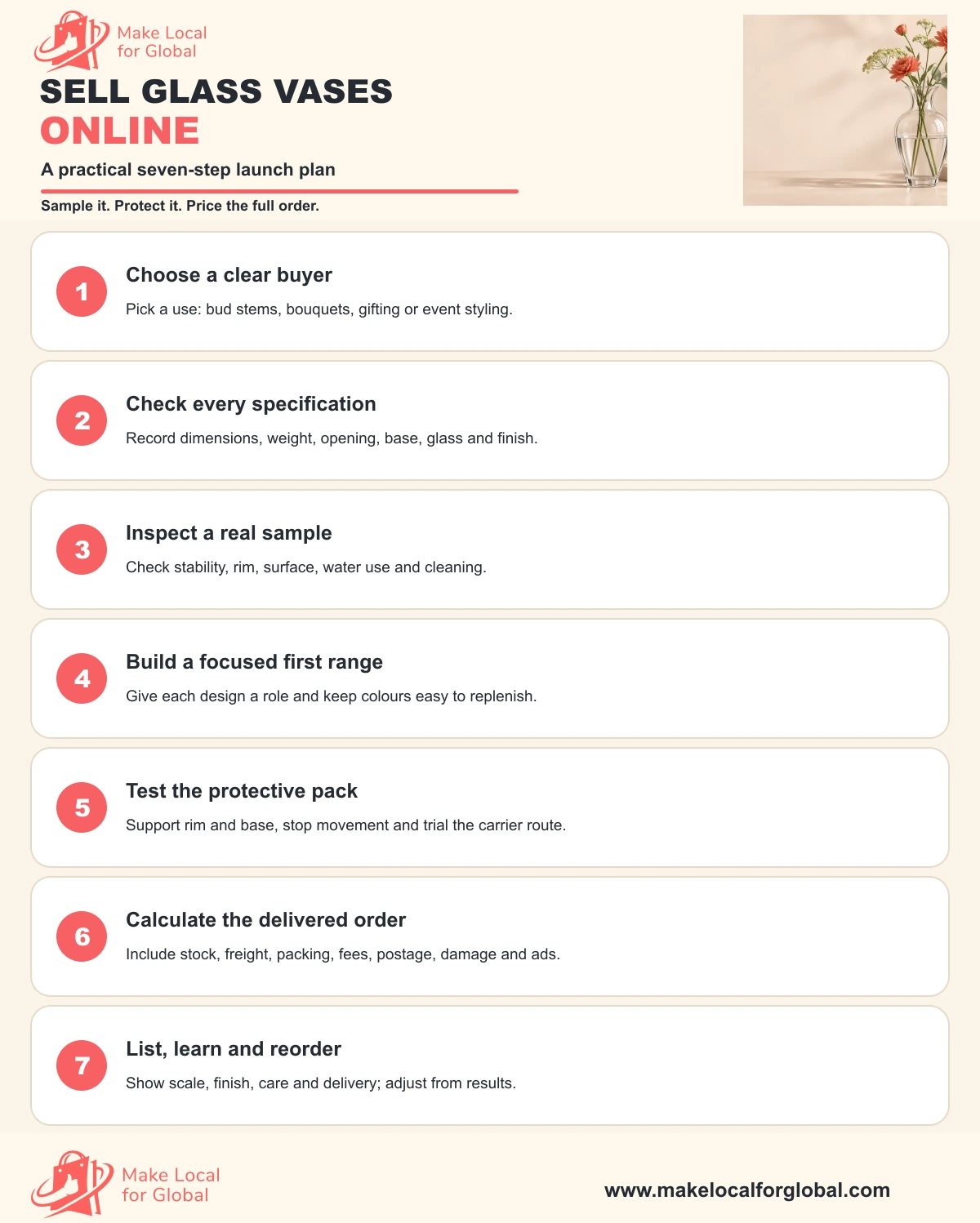
Learn how to sell glass vases online with a focused product range, careful sample checks, protective packaging, clear product pages and a realistic price for every order.


Glass vases can look simple in a photograph, yet every design brings its own choices: opening width, height, weight, colour, finish, flower use and parcel risk. A first-time seller has to make those details easy to compare before a buyer adds a vase to a basket.
The practical route is to choose a clear buyer and room, test a small set of samples, photograph each shape at useful scale, and prove that the packed product can arrive intact. Price the full order, including packaging and delivery, before you commit to stock. A vase that looks attractive on a shelf can still be a poor online product if its glass type is unclear, it tips easily, or postage consumes the margin.
This article gives you a step-by-step plan for building a focused glass vase range and selling it online in the UK. Treat cost figures as examples, check supplier claims against the actual product, and confirm current rules and platform charges before you list.
Choose a clear route for your glass vase shop
Compare how a focused online range, delivery offer and store setup could fit your first launch.
“People who like interiors” is too broad to guide a product range. Start with a use case that affects the shape, size, care and price a customer expects. One buyer may want a compact bud vase for a bedside table. Another may want a tall, narrow-necked vase for long stems, a matching pair for a console, or a sculptural object that can stand empty.
Write a one-sentence buyer profile before approaching suppliers. For example: “I sell small, colourful glass bud vases to renters who want an easy-to-style gift under £30.” This sentence gives you a filter for the height, colour, packaging, image style and likely sales channels.
A use case is more useful than a trend word. It tells you what to test:
These are hypotheses, not proof of demand. Ask potential buyers what they would use, where the vase would sit, what size feels useful and what they would pay after delivery. Show a small group of design mock-ups or samples. Record choices, questions and objections rather than counting casual likes as purchases.
A first test can be small. Make a comparison page or simple survey with three genuinely different concepts, such as a clear bud vase, a coloured medium vase and a tall statement shape. Give each the same amount of exposure. Ask respondents to pick one, state the room and use, then choose from realistic delivered prices.
An email sign-up or a transparent “notify me when available” page can test interest without pretending an item is in stock. Do not accept payment for goods you cannot supply on the promised terms. If you use a preorder, state the dispatch estimate, cancellation terms and what happens if the supplier misses the date.
Look for specific behaviour: a buyer selecting a size, asking about a delivery date, joining a launch list or placing a paid order. Interview a handful of people who match the target buyer. Ask what they currently use and what made them replace or gift it. Their answer may point to a need the range has to solve, such as a wider mouth for cleaning or a smaller gift box.
A first collection should let customers make a choice without asking them to study dozens of near-identical shapes. Use a simple structure: one entry item, a small core group, and a higher-priced design whose materials, finish or scale clearly explain the price. A collection could begin with two bud vases, two medium everyday shapes and one taller feature vase. The right number depends on cash, sample cost and supplier minimums.
Shape affects both the product’s use and how it travels. Record the full height, widest point, base diameter, opening diameter, capacity where reliable, empty weight and packed dimensions for every sample. Do not rely on supplier labels such as “small”, “medium” or “large” as the only size information.
A narrow neck may hold a few stems neatly but make cleaning harder. A wide mouth is easier to reach, though light flowers may lean outward. A tall body may look striking but can be top-heavy. A broad base can improve steadiness, but adds weight and box size. Test each claim with water, stems and the way an ordinary customer is likely to use the product.
Glass may be clear, coloured through the body, coated, painted, textured, etched or made with a surface treatment. These finishes can look similar in a thumbnail and behave differently during cleaning or use. Request exact construction and care details from the supplier. Ask whether colour is in the glass or applied to its surface, and whether the finish is safe for regular washing. Do not advertise a vase as dishwasher-safe, heat-resistant, lead-free, hand-blown or recycled unless the supplier can support that exact claim for the model you sell.
“Crystal” can refer to different compositions and is often used loosely in retail copy. Ask the manufacturer to define the material and provide relevant documentation. If a vase is intended for food contact, such as a glass beverage carafe, it may fall under separate food-contact rules; an ornamental vase is not automatically suitable for serving drinks. Keep decorative-only claims clear and avoid implying otherwise in photos or descriptions.
A useful range has a reason for each item to exist. A buyer should see why a short round vase differs from a tall cylinder, beyond the colour name. Describe that role in a product grid, then keep the selection manageable.
| Range role | Example glass vase | What the shopper needs to compare |
|---|---|---|
| Entry | Small clear bud vase | Height, opening, single-stem use, delivered price |
| Core | Medium coloured bottle shape | Glass colour, finish, water use, packed weight |
| Feature | Tall sculptural vase | Stability, dimensions, visual finish, delivery method |
| Gift | Pair of small vases | Whether the pair is supplied as shown, box contents and gift options |
Do not create colour variants that suppliers cannot replenish consistently. If one batch of green glass is visibly different from the next, disclose that variation and decide whether each batch needs a separate photograph. A customer should not receive an unexpected shade because a swatch name seemed close enough.
Possible routes include a UK wholesaler, a glassware distributor, a maker or studio, a private-label producer, or a wider import. Each changes lead time, evidence available, cash tied up and responsibility for quality. A low unit price does not tell you the real cost of importing, inspection, breakage or slow replenishment.
Ask each supplier the same core questions:
Save answers with a supplier contact, date and model reference. Ask for evidence against a model number, not a general brochure. If the supplier will not say what a finish is or whether a vase can hold water, either narrow your claims or choose another product.
Order samples before setting prices or taking product photographs. Inspect more than the prettiest item in the box. Record any variation from the published specification and send the supplier photographs of concerns before approving a larger order.
Use a repeatable inspection sheet:
Do not treat one successful sample as proof that every production unit will match. Ask how the supplier checks consistency. When a first production order arrives, inspect a defined sample of units and keep a record of defects. Increase checks if early orders show variation.

If you import directly, ask a qualified adviser or the relevant authority which product rules apply to the exact item and destination market. The Office for Product Safety and Standards explains that manufacturers and importers need to demonstrate compliance with relevant rules, give consumers suitable safety information and maintain traceability. The duty changes by product and territory, so do not assume every glass vase needs the same conformity mark or document.
Ask for the manufacturer’s legal name, contact address, model reference, batch details, material specification and instructions. Keep invoices, shipping documents, supplier emails and test or conformity records together. If a product is decorative, say so. If it is meant to hold food or drink, obtain the correct evidence for that use before describing it that way.
For products placed on the market in Great Britain, review the Office for Product Safety and Standards guidance for manufacturers and importers. It covers safety evidence, consumer information and traceability. Northern Ireland has different product-safety routes in some areas; check the applicable guidance before selling there. Product liability insurance may be useful, but it does not replace supplier checks or a safe product.
Breakage can remove more than the wholesale cost. You may need to replace the item, refund the buyer, pay for a second shipment, absorb a platform fee or spend time resolving a complaint. A glass vase has a fragile body, rim, neck and base. Packaging needs to stop movement and cushion each vulnerable part.
Start with the vase’s measurements and packed weight. Choose an inner protection that prevents contact between glass and corrugated board. Use a separate sleeve or soft wrapping that does not scratch a coated finish. Fill the internal voids with material that does not compress flat under stacking. Keep the vase from moving up, down or sideways.
For a single vase, consider a moulded pulp insert, a fitted paperboard support or a well-designed cushioning wrap inside an inner carton. Place that carton inside a larger outer box with cushioning between both boxes, where the carrier and product economics support the extra size. Keep the vase away from the outer walls and put the rim and base under protection rather than relying on one layer of loose paper.
For a pair or set, stop the pieces touching. Create dividers or individual compartments, then test the combined pack. A pair photographed together does not mean the supplier’s box will prevent clinking in transit. The outside label cannot compensate for a weak inner pack.
A package that looks recyclable but lets glass strike a hard surface can create more waste through replacements. Compare protection, material use, package volume, cost and the customer’s unpacking experience. Note the material and weight of the packaging you place on the market, especially if your business may meet a packaging reporting threshold.
A useful test reproduces the finished sales package, not a specially padded sample. Pack the product as a normal order, use the carrier service you intend to offer and send it through a realistic route. Inspect the vase on arrival. Test more than one package if a fragile point or design has varied across samples.
You can use a drop test or a carrier’s packaging guidance to identify weak spots, but avoid treating an informal test as certification. A supplier, carrier or testing laboratory can advise on a suitable test for the actual risk. FedEx’s general guidance for breakables recommends a double-box method and cushioning for its service; follow the carrier you select and check its current UK requirements. Service terms and compensation can differ by carrier, parcel type and destination.
Record:
If a vase breaks, stop and check the cause before sending another one. A cracked rim may point to top pressure; a broken base may point to impact; a pristine outer box with a damaged vase may show that the inner restraint failed. Update the pack, trial it again and keep the carrier’s claim requirements nearby.

Large or heavy vases may fall into a different parcel size or price band. Measure the finished box rather than the item alone. Offer standard delivery only after checking that the carrier accepts the parcel dimensions, weight and contents. For an oversized statement design, collection or a specialist service may be more realistic than a low-cost parcel.
Show delivery costs before checkout and state dispatch estimates plainly. If you need one extra working day to pack orders securely, say so. A realistic delivery date helps a gift buyer decide whether to purchase. Do not promise a guaranteed arrival unless the service actually provides it and you have checked the terms.
For orders outside the UK, check import duties, taxes, carrier restrictions, insurance and the packaging requirements for each destination. A platform’s label or international checkout does not shift all product or consumer obligations away from the seller. Start with one or two destinations and measure damage, cost and delivery time before adding more.
A unit price is only one part of a sale. Each order may involve inbound freight, packaging, payment processing, marketplace fees, postage, a damage allowance, customer acquisition and a share of monthly costs. Use an order model before selecting the retail price.
The following figures are illustrative, not supplier quotes or a recommended margin. Assume a UK business sells one medium vase for £42, charges £5.50 delivery, and buys from a UK wholesaler. The product’s allocated cost, inbound freight and packing materials are shown separately. The payment fee below uses Shopify’s displayed UK Basic yearly rate of 2% + 25p as a worked platform example; the actual plan and rate can change, and card mix or third-party fees can alter the result. Confirm current terms before relying on the arithmetic.
| Order item | Illustrative calculation | Amount |
|---|---|---|
| Vase purchase cost | supplier invoice allocation | £9.50 |
| Inbound freight | £95 delivery split over 50 units | £1.90 |
| Protective packing | inner support, wrap, outer carton and tape | £3.10 |
| Customer postage | actual carrier price for the packed box | £5.50 |
| Payment fee | 2% of £47.50 + £0.25 | £1.20 |
| Damage and return allowance | £1.50 per order planning allowance | £1.50 |
| Customer acquisition | average paid campaign spend per first order | £4.00 |
| Direct order cost | sum of lines above | £26.70 |
| Contribution before fixed costs and tax | £47.50 received less £26.70 | £20.80 |
The £20.80 is contribution, not net profit. It does not include the monthly store plan, insurance, accounting, storage, equipment, your labour, corporation or income tax, or VAT liabilities. If you are VAT registered, model VAT correctly with an accountant: the sample figures above do not include VAT, and whether a price should be treated as VAT-inclusive depends on your position and customer market.
The delivery charge in this example equals the carrier cost. If a customer pays only £3.50 delivery, the business absorbs another £2. If a promotion reduces the item price by £5, contribution falls by £5 unless another cost changes. If breakage rises from one order in 30 to one in 10, the £1.50 allowance is likely too low. Use actual supplier invoices, parcel quotes, platform statements and damage records after launch.
A marketplace can bring discovery, yet each fee affects the order. Etsy’s current policy lists a 6.5% transaction fee on the displayed price plus delivery and gift wrap, alongside listing and payment processing charges. Its UK regulatory operating fee and payment processing terms can apply as well. For a £47.50 order, a 6.5% transaction fee alone is about £3.09 before other charges. Check the current Etsy fees policy and UK fee help page.
A direct store has a different cost structure. Shopify’s UK pricing page displays plan and card prices that depend on billing and plan choice. Use its current UK pricing page and include subscription cost in a monthly break-even model. Compare like with like: payment processing, subscription, themes or apps, marketplace commissions, returns, discovery and the cost of creating product content.
A markup is the amount added to product cost. A contribution margin is what remains after variable order costs. They are not interchangeable. If you want a 55% contribution margin before advertising and fixed costs, calculate using the target margin formula, then test whether customers accept the resulting price.
For instance, if product, inbound shipping and packing total £14.50 and you estimate another £10.70 for postage, fees and a damage allowance, your variable cost before acquisition is £25.20. A 55% contribution target would imply a price-and-delivery revenue of £25.20 ÷ (1 – 0.55) = £56.00 before ad spend or fixed costs. This is only a planning calculation. If similar vases sell for less, change the product, sourcing, delivery offer or target margin rather than hiding a loss in the spreadsheet.
Track actual costs by design. A tall vase may use a larger carton and cost more to ship. A set may increase order value but need a divider, more packing time and a higher damage allowance. Keep separate rows for each shipping zone and package size.
A buyer cannot lift the vase, inspect the rim or compare it with a flower stem through a screen. Your listing has to replace that missing information with accurate images, exact dimensions and plain answers.
Use a product title that includes the item type, shape or material where the supplier supports the claim, and a useful distinguishing feature. For example: “Amber Glass Bud Vase, 15 cm Ribbed Stem Vase for One or Two Flowers.” Avoid stacking repetitive keywords. Keep a product title readable to a person.
Start the description with what the vase is, the best-fit use and one key specification. Then add a scan-friendly set of facts:
Do not use “handmade” if the supplier has not confirmed that description. Do not call a vase “unbreakable”, “crystal” or “eco-friendly” without evidence. Add a note if handmade production creates small variations, but do not use variation language to excuse chips, poor finish or a major mismatch with the listing photograph.
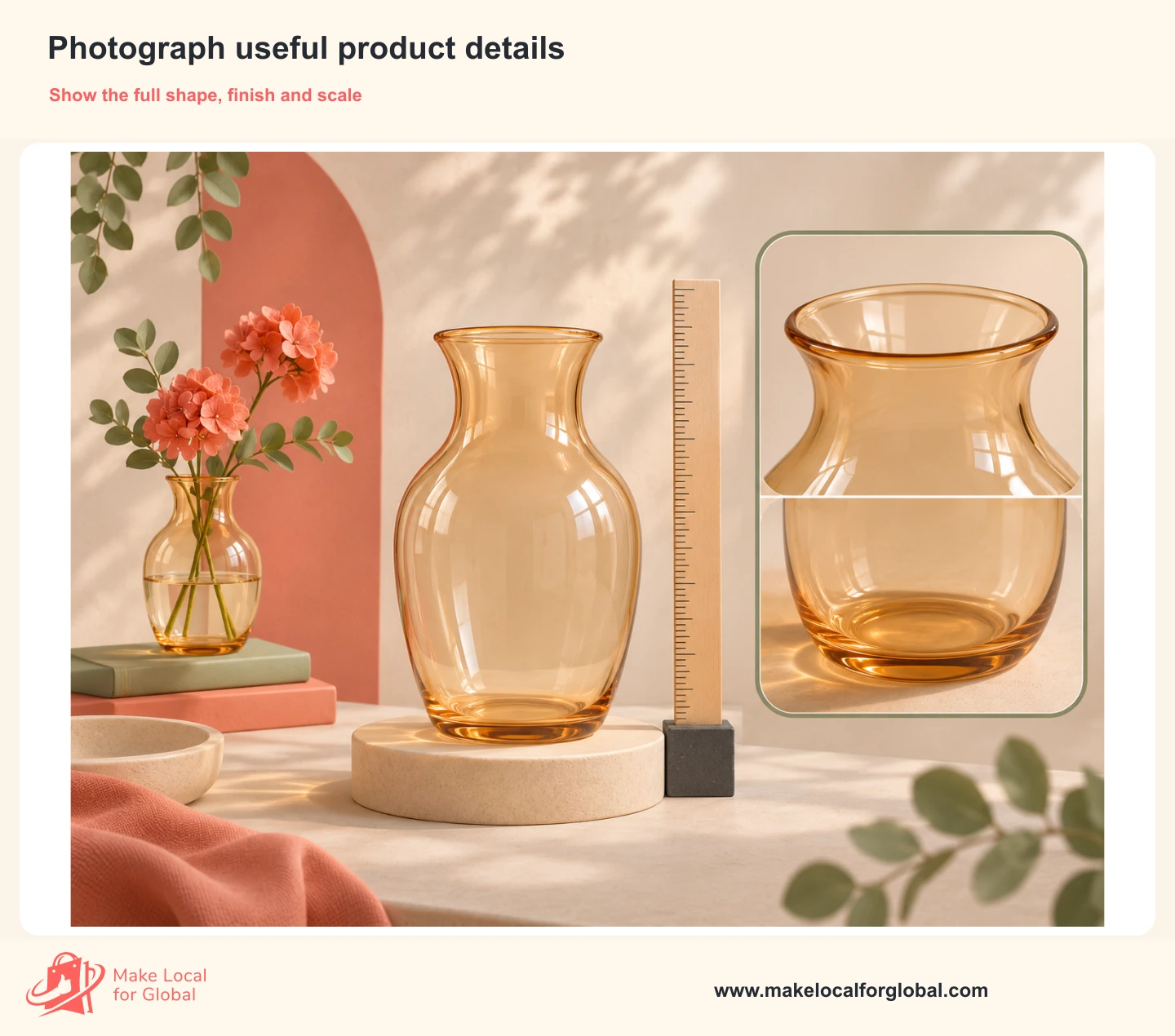
A good set answers five questions: what is it, how big is it, how does the light pass through it, what does the finish look like, and how will it arrive? Photograph each design with a neutral background and even light. Keep the colour honest; glass changes appearance under warm bulbs and direct sunlight.
A useful image sequence could include:
Do not add a bouquet to a listing image if flowers are not included without a clear label. Avoid heavy filters that alter the glass colour. For transparent glass, use controlled reflections and a contrasting edge so the outline remains visible. For tinted glass, include a neutral white reference or a second lighting view to set expectations.
Choose a channel that matches the product and your capacity. A marketplace may help a new seller test product pages and discover what shoppers search for. A direct store gives more control over the range and shopping experience, but you must bring visitors to it. Local design shops, flower studios, gift shops and event stylists may provide wholesale or repeat orders, though they bring different pricing and service needs.
Start with a handful of listings that represent different buyer needs, not a duplicate listing for every tiny colour variation. Use each listing to test a specific product question: do customers respond to a small gifting vase, a coloured pair or a large statement piece? Review search terms, views, saves, conversion and questions weekly. Views without sales may point to a price, image, size or trust problem; do not immediately add more stock.
Etsy can suit handmade, vintage or design-led products where its current seller policies permit the item. Review its eligibility and fees before building an Etsy plan. A general marketplace such as eBay may suit standardised products and broad price comparison. Check image rules, dispatch performance and return policies for each channel before copying a listing across them.
A direct store needs product pages, payment handling, delivery choices, customer support, returns information and a way to attract visitors. Organise the collection by use or size, not only by an internal supplier code. Add filters for colour, height, shape or price when the range is large enough to justify them.
Make product variants understandable. If a vase comes in three colours, use a swatch that matches the actual finish and show a separate photograph for each colour. If stock varies by batch, do not let an old image imply a precise shade the current unit does not have.
Local flower shops, homeware shops, wedding stylists and gift businesses may want a small wholesale selection. Before pitching, prepare a one-page product sheet with clear trade prices, case quantities, lead times, product dimensions, package details and a sample policy. Work out wholesale contribution separately from direct-to-consumer contribution because a shop may require a substantial margin of its own.
A local pop-up is a useful place to learn what people pick up, compare and ask about. Record which shapes attract interest and whether shoppers prefer a vase alone or a gift set. Include the cost of the event, card payments, travel, packaging and unsold stock in the result. One busy day is not enough to prove a year-round sales pattern.
Content can answer questions that product images alone cannot. Make short demonstrations showing the difference between an opening that suits a few stems and one that suits a full bunch. Show how the base sits on a table, how to measure a shelf, how to clean the inside and how the vase is packed.
Create a small set of search-led pages around practical questions, such as “What size vase fits a narrow shelf?”, “How do I choose a vase for a small bouquet?” or “How is a glass vase packed for delivery?” Use language customers actually use in interviews and support messages. Link those pages to relevant products, and link product pages to care and delivery details.
Email can support a new collection if people have agreed to receive updates. Send a launch note with product dimensions, delivery timing and a real photograph. Segment customers who bought a gift set from those who bought a single display vase, then ask for feedback after delivery. Do not send promotional messages to people who did not consent.
For paid adverts, test a few product-specific images and one buyer message at a time. Set a small daily limit and decide in advance which signal will justify continuing, such as an email signup or sale within the planned acquisition cost. Stop a campaign if the cost per order leaves too little contribution. A high click count does not make an unprofitable campaign successful.
Plan the shop around the parcel
Review the store options and checkout flow you may need for a fragile product that requires clear delivery information.
Glass stock needs a clear location and handling routine. Label shelf positions, keep heavier cartons low, avoid stacking beyond supplier guidance and separate saleable stock from returns or inspection holds. Record model, colour, batch, quantity, supplier and landed cost. When a shipment arrives, photograph any transit damage before moving cartons.
Use a simple reorder signal. If the supplier lead time is three weeks and you typically sell two units each week, a reorder trigger needs to consider at least six units of expected demand plus a buffer for delay. Do not apply a formula mechanically. Compare actual sales, seasonal demand, cash available and the supplier’s minimum order before placing a purchase.
Write a short packing checklist and keep it at the packing station. Use the approved insert, wrap the vase without scratching the surface, secure the package so it cannot move, check the packed dimensions and weight, and photograph the finished parcel if your process needs proof. Use batch labels and packing materials consistently so a change can be traced to a change in damage rates.
Train anyone who may fulfil an order with the actual product. A packing note should show which side holds the vase, how the insert locks, what gap to fill and how to close the carton. Generic “fragile” tape is not a substitute for a secure design.
If a customer reports a breakage, respond with empathy and ask for photographs or details needed to understand what happened. Offer the appropriate replacement or refund under your policy and legal obligations. Log the model, batch, carrier, packaging method and damage point. A repeated pattern is a quality signal, not just a customer service cost.
A distance seller must give customers required information before an order and explain relevant cancellation rights. GOV.UK says customers generally have 14 days after delivery to cancel qualifying online orders; there are exceptions, and statutory rights for faulty goods remain separate. Read the current GOV.UK distance-selling guidance, set a clear returns process and get professional advice if the product or sales model raises a question. Do not tell a customer that a fragile item cannot be returned simply because it is glass.
If a vase is returned, inspect it before returning it to saleable stock. Separate unopened packaging, display wear, water marks, chips and cracks in your records. Write down whether the original packaging can safely be reused. If not, use a fresh approved pack for any onward shipment.
Businesses that supply, fill or import packaged products may have responsibilities under UK packaging rules. Thresholds and reporting roles depend on turnover, packaging weight and activities. A small seller may fall below a threshold, but should still know what it imports and what packaging it puts on the market. Review the official EPR packaging eligibility checker and current guidance before making a decision. Keep weights by packaging material so you are not forced to reconstruct them later.
A short launch sprint can test the buyer, product, packaging and offer without buying a wide collection.
| Week | Actions | What to record |
|---|---|---|
| 1: buyer and shortlist | Interview five target buyers; compare three use cases; shortlist suppliers and five models | Chosen buyer, product questions, quoted minimums, lead time and model data |
| 2: samples and costs | Order samples; inspect dimensions and finish; quote packaging and delivery; build an order calculator | Sample defects, confirmed claims, package weight, carrier quote and contribution |
| 3: pack and list | Trial the final pack; photograph each shape; write a listing; make a delivery and returns page | Damage result, packing time, image questions answered and first customer feedback |
| 4: limited launch | Publish a small set; share useful product content; contact relevant local shops; review results | Views, enquiries, sales, conversion, acquisition cost, damage and customer questions |
At the end of the month, choose one next action from the data. It might be ordering a second batch of a proven design, adjusting a weak product page, replacing an unstable model, or pausing a costly channel. Do not place a large reorder simply because the launch date has arrived.
It can be, if the selling price covers the vase, inbound transport, protective packaging, customer postage, payment or marketplace fees, acquisition, damage and returns, fixed costs and tax. A vase with a low wholesale price can still have poor contribution if it needs a large carton or repeated replacements. Build a design-specific calculation, then compare the delivered price with what target customers will pay.
Choose a vase with a clear buyer and use, a size you can describe precisely, supplier information you can verify and packaging you can test. A manageable bud vase can make a sensible first sample, but its opening, stability, finish and shipping cost still need checking. Do not pick a product only because a photograph looks attractive.
Prevent glass from touching the carton walls or other products, support the rim and base, fill voids with materials that retain their shape and test the complete packed parcel through a realistic carrier route. A double box can add a cushioning zone, though the right method depends on the design and service. Check the carrier’s current packing advice and insurance terms.
Only if the manufacturer confirms the product is intended and suitable for food or drink contact and you have checked the rules for the market. A decorative vase should be described as decorative. Do not infer food safety from appearance or from the fact that it holds water for flowers.
There is no single answer for every product and market. A plain decorative vase may have different requirements from a product with electrical parts, a candle function, or a food-contact claim. Ask the supplier for the exact product classification and evidence, then review the relevant official rules for Great Britain, Northern Ireland or the destination market. Do not add a conformity mark unless it applies.
Start with a few distinct choices you can sample, photograph, pack and replenish. A small range can test whether customers prefer bud, medium or statement formats without tying up cash in many similar variants. Add designs in response to real customer behaviour and a workable reorder plan.
Give the exact height, width, base and opening measurements, material and finish claims supported by the manufacturer, care guidance, what is included, delivery timing, returns information and clear images. Show the vase empty, in use and beside a size reference. Label any flowers or props that are not included.
Many online purchases have a cancellation period, with exceptions, and faulty-goods rights are separate. Explain the applicable terms before checkout and respond to damage complaints fairly. Review current GOV.UK guidance or take legal advice for your business model; do not assume fragile goods are exempt from consumer rights.
A marketplace may expose a product to shoppers already searching there, and it charges fees under its current seller policy. A standalone store gives you more control over the shopping experience but requires your own customer acquisition. Compare total cost, audience, listing rules, customer data, fulfilment workload and repeat-purchase potential before choosing.
Use a clear hero image, several angles, a size reference, a close-up of the finish and a photo showing the vase in use. Glass needs careful lighting so its edges remain visible and its colour looks believable. Include the packed product only when the package photo accurately represents the order a buyer receives.
The first good decision is not choosing a large catalogue. It is finding a small group of vases with a defined use, reliable supplier details, real sample checks and a delivery method you can repeat. When those pieces are in place, product pages can answer the questions customers ask, and prices can reflect the cost of the whole order.
Use the first 30 days to learn which shape, colour and price make sense for your buyer. Track damage alongside sales. If the shipping test or contribution model fails, revise the design or offer before buying more stock.
Ready to prepare your product range for online sales?
Talk with MLFG about the store setup, product pages and order flow you need for the launch.
For help planning the online store behind your product range, visit MLFG website design or contact Make Local for Global. Explore other product guides in the Product To Sell collection, including our articles on floral arrangements and gift baskets.
PREFERRED SOURCE
Like what you’re reading? Add Make Local for Global as a preferred source on Google to see more of our articles when you search.

Build your online presence without having to figure out everything yourself.