

READY TO SELL Artisan Soap ONLINE?
Get a store built for you in 5 days, plus training and support to help you start, run, and grow your Alternative business.

A practical guide to selling artisan soap, from choosing formulas and scents to branding, pricing, product pages, shipping, and growing repeat sales.


Artisan soap looks like a simple product.
A bar, a scent, a nice label, job done.
But when you go to actually Sell artisan soap, you realise it’s not a soap business.
It’s a trust business.
People are putting this on their skin.
They want it to feel good, smell good, last well, and not wreck their hands.
They also want to feel like the person behind it knows what they’re doing.
The good news is that small brands can do this better than big ones.
You can be clearer, more personal, more consistent, and more thoughtful.
And you can build repeat customers who come back for their favourites like clockwork.
This guide walks you through how to sell artisan soap online in the UK: choosing a niche, building a range that makes sense, packaging and product pages, pricing for profit, basic safety and admin considerations, and marketing that actually gets sales.
You’ll also see how Make Local for Global can set up your shop for you if you want a done-for-you website and don’t want to wrestle with tech.
Artisan soap sells because it’s a small luxury people can justify.
It’s not a £400 sofa decision.
It’s a “why not treat myself?” decision.
It’s also giftable.
Even people who don’t care about skincare will buy soap if it looks lovely and smells clean.
But here’s why some soap shops struggle:
Your goal is to make choosing easy.
And to make buying feel safe.
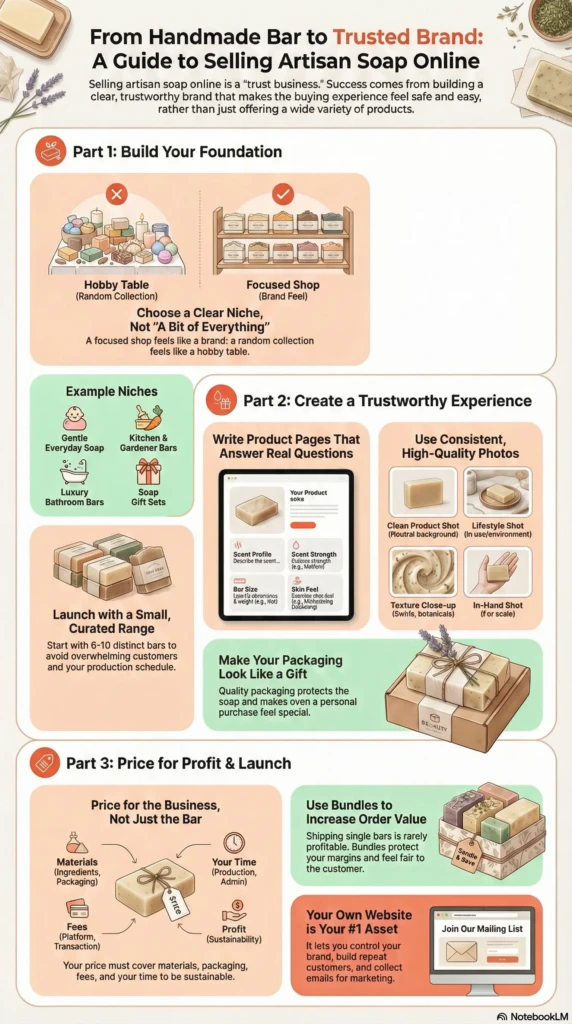
If your shop sells “a bit of everything”, it feels like a hobby table.
If your shop sells a clear style of soap for a clear type of customer, it feels like a brand.
Decide who you’re making for first.
Not forever, just first.
Most new soap sellers launch with 20 bars.
It’s stressful to make, stressful to stock, and confusing to buy.
Start with 6 to 10 core bars and make each one clearly different.
A simple, sellable starter line-up might be:
There are a few ways to sell artisan soap.
The “right” one depends on your time, budget, and how much production you want to do.
This gives you full control and the strongest brand story.
It also means you’re responsible for consistency, safety, and keeping track of batches properly.
You can still build a real brand without making every bar yourself.
This can be a smart route if you want to focus on marketing, packaging, and building a customer base.
You source from makers and sell curated sets and themes.
This is more about taste and presentation.
It can work, but your brand must add value beyond “I resell soap”.
| Approach | Best for | Pros | Watch-outs |
|---|---|---|---|
| Make your own | Makers who love production | Full control, strong story, unique products | Consistency, batch tracking, time heavy |
| Private label | Brand builders | Faster scaling, less production stress | Minimum order quantities, supplier reliance |
| Curate and bundle | Retailers with a clear aesthetic | Low production workload, variety | Harder differentiation, margin pressure |
Most customers can’t judge soap quality from ingredients alone.
They judge it from experience.
How it lathers, how it rinses, whether it leaves a weird film, whether the scent is nice or headachey, and whether it lasts.
Your line will feel more coherent if you decide what your soaps are about.
For example:
Scent variety is fun for you.
It’s stress for customers.
Use a simple scent structure:
People search for natural soap, handmade soap, artisan soap, vegan soap, palm-free soap, and sensitive skin soap.
That’s real demand.
But customers are also wary of greenwashing and overclaims.
Be clear about what you can honestly say.
If your soap is made in small batches, say that.
If you use certain oils or you avoid certain ingredients, explain it simply.
Try not to turn your brand into a debate about purity.
Because soap is a product used on the body, you need to take safety seriously.
This isn’t the glamorous bit, but it’s the bit that protects your business.
I’m not giving legal advice here.
But I am saying: don’t wing it.
Customers want to know:
Some brands write patch testing like a scary warning label.
Better approach:
It’s tempting to say “helps eczema” or “treats acne”.
Don’t.
Even if customers ask, keep your language safe and supportive.
Focus on what you can genuinely describe: gentle, fragrance-light, moisturising feel, simple ingredient list, and so on.
Soap pricing is where a lot of new sellers go wrong.
They price based on what feels reasonable, not on what keeps the business alive.
You’re not pricing just the bar.
You’re pricing:
Do this properly once, then update it quarterly.
Include everything, even tape and printer ink.
Otherwise you end up “busy” and still not making money.
Tiers reduce decision stress.
Shipping one bar is rarely worth it.
Shipping three bars feels fair to the customer and better for you.
Bundle ideas:
Soap is a sensory product, but online it’s visual first.
If it looks cheap, people assume it is.
Pick one of these and commit:
The mistake is mixing all four.
Your customer should recognise your product from a thumbnail.
Customers love a soap that lasts.
Give simple advice:
You don’t need a studio.
You need consistency.
Soap is small.
Show scale, or customers will assume it’s tiny.
When someone is about to buy soap online, they’re thinking:
This is one of the easiest ways to increase sales.
Group soaps by mood:
Then link to that guide from your product pages and your menu.
You can sell artisan soap on social media, at markets, or via marketplaces.
All of those can work.
But your own website is where you build repeat customers.
Why?
If you want to sell online without getting stuck in theme settings and plugins, Make Local for Global can build your shop for you.
You can book a free consultation and talk through your product range, bundles, and the pages you need to convert.
Or you can Get your website for £99/year and get a simple, affordable ecommerce site set up without the tech headache.
Soap marketing doesn’t need to be complicated.
You’re selling a small daily ritual.
Focus on how it fits into real life.
If you post on social, try a repeatable format.
Consistency beats “viral” most of the time.
Most soap businesses are built on reorders.
Collect emails with something simple:
Then send a calm monthly email that feels helpful:
Your soap can be incredible.
If it arrives chipped, crushed, or smelling like a cardboard box, the review won’t match your effort.
Do a trial run.
Pack an order and post it to yourself.
If you wouldn’t be happy receiving it, fix it before you launch properly.
Soap is a repeat purchase, so subscriptions make sense.
But don’t overcomplicate it.
The key is to set clear expectations and make it easy to skip or swap.
It can be, because soap is affordable, giftable, and repeat-buy. The key is to build trust with clear product pages, consistent quality, and bundles that make shipping worthwhile.
Clean, fresh scents and gentle options tend to sell consistently. Warm cosy scents can be strong in autumn and winter, and seasonal drops can create buzz without bloating your range.
Six to ten is plenty. It’s enough variety for customers, but not so much that your production, stock, and marketing become chaotic.
Include materials, packaging, fees, and your time. Then use bundles to raise your average order value, because shipping single bars is rarely profitable.
A website helps you build a brand, collect emails for repeat sales, and present your products properly. If you don’t want to build it yourself, you can book a free consultation or Get your website for £99/year with Make Local for Global.
If you want to Sell artisan soap and build a business that lasts, stop chasing novelty for its own sake.
Be clear, be consistent, and make the buying experience feel safe and lovely.
That’s what turns a nice bar of soap into a real brand.
PREFERRED SOURCE
Like what you’re reading? Add Make Local for Global as a preferred source on Google to see more of our articles when you search.


Build your online presence without having to figure out everything yourself.