

READY TO SELL garden trellises ONLINE?
Get a store built for you in 5 days, plus training and support to help you start, run, and grow your Alternative business.

Learn how to sell garden trellises online with a focused range, accurate specifications, sample checks, safe packing and full delivery costing.


Garden trellises can be light to buy and awkward to deliver. A panel may be wide, fragile at its joints and difficult to describe with one size label. A buyer may want a screen for a patio, a support for a climber, a freestanding obelisk, or a planter that combines growing space with a lattice.
To sell them online with fewer avoidable returns, build the range around the job each product does. Record exact dimensions and materials, check a complete sample with its fixings, photograph how it attaches, and cost the packed item before you set a price. Start with one buyer group and a small selection you can inspect and ship consistently.
This topic concerns trellises, obelisks, fan supports and planter-trellis products sold as garden structures. It does not cover live plants, fences sold as boundary structures, pergolas or structural engineering. Those products raise different questions. Ask the supplier for documented use, installation and care information for every model, and do not claim a load capacity or weather life that the documents do not support.
Compare a few ecommerce routes before you commit to trellis stock, packaging or a store plan.
A first-time seller can be tempted to sort products by colour or lattice pattern. Buyers usually begin with a problem. They may need to train a climber, add a visual screen beside a seating area, cover a bare wall, create a narrow vertical garden, or give a pot-grown plant a freestanding support. Each job points to a different format, installation method and delivery expectation.
Write a short buyer profile before contacting suppliers. It could be a renter looking for a moveable pot support, a homeowner screening a courtyard, a gardener training clematis against a wall, or a landscaping business that needs repeatable panels in a specified size. These are working hypotheses. Speak with likely buyers and check whether they can name an intended space, dimensions and purchase window.
The RHS advises putting supports in place before planting, since many climbers need a trellis or wire system to grow against. Its guidance describes trellis held away from a wall on battens as one option, with an appropriate gap for the structure. This gives a practical product-page question: does the customer need a panel only, or do they need compatible mounting hardware and an installation drawing? Read the RHS guidance on training climbers and avoid turning general horticultural advice into a claim that every panel suits every wall or plant.
Ask five to ten likely customers about the space they want to use, what they would grow or screen, what they already tried and what stopped that solution working. Show simple sketches or supplier images with permission. Ask what dimensions they need, how they plan to attach the product and whether they would collect a sample, request a quote or join a waitlist for a clearly described model.
Record the response as behaviour, not praise. “Looks nice” says little about buying intent. A request for a price at a named size, a question about fixings or a willingness to pay for delivery gives you a more useful signal. Record the date, buyer type, product format, stated dimensions, objection and next step. Do not treat a small set of conversations as proof of a large market.
Check local competitors and marketplaces for how buyers describe their need. Search phrases such as “wooden garden trellis panel”, “expandable garden trellis”, “metal fan trellis” and “planter with trellis” can help you plan page language. Search results show what is being listed, not what is selling. Use your own customer enquiries, site-search terms, ad tests and marketplace data to decide which product family deserves a sample order.
A focused starting point makes product selection and packaging easier. If your buyers are small-space gardeners, a slim wall panel, a fan support and a planter-trellis combination may give them three different ways to use a narrow patio. If your buyers are landscapers, they may care more about repeat sizes, finish consistency, compatible posts, trade quantities and reliable replenishment.
Do not combine every type of garden structure into one store collection. A trellis panel, a privacy screen, a fence panel, an arch and a pergola may look similar in a photograph, yet differ in intended use, load, fixing method, legal classification and delivery. Keep separate product pages where the construction and buyer question change. Link between related collections where a customer is comparing options.
One helpful test is to write a single sentence that describes the first range without listing unrelated products. For example: “A small set of timber and metal supports for gardeners training climbers in patios and compact borders.” If the sentence still needs to include unrelated seating, fencing, lighting and planters, return to the buyer problem and narrow the scope.
The word “trellis” covers products with different shapes and uses. A framed lattice panel can be mounted to posts or a wall. An unframed or expandable panel can adjust across a limited width, though its height and opening size may change as it expands. A fan trellis spreads from a narrow base. An obelisk stands in a pot or border. A planter with a trellis combines a container and support, which adds weight, volume and assembly questions.
Separate each type by what the buyer receives and where it can be used. A freestanding obelisk should not be described as a wall panel. Do not market a decorative fan support for a heavy plant if its maker has not documented that use. A planter-trellis product needs its planter dimensions, liner details, drainage arrangement, assembly and supplied fixings described alongside the trellis height.
The four formats in the range illustration below are examples of different product jobs. The image helps a customer recognise the format; the listing still needs exact dimensions, material, finish, fixings and contents for the model being sold.

Timber is familiar and easy to photograph, but buyers need to know the species or material description supplied by the manufacturer, whether the wood is treated or coated, what maintenance is expected and whether colour or dimensions can vary. Ask for the exact finish and care instructions. Do not call timber “rot proof”, “maintenance free” or “sustainable” based only on appearance or a supplier’s informal phrase.
Metal trellises may be steel, aluminium or another alloy with a specified coating. Ask what the product is made from, how the finish is applied, where fasteners are included and how exposed cut ends should be treated. A powder-coated finish does not make a product corrosion-proof in every climate or installation. State the maker’s care guidance rather than promising a service life.
Willow, bamboo and other natural supports can appeal to buyers who want a lighter, natural look. Ask about the material and construction, how the product is joined, whether it is intended for temporary or repeated seasonal use, and how the supplier describes storage. Natural material can vary in colour, thickness and shape. Explain the expected variation with photographs of more than one sample where it is noticeable.
Plastic-coated or composite products require clear information about core material, coating, UV or weather claims and intended placement. If a supplier uses terms such as “recycled” or “recyclable”, ask what component the claim covers, the evidence behind it and what disposal route is available to the buyer. Keep broad green claims out of headings; use a specific statement only when its wording is supported for the product and market.
Begin with one or two construction families and a few useful dimensions. A timber framed panel in two widths, with one matching fan support, may be easier to test than a dozen patterns across multiple heights and finishes. A small range reduces the number of samples, spare parts, stock locations, listing combinations and packaging methods you must manage.
Use a range matrix to compare the choices before ordering. Record buyer, product format, material, width, height, aperture, frame, finish, fixing method, weight, carton size, price, supplier minimum and sample status. Add a reason for each product’s place in the range. Remove a variant if it differs only by a colour that the buyer did not request or if the supplier cannot provide a stable specification.
| Range role | Example offer | Buyer question to answer | Proof to hold |
|---|---|---|---|
| Entry | One compact panel with listed fixings | Does this fit my planned space? | Exact measurements and included-parts list |
| Main | A framed panel in two documented sizes | Which height and width should I choose? | Drawing, sample measurements and finish description |
| Add-on | A compatible bracket or matching obelisk | Does this fit the product I chose? | Written compatibility from the supplier |
| Bundle | Two panels with a defined joining method | What arrives and how is it joined? | Full bundle sample, packed weight and assembly notes |
The words “entry”, “main” and “add-on” are for your planning. Give customers plain names such as “Timber diamond trellis panel, 90 cm wide” or “Black steel fan support, 150 cm high” only when those values match the supplier’s documents and your sample. Show what is included in each offer. A bundle must not rely on customers to guess whether posts, brackets, screws or planters are part of the price.
Custom cutting or made-to-measure widths can serve customers with unusual spaces, but the work changes lead time, stock planning, delivery and return questions. Ask the supplier how each custom size is produced, what tolerance applies, what happens when a customer enters an incorrect measurement and whether the product can be returned under the seller’s policy and applicable law.
Begin with standard sizes and offer made-to-measure products only when customer evidence supports that route. If you offer a cut-to-size option, name the measuring points, show a diagram, use units consistently and ask the buyer to confirm the entered measurement before the order is placed. Check the supplier’s manufacturing tolerance and add that information to the listing. Do not imply a made-to-order product is exempt from consumer rights without legal advice; cancellation rules can depend on whether goods are made to the customer’s specification.
A UK garden-products wholesaler can offer smaller order quantities, a local return contact and shorter replenishment routes. The unit price may be higher. Check whether it holds stock in the exact finish and size you sampled, or sources the product after your order. Ask how it handles discontinued lines and substitutions.
Buying from an overseas manufacturer can open up different formats, finishes or branding choices. It can bring longer lead times, production minimums, freight allocation, import VAT or duty, customs paperwork, damage risk and added due diligence. A low factory price does not describe the cost of usable stock delivered to your storage location.
A trade distributor may combine several makers and help you compare product families. Check whether its technical information comes from the manufacturer and whether it will tell you when a model changes. A private-label order gives more control over branding, yet makes it more important to agree the specification, inspection criteria, packaging, replacement parts, warnings and batch records in writing.
Request the same information from each potential supplier so quotations can be compared. Ask for the current product drawing, exact code, material, finish, dimensions, packed size and weight, case quantity, minimum order, sample price, production lead time, delivery terms, warranty wording, installation instructions and spare-fixing availability. Ask whether the sample represents the current production run.
If two models appear identical, compare the small details. The number and depth of the frame rails, fastener type, welds, coating coverage, lattice aperture, base width and supplied hardware can change how the product looks and fits. Keep a copy of the drawing and supplier email with the stock record. A near match is not proof that the item is interchangeable.
Create one specification record per supplier model and variant. Use the manufacturer’s exact product code. Record the width and height at the widest points, frame depth, slat or wire dimensions when provided, aperture size, material, coating, colour, weight, packed dimensions, carton quantity, fixings, assembly requirement, care, intended use, stated limitations and warranty terms.
For expandable products, measure the narrow and wide settings and ask the manufacturer for the supported range. Do not show one width as fixed if the panel changes shape as it expands. For an obelisk, measure its footprint and total height when assembled. For a planter-trellis, list the planter’s internal planting area separately from the overall outside dimensions.
Mark which values came from the supplier and which you measured. If your sample is slightly different from the drawing, note the difference and ask the supplier to explain it. Do not quietly choose whichever measurement makes the listing more attractive. If the discrepancy affects fit or stability, hold the product back until you have a written answer.
If you buy timber trellises already placed on the Great Britain market from a UK supplier, the Timber and Timber Products Placing on the Market Regulations distinguish traders from operators. Traders must retain records of businesses they buy from and sell to. Operators who first place timber on the GB market must apply a due-diligence system to assess the risk of illegal harvesting. Read the current GOV.UK timber regulations guidance and identify which role fits your supply route before assuming the duties are the same for every retailer.
Ask a supplier for the timber species, country of harvest, product code and any chain-of-custody documentation it holds. Ask what certification applies to the exact product and supplier, and whether the claim covers the whole item or only some material. Keep the record with the invoice and batch details. A logo on a catalogue page does not prove that every product in the range carries the same certification.
If importing wooden products, check the import rules for the specific goods and route. The Forestry Commission’s guidance explains that regulated wood material imported into Great Britain can involve plant-health requirements. Timber legality checks and plant-health checks are related to supply but are not the same assessment. Ask a customs or plant-health specialist when product species, processing or origin makes the requirements uncertain. The Forestry Commission import guidance applies to England, Scotland and Wales, with separate Northern Ireland guidance.
Order a sample of the exact model and finish you expect to sell. Where possible, inspect two or more samples. One panel can show obvious defects; a small group can show whether measurements, colour and joinery vary from piece to piece. Photograph the carton before opening, the product as packed, the complete assembly, close details and any defect.
Start by checking the frame for splits, loose joints, sharp edges, uneven cuts, bent wire, exposed burrs, missing staples, gaps in the finish and warped sections. Run a gloved hand along edges and joints. Inspect the reverse alongside the front. A product photograph may hide the back, but the buyer still receives it.
Measure the finished height and width, the relevant aperture, the frame depth and the base or footprint. Record the same points for every sample. Compare them to the specification sheet. Measure the packed carton separately, since delivery rates often depend on the parcel dimensions rather than the product dimensions.
Fit the supplied brackets and fasteners to a sample surface only where the supplier instructions allow. Check that holes line up, the bracket sits flat and the fasteners are the stated type. Do not substitute a different screw and then describe it as the supplied fixing. If you plan to sell the product with hardware, confirm the compatibility with the manufacturer and name the material or size only when documented.
For an expandable trellis, open it slowly through the supplier’s stated range. Watch whether joints bind, pins pull loose or the lattice becomes uneven. Photograph it in the narrow and expanded positions, and state both the measurement and setting in the product details. For a planter combination, assemble the container and trellis according to the supplied instructions, then check the pot’s drainage and the support’s connection. Do not fill or load the unit beyond the manufacturer’s guidance to create a demonstration.
For a wall-mounted product, read the installation sheet before you write advice. The RHS describes a common method of fixing wooden trellis to battens, leaving clearance from the wall, and advises installing supports before planting. The supplier’s specific fixing instructions, substrate limits and hardware still control what can be claimed for its model. A sample review does not establish wind resistance, structural capacity or suitability for every wall.
Use a written pass/fail sheet. Mark a defect as cosmetic, fit-related, assembly-related or safety-related. Ask the supplier how it classifies the issue and whether it affects other units from the same batch. Hold a model if the frame loosens, a sharp part is exposed, a coating flakes or the product cannot be assembled as described. A lower wholesale price does not compensate for unclear safety or fit.
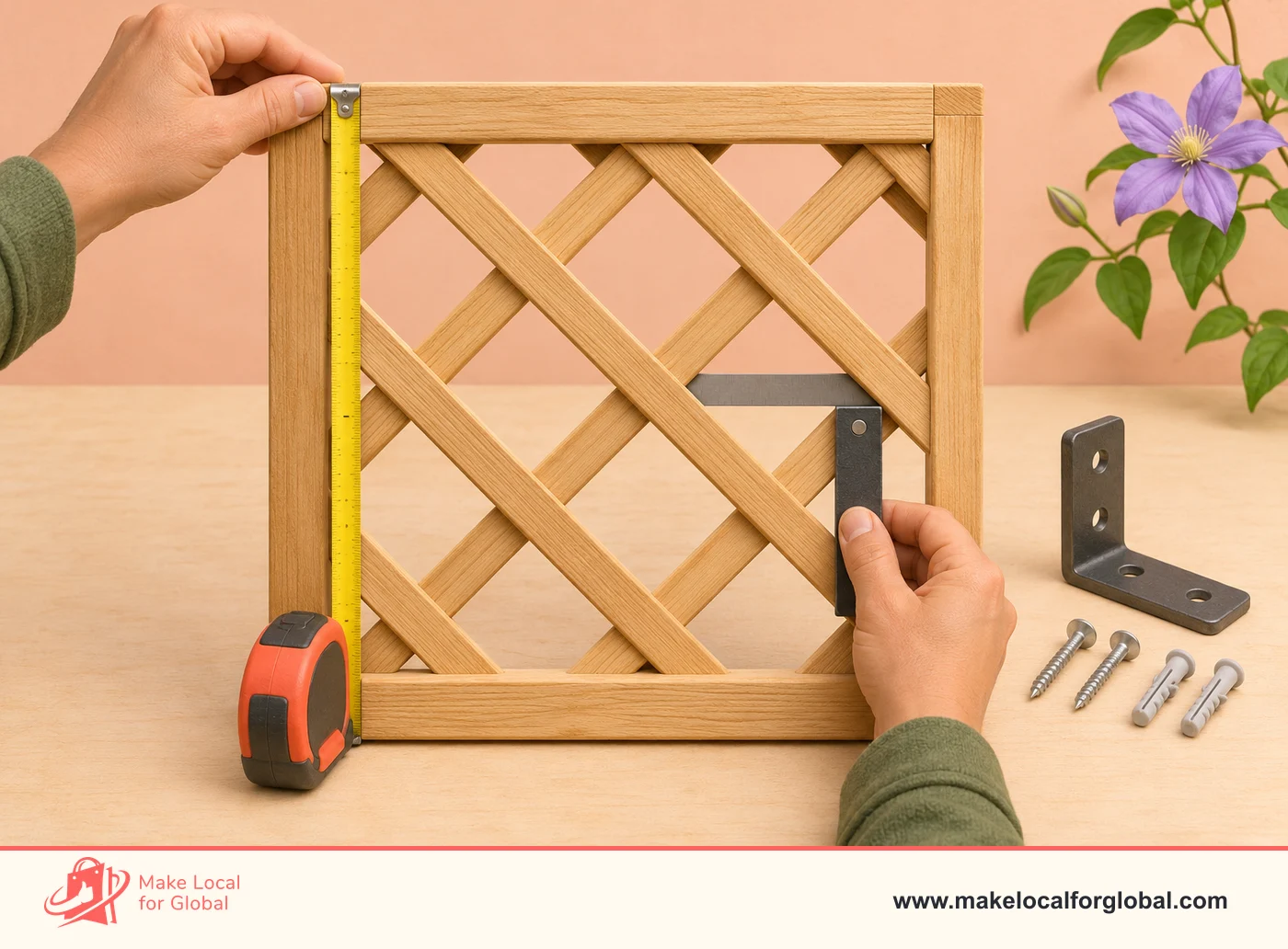
Use the product type and the most helpful verified dimension near the start. Examples include “Timber diamond trellis panel, 90 × 180 cm” or “Black steel fan trellis, 150 cm high”. Use the dimensions and punctuation your customers understand. If the supplier lists centimetres and the customer needs width first, say which side is width and which is height.
Avoid a title that only says “Garden Trellis Premium” or “Outdoor Climbing Screen”. Those names do not explain the shape, size or contents. If a model has a proper collection name, include it after the descriptive phrase. Keep variations as selectable options only when the buyer can easily compare the change.
Describe a product as heavy-duty, weatherproof, maintenance-free, rust-proof, sustainable or suitable for large climbers only when the supplier’s documentation supports the exact claim. If you use a manufacturer’s phrase, identify its scope and keep the original qualification. A short verified statement builds more trust than a bold promise the product cannot prove.
Use a clear front view against a simple background so the lattice pattern is visible. Add a side view for depth and a close detail of the joints, welds, finish, bracket and fixing points. Include a scale reference or measurement graphic only when it is accurate and easy to read. Keep garden scenery secondary to the product.
Show the same model in the position the customer is likely to use it. A wall trellis may need a photo showing the stand-off battens and bracket location. A freestanding fan trellis needs a view that shows its narrow base. An obelisk should appear beside a pot or in a bed with its legs visible. If a climbing plant is used, it must not cover the lattice or make the structure look larger or stronger than it is.
Photograph a second sample if natural wood colour varies. Use the same lighting and camera position so customers can compare finish without mistaking the photographs for separate sizes. If the product is sold in a box, show all parts laid out and state whether screws, plugs, brackets or assembly tools are included. Avoid decorating a listing photo with extras that do not come in the order.
Create a compact information block below the description. It should include the verified product dimensions, material, finish, lattice or wire opening if supplied, supplied fixings, assembly requirement, weight, package dimensions, care instructions and intended use. Use “not supplied” for hardware that the buyer must obtain separately. Don’t leave customers to infer it from an image.
Explain what is measured. “180 cm high” may refer to the frame or the ground-inserted length. “90 cm wide” may be the outside frame or the lattice alone. State if the overall width changes when an expandable panel opens. For a planter-trellis, split outside dimensions, usable soil area, trellis height and included liner into separate fields.
Describe installation in the manufacturer’s terms. Include the fixing type, recommended number and location of fixings if supplied, which surfaces are supported, any required tools and the warning to confirm that the wall or fence can take the installation. If the customer has to select fixings for their wall material, say so and refer them to an appropriate installer or the supplier’s advice. Do not provide a universal screw size for every wall.
List the limitations that affect purchase. Does the item need two people to assemble? Is it shipped flat? Does the buyer need to anchor it? Is it suitable for a pot, a border or a wall only? Is the finish expected to weather or fade? A buyer who understands the limitations is less likely to order the wrong format and more likely to trust the rest of the page.
If you sell a trellis alongside posts, brackets, planters or plant supports, state which part fits which model. Use a compatibility table with exact product codes, not a vague label such as “fits most”. If the supplier has not confirmed a pairing, leave it out of a bundle or describe it as a separate, unverified choice.
Plant type is another question customers may ask. The RHS explains that some climbers use tendrils to hold onto supports. Climbing roses and other plants need tying in. A product seller can explain the physical features of the trellis, but should not promise that one panel suits every plant. Link to reliable growing advice and ask the buyer to check the eventual height and spread of the plant on its label.
If the range includes other bulky garden goods, use separate pages that help the customer compare their real options. A buyer weighing a trellis against a larger garden shed range needs different information about storage, assembly and delivery. A buyer exploring garden fountains faces different weight and water questions. Links should help them navigate a related decision, not make every page compete for the same search phrase.
A trellis’s wholesale price is only one part of the order cost. Long panels may need longer cartons, added corner protection, manual handling or a carrier service with dimension limits. A bundle may lower picking cost per item yet require a stronger box or pallet. Calculate each configuration separately.
The following example is hypothetical. It is an arithmetic exercise, not a supplier quote, retail benchmark or expected margin. Assume an ex-VAT selling price of £78 for one standard panel. The seller is comparing values on an excluding-VAT basis and uses costs net of any input VAT they can recover.
| One-order cost | Illustrative amount |
|---|---|
| Trellis and supplied fixings | £21.50 |
| Inbound freight allocated to one panel | £5.00 |
| Protective carton, edge guards and wrapping | £4.80 |
| Picking and packing time | £3.20 |
| Outbound delivery | £11.40 |
| Payment fee allowance | £2.20 |
| Marketplace or selling fee allowance | £4.10 |
| Damage and returns reserve | £2.00 |
| Customer acquisition allowance | £4.00 |
| Illustrative variable cost per order | £58.20 |
| Illustrative net sale amount for this calculation | £78.00 |
| Contribution before fixed costs and tax | £19.80 |
The arithmetic is £78.00 minus £58.20, which leaves £19.80 contribution before rent, software, insurance, salaries, financing and tax. This is not net profit. Replace each line with an invoice, carrier quote or measured time from your own business. If you are VAT registered, calculate the sale amount after output VAT and the cost after recoverable input VAT. If you cannot recover input VAT, include the non-recoverable amount in the cost model.
For a pallet or container delivery, record the full freight and handling charge. Allocate it across sellable units using a consistent method. Unit count may work when every carton is similar. For a mixed order, weight, volume or a supplier-specific allocation may be fairer. Note any units that arrive damaged or fail the sample check; their cost still affects the stock you can sell.
Separate fixed expenses from variable order costs. A monthly ecommerce platform fee, insurance premium or storage rent does not change with each order, but each order must contribute towards those overheads over time. A useful break-even estimate divides monthly fixed operating costs by the average contribution per sale. The result is a planning threshold, not a promise that every product will sell at the same rate.
Add labour if you spend time checking joints, sorting parts, cutting protection, printing instructions or arranging a large parcel. An owner can record time without paying themselves a wage on day one, but the business still needs a view of the work involved. If fulfilment takes longer than planned, a product that appears to have a margin can consume the time needed to serve other orders.
Measure the final packaged unit, not the flat panel on its own. Record length, width, height and billable weight. Check the specific carrier’s size and weight limits, collection options, insurance terms, delivery postcode coverage, surcharge rules and tracking. If the carrier uses length plus girth, calculate that measure from the carrier’s own formula. Do not copy another seller’s shipping price.
Ask for quotes at more than one order size. A single panel, two panels and a trade carton may cross different parcel bands. Check the cost for remote postcodes, delivery to an apartment, failed delivery, redelivery and returns. Confirm whether an oversized parcel must be delivered by a specialist service or pallet network. Treat a quote as valid only for its stated dimensions, weight, service and date.
Decide whether to charge delivery separately or include it in the displayed price. In either case, show the buyer the total they must pay before checkout. If the item has a long lead time, state it plainly and update the page if the supplier’s estimate changes. A short delivery promise is not useful if the stock has not arrived or the package has not been tested.
During a small pilot, the true damage and returns rate is unknown. Add a temporary allowance and label it as an assumption. Once orders arrive, replace it with actual refunds, replacement stock, second shipments, support time and carrier claims. Keep damage costs separate from change-of-mind returns so you can see when the packaging or product is at fault.
For example, if ten parcels produce two bent panels and each case costs £24 in replacement stock and extra postage, the recorded damage cost is £48 over those ten orders, or £4.80 per order in that small test. The sample is too small to forecast a stable rate, but it is enough to pause and review the packaging. Record which product, batch, carton and carrier were involved.
If a bundle reduces the delivery cost per trellis, recalculate its protection and parcel dimensions. Two panels can rub together or compress the outer carton. A combined order can be cheaper to deliver but harder to carry. Compare contribution, damage performance, customer value and packing time before promoting a bundle.
Long panels need accurate dimensions, visible delivery terms and a checkout that reflects the actual service.
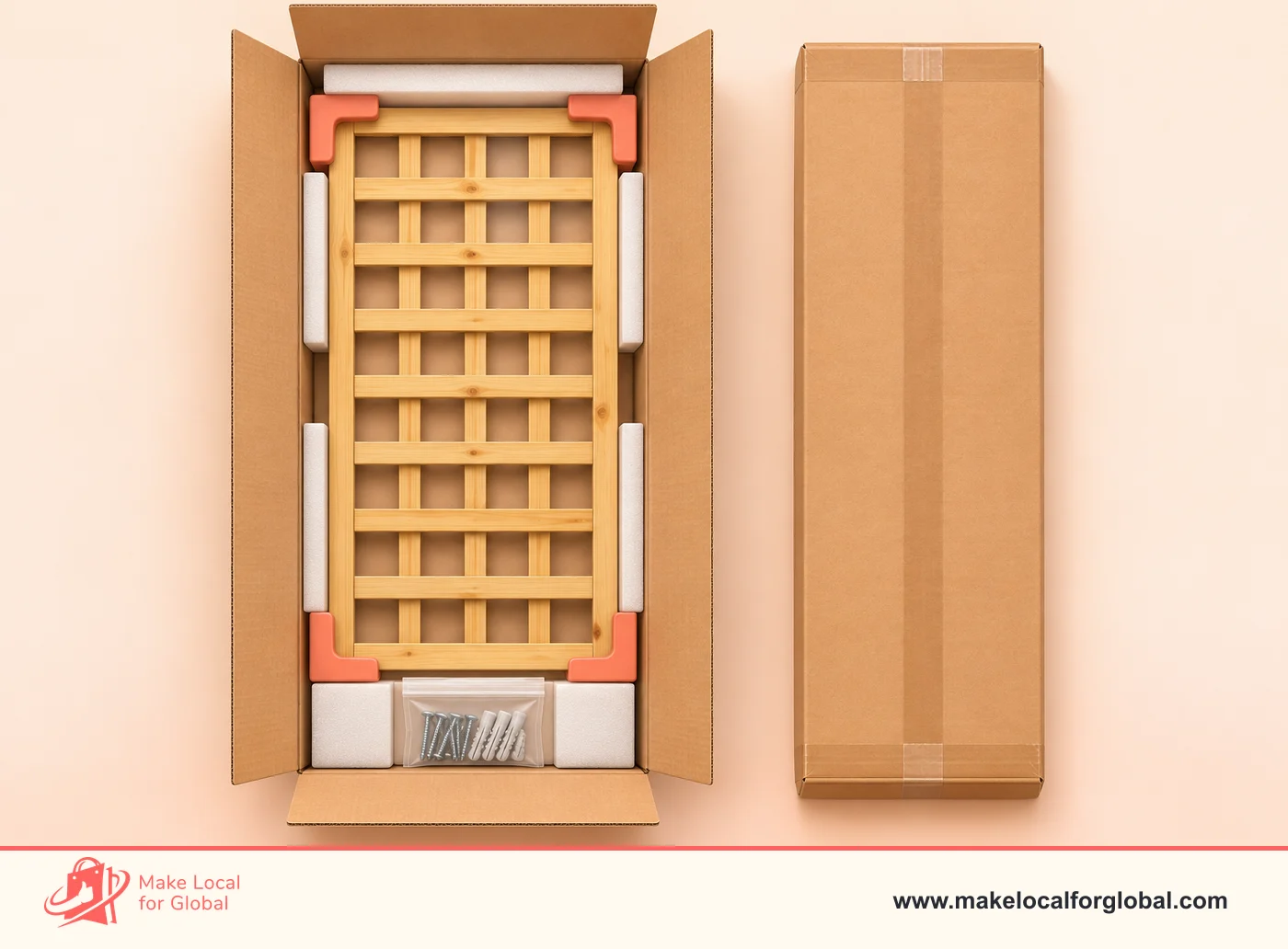
The frame corners, narrow slats, welds, coated ends, hinges and projecting fasteners can be damaged if a long panel moves inside its carton. List the vulnerable points for each product. Use edge protection, a fitted sleeve, corner guards or separators suited to the item. The packaging should stop the product from striking the carton walls or another panel.
Do not rely on a presentation sleeve as transport protection. A display box may look neat in a shop but can split under parcel handling. Place a tested inner pack inside a suitable outer carton. Put screws and small brackets in a sealed parts bag secured so they cannot scratch the finish or disappear under the product.
For a bundle, separate panels with a divider that prevents pressure on the lattice. Keep hardware and instructions where the buyer can find them. Seal the carton using the method in your packing notes. Photograph the packed configuration and record its final dimensions and weight, since that is the product you are asking the carrier to handle.
Pack a saleable sample with the same carton, tape, corner guards and filler you plan to use. Ask someone else to follow your written packing instructions. If the second parcel differs from yours, the process is not ready to hand to a fulfilment helper. Check whether the item slides, bends or rattles when the closed carton is handled normally.
Use a measured test plan suited to the product and carrier. A short in-house handling check helps identify movement and weak spots; it is not a certified test or a guarantee of carrier performance. For a high-value or fragile product, ask the packaging supplier or a qualified test provider to advise on an appropriate method. Send a test shipment through the actual service and route where practical.
Open the returned or received parcel carefully and record the carton, protective material, frame, finish and fasteners. Photograph any contact marks or movement. Change one packaging element at a time and repeat the test with a newly packed unit. Keep the failed sample and results rather than relying on memory.
Long cartons need shelf or floor space that keeps them dry and supported. Do not stack loads above the supplier’s limit. Store different lengths and finishes in labelled bays. A narrow frame can warp if unsupported over a long span, so ask the supplier how it should be stored and follow that method.
Prepare a returns path before launch. Explain how a customer can request help, how to report damage and whether a collection is needed for a large carton. Tell the buyer to retain the packaging for a damage assessment if that is useful, but do not use a voluntary evidence request to remove statutory rights. For a return, record the model, batch, reason, parcel condition, refund or replacement cost and whether the item can be resold.
Plan the replacement route. Can the supplier send a new fixing kit without replacing a full panel? Can you replace a single damaged slat? Are spare parts available? If the supplier cannot provide components, decide how you will resolve a missing-part report. A clear process lowers the chance that a small problem becomes a long customer-service exchange.
In Great Britain, the Office for Product Safety and Standards explains that the General Product Safety Regulations 2005 require products to be safe in normal or reasonably foreseeable use. Producers and importers have responsibilities to demonstrate compliance, and distributors must act with due care, keep supplier traceability and cooperate with authorities. Northern Ireland follows a different general product-safety regime from 13 December 2024. Read the current GOV.UK product-safety advice for businesses and get qualified advice for your role and market.
For a trellis seller, keep product identity, supplier, model or batch, purchase date, sample notes, assembly instructions, complaints and actions. Ask whether the product has sharp edges, pinch points, exposed wire ends, splinter risks, unstable feet or fixings that could fail in intended use. The supplier’s test reports and warnings should match the model you are selling. A disclaimer cannot make an unsafe product safe.
Write installation information in plain language and include the manufacturer’s limits. Do not say a panel can be attached to any fence, wall or balcony. State the surfaces and fixings the supplier confirms. Warn the buyer to check the condition and suitability of the mounting surface and use a competent installer when the installation calls for it. Avoid suggesting that a lightweight decorative product is a privacy fence or a load-bearing structure.
If you import timber trellises or are the first business placing them on the Great Britain market, check whether UK Timber Regulations operator duties apply. The government guidance describes gathering information about the timber, assessing the risk of illegal harvesting and mitigating identified risk to a negligible level. A downstream trader has recordkeeping duties for business transactions. The exact position depends on what the business does, the product and route to market.
Keep origin and species information for each model, and save relevant supplier declarations or certification records. If you use a sustainability claim, check it against the exact source material and product. Do not write “eco-friendly”, “responsibly sourced” or “carbon neutral” from a brand impression or a logo alone. Explain a specific verified fact and its scope, such as the documented material or certification, without implying it covers every component.
GOV.UK says online and distance sellers must provide key information before an order, including business details, a description of the goods, total price, delivery arrangements and cancellation information. Many online customers can cancel within 14 days after delivery, subject to exceptions and the rules that apply to their contract. Read the GOV.UK distance-selling guidance and make sure the store’s terms match the actual product, delivery route and market.
Show whether assembly is required, what arrives in the parcel, how long dispatch is expected to take, delivery cost, any postcode exclusions and how the customer can contact you. Do not bury a long-item surcharge in a later checkout step. Check that the price shown before purchase includes all charges that must be displayed to the customer under the rules that apply to your business.
Packaging extended producer responsibility may apply to some businesses that supply or import packaging or packaged goods. GOV.UK’s current checker sets out producer activities and thresholds, and the small-producer guidance explains separate reporting duties. The result depends on turnover, packaging tonnage, the activity and the relevant obligation year. Check the current EPR packaging guidance rather than assuming a small trellis seller is automatically exempt or obligated.
Record the weight and material of the packaging you receive and send. Keep the supplier’s carton data, your own packaging additions and the number of orders. If you import packaged goods, include the original packaging in your records. Speak with the regulator or a specialist if the producer role or thresholds are unclear.
A direct ecommerce store gives you room to explain measurements, fixings, delivery limits and the difference between formats. It can work well for a focused collection, but you need a plan to attract visitors and answer pre-sale questions. Make the shipping cost visible before the buyer enters checkout.
A marketplace can help you see the phrases and questions shoppers use, but listing fees, product rules, delivery settings and competition affect your margin. Check whether the marketplace supports the dimensions and collection method for the exact panel. Confirm its rules on custom sizes, bundle contents, images, claims and returns before you upload a listing.
Garden centres, nurseries, landscapers and local home stores may offer a way to test samples and collect product feedback. A trade buyer may ask for case quantity, repeatability, lead time, margin, barcode, delivery schedule and spare parts. Prepare a short trade sheet with product codes, measurements, cartons and prices by quantity. Do not promise repeat stock until the supplier confirms it can replenish the model.
If shipping is difficult, test local collection or a regional delivery area first. That can reduce the parcel risk during a trial, but it limits the number of buyers you can reach. Compare the real cost and customer convenience before extending the delivery area. A buyer who expects a quick local collection needs a different stock message from one who orders a made-to-order panel.
Create one product page per distinct format or use. A page about framed timber trellis panels can answer size and mounting questions. A separate page for metal obelisks can explain footprint, assembly and how the product sits in a pot or border. Do not create several near-identical pages that differ only by a keyword or colour name.
Use plain search phrases that describe the product and the buyer’s question. Examples include “wooden trellis panel for wall”, “metal fan trellis”, “expandable garden trellis”, “trellis with planter” and “garden obelisk support”. Validate the wording using your search reports, customer emails, marketplace terms and keyword research. Place phrases naturally in headings, image descriptions and product data only where they accurately describe the item.
Useful supporting pages can answer “How do I measure a trellis panel?”, “Which fixings are included?”, “How do I protect a trellis in a long parcel?” and “What should I check before planting a climber?” Link each answer to the relevant range. The garden benches article covers a related garden product with different size and delivery concerns. The garden lighting article is relevant when a customer is planning an outdoor space, but it should not be used as a substitute for trellis-specific installation advice.
Use photographs that answer a real uncertainty. A front view supports pattern comparison. A measurement image shows width and height. A close-up can show a bracket, joint or coating. A packed-product image helps the buyer understand delivery. Every picture should match the version being sold, including the finish and included hardware.
Choose a test with a clear budget and end date. You might show two panel sizes to a local gardening group, ask a nursery to review the trade sheet, publish one product page and measure qualified enquiries, or run a small search campaign for a specific format. Record impressions, product visits, measurement questions, quote requests, carts, orders and cancellations.
Decide in advance what would prompt a change. If visitors open the page but ask whether screws are included, make the contents clearer. If they view the product but leave after seeing delivery, obtain another carrier quote or test local collection. If one size receives most requests, sample that model before reordering. A small test helps locate the friction; it cannot promise that the product will sell at scale.
Do not launch a discount before you know the full order cost. A lower price may increase interest but still leave too little contribution after packaging, delivery and payment fees. If you test a promotion, set a limit, record the dates and compare contribution with a period at the standard price. State a “was” price only when it reflects the applicable pricing rules and a genuine previous price.
Give every product and component its own SKU. A panel, matching bracket, post, cap, screw pack and planter insert should not share a generic “trellis” label. Store supplier codes alongside your own SKU. If products ship from different locations, record that in the fulfilment system and disclose split delivery where it can affect the customer.
Use stock records for units received, sample units, damaged goods, units on hold, orders allocated and reorder point. Count after receiving a delivery. Check the finish and fixings before the stock is placed into sellable inventory. If the supplier changes its coating, wire thickness or assembly method, treat the revised model as a new sample and compare it with the product page.
Keep a photograph of the correct assembly and packing sequence. A helper should be able to identify the correct size, fixings and carton without relying on memory. Use a checklist to verify product code, finish, parts bag, instructions and parcel label before dispatch.
When a customer asks whether a trellis will fit, ask for the product code, space measurements and planned fixing surface. Compare those details with the documented product dimensions and supplier advice. Do not tell a customer that it fits based on a photograph or a similar panel from another range.
When a parcel arrives damaged, ask for the order reference and photographs of the carton, protective materials and product. Check batch, carrier, packing version, damage location and replacement cost. If a product fault could affect safety, pause that model or batch, contact the supplier and follow the relevant reporting guidance. Keep the response factual and act within the customer’s legal rights.
Use actual questions to improve the page. If several buyers ask if the fixing kit is supplied, put that answer near the price and show the parts. If they ask about height once the panel is mounted, clarify whether the stated dimension includes the frame or part that sits in the ground. Repeated confusion is evidence that the page needs a better answer.
Speak with likely buyers and write down the space, use, size and delivery questions they raise. Compare a small number of formats and select one opening product family. Contact at least three suppliers with the same specification questions. Request drawings, packed dimensions, minimum order, sample price, lead time and evidence for material or finish claims.
At the end of the week, decide which sample to order and what would make it fail your first review. Record the budget for samples and delivery. A supplier’s low minimum order or attractive colour is not, by itself, a reason to place a bulk order.
Measure the sample and its carton. Assemble it using the instructions, inspect joints and finishes, check the supplied fixings and record defects. Ask the supplier to resolve any difference between the sample and the drawing. Confirm material descriptions, intended use, care, warranties and any documented installation or load limits.
Draft a specification sheet and a product-page outline. List which information is verified, which is still unknown and what should be removed from the claims. If the product depends on a compatible wall fixing or post, obtain the exact code and written confirmation before building a bundle.
Build the full cost sheet for a single order and one bundle. Get carrier quotes for the actual packed dimensions. Pack the sample with the intended materials and send a trial parcel if practical. Record movement, carton condition, assembly parts and the time needed to pack it.
Revise the carton or protective material if the panel shifts, corners are exposed or the parcel exceeds a service limit. Update the variable cost and contribution calculation. Do not put a launch date on the page until the supplier and delivery route can meet it.
Publish one clear page with accurate measurements, photos, included parts, installation information, delivery cost and return terms. Ask a few likely buyers to find the product and tell you what they still cannot answer. Make a small channel test with a fixed budget. Track page visits, questions, basket activity, orders, delivery outcome and contribution.
At the end of the month, choose one action: reorder the tested product, revise a specific weakness or stop the test. If people see the page but do not understand the size, revise the dimension images. If delivery costs deter them, compare another service or a collection option. If a parcel arrives damaged, pause the configuration until the packaging has been reviewed and tested again.
Yes. Start with one format and order a sample before buying a case. Check the dimensions, construction, supplied fixings, installation guidance and packed delivery cost. Keep the product claims within what the supplier and your sample checks support.
Choose one that matches a buyer group you have spoken with. A framed panel, fan support, obelisk and planter-trellis solve different space problems. Compare the sample cost, specification, fixings, stock minimum, carton size and buyer response before selecting a first model.
Measure the overall width, height, frame depth and any relevant aperture. State whether the measurement covers the frame, lattice or complete assembled product. For expandable products, record the measurement at the settings you show. Give the product weight and packed dimensions separately.
Include them only when the supplier confirms that they match the model and intended installation. Different walls and fences need different fixing methods. State what is in the box, what surface the supplied hardware is intended for and when the buyer needs separate advice or fixings.
Measure the final carton and check a carrier’s length, girth, weight, tracking, insurance and surcharge rules. Protect frame corners and stop the lattice from moving inside a suitable outer carton. Test the pack you intend to send and record the result before offering nationwide delivery.
Only use a sustainability statement that is supported for the exact product and supply chain. Ask for material origin and any applicable certification record. Make the scope clear, and do not imply that one certified component covers the entire product or packaging.
The role depends on the supply route. GOV.UK distinguishes traders who buy and sell timber products already placed on the GB market from operators who first place them on that market. Traders have transaction record duties; operators have due-diligence duties. Check the current guidance for the product and activity.
Show the format, verified dimensions, material, finish, contents, fixings, assembly, care, intended use, packed weight and delivery terms. Use clear images of the full product, measurements, joints, mounting details and all supplied parts. Answer questions about fit before checkout.
Add product cost, allocated inbound freight, protection, packing labour, outbound delivery, payment and marketplace fees, a returns or damage reserve and customer acquisition. Compare the total with the net sales amount on the same VAT basis. The remainder is contribution before fixed costs and tax, not net profit.
RHS advice says to put supports in place before planting for many climbers. Follow the product maker’s installation guidance for the trellis itself and check the mounting surface. Plant requirements vary, so the customer should check the plant’s label and suitable growing advice.
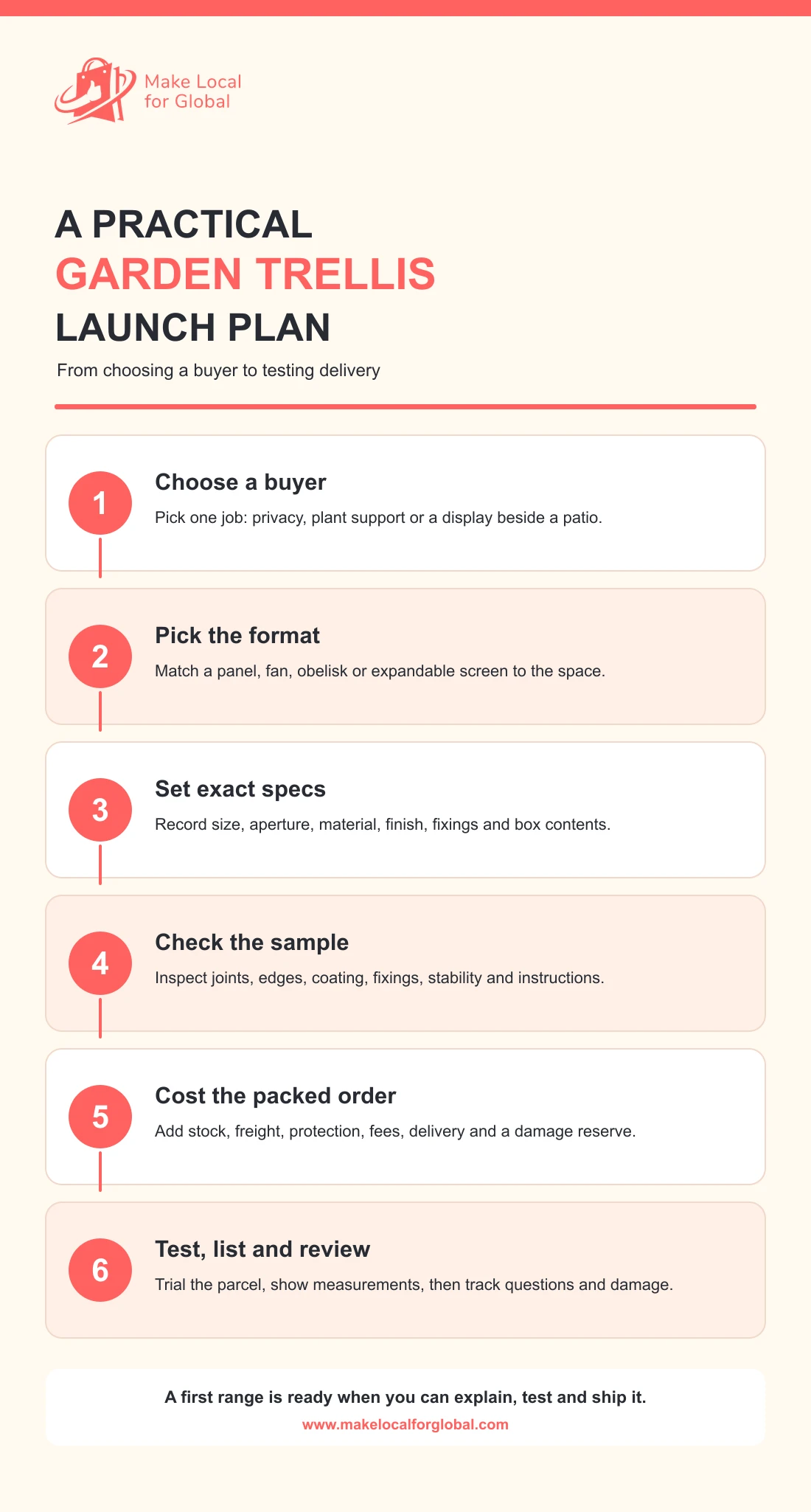
Choose one likely buyer and one trellis format. Ask suppliers for the drawing, material details, fixings, instructions and carton measurements. Order a sample, inspect it with a checklist, then cost the packed order before setting the retail price. If the product cannot be described, mounted and shipped clearly, keep it out of the first range until the supplier answers the open questions.
Talk through the product pages, delivery details and checkout your first trellis range needs.
PREFERRED SOURCE
Like what you’re reading? Add Make Local for Global as a preferred source on Google to see more of our articles when you search.

Build your online presence without having to figure out everything yourself.