READY TO SELL garden benches ONLINE?
Get a store built for you in 5 days, plus training and support to help you start, run, and grow your Alternative business.

Learn how to choose a focused garden bench range, inspect supplier samples, price bulky delivery, and write product pages that answer buyer questions before you commit to stock.


A garden bench is a large, tactile purchase. A buyer wants to picture it in a real space, understand the materials, and know what will happen when a heavy parcel reaches the door. A seller needs to solve those questions before paying for stock.
To sell garden benches online, choose one buyer and use case, test a small range with accurate samples, calculate every order cost, and show dimensions, care and delivery terms clearly. Start with evidence from conversations and small enquiries before committing to a large order.
If you are still comparing a marketplace, a hosted shop or a service led business, use the Ecommerce Pathfinder to write down the trade-offs before you buy stock.
“Garden bench” covers products for very different spaces. A narrow balcony seat has different limits from a heavy memorial bench, a two-person patio seat, or a long bench for a shared courtyard. Your first decision is not a colour. It is the buyer, the location, and the job the seat needs to do.
Write a one-line description, such as “a compact bench for a small paved garden” or “a sturdy seat for a sheltered community courtyard”. Add the constraints a customer will notice: maximum width, floor surface, exposure to rain, available storage, assembly skill, and the route from the gate to the final position.
That line helps you reject products that look attractive in a supplier catalogue but do not fit your customer. It informs your photos, filters, size chart, packaging decisions and first stock order. A shop that tries to speak to every garden at once often ends up with a catalogue and product descriptions that give little help to any one buyer.
Some buyers want a quiet place to sit near planting. Others need a seat by a front door, a place to remove muddy boots, a shared outdoor seat, or a gift for a new home. A storage bench may appeal to a different buyer from a simple slatted seat. Each job changes which details should appear first on the page.
Start by speaking with ten to fifteen people who resemble your intended buyer. Ask where the bench will go, what they have already looked at, which dimensions are non-negotiable, and what makes them pause before ordering online. Do not ask only whether they “like” your idea. A polite yes does not show that the product, price and delivery terms work together.
Record the words people use. If several mention the awkward walk through a side passage, access becomes a buying question and a delivery risk. If they ask whether the finish needs yearly treatment, care information belongs beside the material choice rather than hidden at the bottom of a page.
Use a simple landing page or marketplace draft to compare two clearly different offers. Keep a record of visits, product-page views, questions, email sign-ups and checkout starts. A small paid test can reveal whether people click a clear offer, but it cannot prove that the eventual margin will cover delivery damage, refunds and advertising. Decide in advance what evidence would justify buying a sample, and what result would make you pause.
A focused first range can show meaningful choices without creating a stock puzzle. Begin with a small number of designs that solve distinct needs. A useful starting point might be a compact two-seat bench, a classic longer bench, and one design with storage or arms. The right number depends on your cash, storage, supplier terms and ability to deliver each model.
Timber can suit buyers who like a natural appearance and can follow the maker’s care instructions. Species, treatment, joinery, finish, hardware and the seller’s storage conditions all affect what is suitable outdoors. Use broad claims such as “weatherproof” or “maintenance free” only when exact product evidence supports them.
Metal benches can offer a different visual style and may be easier to wipe clean. Ask what the frame is made from, how it is coated, whether water can collect at joints, and what the maker says about scratches and corrosion. A coating description alone does not tell a buyer how to care for a seat left outside.
Woven-look or composite seats may be lighter to handle than some solid timber designs, but material labels vary. Ask for the exact composition, frame details, UV and cleaning guidance, and any limits on exposure. Storage benches add moving parts and hinges that need their own inspection.

An entry choice could be a compact, simple design with fewer parts. A core option might offer arms, a different back shape or a longer seat. A higher-value choice may have storage or a more elaborate finish. These are roles in your range, not promises that one price tier will sell more than another.
Keep the comparison honest. Put seat dimensions, total dimensions, material, weight, assembly, care, warranty terms and delivery method side by side. If your higher price rests on a thicker frame, stronger hardware or a documented finish, show the evidence. Do not use “premium” as a substitute for explaining the product.
A bench and matching cushion may form a useful set if the cushion is suitable for outdoor use and has clear care instructions. A bench with a compatible cover could solve a storage problem. A random bundle of unrelated garden items makes the price harder to judge and adds fulfilment work.
Check combined parcel dimensions, separate warranties, stock availability, return handling and the supplier’s packing method. If the items ship separately, state that before checkout. If a bundle discount removes the contribution needed for bulky delivery, sell the products separately or change the offer.
| Range role | Example bench | Buyer question answered | Evidence to show |
|---|---|---|---|
| Entry | Compact two-seat model | Will it fit a small space? | Full dimensions, weight and access notes |
| Core | Longer bench with arms | Can two or more people sit comfortably? | Seat length, maker load guidance and assembly |
| Higher-value | Storage bench or detailed finish | Does the extra feature suit my routine? | Storage capacity, hinge detail, care and warranty |
Examples describe range roles only. Confirm every specification with the product maker.
Possible routes include a UK wholesaler, a furniture maker, an importer, a trade marketplace or a direct-to-customer arrangement with a supplier. Each route shifts control, lead time, cash commitment, packaging responsibility and customer-service work. A lower unit quote can become expensive if you must store bulky stock, arrange collection, replace damaged items or pay for a sample from overseas.
Save written answers and the date received. Treat a verbal assurance as a question to confirm in writing before paying. Ask for a sample from the same production route intended for customer orders. A showroom sample may not reveal how a flat-pack carton is prepared or whether the hardware bag is complete.
For timber products, identify whether you are buying from a UK trader, importing goods, or placing timber on a market in Northern Ireland. Great Britain uses the UK Timber Regulations: traders keep records of suppliers and business customers; operators need due diligence on timber legality. Northern Ireland has separate rules and a transition to EUDR requirements. Read the current GOV.UK timber and FLEGT guidance and Northern Ireland EUDR guidance. The NI start date depends on product category and business size. Timber products formerly subject to EUTR have a 30 December 2026 date; other in-scope products may have a later date for micro and small businesses. Check the bench’s commodity classification and your supply-chain role with a qualified adviser.
Do not use “sustainable”, “responsibly sourced” or a forest logo only on the basis of a supplier catalogue. Ask what certificate or chain-of-custody record covers the product, who issued it, which materials it applies to, and whether your own use of the claim is permitted. The CMA Green Claims Code explains how environmental claims should be clear, accurate and supported.
Do not judge a bench from a small catalogue image. Request a sample in the exact material, finish, packaging and assembly format you plan to sell. If an assembled sample is not practical, ask for a production sample plus the complete pack and assembly guide. Record what you tested and photograph the result.

Ask a second person to assemble the sample using only the customer instructions. Note every question they ask. Those points can become product-page photos, clearer assembly copy or a supplier correction. If they cannot complete the build without improvising, do not assume customers will have an easier experience.
Before testing, define what would stop the order: a dimension outside tolerance, unstable feet, a damaged finish, unclear load guidance, a missing warning or packaging that cannot protect the bench. Ask the maker for corrective action and a new sample where needed. Keep the rejected sample photos with the purchase record.
A seller does not need to perform a laboratory test to notice a poor fit, a sharp exposed edge or a confusing assembly step. Do not call an informal check a formal safety test. Use competent product-safety support for technical questions and keep the evidence that belongs with your role in the supply chain.
Bulky products need a cost model before launch. Add the bench, inbound freight, storage or handling, packaging, payment and marketplace charges, outbound delivery, damage and return allowance, and customer-acquisition spend. Add fixed costs separately: site fees, insurance, accounting, photography, software, rent and your own time.
The figures below are an invented planning example, not a supplier quote or a statement of typical market costs. It assumes a seller is not VAT registered, so the retail price is the amount charged to the buyer and supplier VAT paid is part of the relevant cost where charged. A VAT-registered seller must rebuild the calculation using the VAT treatment of each sale and purchase.
| Per-order item | Illustrative amount | What to replace it with |
|---|---|---|
| Customer price | £329 | Your tested selling price |
| Bench cost | £132 | Supplier invoice per unit |
| Inbound freight | £8 | Allocated freight and import costs |
| Packaging | £11 | Carton, protective material and labels |
| Outbound carrier | £42 | A quote for the packed dimensions and route |
| Payment or marketplace fees | £14 | Your channel’s actual fee calculation |
| Returns and damage reserve | £12 | A cautious estimate updated from claims |
| Advertising/customer acquisition | £22 | Measured spend per acquired order |
| Total variable costs | £241 | Sum the actual variable costs |
| Contribution before overhead | £88 | £329 minus £241 |
Illustration only. £132 + £8 + £11 + £42 + £14 + £12 + £22 = £241; £329 − £241 = £88. The contribution is about 26.7% of the £329 sale before fixed overhead, owner pay, tax and any other omitted cost. It is not net profit.
Use the model to ask what changes the result. If a carrier quote is £15 higher, the contribution falls by £15. If a marketplace fee is a percentage of the selling price, a discount can cut both revenue and contribution. If customer acquisition costs rise, repeat the calculation using the measured cost per order rather than the campaign budget.
Do not count the return reserve as money already spent. It is a planning allowance until a return or claim happens. Track actual refund reasons, collection charges, replacement parts and resale condition. Replace the initial estimate with your own history once enough orders exist.
Suppose monthly fixed costs are £880 and the contribution is £88 per order. The simple break-even calculation is £880 divided by £88, or ten orders in that month. This leaves no allowance for tax, owner pay beyond any amount already included, debt repayment, or unexpected repairs. Add those needs before treating ten orders as a viable target.
Run a second version for a quieter month and a third with higher delivery costs. If the model only works when every assumption is favourable, reduce stock exposure, revise the delivery offer, seek another carrier quote, or pause the product. A price that looks competitive but cannot pay for a damaged return is not a sound offer.
A bench may be long, heavy, awkward to turn and vulnerable at corners. Ask carriers for a quote using the packed length, width, height, weight, collection location and delivery postcode range. Confirm whether the service includes a one-person doorstep delivery, room-of-choice delivery, appointment booking, assembly, collection from a depot or a second delivery attempt.
Request carton drawings or a packed sample. Protect corners and protruding arms, separate finished surfaces so they cannot rub, immobilise legs and fasteners, and keep the assembly guide dry and visible. Ask the supplier how the carton is tested and what stacking or storage limits apply. A neat unboxing is useful, but protection during hubs, vans and doorstep handling matters more.
Run a small delivery trial to an address that resembles a real customer route. Photograph the carton before dispatch and after arrival, note the carrier service, and inspect the bench before assembly. One parcel does not establish a damage rate. It can reveal weak packaging or a carrier constraint before a larger batch ships.
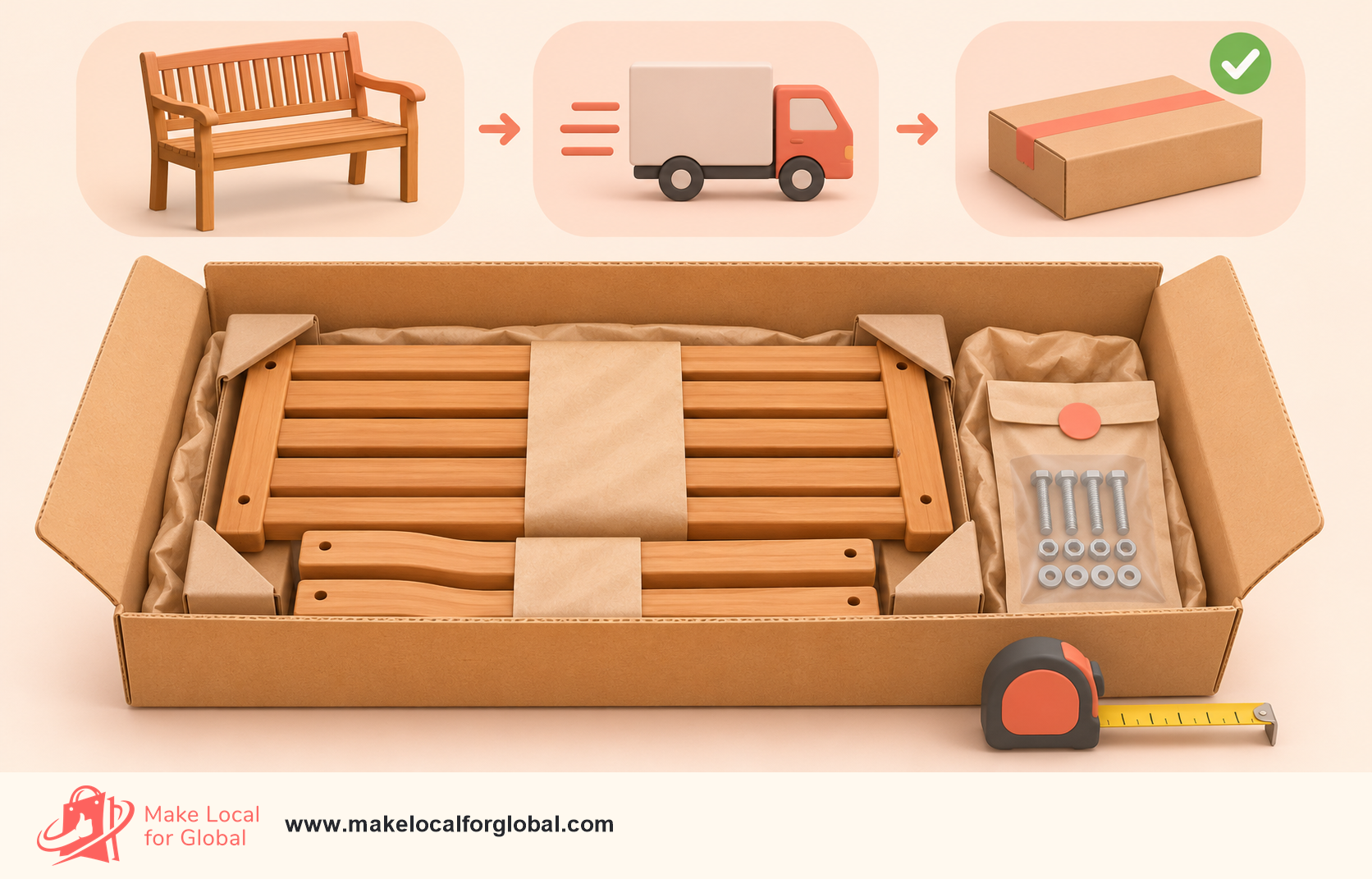
Decide how a customer reports a damaged carton, a missing part, a change of mind or a fault. Tell them which photos or order details help you assess the issue, where to send the report and when they can expect a reply. Do not make a customer pay a return charge where the law says the business should bear it, and do not describe a faulty product as a simple change-of-mind return.
For many online consumer orders, the buyer can cancel within 14 days of receiving the item and then has another 14 days to return it after giving notice. Bespoke products may have different cancellation rules, and faulty goods carry separate rights. Read the current GOV.UK distance-selling guidance and returns and refunds guidance. Give the required business, price, delivery and cancellation information before checkout, then check the rules for the exact type of sale and product before writing your policy.
A good product page is a decision aid. It should help someone judge whether the bench fits, whether it suits their use, and what happens after checkout. Put the most decision-relevant details near the top rather than relying on a poetic description.
A clear title might read “Two-seat acacia garden bench, 120 cm, flat-pack”. Use that wording only if the species, seat count, measurement and assembly format are confirmed. If the supplier cannot verify a material species, say “timber” rather than naming one.
Include overall dimensions in centimetres, usable seat dimensions, product weight, packed dimensions, material and finish, colour, assembly status, what is supplied, tools needed, care guidance, warranty terms and the maker’s load information. State whether cushions or fixings pictured are included. Mark measurements as approximate only when the source specification gives a tolerance or measurement variation.
Use one full product image against a simple background, a side view, a close-up of the joints or finish, and a photo that shows the bench beside a familiar object. Add a dimension diagram that names each measure. Avoid wide-angle images that make a compact seat look oversized or a long bench look short.
Include the packed carton dimensions when the carrier leaves the parcel at a boundary or doorstep. A buyer may need to carry it through a narrow passage or up steps. Explain whether the delivery team can help with that route; do not imply a service the carrier has not agreed to provide.
Write the answer to a real question. “Will it fit through a 75 cm gate?” is answered by showing the longest packed side and whether the carton can be carried upright. “Can I leave it out all year?” needs the exact maker’s care and exposure guidance, not a broad promise.
Keep claims specific. Describe the finish as “oil-finished timber, apply care product as directed by the maker” only where that matches the product documents. If the seat is not supplied with a tested load rating, do not invent one. Make the assembly and care instructions available before purchase when they affect a buyer’s decision.
The rules that apply depend on your role, product and destination. A seller importing a bench may carry different responsibilities from a retailer reselling a product from a UK supplier. Keep records of who made or imported the product, the model or batch, supplier details, safety information, warnings and customer complaints.
For Great Britain, the Office for Product Safety and Standards has guidance on product safety law for manufacturers and importers and the General Product Safety Regulations 2005. Northern Ireland follows different product-safety rules. Review the Northern Ireland guidance on the EU General Product Safety Regulation before selling there.
If you sell into Northern Ireland, check the current rules for timber products and any applicable deforestation-free product requirements. GOV.UK states that the EU Deforestation Regulation applies in Northern Ireland from 30 December 2026 for covered products and operators; whether a particular bench or business is in scope depends on the product and role. Start with the current GOV.UK Northern Ireland EUDR guidance and obtain specialist advice where needed.
Online sellers must give customers the required pre-contract information and follow applicable cancellation and refund rules. The Consumer Contracts Regulations 2013 set out information requirements for distance contracts. Present delivery charges, delivery timing, business contact details, returns information and the total price before the buyer commits. Ask a qualified adviser to review your terms if you are unsure.
Keep environmental wording precise and supported. A claim about recycled content, timber origin, durability or repairability must refer to the product you sell, not a supplier’s wider corporate policy. Make the evidence easy to retrieve if a customer asks how a claim was checked.
A marketplace can provide an existing product-discovery route and established checkout tools, with fees and rules you need to calculate. Your own shop gives you more control over the product story and customer experience, but you must bring visitors, manage the site and handle the operational details. A local showroom or pop-up can let people sit on a sample, but adds venue, staffing and stock costs.
Start with one primary channel and one supporting route. For example, run a shop for the full range and use local garden groups or a weekend event to collect questions and sample feedback. Do not list every design everywhere before you can keep prices, dimensions, delivery promises and stock availability aligned.
When you know your buyer, range and delivery offer, MLFG’s pricing page can help you compare website options and costs before choosing the setup that fits your operation.
Use the same language customers use when describing the space and problem. Search phrases might include “small garden bench for balcony”, “wooden garden bench dimensions”, “garden bench with storage” or “how to care for a timber garden bench”. These are research starting points, not claims about search volume.
Create useful pages that answer one question at a time. A care page can explain how to follow maker instructions. A size page can show how to measure the intended location and delivery route. A comparison can explain which bench depth, material or storage feature suits different uses. Link those pages to the relevant products and back to a broader range.
MLFG already has a broader guide to selling garden furniture online. Use it for wider product-category planning, then keep this bench page focused on seat dimensions, materials, sample checks and bulky delivery. Related ideas include selling folding chairs online, selling folding tables online and selling greenhouses online. Link only where the next page answers a reader’s next question.
Choose one small test each for organic discovery, paid promotion and local outreach. For organic discovery, publish a photo-led article showing how to measure a patio space. For paid promotion, send a limited budget to one product page and track qualified questions and checkout starts. For local outreach, offer a sample viewing to a relevant community or garden group and record the questions people ask.
Set a fixed end date and a budget limit before each test. Track the source, audience, product shown, clicks, enquiries, sales, cancellation reasons and total acquisition spend. A large number of low-intent visits does not prove that the offer is working. Look for signals tied to a real decision: a size question, delivery postcode check, sample request or completed order at a price that leaves a contribution.
Use customer questions to refine the page. If many people ask whether a bench fits a narrow passage, put the packed carton size beside the product dimensions. If a material photo causes confusion, photograph the finish in natural light and label the sample. Improve the information before increasing the budget.
Record each design, finish, supplier code, batch or delivery lot where available, stock quantity, expected replenishment date and location. Keep one sample for photography and inspection if cash allows. For supplier-direct fulfilment, confirm that the supplier sends the version shown on your page and shares tracking details in time for you to update the customer.
Define an order handoff: confirm the address and postcode, check stock, pass the order to the supplier or warehouse, receive dispatch confirmation, send the tracking link, and follow delayed or damaged parcels. A named owner for each step prevents a customer from receiving a delivery estimate that nobody can support.
Write a simple service response for common cases. Ask for an order number and images of damage, but do not ask the customer to dismantle an unsafe or unstable item. If a product fault could cause injury, stop sales of the affected item as you assess it, preserve records and seek product-safety advice. Keep a clear route for urgent reports.
Review stock ageing monthly. If one finish remains unsold, ask whether the photos, price, buyer fit or material story caused the delay. Do not reorder solely to satisfy a supplier minimum when the evidence suggests the product needs a change.
Use the first month to reduce uncertainty, not to force a launch date. Each week ends with evidence and a decision. If a supplier, sample or carrier step slips, move the next action rather than pretending the check has passed.
| Week | Actions | Record | Decision at week end |
|---|---|---|---|
| 1: Buyer and demand | Choose one use case; interview 10–15 likely buyers; compare two offer concepts. | Space constraints, buyer words, objections and sample requests. | Which buyer and product question deserves the first test? |
| 2: Sourcing and sample | Contact suppliers; request documents and sample terms; order only after a cost review. | MOQ, lead time, packed size, material evidence and inspection notes. | Does a sample meet the written pass criteria? |
| 3: Cost and fulfilment | Get carrier quotes; measure the carton; draft the return route and per-order model. | Contribution under base, quiet-month and higher-delivery cases. | Can the offer cover a plausible delivery and returns cost? |
| 4: Page and small test | Build one product page; check all facts; run a small discovery test or sample viewing. | Visits, meaningful questions, checkout starts, costs and delivery feedback. | What information or product change is needed before a larger order? |
This schedule is a planning template. Supplier lead times and product testing can take longer than 30 days.

Possibly, through supplier-direct fulfilment or a made-to-order arrangement. Confirm stock accuracy, dispatch timing, carton details, packaging, returns, damage liability and customer-service access in writing. Order a sample and test the service before representing it as your normal fulfilment route.
Choose a bench that matches one documented buyer need and that you can source, inspect and deliver at a workable contribution. A compact two-seat model can be a useful test if your conversations point to space limits, but validate dimensions and demand rather than assuming it is the best seller.
The amount depends on your sample, minimum order, storage, site or marketplace fees, photography, insurance and delivery model. Prepare a cash plan for one sample, a small test, operating costs and a reserve for a damaged order. Request real supplier and carrier quotes before committing funds.
Start with a tested customer price, subtract the bench, inbound freight, packaging, carrier, channel fees, returns allowance and acquisition spend. The remainder is contribution before overhead, tax and owner pay. Compare that amount with your fixed costs and required cash buffer.
Measure it, inspect joints and finish, check stability, assemble it using the customer instructions, review hardware and moving parts, compare care notes with the material, and examine the packed carton. Keep photos and written pass criteria.
Your duties depend on your role, the product and where you sell. Keep supplier and product records, review applicable Great Britain or Northern Ireland guidance, and seek competent advice for technical questions. Do not present an informal inspection as a formal conformity assessment.
State the delivery price, service type, coverage, expected timing, parcel or access limits, assembly arrangement and what happens after a missed delivery. Use the carrier’s written terms and current quotes; promise a room-of-choice service only after the carrier confirms it.
Offer it only if a supplier, carrier or local contractor can perform it safely and at a price customers will accept. Define the service area, access requirements, appointment process, damage responsibility and cancellation terms. Check the resulting contribution before adding it as a standard option.
Show accurate dimensions, packed size, assembly status, material and care details. Test packaging on the intended route, use a carrier suited to the parcel, track damage reasons and change the weak point. Better information can reduce fit-related surprises, but it cannot remove every return or delivery claim.
Use an environmental claim only when you have current evidence that applies to the product and wording. Ask for the timber origin and relevant certification records, check what the certificate covers, and review the CMA Green Claims Code. A supplier’s general statement does not automatically support a claim about every item in your shop.
There is no fixed number. Use the smallest range that lets your chosen buyers compare meaningful options and keep stock, facts, images and delivery promises accurate. Add a design after questions, enquiries or sales show what the first range does not serve.
Begin with a buyer and a real space, then check a sample, price a complete order and test the delivery route. Add products only when the evidence supports the next commitment. Keep the page factual, the images true to the item and the customer-service route clear.
If you are ready to compare website options or want to discuss the next step for your product business, review MLFG’s plans or get in touch with the team.
PREFERRED SOURCE
Like what you’re reading? Add Make Local for Global as a preferred source on Google to see more of our articles when you search.

Build your online presence without having to figure out everything yourself.