READY TO SELL Folding Tables ONLINE?
Get a store built for you in 5 days, plus training and support to help you start, run, and grow your Alternative business.

Learn how to sell folding tables online: choose a buyer, check hinges and locks, calculate packed delivery, build clear product pages and test a measured first range.

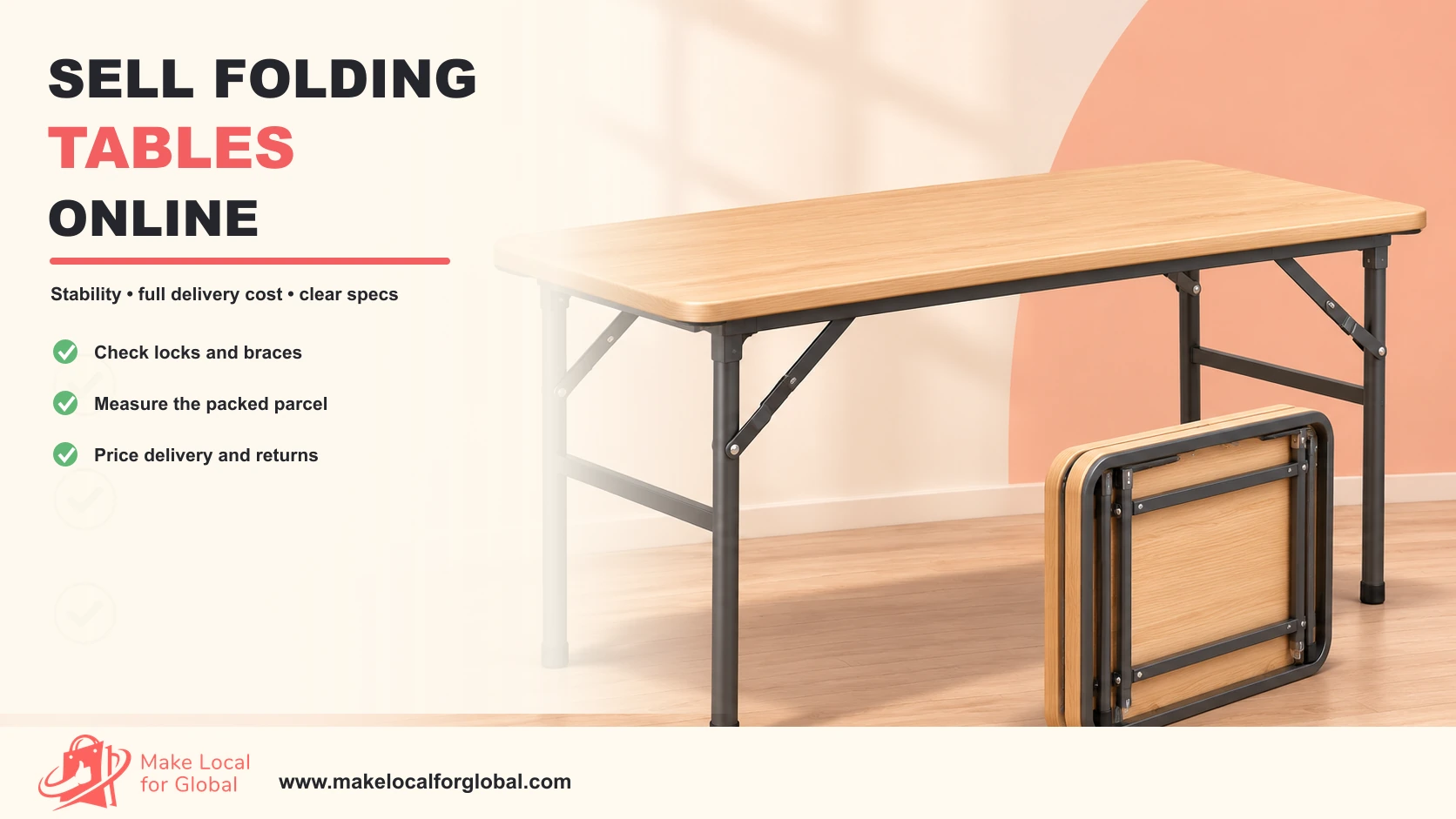
A folding table solves a practical problem: people need a usable surface for a limited time, then want it stored away. That creates different buying occasions. A household may need an extra table for a family meal. A small business may need a portable display surface. A club may need several matching tables for meetings, workshops or events. These customers do not compare the same details, so a shop that tries to serve all of them with one vague product page can leave each group unsure.
A folding table can suit an online shop if you can explain its open dimensions, folded dimensions, intended setting, frame construction, weight, care and delivery terms with precision. The table is bulky compared with many small consumer products. A low wholesale price can be misleading once inbound freight, carton size, delivery, storage and returns are counted. The frame and locking parts matter to safe use, so a seller must assess the product and its evidence before taking orders.
Start with one buyer and one clear use. Find out what that buyer needs to measure, carry, clean, store or replace. Order samples only after a supplier has supplied enough details to let you compare the same specification. Test the actual sample. Then cost the actual parcel rather than the table alone. A small first range with dependable product data is easier to explain and monitor than a large catalogue assembled from incomplete supplier listings.
The sections below set out a route from buyer interviews to sample checks, listing, delivery and first-month review. The figures in the cost example are illustrative, not market quotes or a promise of margin. Replace each one with a written supplier quote and carrier rate for the dimensions and weight you expect to send.
Plan a clear product range and delivery setup with the MLFG website team.
A folding table can be bought for home use, temporary retail, food service, education, clubs, markets, community venues or event hire. Each group has a different use pattern. Someone furnishing a small flat may care about a table that stores behind a door. A market trader may care about a cleanable top, carrying weight and a surface wide enough for stock. A community group may want matching tables, repeat availability and a delivery slot that works for a venue.
Do not use broad audience descriptions such as “for everyone”. Make a buyer statement with a place, task and constraint: “For a weekend market seller who needs one table that fits in a small car”; “for a household that needs an extra meal surface but has limited cupboard space”; or “for a local club that sets up a workshop room each week.” These are hypotheses. Interviews and small tests tell you whether they match real purchasing behaviour.
Speak with people who have bought, borrowed or hired folding tables in the last year. Ask where the table was used, what had to fit on it, how many people used the surface, how it travelled, where it was stored, and what went wrong. Ask what they searched for and which dimensions they checked. Ask whether they paid for delivery, collected the product, or hired it for a one-off event.
Do not start by showing a polished mock-up and asking whether they like it. That can lead to polite approval without a buying signal. Ask about the last occasion first. “What did you do when the table was not available?” can reveal a more useful need than “Would you buy our table?” A buyer who paid for a hire table three times may be worth a closer look. A buyer who says the idea sounds good but cannot name a recent use is weaker evidence.
Record phrases people use. A market seller may say “I need it to go in the boot”, and a home buyer may say “I want it gone when dinner is done”. Those phrases can guide product-page copy and search research. They can inform your first range, but they do not tell you what the frame can safely support. Supplier documentation and sample checks have a separate role.
Individual households often place one order. A venue or organiser may need multiple tables, a repeat supply route, invoicing or a delivery appointment. Trade and group orders can make larger cartons more worthwhile, yet they can bring different expectations around stock consistency, replacements and lead times. Do not assume a higher quantity equals a better order. Measure the contribution from the complete delivery, including picking, packing, failed delivery attempts and customer service time.
You can test interest without purchasing a container of stock. Set up a simple enquiry page with a named use, the proposed size range, an honest price band and a delivery postcode checker if available. Invite a small group to join an availability list. Talk to local clubs or market organisers with a clear one-page specification. A paid preorder can be useful evidence only when the delivery date, refund process and stock status are clear. Do not use a preorder to conceal that the item has not passed your checks.
Write one paragraph for internal use: who the first customer is, which task the table supports, what limitation matters most, and what you still need to verify. Example: “We are testing a compact home dining table for renters who need extra seating space a few times a month. We must confirm that open size, folded thickness and carry weight suit a small flat, then test the lock and return parcel.” A note like this helps you reject suppliers that cannot provide the relevant measurements.
“Folding table” covers products with different shapes and mechanisms. A compact card table, a wall-mounted drop-leaf table, an outdoor folding table and a long event trestle table do not share the same use, storage or delivery needs. Start with one coherent family. Your first stock list should make a buyer’s choice easier, not fill a spreadsheet with every product a supplier offers.
| Format | Likely use to research | Details to compare | Cost or service issue |
|---|---|---|---|
| Compact square or card table | Small homes, games, temporary work | Open footprint, height, folded thickness, top finish | Low unit value can be swallowed by delivery |
| Rectangular home table | Extra dining, craft, flexible work | Length, width, knee clearance, folded size | Carton dimensions and returns route |
| Trestle or banquet table | Clubs, markets, events | Length, frame braces, carry weight, top surface | Bulky delivery, storage and multi-unit damage |
| Round folding table | Meetings, parties, small group settings | Diameter, leg layout, stability, clearance | Wide carton despite a shorter length |
| Outdoor table | Gardens, camping or temporary outdoor service | Materials, finish, care, intended exposure | Do not imply weather resistance without evidence |
| Height-adjustable table | Different tasks or user heights | Adjustment steps, locking parts, load evidence | More mechanisms mean more checks and support questions |
A table’s shape can change how it is used. Compare your planned offer with our guide to selling folding chairs online; chair size and table size need to work together when you sell a portable event setup. A round top can help people sit around a meeting surface; a rectangular top may fit a narrow room or market stall. A narrow table may fit a small room but leave little space for displays. Ask users to mark the intended footprint on a floor or table. That test gives you more specific feedback than a catalogue photograph.
Manufacturers may offer plastic, resin, laminate, steel, aluminium, timber or mixed construction. A material name is not a performance guarantee. Plastic tops differ in thickness and construction. Timber species and finishes differ. Steel and aluminium frames can differ in section shape, wall thickness, joint design and corrosion protection. Ask for the product’s bill of materials or a clear specification; ask the supplier to identify the exact model and variant covered by each document.
For a home table, customers may care about wipe-clean care and surface marks. A food stall may need a surface that can be cleaned under its operating requirements. An outdoor buyer may ask how the finish handles moisture and sunlight. Do not claim a table is waterproof, food-safe, stain-proof or suitable for continuous outdoor exposure based on a generic sales page. Get evidence that applies to the actual finish and use. Where you cannot substantiate a claim, describe the visible material and care method in plain terms, or leave the claim out.
A useful first range might have a compact entry model, a medium core model and one larger format for buyers with a clear need. The differences should be easy to explain: surface dimensions, height, frame construction, top finish, folded size, weight, included carry handle or intended environment. Avoid variants that differ only by colour if the buyer cannot tell which table suits the task.
Do not add an extra size to make the range look complete.

Each new SKU creates stock, image, page, carton, supplier and customer-service work. If a large table has a different delivery class, it may have a different contribution. If a white top scratches more visibly, the product page should say how to care for it. If colour choices share the same frame and carton, they may be simpler to test, but confirm that the supplier can keep shades consistent.
Buyers may search for a stated load or capacity. Use only a specific value supplied for the exact model and explain how the manufacturer defines it. Ask whether it is a uniformly distributed load, a point load, a static value or a value from a named test. Do not turn an unqualified supplier figure into a promise that the table is safe for any load. Do not compare two products’ figures until their methods and conditions match.
If a supplier cannot explain the figure, do not make it a headline claim. Ask for the relevant test report or technical file and decide whether a competent product-safety adviser or testing laboratory should review it. A seller’s own test can reveal defects, but a casual test with household objects cannot establish a formal safe working load.
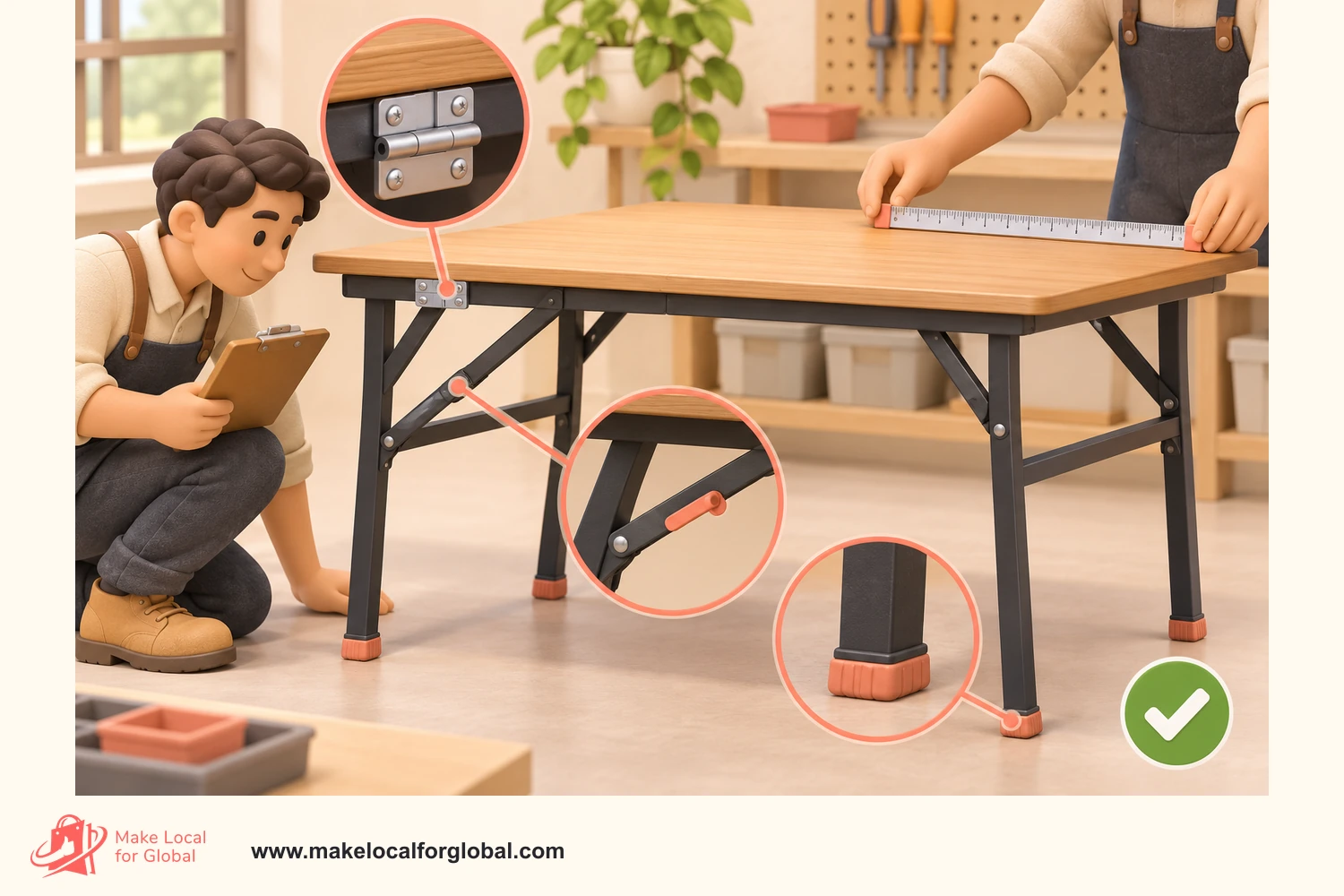
You may source through a UK wholesaler, a manufacturer, an importer, a trade marketplace or an overseas factory. The right route depends on the buyer, quantity, time, funds and how much product responsibility you can manage. A local wholesaler may offer smaller quantities and a simpler replenishment route. Direct importing may provide more control over specification or packaging, yet it can add freight, customs, inspection and traceability work. A dropship route can reduce stockholding, but it may limit your ability to inspect the table and control the delivery experience.
Ask each supplier to quote the same model and same specification. Send a short form with open and folded dimensions, top material and finish, frame material, table weight, carton dimensions, packed weight, minimum order, sample cost, lead time, warranty terms, spare-parts route, shipping method and the exact model reference. If the supplier answers with a catalogue family name instead of a model code, request the exact code before comparing prices.
Ask the supplier to identify the manufacturer and factory, the importer or responsible business where applicable, the model code and production batch. Ask for dated technical drawings and photos of the exact table from above, below, at each hinge and at each locking point. Ask how the product is opened, closed, locked and stored. Ask what misuse the instructions warn against. Ask how a customer can identify the model and whom they should contact if a defect appears.
Ask for test reports and risk documentation that match the exact product, not a similar table. Check the report’s issuer, date, model name, tested configuration, sample identification and result. Ask what test standard or method was used and what the report does not cover. If there is a claim about load, ask for the method and how the load was distributed. Ask for any current or past safety notices, corrective action, complaints or changes to the model. Save supplier replies with quotes and batch records.
Ask how the supplier handles a hinge or locking-part failure. Can they provide replacement feet or hardware? What is the expected remedy for a damaged carton, a missing piece or a table that does not lock? Will a replacement come from the same production specification? A supplier’s willingness to answer does not prove a table is safe, but vague or changing answers are a reason to pause.
An overseas quote may exclude transport to port, freight, insurance, customs declarations, import duty, import VAT, broker fees, handling, storage, inspection or the last-mile move to your premises. A UK quote can still exclude pallet delivery, tail-lift service or onward parcel costs. Request a landed-cost breakdown and confirm which charges can change with carton size or shipment date. Ask an accountant or customs specialist about your own tax and import position.
Before ordering stock, compare the supplier’s carton measurements with a physical sample. A small error can move the parcel into another carrier price band. For pallets, the table’s height, stack pattern and weight may affect storage and transport. If the supplier changes packaging to reduce freight, ask for a sample of the new packed version and repeat your damage checks.
Sample one item from each proposed construction, not one model and then a full range on supplier assurances. When the sample arrives, record the carton condition, model markings, parts, assembly steps and any difference from the sales photos. Photograph the table’s underside, joints, locking parts and labels. Keep the sample and documents together.
A small first order is a learning purchase. It can show whether the supplier keeps the same model, whether packing survives the route, how long setup takes, and what customers ask before buying. Agree a reorder point only after you know how long replenishment takes and how many sales are supported by evidence. If your buyer test has weak results, retain cash rather than tying it up in slow-moving large cartons.
Folding furniture has moving parts. A table can look polished in a photograph and still wobble, fail to lock, pinch a hand or arrive with a damaged edge. Inspect a physical sample on a flat surface and follow the supplier’s instructions. Do not use people, heavy objects or improvised loads as test weights. A sample review is not formal certification. Record what you checked and ask a qualified testing provider to carry out any testing needed to support safety claims.
First confirm that the sample’s model code, colour, dimensions and hardware match the quote. Compare it with the technical sheet. Check whether the seller, manufacturer or importer details are present on the product, packaging or supplied documents as applicable. Photograph the label and retain the invoice and supplier details. If the item has no clear identity, you may not be able to trace a later customer complaint back to a batch.
Inspect the top for sharp edges, cracks, deep scratches, exposed fasteners, loose trim or visible defects. View the underside. Look for gaps, uneven joints, missing rivets, bent brackets, loose bolts, sharp burrs or parts that move unexpectedly. Check the feet and end caps. They should be present, seated and alike across the model. A neat top does not compensate for a weak frame.
Follow the supplied instructions and open the table on a level surface. Check that each leg reaches its designed position and that each brace or locking mechanism locks as described. Do not force a part that does not fit. Watch for hinges that bind, sudden movement, loose pins, a lock that slips, or a brace that looks misaligned. Close the table using the stated method and check whether fingers need to pass near a pinch point.
Repeat the open and close sequence several times to spot a part that becomes loose or difficult to operate. This is an early inspection only, not a durability test. A laboratory or competent testing provider should establish suitable cycling or load tests for the product and intended use. Keep a note of how many cycles you performed, what instructions you followed and any issue you found. Do not turn “opened ten times without a visible issue” into a public claim about years of use.
With the table open and locked, check that it sits on a flat, firm surface and that all feet make contact. Use gentle hand pressure at different points around the top to notice rocking, leg movement or joint noise. Follow a defined, safe test method if one is available for that model; do not climb, sit or stand on the table. Do not load it with people or heavy items to “see what happens”. If the table rocks or a lock shifts under gentle handling, stop and seek a replacement sample or qualified assessment.
Check that the top remains attached when the table is opened and folded. Inspect screws, brackets, hinges and the underside after the movement. Look for changes in alignment or new cracks. Repeat checks after moving the sample and after reading the supplier’s care and storage instructions. Keep all test notes with the model code and sample date.
Moving hinges, folding legs and sliding braces can trap fingers. Study where hands naturally go during opening and closing. Note any sharp corners, unstable edge, exposed spring or gap where fingers could enter. Check the manufacturer’s safety information and warnings. Decide whether instructions explain how many people are needed to lift or open a larger model, how the table should be positioned, and where not to place hands. Do not write your own safety instructions without product expertise.
Folding tables may be used on floors and surfaces that differ from your sample bench. A garden lawn, paving, a carpet and a temporary event floor can change stability. The seller should describe the intended setting only as supported by product information and testing. Ask whether outdoor use is limited to a dry surface, whether the table must be stored indoors, and how to clean and dry it. Do not infer outdoor suitability from a product photo.
A GOV.UK product safety report recorded a high injury risk for one folding table with four seats as its structure was not sufficiently resistant to load and it broke easily; the report noted inadequate safety warnings too. This is a report about that named product, not proof that every folding table has the same defect. It is a useful reminder to check structural evidence, instructions and traceability before a similar product enters your range. Read the OPSS product safety report.
Write a simple pass, pause or reject record. A pass means the sample matches the specification and no initial issue was found within your limited inspection; it does not mean a laboratory has certified it. Pause means missing information or a repairable sample issue needs a new sample or documents. Reject means a visible safety concern, inconsistent model or supplier refusal to identify the table makes the product unsuitable to list on current evidence.
Do not quietly fix a product and sell it as supplied. A change to the brace, fastener, foot or packaging may alter the product or its safety. If you make or commission a change, get advice on your responsibilities and have the changed product assessed. Keep a version history so a later batch is not confused with the sample you reviewed.
Product rules depend on the product, market, supply route and intended use. This section is a practical starting point, not legal advice. Before selling, check the current rules for each part of the UK and any destination country. Ask a competent product-safety professional if you import, relabel, modify or sell a product with an uncertain regulatory route.
For Great Britain, GOV.UK guidance says the General Product Safety Regulations 2005 cover consumer products intended for, or likely under reasonably foreseeable conditions to be used by, consumers. The guidance describes duties for producers, including importers, to place safe products on the market, give relevant user information, support traceability and monitor risks. Distributors must use due care, retain information that shows where the goods came from and cooperate with authorities. The guidance states that Northern Ireland follows a different general product-safety regime since 13 December 2024. Read the Great Britain product safety guidance and the relevant Northern Ireland guidance before expanding the delivery area.
A product’s country of manufacture does not answer which rules apply to your business. Your position can depend on whether you are the manufacturer, importer, distributor or seller, and on product-specific laws. A supplier logo or general certificate alone is not grounds to claim “UKCA approved” or “CE certified”. Ask which legislation and standards apply to the actual table, who prepared the documents, which model and batch they cover, and whether the testing scope matches your intended sale. If you are unsure, pause the listing and get competent advice.
Keep supplier invoices, technical documents, model codes, batch information, customer complaints, inspection notes and any corrective action in a record you can retrieve. Link each inbound stock batch to supplier and purchase date. A simple spreadsheet may work at first: model, colour, supplier, batch or lot reference, arrival date, quantity, carton condition, defects, orders and complaints. When an issue arises, this can show whether it is one item or a broader batch pattern.
Place the manufacturer’s instructions where a buyer can read them before purchase if the instructions affect choice. Include the exact permitted use, opening method, locking steps, storage and care. State a load limit only if it is supported for that exact table and you can explain the test condition. Describe the need for a firm, level surface and warnings against standing, climbing or sitting only when these match the manufacturer instructions and the product risk information. Never add a warning as a substitute for a defect or an unsafe design.
If a customer reports a broken leg or a lock that released, stop and assess the concern. Capture photos, order details, model and batch information, when and where it was used, whether the instructions were followed, and whether there was an injury. Do not dismiss the report as user error before reviewing it. Follow the current guidance for reporting a safety issue and contacting the relevant authority. If you learn that a product poses an incompatible risk, the GOV.UK guidance describes notification and action duties for producers and distributors.
A table can have a low wholesale price and a high parcel cost. Measure the packed sample, then obtain carrier prices for the actual length, width, height and weight. Check maximum dimensions, oversize surcharges, postcode exclusions, delivery appointment options and what happens after a failed attempt. For larger formats, a pallet or two-person service may be needed. Confirm whether the quoted service includes a tail lift, kerbside delivery, room-of-choice delivery or packaging removal; these are different services.
Assume one medium table has a supplier cost of £34.00. Inbound freight, inspection and allocated import handling add £8.00 per unit. A protective carton and edge protection cost £3.20. A carrier quote is £12.50. Payment processing at an illustrative 2.0% of a £79.00 sale is £1.58. An allowance for returns, damage and replacements is £4.00 per order. Customer acquisition is estimated at £6.00. These are sample figures only; they are not current quotes from a supplier, carrier or payment provider.
| Cost line | Illustrative amount |
|---|---|
| Table purchase cost | £34.00 |
| Inbound freight and handling allocation | £8.00 |
| Protective packaging | £3.20 |
| Outbound delivery | £12.50 |
| Payment fee at 2.0% of £79 | £1.58 |
| Returns and damage allowance | £4.00 |
| Customer acquisition cost | £6.00 |
| Total variable costs shown | £69.28 |
| Example selling price | £79.00 |
| Contribution before overhead and tax | £9.72 |
Arithmetic: £34.00 + £8.00 + £3.20 + £12.50 + £1.58 + £4.00 + £6.00 = £69.28. £79.00 minus £69.28 = £9.72 contribution before overhead and tax. This is not net profit. It excludes storage, staff time, rent, software, insurance, accounting, photography, website costs, financing and any other business cost. If the delivery quote changes or a second delivery attempt is needed, contribution falls.
This example treats the £79 price and cost figures as a simplified cash model, with no VAT collected or reclaimed. A VAT-registered seller needs to model output tax and recoverable input tax according to their own position. GOV.UK states a £90,000 registration threshold for total taxable turnover, subject to rules for when registration becomes due and other cases. Check current VAT threshold guidance and speak to an accountant if the threshold or import VAT applies to you.
A table that is expensive to deliver can be expensive to return. Ask the carrier for a return label or reverse collection quote for the same packed size and collection postcode. Find out whether a collection requires the item to be boxed, whether the driver will bring packaging, and whether the buyer must move the carton outside. Do not assume that a return costs the same as sending the order to the buyer.
An allowance can help you compare models, but it does not replace a return policy. Track each return reason: too large, top colour different from expectation, hard to fold, damage in transit, missing part or quality concern. If most returns come from one confusion, revise the product page or images. If defects are recurring, review the supplier or stop the model rather than increasing the allowance.
A carry bag, spare feet or protective cover may create a more complete offer if it has a clear use and the supplier can confirm fit. A bundle can raise the order value, yet it adds another SKU, stock record and chance of a packing error. Check the add-on’s cost, dimensions and return handling. Do not describe a cover as weatherproof or a bag as suitable for a given model until compatibility has been confirmed.
A multi-table pack may suit a club or event organiser. Quote the total carton or pallet cost instead of multiplying a one-table delivery estimate. Verify whether the carrier can move the combined parcel, whether a delivery appointment is needed, and whether the buyer can receive the load. A price that looks lower per table may still leave the seller with a poor contribution after fulfilment.
For a larger home-furnishing range, our dining tables selling guide covers related buyer and fulfilment decisions. Keep this article focused on the extra checks that folding legs and bulky parcels add.
For bulky furniture, product data prevents avoidable hesitation and returns. A buyer needs to know if the table fits the room, vehicle, storage space and intended task. “Folds flat” is not a measurement. “Large table” does not say whether it fits through a doorway. Use a verified specification and keep the same measurements across the page, packaging, feed and customer service replies.
A product title should name the table type, its most useful verified size or feature, and the intended setting where the model supports it. For example: “Rectangular Folding Table, 120 × 60 cm, Indoor Use” is clearer than “Flexi Table Premium”. Do not place dimensions in the title until you have checked the sample and supplier drawing.
The first lines should answer what the buyer receives and which task it fits. “A rectangular folding table for extra indoor dining or craft space. Open size: [verified length] × [verified width] × [verified height]. Folded size: [verified dimensions].” Replace bracketed placeholders only after confirming the model. Avoid a general headline like “perfect for every occasion”, which makes a claim you cannot prove.
List open length, open width, height, folded dimensions, table weight, carton dimensions, packed weight, top material, frame material, finish, colour, locking steps, maximum load with test context if verified, intended indoor or outdoor setting, care instructions, contents, warranty information, model reference and assembly requirements. Mark values as estimates only if the supplier has identified them as estimates and you can explain why the customer can rely on them.
Clarify whether the top folds in half or the legs fold underneath. State whether the table has a carrying handle. Say whether the buyer needs tools. Explain what is included and what is not: chairs, tablecloth, storage bag or other accessories. If you cannot verify a particular specification, contact the supplier before publication rather than guessing from another product in the range.
Use a clean full product image, a close view of the underside and lock, a side view showing height, and a photo of the table folded beside an ordinary scale reference. Show the actual colour in neutral light. A room scene can help buyers judge its proportions, but a staged room must not hide the feet or make the table appear larger than it is. Do not add props that imply a use or load the manufacturer does not support.
A short demonstration can show the correct opening and closing sequence if it follows the actual instructions. Keep hands clear of pinch points. Do not speed up the mechanism so much that a buyer cannot see the lock move into position. Add captions and text for important steps so a visitor can follow without sound. If the image has been enhanced or the scene is illustrative, use a label or caption that makes this clear.
Include a short FAQ on the product page: What are the open and folded dimensions? How much does the packed table weigh? How does the lock move into position? Can it be used outdoors? What care does the surface need? What is the supported load and its test condition? How is a bulky return arranged? Which carrier service is used? When will it arrive? Do not copy an answer from a similar model. A concise “contact us if you need a room-fit check” can help, but the business must be ready to respond.
An own website gives you room for detailed specifications, delivery terms, measurement diagrams, comparisons and support information. It makes you responsible for traffic, payment, fulfilment and customer service. A marketplace can expose a product to shoppers already searching, but its rules, fees, returns process and listing fields must fit the product. Review current seller terms directly before calculating your contribution or placing stock.
A local collection option can be useful for customers who can pick up a table and avoid a long parcel route. It needs a clear collection address, opening hours, loading arrangement and process for checking a bulky item. A club or trade offer may work through direct quotes and repeat purchasing, but set limits on delivery area and minimum quantity based on what your carrier can actually handle.
Do not list every model on every channel on day one. Start with the route where you can make the delivery promise, show the full measurements and support the buyer. Use one or two models. Review questions and abandoned-checkout feedback before adding more. If a channel cannot show folded dimensions or if it forces delivery settings that do not match the carrier, choose a different route or give the buyer a clear pre-purchase contact option.
A table’s carton is part of the offer. Measure the packed sample at its widest points, including protective corners, handles and loose straps. Record all three dimensions and packed weight. Ask a carrier whether it prices by actual or volumetric weight and which maximum length or combined dimensions apply. Never rely on the supplier’s carton measurement alone if the supplier has not shown how the product is packed.
Send a packed sample through the intended carrier route to a colleague or test address. Photograph the carton before dispatch and after arrival. Inspect the top, edges, hinges, frame, feet and hardware. Check whether the carton can be carried safely by the receiving person and whether the table moves inside the box. A drop test done without an agreed procedure should not be described as proof of transit protection. If transit damage matters to the product, use a qualified packaging test provider or follow carrier guidance for the shipment type.
Keep packaging that protects the corners and locking parts. Use separators to stop metal frame parts rubbing against the top. Prevent hardware from moving loose inside the carton. Add instructions so a buyer knows which end to open and how to lift the table out. Keep the carton compact without placing pressure on the frame. Recheck the packed dimensions after any change; a stronger carton may raise the carrier cost.
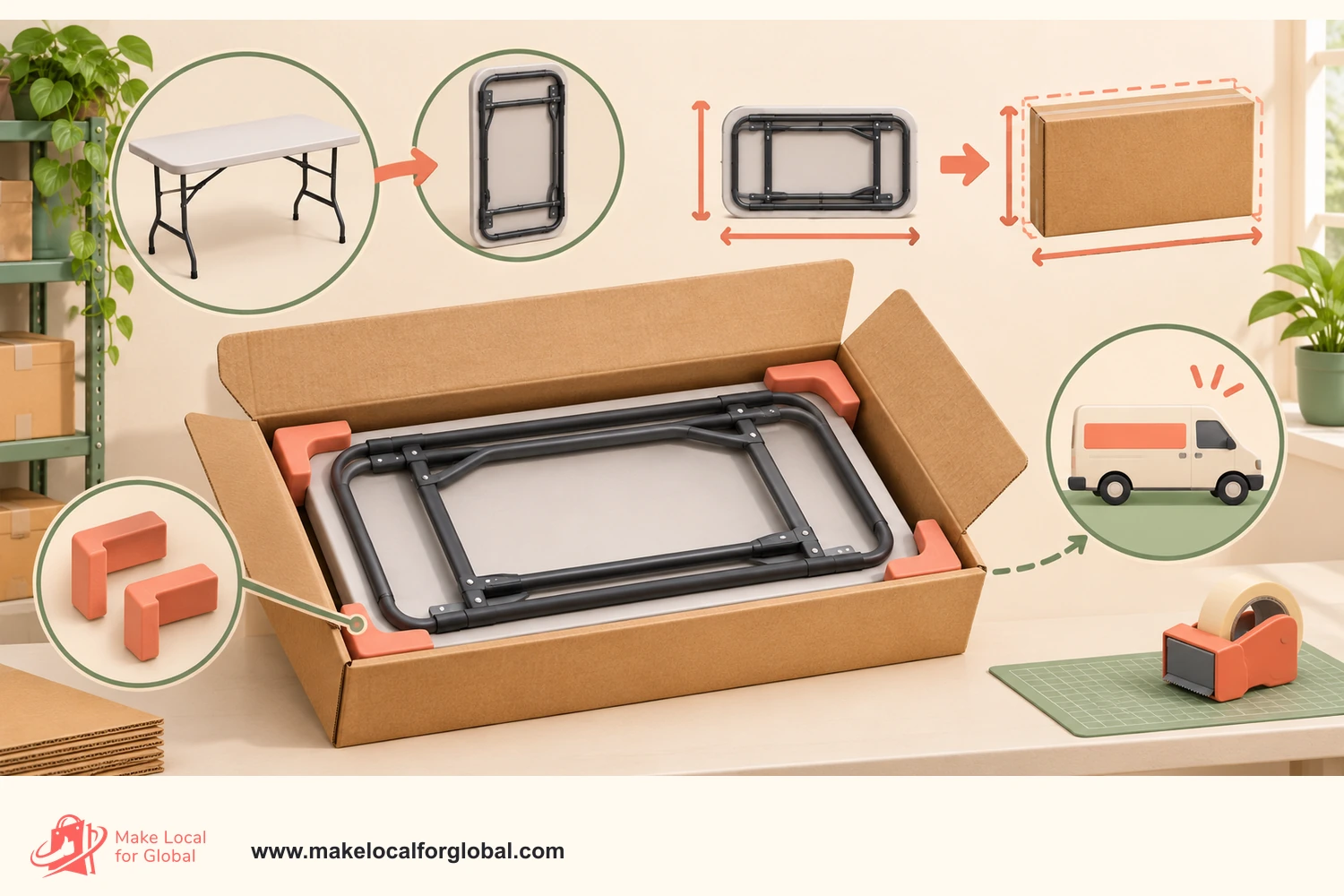
A dozen table cartons can take more floor space than a dozen small parcels. Measure the storage area, aisle access, door width and any shelving limits. Follow supplier stacking guidance. Do not stack pallets beyond a stated limit or in a way that puts load on the table top, hinges or carton edges. Count receiving time, moving equipment, safe lifting and any pallet storage fees.
Plan who checks the delivery on arrival, who records damaged cartons, how stock is labelled and where the inspected sample is kept. If the carrier leaves goods without a signature, photograph them as soon as they are found. Set a process for keeping damaged stock out of sellable inventory. A simple “available / held / damaged / returned” stock status can reduce the chance that a customer receives an item that has not passed the receiving check.
State the delivery price, delivery area, estimated timeframe, service type, tracking method and any access limits before checkout. Tell customers if the service is kerbside, one-person, two-person, room-of-choice or collection. For a heavy or long carton, explain who must be present and what happens if no one can accept it. Avoid a vague “free delivery” claim if the cost has been built into the price; the price and service should still be clear.
GOV.UK distance-selling guidance says a seller must provide business contact details, a description, the price including taxes, payment information, delivery arrangements and costs, cancellation information and other contract details before the order. It states goods should arrive within 30 days unless another period is agreed. Read the current online and distance selling rules and make the delivery promise visible before payment.
Online buyers normally have a limited period to cancel an eligible distance purchase. GOV.UK says the customer can tell the seller within 14 days of receiving an item that they want to cancel and has another 14 days to return it; the seller must refund within 14 days of receiving the item back, subject to the rules. Faulty goods and goods not as described have separate rights. See GOV.UK guidance on returns and refunds. Check how these rules apply to your exact business and product.
A practical return workflow records the request date, order number, product model, condition, reason and collection plan. Give clear instructions for retaining or sourcing the packaging. Agree who pays which delivery cost under the applicable rules and stated terms; do not create a blanket “no returns on furniture” statement. Check each returned table for damage and put it on hold until inspected. Do not resell a returned table as new without checking its condition, hardware, carton and instructions.
If you are testing the product as part of a new shop, explore the MLFG business apps and select a tool that matches the decision you are trying to make. Use any output as a planning aid, not proof of demand.
Use small, measurable tests before committing to stock. Ask people in the chosen buyer group to compare two clear size options, each with verified dimensions and a delivery estimate. Track how many open the specification, ask about carrying or fit, request an order quote, or complete a purchase. “Likes” can show that someone saw a post; they do not show whether the full offer works at the delivered price.
A landing page can show one sample, the measurements, a planned delivery area and an interest form. A local business group may help you reach market sellers or clubs. A small search campaign can test phrases such as “folding table for market stall”, “compact folding dining table”, or “folding table delivery”. Treat search terms as test ideas, not claims of demand. Review the words people actually use and compare them with the product’s verified fit.
If the supplier can sell a small quantity, one or two samples plus a limited stock run may be lower risk than a large import. If they require a high minimum order, compare the amount at risk with evidence from interviews, enquiries and signed purchase requests. Keep the stock commitment separate from an expression of interest. A customer who submits a refundable reservation at an honest delivery date is stronger evidence than someone who says they might buy at an unknown price.
Review the result by buyer, model and delivery postcode. A medium table may get interest but lose orders after shipping is shown. That is useful information: the offer, price or service route may not fit. A long table may receive few enquiries yet one club asks for six; then quote the whole delivery and storage plan before adding it. Do not average these very different signals into one vague demand score.
A launch plan should say what you will do, what result you will record and what decision that result supports. The aim is to learn whether one table, one price and one delivery route can serve one buyer group with an acceptable customer experience. It is not a promise that the first ten orders will happen on a fixed date.
Speak with five to ten people who have used or bought a folding table recently. This number is a working test target, not a statistically representative survey. Ask about the last use, surface size, folded storage, transport, price paid and frustration. Record the exact phrases. Choose one target group and write the constraint that your first product must solve.
Search existing listings and customer questions to learn which measurements sellers publish. Save a small comparison with model type, dimensions, weight, folded format, delivery and stated use. Do not copy competitors’ product claims; use this only to find gaps in the information a buyer needs. If you see repeated complaints about size or damage, verify them with your own buyer interviews before treating them as a market fact.
Send the same specification request to at least three suppliers where possible. If only one can supply the product you want, record that limitation and consider whether it increases sourcing risk. Request exact model documentation, carton measurements, lead time, minimum order, sample price, safety evidence and written delivery terms. Compare landed costs on the same basis.
Inspect the sample on a flat surface. Photograph the lock, hinge, brace, top, feet, model label and carton. Follow the instruction sequence. Record defects and unanswered questions. Decide whether the evidence supports a small listing test or whether a second sample or professional review is needed. Do not let a low sample price move you past an unresolved safety concern.
Choose one or two models. Confirm every measurement and material statement against the actual model. Get a carrier price for the packed table and a reverse collection estimate. Build the contribution calculation with supplier cost, inbound handling, packaging, carrier service, payment fees, returns allowance, customer acquisition and overhead assumptions. Test a higher-cost scenario for a failed delivery or a damaged carton.
Write the listing with verified dimensions, folded size, weight, care, instructions, delivery and returns. Make a product page image set that shows the open table, folded table, underside, locking points, size reference and carton dimensions. Use alt text to describe each image for people using screen readers. Ask one person unfamiliar with the item to find the folded dimensions and delivery terms without your help; revise any confusing section.
List the chosen model on the channel you can support. Contact the small buyer group you interviewed and share the actual page and delivered price. Record impressions, product-page visits, questions, add-to-basket activity, completed orders, delivery outcomes, return requests and time spent on support. Review each sale individually. A low order count may reflect limited reach, an unclear offer, a price mismatch, an unsuitable delivery area or weak demand. The evidence needs context before you decide.
After the first orders, check packaging condition, setup questions, table performance reports, delivery time and return reasons. Compare actual variable costs with the estimate. Update the margin model when a carrier invoice or payment statement arrives. Reorder only if the sample and batch remain consistent, the product is traceable and the delivered offer contributes enough to cover overhead.
For each model, record: buyer, product code, batch, sample status, evidence reviewed, landed cost, carton size, delivery quote, public claims, returns route, date listed and decision date. Mark each decision as continue, revise, pause or stop. Write one sentence describing why. A decision log can help you avoid repeating an early assumption when a supplier changes a hinge, carton or finish.
Include the table, packaging, carrier, payment fee and a realistic returns allowance in your contribution estimate.
Choosing by unit price alone. A supplier quote that looks low can be outweighed by a long carton, pallet storage, handling or a return collection. Compare complete order costs before committing.
Using a supplier photo as proof of fit. A staged scene can make a small table look large or hide the folded format. Ask for exact dimensions and use your own measurement diagram.
Copying a load claim from another model. A similar-looking frame may use another top, hinge or brace. Keep every claim attached to the exact model and evidence.
Treating warnings as a repair. Warnings can tell a buyer about safe use; they do not make an unsafe or defective structure acceptable. Follow up on the design concern itself.
Ordering too many sizes at once. Additional models tie up cash and create carton, image, storage and stock-control work. Expand only when a buyer group and sales record support the next option.
Assuming a large return costs the same as a parcel. Get the reverse collection rate and process before publishing the return promise. A customer should not discover after purchase that the product cannot be sent back through the stated method.
Hiding delivery restrictions until checkout. If the service excludes certain postcodes or needs someone to be home, say so before the buyer pays.
Making outdoor or waterproof claims from appearance. A coated frame or plastic top does not prove that the whole table can stay outdoors. Use supplier evidence for the exact model, then state care and exposure limits.
Selling a changed product as the same model. A new foot, hinge, top or carton can change performance. Review supplier change notices and compare each batch with the approved sample.
Calling contribution profit. Contribution covers only the costs included in the calculation. Net profit must account for overhead, tax, owner time and other business expenses.
Choose a size after speaking with your intended buyers and checking their room, vehicle, storage or stall constraints. A medium rectangle may fit several tasks, yet it is not a universal best choice. Compare its open and folded dimensions with a specific buyer use. Start with a product whose measurements and delivery route you can explain.
Possibly, if the supplier can identify the exact model, provide usable safety and traceability information, ship in protective packaging, share accurate dimensions, handle stock changes and explain returns. Order a sample and test the customer route before listing. If you cannot inspect the product or investigate a defect, the lower stock commitment may not make up for the gap in control.
The documents depend on the product, role and market. Ask the manufacturer or supplier for product-specific risk information, instructions, traceability, relevant test reports and the exact models or batches they cover. Do not assume a generic certificate or a compliance logo answers every question. Review current rules for Great Britain, Northern Ireland and each export destination.
Follow the manufacturer’s instructions, use a flat firm surface and inspect the actual locking, hinge, brace, top and feet. Do not sit, stand or climb on the product or use people as test weights. Record limited visual and operational checks. For formal loading, durability or safety questions, use a competent testing provider and the right method for the product.
Measure the packed sample at its longest, widest and highest points and weigh it. Ask carriers which pricing method, size caps and surcharges apply. Check postcode coverage, delivery attempts, appointments, access and reverse collection. Add the full delivery charge to the order model rather than pricing from the table dimensions alone.
Show open and folded dimensions, height, weight, materials, care, locking steps, model reference, carton size, delivery service, timeframe, cost, returns route and any supported load data with test context. Use photos of the open table, folded table, underside and locking points. Do not publish a figure until you have checked it against the exact model.
Ask them to stop using the table and share the model, order, batch or label, photos and a description of what happened. Keep the product and related stock out of sale during the review. Record the issue, contact the supplier and follow the relevant authority’s current reporting guidance where required. Do not dismiss a safety complaint before examining it.
Only when evidence for the exact product supports that claim and defines what it means. The top, frame, joints and hardware may respond differently to exposure. A better listing may state the manufacturer’s tested use, care and storage advice in plain terms. If the documentation does not support continuous outdoor exposure, do not imply it.
One well-documented model can be a sensible first test. Add a second when it serves a different buyer task or size need and you can handle its separate stock and delivery costs. Three options can help shoppers compare only when the distinction is meaningful. A wide catalogue is not evidence of demand.
Calculate the carrier cost and include it in the selling-price model if you choose to advertise delivery as included. State the actual service and any postcode or access limit. A separate delivery charge can be clearer for a bulky item, particularly when the cost varies by region. Compare completed orders and abandonment with the same service terms before changing the offer.
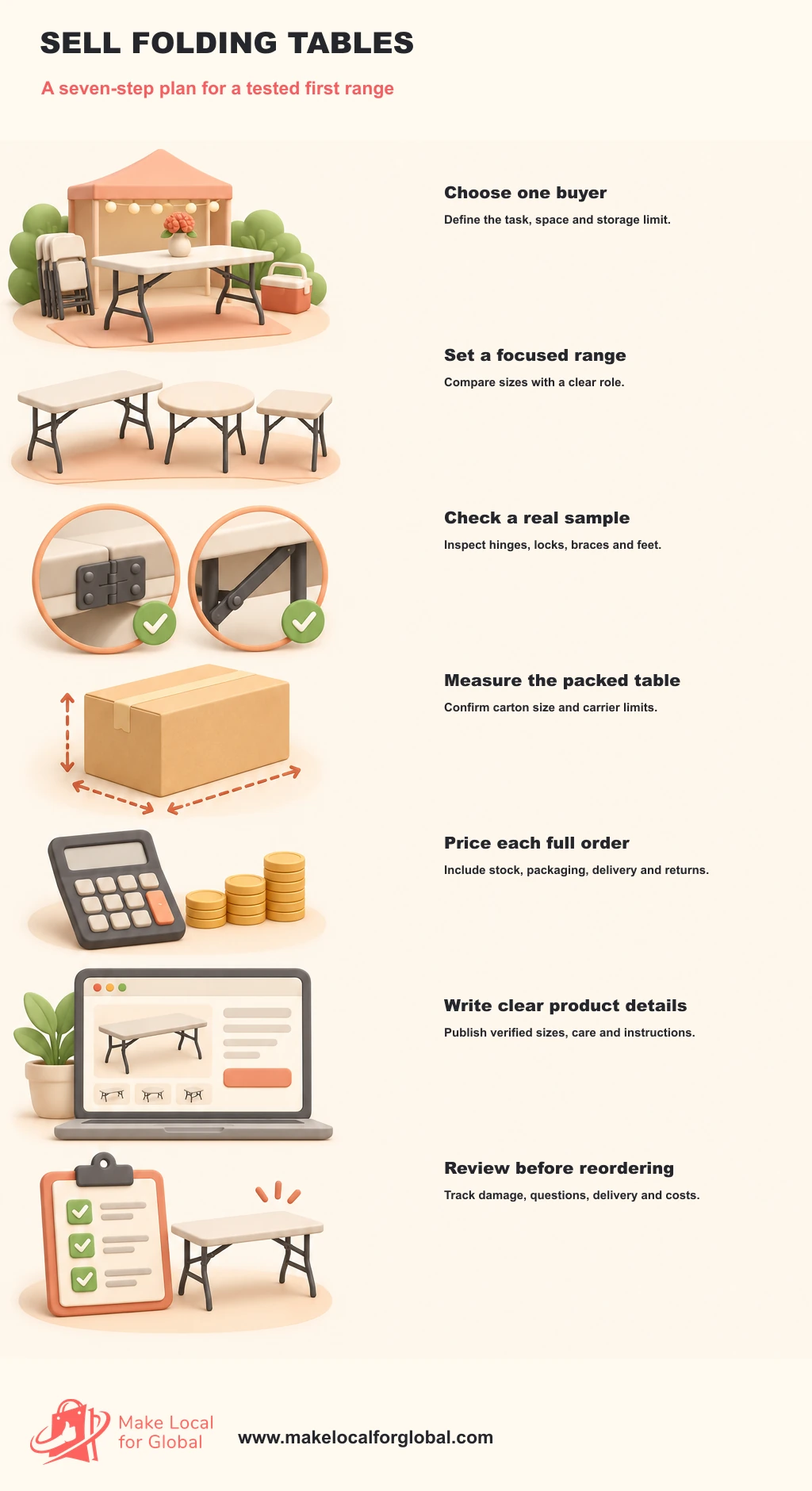
Selling folding tables online starts with the measurements and evidence behind one real product, not a large catalogue. Choose one buyer, compare the same specification across suppliers, inspect the locks and frame, calculate the packed delivery cost and publish facts you can support. Keep the first offer small enough that a defect or a poor delivery result can be investigated before a larger reorder.
If your sample passes the checks you can make, the supplier can identify the model and batch, and the delivered price leaves room for operating costs, run a small sales test. Track what buyers ask, what the carrier charges, how the carton arrives and why anyone returns the table. Use those records to revise the page or range before you increase the order.
Explore MLFG’s free business apps to organise your product test, assumptions and next steps.
PREFERRED SOURCE
Like what you’re reading? Add Make Local for Global as a preferred source on Google to see more of our articles when you search.

Build your online presence without having to figure out everything yourself.