Compare wholesale payment terms, supplier due dates and deposits to plan the cash gap before accepting a retailer order.


Wholesale can look healthy on paper while cash feels tight in the bank. A retailer may owe you money, your supplier may already need paying, and the next order may require another outlay before the last invoice clears. That difference in timing is the payment terms gap.
Planning the gap does not mean demanding the shortest possible terms. It means understanding what your agreement asks each side to do, how much cash may be committed while you wait, and what questions to settle before accepting an order.
“Net 30” can sound clear until the parties count from different events. One business may mean 30 days from the invoice date. Another may expect the clock to start after delivery or acceptance. The written order or contract should make the trigger, due date, payment method and route for invoice questions unambiguous.
Agree the terms before the first order and keep a written record. The UK Small Business Commissioner explains that payment terms should be agreed in advance. Its guidance describes common payment periods and payment rights, but the terms that apply depend on the contract and situation. Read the current official guidance rather than treating an example term as a rule.
Compare supplier due dates, retailer payment scenarios, deposits and a delay buffer in the free Wholesale Payment Terms Lab.
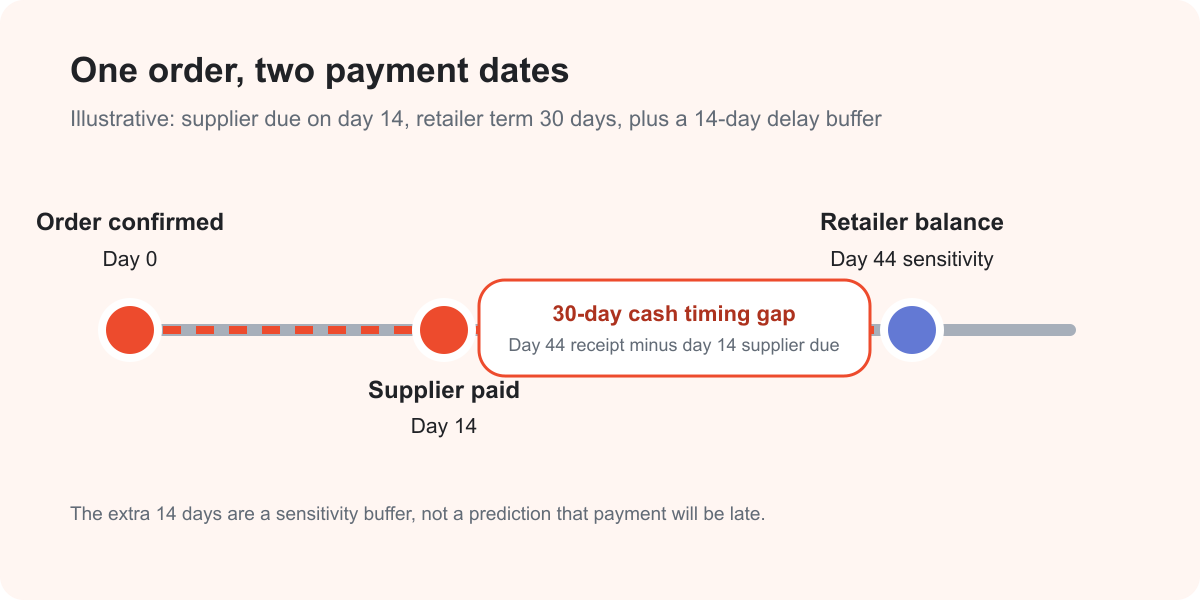
Suppose one representative retailer invoice is £600. You expect a £120 deposit before fulfilment, and you estimate £330 in product and delivery costs that must be covered before the invoice balance arrives. Your supplier expects payment 14 days after the order. You also want to examine what would happen if the balance arrives 14 days after its agreed date.
With payment at dispatch, the delay-buffer case places the estimated receipt on day 14, the same day the supplier payment is due. With 30-day retailer terms, the sensitivity case places receipt on day 44. The cost payment is due at day 14, so the simple timing gap is 30 days. A 60-day term with the same buffer means receipt on day 74 and a 60-day gap.
The £120 deposit reduces the amount of the £330 pre-receipt costs that needs covering to £210 for this illustrative order. It does not remove every cash requirement. Repeated orders can overlap, and overheads, tax, refunds and other supplier bills still need attention. Treat this example as arithmetic to discuss, not a forecast or a recommended term.

A one-order gap is only one part of the picture. If you fulfil similar orders regularly, some may be waiting for payment while new ones are being produced. A basic sensitivity model can make this overlap visible, as long as you understand its assumptions.

For a rough estimate, divide your gap days by 30.4375 and multiply by similar orders per month. That gives an approximate number of open orders under an even-order assumption. Multiply that by the cost still uncovered after deposits. Then, if useful, add the portion of monthly operating costs you intend to cover during those same days.
Keep outstanding invoices as a separate measure. A business may have substantial receivables even when its estimated cash gap fits the reserve it entered. Conversely, a short gap can still feel difficult if orders arrive together or other bills fall due. Seasonality, disputed invoices, late payment, VAT and taxes, finance costs, bad debt and supplier changes are not included in the simple estimate.
Use a model to prepare a conversation, not to dictate the answer. Ask both sides what each date means and which event proves that the next action is due.
Write down the terms that both parties have accepted. A spreadsheet, quote or friendly message can be useful evidence, but check that the final contract and purchase documents match what you intend. If the transaction is material or unclear, get appropriate professional advice.
Cash planning also depends on consistent invoicing and follow-up. Send a correct invoice through the agreed channel, include the purchase-order reference if required, record the due date, and confirm receipt. Set a reminder before the date and a calm follow-up for the day after an overdue invoice. Keep copies of delivery evidence and messages so a real query can be resolved promptly.
UK rules can provide rights when a commercial invoice is late, including statutory interest and recovery costs in qualifying circumstances. The details matter, and a contract may contain agreed terms that affect the position. Check the current GOV.UK late commercial payments guidance, the Small Business Commissioner guide to payment rights and, where needed, the relevant legislation. This article is general education, not legal advice.
Try the payment-at-dispatch, 30-day and 60-day examples with your own £ figures, supplier due date and reserve. Then take the assumptions to your buyer and supplier.
This lab isolates one part of a wholesale order: when money leaves for costs and when a retailer balance may arrive. For a broader view across more months, sales assumptions, stock and overhead, continue with the wholesale cash-flow planning guide and the Wholesale Simulator. If you are still shaping a first retailer order, the wholesale first-order plan helps organise the wider checklist.
Choose one actual or likely order. Confirm the supplier due date, retailer invoice trigger, deposit and remaining payment date. Add a delay sensitivity that you can explain. Check how many orders could overlap and what cash is already committed. If the estimate is uncomfortable, discuss different timing, a deposit, staged fulfilment or a smaller first order before accepting terms.
Clear terms support a better working relationship because both parties know what was agreed. A simple model cannot make a buyer pay on time, but it can help you ask a precise question before you commit cash.
Check how supplier due dates and retailer terms change the estimated cash you need. The free lab keeps the assumptions clear and lets you download a worksheet to discuss.
PREFERRED SOURCE
Like what you’re reading? Add Make Local for Global as a preferred source on Google to see more of our articles when you search.