

Use an eight-point ecommerce customer service audit to review real customer journeys, separate evidence from assumptions and choose one improvement to retest.


An ecommerce customer service audit is a practical review of what happens when someone needs help before or after placing an order. Instead of judging your shop by a vague feeling or one unusual complaint, follow a small number of real customer journeys, record what you can verify and choose one improvement to test. This eight-point review is designed for a small online shop that needs a clear view without a complicated support platform.
The aim is not to give customers a score or to promise that every issue will disappear. It is to see whether buyers can find help, understand what to expect and receive an accurate next step. For a broader guide to writing the routine itself, see our ecommerce customer service process guide.
Use the free Customer Service Assessment to check eight parts of your support journey and turn your answers into a focused three-page PDF plan.
Choose one ordinary question that your shop is likely to receive, such as “Where is my order?”, “Will this fit?” or “How do I request a return?”. Follow what a customer can see from the relevant product or order page through to the next useful action. You can also review a real support example, but remove names, contact details, addresses, order references and other personal information before turning it into a learning note.
Keep the sample small enough to review consistently. A handful of recent questions or a few test journeys can reveal a gap worth checking. It is not a statistically representative measure of customer satisfaction, and one contact does not prove that every customer has the same experience. Note the date, the page or route reviewed and what you actually observed. If your products, order volume or fulfilment arrangements have changed, record that context too.

Check the route from places where a question is likely to arise: a product page, order confirmation, account area and help or contact page. Try it on a phone and with a keyboard. Does the link work? Is it clear which inbox or form handles the request? Does it explain what order information will help, without asking the customer to send information that is not needed? If social messages are not monitored, avoid presenting them as a reliable service channel.
Compare the wording on your site with the hours and people actually available to read messages. “We usually reply within one working day” is more useful than “We will get back to you soon” only if you can normally meet it. Check weekends, holidays, busy periods and messages received outside your usual hours. If a customer is waiting longer than expected, review whether the team has a simple way to send an honest update with a realistic next time.
Review the product details and order information customers use most: dimensions, materials, compatibility, setup, delivery estimates, payment details and the route for returns. Is the wording readable on mobile? Does it agree with your current operation and the information shown at checkout? GOV.UK explains information businesses need to provide for online selling. Use that current official guidance to review your own obligations rather than treating a service audit or template as a legal assessment.
Review whether the response acknowledges the issue, shares facts that have been checked, names an action and tells the customer when to expect another update if the matter remains open. A saved reply can help with structure, but it should not hide the person’s actual concern or state a fact that has not been confirmed. If you do not know yet, say what you are checking rather than guessing.

Compare a response with the relevant order record, product information, carrier update or current published policy. Separate what the record confirms from what is still uncertain. A delivery scan can show that an event was recorded; it may not explain the customer’s whole situation. A generic script is not a reliable way to decide whether a product is faulty or what remedy applies. For returns and refunds, read the current GOV.UK guidance and consider the specific product, transaction and circumstances. Get qualified advice when a case is unclear or significant.
Follow an unresolved question across the people or systems involved. If a supplier, carrier or colleague needs to investigate, is there one owner who will request the check and update the customer? Can another team member see what is still open without asking the customer to repeat everything? Look for a point where a case could be passed between inboxes and forgotten. The audit is about the hand-off, not about blaming the person who handled one message.
Identify a few cases that should not be answered from a routine template: a safety concern, a possible privacy issue, a disputed payment, a complex complaint or a request that needs a policy decision. Does the team know when to pause, who can review it and how the customer will be kept informed? A clear escalation route helps a small shop avoid unsupported promises while making sure an unusual issue is not left waiting without an owner.
Group recurring topics into broad categories such as delivery, fit, product detail or setup. Compare them over a period that suits your order volume, and note relevant changes such as seasonal demand or a new product. A pattern is a prompt to investigate, not proof of a single cause. The Information Commissioner’s Office recommends that small organisations review feedback and complaints while paying attention to data accuracy, security and keeping information no longer than necessary. See the ICO’s data protection advice for small organisations. Keep an improvement log focused on the issue and action, not unnecessary customer details.
For each gap, write four short points: what you observed, why it could matter to the customer, what small change you will make and when you will repeat the check. For example, you may notice that the delivery estimate appears on the product page but the contact route is difficult to find after an order. You could move the monitored support link beside the delivery information, then repeat the same task on a phone. Record whether the route was easier to find and whether the page still matches your actual support capacity.
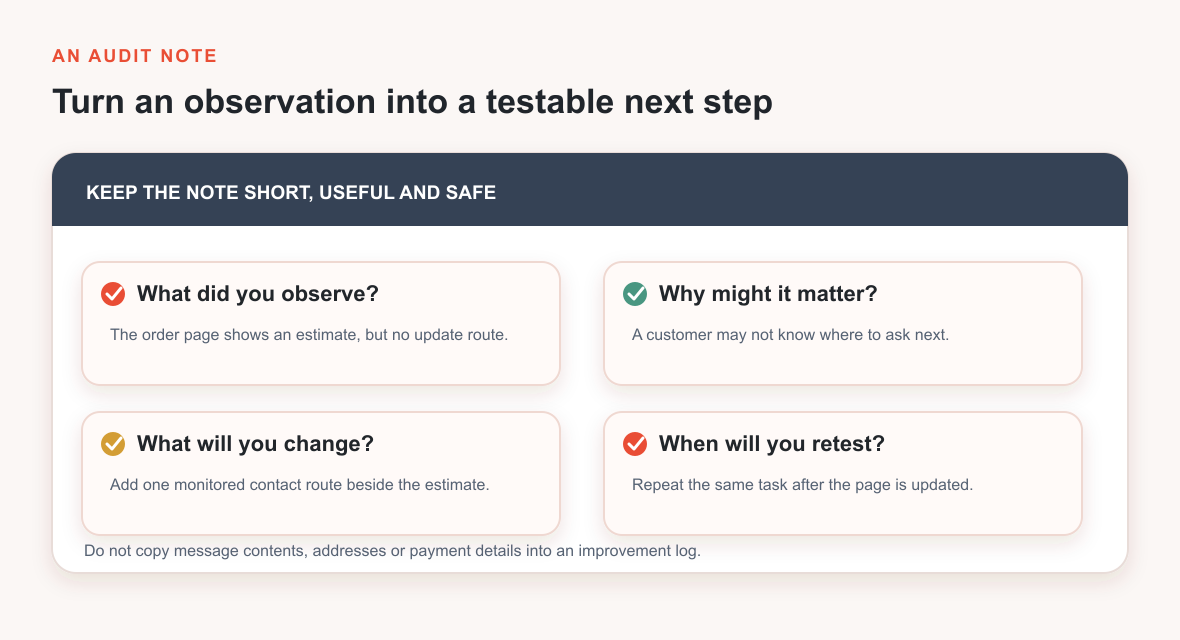
Avoid changing several parts of the service at once if you want to understand what changed. For a small shop, a simple before-and-after note may be enough to make the next decision. It cannot prove that the change caused every difference, but it creates a clearer record than relying on memory.
Review your current evidence in the free app, then use the suggested next check to decide what to inspect first.
The free Customer Service Assessment asks eight questions. Each answer reflects a step you can currently verify, with scores of zero, two or four, for a total of up to 32 evidence points. The result organises your answers and suggests a practical next check. It is not a probability, a customer-satisfaction rating, legal advice or a prediction of revenue or business success.
A lower result directs you to map the support journey before adding tools. A middle result highlights the next customer update to clarify. A higher result encourages you to keep an established routine aligned with the channels, products and capacity people experience today. In every case, use the individual answers and evidence map to choose one next action. Do not treat a band as a pass mark.
To build the response routine itself, the free Customer Service Mini Course offers a broader six-lesson activity. The audit and the course have different jobs: one reviews what is currently visible and verifiable, while the other helps you draft a working process.
It is a structured review of how a customer finds help and what happens when they ask a question. A small audit follows selected journeys, checks evidence and records a practical improvement to revisit. It is not automatically a customer-satisfaction survey or a legal compliance assessment.
Choose a review rhythm that fits your order volume and the amount of change in the shop. You might review a recurring issue monthly, after a checkout or fulfilment change, or before a busy period. The important part is to use a similar task and record the date and context.
There is no universal sample size for every small shop. Start with a manageable selection of recent examples or a repeatable test journey. Use the result as a signal for investigation, not as a statistically representative customer score.
Choose a measure linked to a process you can observe, such as whether a monitored support route is findable, whether the first reply includes a verified next step, or whether open cases have an owner. Pair counts or timings with a review of the underlying examples so the number is not mistaken for the whole customer experience.
No. This educational review helps you inspect your process. Legal obligations can depend on what you sell, who buys it, where the transaction takes place and the facts of a particular case. Check current official guidance and get qualified advice when you need it.
A useful ecommerce customer service audit does not need to end with a long list of new software or policies. Start with a real question, follow the customer-visible route, check the relevant facts and write down one change you can review. When the next similar journey comes along, repeat the task and see what is clearer, what remains uncertain and what needs a different owner.
Use the assessment to organise your current evidence. If you also want help setting up the wider store, compare the £99/year plan or talk through your needs with MLFG.
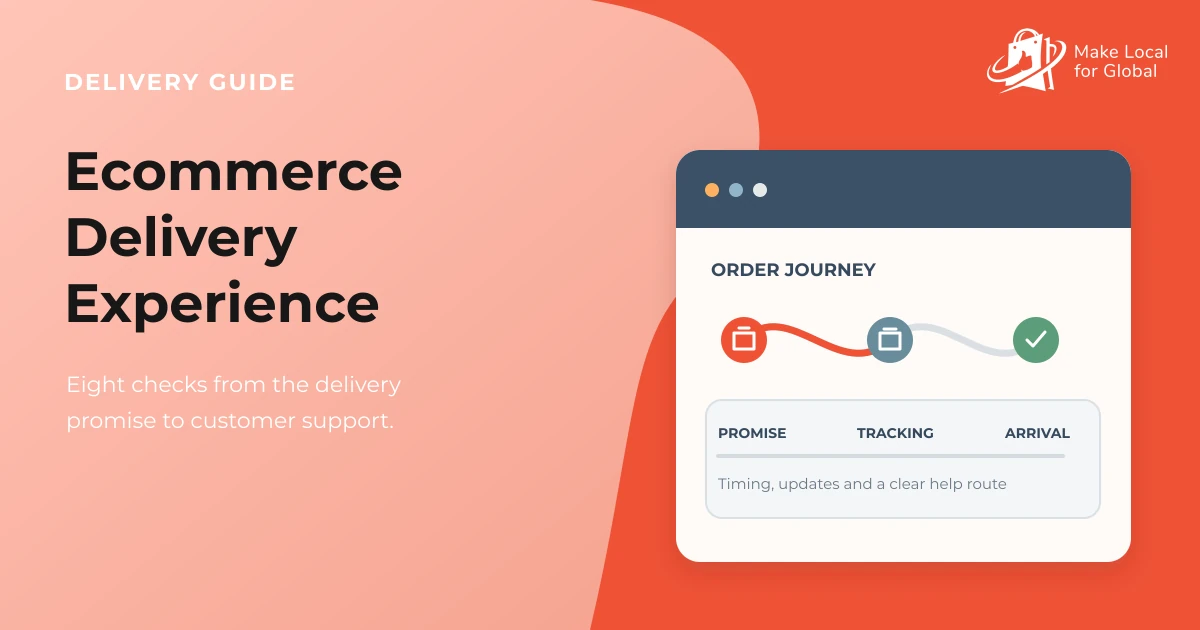
For another operational review, read our ecommerce delivery experience checklist or return to the customer service process guide.
PREFERRED SOURCE
Like what you’re reading? Add Make Local for Global as a preferred source on Google to see more of our articles when you search.
























Build your online presence without having to figure out everything yourself.