

Use eight customer-focused checks to review delivery promises, costs, tracking, delays and support across an ecommerce order.

Delivery is part of the product experience. A buyer notices what your store promises before paying, whether updates arrive while the parcel is moving, and how quickly someone helps when a delivery goes off plan. A low-cost carrier label is not a complete delivery experience if the customer cannot tell when an order will arrive or what to do next.
This guide gives you eight practical checks for reviewing an ecommerce delivery experience. The aim is not to make every parcel arrive on the same day. It is to make the customer-facing promise clear, keep it aligned with the way orders are prepared, and give people a useful update when circumstances change.
Answer eight short questions about timing, options, tracking and support. Get an evidence summary and practical checks for the next review.
Customers need enough information to decide whether a delivery option fits their needs, then enough communication to understand what happens after an order. That usually means a realistic time estimate, a visible total cost, clear service limits, a dispatch update, a useful tracking route and an accessible way to ask for help.
Dependability does not mean promising a date you cannot control. It means explaining what your estimate includes and how you will respond if the parcel moves outside that expectation. Your preparation time, the carrier journey, product availability, destination and seasonal demand can all affect the experience. Keep those parts distinct in your own records.
In the UK, official online selling guidance says customers should be given the total price, including delivery costs or how those costs are calculated, before they place an order. The Consumer Rights Act 2015 also sets out delivery timing rules: where a different time has not been agreed, goods should be delivered without undue delay and within 30 days. These are general references, not a complete legal checklist. Check the current guidance and get qualified advice for your situation.
GOV.UK guidance on online selling · Consumer Rights Act 2015, section 28
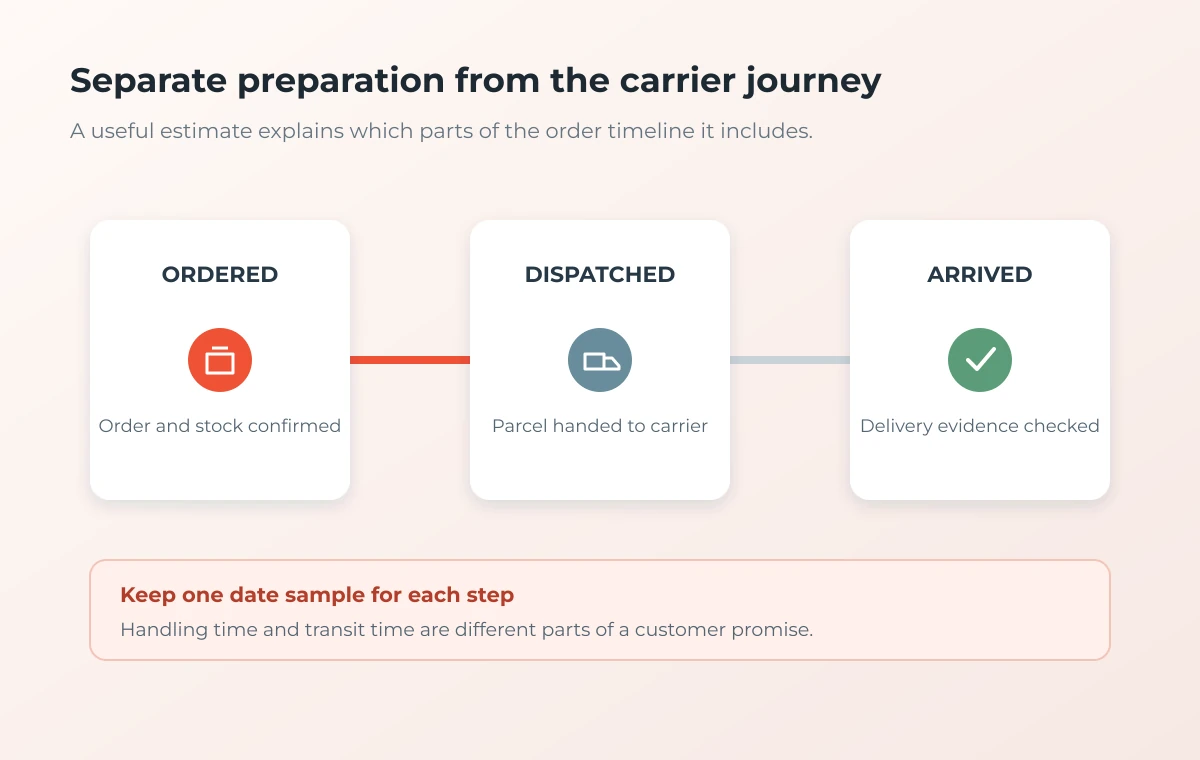
Look at a small, recent sample. Record the order date, the date the order was ready, carrier handover date and arrival date. Compare these with the estimate a customer sees before payment. Separate handling time from transit time, especially if some products are made to order or dispatched on set days.
Do not base the promise only on a carrier’s usual service description. Your own picking, packing, stock availability and cut-off times may add time before the carrier has the parcel. Review the estimate again after a supplier, fulfilment route or seasonal pattern changes.
Check the customer journey on a phone as well as a computer. Can a buyer compare the delivery methods, prices and expected timing before they commit? Are surcharges, free-delivery conditions, bulky-item limits or postcode exclusions visible when a customer chooses an option?
For example, if standard delivery costs £3.50 and an optional tracked service costs £5.95, show the difference and timing in the same decision area. These are sample amounts only. Use your actual prices and make sure the order total reflects the option selected.
Try the boundaries of your service: a remote postcode, a region you do not serve, an oversized product or an item with special handling needs. Note when the customer learns that a route is unavailable. A restriction that appears only after several checkout steps can feel like a surprise, even if the carrier configuration is technically correct.
Customers can interpret “delivery in three days” differently from “dispatches in three working days, then travels with the carrier”. Make your wording specific enough to explain the timeline without overwhelming the buyer. If stock status, personalisation, weekend handling or a daily cut-off changes the estimate, say so near the delivery choice.
Place a test order and check the messages that arrive: confirmation, dispatch, tracking and any delivery-day notice. Open links on a mobile phone. Confirm that a customer can tell whether the parcel is awaiting collection, moving, delayed or marked delivered. If a service does not provide tracking, explain what updates the buyer should expect instead.
Decide who checks a stalled tracking event, returned parcel, missed delivery or carrier exception. Give that person a simple route to contact the customer with what is known, what is being checked and when the next update will arrive. Avoid promising a replacement, refund or delivery date before the facts and the applicable policy have been checked.

Review what the customer sees when the carrier marks an order delivered. Can they find the proof or delivery status? Is there a clear support route if the parcel is not where expected, arrives damaged or is delivered to the wrong place? Check your process against the evidence and options provided by the carrier services you actually use.
Group recent delivery questions into themes such as cost, timing, tracking, missed delivery and damage. You do not need a complicated dashboard. A simple monthly count can show whether the same unclear message or fulfilment issue keeps appearing. Record the process change you make, then repeat the same customer-view test.
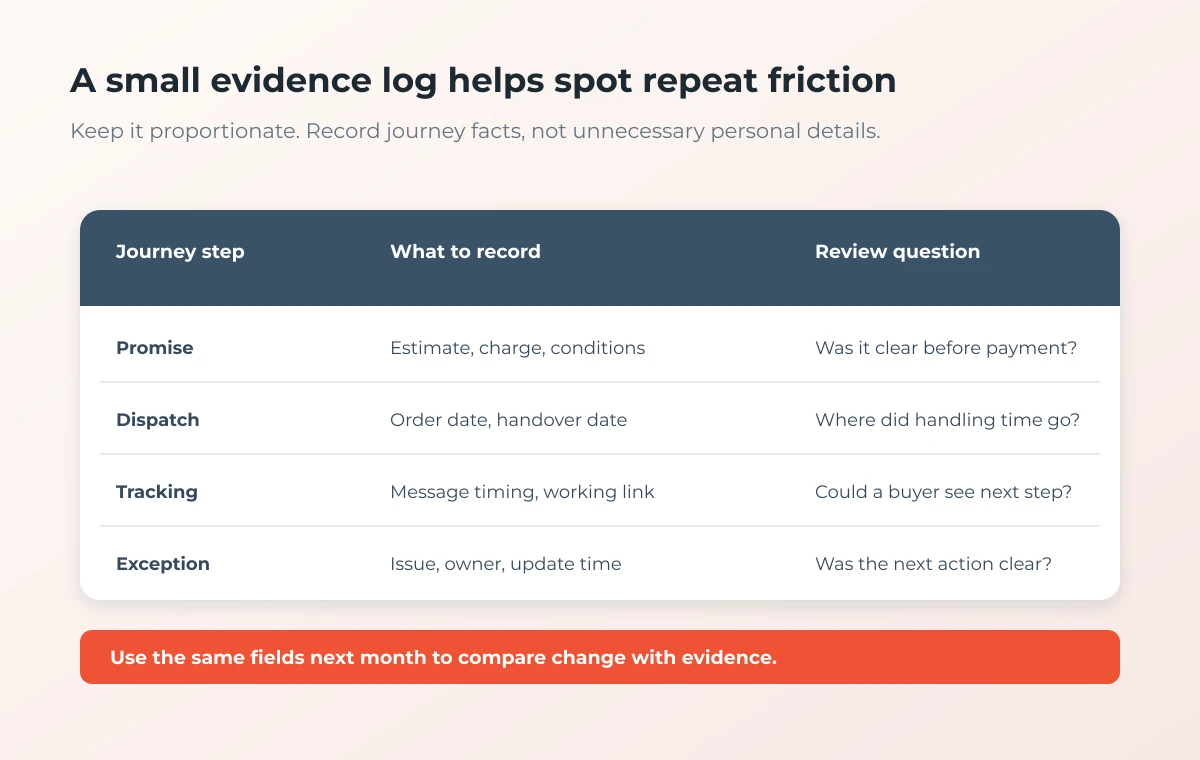
Choose a small, consistent set of fields. Avoid collecting unnecessary personal information; use an order reference or anonymised sample where possible. The point is to compare the promise and the outcome, not to create a large reporting project.
| Journey point | What to record | What to check next |
|---|---|---|
| Promise | Estimate, cost and conditions shown before payment | Was the information clear on mobile? |
| Preparation | Order date and date ready for dispatch | Is handling time included in the estimate? |
| Carrier journey | Handover, tracking updates and arrival date | Did the customer know what would happen? |
| Exception | Issue, owner, customer update and follow-up time | Was the next step clear and realistic? |
A disappointing order can be important, but one unusual event does not always show a general pattern. Start with the clearest gap between what a customer was told and what the order record shows. Then check whether it affects one product, one delivery route, one message or a wider part of the process.
When reviewing delivery charges in the wider order total, MLFG’s print-on-demand pricing guide explains how fulfilment costs can affect a product offer. For a step-by-step introduction to shipping choices, see the Shipping and Delivery Mini Course.
Use the assessment to organise your evidence across the promise, tracking and support journey, then choose one check to run with a real customer view.
It is a customer journey where delivery choices, costs and timing are understandable before purchase, updates help the buyer know what is happening, and a clear support route exists when something changes. The right service depends on the products, customers and operations.
Review them when a carrier, supplier, fulfilment route, product range or seasonal pattern changes. A small regular check of recent orders can also reveal whether the published estimate still reflects the way orders are handled.
Tracking can make progress easier to see, but it cannot prevent every delay or explain every exception. Check that links work, messages are understandable and customers know how to get help if the information stops changing or does not match the handover.
No. The app and article are educational planning tools. They do not certify legal compliance, carrier performance or customer satisfaction. Read current official guidance and seek qualified advice for legal questions or complex fulfilment situations.
Choose one route and follow it as a buyer would: look at the product information, compare delivery options, place a controlled test order if appropriate, open each message and find the help route. Record the evidence, fix the clearest gap and repeat the same journey after a change. That gives you a grounded way to improve the experience without relying on assumptions.
The free Delivery Experience Assessment can help structure that review. If you are considering broader ecommerce support, compare the £99/year plan or contact MLFG with your questions.
Review eight parts of the journey, identify a gap in your evidence and choose a practical next test.
PREFERRED SOURCE
Like what you’re reading? Add Make Local for Global as a preferred source on Google to see more of our articles when you search.























Build your online presence without having to figure out everything yourself.