

Use an international ecommerce readiness checklist to review buyer demand, landed costs, export records, delivery, returns and customer support before testing one market.

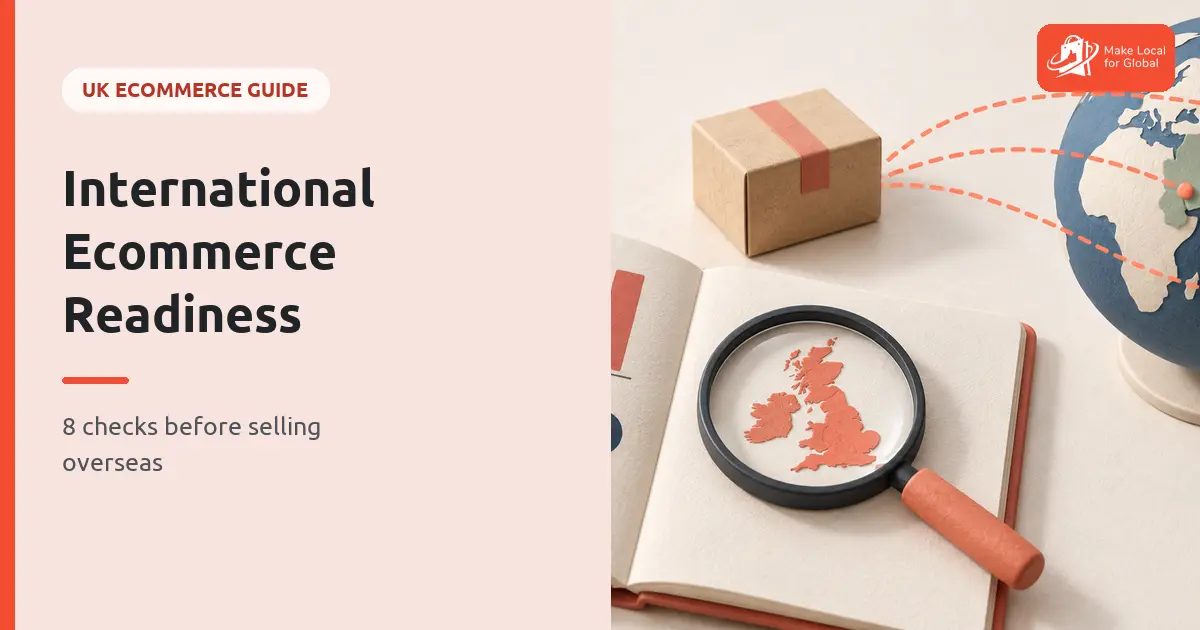
International ecommerce can open a useful new route for a small UK store, but a translated checkout is only one part of being ready. Before promoting to another country, check whether you understand a specific buyer, the full cost and paperwork for the route, and how you will deliver, handle returns and answer questions.
This international ecommerce readiness checklist helps you assess one destination at a time. It is an operational planning guide, not a legal, tax or demand forecast. Export rules and customer obligations depend on your product, destination and selling arrangement, so confirm current requirements with official sources and qualified advisers where appropriate.
Use the free International Readiness Assessment to review eight practical areas and identify one next check before you commit to a launch.
Readiness means you have enough evidence and operating capability to run a small, controlled test in one market. It does not mean every uncertainty is gone. You should be able to explain who the first buyer is, why the offer might fit, what an order could cost to fulfil, which checks still need confirmation and what happens if an order is delayed or returned.
A score is useful only as a summary of your current answers. It cannot verify customer demand, classify a product, calculate every destination charge or guarantee a profitable result. Treat a low score as a list of questions to investigate, not a verdict on your business.
Begin with a country or clearly defined customer group, rather than “selling worldwide”. Write one sentence about the buyer, the problem your product addresses and when they might buy. Then look for evidence: relevant search language, enquiries, conversations, marketplace patterns or existing orders. Record the source and date. A social media like or a broad population statistic is not the same as evidence that someone will buy your particular offer.

Compare your product, price, instructions, sizing, materials, plug or power requirements and customer expectations with the destination. Check whether product labels, packaging or claims need to change. Do not assume that an item permitted in the UK can automatically be advertised or sold in the same way elsewhere. The UK Government’s export goods steps point businesses towards destination rules, restrictions and licences where relevant. Product-specific requirements should be verified before accepting orders.
Start with a single order and list the costs from stock to customer: product and packaging, pick and pack, carrier charge, payment processing, marketplace or platform fees, any fulfilment service, and a realistic allowance for support, damage or returns. Keep customs duty, import VAT and other destination charges as separate items until you have verified how they apply and who is responsible for payment. The UK Trade Tariff can help you investigate commodity codes and UK duty or VAT information, but the destination’s rules and the details of the goods matter.
| Illustrative order item | Example amount | What to verify |
|---|---|---|
| Product and packaging | £14.00 | Your actual unit, packing and preparation cost |
| Outbound carrier charge | £8.00 | Service, destination, parcel size and any surcharge |
| Payment processing example | £1.40 | Your provider, currency conversion and transaction terms |
| Known subtotal before other charges | £23.40 | This is not a full landed cost or margin calculation |
The figures above are invented solely to show how to organise a calculation. Replace them with current quotes and your actual product costs. A carrier quote may not include every destination charge, handling fee or return cost. If you compare the numbers with a proposed customer price, make clear what is and is not included.

Identify the product details you need for accurate declarations and check whether your goods have restrictions, licensing or certification requirements. Commodity classification can depend on what an item is made from, what it does and how it is presented. Do not copy a code from a similar-looking product without checking. Use the current Trade Tariff guidance and the relevant GOV.UK export steps; seek specialist help if classification or a restriction is unclear.
Also decide who will prepare and retain the information required for the route. Keep order records, product descriptions and evidence in a consistent place. HMRC’s VAT Notice 703 explains when zero-rating may apply to exported goods and the evidence businesses need. The notice was updated in March 2026, so use the current version and check your own circumstances rather than relying on an old checklist.
Ask carriers for a quote for the exact destination, parcel dimensions, weight and service level. Check the expected delivery window, tracking events, handover points and what the service does when a delivery fails. If the parcel is delayed or lost, know which provider you contact, what evidence they need and how you will keep the buyer informed. Do not publish a delivery promise that depends on an unverified average or a single best-case shipment.
Before opening a market, write down how a customer can contact you, what language and time zone you can support, where a returned parcel would go and who pays the return carriage in the situations that matter. Explain the process clearly on your store. Requirements vary by destination and product; review current consumer rules before setting terms. GOV.UK’s online and distance selling guidance includes information about selling outside the UK and links to more specific guidance.

Test your store as a new customer using the device they are likely to use. Check currency display, product details, delivery cost and timing, payment options, address fields and order emails. Make sure the customer can see the final amount and understands which charges may be collected separately. Ask whether your payment provider supports the destination and currency, how refunds are handled and when funds reach your account. Never claim a currency or payment option is supported until you have confirmed it with the provider.
Choose a limited test: one market, a small product selection, a defined time period and a budget you can afford to learn from. Decide what evidence you will collect, such as qualified enquiries, completed orders, delivery performance, support time and the actual contribution after known costs. Write down the point at which you will pause to investigate a problem. A small test is not proof of future demand, but it can replace some assumptions with direct evidence.
Review the eight readiness areas, record what you know and what still needs checking, then choose one bounded task for your first market.
Use a readiness result to decide what to investigate next, not to certify a market as safe or profitable. Review the strongest evidence alongside the largest gap. A high score can still contain a weak assumption; a low score may simply mean you have not yet gathered information. Keep notes about the source, date and confidence of each important answer.
If a customs, tax, product-safety or consumer-law answer could change whether you accept an order, pause and verify it before launch. Official guidance is a starting point, not advice tailored to your business. Check the current rules for the exact product, route and customer type, and use a qualified professional for decisions outside your expertise.
For a broader introduction to taking a UK business into overseas markets, use the International Selling Mini Course. This checklist focuses on whether your store can operate a measured test in one chosen market.
Start with one target market and review buyer evidence, product fit, full route costs, export information, delivery, returns, payment and support. Write down what is confirmed and what remains an assumption. Verify destination-specific requirements before accepting orders.
Depending on the route, consider product and packaging, preparation, carrier charges, payment processing, platform fees, fulfilment, currency conversion, returns and support. Duties, taxes, brokerage and other destination charges depend on the goods and arrangement. Verify who is responsible for each charge and whether your customer may be asked to pay separately.
No. The score summarises the answers you provide; it does not prove demand, account for every cost or predict profit. Use it to organise research and design a small test. Review actual orders and costs before making a larger commitment.
Some goods have special export rules, restrictions or licensing requirements and many do not. The answer depends on the product, destination and circumstances. Check the current GOV.UK export guidance and seek qualified advice if your goods or destination raise a restriction question.
International readiness is not a single switch. It is a set of linked questions about a buyer, an offer and a route your small business can operate responsibly. Choose one destination, verify the important requirements, model the known costs and plan for delivery, returns and support before you invest heavily in promotion.
Use the free assessment to turn your current evidence into a practical checklist. If you also need a store, hosting, domain, business email, AI tools and training, compare the MLFG £99/year plan.
Want to discuss your route before you test it? Talk with MLFG.
PREFERRED SOURCE
Like what you’re reading? Add Make Local for Global as a preferred source on Google to see more of our articles when you search.




















Build your online presence without having to figure out everything yourself.