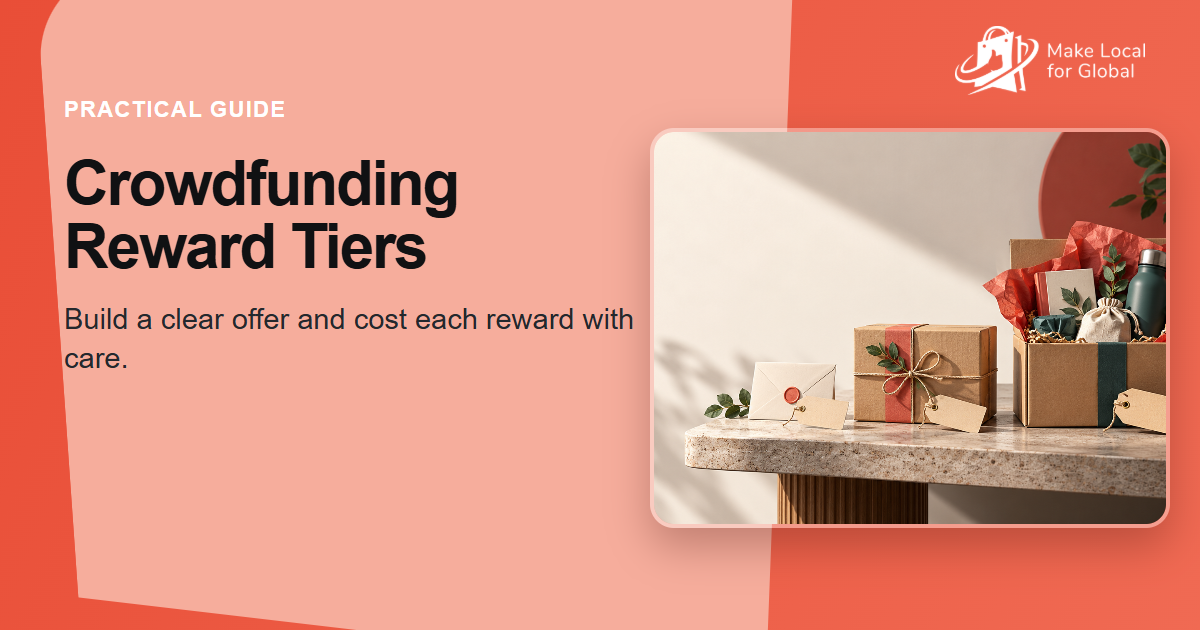
A crowdfunding reward can look attractive to a backer and still leave too little to make, pack and deliver. Before you publish a tier, calculate what one pledge brings in, what each supporter costs to fulfil and what the platform and payment fees may take. A crowdfunding reward tier planner makes those assumptions visible so you can compare levels before opening a campaign.
The figures are planning estimates, not a promise of demand or profit. Start with supplier quotes, realistic postage and current platform terms, then use the comparison to decide what to test.
Compare your reward tiers before launch
Enter a pledge, estimated backers and fulfilment costs for each reward to see the assumptions side by side.
What makes a crowdfunding reward tier workable?
A tier is more than a price and a product. It is a promise to deliver a defined bundle to a particular number of supporters. A useful first check is whether the pledge covers the reward, protective packaging, postage and fees while leaving room for the other costs the simple calculation does not include.
Keep the first offer easy to explain. A low-cost way to support the project, one core reward and one higher-value bundle can be enough to test whether people understand the choices. Each extra variation can add supplier, inventory, packing and customer-support work.

Describe the promise before you choose the price
Write down exactly what a supporter receives, when you expect to send it, where you can deliver it and any limits on colour, size or personalisation. Cost the packed parcel, not just the item. A mug may fit in a small product box but need a larger outer carton and protective fill once it is ready for a courier.
If shipping is charged separately, state that clearly and check how the platform treats postage when it calculates fees. If you include delivery in the pledge, include the full postage cost in your per-supporter estimate. Do not assume international delivery costs the same as UK delivery.
Build a realistic cost for every supporter
For each tier, gather a current unit cost for the reward and add the packaging and delivery cost per supporter. Use a supplier quote for the quantity and specification you expect to order. Include small-run set-up charges, samples or minimum order quantities in your wider budget, even when they do not fit neatly into a per-unit field.

- Reward: the product, materials or service promised to one supporter.
- Packaging: the inner and outer packaging needed to protect and present it.
- Postage: the likely delivery cost for the packed item and destination.
- Fees: percentage charges on the pledge plus any fixed charge per payment.
Also note costs the planner does not calculate: design and tooling, photography, campaign promotion, storage, labour, tax, refunds, damaged parcels, replacements and customer support. Those costs still matter when you decide whether a campaign target is enough.
Worked example: compare three reward levels
The planner opens with three sample tiers. With its illustrative fee settings of 5% platform fee, 1.5% processing fee and £0.20 per pledge, the model applies this calculation:
Estimated amount remaining per tier = (pledge × estimated backers) − (reward + packaging + postage) × estimated backers − percentage fees − fixed fee × estimated pledges.
The tool treats each estimated backer as one pledge for the fixed-fee calculation. Change the assumptions to match your campaign and check whether multiple items, add-ons or shipping charges alter the real transaction count.
| Sample tier | Pledge | Estimated backers | Reward cost each | Packaging each | Postage each |
|---|---|---|---|---|---|
| Thank-you pledge | £10 | 50 | £0 | £0.50 | £1.50 |
| Notebook and mug | £35 | 80 | £11 | £1.25 | £3.50 |
| Studio bundle | £65 | 35 | £24 | £2 | £5 |
Illustrative inputs only. The backer counts are assumptions, not evidence that supporters will choose these tiers.
Across the sample, the entered counts total 165 estimated pledges and £5,575 in gross pledges. Reward fulfilment is estimated at £2,445, and the fee assumptions add about £395.38. The model therefore shows about £2,734.63 remaining after those two categories. This is not profit, a campaign forecast or a promised payout: it excludes the wider costs and obligations listed above.
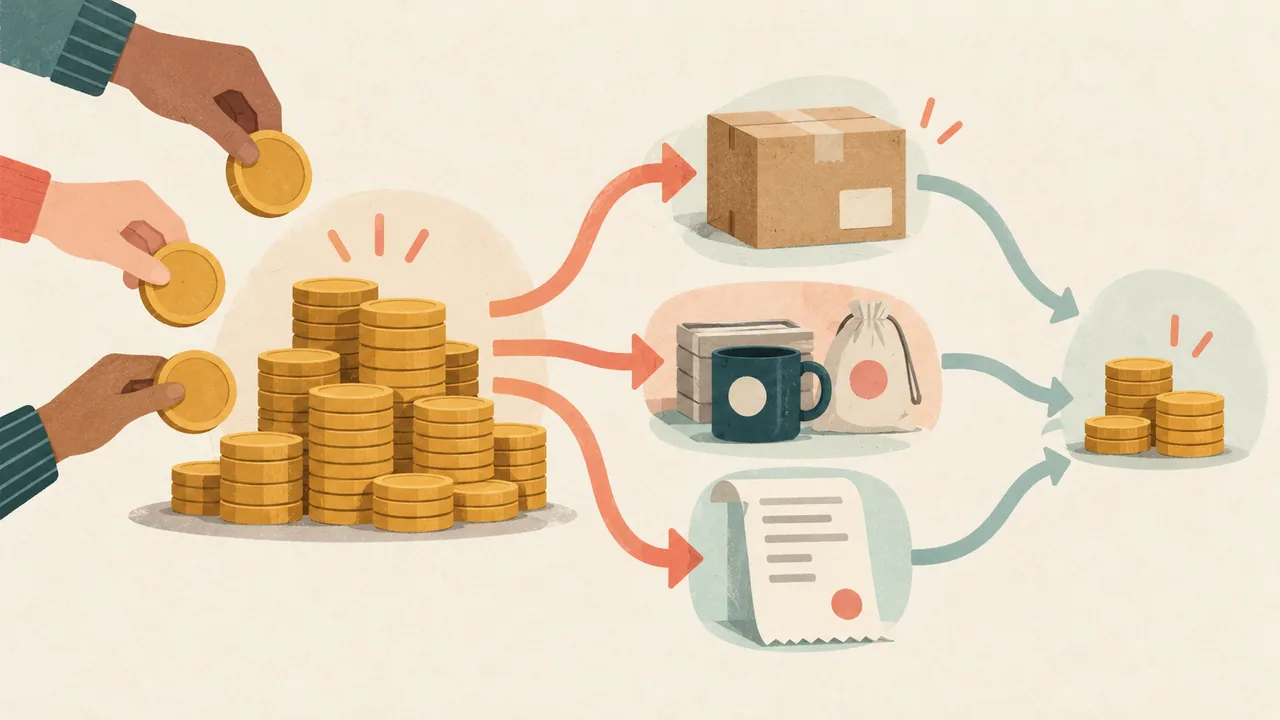
Change one input at a time to see what drives the comparison. If the higher tier appears to leave more per supporter, check whether its extra value is clear and whether you can deliver it reliably. A larger contribution in the model does not mean more people will choose that tier.
Check platform fees instead of copying an example
Fees depend on the platform, payment method, pledge amount, project type and campaign terms. The planner’s default percentages and fixed charge are deliberately labelled as examples, not current quotes. For comparison, Kickstarter’s UK fee page currently states a 5% platform fee for successfully funded projects and payment processing of 3% plus £0.30 per pledge, with different micropledge terms below £10. Check the current Kickstarter UK fees before using it.
Crowdfunder explains that its fees vary by project and organisation type. Its current fee table separates platform and transaction charges and notes that VAT may apply to some fees. These examples show why one preset cannot represent every campaign. Read the specific platform terms, payment processing rules, payout conditions and any VAT wording that applies to your project.
If you are offering a product or service in return for a pledge, tax treatment may depend on the arrangement. HMRC says that where a reward has intrinsic value, such as clothing or tickets, there may be a supply for VAT purposes. Read the relevant HMRC crowdfunding VAT guidance and get professional advice for your circumstances.
Stress-test the campaign as well as the rewards
Once you have checked the tier economics, compare your campaign target and cost assumptions in the companion simulator.
Test delivery before you promise a date
A promising spreadsheet does not prove that a reward is ready to ship. Before launch, request a sample, test the packaging and weigh the finished parcel. Check whether the supplier can meet your quantity and schedule, and ask how substitutions, defects and reorders are handled.
- Get a written quote for the exact specification and quantity, including delivery to you.
- Measure and weigh the packed item, then check postage for the destinations you intend to serve.
- Estimate how long it takes to assemble and dispatch a small batch, including address checks and support.
- Write down what happens if a supplier is late, an item arrives damaged or a supporter changes address.
- Choose a delivery window that leaves time for production and unexpected delays.
For an ecommerce launch more broadly, use the ecommerce launch readiness checklist to review the wider store and promotion tasks. If returns or replacements would materially affect your offer, see how to calculate product return costs as a separate planning exercise.
Sources and further reading
Common reward-tier pricing mistakes
- Pricing from the product alone: include packaging, postage and fees, then keep a separate list of campaign-wide costs.
- Using a backer guess as demand evidence: treat it as a scenario to compare, then test the offer with real people and evidence.
- Assuming postage is a small extra: check the packed dimensions, weight, zones and tracked delivery price.
- Making too many near-identical tiers: simplify choices and make the difference in value clear.
- Copying a platform fee from an old article: verify the current terms for your project type and payment route.
- Calling the remainder profit: the planner subtracts selected fulfilment and fee inputs only. It does not model every cost, tax position or refund.
Frequently asked questions
How many reward tiers should a first campaign have?
There is no universal number. Start with a small set that is easy to explain and fulfil, then remove choices that add complexity without making the offer clearer. Compare the time and cost of every reward before adding another level.
Should I include postage in the pledge?
Either approach can work if it is clear to supporters and matches the platform’s rules. If postage is included, put the full delivery estimate into the tier cost. If it is charged separately, confirm whether the amount is included when platform or payment fees are calculated.
Is the amount remaining the same as profit?
No. It is an arithmetic estimate based on the pledge, backer and fulfilment values entered plus the selected fee assumptions. It excludes other costs such as labour, promotion, tax, refunds and overheads, and it cannot predict actual campaign demand or payout.
Can I use one fee setting for every platform?
No. Check current platform, payment processing, project-type and pledge-size terms. The planner lets you edit percentage and fixed fees so your comparison can reflect the rules that apply to your campaign.
Make one clear promise, cost the parcel that fulfils it and verify the fees before you publish your campaign. Then compare your reward levels with the Crowdfunding Reward Tier Planner and use real feedback to decide what to improve.
Ready to check your reward economics?
Compare up to six reward tiers, adjust the fee assumptions and download a working plan for your next review. Need help with your wider ecommerce setup? Talk to MLFG.