

READY TO SELL Face Rollers ONLINE?
Get a store built for you in 5 days, plus training and support to help you start, run, and grow your Alternative business.

A practical guide to selling face rollers online: choose a focused range, check supplier samples, calculate the full parcel cost and build a careful product page.


A face roller looks simple on a product grid. For a new seller, the business decisions sit in the material description, the feel of the moving head, the way the item reaches the buyer, and the claims made on the page. One sample with a loose fitting can create returns, and a low purchase price can disappear once protective packing, delivery and payment costs are added.
You can start with a small range, verify every product statement with a supplier document or your own inspection, and test the complete parcel before committing to a large order. This article sets out a practical route for choosing a buyer, comparing roller types, checking samples, planning a costed offer and learning from the first month of sales.
“Face roller” covers a product style, not a single customer. The first decision is what the shopper is trying to buy and what problem the roller solves in their buying decision. A focused first range makes your product page easier to explain and limits the number of samples, photographs and stock lines you must manage.
Potential buyer groups include gift shoppers, people buying a small personal-care accessory, travellers who want a compact item, and independent beauty retailers choosing accessories for a counter or gift set. These groups have different questions. A gift buyer may care about presentation and delivery dates. A traveller may check packed size, weight and a storage pouch. A retailer may ask for case quantities, reorder times and consistent colours across batches.
Write one buyer sentence before asking a supplier for a catalogue. For example: “I am testing a giftable face roller for shoppers who want a present under £40, with a protective box and plain material details.” The sentence is a working choice, not a claim that demand already exists. If your interviews point to a different customer, rewrite it before placing an order.
Start with conversations and observed behaviour. Speak with a small group of people who fit the audience you have chosen. Ask what they compare before buying, which details stop them from ordering, and what they expect in the parcel. Do not ask only whether they like a colour; a compliment does not establish that someone will pay the listed price.
Review public questions and reviews on competing listings. Record repeated complaints in a table: broken heads, loose brackets, unclear stone names, unexpected size, difficult cleaning, weak gift packaging or slow delivery. Separate an isolated complaint from a recurring pattern. The useful result is a list of questions your own product page and sample checks can answer.
Test a product page or short landing page before you buy a full carton. Show one sample, state the intended price range, describe what is included and invite a genuine expression of interest. A small, clearly labelled paid test can reveal whether the page receives relevant visits and whether people ask about materials, gifting or delivery. Keep a record of the traffic source, questions and sign-ups. Do not describe a waitlist as orders, or an early test as proof of a large market.
If there is no usable sample yet, test the product concept without presenting a computer render as an item in stock. Use a supplier image only when you have permission and it shows the exact model under consideration. Mark a pre-order accurately, state the expected dispatch window and keep a reliable way to refund a buyer if the supply plan changes.
Set out the item, its verified details and the delivery choices before inviting a customer to order.
A face roller can be sold as a standalone tool, a modest gift or part of an accessory set. Choose one lead occasion for the opening offer. A single product page that tries to speak to gifts, professional treatment rooms, travel and every skincare routine may end up unclear about who should buy it.
For a gift-led offer, photograph the box, the item and the contents together. State whether the gift wrap is included or paid for, the dispatch cut-off you can meet, and the parcel dimensions. For a travel offer, show the roller beside a ruler and inside its pouch. For a retailer offer, state case quantity, outer carton dimensions, reorder lead time and whether each unit arrives ready for retail display.
Manual face rollers share a basic purpose but differ in material, weight, surface, size and construction. Your job is to describe what you can verify, then decide which version suits the buyer and the fulfilment plan. Do not build an opening range from colour names alone.
| Product form | Useful buyer details | Checks before listing | Main trade-off |
|---|---|---|---|
| Double-ended stone roller | Supplier-declared material, head widths, handle length, packed weight, care instructions | Confirm material evidence; inspect both heads, axle fit and edges | Stone can chip if dropped or poorly packed |
| Stainless steel roller | Grade or material statement supplied by manufacturer, dimensions, finish, head movement | Check surface, joins, corrosion information and movement after repeated use | Metal look and feel differ from stone, and finish quality varies |
| Compact travel roller | Overall length, packed dimensions, pouch or case, included parts | Measure the packed unit; check that the head stays secure in its case | Smaller size may not suit buyers expecting a full-size handle |
| Roller with a gift box | Box size, insert materials, included card, assembly and gift-wrap options | Check the box survives storage and the item cannot move inside | A larger box can raise postage and storage costs |
The table names product forms, not universal standards. Ask the supplier for material specifications and preserve the answer with the purchase record. A listing that says “jade” or “rose quartz” needs support for that exact material. If the supplier cannot verify a stone name, use a precise description that does not imply a mineral identity you cannot establish.
Metal finish deserves the same care. “Gold-tone” describes an appearance. It does not say whether the surface is plated, what material lies underneath or how the finish performs. Use the exact supplier description only when it matches the product sample. Avoid a long list of technical material terms that the supplier cannot document.
Start with one product form and a limited set of meaningful choices. A sensible test could be one full-size double-ended roller in two verified finishes, plus one compact version if your audience asks for it. The aim is to compare a few clear options, not fill every colour slot in a catalogue.
Give each option a role. An entry item might be the compact version; a core item might be the full-size roller with a protective case; a gift option might add a stronger presentation box or a gift note. These roles should reflect real differences in what the buyer receives. Do not call a colour or box “premium” when the product and service are the same.
Count every sellable variant as a separate stock line. A rose-coloured handle in two lengths and a choice of three stone colours can create six combinations, each of which can sell out at a different pace. A narrow initial range gives you cleaner demand evidence and reduces the cash tied up in slow variants.
Possible extras include a storage pouch, a gift box, a cleaning cloth or a printed care card. Add an extra only when it improves the offer for the chosen buyer. A card that explains the actual supplier-approved care steps can be useful. A random accessory makes the parcel larger and creates another item to check and count.
Do not bundle facial oils, creams or other cosmetic products casually. A cosmetic product has separate rules for its responsible person, notification, product information and labelling in Great Britain. If you want to sell a roller with a cosmetic, check the applicable requirements for the cosmetic itself and the relevant rules for the UK nation where it will be sold. GOV.UK explains the requirements for cosmetics made available in Great Britain.

Face rollers are often offered through wholesalers, importers, manufacturers and private-label suppliers. Each route changes your control over materials, branding, minimum order quantity and replenishment time. Compare a few suitable suppliers using the same questions so the answers are easy to review side by side.
Ask for the manufacturer’s legal business name, trading address, the factory or production location, and the identity of the contact who will handle quality problems. Request the product specification for the exact model and finish, including material names, dimensions, net weight, unit packaging and care instructions. Ask how product versions or batches are identified on invoices or cartons.
For a stone roller, ask what evidence supports the exact stone description. The answer might be a supplier declaration, material data or a relevant independent report. A supplier’s photo or product title is not the same as a test report. Keep the evidence tied to the specific model and supplier, then compare the shipped sample with the description.
For metal parts, request the grade or composition information the supplier can substantiate, the coating or finish details, and any care or storage limitations. Ask whether the fittings or surface have changed between recent batches. If the answer is “same as before”, ask them to confirm the version code and date of the current sample.
Ask about minimum order quantity, sample charge, payment terms, shipping method, lead time, re-order lead time, defect handling, replacement policy and what happens when an order arrives short. Get these answers in writing. A price that looks low can be less attractive if every replacement sample takes weeks or if a mixed carton is not allowed.
A UK wholesaler may offer shorter restock times and simpler communication, though the purchase price can be higher. A direct overseas order may give a wider choice or a lower quoted unit cost, but the seller takes on more work around freight, customs, records, inspection and delivery uncertainty. Neither route is automatically right for a small test.
Compare the cost at your door, not only the supplier’s unit price. Add freight, insurance if purchased, duties or import charges that apply to the transaction, exchange-rate movement, customs handling and any cost to move the cartons to storage. For orders crossing a border, check the current HMRC and carrier guidance before calculating a landed cost; details can vary by route and business status.
If a supplier proposes that the product will ship directly to your buyer, ask who owns the customer experience. Get a sample sent to you first, verify the listing images against the exact model, agree how returns or damaged parcels are handled, and make sure the fulfilment route protects customer details. Dropshipping does not remove your obligations to describe the goods accurately or respond to a complaint.
Create a folder or simple supplier log for the invoice, specification, sample photographs, material statements, packaging details and correspondence. Record when you checked each item and which batch it relates to. Put the product code in the filename so it cannot be confused with another finish or a replacement sample.
If a supplier sends a new version, pause the old listing until you compare it. A different axle, coating, stone supplier or carton can change the way the item looks or performs. Keep one approved reference sample if storage permits, labelled with supplier, product code and date received.
Do not approve a sample from a quick glance. Handle every part, test the roller in the way the buyer will use it, check the supplier’s care instructions and record the result. A sample checklist turns your judgement into a repeatable process for later cartons.
Start with the outside carton. Record damage, odour, loose parts, print errors and any mismatch between the package and the order record. Photograph the sealed package, the opening sequence and the item as it arrives. This helps you distinguish a product fault from damage that happened in transit.
Check the roller heads under bright, neutral light. Look for chips, cracks, rough edges, cloudy or uneven surfaces, visible glue, sharp points or marks that do not appear in the approved sample. Run a clean, soft cloth over the surface and inspect for snagging. Use a cleaning chemical for a sample check only when the manufacturer’s instructions say it is suitable.
Hold the handle and turn each head slowly. Look for wobble, scraping, an uneven gap, a loose fitting or a part that falls out when tilted. Repeat the movement several times. The roller should move in a consistent way without a part becoming loose. If the supplier provides a test method or tolerance, use that rather than inventing your own specification.
Check the handle for splinters, rough seams, coating marks or sharp transitions. If a pouch, case or gift box is included, inspect stitching, closures, insert shape and whether the item stays in place during ordinary handling. Photograph the product beside a ruler and on a scale for your records; use the measurements of the item you will actually sell.
Follow the manufacturer’s care instructions. If they are missing, request them before you write a care panel. Do not assume a stone, metal fitting or coated handle can be soaked, heated, chilled or cleaned with any household product. Your listing should not advise a method that can damage the product or conflict with the supplier’s own directions.
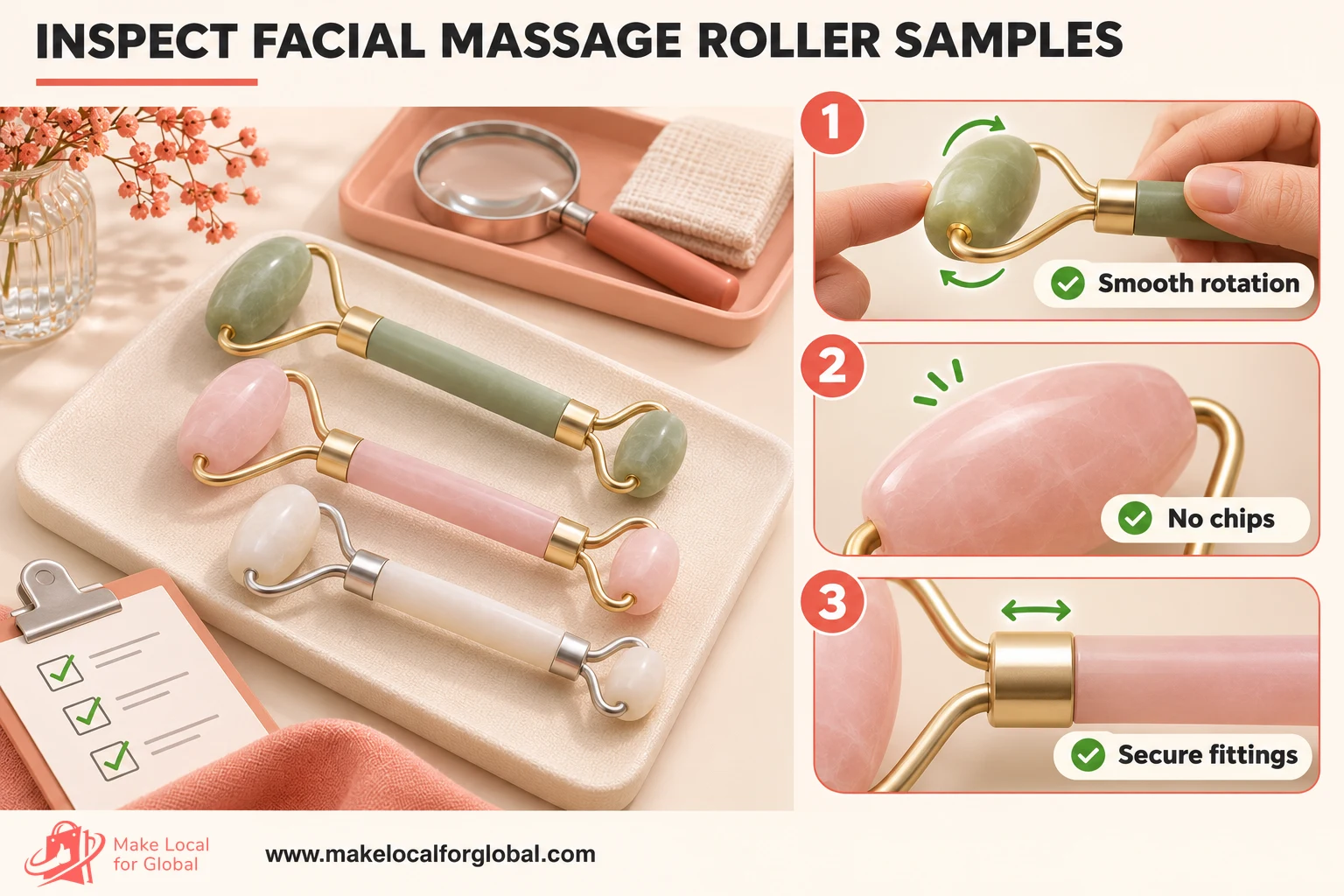
One passing sample cannot show whether a production batch will be consistent. When the order size makes it practical, inspect multiple units selected from different cartons. Record the number inspected, the defects found, the product code and the supplier’s agreed response. A simple record may show, for example, that two of twelve pieces have a loose roller head. That result gives you a clear basis for asking the supplier to correct the assembly before dispatch.
For a small first order, inspect every unit before dispatch. If you use an overseas inspection service or a third-party quality checker, agree the sampling plan and defect categories in writing. A report is useful only when it names the product, batch, inspection date and method.
Write down which defects you will accept, which require a supplier decision, and which prevent sale. A minor variation in natural stone appearance may be acceptable if the listing explains it and it does not change material identity or safe use. A sharp chip, loose head or misleading material label should trigger a hold until resolved.
Do not repair a loose fitting with glue and list the item as new. Use a repair route only when the product design and supplier instructions permit it and you can verify the finished item. Rework can change safety, durability or care. Ask for replacement stock, a documented approved repair route or a refund instead.
When a sample fails, keep the failed unit and photographs until the supplier responds. Mark it as not for sale. If the product presents a safety concern, pause the listing and seek advice from the relevant product safety authority or qualified specialist. Do not let a sunk sample charge persuade you to sell something you cannot stand behind.
The purchase price is one line in the economics of an online order. Your working model should show every cost that changes when you sell one roller, plus the fixed costs that the contribution from many orders will need to cover. Use your own supplier quote, parcel measurements and actual checkout fees when you have them.
The figures below are illustrative. They are not supplier quotes, fees or a recommended retail price. The example assumes a seller is not VAT-registered and offers delivery within the listed customer price. A VAT-registered seller should calculate the sale and input tax treatment using their actual circumstances.
| Cost item | Example per order | What to replace with your own figure |
|---|---|---|
| Face roller purchase cost | £8.20 | Supplier invoice price for the exact model |
| Inbound freight and import allowance | £1.60 | Freight and any applicable import costs allocated per unit |
| Protective packaging and printed care card | £0.95 | Carton, insert, tissue, tape and card cost |
| Payment and checkout allowance | £1.30 | Your current processor and platform charges for this basket |
| Outbound tracked delivery | £3.50 | Actual carrier price for the packed parcel |
| Returns and damage allowance | £1.20 | Your observed return, refund and replacement experience |
| Customer acquisition allowance | £4.00 | Advertising or other acquisition cost per completed order |
| **Variable cost total** | **£20.75** | **Add the line items above** |
| Example customer price including delivery | £34.00 | Your tested price, shown with the correct tax treatment |
| **Contribution before fixed overhead** | **£13.25** | **£34.00 less £20.75** |
This £13.25 is contribution, not net profit. It is the amount left before fixed costs such as website software, accounting, storage, insurance, equipment, professional advice, wages and tax. If the seller has to pay an additional packaging levy, import fee or marketplace charge, that belongs in the model too.
The example payment allowance is a placeholder. Do not copy it into a forecast as a universal rate. Check the current fee schedule for the payment provider and sales channel you actually use, then calculate the charge on the buyer’s full checkout amount. Some services charge a percentage, a fixed amount, or both. A free-delivery offer still has a delivery cost; it simply moves the price into the product economics.
Compare a single roller with a gift set only after you know what the extra components cost. If adding a pouch costs £1.10 and a box costs £1.45, add those amounts along with any larger parcel price, extra packing time and payment fee on the higher basket. A bigger basket can create more contribution, and it may raise costs or add another point where the goods may be damaged.
Model at least three scenarios: the price you hope to charge, a lower conversion-test price, and a case where delivery or return costs rise. Do not change five assumptions at once. If your actual postage is £4.25 rather than £3.50, update that row and calculate the result again. If the full-order contribution becomes too small to fund overhead, adjust the price, product, pack size or sales route before ordering more stock.
For a wholesale order, calculate separately. A retailer price may be lower than the consumer price and may involve a case discount, longer payment period, outer carton, trade returns agreement and sales time. Do not take a consumer retail price and divide it by two without checking whether the remaining amount can cover your costs.
The example above leaves VAT out under its non-registered seller assumption. That is not a universal way to show tax. A business must check its current taxable turnover and registration duties, and some businesses choose to register before a threshold applies. The current GOV.UK VAT threshold page explains the threshold and related rules; confirm the live position when you build a forecast.
If you are registered, decide whether the price shown to a consumer includes VAT and use a calculation that separates sales value and VAT due. Check which input tax you can reclaim and keep appropriate records. Ask an accountant if a cross-border sale, imports or a particular scheme changes the calculation. Do not treat the gross checkout amount as all available revenue.
Model product, freight, packing, checkout, delivery, returns and customer acquisition against the price you plan to charge.
A buyer cannot turn a roller in their hand before purchase. Your page must describe the exact model, show its scale, state what arrives and explain the delivery and returns process. Clear details help shoppers compare products and can reduce avoidable messages and mismatched expectations.
Use a title that identifies the item and the most useful distinction. For example: “Double-ended stone face roller with protective case” is more informative than “Luxury beauty tool”. Use the mineral name only when your supplier evidence supports it. Add the colour or finish as a variant, not as a substitute for material details.
The first two lines should answer what the item is, what is included and how it differs from another option in your range. Avoid a promise about visible skin change or a treatment result. Describe what can be checked: the roller has two heads, a stated handle length, a named supplier-declared material, and a case in the box.
Measure overall length, widest head width, handle diameter and packed dimensions. Use millimetres or centimetres consistently and show which measurement belongs to the item versus the box. Include net weight only if you have measured or verified it, and distinguish product weight from the packed parcel weight used for postage.
List the box contents in plain terms. If a pouch, care card or gift box is shown in a photograph, say whether it is included. State whether colour, natural pattern or surface variation differs by unit. For a retailer pack, specify the number of rollers per case and whether the wholesale carton contains mixed finishes.
Capture a front view, both roller heads, the fittings, the item held beside a ruler, the included accessories and the final packaging. Use neutral light that shows the true colour. Keep close-ups sharp enough to show the surface and joins. Do not retouch a chip from a sample photograph or use a filter that makes a finish look different.
The featured image should communicate the business topic at a glance. Inline photographs or illustrations should explain a specific decision, such as comparing product forms, inspecting a sample or protecting both heads in a parcel. Add descriptive alt text for what the image communicates. Keep the image text short and readable on a phone.
Put the supplier’s confirmed care directions in a short panel and keep the supplier document on file. Name the material accurately, tell the buyer how to store it, and describe which components need gentle handling. If the supplier has not supplied reliable care instructions, ask for them instead of guessing.
If you add a generic hygiene note, keep it factual and proportionate. A tool that contacts skin needs clean handling and storage; avoid implying sterilisation, clinical suitability or a particular health result without product-specific support. If an accessory cannot be cleaned in a particular way, state the limitation precisely.
Before checkout, show the total price, delivery cost, delivery method and estimated dispatch or delivery time. Keep the estimate tied to an operational process you can meet. After purchase, send the order confirmation and the required details in a format the customer can keep. GOV.UK’s online and distance-selling information explains the information a seller must provide before an order and the rules for online sales.
Explain how customers can contact you about an order and what information you need for a damaged item report. A simple form can ask for the order number, the condition of the outer box and clear photographs of the affected roller. Tell the customer when you will respond, and make sure the stated response time fits your capacity.
Do not write “no returns” as a blanket policy for online consumer orders. In many distance sales, a shopper can tell the seller within 14 days after receiving the item that they want to cancel, then has another 14 days to return it. The seller usually has to refund standard delivery and repay the customer within the legal time after receiving the goods back. There are exceptions, including sealed goods that cannot be returned for health or hygiene reasons after opening; that is not an automatic exception for every face roller. Review the current GOV.UK rules on returns and refunds and get advice on your exact product and return process.
Faulty or misdescribed goods are a separate matter. A product page that accurately states the material, size, finish and contents helps the buyer make an informed choice. It does not remove their statutory rights if the delivered item fails to match the contract. Keep the returns process easy to find and train whoever handles messages to separate a change-of-mind request from a fault report.
Face rollers are often promoted with claims about puffiness, circulation, wrinkles, lymphatic drainage, skin firmness or anti-ageing effects. A seller should not repeat a phrase from a supplier catalogue without checking whether it is accurate, supported and allowed in the marketing context. An image, influencer caption or customer quote can communicate a claim even when the product description uses different wording.
The Advertising Standards Authority and CAP guidance on beauty and cosmetics says objective claims need evidence and warns marketers not to exaggerate effects. It further discusses the distinction between the product’s composition and benefits achieved through an application such as massage. The guidance focuses on beauty marketing, so sellers should review the wording and context of their own product promotion rather than treating a single phrase as automatically cleared.
Use factual wording about the tool itself: “manual double-ended roller”, “stainless-steel head”, “handle length”, “supplied with a pouch” or “intended for gentle facial massage” if that matches the product and its instructions. Avoid promising that a roller removes wrinkles, changes facial structure, cures a condition, improves circulation or produces a permanent result. If you wish to make an objective benefit claim, obtain suitable evidence for the exact claim and product before publishing it.
Be wary of before-and-after images, staged testimonials and edited photographs. Lighting, angle, expression and image processing can imply an effect the product has not demonstrated. Do not present a customer’s personal statement as proof that all buyers will have the same result. Keep wording and images aligned with what you can verify.
For a manual roller sold to consumers in Great Britain, product safety duties apply to the product’s normal and reasonably foreseeable use. The Office for Product Safety and Standards guidance for Great Britain describes the rules for producers and distributors. Northern Ireland has a different regime: the 2005 Great Britain regulations were superseded there by the EU General Product Safety Regulation from 13 December 2024, as set out in the UK government’s Northern Ireland guidance.
Keep the supplier, model and batch information that lets you identify the goods you bought. Review the actual item for sharp edges, cracked stone, loose parts, coating damage and packaging risks. If you import, rebrand or change the product, understand whether the law assigns you extra responsibilities. A supplier’s statement does not remove your need to know what you are selling.
Do not add a UKCA or CE mark merely to make the packaging look more official. A mark belongs on a product only when a law that applies to that product requires it and the conformity process has been followed. If the item gains an electrical function, heating, vibration or LED feature, the applicable product rules can change; treat it as a different project and seek technical advice before buying stock.
If you plan to sell outside Great Britain, check the destination’s product rules, consumer rights, language and tax duties before opening checkout. A seller who can ship a parcel abroad is not automatically ready to sell there. For a first launch, one well-understood market can be easier to support than several different return addresses and legal regimes.
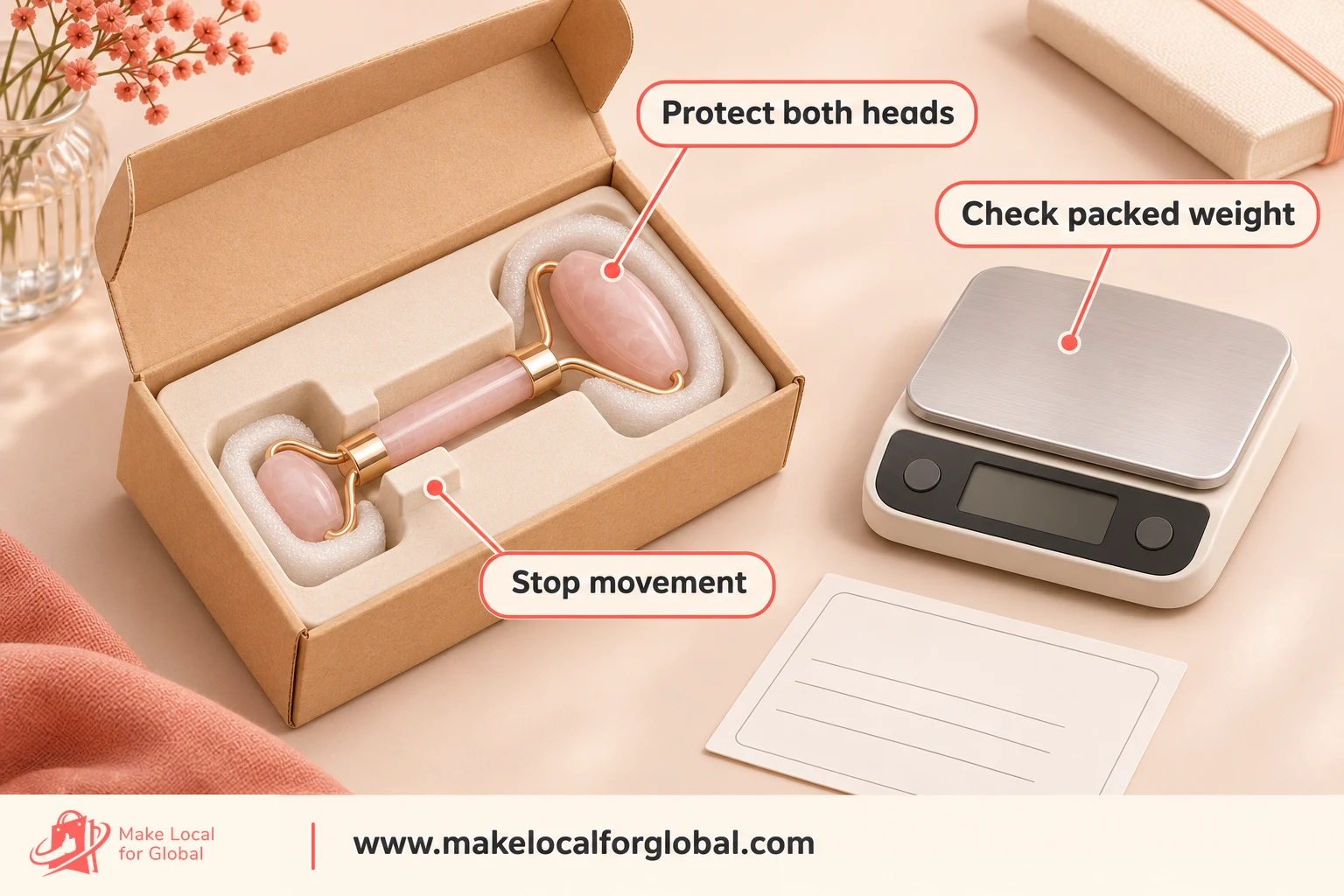
Stone heads and metal fittings can be damaged by knocks and by movement inside a box. The right packaging depends on the actual product and carrier route, so test the packed unit you intend to send. A decorative box is not automatically a shipping carton.
Use a fitted insert or other protection that keeps each head apart from hard fittings. Protect the handle from rubbing against the head and stop the item moving when the outer carton is turned gently. Choose a carton that protects the item without adding so much empty space that it needs excess void fill.
Send a test parcel through the service you expect to use. Inspect the roller when it returns and compare the carton with the photos taken before dispatch. If the item is chipped, a bracket has shifted or the presentation box is crushed, revise the pack and repeat the test. Use the phrase “drop tested” only after a defined test procedure and keep the result on file.
Measure and weigh the final packed unit. Carriers may price by size, weight or both, and the packaged dimensions may move the parcel into a different service band. Keep a packing record with carton size, protective materials, packed weight, packing time and carrier service. These numbers belong in your cost model.
Label received cartons with the supplier, product code, variant and receipt date. Count units before shelving them. Move damaged or unverified stock into a separate hold area with a visible note so that it cannot be picked accidentally.
For each order, use a short checklist: match product code and finish, check the roller head and handle, include the listed accessories, protect the item, weigh the parcel, confirm the label and record dispatch. If you are the person who packed the order, the checklist reduces the risk of a compact version being sent instead of the full-size model.
Set a cut-off time and publish a dispatch estimate that leaves room for weekends, bank holidays and stock checks. If the supplier has not delivered a new carton, pause the listing or show a truthful back-in-stock date. A cancelled order creates service work and can erode the margin from several completed orders.
An own website, a marketplace, social commerce or local retail can each support a different first test. Choose the route that lets you reach the audience, explain the product and fulfil the order without hiding the real costs. Platform fees and listing rules change, so inspect the current schedule and terms before committing to a sales forecast.
An own store gives you control over the page structure, email capture and customer buying process, but you need to attract visitors and manage checkout, delivery information and support. A marketplace can expose a listing to shoppers who are already browsing, though rules, fees and competition affect the result. A local boutique or salon may let you show the product in person, but it brings wholesale pricing, replenishment and stock-count questions.
Do not launch everywhere at once. Choose one primary route and, if useful, one small secondary test. Keep one stock record so an online order and a retail sale do not claim the same unit. Compare orders, conversion, acquisition cost, messages, returns and fulfilment time by channel.
Build page copy around the queries a shopper might use: “sell face rollers online”, “face roller with case”, “stainless steel face roller” or the exact stone phrase only when supported. Do not repeat the phrase in every paragraph. Use it in the page title or introduction where it fits, then answer the practical questions in natural language.
Create supporting content that solves a real buying question. A comparison can explain what changes between stone and stainless steel. A short video can show the roller head moving and the size beside a ruler. A packing clip can show the box contents without implying a beauty result. A care article can repeat only the instructions provided for that exact product.
For social posts, show the product in use as a tool and state what the viewer can see. Avoid filters that alter the skin or claims about a result. Save the original sample photographs and keep captions consistent with the listing. If an influencer receives a sample or payment, follow the applicable disclosure rules and the platform’s current policy.
Choose a small set of measures before the test begins: relevant page visits, add-to-cart rate, orders, revenue after variable costs, customer questions, returns, damage reports and time spent packing. Put the starting assumptions in a sheet and update them weekly. A low visit count says little about the product page; a high click count with few orders may mean the price, offer or product details need work.
Read questions as evidence. If several visitors ask whether the roller includes a pouch, put that answer beside the product title and in a photograph. If they ask for an exact stone type that you cannot verify, do not invent a claim; either collect credible evidence or use a different product. If customers repeatedly report loose heads, halt sales and investigate the supplier batch.
The purpose of a first test is to decide what to change next. Keep a note of each change and its date. A price change, new photograph and discount all at once makes the result harder to interpret. Make one material change at a time when the volume permits, then compare the same metrics over a similar period.
The calendar below is a working sequence for a small launch, not a promise of results. Adjust it to your sample lead time and the work needed to meet the product requirements.
| Period | Work to complete | Evidence to record |
|---|---|---|
| Days 1 to 7 | Choose a buyer, interview potential customers, review public product questions and write a focused offer | Repeated buyer questions, preferred product form, price concerns |
| Days 8 to 14 | Contact suppliers, compare written specifications and order samples from the strongest candidates | Supplier replies, material evidence, lead time, sample cost |
| Days 15 to 21 | Inspect samples, test packaging, calculate full-order contribution and draft the listing | Pass or hold decision, packed dimensions, cost per parcel |
| Days 22 to 30 | Publish the page or run a clearly labelled interest test, answer questions and review the numbers | Visits, orders or sign-ups, contribution, messages, returns or damage |

If a supplier sample arrives late, do not compress the inspection into a quick glance to protect the launch date. Move the page date, tell any early customers what has changed and refund them if the offer no longer matches. The cost of waiting is visible; the cost of sending an unverified product can be greater.
At day 30, decide among three routes: continue with the same product, change one part of the offer, or stop. Continue only if the evidence supports the next stock commitment. A change may be a better box, a different roller head, stronger material documentation or a revised price. Stopping an unpromising test before ordering a large carton is a useful decision, not a failure.
A colour is not proof of a mineral. If your supplier cannot identify the material, either use a description that is accurate without implying a stone type or find another source. Keep the supporting document with the product code.
A tool photograph and a few lines of copy can imply more than the item can establish. Keep the page focused on construction and intended manual use. Publish an outcome claim only when you have evidence that matches the product, wording and audience.
Every finish or size ties up cash and requires a stock count, photograph, listing and reorder decision. Begin with a small set of differences buyers can explain. Add a variant after a question or sale gives you a reason.
A slim roller can need more space once it is protected. Price the delivered order after measuring the final parcel, not from the dimensions printed in a supplier catalogue. Keep the parcel sample for future comparisons.
Presentation packaging can be damaged in transit or leave the roller loose. Test the complete carton and revise the insert before dispatching customer orders.
Supplier wording can be inaccurate, unsuitable for the UK audience or unsupported by the material evidence. Rewrite the description around what you have verified and keep the evidence record.
An order cost model that ignores reply time, replacement packing and refund handling can overstate what remains. Record those costs and service hours as soon as sales begin.
Yes. A single well-specified roller can be a useful first test if the supplier, sample, page and delivered-order costs have been checked. The range can grow after customers give a reason to add another form, finish or bundle.
No. The appearance of a green stone does not establish its mineral identity. Use “jade” only when supplier documentation or suitable independent evidence supports that description for the exact product you sell.
Do not assume that a mark applies or add one as decoration. The product rules depend on the product and any features it has. Check the relevant official requirements for the exact item and seek specialist advice if it includes electrical, heating, vibration or light functions.
Publish an objective result claim only when you hold evidence that supports the exact wording and context. Beauty and massage claims may be judged on both words and images. Safer copy describes the actual tool, material and intended use without promising a treatment outcome.
That bundle adds a separate cosmetic product with its own responsible-person, safety, notification and labelling duties. Review the requirements for the relevant UK nation and confirm that the product is compliant before offering it to buyers.
Name the exact product form, supplier-supported material, dimensions, what is in the box, care instructions, delivery timing, full price and returns contact route. Show the head, handle, fittings, scale and packaging in clear photographs.
Protect the roller heads from hard fittings, hold the item in place inside a suitable carton, measure the final package and test a parcel through the delivery service you plan to use. Inspect the returned test item before approving the pack.
Do not assume that every face roller is exempt. A specific sealed product may qualify for a hygiene exception in some circumstances, but this depends on whether it cannot be returned for health or hygiene reasons after unsealing and how it was supplied. Review current official guidance for your exact product and policy.
Order the smallest quantity that lets you complete a credible test and meet the supplier’s terms. Include sample costs, shipping, defects and storage in the decision. Use evidence from real enquiries or orders before increasing the quantity.
Hold the stock, record the mismatch and contact the supplier with the product code and photographs. Update the listing only after you decide whether the delivered item is acceptable and can be described accurately. Do not ship an item using an image or specification from a different model.
Write your buyer sentence, contact suppliers with the same specification questions and order one or more samples you can inspect. Then build a delivered-order cost model using your real product, packing, fee, postage and returns figures. Open the product page only when its claims, photographs and measurements match the sample in your hands.
Use real buyer questions, supplier evidence and delivered-order costs to decide whether to continue, revise or stop.
PREFERRED SOURCE
Like what you’re reading? Add Make Local for Global as a preferred source on Google to see more of our articles when you search.

Build your online presence without having to figure out everything yourself.