READY TO SELL Fountain Pens ONLINE?
Get a store built for you in 5 days, plus training and support to help you start, run, and grow your Alternative business.

Learn how to sell fountain pens online with tested nibs, clear ink compatibility, verified suppliers, accurate product pages and protected UK delivery.


Fountain pens are small products with surprisingly different buying questions. A new writer may want an affordable pen that takes familiar cartridges. A collector may care about a particular filling system, nib material, trim or condition. Someone choosing a gift may need a clear explanation of what comes in the box and which ink will fit. A seller who lists every pen as “smooth and premium” leaves buyers to guess.
You can sell fountain pens online with a focused range, accurate product testing, clear writing samples, supplier and authenticity checks, useful photographs, a complete cost model and packaging that protects nibs and ink. Pick one kind of buyer first. Test each model and nib combination you plan to sell, then expand only when customer questions, sales and margins support it.
This guide is for a new UK seller planning a fountain pen shop. Products, warranties, trademarks, used-goods condition and shipping rules vary. Check current requirements for your products and destination, and seek specialist advice for legal or tax decisions.
Explain nibs, filling systems and compatible accessories before customers choose a pen.
Fountain pens can be sold as new branded products, private-label models, accessories, or inspected second-hand and vintage pieces. These routes have different margins, evidence, return risks and stock demands. Choose one route for your first offer instead of mixing an entry-level starter kit with collectible pens before you know how to support each customer.
Buying new pens from an established distributor can make product details and warranty routes easier to confirm. Ask for written proof that the supplier is authorised to sell the products, current model and nib specifications, compatible cartridge or converter details, packaging contents, spare-part availability, warranty terms, batch or model identification, and the process for reporting a defect. A supplier’s marketing page does not prove that the goods are authentic or that your shop can use its images.
Check the source of the goods and keep purchase records. Do not claim that a pen is genuine, new, unused or covered by a manufacturer warranty unless you can support that statement. If a product is discontinued or parallel-imported, describe the situation accurately and ask the distributor about service and parts.
An own-brand pen gives more control over colours, trim, packaging and price. It shifts more work to your business: model verification, sample testing, quality acceptance, packaging, instructions, complaint handling, spare parts and any claims you make. Agree in writing who owns the artwork, which factory and model the documents refer to, how changes are approved, what defect rate is acceptable and how replacement parts will be supplied.
Do not approve a large run from a single attractive sample. Request samples from the actual production specification. Record the nib, feed, cap, barrel, clip, filling parts, finish and packaging. A change to the nib supplier or seal material can change the writing feel or reliability.
Second-hand pens can appeal to buyers who value a particular model, repairability or an older style. Each item needs an individual condition record. Note the model, markings, material, filling system, visible wear, repairs, missing parts, cap fit, filling test and writing sample. State whether the pen was restored, serviced or merely inspected, and who performed that work.
Do not describe a pen as “rare”, “mint”, “restored” or “working perfectly” without evidence and precise definitions. Photograph the actual item and disclose marks, hairline cracks, plating wear, parts replacements and any known issue. Keep vintage and new stock separate in your inventory so the right condition text follows the right order.
The first range can be aimed at beginners, everyday writers, journallers, students, gift buyers, sketchers or collectors. These groups overlap, yet they compare different features. A beginner may ask how to fill the pen and what ink fits. A journal writer may prioritise comfortable weight and a fine line. A collector may want model-specific details and close photographs of trim and nib markings.
Talk with potential buyers about the last pen or notebook they chose. Ask how they use it, what went wrong, what size or feel they prefer, where they buy ink, and how much detail they need before ordering online. Ask what made them return or keep a pen. Avoid leading questions such as “Would you buy my premium pen?” A polite yes is weak evidence of purchase intent.
Record recurring needs in the customer’s words. “An everyday fine nib that works on ordinary notebook paper” is a useful starting point, though the paper and ink still affect the line. Use the notes to shape a test offer and later compare the actual questions with site search and support messages.
Compare products by price, body material, weight, length, cap style, nib size, filling system, included cartridge, converter availability, warranty, return conditions, product photographs and delivery. Check whether the seller provides a writing sample or only repeats manufacturer copy. Record which questions appear in reviews, but do not treat a few reviews as proof of general product quality.
Compare the same configuration. A model with an included converter and boxed ink sample is not directly comparable with a pen sold alone. Calculate total basket price and likely replenishment cost for cartridges or bottled ink. Look for opportunities to explain compatibility and the writing experience more clearly rather than competing only on headline price.
A first range should help a buyer choose without making your stock difficult to manage. One structure might have an entry-level starter pen, a lighter everyday option, a gift-ready set and a small set of useful accessories. Another might focus on a single writing use, with a few body colours and two tested nib sizes. The right range depends on supplier terms, buyer conversations, cash and your ability to inspect each variant.
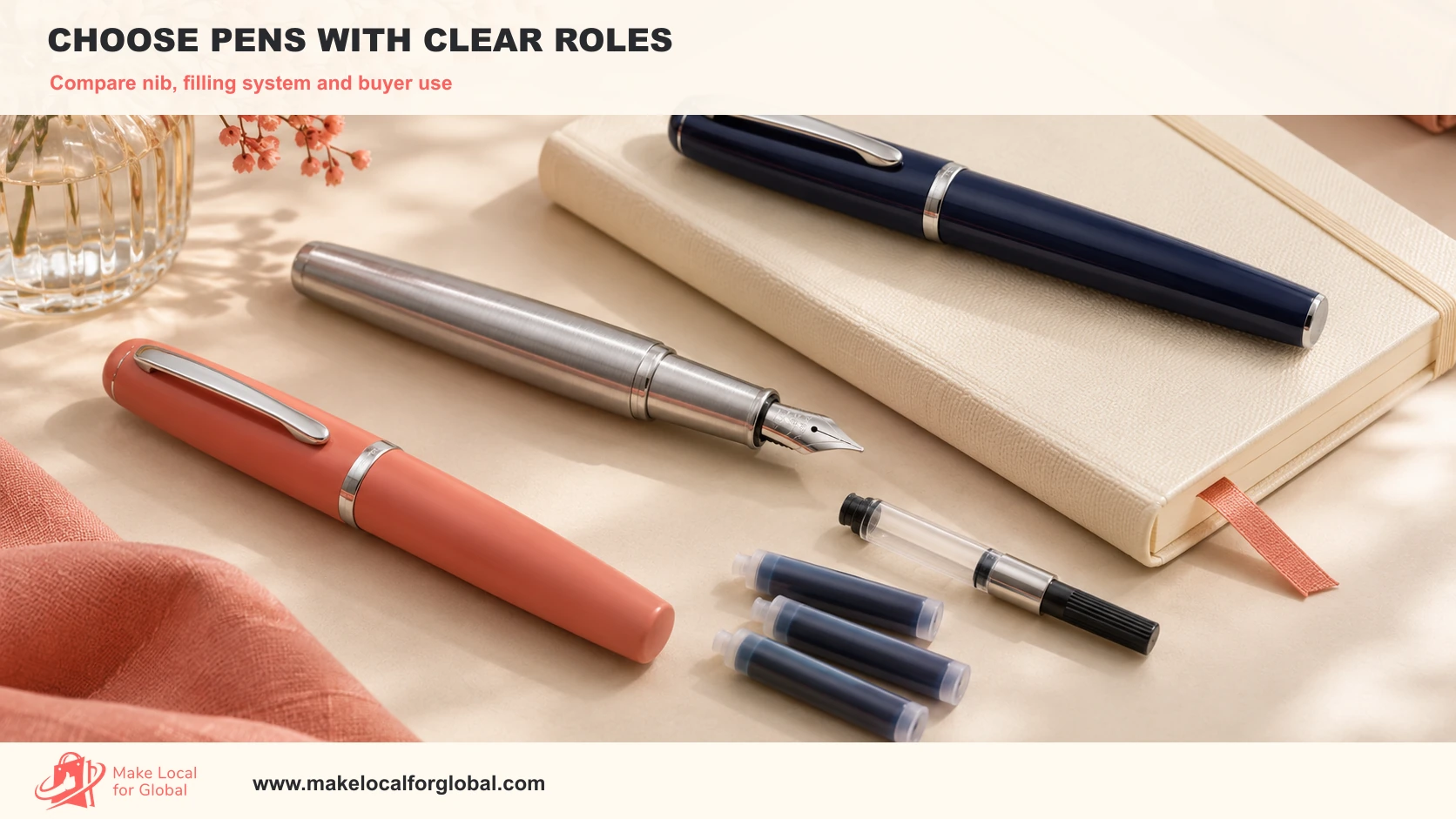
Common labels include extra fine, fine, medium and broad. The actual line can vary by manufacturer, nib material, ink flow, writing pressure, angle and paper. A fine nib from one brand may not match a fine nib from another. For each model and nib size, write a consistent sample with the same ink and paper, photograph it, and describe the sample conditions. Do not promise an exact line width unless you have a measurement method and the manufacturer’s specification.
Offer only nib options you can explain and support. If your supplier offers many sizes but you cannot inspect them or arrange a reliable exchange, begin with fewer. Tell customers whether the nib is smooth, feedback-rich or wet only when your own testing supports that description and you explain the conditions.
Cartridge pens may use standard international cartridges or a proprietary format. A converter can allow bottled ink, but the converter must fit the exact model. Other pens use a built-in piston, vacuum, lever, eyedropper or another filling system. Each changes ink choice, filling steps, cleaning and service needs.
List the exact included items and compatible products. Show whether the converter is included, sold separately or unavailable. If a pen accepts only a named cartridge format, state that clearly before checkout. Do not infer compatibility from a photo or from another model in the same brand family.
Cartridges, converters, bottled ink, pen cases, blotting paper and notebooks can make a helpful range. Pair accessories only when they fit the pen and the use case. A beginner kit can include a pen, compatible ink and a short guide to filling and care, but avoid implying that every ink works with every pen. Ink that is not confirmed compatible should not appear in a bundle.
Start with suppliers who can identify the model, its maker, the nib size and included parts. Ask about supply continuity, minimum order, lead time, warranty process, replacement nibs and repair support. For private-label goods, get the exact product specification, packaging artwork, inspection procedure and change-notification terms in writing. For vintage items, document where each pen came from and how you assessed it.
Ask a supplier for:
Check that supplier documents identify the same model and configuration that you will sell. Ask for replacement nibs and service guidance before a problem arises. If an importer or private-label arrangement leaves you unclear about responsibilities, consult an appropriate product or legal adviser. Do not present a supplier’s general certificate as proof that every pen or ink in a catalogue is suitable for every market.
Consumer products must be safe in normal and reasonably foreseeable use. The applicable duties depend on your role and destination. Review the current Great Britain product safety guidance and the separate Northern Ireland guidance before choosing where to sell. Keep supplier and batch records, pass on relevant risk information, and know how to isolate stock if a product concern arises. The government’s business notification guidance for unsafe or non-compliant products explains when businesses need to notify the relevant authority.
Describe the pen and its materials accurately. A statement such as “solid brass”, “gold nib”, “recycled resin” or “made in Britain” needs evidence that matches the exact model. Do not imply a nib contains solid gold when it is gold-plated or when only a small part uses that material. If you sell a pen intended for children or make claims about age suitability, obtain a product-specific safety review and show required warnings and instructions clearly.
Inspect samples from the model and nib size you plan to list. Keep a record with the supplier, model, colour, nib, filling system, sample date, notes and photos. For used stock, create a separate record for every item.
Inspect the nib tipping, tines, slit alignment, feed, section, cap seal, threads, clip, barrel and finish under good light. Check that the cap closes securely and that the pen posts only if the manufacturer designed it to do so. Look for scratches, cracks, loose trim, dried ink, bent parts, damaged threads and stains. A visual check does not prove that the pen writes correctly, so record it as one part of inspection.
Follow the maker’s filling and cleaning instructions. Use a compatible ink and a consistent sheet of paper. Check startup, ink flow, skipping, hard starts, leaks, cap seal, comfort, balance and cleanup. Write a sample of short strokes, loops and ordinary words. Record the paper, ink, nib size and writing conditions. Do not adjust a nib unless you have the skill and a clear repair process; refer a problem to a qualified technician or the supplier.
For photographs, include a close view of the nib and a legible line sample. Show the full pen, uncapped pen, cap, filling mechanism and all included parts. A macro image can make a small mark look larger than it is, so include a normal-scale view too.

Pack the pen as a customer would receive it. Check the box, inner tray, nib protection, cap retention, accessory separation, gift wrap and outer carton. Ask the carrier about liquid ink shipments and any route or quantity restrictions. Do not assume every ink has the same transport classification; check the exact formulation, packaging and carrier rules.
Record damage and leakage after a representative handling check. A home drop test is not a certification. If you plan to ship higher-value pens, confirm tracking, insurance limits, signature options and the claims process. Photograph the packaging standard so a fulfilment helper can reproduce it.

Each product page should help the reader decide whether the pen suits their hand, writing routine and ink preference. Include model, dimensions, uncapped and capped length, weight, body materials where confirmed, nib size, filling method, included items, cartridge format, converter status, ink compatibility, warranty route, care instructions and dispatch timing. Use metric measurements consistently and tell buyers whether weight is measured with the pen empty or filled.
Nib descriptions are subjective. State the test conditions and use a measured description: “tested with the included blue ink on 80 gsm notebook paper” is more useful than “writes perfectly on all paper”. Avoid claims such as “never leaks”, “scratch-proof”, “the smoothest pen” or “archival” unless you have a reliable basis and the claim is narrowly defined. A fountain pen can behave differently with another ink, paper or writing angle.
Photograph the pen, cartridge or converter, instructions, warranty information, presentation box and any sample ink. List each included item separately. If a converter, case or bottle of ink is an optional extra, identify that in the page copy and in the product images. Do not use a staged photo that implies accessories are included when they are not.
Link to the manufacturer’s instructions for filling, cleaning, storage and compatible ink. Give general care guidance only when it fits the specific model. Do not advise a customer to force a stuck cap, dismantle a nib or use a cleaning fluid the maker has not approved. A short support page with model-specific steps can reduce avoidable questions and damage.
Fountain pens are detailed objects, so use more than one image. Photograph the capped and uncapped pen, nib close-up, writing sample, filling system, clip and trim, packaging and included accessories. Add a scale reference or dimensions so a buyer can judge size. For second-hand stock, photograph the exact pen and each flaw.
Use neutral light and a clean background that shows the true colour and finish. Avoid strong reflections that hide scratches or make trim appear gold when it is plated in another colour. Keep white balance consistent across a range. Do not generate a product image that represents a real branded model inaccurately. If you use an illustration, label it as illustrative and keep real product photos available.
Use descriptive alt text for informative images, such as “Fountain pen with a medium steel nib beside a writing sample on lined paper”. Decorative images can use empty alt text. Keep the phrase natural; repeating the target keyword in every alt field does not help the person using a screen reader.
Calculate landed cost for each pen: wholesale price, inbound freight, duty if relevant, payment fee, packaging, pick and pack, outbound delivery, marketplace commission, expected returns, repair or replacement allowance, customer acquisition, storage and fixed-cost contribution. Use the complete configuration, since an included converter or gift box changes cost and basket value.
Imagine an example pen sells for £48 including VAT at the standard 20% rate. The net sales value is £40. A hypothetical order has £17 product cost, £1.80 inbound freight and duty allocation, £1.50 packaging and fulfilment, £3.20 outbound delivery, £1.40 payment fee and £2.10 allowance for returns or service. Contribution before marketing and fixed overhead is £13. If it costs £8 to acquire the order, £5 remains for overhead and profit.
These numbers are examples, not supplier quotes or a recommended retail price. Replace them with invoices and carrier quotes. Confirm your VAT registration and the correct treatment with an accountant. GOV.UK explains that most goods and services are charged at the 20% standard VAT rate, with exceptions depending on the supply. Use the Wholesale and Retailer Margin Lab to model your own product and delivery assumptions.
Compare pen cost, fulfilment, delivery, fees and an allowance for service before choosing a price.
A pen can be returned due to a customer preference, a fault, a damaged nib or an unclear product page. Estimate these costs by order type and update the estimate as you collect records. Decide how a pen will be inspected after return, whether it needs cleaning, and when a returned item must be listed as used or open-box. Keep any hygiene or ink handling process aligned with your legal duties and customer rights.
Bundles can lift basket value when all components are compatible. Show the bundle saving against the separate prices and keep the contents clear. Ink and cartridges are repeat-purchase products, but reorder timing depends on how a customer writes and the pen’s ink capacity. Offer a reminder or easy reorder page before you introduce automatic subscription billing.
Organise pages around the buyer’s choice: everyday pens, beginner sets, nib size, filling system, colour, gift sets and accessories. Use filters only when product data is accurate. A “fine nib” filter should not include every model in the collection if the nib options differ. Add a comparison table for the main features and link each model to compatible inks or converters.
Show the full price, delivery cost, estimated dispatch date, return route and contact information before checkout. The GOV.UK online and distance selling guide sets out information consumers need before ordering. The returns and refunds guidance explains cancellation rights for online purchases. Keep your policies aligned with the actual product and current rules; do not write “sale items are final” if that conflicts with statutory rights.
Choose an e-commerce platform that lets you maintain product variants, stock, shipping and customer support without creating confusing duplicate pages. Keep stock records by model, colour and nib size. Use unique SKUs so the right pen and accessories reach the right buyer.
Protect the nib first. Keep the pen capped, immobilise it in its case or tray and prevent the box from moving inside the carton. Separate bottles of ink from pens and protect them from impact. Use outer packaging that suits the parcel’s weight and value. Do not place a loose nib against another item in a gift set.
Ask the carrier about liquids, insurance, tracking, signature and international destinations. Confirm the rules for the exact ink product, not a generic category. Record how you handle leaking ink, damaged boxes, missing accessories and parcels delayed in transit. Keep spare boxes, compatible cartridges and any common replacement parts accessible.
Write a customer support guide for filling, cleaning, cartridge compatibility, nib differences and returns. When troubleshooting, ask for the model, nib, ink and paper before suggesting a cause. Do not tell a customer to modify a nib or dismantle a pen unless the manufacturer’s instructions support that action. Refer damage or repair questions to the supplier or a qualified repairer.
Nib and colour variants can multiply quickly. A pen available in five colours and four nib sizes creates twenty stock choices before you add accessories. Begin with the variants that research supports and that your supplier can replenish reliably. Track each SKU separately; combined totals can hide a slow colour or a nib size that attracts frequent exchanges.
Set a maximum launch budget after allowing for website costs, packaging, returns, taxes, service and marketing. Confirm minimum order and lead time for each variant. Hold a modest reserve for a defective nib or replacement shipment. Do not commit all available cash to a limited edition before checking demand and service support.
Review weekly sales, contribution, conversion, returns, defects, support messages, inventory age and repeat ink purchases. An item with many page views but few purchases may need clearer photos, compatible ink information or a better price; it may simply have weak demand. Test one change at a time and compare actual orders, not only likes or clicks.
Write practical pages that answer real fountain pen questions: nib size differences, cartridge compatibility, filling methods, choosing a pen for a first purchase, writing samples and cleaning routines. Keep each guide tied to the products you stock. Do not publish near-identical pages for every colour if the buyer needs the same information.
Use search phrases where they naturally describe the page: “fountain pens”, “fine nib fountain pen”, “fountain pen starter set” and exact model details can help people find the right product. Write page titles and descriptions that are distinct, useful and truthful. Product structured data should match the actual price, availability, reviews and variant data shown on the page.
Offer a printable comparison card or a short email course if you can deliver it reliably. Ask for consent before sending marketing. Use post-purchase messages to share care instructions, collect permission-based feedback and make compatible ink easy to find. Do not promise that a particular nib or ink will suit every writer.
For adjacent stationery products, read our guides to selling journals online and selling day planners online. The same product-page discipline applies, yet pens need their own compatibility and writing-test details.
Speak with likely buyers and select one main use case. Decide whether the first range is new branded, own-brand or inspected pre-owned stock. Set a cash limit and identify which nib sizes, filling systems and accessory combinations you can support.
Request model-specific specifications, sample costs, minimum orders, lead times, warranty and replacement-part details from several suppliers. Verify the source of branded goods. Create a SKU list with exact model, colour, nib, filling system and included items.
Test the nibs and filling systems using a consistent ink and paper. Record startup, line, flow, comfort, cap fit and any issue. Photograph the actual sample and writing. Ask a repairer or supplier to resolve faults before approving stock.
Cost each variant, bundle and shipping option. Write product pages with compatibility and included contents. Photograph the nib, writing sample and parcel. Check mobile checkout, delivery timing, returns information and order confirmation.
Launch with a manageable quantity and a modest campaign budget. Track each SKU’s views, conversion, contribution, return reason, defect rate and customer question. Fix unclear details promptly. At day 30, reorder only the variants with evidence of demand, supportability and acceptable economics.

Nib labels vary by model. Test the actual model and explain the paper and ink used for the sample. Start with fewer variants if exchanges and service are not ready.
Compatibility can be model-specific or proprietary. Verify it with the manufacturer or supplier and state what is included. A similar-looking cartridge does not prove it fits.
Each used pen has an individual condition. Photograph and describe the actual item, the filling test and any repair. Do not reuse a “mint” description across multiple used pens.
Styled product photos can imply a gift box, converter or ink bottle is part of the price. List inclusions and label optional items clearly in both the image and page copy.
Nib preference, ink flow and compatibility questions take time to resolve. Include a support and return allowance in pricing, and create a reliable route to the supplier or repairer.
Variants tie up cash and make stock control harder. Start with the combinations buyers have asked for, then expand from sales and customer questions.
It can be profitable when the range has a clear buyer, supplier terms support the price, and the shop accounts for delivery, returns, defects, service and customer acquisition. Repeat ink sales can help, but they do not make a weak pen margin work automatically.
Choose a small set of models with clear use cases and reliable supplier support. A beginner pen should have understandable filling instructions, verified ink compatibility, an accessible replacement route and accurate product details. Test the exact nib sizes before listing them.
There is no single best size for every writer. A fine line may suit small handwriting; a broader nib can produce a more expressive line. The result depends on the specific pen, ink and paper. Show a consistent writing sample and explain the conditions.
No. Some models use a proprietary cartridge format, and a converter is model-specific. Check the manufacturer’s compatibility information and state the exact cartridge or converter that fits each pen.
It can be a useful accessory when compatibility is clear and you can handle storage and delivery safely. Confirm the ink’s transport conditions with its supplier and carrier. Do not assume every ink is compatible with every pen or paper.
Inspect the nib, feed, cap, threads, barrel and filling mechanism, then fill it according to the maker’s instructions and write with a compatible ink on known paper. Record the model, nib, ink, paper and observations. Send a fault to a qualified technician or supplier.
Yes, but describe each item individually. Record its identity, condition, parts, repair history where known, filling test and writing sample. Be precise about uncertainty and avoid unsupported terms such as “rare” or “mint”.
Use a full-pen photo, uncapped view, nib close-up, writing sample, filling system, included accessories and packaging. Add dimensions or a scale reference. Use true-to-life light and show marks on pre-owned items.
Use the actual packed size, weight, carrier service, insurance and fulfilment cost. Test a multi-item order to see whether a bundle changes the rate. Show delivery charges and timing before checkout.
Include only items that fit and have clear instructions: a tested pen, a compatible cartridge or converter, and a simple care guide. State whether ink, notebook, case or gift packaging is included or optional.
Avoid absolute claims. Describe the pen’s tested filling and cap behaviour under stated conditions, and provide the manufacturer’s care instructions. A pen’s performance can depend on filling, handling, seal condition, ink and transport.
Record the order, package photos, pen model and any damage. Follow your customer service and carrier claims process, and contact the supplier when the defect involves a product component. Apply the customer’s statutory rights and do not ask them to repair a damaged nib.
A strong first fountain pen shop helps customers understand what they are buying and what the pen needs to write well. Verify each model and compatible accessory, test the nib and filling system, show honest writing samples, price the complete order and protect the pen in transit. Add variants when your customers and your records support the next step.
If you want help planning an online store around a specialist product range, contact Make Local for Global to discuss the site and customer journey. Use supplier evidence and order data to decide which pen earns a permanent place in your range.
Use writing tests, supplier support and order contribution to decide which pen belongs in the range.
PREFERRED SOURCE
Like what you’re reading? Add Make Local for Global as a preferred source on Google to see more of our articles when you search.

Build your online presence without having to figure out everything yourself.