

READY TO SELL bicycle helmets ONLINE?
Get a store built for you in 5 days, plus training and support to help you start, run, and grow your Alternative business.

A detailed guide to selling bicycle helmets online, covering niche selection, supplier checks, sizing and fit guidance, pricing, product page structure, safety-focused messaging, bundles, shipping, marketing and repeat-sales opportunities.

Bicycle helmets are not an impulse product in quite the same way as a water bottle or pair of cycling gloves.
People buy them because they want protection, reassurance, comfort, and something they’ll actually wear every time they get on a bike.
That makes bicycle helmets a strong ecommerce category, but also one where careless product descriptions, vague sizing, or unsupported safety claims can damage trust quickly.
If you want to sell bicycle helmets online, your advantage is not simply offering more colours or cheaper prices.
Your advantage is helping customers choose the right helmet for their riding style, head size, comfort needs, and budget without making the process feel technical or intimidating.
Most customers aren’t browsing helmets because they enjoy comparing pieces of protective equipment.
They’re usually buying because something has changed.
They may have bought a new bicycle, started commuting, signed up for a cycling event, bought bikes for their children, or decided their old helmet has had enough years of service.
Understanding those buying moments makes your marketing much easier.
These situations should influence your categories, product descriptions, photography, and advertising.
A commuter doesn’t necessarily care about the same things as somebody planning long weekend road rides.
A parent shopping for a child wants completely different reassurance from somebody buying a premium adult helmet.
Bicycle helmets cover a surprisingly large market.
You could stock everything from simple children’s helmets to high-end performance models, but that doesn’t mean you should.
A small ecommerce business usually benefits from a tighter range with clearer positioning.
This is one of the most approachable places to start.
Customers generally care about comfort, easy adjustment, reasonable ventilation, visibility, and a design they’re happy to wear to work or around town.
You can build a very understandable range around practical everyday cycling.
That also gives you natural add-ons such as lights, reflective accessories, helmet covers, cycling gloves, and storage products.
Road cyclists are more likely to compare weight, ventilation, fit systems, aerodynamics, and comfort over longer distances.
This market can support higher selling prices, but expectations are also higher.
Your product descriptions need more detail, and your photographs should show the profile, ventilation openings, adjustment system, and fit clearly.
Mountain bike customers often look for more coverage around the rear of the head, secure fit, visors, ventilation, and compatibility with the way they ride.
This category works particularly well if the rest of your store already serves off-road cyclists.
Children’s helmets create regular replacement demand because children grow.
Parents also care intensely about fit, comfort, adjustability, and whether the child will actually agree to wear the helmet.
Colour and design matter more here than some sellers expect.
A technically good helmet that a child refuses to wear is not a particularly useful purchase.
Some customers want a bicycle helmet that looks less sporty.
They may ride short distances, use an e-bike, commute in normal clothes, or simply prefer a cleaner design.
Urban helmets can be a strong niche because design and practicality are both important, giving you more room to build a distinctive brand instead of competing entirely on price.
If you’re starting from scratch, everyday commuter helmets are often easier to explain and market than specialist race equipment.
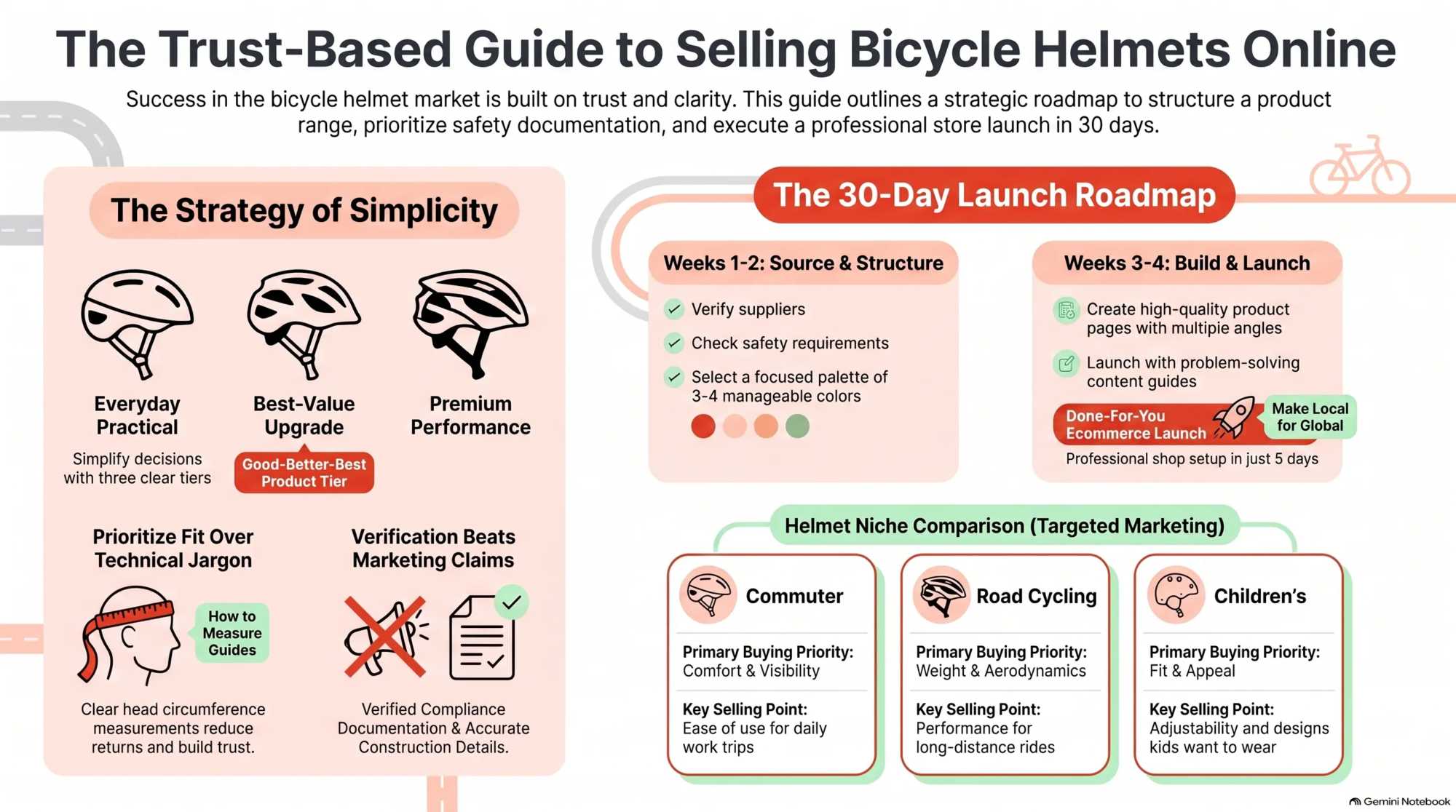
You can build a small range around three clear needs:
That gives customers a clear decision instead of presenting them with 30 helmets that all look vaguely similar.
Bicycle helmets are protective equipment.
That changes how you should think about selling them.
You need accurate product information, reliable suppliers, clear documentation, and responsible claims.
This is not a category where you should copy a supplier description, add the word “ultra-safe”, and hope for the best.
You should know exactly where your products come from and what documentation supports their safety and compliance claims.
Ask suppliers for relevant test documentation, conformity information, manufacturing details, labelling information, and any other records required for the market in which you sell.
Keep those records organised.
If a supplier becomes strangely vague the moment you ask for compliance information, that’s useful information in itself.
Product safety rules and applicable standards can change, so confirm the current UK requirements that apply to the exact helmets you intend to sell.
Do this before committing to inventory, not after you’ve already imported hundreds of units.
Your supplier should be able to provide documentation that matches the exact model you’re purchasing rather than a vaguely similar product.
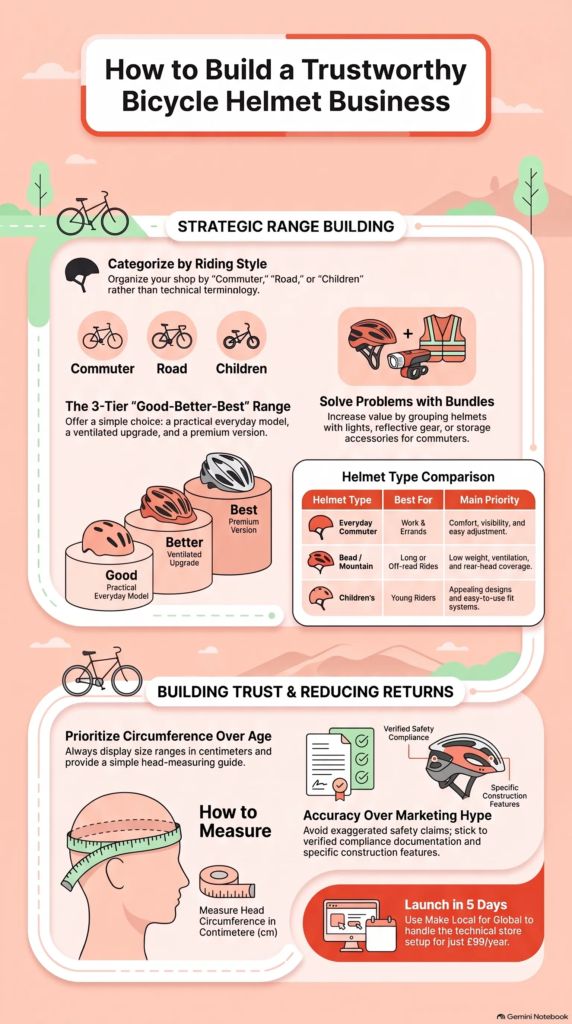
Avoid turning legitimate compliance information into exaggerated marketing.
Statements such as “guaranteed to prevent head injury” or “the safest helmet available” are not sensible claims.
Instead, describe what you can verify.
Accuracy builds more trust than dramatic language.
Helmet listings can become technical very quickly.
Your job is to translate the important differences into normal language.
A helmet that doesn’t fit properly is not the right helmet for that customer.
That means sizing information should never be buried near the bottom of the page.
Show head circumference ranges clearly and explain how customers should measure.
A simple process works well:
That explanation is much more useful than simply listing “M: 55-59 cm”.
Most buyers want a helmet they can fine-tune easily.
If the helmet uses a rear adjustment dial or another fit system, show it clearly.
Explain how it helps the customer create a snug, stable fit.
Customers should also understand how the chin straps adjust.
Ventilation becomes especially important for commuters, road cyclists, and anyone riding in warmer weather.
Don’t just write “excellent ventilation”.
Explain who benefits from it.
For example:
“A good choice for longer rides and warmer commutes where airflow matters more than maximum coverage.”
That gives the feature context.
Weight matters more as ride duration increases.
Someone cycling ten minutes to the station may barely notice the difference between two helmets.
Someone riding for three hours probably will.
If weight information is available and verified, include it.
But avoid implying that lighter automatically means safer or better.
Different helmet styles provide different levels of coverage around the head.
Show side and rear photographs so customers can see the actual shape.
This is particularly useful when comparing road, commuter, and mountain bike designs.
Some riders love a visor.
Others don’t want one anywhere near their helmet.
If the visor is removable, say so.
If it isn’t, show it from multiple angles so customers know what they’re getting.
Padding affects comfort and hygiene.
If pads are removable or washable, that’s worth highlighting.
Regular cyclists appreciate anything that makes sweaty equipment easier to live with.
A good range does not necessarily mean a large range.
It means customers can understand the differences quickly.
The middle option should usually be your strongest commercial product.
It gives customers a reason to trade up without jumping immediately to premium pricing.
Don’t simply mix adult and children’s helmets together.
Parents need a much more guided purchase.
Organise children’s products by measured head size, then use age only as secondary guidance where appropriate.
Children of the same age can have different head sizes, so measurements matter more than broad age labels.
Colour creates stock complexity quickly.
If you have four helmet models, three sizes, and six colours, you suddenly have 72 variants.
That can turn a simple ecommerce operation into an inventory puzzle.
Start with a focused palette.
Add more colours when sales data tells you which direction customers want.
| Helmet type | Best for | Main buying priorities | What your listing should explain |
|---|---|---|---|
| Everyday commuter helmet | Work, errands and casual cycling | Comfort, easy adjustment and practical styling | Fit, ventilation, visibility features and everyday comfort |
| Road cycling helmet | Longer and faster rides | Ventilation, low weight and secure fit | Weight, airflow, adjustment and intended riding style |
| Mountain bike helmet | Trails and off-road cycling | Coverage, stability, visor and ventilation | Rear coverage, visor design, fit and use case |
| Urban lifestyle helmet | City riding and e-bike commuting | Design, convenience and everyday wearability | Style, ventilation, weight and practical features |
| Children’s helmet | Young riders | Correct fit, comfort, adjustment and appealing design | Head circumference, fit adjustment and intended use |
There will always be somebody selling a cheaper helmet.
Trying to beat every marketplace seller on price is rarely a good business strategy.
Your pricing should reflect the full customer experience, including sourcing, product verification, packaging, support, payment fees, marketing, and returns.
Start with the landed product cost.
Then add everything else involved in making the sale.
If you only compare your supplier price with your selling price, your margin will look healthier than it really is.
Customers understand a three-level range naturally.
Make the differences concrete.
Don’t say “premium technology”.
Say what the customer actually gets for the extra money.
Discounting can help move seasonal colours or discontinued models.
But constantly positioning helmets as bargain-bin products can undermine the trust you’re trying to build.
Use promotions around real buying moments instead.
A strong helmet product page should make the customer feel more certain with every scroll.
It should not force them to decode technical specifications.
The first practical question is usually: “Will this fit me?”
Answer that before talking about anything else.
Include:
Add a simple section such as:
This helps customers self-select quickly.
Your photography should include:
If customers can only see one glossy three-quarter photograph, they’re being asked to take too much on trust.
A lifestyle photograph helps customers judge shape and coverage.
It also makes the product feel much more real than a floating white-background image.
Use realistic riding clothing rather than making every customer look like they’re competing in a professional race.
If you sell commuter helmets, photograph commuters.
A bicycle helmet often sits in a larger buying journey.
Someone buying a helmet may also need lights, gloves, glasses, a lock, or other cycling essentials.
That gives you a natural opportunity to create useful bundles.
This works because it solves a clear problem: getting somebody ready for everyday commuting.
You could offer more flexible family configurations rather than forcing every household into the same bundle.
This gives you a seasonal UK angle without needing to discount the main helmet heavily.
This can be a simple add-on rather than a major product.
Useful accessories increase order value and can also increase repeat purchases later.
Helmet marketing works best when you answer practical questions.
People researching helmets usually have strong buying intent.
If your content helps them make a decision, you’re much closer to a sale.
These topics have something important in common.
They solve a question immediately before or after somebody buys.
That makes them much more commercially useful than generic articles such as “10 benefits of cycling”.
Don’t squeeze every variation into every paragraph.
Write naturally and use specific search language where it genuinely helps the reader.
A 30-second video can answer questions that take several paragraphs to explain.
Useful clips include:
You can reuse those videos on product pages, social media, and customer support replies.
Every pre-sale question is free research.
If three customers ask whether a helmet fits a 59 cm head, your size information probably isn’t obvious enough.
If people keep asking whether a visor removes, put it in the product title or first few bullets.
If customers ask whether padding can be washed, add a photograph of the padding removed.
You don’t need fancy software.
A simple spreadsheet can track:
After a few months, your customer service inbox can effectively write your product page improvements for you.
Fit-related returns are a major risk in this category.
The best return policy in the world is still more expensive than helping customers choose correctly the first time.
Because bicycle helmets are protective equipment, returned items need appropriate inspection and handling before you decide what happens next.
Follow your documented product safety, supplier, and returns procedures rather than treating returned helmets exactly like ordinary clothing.
If there is any uncertainty about the integrity of a returned helmet, deal with it conservatively.
Bicycle helmets are relatively light, but that doesn’t mean you can toss them into thin mailers.
Your packaging needs to preserve the helmet’s condition and protect it from crushing or unnecessary impact in transit.
Too much empty space means the helmet moves around.
Too little space means pressure can be transferred directly to the product.
Use packaging that secures the helmet without crushing it.
Glossy shells can scratch.
Matte finishes can show rub marks.
Visors can become scuffed if loose parts rub against them.
Use internal protective wrapping that doesn’t damage the finish.
Keep all manufacturer-supplied instructions, warnings, labels, and other required information with the helmet.
Don’t remove useful documentation just because you prefer cleaner-looking packaging.
A bicycle helmet isn’t shampoo.
Customers don’t reorder one every month.
That means your repeat-order strategy needs to expand beyond the helmet itself.
After somebody buys a helmet, they may later buy:
Use post-purchase emails to introduce relevant accessories rather than constantly trying to sell another helmet.
One cyclist can easily lead to several customers in the same household.
If somebody buys an adult helmet, a follow-up guide about choosing children’s helmets may be useful.
If someone buys a child’s helmet, they may later need a larger size as the child grows.
You can stay relevant without sending endless promotional emails.
Useful seasonal topics include:
This keeps your brand connected to cycling rather than becoming “that website I bought a helmet from once”.
Bicycle helmets have variants.
Sizes, colours, riding styles, product specifications, safety information, and stock levels all need to be presented clearly.
That can turn website setup into a project of its own.
A simple shop that answers those questions is more useful than a visually impressive site that makes customers hunt for size information.
If you’d rather focus on sourcing good helmets, building your product range, and helping customers choose the right model, you don’t have to spend weeks wrestling with ecommerce settings.
Make Local for Global offers a done-for-you ecommerce setup aimed at small sellers, niche product businesses, and people who want to start selling without becoming their own web developer.
You can book a free consultation to discuss your bicycle helmet range, categories, sizing setup, and how your store could be structured.
If you’re ready to get your shop online, you can also Get your website for £99/year.
Yes, bicycle helmets can be a strong online category because new cyclists, commuters, parents, road riders, and mountain bikers all need them, but success depends heavily on trust, accurate sizing, reliable suppliers, responsible safety information, and product pages that help customers choose correctly rather than simply pushing the cheapest option.
A focused commuter and everyday cycling range is often a practical starting point because the audience is broad and the products are easier to explain than specialist racing equipment, so you could begin with an entry helmet, a better-ventilated best-value model, a premium commuter option, and a small separate children’s range.
Show head circumference ranges next to every size selector, provide a simple measuring guide using a soft tape around the widest part of the head, and explain how the helmet should feel once adjusted, because clear measurement guidance is one of the best ways to reduce fit-related returns.
You should avoid unsupported comparative safety claims and instead describe verified product features, intended use, construction, fit systems, and applicable compliance information accurately, because protective equipment deserves precise language rather than marketing exaggeration.
Yes, useful bundles can increase order value without feeling pushy, particularly commuter kits that combine a helmet with lights or visibility accessories, because customers buying their first cycling setup often need several essentials at the same time.
Compete by making the buying decision easier: offer a tighter range, explain differences in plain English, provide excellent sizing guidance, show every helmet clearly from multiple angles, answer common fit questions, and build collections around real riders such as commuters, parents, and casual cyclists rather than trying to beat every competitor on price.
You don’t need hundreds of products to launch.
You need a small, verified range that customers can understand.
Spend more time on this stage than you think you need.
A reliable supply chain is worth far more than rushing to launch.
The goal is to create a range that can be understood in a minute.
This is where you prevent a large proportion of future customer support work.
Don’t judge the entire business by the first few days.
Use early orders to understand which sizes, colours, and use cases customers actually want.
Bicycle helmets are a product category where trust is your real competitive advantage.
Customers want to know that the helmet is suitable for their riding, that it fits properly, that the product information is accurate, and that the seller understands what they’re offering.
You don’t need the biggest catalogue.
You need reliable products, clear sizing, sensible pricing, responsible safety information, and product pages that answer questions before customers have to ask them.
Build around everyday cycling problems, keep your first range focused, and use bundles to sell the wider cycling setup rather than relying on helmets alone for repeat revenue.
Do that well and you can build a bicycle helmet business that feels specialist, useful, and trustworthy instead of looking like another wall of nearly identical products.
PREFERRED SOURCE
Like what you’re reading? Add Make Local for Global as a preferred source on Google to see more of our articles when you search.