

READY TO SELL body lotion ONLINE?
Get a store built for you in 5 days, plus training and support to help you start, run, and grow your Alternative business.

A detailed guide to selling body lotion online – choose a clear skincare niche, describe texture and fragrance properly, price for repeat orders, create gift bundles, prevent shipping leaks and build an ecommerce shop that turns first-time buyers into loyal customers.

Body lotion is the sort of product customers can quietly become very loyal to.
When somebody finds a lotion that feels good, smells right, absorbs properly, and fits naturally into their routine, they often want it again.
That repeat-purchase potential is exactly what makes body lotion interesting for a small ecommerce business.
It can also be a crowded market, so simply putting “moisturising body lotion” on a bottle and hoping for the best won’t get you very far.
You need a clear customer, a recognisable product range, believable benefits, useful product descriptions, strong photography, and a simple way for shoppers to reorder.
Whether you make your own products, work with a manufacturer, create a private-label range, or curate body lotions from approved suppliers, the same basic principle applies: make choosing easy and give people a reason to come back.
This guide explains how to sell body lotion online, price it sensibly, create bundles, write product pages that feel trustworthy, market it without making wild claims, and build a skincare business that can grow beyond one bottle.
Body lotion sounds like a narrow product category until you start looking at how people actually shop.
Some customers want something rich and comforting for dry-feeling skin.
Others want a lightweight lotion that disappears quickly because they cannot stand anything sticky.
Some buy mainly for fragrance.
Others actively avoid fragrance.
Some want a beautiful bottle for the bathroom shelf, while others want a large pump bottle that can survive family life.
If you try to please all of them with one product, your positioning becomes vague.
A better approach is to decide who your main customer is and build your first collection around their routine.
This is one of the broadest and easiest niches to understand.
The customer wants something they can use after a shower, before getting dressed, or whenever their skin feels dry.
The most important selling points are usually quick absorption, comfortable texture, a non-greasy finish, and convenient packaging.
This niche works particularly well if you want repeat sales because everyday users can get through products regularly.
This customer is looking for something more substantial.
Texture becomes a major part of your offer.
Instead of vaguely saying “luxurious”, explain whether the lotion feels creamy, buttery, cushioning, or rich while still spreading easily.
Customers in this niche are often prepared to spend more if your product genuinely feels like an upgrade from a thin supermarket lotion.
For some shoppers, body lotion is almost as much about scent as skincare.
They may want something that layers with perfume, makes bedtime feel more relaxing, or simply leaves their skin smelling pleasant.
A fragrance-led range can become very collectable because customers may buy more than one scent for different moods or seasons.
The key is to describe fragrance properly instead of using names that tell customers nothing.
“Midnight Garden” might sound lovely, but buyers still need to know whether that means jasmine, vanilla, cedar, citrus, or something completely different.
This niche attracts customers who want a straightforward product without a strong scent.
They often read ingredient information carefully and appreciate simple, calm product pages.
A fragrance-free collection can also help you differentiate yourself from brands that compete mainly on colourful scents and packaging.
Here, presentation matters almost as much as the lotion.
The customer may be buying for a birthday, Christmas, Mother’s Day, a new home, a thank-you gift, or a small “thinking of you” present.
Beautiful packaging, gift sets, coordinated scents, and optional gift notes can significantly increase the value of the order.
This can appeal to regular customers who already know they like the product.
You might begin with a standard bottle and later introduce larger pump bottles or refill formats where appropriate for your production and packaging system.
The business benefit is simple: customers have a natural reason to return instead of treating the product as a one-off purchase.
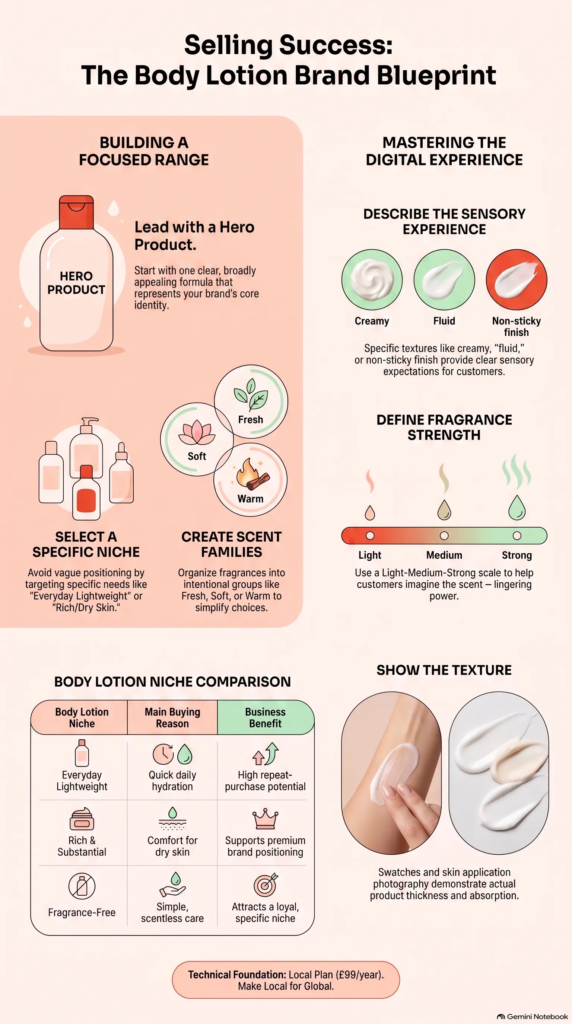
One of the easiest ways to make a skincare shop feel confusing is to launch too many products with tiny differences.
If one lotion is “hydrating”, another is “deeply hydrating”, another is “intensely moisturising”, and another is “ultra nourishing”, most customers will have no idea which one to buy.
Clear product roles are much better.
You could begin with something like this:
Four products are more than enough to create a proper collection.
You could even begin with two.
The important thing is that every item has a clear job.
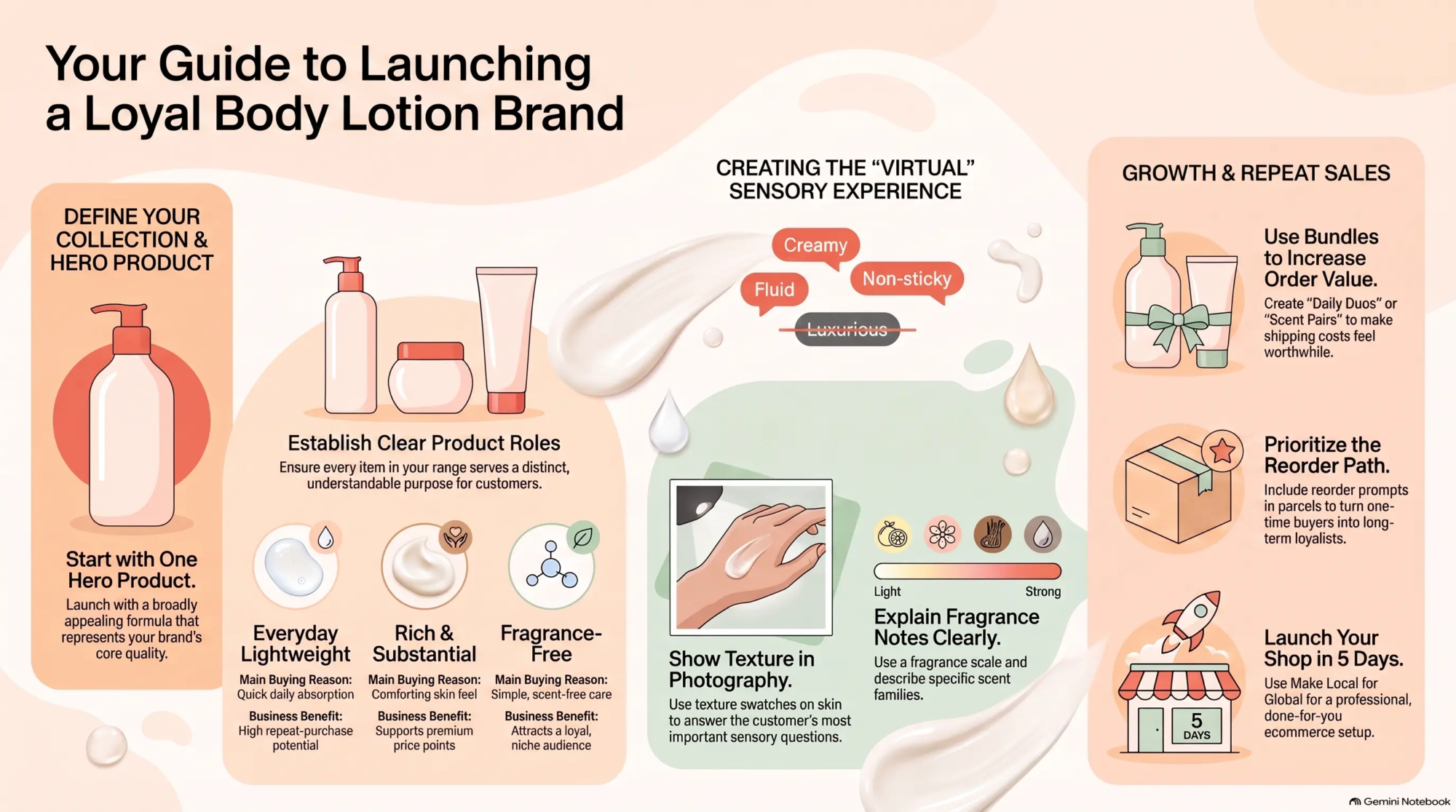
Your hero product is the lotion you want most new customers to try first.
It should be the easiest to understand, broadly appealing, and representative of your brand.
For many sellers, that will be an everyday lotion with a pleasant texture and either a subtle signature fragrance or fragrance-free option.
This hero product should appear prominently on your homepage, in your social content, in your email marketing, and in your bundles.
You do not need to give every product equal attention.
A strong hero product makes your marketing much easier.
If fragrance is part of your offer, make the collection feel intentional.
For example, you could build around:
This makes it easier for customers to choose and easier for you to create future launches.
You do not necessarily need three sizes on day one.
Every additional size creates extra packaging, inventory, labels, photography, and website variants.
A standard full-size bottle is enough to begin.
Later, you could add:
Smaller sizes can help hesitant customers try the product.
Larger sizes reward regular customers.
That creates a natural customer journey rather than simply adding more stock.
Packaging affects the buying experience more than many new skincare sellers expect.
A body lotion can be excellent and still frustrate customers if the pump stops working halfway through the bottle or the container leaks in transit.
Common options include:
Your packaging should match your formula and customer.
A lightweight everyday lotion in a huge wide-mouth jar is unnecessarily awkward.
A very thick formula in a narrow pump bottle may become equally annoying.
| Body lotion offer | Best for | Main buying reason | Business opportunity |
|---|---|---|---|
| Lightweight everyday lotion | Broad everyday audience | Easy daily moisturising without a heavy feel | Strong repeat-purchase potential |
| Rich body lotion | Customers wanting a richer texture | More substantial, comforting skin feel | Supports premium positioning |
| Fragrance-free lotion | Customers avoiding strong scents | Simple, uncomplicated body care | Clear niche and loyal customer potential |
| Scented gift duo | Gift shoppers | Ready-made self-care gift | Higher average order value |
Skincare shoppers are often cautious.
They cannot smell the fragrance through the screen.
They cannot feel the texture.
They cannot test how quickly the product absorbs.
Your product page has to replace all of that missing sensory information.
Ingredients matter, but most customers begin with a simpler question: “What will this feel like?”
Your opening description should explain the experience.
For example:
“A lightweight everyday body lotion that spreads easily, absorbs without a heavy finish, and leaves skin feeling soft and comfortable.”
That tells the customer more than a paragraph packed with ingredient names.
Avoid relying on words like “luxurious”, “silky”, and “indulgent” without explanation.
They are fine as supporting words, but they do not tell customers how the lotion behaves.
Useful texture descriptions include:
Specific language reduces disappointment.
If the product is scented, describe the actual notes.
For example:
“A warm fragrance with soft vanilla-style sweetness, gentle woody notes, and a clean finish.”
That is much more useful than simply calling it “Cosy Evening”.
You can still use creative fragrance names.
Just translate them for the customer.
Customers vary hugely in fragrance preference.
A simple scale can help:
This is a small detail that can prevent quite a few “too strong” or “I can barely smell it” complaints.
Never assume customers can visualise millilitres easily.
Include the actual volume and show the bottle in a hand or next to a familiar bathroom item.
A 100ml bottle and a 300ml bottle can look surprisingly similar in isolated product photography.
Keep them simple.
For example:
You do not need to turn a lotion into a complicated ten-step ritual.
Body lotion is a cosmetic product category, and your marketing should stay grounded in cosmetic benefits unless you have appropriate evidence and authorisation for stronger claims.
It is sensible to focus on language such as:
Avoid casually promising to cure eczema, heal medical conditions, remove scars, repair disease, or create guaranteed physical changes.
Those claims are not necessary to sell a good lotion anyway.
Body lotion needs enough margin to support a real business.
If you price too low because you are worried customers will compare you with supermarket products, you may end up working extremely hard for very little return.
Your customer is not necessarily comparing you with the cheapest lotion available.
They may be comparing you with other independent skincare brands, gifts, self-care products, and premium bathroom products.
Your cost is more than the lotion itself.
Depending on your business model, it can include:
If you leave several of these out, a product that appears profitable on paper can become disappointing very quickly.
A small brand rarely wins by being the cheapest.
Compete on:
Rather than relying on one bottle at one price, create options that naturally increase order value.
The customer feels they have choices without having to navigate twenty different products.
Body lotion can be relatively inexpensive compared with the cost of packing and shipping it.
Bundles help solve that problem.
Instead of trying to convince somebody to pay postage for one small bottle, give them a good reason to order two or three products together.
Make sure each bundle feels like a useful combination, not a pile of slow-moving stock tied together with a ribbon.
Body lotion is difficult to sell with bottle-only photography.
The bottle matters, but the texture is the product.
Your images should help customers imagine using it.
This matters more than people realise.
A customer who wants a rich winter lotion may reject something that looks watery.
A customer who hates heavy creams may avoid a thick product.
One good texture image can answer that question instantly.
For pump bottles, a close-up image or short video of one pump being dispensed is useful.
It tells customers roughly how much product comes out and makes the packaging feel more tangible.
If your lotion is naturally cream, white, pale pink, or another shade, avoid editing it heavily.
Customers notice when what arrives does not match the pictures.
If your lotion has a citrus fragrance, a subtle piece of citrus peel in the background may help.
If it has warm vanilla-style notes, a soft neutral setting can suggest warmth.
But do not surround the bottle with fifteen ingredients unless those visuals are truthful and useful.
Your photography should support the product, not create a fictional recipe around it.
Liquid and semi-liquid products require more packing thought than a T-shirt or print.
A leaking parcel is annoying for the customer and expensive for you.
It can damage labels, gift packaging, other products in the order, and your reputation.
Do not assume a cap or pump will stay closed because it looks secure.
Test realistic shipping conditions.
Turn bottles upside down.
Shake parcels.
Leave them on their side.
Think about warmer weather.
You are trying to discover problems before your customers do.
Depending on your packaging, you may need protective measures such as seals, locking pumps, shrink bands, or internal parcel protection.
The exact solution depends on the container, but the principle is consistent: nothing should be able to twist open or pump accidentally during transit.
A bottle bouncing around inside a large box is more likely to become damaged.
Use packaging that holds products securely without crushing them.
If the customer is paying extra for presentation, the gift packaging needs to arrive looking like a gift.
That may mean protecting the decorative box inside a tougher shipping box.
Do not make the pretty retail box do all the hard work of surviving the courier network.
A small insert can include:
Keep it useful.
You do not need a three-page manifesto in every parcel.
This is where body lotion can become a genuinely attractive ecommerce product.
A customer can finish it.
That means the sale naturally creates the possibility of another sale.
Your job is to make reordering easier than discovering a completely different brand.
A customer should be able to remember what they bought.
If your range has seven products called “Hydrating Body Lotion No. 1”, “Nourishing Body Lotion”, and “Moisture Body Cream”, reordering becomes harder.
Use clear, memorable names and keep them consistent.
A small insert can say something like:
“Running low? Your lotion is available in the Everyday Body Care collection.”
Simple.
No hard sell required.
A first-time customer may only want one bottle.
After they know they like it, a two-pack or larger format becomes much more appealing.
This is why repeat-customer offers often work better than aggressive discounts for new customers.
Once your body lotion has regular buyers, you can expand into products that make sense alongside it.
Potential additions include:
Do not add all of them at once.
The easiest path is usually to create one complementary product based on what existing customers are already asking for.
Limited fragrance drops can create excitement.
But your core hero lotion should remain available if it is working.
A good structure might be:
That gives you novelty without turning inventory management into chaos.
Body lotion marketing works best when customers can imagine it fitting into their day.
A bottle photographed against a white background tells them what the packaging looks like.
A short video showing the texture disappearing into skin tells them why they might want it.
Good marketing moments include:
These scenarios help customers understand the role your lotion plays.
Texture videos are excellent for body lotion.
Show:
You are reducing uncertainty without needing exaggerated claims.
Fragrance is emotional, so describe it through familiar references.
For example:
The customer should know what family of fragrance they are buying.
Body lotion gift sets are not just for Christmas.
Useful occasions include:
You do not need a completely different product for each occasion.
The same gift set can often be photographed and presented differently.
Useful content ideas include:
This type of content can attract customers who are already thinking about buying.
Instead of posting the same bottle photo repeatedly, rotate between:
The more questions your content answers, the easier purchasing becomes.
A body lotion business needs more than social media messages and payment links if you want it to grow smoothly.
Customers should be able to browse, compare scents, check the bottle size, understand delivery, place an order, and reorder without needing to message you first.
Instead of making customers browse an alphabetical catalogue, you could use collections such as:
That reflects how customers actually think.
Beauty products are often discovered through phones.
Make sure customers do not need to pinch and zoom just to find the size or fragrance notes.
Your key information should be close to the product title and purchase button.
A homepage full of equal-sized choices can overwhelm new customers.
Lead with something like:
“New here? Start with our everyday body lotion.”
Then explain why.
Guidance feels helpful, not pushy.
If you’re spending more time changing website layouts than improving products, your priorities have probably flipped.
Make Local for Global offers a done-for-you ecommerce setup for small sellers who want a professional shop without having to become website developers.
You can book a free consultation to discuss how to organise your body-care range, gift sets, product pages, and repeat-purchase offers.
Or if you want a straightforward way to get started, Get your website for £99/year.
Your first sales are less about having a massive range and more about getting one product into enough hands to create trust.
A focused launch is usually stronger than a giant catalogue.
Choose the product with the broadest appeal and clearest story.
Give it excellent photography, clear texture information, useful fragrance notes, and a strong product page.
That becomes the centre of your marketing.
Your second product should solve a different need.
If the hero lotion is scented, the second option could be fragrance-free.
If the hero lotion is lightweight, the second could be richer.
That creates a useful choice without creating confusion.
Once customers understand the products, add a bundle.
A two-bottle set is easy to understand and useful for:
“Lovely product” is nice.
“Absorbs quickly and doesn’t feel sticky” is much more persuasive.
Encourage customers to mention things future buyers care about, such as:
Do not script fake reviews.
Just make it easy for real customers to describe what they genuinely experienced.
You do not need to chase customers constantly.
A simple email after a sensible interval can remind previous buyers that their favourite lotion is available.
The tone should feel useful rather than desperate.
Choose a single seasonal moment and do it properly.
For example, winter could focus on richer textures and gift sets.
Summer could focus on lighter textures and fresh fragrance profiles.
One strong seasonal story is more effective than randomly changing your branding every fortnight.
If your lotion is selling regularly and customers are returning, then add the next logical product.
Maybe that is hand cream.
Maybe it is body wash.
Maybe it is a larger bottle.
Let customer behaviour tell you what to build next.
Body lotion is a forgiving category in some ways, but a few mistakes can make an otherwise good product difficult to sell.
A wall of technical ingredient language can make a simple product feel confusing.
Customers still need the ingredient information, but your main description should explain the actual product experience in normal language.
Do not turn cosmetic marketing into medical treatment claims just because those claims sound more dramatic.
Softness, moisturised feel, texture, comfort, and routine are enough to sell a good lotion.
Creative names are fine.
But always explain the fragrance family and key notes.
A bottle photograph cannot tell customers whether the product is runny, creamy, rich, or quick absorbing.
Show it.
Every fragrance becomes another product to photograph, stock, label, and promote.
Start with a small signature range.
Test pumps, caps, seals, and shipping packaging before sending large volumes.
A lotion business with regular leakage problems will become expensive very quickly.
Pretty boxes still need to survive delivery.
Protect the presentation packaging inside a stronger shipping package.
If three lotions sound identical except for the fragrance name, customers will struggle to choose.
Explain why each one exists.
Body lotion is consumable.
Make reordering ridiculously easy.
That is one of the biggest advantages of this category.
Yes, body lotion can be a strong ecommerce product because it is consumable, giftable, and suitable for repeat purchasing. Success depends less on having dozens of products and more on having a clear niche, trustworthy product information, attractive packaging, good photography, and an easy reorder process.
A broadly appealing everyday body lotion is usually the simplest hero product. It should have a clearly described texture, sensible packaging, and an obvious use case. You can then add a richer lotion, fragrance-free option, or signature scented version to give shoppers useful choices without overwhelming them.
Two or three is plenty for a new brand. You might offer one fresh fragrance, one warmer fragrance, and a fragrance-free option. A smaller range makes inventory easier and helps customers understand what your brand is known for before you introduce seasonal scents.
Focus on the sensory details customers cannot experience through a screen. Show the lotion texture, explain how quickly it absorbs, describe the fragrance notes and strength, include bottle-size photographs, and make the intended routine clear. Customers do not just need to know what the bottle looks like – they need to imagine using it.
Keep gift sets simple and useful. A lotion plus hand cream, two complementary lotion fragrances, or a lotion plus body wash can work well. Presentation should feel special, but the products should still make sense together. Gift sets are particularly useful for increasing average order value around birthdays, Christmas, Mother’s Day, and thank-you gifting.
Make the product name memorable, keep the hero lotion easy to find, include a simple reorder reminder in the parcel, offer multi-buy options once customers trust the product, and use occasional email reminders. Consumable products naturally create repeat-purchase opportunities, so the main job is removing friction from the second order.
If you want to sell body lotion online, you do not need to launch an entire skincare empire on day one.
Start with one lotion people can understand immediately.
Describe the texture honestly.
Explain the fragrance clearly.
Photograph the product in use.
Test the packaging properly.
Then add one useful alternative and one bundle.
That is enough to build a real shop and learn what customers actually want.
If you want a professional ecommerce setup without spending your evenings wrestling with website settings, you can Get your website for £99/year.
And if you want help planning your body-care collections, product-page structure, gift bundles, and repeat-purchase journey, you can book a free consultation.
Body lotion is not a complicated product to understand.
That is precisely why your business needs to be specific.
Make the texture obvious, the scent easy to imagine, the choice simple, and the reorder effortless.
Do that well, and one bottle can become the start of a surprisingly loyal customer relationship.
PREFERRED SOURCE
Like what you’re reading? Add Make Local for Global as a preferred source on Google to see more of our articles when you search.