

READY TO SELL Survival gear ONLINE?
Get a store built for you in 5 days, plus training and support to help you start, run, and grow your Alternative business.

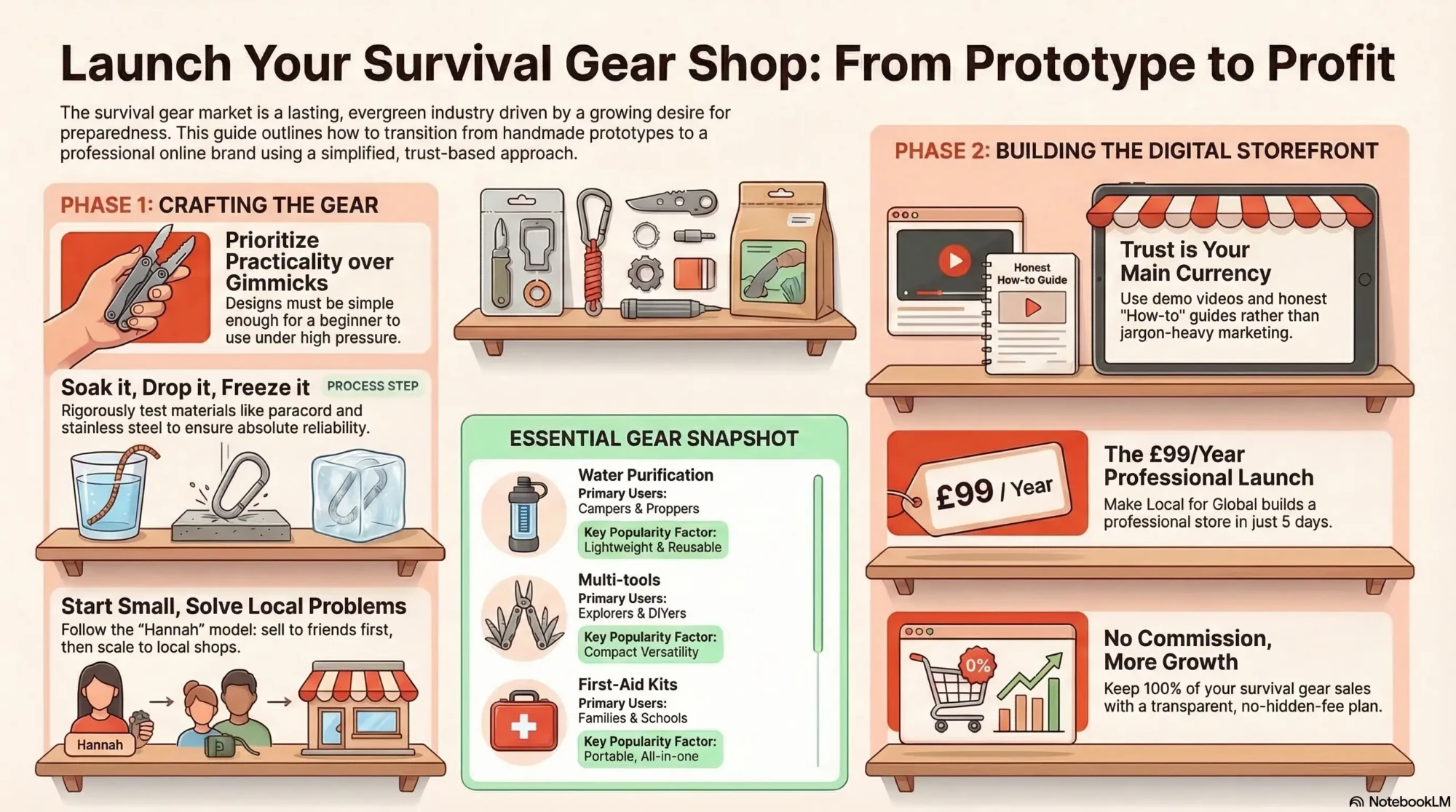
Discover practical tips for selling survival gear online, building trust with customers, and standing out in a lasting market that meets everyday preparedness needs.

Survival gear is one of those product categories people buy with their emotions pretending to be logic.
It’s “just in case”, “I like being prepared”, or “I’m going camping and I don’t want to be miserable”.
If you want to sell survival gear online, you can build a solid business – but only if you stay practical, honest, and clear about what your gear is for.
This guide is built for small sellers, side hustlers, and niche shop owners who want to sell survival gear without turning their website into a confusing wall of tactical buzzwords.
We’ll cover what to stock, how to bundle it, how to price it, and how to market it in a way that attracts the right customers.
Survival gear can mean wildly different things depending on who’s shopping.
If you treat everyone the same, your store will feel messy and untrustworthy.
Pick your primary buyer group first.
You can still sell to others, but your product selection and messaging should feel like it’s built for a real person, not “everyone with money”.
The fastest way to attract the wrong customers is to lean into fear and fantasy.
The fastest way to build a long-term business is to keep it calm and useful.
You’re selling solutions to common problems: staying warm, staying dry, getting water, seeing in the dark, charging devices, and sorting minor injuries.
That’s what most people actually want.
Survival gear is competitive.
If you try to be a general mega-store, you’ll end up competing with bigger retailers on price and ads.
Small businesses win by being specific and helpful.
Pick one niche as your home base.
Then stock around it like a specialist.
A hero kit is the one product bundle that makes people think, “Yes, that’s exactly what I need.”
For survival gear, hero kits can be:
Once you’ve got a hero kit, everything else becomes an add-on that makes sense.
That’s how you increase order value without feeling pushy.
Stocking survival gear is not about cramming your shelves with cool gadgets.
It’s about stocking the items people genuinely use and replace.
That’s where repeat sales come from.
Most “survival situations” come down to the same needs.
If your survival gear range covers these, you have a real business.
Water products are practical, easy to explain, and often bought in multiples.
Good options include:
Be careful with claims.
Describe what the product is designed for and what standards it meets if you have verified info from the manufacturer.
If you don’t know, don’t guess.
Warmth gear is a big driver of reviews.
People buy it when they’re worried about being cold, then judge it harshly if it feels flimsy.
Stock warmth items that feel reliable:
Warmth products also bundle beautifully with light and power.
Light is one of the simplest “yes” purchases.
People understand it instantly.
Position light products around moments: “power cut”, “camping toilet trip”, “walking the dog in winter”.
Power products can become return magnets if you’re vague.
Buyers need to know what works with what.
Make compatibility obvious and avoid overpromising on charge times and capacity.
Most customers are not buying for wilderness surgery.
They’re buying for blisters, cuts, and everyday mishaps.
Be careful with medical claims.
Focus on what’s included, how it’s organised, and what it’s best for.
This category can go off the rails fast.
Keep it grounded.
Sell the basics that solve real problems: broken straps, wet weather, and simple cooking.
Survival gear is perfect for bundles because customers are often overwhelmed.
They don’t want to research 14 separate items.
They want someone to say, “Here’s what you need, and here’s why.”
Situation bundles sell because they feel complete.
Here are bundles that consistently make sense.
Add-on upsells: extra lantern, candles (if you stock them), spare cables.
Add-on upsells: phone charger, extra blanket for family cars.
Add-on upsells: upgrade to a better lantern, add a repair kit.
Add-on upsells: tick remover, extra water tabs.
| Bundle | Best for | What to include | Common buyer worry to answer |
|---|---|---|---|
| Power cut kit | Homes and flats | Lantern, head torch, power bank, batteries | “Will this actually last a whole evening?” |
| Car emergency kit | Commuters and families | Torch, blanket, first aid, water | “Will this fit neatly in the boot?” |
| Camping starter kit | Beginners | Head torch, water solution, first aid, rain cover | “Do I need loads of extra stuff?” |
| Day hike kit | Walkers and casual hikers | Mini torch, blister care, water tabs | “Is this overkill for a few hours?” |
Use this simple structure:
Example: “This kit is for power cuts at home. It gives you light, phone charging, and a bit of warmth so you can stay comfortable while you wait it out.”
Survival gear pricing can get messy because customers can compare endless listings.
If your only strategy is “cheaper”, you’ll attract the most difficult customers and the most returns.
The smarter strategy is to price around reliability, clarity, and convenience.
Most of your sales should land in “best value”.
That’s where you balance profit and buyer confidence.
Survival gear buyers ask questions.
If you price like you’ll never answer emails, you’ll resent your own business very quickly.
Higher prices should be justified by real things you can show:
Stay away from miracle claims.
It backfires in reviews.
Survival gear shoppers are often anxious and uncertain.
They need your product page to do the reassurance work.
Instead of:
Write:
Clear language sells because it reduces the mental load.
Bundles convert better when buyers understand the logic.
Add one short line for each item:
This also reduces returns because expectations are clearer.
Survival gear can look boring as isolated product photos.
Show it in use and in scale.
A neat “flat lay” photo can sell better than a glossy studio shot because it feels honest.
This matters more than you might think.
Survival gear marketing can quickly drift into fear, fantasy, or nonsense.
That attracts the wrong customers and repels normal people.
Most people who buy survival gear are not preparing for dramatic scenarios.
They want to feel capable during:
Your content should meet those moments.
That’s how you build an audience that actually buys.
Each of these can lead directly to your products and bundles.
Work these naturally into headings, product copy, and FAQs:
If your site answers these, it becomes the obvious place to buy.
Survival gear buyers love guidance.
Not because they’re helpless, but because they want to feel confident.
Simple ways to build this into your shop:
Confidence creates good reviews.
Good reviews create sales.
Survival gear returns usually come from one of three things:
This is counterintuitive, but it works.
If you tell buyers what the item is not for, they trust you more.
Those lines prevent angry reviews.
For power banks, lights, and radios, list:
Also, photograph what’s in the box.
A simple photo of cables and accessories reduces a lot of “Where is the…” support tickets.
Some buyers want the cheapest option.
Some want to buy once and buy well.
Help them choose with upgrade paths:
This increases revenue while reducing disappointment.
Survival gear shops live or die based on organisation.
People need to find what they need quickly, understand it quickly, and trust you enough to buy.
Survival gear is not the easiest category to set up well.
You need clear categories, bundles, and pages that feel trustworthy.
If you don’t want to wrestle with tech, Make Local for Global is built for small sellers who want a proper ecommerce site without doing the setup themselves.
You can book a free consultation to talk through what you want to sell and how to structure your shop.
Or you can Get your website for £99/year and get a clean, affordable shop set up without the usual faff.
For survival gear, a few pages do a lot of heavy lifting:
These pages make your shop feel like a specialist, not a random reseller.
Yes, because people buy it for everyday preparedness, camping, travel, and seasonal weather, and it works especially well when you sell curated kits and bundles that remove confusion rather than relying on single-item sales.
Beginner buyers usually start with practical basics like torches, lanterns, power banks, compact first aid kits, emergency blankets, and simple water solutions, especially when you package them as a clear “power cut kit” or “car kit” with a quick-start guide.
Price around reliability and convenience by offering clear tiers, useful bundles, and honest product pages, because many customers will pay more for a kit that feels complete and trustworthy than for the cheapest item with unclear quality.
Reduce returns by making compatibility clear, listing exactly what’s included, showing scale in photos, and setting expectations with honest limitations, because most returns come from confusion rather than genuine faults.
A good basic power cut kit usually includes a lantern, a head torch, spare batteries or a rechargeable option, a power bank for phones, and a simple warmth item like an emergency blanket, because those cover light, safety, communication, and comfort until power returns.
Usually yes, because bundles remove decision fatigue and make the purchase feel like a complete solution, especially for beginners who don’t want to research every item and worry they’ve missed something important.
If you want to launch fast without chaos, keep your first month focused on one niche and one hero kit.
Survival gear is a great category if you treat it like a service, not just a product list.
Be clear, be honest, and help people feel confident.
Do that, and you’ll attract the customers who buy, recommend you, and come back for upgrades and refills.
PREFERRED SOURCE
Like what you’re reading? Add Make Local for Global as a preferred source on Google to see more of our articles when you search.

Build your online presence without having to figure out everything yourself.