READY TO SELL Greenhouse Kits ONLINE?
Get a store built for you in 5 days, plus training and support to help you start, run, and grow your Alternative business.

Learn how to sell greenhouse kits online: compare kit types, test a full sample, price bulky delivery and plan a focused UK launch.


Selling greenhouse kits online means selling a set of parts, dimensions and assembly expectations, not just a frame with panels. A customer needs to know what footprint will fit, which covering and frame they are buying, what arrives in the boxes and how bulky items reach their address. A new seller needs to verify the kit list, test a full sample, price long and fragile components and make a plan for missing or damaged parts.
A practical first approach is to choose one buyer group, compare a small number of greenhouse formats and build a sample before ordering stock. Publish exact dimensions and included components, get delivery prices for the longest package and calculate contribution after every variable cost. Start with a few SKUs you can support. Expand only when customer questions, supplier records and delivered orders show what to add.
This article is for UK founders planning to sell greenhouse kits. Product safety, consumer and planning rules may differ across England, Wales, Scotland, Northern Ireland and overseas markets. The legal notes below point to UK sources and are not a substitute for advice on your specific product or business.
Write down your buyer, first kit range, supplier questions and real delivery costs before you commit working capital.
“Gardeners” is too broad to make a useful first product range. A customer with a small paved courtyard may need a compact lean-to with clear assembly information. Someone raising seedlings may compare a small freestanding greenhouse with shelving, ventilation and room to work. A grower with a larger garden may want a walk-in structure, different door access and space for staging.
Start by describing the job the greenhouse will do. Will the buyer start seeds, protect tender plants, grow salad crops, keep herbs close to the kitchen or create a year-round growing space? Ask what they currently use, where it will stand, how much ground space is available and which part of the purchase feels uncertain. Do not assume the greenhouse will extend a season by a fixed number of weeks. That depends on location, weather, structure, ventilation and how the buyer uses it.
Ask ten people who fit the buyer you want to serve to compare two sample product pages. Give them a small set of exact options and ask which one they would investigate further, what they still need to know and what might prevent delivery or assembly. Record their answers. A comment such as “I need to know whether it fits beside the shed” points to a product-page measurement and a useful photo, not automatic proof that the person will buy.
Test the sale before buying a pallet of kits. A research page can describe a proposed range and invite an email enquiry, provided it is clear that the item is not yet in stock and no order is being taken. Ask respondents for permission before adding them to marketing. Compare questions and enquiries with paid orders once the item is available. A click or survey answer does not prove demand or profit.
Write down three things before choosing stock:
You can use the Business Idea Stress Test to put buyer assumptions and open questions in one place. Treat it as a planning aid. It cannot confirm supplier quality or future sales.
Greenhouse kits differ in footprint, shape, frame, glazing, base system and what comes in the carton. Names such as “mini”, “lean-to” or “walk-in” do not give enough information to compare products. Read each manufacturer’s exact specification and ask the supplier which components, fasteners and instructions belong to that SKU.
A small mini greenhouse can use little floor space and suit seed trays or young plants. Check how shelves attach, how the door or cover opens and whether the structure is intended for indoor, sheltered or outdoor use. Do not describe a light cover or frame as storm proof without product evidence.
A lean-to uses a wall or other structure as one side. Buyers need to know the full depth, overall height, fixing method and any wall clearance required. Ask whether the kit includes the wall fixings, whether the wall material affects installation and who is responsible for confirming that a proposed fixing is suitable.
A freestanding walk-in greenhouse gives access from more than one side, depending on its design. Compare the external base footprint with the usable floor area. Show the door opening, ridge height, eaves height and any support bars that reduce clear space. A buyer may care less about the largest stated width than whether they can move a tray through the entrance.
Polytunnel kits and rigid-frame greenhouses are not interchangeable. A tunnel uses a flexible cover and a different anchoring arrangement; rigid systems may use glass, polycarbonate or another panel type. Explain the material as supplied. Claims about heat retention, UV life or impact resistance need evidence from the maker for the exact component.
| Kit type | What it may suit | Checks before listing |
|---|---|---|
| Mini or compact | Seed trays, young plants or a small available footprint | Indoor/outdoor use, shelf fittings, door access, cover and base |
| Lean-to | Buyers placing a structure beside a suitable wall | Depth, height, wall clearance, included fixing method and site suitability |
| Freestanding walk-in | A buyer who wants access inside a larger structure | External and usable dimensions, doorway, vents, base and anchoring instructions |
| Polytunnel | A buyer seeking a flexible-cover growing structure | Cover material, frame, anchoring, package length, replacement cover and site needs |
| Glass or rigid panel kit | A buyer comparing panelled structures and exact frame specifications | Panel material, thickness if stated, edge protection, box count and maker instructions |
Planning comparison only. Check each product’s current specification, included parts and approved installation information.
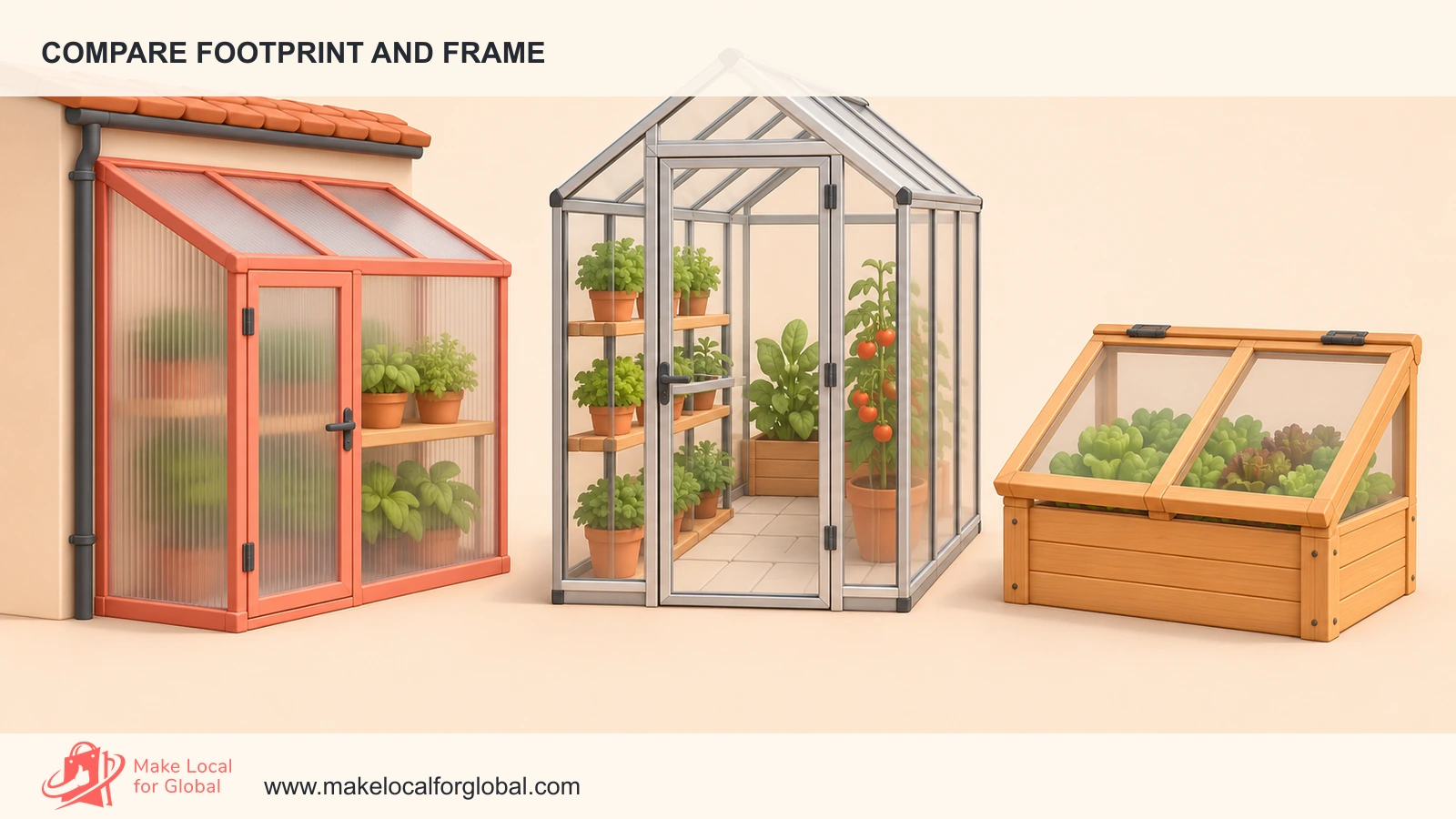
Treat a range comparison as a list of decisions, not a ladder where each higher price is automatically “better”. A smaller kit may fit the buyer’s site, arrive in fewer manageable packages and cost less to ship. A larger kit may support a different growing task, but it brings more components, storage volume and delivery exposure. Make each option earn its place.
A focused launch could have one compact option, one mid-size option and one larger or specialist option, if each serves a distinct buyer need and your supplier can support all three. You might instead launch a single model in two lengths. The right choice depends on confirmed samples, stock terms, available capital and delivery access.
Avoid opening with several near-identical kits that differ only by a small width change. Each extra SKU adds product data, stock counts, carton dimensions, spare-part questions and opportunities for a picking error. Use a range worksheet to record:
If the supplier revises a panel, connector or instruction sheet, note the new revision and recheck the sample. A product photo from an older kit may show a part that no longer ships. Keep one master specification for each SKU and use it for the listing, packing checklist and customer service replies.
Consider related add-ons only after you have confirmed compatibility. Staging, automatic vent openers, gutters, shade cloth, anchors and replacement clips may suit some kits and not others. List the compatible model numbers and any fitting requirements. Do not bundle an accessory on the basis of its name alone.
For adjacent product planning, see how to sell camping gear online. The storage and delivery questions differ by product, but the same habit of checking package dimensions and the exact kit contents applies.
Potential sources include UK manufacturers, importers, garden-product wholesalers and direct overseas factories. Each route changes lead times, order size, paperwork, quality control, warranty support and who handles damaged deliveries. Ask who is the legal supplier, who imports the product and where replacement parts are held.
Request the full specification sheet, parts list, assembly instructions, packaging dimensions, current stock status and written trade terms before placing an order. Ask whether the price is for one complete kit or a frame, covering and accessories priced separately. Check if the product code changes by colour, glazing or size. Confirm how long a quote remains valid and what happens when a model is superseded.
Ask each supplier:
Check that the supplier’s trading name, invoice, bank details and correspondence match. Request written answers rather than relying on a sales call. If importing, get advice about the responsibilities that apply to the specific goods and route. A seller can have duties even when another company made the product.
Do not compare supplier prices alone. A lower quote can be outweighed by expensive freight, high minimums, slow spare-part supply, unclear documentation or weak packaging. Calculate landed cost per saleable kit, including duty and import VAT where applicable, customs or handling charges, inspection time and the share of inbound transport.
Order one complete kit through the route you intend to use for stock. Keep the order confirmation, invoice, tracking information and all supplier replies. Photograph the unopened cartons and labels. Check carton count, visible damage, SKU and revision before opening.
Set up a clean work area and follow the supplied instructions as a customer would. Prior familiarity with the frame can hide a skipped direction, so follow each step. Record where instructions are unclear, where two parts look similar and whether a tool or fixing is missing from the instructions. Note how long each stage takes, but label your result as one sample build, not a promise that every customer will finish in that time.
Compare the parts against the packing list before assembly. Lay out rails by length, panels by shape and fasteners by type. Check whether the diagrams identify each piece. Measure key components against the specification. Inspect cut ends, coating, drilled holes, connector fit and panel edges for visible defects. If the manufacturer gives tolerances or inspection criteria, use those. A visual inspection does not establish structural performance.
For panels, identify exactly what the supplier calls the material. Do not infer that two clear or translucent sheets are the same plastic. Check markings, protective film, thickness where documented, edge finish, UV-side markings if applicable and how the instructions orient the panel. Photograph the markings and the installed fit. Avoid testing strength by impact or unsupported load.
Check frame joints and connectors for alignment. Raise a part that fits only after force or improvisation with the supplier. Verify that screws and clips hold as intended in the sample build. Claim a specific wind or snow performance only where product documents support it. Record the maker’s stated site preparation, base and anchoring requirements. Keep assembly and anchoring advice within the manufacturer’s instructions.
Test doors, vents, latches and included accessories through their full movement. Look for sharp edges, obstructions, gaps or a need for a second person during a step. Ask another person who has not seen the instructions to find the correct parts and explain the sequence. Their confusion can reveal where your listing needs a diagram or a clearer note.

Create an approval record for each sample: SKU, date received, revision, contents, inspection notes, photos, assembly notes and supplier response to any discrepancy. Pause the product if parts are missing or the supplier cannot resolve a specification conflict. Sell an assembled sample as new stock only if the condition is accurately described and the terms support that sale.
A greenhouse kit can be inexpensive to buy and costly to ship. Length, weight, number of packages, postcode restrictions, handling surcharges and damage risk can change the unit economics. Ask a carrier for an actual quote using the carton data; do not price delivery from the product’s assembled size or a standard-parcel guess.
Use this hypothetical example to check the arithmetic. It is not a supplier quote, recommended retail price or forecast. Assume one kit sells for £450 including VAT charged to the customer. For simple illustration, assume the seller is VAT registered and the displayed price includes standard-rated VAT at 20%. The net sales value is £375 and output VAT is £75. The real VAT treatment depends on the supply, registration status and tax advice.
Suppose the hypothetical variable costs, excluding recoverable VAT, are: product and inbound freight £205; payment fee £8; protective packaging £12; delivery to the customer £58; pick and pack labour £10; customer acquisition £22; returns and damage allowance £15. These costs total £330. Subtracting them from £375 net sales leaves £45 contribution before fixed overhead, corporation or income tax, finance costs and any VAT that cannot be recovered.
That £45 is not net profit. It can be reduced by insurance, storage, software, rent, photography, support time, accounting, chargebacks, failed deliveries, replacement parts or unsold stock. If delivery costs £20 more than expected, the contribution falls to £25. If the seller is not VAT registered, the sales and cost calculations need to be rebuilt; do not reuse this illustration as a quote.
| Illustrative order calculation | Amount |
|---|---|
| Customer payment including VAT | £450.00 |
| Net sales value before output VAT | £375.00 |
| Product and inbound freight | £205.00 |
| Payment fee | £8.00 |
| Protective packaging | £12.00 |
| Customer delivery | £58.00 |
| Pick and pack labour | £10.00 |
| Customer acquisition allowance | £22.00 |
| Returns and damage allowance | £15.00 |
| Listed variable costs | £330.00 |
| Contribution before overhead and tax | £45.00 |
Hypothetical example, not a quote or forecast. VAT, fees and recoverable input tax depend on the seller and transaction. Replace each figure with current business costs.
Replace every assumed line with a current amount. Ask the carrier to explain volumetric or non-standard parcel pricing, remote-area charges, timed delivery, failed-delivery fees, damage cover, claim deadlines and collection options. A quote for one postcode is not a national rate. Recalculate at the customer destinations you actually plan to serve.
Estimate a returns and damage allowance from your own order records once you have them. At launch, show it as an assumption and update it as evidence arrives. Do not hide the uncertainty by using a zero allowance. A single cracked panel may trigger replacement freight and customer-service time in addition to the part cost.
A kit can arrive as one large carton, several long parcels or separate frame and panel shipments. Confirm how the supplier protects each part and whether the carrier accepts the exact package dimensions. Measure the longest carton, girth if relevant to the carrier and loaded weight. Ask whether the carrier needs a two-person lift, a tail lift, a safe place or a delivery appointment.
For your sample, inspect corner protection, panel separation, restraint, moisture protection and whether loose fasteners can puncture a sheet. Photograph the packaging before and after opening. Ask the supplier what packing materials are approved for the panel and frame surfaces. Do not add tape or protective film directly to a surface without checking that it will not leave residue or damage a coating.
If repacking, use a simple checklist:
Use a carrier that confirms acceptance of the size and weight in writing. Confirm whether the service covers delivery from collection to the customer and which party handles the claim. State delivery restrictions before checkout. A rural postcode, narrow access, island delivery or commercial site may have a different service or price. Ask the buyer to check the route and unloading arrangements before dispatch.
Decide how you will respond to a missing carton, punctured panel or bent rail. Keep a supplier contact, carrier reference and parts diagram available. Ask for photographs of the outer carton, label and damaged part, but do not make a customer wait indefinitely as you decide who is at fault. Explain the process and timing in your support policy. For stock, hold replacement parts or have a supplier agreement that names the dispatch time.

A useful product title names the type, size and important material or covering. “Walk-in greenhouse kit, 6 ft by 8 ft, aluminium frame, twin-wall polycarbonate panels” is more informative than “Large premium greenhouse”. Only include material names and panel descriptions that match the supplier’s documents.
Show what the buyer receives. List each box, frame sections, panels, door parts, vents, clips, fixings, base, shelves and instruction sheets. Mark items that are shown in photographs but sold separately. State if a base is included, optional or not supplied. Clarify whether the pictured plants, staging, wall fixings, anchors or tools are part of the order.
Add verified dimensions in a consistent unit. Include external width, depth, overall height, doorway width and the dimensions of each package. If available, show the usable internal area and explain how you measured it. Use a simple diagram with measurements and a photo of the structure beside a familiar object, but do not let perspective distort the scale. Include a note that the customer should check the site, access route and local requirements before ordering.
A practical product description can answer:
Use several genuine photos: the complete assembled sample, close-ups of frame joints, panel markings, door and vent details, the parts laid out, and the cartons ready for dispatch. Take photos of the exact revision for sale. Do not use a lifestyle image to imply that accessories are included. Add diagrams that clarify dimensions or parts, not decoration that makes unsupported claims.
Write alt text for the information a photo conveys. “Aluminium greenhouse frame assembled with polycarbonate panels beside the packing list” is more useful than repeating the product title in every image field. If an image is decorative, WordPress may use empty alt text; do not stuff keywords into it.
UK sellers, importers and manufacturers have responsibilities for consumer product safety. The Office for Product Safety and Standards says products must be safe in normal or reasonably foreseeable use under the General Product Safety Regulations 2005, with separate EU General Product Safety Regulation provisions applying in Northern Ireland from 13 December 2024. Read the current GOV.UK product safety advice for businesses and ask a qualified adviser which duties apply to your role, product and destination.
Keep supplier identity, product codes, batch or revision information, instructions, safety information and complaint records together. Check how a customer can identify the seller and contact support. Make sure the product information and instructions are available in the language required for the market. Ask the supplier to identify foreseeable risks and the controls used. Do not invent safety marks or claim that a kit is “certified” without evidence for the exact product and a valid basis for the claim.
The greenhouse can have sharp sheet edges, long sections, small fixings and assembly steps that need careful handling. Use the supplier’s written warnings and instructions as the starting point. Verify that the parts and instructions match. Do not write DIY structural advice that overrides maker guidance. Questions about anchoring, wind exposure, snow loading or a particular foundation should go back to the supplier or a competent installer.
The legal position may differ by destination. The official product safety page explains the distinction between Great Britain and Northern Ireland. If shipping to the EU, check the EU rules and seller/importer duties separately. For a product with a safety concern, stop sale of affected stock, preserve records and seek advice about the correct incident and customer process.
Before checkout, online sellers must provide specific information about the business, goods, total price, delivery and cancellation rights where they apply. The UK Government’s online and distance selling guidance lists information businesses must give before an order and requirements after it. The exact requirements can depend on the transaction and destination; get advice before writing your terms.
Show the full delivery price or how it will be calculated. Give the delivery area and known restrictions. State the expected dispatch or delivery window based on supplier stock and carrier service, not a hoped-for date. Explain what happens if a buyer is unavailable or access is unsuitable. Provide confirmation of the contract in a form the customer can keep.
Do not write “no returns on opened kits” as a blanket rule. Consumer cancellation and remedies for goods that are faulty or not as described are governed by law, and the details depend on the circumstances. Write a returns policy that describes how to contact you, how to protect long or fragile parts for return, who arranges collection and how refunds or remedies are handled under applicable rules. Have a solicitor review it. A kit assembled by a buyer may need a careful assessment of its condition and handling; do not assume assembly removes every right.
Planning rules are a separate question from product safety. A kit seller should not promise that a buyer can place any greenhouse anywhere without permission. England’s permitted development guidance for householders contains conditions and exceptions for outbuildings; protected land, listed buildings and local restrictions can affect a site. Rules vary across the UK, so advise buyers to contact their local planning authority when unsure. Keep your page factual: give dimensions and point to the right authority rather than offering a blanket permission claim.
Your own ecommerce shop gives you control of product pages, shipping choices and customer contact. It makes you responsible for traffic, checkout, returns information and support. A marketplace may bring discovery but can set fees, parcel limits and account rules. A specialist garden retailer may expect trade pricing, product documentation, stock reliability and a clear after-sales route.
Choose one main channel for the first launch. Before listing, make a test order from the buyer’s perspective. Check that package dimensions and surcharges appear before payment, the confirmation email names the exact kit and support contact, and a customer can find the delivery, returns and assembly information. If the platform cannot represent multi-box delivery or size-based prices clearly, choose a different fulfilment arrangement.
For a bulky kit, the channel needs more than a product upload. Make sure it can handle the right stock quantity, carrier service, delivery zones and tracking. If the supplier ships on your behalf, clarify whose name appears on the parcel, who sends tracking and who deals with damage. Do not describe drop shipping as low responsibility; the seller still needs to support the order and keep customer promises.
If you sell other outdoor products, the Product To Sell collection has ideas to compare. A greenhouse kit can share a customer with gardening accessories, but product adjacency is a hypothesis. Let actual enquiries and order data decide whether to add another category.
Useful search content answers what a buyer is trying to confirm before choosing a kit. Start with questions customers ask your support team, supplier and sample testers. Examples include “what size greenhouse fits this space?”, “what is included in a greenhouse kit?”, “polycarbonate or glass greenhouse panels?” and “how is a greenhouse delivered?”. Check search suggestions and your own site queries, but do not treat a keyword list as proof that a product will sell.
Use a clear page title and one direct introduction. Include the exact measurements and kit contents in the product page, not just in a blog post. Create supporting pages only when they answer a distinct question: a measurement checklist, a panel-care explanation from the maker, an assembly support page or a delivery guide. Link the pages so a buyer can move from explanation to the exact kit.
Avoid repeating “greenhouse kits” in every heading. Use natural terms such as greenhouse frame, panel type, footprint, kit contents, vents and delivery where relevant. Write image names and alt text from the actual scene. Add structured data only through the store platform or a supported plugin, and check that price, stock and product identifiers match what is shown.
Track search impressions, product-page visits, add-to-basket events, completed orders, customer questions, delivery incidents and returns by SKU. A high number of views with no enquiry may point to an unclear price or a mismatch between promise and delivery cost. A lower-traffic product with clear orders can be more useful than a page attracting broad but irrelevant attention. Change one part of the page at a time and note the date.
A kit has many pieces, so stock control must track complete saleable units and replacement parts. Count cartons, not just kits. Record the box number and expected quantity per package. Store cartons on a surface and in a position that matches the supplier’s handling instructions. Keep panel cartons away from sharp edges, damp and heavy items that can crush them.
At goods-in, compare delivery paperwork with the purchase order. Check visible carton damage before signing where the carrier process allows it. Photograph labels and defects. Quarantine any kit with a mismatch, damaged carton or incomplete packing list. Do not mix old and new revisions in one bin without a clear SKU and picking rule.
Write a packing check for every order. It should list carton count, correct label, all required boxes, customer postcode, carrier service, tracking number and dispatch photos. For split deliveries, tell the customer how many parcels to expect and whether the tracking may arrive separately. If one box is delayed, send a useful update with the reference and a next contact time.
Prepare short support replies for common questions: the base is not included, one box has arrived, a panel is cracked, a part is missing, the customer cannot identify a rail, or the carrier could not deliver. A reply should ask for enough evidence to identify the SKU and part without demanding unnecessary information. Give a clear owner and next step. Measure response time and resolution time; those affect how confident customers feel about buying a large product online.
Keep supplier and carrier records tied to the order. If the same clip or panel fails repeatedly, look for a pattern by SKU, revision, carrier and packing method. Pause new orders if the issue may affect safety or the ability to complete the kit. Ask the supplier for a written fix and inspect the next sample before returning the SKU to sale.
A month is enough to complete basic checks and collect early evidence. It does not guarantee a profitable launch. Adjust the dates to supplier lead times and the time needed for advice or product review.
Week 1: test the buyer and site fit. Speak with likely buyers. Ask about the growing task, available footprint, access and delivery worries. Compare two or three real supplier specifications. Record which unanswered question most often stops people from choosing. Do not order volume stock yet.
Week 2: approve the sample and costs. Buy one complete sample. Check its revision, parts list, instructions, carton condition and assembly. Measure every parcel and request carrier quotes for representative postcodes. Build a per-order cost sheet with VAT treatment confirmed by an accountant.
Week 3: prepare the product page and operations. Write the SKU specification, photograph the sample, state exactly what is included and list exclusions. Confirm supplier support, spare-part terms, carrier service, delivery zones and customer policy. Place a trial order through the full workflow if possible. Correct errors before taking paid orders.
Week 4: launch a controlled range. Publish the product page only when stock, price and delivery are accurate. Start with a manageable quantity or clearly stated supplier lead time. Track visits, enquiries, orders, support questions, delivery cost and damage reports by SKU. Review the data weekly and change one issue at a time.
At each review ask: Did the buyer find the exact dimensions? Did the delivery estimate match the invoice? Did every carton arrive? Did the customer understand assembly and what was excluded? Which question took longest to answer? Use the answers to improve the page, supplier agreement or packing process before adding more sizes.
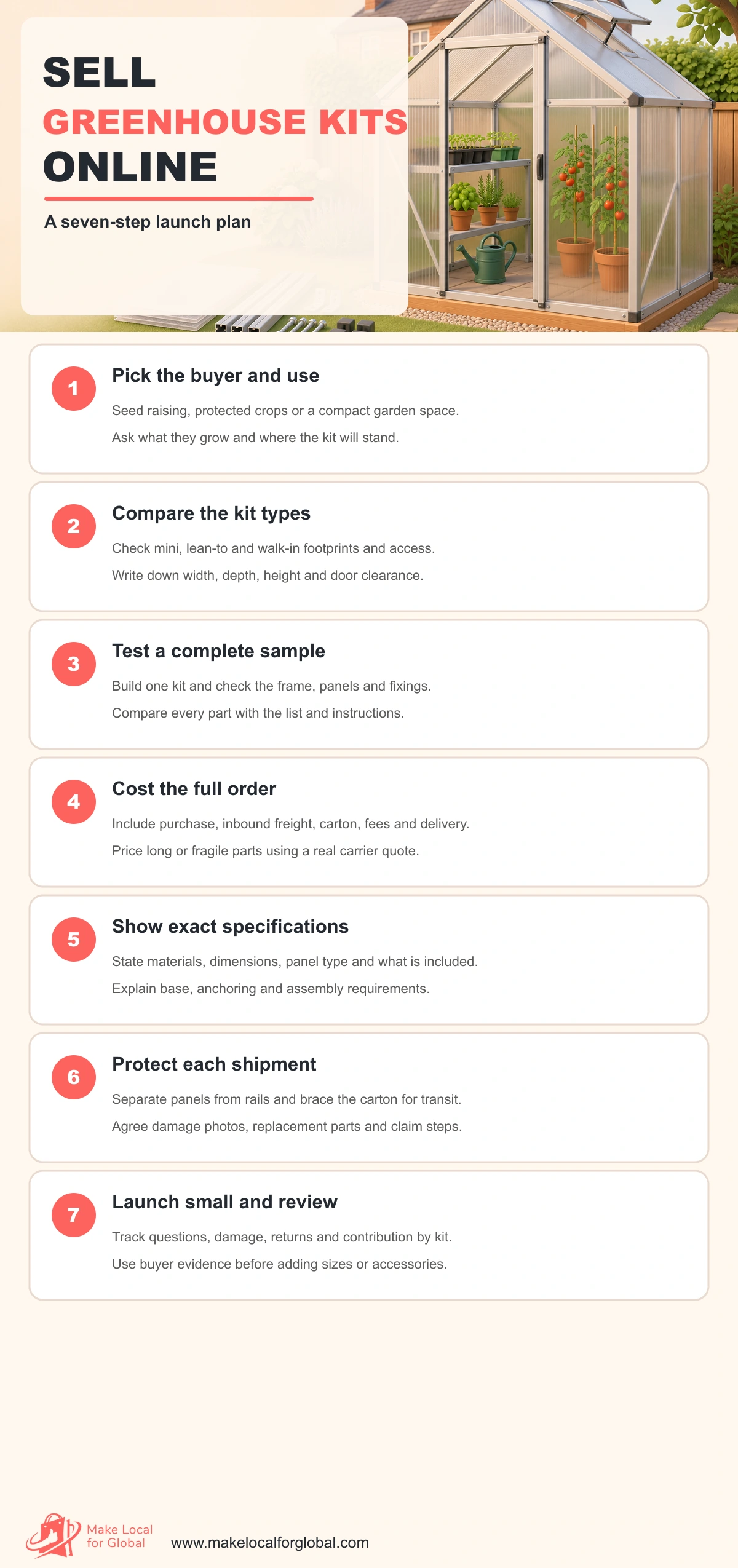
Organise the greenhouse sizes, kit contents and buyer questions before placing a stock order.
Choosing by advertised size alone. External measurements do not show door clearance, usable space or the room needed to assemble the kit. Publish more than a single width and length.
Assuming the supplier’s sample represents every revision. Parts and instructions can change. Record the revision and check replenishment against the approved version.
Treating freight as a small add-on. Long cartons can cost more than standard parcels and require a special service. Price using actual box dimensions and destination postcodes.
Listing accessories as if they are included. A photograph may show shelves or a base the kit does not contain. Mark included and optional items clearly.
Using broad claims about weather performance. Wind, rain and snow conditions differ by site. Repeat only claims supported by the maker’s documentation for that exact product and state the conditions.
Offering too many models at launch. Every variant adds stock, data and parts questions. Begin with a range you can inspect and support.
Writing a blanket “no returns” notice. Consumer cancellation and fault rights can apply. Use reviewed terms that describe the correct process.
Promising planning permission. A greenhouse’s size, location and local constraints matter. Give buyers dimensions and direct them to the local planning authority when needed.
Using a render instead of the exact kit. A polished image can conceal missing details. Show real photos of the sample, parts and cartons; disclose when an illustration is not the exact product.
Choose the model that serves a specific buyer and passes your sample, specification and delivery checks. A compact kit may suit a small site; a larger walk-in model may fit another task. The buyer, carrier quote and ability to support the kit should shape the first SKU.
Compare products using supplier documentation for the exact panels. Glass and polycarbonate have different handling, weight and product characteristics. Do not claim one is safer, longer lasting or better at retaining heat without evidence relevant to the model and conditions.
There is no fixed opening quantity. Start with a number your working capital, storage and supplier lead time can support. Consider a sample plus a small saleable quantity, then use enquiry and order records to plan replenishment. Be clear if customers are ordering against a supplier lead time rather than available stock.
Use the number of cartons, each carton’s dimensions and gross weight, destination and service level. Obtain real carrier quotes for representative postcodes. Add surcharges, packing material, handling and a damage or returns allowance to the cost sheet.
Only after calculating the delivery cost in the price and checking the effect on contribution across the postcodes and kits you sell. A single free-delivery figure can underprice remote areas or the longest parcel. You can offer a clear delivery charge or state how it is calculated before checkout.
Tell the buyer how many cartons to expect and send tracking references. If one is missing, check the carrier scan, contact the carrier or supplier and give the customer a named next step and update time. Do not mark the order complete until every required carton has been accounted for.
Ask the buyer to stop handling the damaged part and contact you with the SKU, carton label and useful photos. Keep the record tied to the supplier and carrier. Follow the agreed damage process, arrange an appropriate replacement or remedy and review whether the packaging or service needs to change.
That depends on the kit instructions and the model. State whether the base is included, optional or excluded, and quote the manufacturer’s site-preparation guidance. Do not recommend a substitute base without checking compatibility.
No blanket statement is safe for every site. Planning rules can differ by location, land designation, building restrictions and structure. Provide product measurements and ask buyers to check with their local planning authority when they are unsure.
Potentially, if the marketplace and carrier can handle the product’s dimensions, parcel count, delivery zones and customer support needs. Check current listing, fee, shipping and returns terms before choosing the channel. Confirm that the checkout can display the total delivery price and restrictions.
Keep supplier identity and invoices, SKU and revision records, product specifications, instructions, safety information, sample inspection notes, order records and complaint or incident details. Ask a product-safety adviser which records are required for your role and destination.
Track completed orders, contribution per SKU, product questions, conversion points, delivery cost, damage, returns and the time needed to resolve issues. Clicks alone do not show whether the range works. Keep, change or remove a model based on what the order and support records show.
Use your sample notes, carrier quotes and per-order costs to decide what to test next.
PREFERRED SOURCE
Like what you’re reading? Add Make Local for Global as a preferred source on Google to see more of our articles when you search.

Build your online presence without having to figure out everything yourself.