

READY TO SELL Chandeliers ONLINE?
Get a store built for you in 5 days, plus training and support to help you start, run, and grow your Alternative business.

A practical guide to selling glass chandeliers online: choose a focused range, verify electrical product information, protect fragile parts and price delivery.


A glass chandelier can be a striking focal point, but selling one online involves more than finding a pretty fixture and uploading a photograph. Buyers need confidence about scale, ceiling height, glass details, electrical compatibility, installation requirements and what will arrive in the box. The seller must be able to verify the product, describe it accurately, protect its fragile parts and cover the cost of a bulky delivery or a damaged return.
This guide focuses on new decorative ceiling chandeliers that include electrical components and glass shades, arms or drops. It is written for a small UK ecommerce business choosing an opening range. Antique restoration, bespoke rewiring, commercial lighting projects and standalone non-electrical glass ornaments have different requirements. Start with the product itself, then work through supplier evidence, buyer fit, pricing, page content, packing and a small test. The aim is to build a range you can explain and fulfil consistently, not to stock every style in a supplier catalogue.
Compare the range, costs and sales route with the free Ecommerce Pathfinder.
A chandelier is usually bought to solve a room problem as much as to decorate a ceiling. Someone furnishing a dining room may need a fitting that sits above a table without blocking conversation. A buyer planning a hallway may care about the drop length and whether a tall person can pass below it. A bedroom shopper may want a soft finish and a smaller body that does not overwhelm the room. A homeowner replacing a fitting may be comparing the existing ceiling point, available space and the electrician’s advice.
Write one useful buyer description before ordering samples. For example: “UK homeowners refreshing a dining area who want a visible glass focal point, clear dimensions and a delivery plan that does not leave them guessing about installation.” This is specific enough to guide product selection and page content. It does not claim that every buyer has the same room or budget.
Look for evidence in questions, interviews, search terms, competitor reviews and conversations with tradespeople. Record the actual wording people use. If several ask whether a fitting suits a low ceiling, the answer belongs near the top of the product page. If they ask whether bulbs are included, show the bulb base, quantity and maximum wattage from the verified specification. A buyer’s uncertainty can reveal the information your store is missing.
Do not infer demand from a dramatic supplier photograph alone. A large glass chandelier can attract clicks yet prove difficult to deliver, install or return. Compare the room, intended use, product dimensions and fulfilment burden. A smaller fitting with reliable specifications and a tested carton may be a better first experiment than the most elaborate model in the catalogue.
Choose a narrow first group, perhaps three to five models that share a clear buyer and a manageable set of differences. The purpose is not to make the shop look large. It is to keep sampling, compliance checks, photography, stock decisions and customer support within reach. A new finish or glass shape should earn its place by answering a real buyer preference, not because it happens to appear in a supplier feed.
For each candidate, make a simple range record: intended room, overall width, height, adjustable drop, weight, glass type and finish, number of lamp holders, bulb specification, ceiling fitting, included parts, pack size, supplier lead time and sample status. Keep the supplier’s claims separate from facts you have verified yourself. If the supplier cannot confirm an important detail, mark it as unresolved rather than filling a gap with a guess.
A focused selection could include one compact form for a smaller room, one medium focal point and one wider model for a table or open area. That is only a planning structure. Actual sizes must come from your selected product and buyer research. Avoid presenting a model as “small” or “large” without showing measurements and a reference scale. The same fitting can look compact in a tall room and dominant in a modest one.
Keep variants understandable. If a model comes in two finishes, confirm that the electrical assembly, glass pieces and dimensions match the variant shown. Give every finish a clear image and stock identifier. Do not combine products on one page when their canopy, glass pattern, wiring or fitting method differs materially. A buyer should be able to tell exactly which model they are ordering.
| Chandelier type | Buyer question | Verify before listing |
|---|---|---|
| Compact glass fitting | Will it suit a smaller room? | Width, height, lowest drop and room use |
| Dining focal point | Will it clear the table and circulation space? | Body width, suspension range and weight |
| Multi-arm chandelier | What assembly and parts are included? | Arm count, glass pieces and instructions |
| Glass bowl design | How is the shade cleaned and secured? | Glass material, attachment and care guidance |
| Multiple finish variants | Is the pictured finish the selected one? | Variant SKU, materials and electrical spec |
These are planning groups. Use the exact model specifications and sample to describe each product.

“Glass chandelier” covers a broad mix of construction. A product may use cut glass drops, pressed glass shades, a glass bowl, globes, rods or decorative panels. The frame could be steel, aluminium, brass or another material, and the finish might be plated, painted or coated. Appearance in a studio image cannot establish the exact material, construction or finish. Request written specifications for the exact model and keep a copy tied to its SKU or batch.
Ask the supplier to identify which parts are glass and which are acrylic or another material. Clarify whether the metal is solid, plated or coated. Record dimensions for the body, canopy and hanging elements, plus the minimum and maximum drop. Ask how much adjustment is possible and whether shortening requires an electrician or a particular ceiling condition. If the product’s total weight is not documented, do not estimate it from a photograph. Weight affects installation suitability, delivery price and the buyer’s decision.
Confirm the lamp holder type, number of lamps, maximum permitted wattage, voltage range, bulb shape and whether bulbs are included. Check if dimming depends on compatible bulbs or a separate dimmer. Avoid broad claims such as “works with all dimmers” unless they are supported for the exact fitting and bulb combination. If the supplier states an IP rating, obtain the evidence and explain the rating accurately. A decorative interior chandelier should not be implied suitable for a bathroom or outdoor location without a supported specification for that use.
Ask for the instruction leaflet, installation information, product label, traceability details and current conformity documents that apply to the exact model. Keep copies and note who supplied them and when. Check that the model number on the paperwork corresponds with the item and that the importer or responsible business details are consistent where required. A generic document with a different product name or unexplained model range is not enough to resolve a mismatch.
A supplier conversation should reveal whether the business can provide dependable product information, repeatable stock and a workable route for defects. Ask who manufactures the chandelier, where it is made, who exports it and who will act as importer into the market where you sell. Request the legal business name, address, product reference, batch or serial approach, lead time, minimum order and process for reporting a safety concern. Save replies with the relevant model record rather than relying on chat history that may disappear.
Ask how the supplier handles substitutions. A replacement glass drop, canopy or wiring loom may look similar but have different dimensions or material. Confirm that you will be notified before a component or specification changes. Ask whether production has changed since the supplied test documents were prepared. A supplier’s promise that “it is the same” should be backed by model and revision details that you can retain.
Order a complete sample in the configuration you intend to sell. Inspect the outer box before opening and photograph any transit damage. Check the product against the list of included parts. Lay out the glass components on a protected surface, count them, inspect each for chips, cracks, sharp edges, scratches and inconsistent finish, and compare them with the assembly instructions. Check metal joins, threads, sockets, strain relief, cable condition and the fit of each shade or drop without modifying electrical components.
Do not attempt live electrical testing or installation unless you are qualified and equipped to do that work safely. Use an appropriately competent person for technical inspection when needed. Your job as seller is to verify the product and documentation, not to improvise a test that could injure someone or create a false assurance. Record the sample date, model, batch, measurements, defects and decision. Keep a retained sample or clear photographs if practical.

A chandelier containing electrical equipment can fall within product rules that depend on its design, voltage, role in the supply chain and destination. In Great Britain, the Electrical Equipment (Safety) Regulations apply to equipment within their stated voltage range. The manufacturer has duties around conformity assessment, technical documentation, declaration, marking and traceability. Importers and distributors have separate duties. A business placing a product on the market under its own name or modifying it may take on manufacturer responsibilities. Identify your role before importing or relabelling. Read the current GOV.UK guidance for electrical equipment in Great Britain and take specialist advice where your case is unclear.
Great Britain currently accepts CE or UKCA marking for covered electrical equipment under the applicable arrangements. That does not make a mark a substitute for a valid conformity assessment, a declaration or technical evidence. Check the current rules before placing an order because policy and transition periods can change. Northern Ireland follows a different set of arrangements for some product regulations; consult the current Northern Ireland electrical equipment guidance if you sell there. Do not apply one nation’s assumptions to every UK destination.
Ask whether the product is within the Restriction of Hazardous Substances regime and request its technical evidence and declaration where applicable. The GOV.UK RoHS guidance explains the framework and supply-chain responsibilities. The seller should be able to identify the precise equipment and the documents that support its status. Save versions with dates. If a supplier provides only a general statement, ask how it relates to the specific model and components.
Electrical safety is not a badge you add to a product page. Do not write “UK certified”, “fully compliant” or “safe for every home” based only on a marketplace photo or a logo in a supplier catalogue. State verified features in plain terms and keep the underlying records. Use a qualified product compliance professional if you cannot establish which regulations, tests or documents apply to your role and product.
Electrical equipment can bring Waste Electrical and Electronic Equipment obligations. Whether you count as a producer depends on activities such as manufacturing, importing and selling under your own brand, together with the relevant regulations and market. A small online shop can still need to check its status. GOV.UK explains EEE producer responsibility, including registration routes and reporting duties. Check thresholds, deadlines and the current scheme information before importing or placing products on the market.
Retailers have separate distributor duties. Online sellers may need to provide take-back information and arrange a route for customers to recycle old equipment. GOV.UK describes electrical waste responsibilities for producers and suppliers and the Distributor Takeback Scheme. Eligibility and fees can change, so confirm current terms rather than copying a figure from an old article. Add the relevant information to the site and order communications where required.
Glass packaging and electrical waste are different waste streams. Do not suggest that a glass shade belongs in a household glass recycling bin without checking local rules; specialist glass types may not be accepted with food jars and bottles. Explain packaging disposal only when you have verified local or scheme guidance. If you ship from outside the UK or sell into another country, investigate that market’s obligations as a separate task.
Keep a compliance calendar with registration dates, scheme renewals, reports, supplier document reviews and product changes. Assign a person to each action. A reminder in a spreadsheet is better than relying on memory, but the record still needs an owner and a source. If your business expands into more electrical categories, revisit the assessment rather than assuming that a past decision covers a new product type.
The buyer needs to understand what the product is and what professional help may be needed. Provide the installation leaflet before purchase if the supplier permits it, or summarise the verified requirements without turning them into DIY instructions. Make clear whether the product is supplied as a complete fitting, whether bulbs are included, what ceiling attachment hardware is in the package and whether any parts must be sourced separately. Never promise that the fitting will attach to every ceiling or existing wiring arrangement.
For England and Wales, domestic electrical installation work is covered by Building Regulations requirements, including Part P. Requirements and notification arrangements vary by work and by nation. Point buyers to current local guidance and a qualified electrician for installation questions. Do not interpret a buyer’s wiring photograph or advise them to connect wires through a product page chat. If a customer reports heat, sparking, a burning smell, a cracked electrical part or another possible safety fault, tell them to stop using the item and follow an appropriate safety escalation and reporting process.
Check whether the chandelier’s weight, dimensions and mounting arrangement require assessment of the ceiling structure. The product page can state the documented weight and fitting details, but it cannot inspect a customer’s ceiling. Avoid language that assures suitability for plasterboard, a concrete ceiling, a sloped ceiling or a particular junction box unless the manufacturer explicitly supports that configuration and any conditions are stated.
Write a support script for common pre-sale questions: “What is the total drop?”, “Can it be shortened?”, “What bulb does it use?”, “Are the bulbs included?”, “Does it arrive assembled?”, “What is in the box?” and “Who should install it?” Put answers on the page when they are stable facts. Route product-specific electrical questions to a competent person instead of guessing in a sales conversation.
Lead with a plain product name, a concise description of the room and use, and the measurements a buyer needs to assess fit. Put the overall width, body height, adjustable drop, canopy size and product weight in a specification block. Distinguish the fitting’s dimensions from the parcel dimensions. State the number of glass pieces if verified, the frame material and finish, the lamp holder, number of lamps, maximum wattage, voltage, bulb inclusion, dimming conditions and included components. If a value is unknown, resolve it before launch or say clearly that the information is unavailable and do not imply otherwise.
Write for a person comparing a real room, not for a list of search phrases. Explain where the fitting may work, what must be measured and what makes this model different from another in your range. A useful sentence might say that the buyer should compare the width with the table or room and check the lowest hanging point against the room’s circulation space. Avoid declaring that a product will “transform any home” or “fit all ceilings”; those claims are too broad to help someone decide.
Include care guidance from the manufacturer. Glass can be fragile and finishes can be damaged by unsuitable cleaning products. Tell buyers whether shades detach for cleaning, whether a dry or damp cloth is specified, and what should be avoided. Do not recommend abrasive materials, solvents or water near electrical connections unless the official instructions specifically say what is safe. Include a note to isolate power and follow the product’s instructions before any cleaning that requires access to electrical parts.
Put delivery and return information where the buyer can find it before checkout. Show whether delivery is kerbside, room-of-choice or another service, whether the parcel is oversized, whether a signature is needed and what to do if the box is visibly damaged. Be clear about lead times and dispatch status. The more costly the item, the less helpful a vague “free delivery” badge becomes if a customer cannot tell when it will arrive or how a large parcel is handled.
A staged image can communicate style, but it cannot replace a measurement view. Photograph the whole fitting from the front, at a slight angle and from below if the glass arrangement is hard to understand. Add a close view of the shade, glass edge, frame joint, canopy and finish. Include a clear image of the ceiling attachment and the contents of the box. Keep props restrained so the fitting remains the subject.
Show scale with a room scene that has believable furniture and ceiling proportions. Do not use an extremely tall entry hall as the only lifestyle setting if the product is intended for a typical dining room. A size diagram with width, body height and drop is more useful than a hand or unrelated object placed beside the chandelier. Keep every dimension in the same unit system, label the view and state whether the cable or chain is included in the drop measurement.
Use a separate photo for each finish. Make sure the lighting and white balance do not turn brass into gold or clear glass into coloured glass. If the product uses seeded, frosted or tinted glass, show the texture under neutral light. Do not remove a seam, screw, cable or joint that a buyer will receive. Retouch dust and background distractions, but preserve the product’s real construction and finish.
If a photograph is a rendered visualization, label it as an illustration and pair it with real product images before accepting an order. Do not use AI-generated room scenes to invent a product detail or show a fixture as installed when its mounting is unknown. Your image set should make the object easier to judge, not decorate away uncertainty. Use descriptive alternative text for product images, such as “three-light brass chandelier with clear faceted glass shades, shown from the front,” rather than repeating a keyword list.
A chandelier carton has to protect glass parts and prevent metal arms, screws and shades from striking one another. Inspect the supplier’s original packaging rather than assuming it is suitable for your delivery route. The inner supports should hold the frame and glass separately, resist compression and keep parts from shifting when the box is turned. Small fixings should sit in a closed, labelled bag secured away from glass. Loose pieces inside a large box are a predictable source of breakage.
Photograph how the sample is packed before removing it. Then re-pack it using the supplied method and note any step that is confusing or easy to miss. Check if a customer could distinguish the glass pieces and identify them from the assembly guide. Verify that the carton closes without pressure on a shade or arm. Use a carrier-rated outer box or tested overpack when required. Record dimensions and packed weight because carrier tariffs often depend on both weight and parcel size.
Run a practical pack trial. Move the carton through normal handling, check for movement and inspect the contents after the trial. For a high-value or unusually fragile fitting, ask the carrier or a packaging specialist about suitable testing and service terms. A home shake test is not a certification and cannot guarantee survival in a carrier network. It can reveal obvious movement, missing dividers and pressure points before the first sale.
Save the final pack specification: carton code, insert layout, wrap type, orientation marks, void fill, tape, packed dimensions, weight and a photo of each stage. Create a pack checklist for staff or a fulfilment partner. If the supplier ships directly to the customer, obtain clear confirmation of how packaging is built, who owns the delivery claim and whether the pack is consistent across batches. Ask for sample shipment images or inspect a test shipment yourself.

A large chandelier may need a service with parcel limits that differ from ordinary small items. Compare the carriers’ current size and weight rules, declared-value limits, delivery postcode coverage, collection process and damage claim requirements. Ask how fragile items are treated under the service terms. Do not assume that an “insured” label covers breakage in every circumstance. Read exclusions, packaging requirements and evidence deadlines before relying on a policy.
Create a receiving process for stock. Photograph cartons on arrival, record visible damage, count the units and inspect a sample according to a written plan. Quarantine items with cracked glass, missing labels or inconsistent wiring. Record the lot or batch so a concern can be traced to other units. A supplier credit for one broken shade does not resolve the risk that the same packaging fault affects the rest of the shipment.
Write a customer damage process that is calm and specific. Ask the buyer to stop handling loose glass, keep the packaging and send clear photographs of the outer carton, internal packing and affected part. State the support route and expected response time. Avoid asking a customer to dismantle electrical components or to ship broken glass without safe instructions. Your process should respect statutory rights and carrier rules. If the event suggests a product safety problem, escalate beyond an ordinary delivery claim.
Track damage by model and packaging revision. A high rate on one model may point to a weak insert, an exposed glass edge, poor assembly instructions or a carrier mismatch. Compare incidents with shipment count, not just raw complaints. Change one factor at a time when possible and record the result. A lower unit cost can be wiped out by repeated replacements, customer service time and negative reviews.
A price model should begin with the amount the customer pays and list every variable cost attached to an order. Include product purchase, inbound freight, duties and clearance where relevant, packaging, fulfilment time, payment processing, outbound delivery, marketing cost, expected breakage, return handling and any marketplace or ecommerce transaction fees. Include VAT treatment accurately for your business and seek tax advice where the calculation is unclear.
Here is an illustrative order for a chandelier. It is a planning exercise, not a supplier quotation or market average. Assume the customer pays £349 for the fitting and delivery combined. Product cost is £132, inbound freight allocation £22, protective packaging £28, packing labour £14, payment fee allowance £10.47, outbound bulky delivery £52, damage and return reserve £18 and customer acquisition allowance £25. Those variable items total £301.47, leaving £47.53 contribution before fixed overhead, tax and any costs not listed. If VAT applies to the sale, the business must calculate the amount on the correct VAT basis; the simple subtraction here does not do that accounting.
The example shows why a product that looks profitable at wholesale can be fragile at retail. If the carrier price rises by £12, the contribution falls to £35.53. If the order needs a replacement glass shade costing £24 plus £8 postage, the reserve can be exceeded. If paid advertising takes £40 rather than £25 to generate an order, the remaining contribution falls again. These are scenarios to model with your actual prices, not forecasts.
Use a spreadsheet with a variable for each input so you can test a price change, carton change or delivery service. Track contribution per dispatched order, not just gross margin on the purchase invoice. Include returns that are resellable separately from damaged or incomplete returns. Review actual costs monthly and after any packaging, supplier or carrier change. A small amount of arithmetic before a purchase order can prevent a large, expensive stock mistake.
| Order component | Illustrative amount |
|---|---|
| Customer payment, item and delivery combined | £349.00 |
| Product purchase | £132.00 |
| Inbound freight allocation | £22.00 |
| Protective packaging | £28.00 |
| Packing labour | £14.00 |
| Payment fee allowance | £10.47 |
| Outbound bulky delivery | £52.00 |
| Damage and return reserve | £18.00 |
| Customer acquisition allowance | £25.00 |
| Total listed variable costs | £301.47 |
| Contribution before fixed overhead and tax | £47.53 |
Illustration only, not a quote or market average. Replace with actual invoices, current carrier charges, fees and correct VAT treatment.
Once the product, evidence and delivery costs are mapped, consider how your online shop can present them clearly.
When customers compare chandeliers, the word “style” rarely answers the whole question. Give each model a compact comparison record that translates its differences into buyer decisions. A narrow fitting with a shorter drop may suit a smaller dining area. A wider fitting may need more clearance around a table and a stronger ceiling fixing. A model with many separate glass drops may take longer to assemble and need more careful packing than a shade with one glass bowl. These are possible implications to verify for each design, not assumptions to apply to every product.
Compare only attributes that you can support. Useful fields might include body width, body height, overall drop range, weight, number of lamps, shade material, frame finish, bulbs included, assembly level, pack size and lead time. A “best for” column can help when it describes a measurable fit, such as “shorter drop option for rooms where a long hanging chain is unsuitable,” and does not claim every home will suit it. Avoid subjective ranking labels such as “best quality” unless you explain the evidence behind them.
Use the comparison to identify confusing gaps in the catalogue. If every model has the same finish and dimensions, a broader selection may not give shoppers a meaningful choice. If models differ in too many ways, a buyer may need clearer photos or a more structured filter. Do not make the table so wide that it becomes unusable on a phone. Put the most decisive fields first, then link to the full specifications for each model.
Review the table whenever a supplier changes a component or a product is replaced by a newer revision. A comparison that mixes old and new specifications can mislead buyers even when each individual page looks plausible. Keep a date and source beside the business record, then update the public pages promptly after a verified change.
Many buyers have never measured a chandelier. A useful guide explains what to measure without giving an arbitrary universal rule for selecting size. Ask the buyer to note the room dimensions, ceiling height, table size if relevant, walking route and the lowest point of the fitting. Explain which measurement on your page corresponds to the body and which includes the suspension. A simple annotated drawing can show where width, body height, canopy and adjustable drop are measured.
If the chain or cable can be shortened, state the adjustment method only from the product documentation. Some products have a limited range, and shortening may require specialist work. A product may have a decorative hanging loop or fixed stem that cannot be altered. A buyer should not discover this after opening the box. If a size is fixed, say so clearly and show the full hanging length in the first set of specifications.
Room images should help a shopper visualise scale while making no promise about their specific ceiling. Use a photograph or rendering with credible proportions and label the actual product dimensions near the image. If possible, show the same model in a second setting with different room scale. Keep the lens angle moderate; a close wide-angle shot can make a small fitting look huge or a very large fitting look compact.
Do not call a fitting suitable for a staircase, double-height hall or sloped ceiling based only on appearance. Confirm product compatibility and any installation conditions. When a buyer asks about a specific room, provide the documented facts and recommend that they check the installation with a qualified person. Clear boundaries can prevent a wrong purchase and reduce the pressure on customer support.
Keep product claims tied to evidence. “Hand-finished,” “solid brass,” “hand-cut crystal,” “recyclable glass,” “energy saving” and “compatible with smart bulbs” can each change a customer’s expectations. Ask what records substantiate each phrase and whether it applies to every variant. If the source is uncertain, use a narrower factual description such as “brass-coloured plated frame” when that is what the supplier’s specification says. Do not use a material or sustainability claim because it appears in a search trend.
Check the images and text against the exact item before publication. The cover may show a three-light model while the selected SKU is a five-light version. A lifestyle photograph may use a different canopy. A specification copied from a similar fitting may have the wrong wattage. Use a model-by-model content sign-off: product identifier, title, photos, dimension diagram, specification table, included parts, document set, price and delivery. A second person can compare the page with the sample or supplier file before it goes live.
Set an escalation threshold. A scratch on a canopy may be a service defect. Exposed wiring, a loose live part, recurring overheating, incorrect labels or a mismatch in safety documentation needs prompt investigation. Pause the affected batch when appropriate, preserve evidence and seek competent product-safety advice. A routine replacement or refund may resolve one order, but it does not answer whether other units carry the same issue.
Keep a record of the decision and its reason. Include who reviewed the report, what evidence they examined, which batches were involved, the supplier’s response, any corrective action and the decision to resume or end sales. Share only necessary details with a supplier, carrier or regulator. Review the process after an incident so that the next report is easier to handle.
Before advertising, write down what the business needs to learn. The first test may be about whether people understand the dimensions, whether a particular finish attracts more qualified interest, or whether a carrier can deliver the parcel within the target cost. A vague goal such as “get more sales” makes it hard to decide what to change. Use a small set of measures connected to the question.
For discovery, note search impressions, relevant queries, visits to the guide and product pages, and the share of visits that reach the specification or delivery information. For buying behaviour, track add-to-basket events, checkout starts, completed orders and customer questions. For fulfilment, track on-time dispatch, arrival time, damage, replacement parts, returns and support minutes. For business health, review contribution per order and cash tied up in inventory.
Separate a product problem from a traffic problem. If there are very few qualified visitors, a conversion percentage from a handful of people is not a sound verdict. If shoppers visit the page but repeatedly ask for the same missing information, improve the product content before increasing ad spend. If orders arrive intact but the contribution is poor, review delivery, pack and acquisition costs. If damage clusters around one model or carrier, investigate that route before applying a discount.
Record the date range, number of orders and changes made. If you adjust price, product photos and shipping service at the same time, you may not know which change affected the result. Where the volume is small, use customer interviews and careful case review alongside metrics. The numbers point to questions; they do not explain every cause on their own.
After the first chandelier test, the next product should share enough of the audience or fulfilment method to make expansion practical. A related glass pendant may attract a similar room-design shopper, yet it can have different installation and packaging details. A floor lamp avoids ceiling installation but introduces a base, upright sections, a cable and a different carton shape. Product similarity in a photograph does not mean the same evidence or pack design applies.
Map the next category against the current one: buyer overlap, supplier overlap, safety rules, technical documents, photography needs, storage footprint, delivery limits, replacement parts and customer support. Choose an adjacent item if the shared work is real and the new costs are understood. Keep the categories distinct in navigation so a buyer can find what they need without assuming that one item’s specification applies to another.
Before adding stock, confirm that the existing range is stable. Are supplier documents current? Are model records complete? Can the packing process be repeated by another person? Is there enough cash for the existing order and returns? Has the damage rate been reviewed? Expansion while the first model still has unresolved paperwork or recurring breakage multiplies operational friction.
Use buyer questions to guide the next step. If customers repeatedly ask for a smaller fitting, test a smaller chandelier from a verified supplier. If they ask for table lighting but not a ceiling fixture, research another category. If shoppers like the glass style but reject the delivery cost, a lighter or smaller related product may be worth investigating. Treat each idea as a testable hypothesis, not proof of demand.
Each chandelier page needs a title and description that distinguish its useful attributes. If the product is a three-light fitting with clear glass and a short adjustable drop, state those facts only when verified. Do not copy the same title structure and paragraph across every model with the product name swapped. Search engines and shoppers need to understand the actual difference between pages.
Use one main page heading that names the product and one concise introductory paragraph. Organise specifications under descriptive headings such as “Dimensions and drop,” “Glass and finish,” “Bulbs and electrical details,” “What arrives in the box,” “Delivery” and “Care.” A comparison table can help buyers judge two or three models when each field is based on reliable product data. Do not add filler paragraphs to reach a word count on a product page; the supporting guide can cover broader buying and business decisions.
Write a unique meta title and description for each page. Include the product type naturally, then a detail that helps distinguish it. Avoid an identical meta description repeated across the catalogue. Use clean image filenames and descriptive alt text. Keep internal links relevant: a chandelier guide can connect to related lighting categories such as selling floor lamps online and selling garden lighting online, while a materials discussion can point to selling glassware online. Those links add context for readers exploring a broader homewares range.
Do not claim search rank, rapid sales or a guaranteed return. Measure impressions, relevant queries, clicks, product page engagement, questions, add-to-basket activity, orders, returns and contribution. Give a page enough time and traffic to gather useful evidence. A few visits cannot validate a keyword strategy or a product-market fit.
A focused ecommerce website gives you control over product specifications, imagery, delivery information and support. A marketplace may already have relevant shoppers but can set rules for listing details, fees, returns and delivery. A social channel can introduce the design, but the transaction still needs clear product information and a dependable checkout. Choose one main sales route for the first test and learn its real costs before splitting effort across several channels.
Walk through the purchase as a buyer. Can a person find the dimensions, drop length, bulb details and delivery charge without sending a message? Does the selected finish match the photo? Are the return terms visible before payment? Does the confirmation email state what was ordered and how to contact the seller? Is the box likely to arrive when promised? If a step feels unclear to you, record the exact question and improve the page or process.
Set a small test budget and a decision date. Choose a limit for samples, initial units and promotion that the business can afford to lose. Decide in advance what evidence would justify a reorder: a minimum number of orders, acceptable contribution, a damage rate below a defined threshold, and manageable customer questions. The threshold should come from your own business capacity, not a universal ecommerce formula.
If the test has few sales, diagnose one part at a time. Low visits may point to weak discovery. Many product views but few add-to-baskets may point to price, fit information or trust. Cart starts without completed orders may suggest delivery cost, checkout friction or payment concerns. A high cancellation rate may reveal lead-time or specification mismatch. Treat these as possible explanations to investigate rather than proof from a small sample.
Before accepting an online order, provide the business identity and contact details, product characteristics, total price including taxes where required, delivery arrangements, payment information and the applicable cancellation process. Distance-selling rules require specific information before the customer is bound. The exact obligations depend on the transaction and any exceptions. Read the current GOV.UK distance-selling guidance and have your terms checked for the way you sell.
For many online consumer purchases, buyers can notify the trader that they wish to cancel within 14 days after receiving the goods, then have a further period to send the goods back. There are legal exceptions and details about refunds, delivery charges and return costs. Faulty goods have separate protections. Read GOV.UK guidance on returns and refunds and do not write a blanket “no returns on glass” policy. Fragility does not remove statutory rights.
Explain what a return looks like for a bulky chandelier: whether the original packaging should be kept, how the buyer requests a collection, who pays an ordinary cancellation return where lawful, what happens if an item arrives damaged, and how long a refund typically takes under the law and your process. Do not promise a refund timeline that conflicts with statutory rules. Make the steps easy to find before checkout.
Ask a legal adviser to review the terms if you sell cross-border, use instalment payments, provide assembly, sell customised fixtures or have a complex return arrangement. Keep a record of the version shown to each customer. A policy page alone is not enough if customers cannot locate it or if the checkout presents different terms.
A fitting is a considered purchase, so service should continue after payment. Send a confirmation that names the selected model and finish. Send dispatch information and a realistic delivery window. For a bulky parcel, explain whether someone needs to be present and how to report a visible box problem. Provide the installation leaflet or a secure link to it if permitted. Avoid sending unsolicited technical instructions that could conflict with the product manual.
When a customer says parts are missing, check the box contents list and batch record before assuming the buyer overlooked an item. If glass is broken, ask for the smallest set of photos needed to identify the issue and start a remedy. Keep personal information to what you need, store it securely and share it only with the carrier or supplier when necessary. A customer should not have to repeat the story to multiple staff members.
Set a clear escalation route for potential safety incidents. Record the date, product model, batch, customer description and any evidence. Suspend sales of a potentially affected batch while a competent person assesses the issue. Contact the supplier and follow the required reporting and corrective action processes. Do not delete a review or dismiss a complaint because the customer’s account is inconvenient. Safety concerns require careful handling and a traceable decision.
Use questions and returns to improve the listing. If several buyers ask whether a chandelier includes bulbs, move that answer higher. If many need clarification about the drop, add a diagram. If a part is repeatedly damaged, review the packaging rather than asking each customer to accept a replacement as normal. Good customer support is a source of product information and operational evidence.
A large chandelier can tie up cash in a small number of units. Calculate the cash required for stock, inbound transport, import charges, packaging materials and the period before payment settles. Include a reserve for refunds and replacement parts. If the supplier has a long lead time, a pre-order promise should state a realistic dispatch window and explain the risk of a delay. Do not show stock as available when you cannot fulfil it within the stated period.
Set a reorder point based on observed sales, confirmed lead time and a safety buffer that fits your finances. Avoid copying a formula from another business without checking whether demand and delivery are stable enough for it. Review supplier performance by on-time arrival, document quality, sample consistency, defect rate, response speed and change notification. A low unit price cannot compensate for a supplier who cannot trace a safety-related change.
Keep spare parts only when they can be sourced, stored and identified safely. A replacement glass drop may be a practical service item if it is correctly matched and safely packed. Electrical parts should be supplied only with correct compatibility information and handled through an appropriate support route. Do not make a substitute component look identical in the listing without confirmation that it is the correct specification.
If you store customer returns, inspect them before marking them as new. Check completeness, packaging, scratches, glass condition and any evidence of installation. Keep returned electrical products separate until inspected. Define whether an opened but unused item can be resold and what information or packaging must be restored. A quick relist can put a damaged product back into circulation.
Create one digital folder per model with the supplier quotation, specification, invoice, product photographs, compliance documents, sample report, carton test, listing copy, customer questions and change history. Give each file a date and model identifier. If a product is revised, record what changed and whether the listing, documentation, photos, parts list or price needs an update. Old files should remain archived so a past sale can be understood.
A practical model sheet can include: supplier and manufacturer identity; product identifier; batch or revision; countries sold; business role; exact materials; dimensions; weight; electrical specifications; documents received; who reviewed them; sample result; package specification; carrier limits; cost inputs; listing URL; stock count; incident log; review date. Add a named person responsible for unresolved actions. A spreadsheet with blank cells is not evidence that a check happened.
Review the record before placing a repeat order and when a shipment arrives. Ask whether the model, supplier, components, labels, packaging or destination changed. If any answer differs, pause and determine the effect. A supplier may change a glass mould, cable length or carton without changing the catalogue image. Small physical differences can affect customer fit, installation or compliance.
Keep customer data out of general product files unless there is a clear business need. Use a separate restricted support system for order details and safety incidents. Store records for the period required by relevant rules and your business policy. Do not keep personal information indefinitely just because a folder is convenient.
In days one to five, define the buyer and collect evidence. Speak with prospective buyers, note room types, price expectations, size concerns and installation questions. Review search terms and competitor listings to see how products are described, but do not copy their claims. Build a list of three candidate models and record the unanswered questions for each.
In days six to ten, contact suppliers and request specifications, documents, samples, packaging information and change controls. Compare the exact model identifiers across the replies and paperwork. Stop pursuing a candidate if the supplier will not provide critical information. Decide which samples are worth ordering based on fit with the buyer and your ability to deliver them.
In days eleven to sixteen, inspect samples and packaging. Verify parts, finish, dimensions, labels, instructions and the box. Obtain competent help for electrical questions. Calculate product cost, freight, packaging and delivery using current quotes. Write down the business’s role and check the regulatory requirements for the sales destinations. Get specialist advice when the boundaries are uncertain.
In days seventeen to twenty-three, prepare the product pages and operating process. Photograph the real product, write unique copy, show measurements, identify included components and explain delivery and returns. Finalise the carton, customer support route, batch record and incident process. Test checkout and email on a mobile phone and desktop. A page is not ready if the buyer still has to ask for basic specifications.
In days twenty-four to thirty, run a limited test. Start with a controlled quantity or a clearly managed pre-order if the supply and delivery promises are clear. Monitor questions, conversions, delivery performance, breakage and contribution. At the review date, decide whether to change the page, carton, carrier, price, supplier or product. Expand only after the evidence supports that next step.
It can be tested, but it suits a seller who can manage detailed product information, supplier evidence, fragile packaging and bulky delivery. Begin with samples and a small number of products. A low unit cost alone does not show whether an order will contribute after freight, delivery, returns and customer support.
Choose a model that fits a clearly described buyer and room, has complete specifications, can be sampled, and can be packed and delivered within your budget. Compare compact, medium and wider options only after checking actual dimensions and supplier evidence. There is no universal best first size.
Include dimensions, drop range, weight, glass and frame materials, finish, lamp holder, number of lamps, bulb requirements, maximum wattage, voltage, dimming conditions, included hardware, assembly information, care, delivery, returns and clear photographs. Base each statement on the exact model documentation.
Some electrical equipment must carry the conformity marking applicable to the market and product rules. The mark alone does not replace the assessment, declaration and technical documentation. Check current Great Britain or Northern Ireland guidance for your specific role and model before placing it on sale.
Potentially, but commercial importing can make you responsible for checking product safety, technical files, traceability, labelling, waste duties and the import cost. Confirm your role, destination rules and supplier evidence before ordering. Consider advice from a product compliance specialist.
Keep glass pieces separated from each other and from metal arms. Immobilise the frame, protect protruding parts, secure small fittings in a closed bag and use an insert that resists pressure. Test the complete carton for the route and carrier, and record the packaging specification so it can be repeated.
Offer a clear support route and ask for the information needed to identify the carton, packaging and affected part. Tell the customer not to handle loose glass unnecessarily. Arrange an appropriate remedy under the law and your carrier process. Review the model and packaging for a wider issue, especially if similar damage occurs again.
Many online consumer purchases have a cancellation period, with exceptions and rules about notification, return and refunds. Fragility alone does not remove statutory rights. Explain the process before checkout and check current GOV.UK guidance for the transaction you offer.
Give the buyer accurate dimensions, the lowest hanging point, weight, finish, bulb information, included parts, room-scale images, delivery terms and installation boundaries before checkout. Track the reason for each return. Better information can prevent expectation mismatches, though it cannot remove lawful cancellation rights or product defects.
Only if you have the right qualified people, insurance, scheduling, geographic coverage and a clear service scope. Installation can add separate obligations and customer expectations. If you sell the product alone, state that clearly and point customers to the manufacturer’s instructions and a qualified electrician for installation advice.
Use the smallest selection that lets a buyer make a meaningful choice. Three well-understood models may be more useful than a broad catalogue with incomplete specifications. Add variants when demand or customer feedback shows a genuine gap and when you can maintain the related samples, documents, stock and images.
Interview likely buyers, request samples, publish accurate product information only when supply and delivery promises are clear, and set a capped test budget. Track relevant visits, product questions, orders, cancellations, damage and contribution. Decide in advance what would justify a reorder or a change.
The first chandelier range should be small enough to inspect and detailed enough to answer a buyer’s real questions. Confirm the product identity, dimensions, materials and electrical details. Obtain documentation for the exact model, test a complete sample, build a pack that protects the glass and calculate the whole order cost. Then present each item with honest images, clear specifications and delivery terms that match what you can fulfil.
Treat the first launch as a learning cycle. Use customer questions to improve the page, incidents to improve the pack, and actual contribution to guide the next order. If the product, paperwork or delivery method cannot be explained with confidence, pause that model and choose a more manageable one. A clear, dependable first range gives you better information for deciding what to add next.
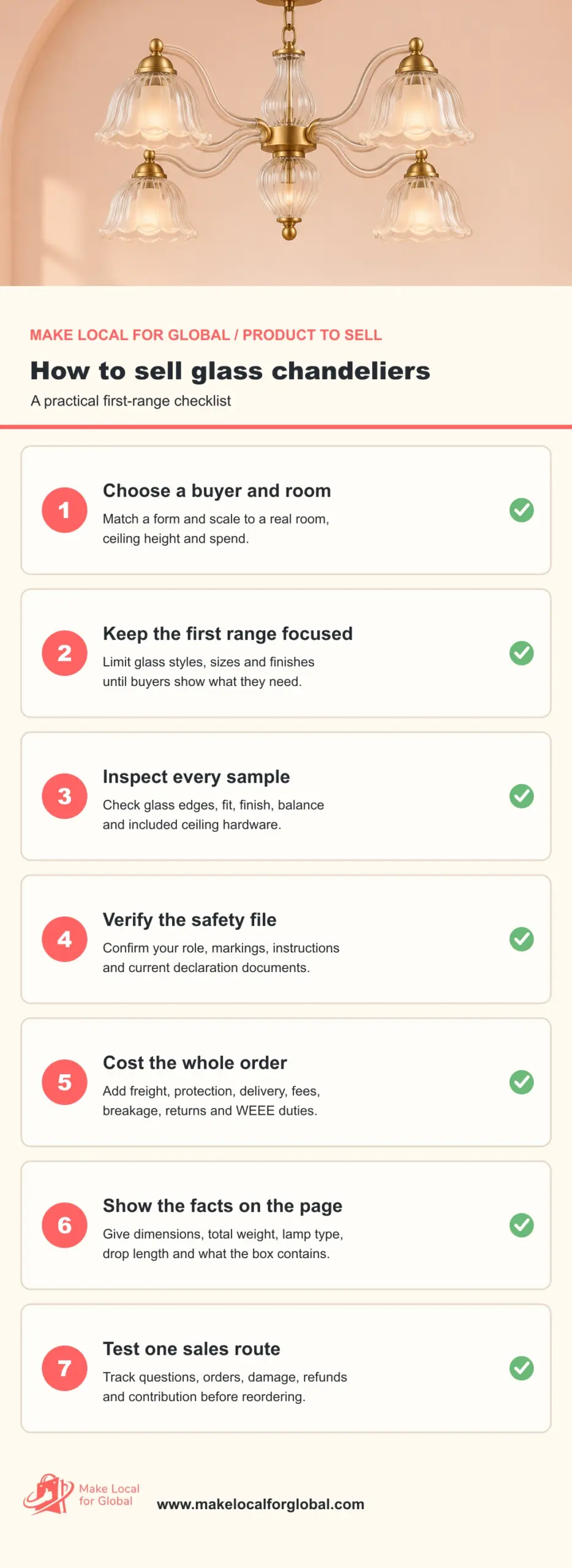
Use the supplier checks, sample notes and order costs to decide what to test first.
PREFERRED SOURCE
Like what you’re reading? Add Make Local for Global as a preferred source on Google to see more of our articles when you search.

Build your online presence without having to figure out everything yourself.