
READY TO SELL Garden Decorations ONLINE?
Get a store built for you in 5 days, plus training and support to help you start, run, and grow your Alternative business.

A practical plan for selling garden decorations online: choose a focused range, test suppliers, price each order and pack outdoor accents for delivery.


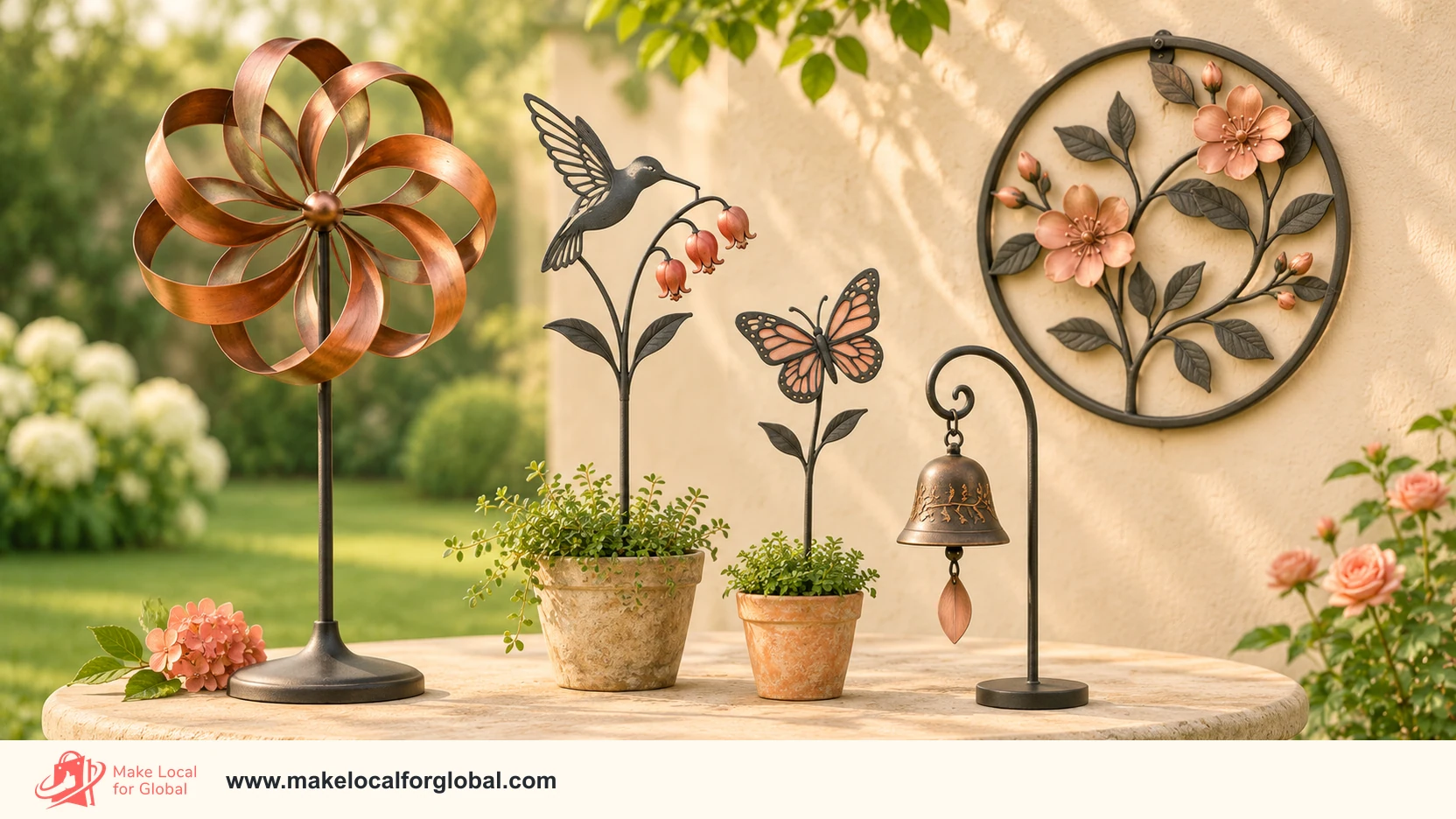
Garden decorations can be light enough to ship as a small parcel, yet varied enough to turn a first catalogue into a jumble. A wind spinner, a hanging ornament and a set of garden stakes have different buyers, fixing methods, weather exposure and packing needs. Start with the corner of the garden your first range should improve, then choose pieces that work together and can be checked, described and delivered with confidence.
This article focuses on non-electrical outdoor accents such as wind spinners, metal garden stakes, wall plaques and hanging ornaments. It does not cover statues, garden lighting, flags or fountains in detail; those product groups need their own range and product-page decisions. Sellers developing those lines can compare our garden statues, garden lighting and garden flags guides.
Compare the practical steps and costs for your first small product range with the free Ecommerce Pathfinder.
A garden accent is bought for a place and a feeling. The buyer may want a bare patio to feel less exposed, a border to look more finished, a gift for an enthusiastic gardener, or a small change that suits a rented home. Those needs affect the size, colour, installation and price of the item.
Write a short buyer note before you contact suppliers. Include the buyer, the space where the product will go, the problem or occasion, the likely spend, and what would make the buyer hesitate. For example: “A present buyer wants a compact copper-look spinner under £40 that can be assembled without tools and delivered in a box they can wrap.” This gives you a testable offer. “People who like gardens” does not.
Separate the person buying from the person using the product. A relative choosing a birthday gift needs a clear size and a reliable delivery estimate. A renter may need a decoration that can be moved without drilling. A small garden designer may want a consistent finish across several matching pieces. A householder with an exposed, windy plot may care more about the fixing and replacement parts than a buyer decorating a sheltered balcony.
A patio buyer might look for a small wall piece or a pot stake that works in a limited space. They need overall dimensions and a close photograph that shows how the piece attaches. A buyer with a long border may look at height, visibility from a path, the number of stakes in a set and whether each stake can be positioned independently.
A gift buyer often needs an item that feels complete on arrival. A simple presentation sleeve or gift box can help, but it adds cost and parcel size. A garden designer may care about finish consistency, batch availability and a larger order. A buyer shopping for a seasonal display may want the item by a specific date, which makes dispatch cut-offs and stock cover part of the offer.
These are hypotheses, not sales evidence. Ask people who have recently bought a garden gift or outdoor accent what they chose, where they placed it, what they paid and what made the choice difficult. Ask what product details they checked before paying. Do not treat a polite “I like it” as proof that someone will order. A question about a mounting kit, an order for a sample or a request for a dispatch date gives you more to investigate.
“Garden decorations” can describe almost anything put outdoors for appearance. A new seller needs a tighter definition. For this range, choose accents whose main job is visual interest and whose fulfilment does not require specialist installation: wind spinners, garden stakes, hanging ornaments, small wall art and coordinated sets of plant markers.
Keep the first offer away from products with a different buying and delivery decision. A heavy freestanding statue needs a careful damage and delivery calculation. Lighting brings electrical and battery questions. A fountain adds pumps, water connections and leak testing. A flag has fabric, printing, pole and seasonal issues. Those are valid product ideas, but adding them to the first range makes it harder to explain one clear shop.
Decide whether your products are primarily decorative, functional, or both. A plant marker may identify a bed and decorate it. A spinner might add movement and colour. A wall plaque needs a useful hanging point and enough detail to show its scale. Write the main use for every product in one sentence, then remove items that do not fit the same buyer or visual theme.
Before selecting a design, note what a customer might mistake. “Copper” could mean solid copper, a copper-coloured finish, or a thin copper layer over another material. “Handmade” describes a process only when the maker’s work supports that claim. “Weatherproof” is not a substitute for a material, finish or test record. Use the supplier’s evidence and your own checks to say what the product is, what it is made from and how it is expected to be used.
A first catalogue can include one entry item, a dependable core product and a higher-value option. They should serve the same type of buyer rather than creating three unrelated themes. For example, a botanical garden accent range could start with a single plant stake, add a matching pair of wall ornaments and offer a larger spinner as its main statement piece.
Keep variants limited. Colour, height and pack size can create a useful choice, but each option adds inventory, photographs, product details and opportunities for picking errors. Start with two or three choices that a buyer can tell apart. A copper-look finish and a charcoal finish may be useful. Five nearly identical shades are hard to explain unless buyers have asked for them.
Use a simple range sheet with the product name, material, finish, height, width, weight, fixings, care notes, supplier, minimum order, unit cost, carton size, lead time and any evidence supporting a durability claim. Record what is confirmed and what still needs checking. If the supplier later changes the metal thickness, coating, fixing or pack contents, update the sheet and review the listing before the new stock goes live.
| Product group | Buyer or use | Checks before listing |
|---|---|---|
| Wind spinner | A moving focal point for a border or patio | Assembly, bearings, movement, balance and wind exposure |
| Metal garden stakes | A small accent for pots or planted borders | Length, sharp ends, coating and ground insertion |
| Wall plaque | A vertical accent for a fence or sheltered wall | Fixings, weight, dimensions and rust protection |
| Hanging ornament | A gift or detail for a covered seating area | Hanging point, moving parts, finish and noise |
| Coordinated gift set | A ready-made combination for gardeners | Pack fit, damage protection and included components |
These are planning examples. Check each supplier sample and describe the exact materials and fixing method.
The formats in the table are planning examples, not a recommendation to stock each one. Choose the products that make sense for your buyer and cash limit. A compact offer can still look considered when each product has a purpose and the photographs show how the pieces relate.
An entry product should offer a complete use on its own. It might be one garden stake with a stable shaft and a clear insertion depth. The customer should not need to buy an unmentioned pole, clip or bracket to display it as pictured.
A core product can introduce the theme more fully. A matching pair of wall accents or a spinner with a separate ground stake can create a stronger display. Make the number of included pieces clear in the title, first image or product details. If the stake and decorative top come apart for delivery, explain how they join and whether any tools are needed.
A premium option can add material, scale or a well-chosen set of pieces. Higher price alone does not make a product premium. Show what changes: the stated dimensions, material grade, more secure fixing, a larger set, a replacement component, or a box suited to gifting. Do not imply a better finish or longer life without a supplier specification or test evidence to support it.
Bundles work when the products belong in the same place. A spinner and a pair of matching stakes may make a coherent border set. A random mix of a wind chime, wall panel, ceramic mushroom and plant marker may look like a clearance bundle. Before offering a set, photograph the items together, calculate the bundle’s full packed dimensions and check whether the parts can share protective packaging without touching.
A seller can buy finished goods from a UK wholesaler, work directly with a small maker, import stock, or commission a design. Each route changes the amount of cash at risk, the time spent checking goods and the level of control over finish and packaging. Do not compare suppliers by unit price alone.
A wholesaler may provide a lower minimum order or faster replenishment, but ask how long the model will remain available and whether the specification can change. A small maker may offer a distinctive design, but production capacity can be limited before seasonal peaks. An importer may give access to a wider choice and adds responsibilities for checking product safety, traceability and documentation. A commissioned design can give you control over dimensions and finish, but tooling, samples, minimums and lead times need careful costing.
Ask each supplier the same practical questions:
Ask for written specifications, invoices, assembly instructions and safety information that apply to the exact product. Keep versions and dates. A general catalogue page may not describe the sample or later stock. If the product arrives with a different coating, fixing or size from the sample, pause the listing and resolve the discrepancy before selling it.
When sourcing from outside the UK, add freight, customs charges, import VAT treatment, exchange-rate changes, clearing fees, damaged stock and the cash tied up during shipping to the comparison. Ask who is the importer of record and which business keeps the technical files and supplier contact details. A lower price at the factory can turn into a higher landed cost after packaging, duties and a long lead time are counted.
A studio photograph cannot show whether a spinner catches in a light breeze, whether a coating chips at a joint, or whether a stake bends when it enters firm soil. Test a real sample. Follow its instructions first, then record simple checks that match its intended use. The goal is to spot an obvious mismatch or damage risk, not to claim formal product certification.
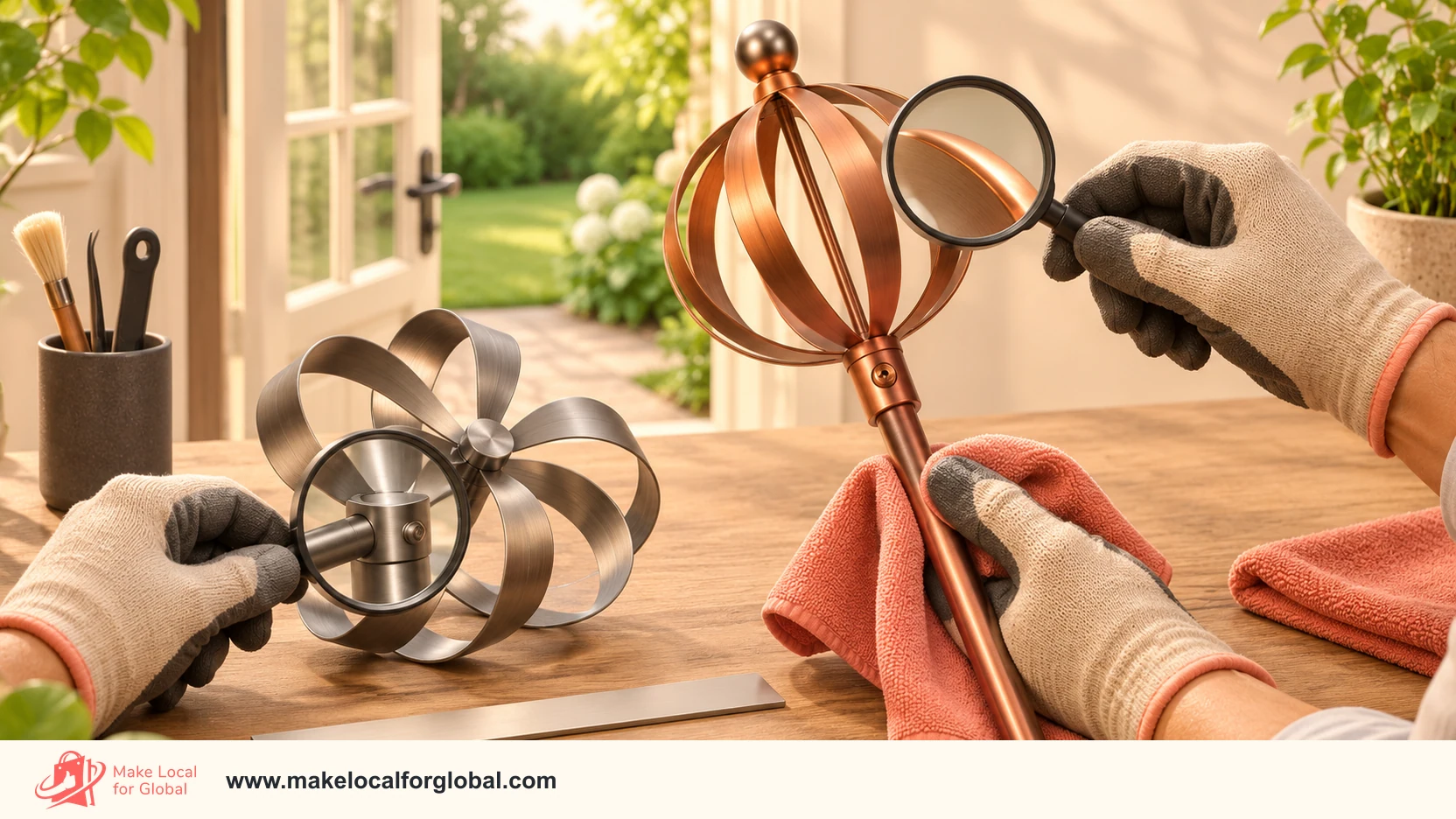
For a wind spinner, check that the parts fit together without force, the moving pieces rotate without rubbing, the hanging point is secure and the post remains steady when installed as described. Test it in a sheltered, ordinary garden position. Movement in a light breeze does not prove that a product is safe in storm conditions. If the supplier gives a wind or weather limit, repeat that wording accurately and make the limit visible to buyers.
For stakes, confirm the finished height, insertion depth, material thickness and whether the point is covered in the package. Check that the top does not detach when gently handled. Try the stake in the kind of soil described by the supplier, then remove it and look for bent parts or damage to the finish. A stake that works in loose potting mix may not suit compacted ground. Say what you tested; do not generalise beyond it.
For wall art and hanging decorations, inspect the rear fixing, mounting holes, hooks and included hardware. Measure the distance between holes and confirm that a buyer can tell which fixings suit the product. If the customer must supply a screw, say so. Check whether the decoration can swing into glass, a fence or a wall in ordinary wind. Photograph the back of the product so buyers can see the mounting arrangement.
Look closely at the finish around bends, welds, cut edges and contact points. Run a clean cloth over the edges to find burrs or snagging. Check coatings for bubbles, exposed base metal, uneven colour and scratches from the packaging. Leave an outdoor sample in the intended setting for a reasonable observation period and record where it was placed, the weather exposure and what you observed. That is a practical incoming-sample check, not proof of years of durability.
Make a pass/fail sheet for every model. Record sample date, supplier, product code, batch, assembly notes, photographs, test observations, faults and the person who checked it. Keep the sheet with supplier records. If the product fails, ask the supplier to investigate, request a replacement sample and repeat the checks before buying a larger quantity.
Garden accents are consumer products. The exact rules depend on the item and the place where you sell it. In Great Britain, general product safety rules require products to be safe in normal and reasonably foreseeable use. The Office for Product Safety and Standards says manufacturers, importers, distributors and sellers each have responsibilities; a distributor should keep records showing where products came from and cooperate if a safety concern arises. Start with the current GOV.UK product safety advice for businesses and the Great Britain guidance on the General Product Safety Regulations.
Northern Ireland follows different general product safety requirements. If you plan to sell there, read the current EU General Product Safety Regulation guidance for Northern Ireland. Keep jurisdiction and supply-chain role clear. A product sold only in England, Scotland and Wales may not face the same rules as a product offered to Northern Ireland customers.
A conformity mark is not required for every product. The UK Government’s current product marking guidance by sector explains which product groups have sector-specific marking rules. Check the category before displaying UKCA or CE on a listing. Do not add a mark solely on the basis of another model or a competitor’s photo.
Keep basic traceability records even for a small test order. Record supplier, manufacturer where known, model or product reference, purchase date, invoice, quantity and batch or lot information where available. Keep a way to contact affected buyers if a supplier reports a fault. If you receive a safety complaint, stop and review the affected stock, contact the supplier and follow current Trading Standards or OPSS guidance. Do not dismiss a loose fixing or sharp edge as a one-off until you understand whether other stock shares the same issue.
Descriptions and images must match what you send. If the photograph includes several ornaments but the product is a single spinner, state that clearly and use a caption or image label to identify what is included. Avoid unsupported claims such as “will never rust”, “storm proof”, “child safe” or “wildlife friendly”. Describe the material and the supplier’s supported care advice instead. Do not claim that a decorative piece is made from solid copper when it is copper coloured or plated.
For online orders, provide the product description, total price, delivery arrangements and cancellation information before the customer pays. GOV.UK’s distance selling guidance explains the information a seller must show and the right to cancel most online goods orders within 14 days after delivery. The rules include exceptions, but a standard garden decoration does not automatically qualify for one. Write a returns policy that explains the legal right to cancel, the process for faulty goods and how a customer can contact you. Check the current guidance for the products and sales route you use.
A small metal accent can look inexpensive until its parcel needs extra protection or its shape pushes it into a larger carrier band. Calculate what each order costs from the shelf to the customer. Use current supplier and carrier information rather than copying a competitor’s price.
The example below uses an illustrative garden accent set sold for £44 with £4.95 delivery. It assumes a seller who is not VAT registered and uses a £1.10 payment fee allowance. These are planning figures, not a quote, market average or suggested retail price. Replace them with actual terms. If you are VAT registered, model the correct VAT treatment for the goods and sales before treating the full payment as revenue.
| Order component | Example amount |
|---|---|
| Customer payment (£44 item + £4.95 delivery) | £48.95 |
| Products, allocated per order | £15.50 |
| Inbound freight allocation | £1.20 |
| Presentation pack | £1.60 |
| Outer carton and protection | £1.25 |
| Packing labour | £1.50 |
| Payment fee allowance | £1.10 |
| Outbound delivery | £5.25 |
| Damage and return allowance | £1.20 |
| Customer acquisition allowance | £4.00 |
| Total illustrative costs | £32.60 |
| Contribution before overhead and tax | £16.35 |
Illustration only. It assumes the seller is not accounting for VAT on these figures. Replace each amount with current supplier invoices, carrier rates and actual channel charges.
The arithmetic leaves £16.35 before rent, insurance, software, accounting, equipment, income tax and owner time not counted in the packing allowance. That amount is contribution, not net profit. If the business pays VAT, changes the price, offers free shipping or acquires a customer through a costly advert, rerun the calculation. Do not assume that higher order volume will fix a weak contribution.
Set the lowest contribution you are willing to accept after variable costs. Then model the order with a higher delivery band, a small increase in supplier cost, an extra packing minute and one replacement or refund. If the margin disappears after a minor change, simplify the product, reduce damage risk, increase the price or choose a different supplier.
Consider the parcel as a real packed product. A single spinner may fit in a narrow box, but a matching set may need a larger carton. Measure and weigh the final package with its insert, protection and assembly instructions. Ask the carrier or fulfilment partner which service applies to those dimensions and whether a long or irregular package has a surcharge. Count the cost of a damaged parcel in your planning; do not treat replacement stock as free.
Compare three price presentations: item price with delivery shown separately, a delivered price with shipping included, and a multi-item bundle. Make the full amount visible before checkout. Record visits, questions, basket additions, completed orders, refunds and the order contribution for each offer. A popular product can be unviable if the parcel costs more than expected or arrives damaged too often.
A buyer cannot hold a garden ornament or test its finish through a screen. Give them the dimensions, material, mounting method and care information that help them decide. A useful page reduces surprises and gives you fewer avoidable enquiries.
A product title could read: “Copper-look metal wind spinner, 145 cm, ground stake included”. Use only the dimensions, finish and included parts that match the item. Avoid titles that repeat “garden ornament”, “garden decor”, “outdoor art” and other near-identical phrases without explaining what the product is.
The opening description should answer who the product suits and what arrives. For example: “A freestanding metal spinner for a border or large container. The 145 cm height includes the ground stake; the decorative wheel measures 32 cm across. Supplied in two sections for assembly. One spinner is included.” This is a sample structure, not a description of a verified model. Replace each detail with your product facts.
List product details in a consistent order:
Photograph the front, back, fixing, joint, scale and packaging. Include one image in an ordinary garden setting and one close-up of the finish. Use a familiar object for scale only when it gives a fair comparison. If the product is shown against a wall, do not let the background hide its real size. Show all parts in the image when they are included; avoid props that imply a plant, pot or light is part of the order.
For accessibility, write alt text that describes what the image shows: “Copper-look garden spinner on a stake beside a planted border” is more useful than a string of search terms. The caption can clarify that the pictured plant pot is a styling prop if a buyer could reasonably assume it is included. Keep image alt text different when each image shows a different feature.
Explain whether the product should be removed during strong winds, taken indoors in winter or kept away from salt spray, if the supplier’s instructions say so. Do not invent a maintenance schedule. If the surface is a coated finish, name it only when the supplier confirms the coating. If the supplier advises wiping it dry, state that accurately and show the advice on the page or with the delivered instructions.
Tell the buyer whether a wall decoration needs masonry plugs, whether a fence fixing is included, and what kind of surface the supplied hardware suits. Do not state that one fixing suits every wall. If the buyer must source the fixing, give the screw size or compatible fitting only when verified. For products with assembly, show the joining points and the tools required.
A short troubleshooting note can prevent an unnecessary return. Explain how to identify the top and bottom of a stake, how to secure the spinner’s moving section, or how to position a hanging piece away from a window. Keep instructions specific to the model. A generic note that ignores the product can create more uncertainty than it solves.
Garden accents often combine long shafts, open metal curves and small fixings. A carton that only fits the product can still allow parts to rub, bend or poke through the wall. Build the pack around the product’s most exposed points and test the finished parcel before opening orders.

Separate finished surfaces with sleeves or wraps that do not leave marks. Secure a spinner’s moving parts so they do not strike one another. Keep a wall plaque flat between rigid sheets. Place screws and small fittings in a closed bag, then secure the bag so it cannot scratch the decoration. Protect a stake’s point with a cap or fixed insert that cannot come loose in transit. Do not rely on loose fill alone to immobilise a long piece.
Use an outer carton that resists crushing and has enough space for protective material at the ends. Close a sample parcel and shake it gently in more than one direction. Open it and inspect the product, finish, moving parts and fastener pack. Send a test parcel through the service you intend to use when the item is vulnerable or has a valuable finish. Record the carton size, weight, parts placement and materials, then repeat the test after changing the supplier or package.
Price the packaging before you publish. Presentation packaging can help a gift buyer but adds material and time. A separate instruction card may reduce assembly questions. A long rectangular carton can cost more to store and ship than a compact box. Use only the pack layers that protect the item, present the gift or provide necessary information.
If you supply or import packaged goods, check whether UK extended producer responsibility rules apply to your business. The GOV.UK EPR checker and packaging guidance explains producer roles and the current thresholds. Obligations depend on turnover, tonnage and activity, so use the official checker and current guidance rather than assuming a small shop is automatically exempt. For your own cost model, weigh and record the packaging types you use even when you are not an obligated producer; the information helps you compare box designs and understand material use.
A new seller can begin with a direct website, a marketplace, a local garden event, a design partnership or a combination. Choose one main route for the first test so you can understand its costs and customer questions. Marketplaces may already have customers browsing related products, but fees and listing rules apply. A direct shop gives you more control over the product page, but you need a plan to attract visitors. A market lets buyers see scale and finish, but it requires stock, display space and time on site.
Create one product page and one small promotion around a single buyer situation. For example, show a set of matching garden stakes for a narrow border, with the exact number included, height and delivery charge. Ask a group of gardeners or gift shoppers to describe what they think will arrive. Note every question about size, finish, fixing, wind and delivery. Revise the page if people infer a different product or quantity.
Set a cash limit for paid promotion and a stop date before you spend. Track the product-page visits, saves, enquiry topics, basket additions, completed orders, refunds and contribution. If people visit but do not add the item to a basket, review the fit between product, page and price. If many visitors ask what “weatherproof” means, replace that claim with material and care information. If the product sells but shipping damage rises, pause promotion and fix the pack.
Search language should reflect what a shopper means. A buyer might search “metal garden wall art”, “garden wind spinner”, “garden stakes for border” or “outdoor garden ornament”. Use those phrases where the page genuinely answers that search. Keep one page centred on one product. Do not repeat a list of keyword variations in every heading. Add internal links to a related offer only when they help a reader compare a different product group, such as garden planters or garden fences.
For content, demonstrate the product at its real scale, explain how it is installed, show a close-up of the finish, or record how a bundled set is packed. A short demonstration answers more than a generic garden mood image. Ask permission before using a customer’s garden photo or quote. Never present a staged image as a customer installation.
When the range, measurements and shipping plan are clear, review how a focused ecommerce shop could present the products.
A launch test can fit into four weeks if you cap the range and gather the information before placing a large order. The plan below is a sequence of checks, not a promise that a shop will be ready to trade in a month. Product safety duties, supplier lead times and any local requirements can change the schedule.
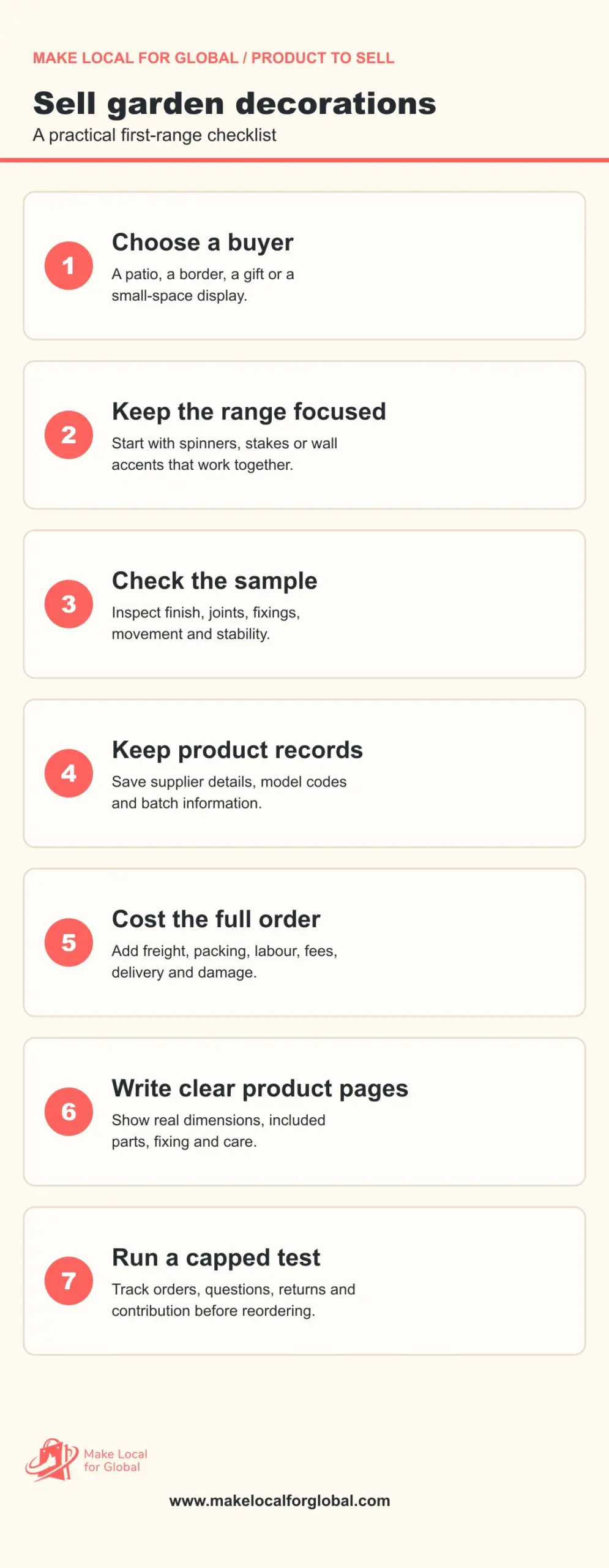
Pick one buyer and one garden use. Review several suppliers, compare the same information for each model and request specifications and sample costs. Write a maximum first-order budget and a decision rule for moving forward. For example, you may require a complete specification, one sample that passes your handling checks and a full-order contribution above your chosen floor.
Ask potential buyers what they bought recently and what they looked for. Show a simple product concept with its likely dimensions and price range, and ask what they would need to know before ordering. Record the words they use for the product and which details they ask to see. Do not take payment for stock you cannot supply on the date promised.
Order one sample from the strongest supplier. Check assembly, finish, fixings, dimensions and stability according to the item’s intended use. Photograph any fault and raise it with the supplier. Draft packaging from the real sample, measure the finished parcel and obtain a current delivery price.
Update the cost model with sample freight, packaging, assembly time, payment fees, delivery and a damage or returns allowance. If the product only works financially at a price your interviewees rejected, revise the offer before committing to inventory. A smaller version or a single-item pack may provide a more useful test than a broad assortment.
Write the product page with verified facts: material, dimensions, included pieces, installation, care, delivery and returns. Photograph the actual sample in its packaging and in a suitable outdoor setting. Check that the styled image does not imply a pot, plant or accessory is included when it is not.
Ask someone unfamiliar with the product to read the listing and say what they expect to receive. Compare their answer with the real parcel. If they misunderstand the product count, installation or finish, improve the first image or description. Confirm that the supplier can replenish the same version before you open a larger preorder window.
Make a small quantity available through one channel. Keep the stock limit and dispatch window visible. Share the product with an audience that matches the intended buyer rather than posting it everywhere. Record questions, orders, cancellations, damage, returns and contribution. Review the results on a fixed date.
Decide whether to reorder based on the written rule, not on compliments alone. Keep a product that attracts suitable buyers and arrives in good condition at a viable contribution. Change one part at a time when the test points to a clear issue, such as unclear dimensions, weak packaging or an unattractive delivery total. Stop the offer if a safety or supplier question remains unresolved.
Garden decorations are outdoor accents whose main role is visual interest, such as wind spinners, garden stakes, wall plaques and hanging ornaments. Define the range you intend to sell. Statues, lights, flags, fountains and large structures have distinct purchasing, safety or delivery requirements and are better assessed in their own product groups.
Start with one type that suits a clear buyer and is straightforward to specify, test and pack. A compact stake, wall accent or spinner can be a candidate if the supplier provides clear details and the sample works as described. Choose based on buyer evidence, sample checks, landed cost and delivery risk rather than the item that looks most impressive in a catalogue.
Consumer product safety requirements apply, but the exact rules depend on the product and the market. Great Britain and Northern Ireland use different general product safety frameworks. Check the current OPSS or GOV.UK guidance, identify your role as maker, importer or distributor and retain supplier and batch records. A product marking is only needed where sector-specific rules require it.
No. A conformity mark is required only for product categories covered by relevant sector rules. Check the official product marking guidance for the exact product. Do not copy a mark from a different model or a supplier’s generic image to a listing.
Immobilise each part, separate finished metal surfaces, protect points and long shafts, and secure small fixings in a closed bag. Test the fully packed sample and inspect it after movement or delivery. Record the carton size and construction so the same pack can be repeated for later orders.
You can source internationally, but check the product rules, traceability, documentation and your importer responsibilities for the market where you sell. Include freight, import charges, packaging, inspection and lead time in the cost model. Read current product safety guidance before placing a commercial order.
State what the item is, its material and finish, exact dimensions, included parts, fixing method, assembly, care and delivery details. Use photographs to show scale and the back or fixing. Avoid claims about weather resistance, material or safety that you cannot substantiate.
Most consumers who buy goods online can cancel within 14 days after delivery, subject to legal exceptions. The seller must explain how to cancel and the return process before purchase. Faulty goods have separate rights. Check the current GOV.UK distance-selling and returns guidance for your exact sale.
Talk to people who recently bought a similar item, show a specific product concept and record the details they ask about. A small sample listing or limited test can reveal response to the dimensions, style, price and delivery charge. Set a spending limit, a stock cap and a decision date before you start.
You can expand later, but lighting adds electrical, battery, charging and product marking checks that a non-electrical decoration does not need. Learn the relevant product rules and test the complete light before offering it. A separate guide to selling garden lighting online covers that category.
A focused garden decoration range begins with a clear place, a verified product and a pack that survives the route to the buyer. Choose one customer situation, request the supplier evidence, inspect the sample, cost the whole order and describe the item with photographs that show its real dimensions and fixings. Add a second product only when the first test shows what buyers value and what you can deliver consistently.
Use the buyer notes, supplier checks and order costs to decide what to test first. Contact MLFG if you want to talk through the ecommerce setup.
PREFERRED SOURCE
Like what you’re reading? Add Make Local for Global as a preferred source on Google to see more of our articles when you search.

Build your online presence without having to figure out everything yourself.