READY TO SELL Garden Flags ONLINE?
Get a store built for you in 5 days, plus training and support to help you start, run, and grow your Alternative business.

Plan a garden-flag range buyers can understand: choose designs, test samples, calculate full order costs, build useful listings and prepare for safe dispatch.


Garden flags are small products with a surprisingly full set of decisions behind them. A buyer wants a design that suits a garden, porch or seasonal display, but also needs to know how large it is, how it hangs, whether the stake is included, what the fabric feels like, how it should be cared for and when it will arrive. A useful online range answers those questions before checkout.
If you are planning to sell garden flags online, begin with a tight, testable collection rather than a catalogue of every possible theme. Decide who you are designing for, choose a few distinct visual directions, order samples, measure the packed parcel, and calculate the contribution from each order after the costs that are easy to forget. Then build product pages around real photographs and precise product information.
This guide takes you from the first buyer decision to dispatch. It covers design rights, fabric and construction checks, range planning, supplier questions, pricing, marketplace and own-site choices, product photography, search-friendly listings, fulfilment, returns, and a practical first-month plan. The aim is to help you make a small range that you can explain and fulfil consistently.
Explore MLFG’s ecommerce website options and see what is included before choosing a route.
“People who like gardening” is too broad to guide a first range. A person buying a present for a keen gardener may want a cheerful design and gift-ready presentation. Someone decorating a porch for a season may care about colour, quick changes and a clear size. A garden centre buying for its gift section needs dependable replenishment, a barcode or SKU process and margin room. A small business ordering a branded outdoor display needs permission to use its logo, a proofing process and a delivery date it can plan around.
Write one short buyer profile for the first collection. Include the occasion, the place the flag will be displayed, who is paying, who will receive it, how much comparison shopping they are likely to do, and what would make them hesitate. For example: “A family member buying a modest thank-you gift for someone with a cottage garden; wants a bright floral flag, a gift note and confidence that the stake fits.” That description suggests a different page and bundle from “a homeware shop choosing a spring display item for resale”.
Next, test that buyer with five to ten conversations. Ask what they have bought before, what made them choose it, how they display it and what they would need to know before paying. Show rough sketches or sample photographs only after the person has described their own needs; otherwise they may simply praise the picture. Record exact phrases customers use, especially their questions about size, fading, washing, double-sided printing and whether the pole comes with the flag.
Use the answers to pick a first group of three designs that belong together without looking like recolours of one idea. A considered group might include a botanical illustration, a simple seasonal motif and a bird or wildlife theme. Keep the visual language coherent through line weight, background treatment and palette, but make each design recognisable at thumbnail size. If you cannot explain why a design belongs in the collection or who would choose it, leave it out of the first sample order.
A first range can stay narrow while still giving a buyer a real choice. Separate products by an attribute that matters: design, flag size, finish or whether a stake is bundled. Avoid publishing nearly identical listings that differ only by an unclear code. A shopper should be able to tell which flag is smaller, which one has a different reverse, and whether the hanging hardware is part of the price.
Start with one main format and a small set of designs. Add a second size only when the supplier can make it reliably and you can photograph and describe the difference. A bundle can be useful if it solves an actual display problem, such as two seasonal flags for a buyer who changes a porch through the year. It is not automatically a bargain: check that the larger order still covers packaging, postage, platform charges and the possibility of a replacement.
Think about the displayed shape, not just the artwork file. A garden flag is normally a small hanging panel with a sleeve or other attachment for a short garden stand, but dimensions and construction vary between suppliers. Record the finished width and height, the sleeve opening, the position of the stitching and the usable print area. A design that fills a square canvas may become cramped after the hem and sleeve take their share of the fabric.

Use a range sheet to compare each planned SKU. Include the design name, finished dimensions, fabric, print method, single- or double-sided construction, sleeve size, included accessories, care wording, supplier minimum, lead time and sample result. Add a photograph of the actual approved sample. If a supplier changes the fabric or print process later, you will have a reference for checking whether the delivered stock still matches the product page.
There are three common starting routes. You can buy finished stock from a wholesaler, create a design and use a print-on-demand provider, or commission a printer or textile maker to produce your own batch. They trade control against cash tied up and operational work. Wholesale is quick to trial but gives you less control of originality. Print on demand can reduce inventory, but unit price, colour control, production time and packaging may be outside your hands. A batch order can give more control and a lower unit cost at volume, but you take the risk of unsold stock and must inspect what arrives.
Ask suppliers for the specifications that change the customer experience. What is the fabric fibre content and weight? Is the print visible on one side or both? If the reverse is printed, is it mirrored, separately printed or made with a blocking layer? What process is used to attach the sleeve? How are the edges finished? What tolerances apply to the finished size? Is a garden stake included, and what diameter fits the sleeve? Which care instructions are supported by the fabric and ink supplier?
Ask for a sample made with the same production method as a full order. A digitally printed prototype may look different from a bulk screen print; a sample using a substitute fabric cannot tell you how the chosen fabric behaves. Request a colour reference or production proof, confirm who pays for it and whether the sample fee is credited against a later order. Put agreed specifications in writing so both parties know what “same as the approved sample” means.
Keep your own design files clean and controlled. Save an editable master, an outlined or embedded-font production file if the printer requires it, and a dated export used for approval. Keep the design ratio, safe margins, bleed instructions and colour profile with the file. Do not rely on a compressed social-media image as the only production artwork. Ask the supplier to identify any changes they make to scale, colour or placement before printing.
Consider the first run as a test, not proof that the product will sell. If a supplier minimum is high, ask whether several designs can share a production run, or whether a smaller paid sample batch is available. Calculate the total cash required for stock, freight, import charges if relevant, packaging and rejected units. A cheap unit price can be an expensive decision if you must buy hundreds before learning whether customers understand the design.
Inspect the sample indoors and outdoors. Compare its colour with the approved proof in daylight and under a normal indoor light. Look for muddy areas, thin lines that disappear, unexpected white edges, uneven registration and print that sits too close to a seam. Photograph the sample beside a ruler and on the intended stake. A close-up may look attractive, but the flag should also be readable from the distance at which a customer is likely to view it.
Check the stitch line and sleeve by inserting the intended stake. The sleeve should be open, straight and long enough to stay on the pole without bunching the printed area. Pull gently at the seams and corners, looking for skipped stitches, loose threads and fraying. Check that the bottom edge hangs evenly. Record whether the flag twists or folds against the pole in a light breeze; avoid promising performance in wind until you have tested it in conditions that match your intended use.
Use care tests that are consistent with the supplier’s instructions. If washing is allowed, follow the stated method and take photographs before and after. If the maker says spot-clean only, do not advertise a machine-washable product because one sample survived a wash. Keep a sample log showing the date, supplier, material, test method, result and any limitation. This gives you evidence for accurate product copy and helps you spot changes between batches.
Check how the fabric reacts to being folded and packed. Does it crease sharply? Does the print transfer when damp? Does the sleeve flatten into a shape that is hard to open? If the stake is sold in a bundle, check its fit and packaging separately. A stake may have a sharp point or small components; include sensible product and handling information, and consider whether the product is appropriate for the age group implied by the design or listing.
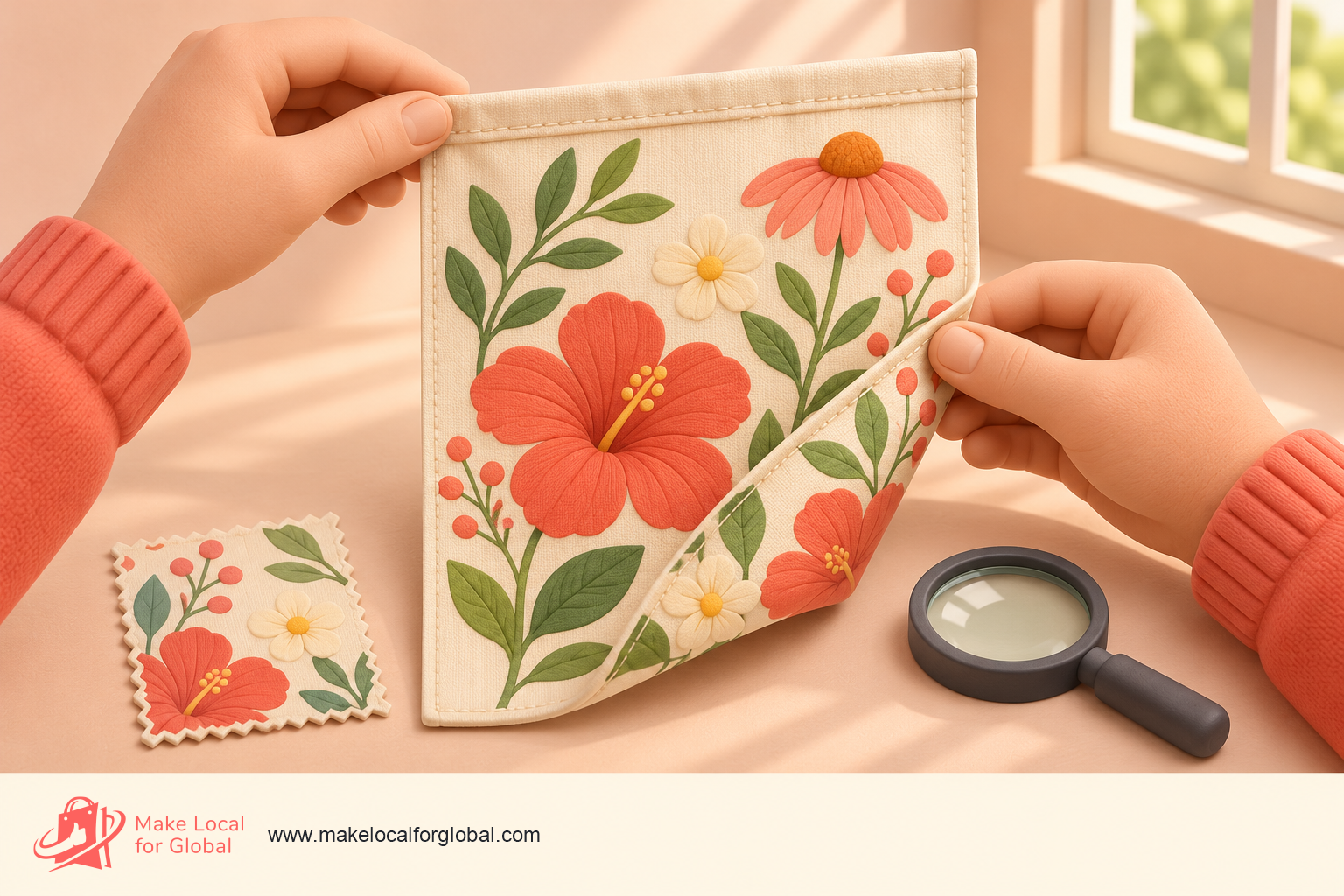
A sample is also a test of your photographs and listing claims. Photograph the actual flag flat, on its stand and in a garden setting. Put a ruler or a known-size object beside it in one image. Ask someone unfamiliar with the product to read the dimensions and explain what is included. If they assume the stand is included when it is not, the listing needs a clearer image and a more direct sentence.
Garden themes invite familiar motifs: flowers, birds, fruit, seasonal messages and landscape illustrations. Familiar subject matter is not the same as permission to copy a particular illustration, character, photograph, slogan or brand. Create original artwork, commission it under a written agreement that says what rights you receive, or use properly licensed material that covers commercial products and the territories where you will sell. UK government guidance explains that you should get permission or a licence before using copyright-protected material: GOV.UK copyright guidance.
Keep a rights record for every design: creator, source file, date, licence or contract, permitted products, territory, duration and any credit requirement. If a customer asks for a personalised name, photograph or logo, confirm that the customer has the right to provide it and obtain written approval for the final proof. A buyer’s request does not transfer someone else’s copyright to you.
Be exact with claims about material and performance. “Weather-resistant” means little without a defined test or supplier evidence. “Fade-proof”, “waterproof” or a guaranteed lifespan can create expectations your sample tests do not support. Say what you can substantiate: for example, that the supplier identifies the fabric as polyester, that the product is printed on one side, or that the care label recommends spot cleaning. If a product has only been checked for a short sample period, do not turn that into a long-term durability promise.
State whether the stand is included, what it is made from and how it fits. If the flag is sold without a pole, say so near the top of the listing and show the sleeve opening. Give the finished fabric dimensions, not just the canvas or artwork dimensions. If a product is handmade or printed to order, explain what that means for dispatch time and small variations in placement or colour.
Start with the cost of a saleable unit. Include the flag, printing, labels, inbound freight, duty or import charges where applicable, damaged or rejected stock allowance, and any accessory supplied with it. Then add the packaging, payment or marketplace charges, postage subsidy, labour for checking and packing, expected replacements, discounting and promotion. If you use a paid advertising channel, model it separately as well as in a realistic blended average.
Here is a deliberately simple worked example in pounds. Assume one flag costs £4.20 landed and saleable; packaging is £0.65; the packing and customer-service time allocation is £1.50; average postage paid by the seller is £3.75; and the seller charges the buyer £2.95 for postage. The seller’s postage contribution is therefore £0.80. Suppose the item sells for £16.00, and the marketplace charges 6.5% of the £18.95 item-plus-postage transaction, plus a payment-processing charge of 4% + £0.20 and a £0.15 listing fee, following the current fee information published on Etsy UK’s selling page. Fees can change and the actual fee base may vary by account, tax treatment or promotion, so confirm your own account schedule.
The example transaction fee is about £1.23 (6.5% of £18.95); payment processing is about £0.96 (4% of £18.95 plus £0.20); and the listing fee is £0.15. The order contribution before overheads and tax is approximately: £16.00 product revenue + £2.95 postage charged − £4.20 stock − £0.65 packaging − £1.50 labour − £3.75 actual postage − £1.23 transaction fee − £0.96 processing fee − £0.15 listing fee = £6.51. This is not net profit. It excludes business overhead, unsold stock, refunds beyond the allowance, tax, VAT where applicable and any advertising cost.
Change one assumption at a time. If you offer free delivery, the buyer pays £16 rather than £18.95 and you must cover the £3.75 postage from the item revenue. If a sale uses a 10% discount, recalculate marketplace charges on the actual charged amount and check that the remaining contribution still pays for your time. If an order has two flags, the parcel may cross a size or weight threshold; do not assume the postage doubles or stays the same without measuring it.
Use a spreadsheet with columns for standard price, actual average selling price, buyer-paid postage, stock cost, packed dimensions, postage label, marketplace and payment fees, packaging, labour, returns/replacements allowance and contribution. Add a separate line for fixed monthly costs such as web hosting, insurance, accounting software and any storage. Decide how many orders at the expected contribution are needed to cover those costs, then compare that target with your real capacity and available demand.
Price with the rest of the range in mind. A two-flag bundle can raise order value and spread one parcel cost over more than one item, but it can also require a larger mailer or box. A gift option may justify extra packaging only if buyers value it and the labour is counted. A wholesale price must leave margin for the retailer as well as you. Do not use a competitor’s visible price as proof that the same price works for your product; their stock cost, service, advertising and customer base may be different.
Include product, packing, time, platform charges and the postage you actually pay in your first price model.
A marketplace can help a new seller reach people already browsing for gifts or garden accessories. It also brings listing rules, fees, competition, account dependence and a requirement to answer customer messages within that marketplace. An independent website gives more control over branding, product grouping, email capture and repeat-customer journeys, but you must bring visitors to it and maintain checkout, policies, analytics and technical upkeep.
You can start in one channel and add another when the first process is stable. If you list on a marketplace first, record how much a click, sale, promotion, return and repeat purchase costs. If you launch on your own website, check that a customer can find dimensions, delivery cost, expected dispatch date, returns information and a working way to contact you before adding paid traffic. Read our guide to planning a range of garden planters for a related look at balancing product choice with outdoor-product fulfilment.
Keep stock counts and order records in one system, even if you sell in two places. A low-cost shared sheet can work for a small first range if each SKU is unique and you update it immediately after a sale or restock. Once manual updates become unreliable, choose inventory software that can sync the channels you actually use. The cost of a system is not just its monthly fee; include setup, data cleanup and the time needed to correct a failed sync.
Do not put your whole customer relationship at the mercy of one social platform. Use your own domain, keep exportable product and order records, and follow each channel’s rules for customer contact. Build an email list only with clear consent and a lawful reason for sending marketing. Make Local for Global’s guide to building an online business can help you think through the wider sales setup as your collection grows.
Give each listing a title a shopper can understand at a glance. Lead with the product and the distinctive design or use, rather than stuffing every keyword into one line. For example: “Robin and Wildflower Garden Flag, 30 × 45 cm, Single-Sided” is more useful than a string of repeated phrases. Only include a dimension, material or construction claim after checking it against the final product specification.
Open the description with a plain statement of what the buyer receives and who the item suits. Then make the essential facts easy to scan: finished dimensions, fabric composition, print sides, sleeve opening, stand inclusion, care guidance, dispatch estimate, packaging and personalisation options. Avoid burying “flag only, stake sold separately” at the bottom. If a screen reader or phone user sees only the first few lines, they should still understand the product and any important exclusion.
Use photographs to prove the written details. Include the flag flat with the full shape visible, a close-up of print and stitching, the flag on the intended garden stand, a size reference, the reverse side if relevant, and a photograph of the packed or gift-ready item if that is part of the offer. Use an actual sample wherever possible. A mock-up can help show a design concept, but do not present a digital rendering as though it records the exact print colour or texture of a finished item.
Write alt text for the image’s purpose, not for keyword repetition. “Coral wildflower garden flag on a black garden stake beside a patio border” tells a person what is shown. For a diagram, describe its key point. For a decorative image that adds no information, empty alt text may be right; do not paste a whole product description into every image. Keep captions concise and use them only where a visible note genuinely helps.
Search optimisation begins with a page that meets the query. Use the natural phrase “sell garden flags online” in the article title or a prominent heading only when it describes the page accurately, and explain the subject with related terms such as garden flag size, fabric, stand, design, gift and postage. Avoid repeating the same phrase in every heading. A helpful page can answer questions about selling a product without manufacturing a keyword density target.
Make variants easy to compare. If the buyer can select a design, show the name and a small swatch or image for each option, not a cryptic SKU. If there is a size variant, give the dimensions beside each selection. Confirm the selected variant in the cart and order confirmation. Those small checks reduce avoidable messages and make fulfilment more accurate.
Garden flags are light and can be hard to photograph well. A straight-on image against a calm background helps buyers see the artwork and edge shape. A second image on its stand explains the scale and sleeve. Take both on a bright, overcast day or in soft open shade so the cloth has detail without deep glare. Keep the flag flat and remove folds that do not represent the product. If the fabric naturally creases, show that honestly rather than retouching it into a rigid panel.
Use a consistent distance, lens and background for the first range, but give every design enough space to be recognised. A close-up should show the texture and seam, not crop off half the product. Include one image with a common object or ruler for scale. State that the comparison object is not included. A lifestyle photograph can help buyers imagine a porch or garden, but keep it credible: the flag should sit on a realistic stand, at a plausible scale and in a setting that does not imply weatherproof performance you have not checked.
Show the reverse accurately. A single-sided print may show a paler or mirrored image on the back. A double-sided flag may have an intervening layer, different stitching or different weight. Photograph the actual reverse, then name its construction in the description. If all product photographs use a polished mock-up while the shipped flag is a lighter print, customers may regard the mismatch as a defect.
Keep the thumbnail legible at a small size. The flag should dominate the product scene and remain distinct from busy flowers or garden furniture behind it. Leave a consistent quiet area for the headline if adding words to a feature image. Use one short line of action and the product name, not a paragraph of advice. Longer guidance belongs in the article or product listing. A brand mark should be crisp, in its original proportions and large enough to read without competing with the product.
Check that exported images are sharp, not stretched and not needlessly huge. Use a descriptive filename before upload, and add accurate alt text in the Media Library. Make the image clickable only if there is a useful reason. On the page, preserve the complete image aspect ratio; avoid fixed height or “cover” cropping for an infographic that contains text.
Map one main search intent to each product page. A buyer searching for a “floral garden flag” may be ready to compare products; a buyer searching “how to sell garden flags online” needs business guidance. Keep your shop landing page, product category and article distinct so they do not all compete for the same sentence. Link between them where it helps the reader move from planning to product selection or from an article to a relevant collection.
Write a descriptive SEO title that says what the page offers, then a meta description that gives a specific reason to click without promising unverified outcomes. Use the product name naturally in a readable URL. Add useful internal links to adjacent guides, such as garden planters, garden lighting and garden fountains, when those links fit the point being made. Use a descriptive anchor phrase rather than “click here”.
Make each product page useful to someone comparing options. Add material, measurements, assembly or display information, what is included, care, shipping and returns. Keep structured product data in sync with the visible price, availability and variants. If a sale price ends or a flag is out of stock, update both the visible product information and the underlying fields. Do not add review markup for testimonials that are not genuinely present on the page.
Use search data as feedback, not as a reason to pad the copy. Search Console can show the queries and pages that earned impressions; marketplace analytics may reveal which image or product option customers viewed. If visitors search “garden flag pole included” and your listing excludes the pole, make that fact visible in the first screen and consider a compatible bundle. If people land on a page and leave, check relevance, image clarity, delivery cost and mobile usability before adding more paragraphs.
Keep site speed and mobile layout in view. A 4 MB hero image can delay the page, especially on a phone. Compress the photograph before upload while retaining readable detail. Check that product selectors, image galleries, delivery details and checkout work with a narrow viewport. A clear page that loads quickly is more useful than a heavily animated one with every possible badge.
Measure the flag both folded and packed. Test a stiff mailer, a recyclable paper wrap and a small box if the fabric or stake needs protection. Check whether the package stays within the service’s size band after you add a thank-you card or protective sleeve. Record packed weight and three dimensions, then check the current carrier price rather than relying on an old label receipt. Royal Mail lists current “from” prices, but the service and price depend on parcel size, weight, destination and how the postage is bought: check Royal Mail’s current postage prices.
Do not roll a metal stake loosely beside printed cloth. Protect the point and prevent the pole from rubbing or puncturing the flag. If the stand is included, test the complete parcel by gently shaking it and then inspecting the contents. If you ship flag-only, say so in the product page, order confirmation and packing checklist. The label printer, pick list and listing should all use the same SKU so a similar design is not sent by mistake.

Choose dispatch promises that fit your real routine. A made-to-order product has a production lead time before you can pack it. A stocked product may leave sooner, but only if you have checked and labelled it in advance. State the dispatch window, the carrier service and whether delivery estimates are guarantees or estimates. A short, dependable promise is better than a next-day claim that becomes impossible during a seasonal peak.
Make a simple packing station checklist: confirm SKU and design, check the print and stitching, match the order quantity, fold with the print protected, add the stake safely if included, include the right insert, weigh and measure the parcel, print the correct label, and record dispatch. Photograph any damage before replacing stock. If a batch has the same defect, pause fulfilment and inspect more units instead of sending the problem onward.
Plan for international orders separately. Check customs descriptions, origin data, carrier exclusions, delivery times, import VAT and duty responsibilities for the destination. Do not describe a retail product as a gift to avoid a customs charge. Explain that international buyers may owe import costs if local rules require them, and verify the marketplace’s current terms before enabling a country.
Before checkout, show the total price, delivery charge, dispatch time, return route and how a customer can contact you. For UK distance sales, the government’s guidance explains information that must be provided before the order and the normal cancellation rights, including a 14-day cancellation period after delivery for many online purchases. Rules and exceptions depend on the product and circumstances, so read the current GOV.UK distance-selling guidance and get appropriate advice for your business rather than copying another shop’s policy.
Made-to-order does not automatically mean a product is excluded from cancellation rights. There can be an exception for goods made to a consumer’s specifications or clearly personalised, but the exact test matters. A design printed after an order is placed may still be a standard product. If you take a custom name, date or customer-supplied artwork, state the proofing steps and cancellation point clearly, and make sure the policy reflects the law and marketplace rules.
When a buyer reports a problem, ask for the order number and a photograph of the issue. Separate a wrong item, a print defect, transit damage, an unexpected colour variation and a change-of-mind return. Respond with the available remedy, timings and postage instructions. Keep the response calm and specific. A quick replacement can be the right business decision when the error is yours, but track its cost so the next batch or product page can be improved.
Use complaint patterns to improve the offer. If customers often thought the pole was included, make that distinction more prominent. If the flag appears too small beside the average garden stand, show the full measurements next to a real reference. If the fabric varies between print runs, tighten the sample approval and incoming inspection. Customer service is product research when you record what the customer expected and compare it with what the page actually said.
Even a decorative item needs a proportionate safety check. Review the fabric, dyes, coatings, metal stand and packaging with the supplier. Ask what safety documents apply, who is responsible for them and how to identify the production batch. If the flag or stake is designed for children or is marketed for use by children, assess whether extra rules apply; do not infer safety from a small size or a friendly illustration. Keep records of supplier identity, purchase orders, specifications, inspections and any safety issue reported.
The Office for Product Safety and Standards advises businesses to make products safe in normal and reasonably foreseeable use, keep supplier and traceability information, and report relevant safety incidents. Read the current OPSS product safety advice for businesses and check which responsibilities apply to your product, business role and sales territory. If an incident suggests a product could cause harm, stop selling affected stock while you investigate and follow the applicable reporting process.
For textile flags sold in Great Britain, check whether fibre-content labelling rules apply to the product and how the label should be presented. The government’s current textile labelling guidance says that covered textile products must state fibre composition and explains relevant scope and responsibilities: read the GOV.UK textile labelling guide. If you import finished flags or sell into Northern Ireland or the EU, requirements can differ. Confirm the rules for the product and market rather than assuming one label is suitable everywhere.
Review claims, instructions and warnings whenever a supplier, material, accessory or intended buyer changes. Keep a dated copy of each product page and label. If the product is not suitable for continuous weather exposure, say what limitations the supplier supports and avoid a misleading garden-weather promise. This attention improves safety and reduces unhappy orders because buyers receive a more accurate description.
Launch with the material customers need to choose, not a large campaign that hides the product. Show the three designs, state the main dimensions, explain what is included and share a photograph of the sample in use. Ask early buyers what remains unclear. If you offer an introductory bundle, calculate its contribution first and make the end date or quantity limit real. A permanent “launch” discount teaches shoppers to wait for a lower price.
Contact garden clubs, independent garden centres, local gift shops and small event organisers only when the collection matches their audience. Send a short wholesale sheet with product photographs, dimensions, case quantities, lead times, wholesale and recommended retail prices, packaging, reorder terms and a contact method. Do not describe a tentative supplier lead time as guaranteed. A retailer needs enough information to compare your range with alternatives and make a buying decision.
Useful content can support product discovery. Explain how a buyer chooses a garden flag size, how to fit it to a compatible stand, or how to rotate a seasonal display. Use your own photographs and do not imply that one flag will withstand every weather condition. Link that guidance to the relevant collection or listing. A useful answer earns trust even when the reader is not ready to buy that day.
Use email or social content only with a plan you can maintain. One new design story, one sample-making post and one clear care note are more useful than daily filler. If you collect email addresses for a launch alert, explain what the person is signing up to receive and follow marketing consent rules. Keep order notifications separate from promotional messages.
At the beginning, a short weekly review is enough. Record visits, product-page views, add-to-basket events, orders, average item value, postage charged, actual postage, fees, contribution, cancellations, returns, dispatch time and customer questions. Add a design-level view so the best-selling print is not hiding a weaker range behind the total. Record the period and sample size; two sales are a signal to investigate, not proof of a stable trend.
Diagnose the stage where interest drops. Few impressions may mean the channel or product title is not reaching a relevant buyer. Impressions with few clicks may point to a weak thumbnail, price or unclear design. Product-page views without orders may signal missing measurements, shipping cost, an uncertain pole inclusion or a mismatch between image and product. Orders with poor contribution point back to pricing, discounting, postage or acquisition cost.
Change one prominent feature at a time and leave a note of the date. A thumbnail test is hard to interpret if you also change the price, title and product image set in the same hour. Use a period long enough to gather a meaningful comparison, while accounting for seasonality and promotions. If traffic is very low, talk with customers and test the product page manually before drawing conclusions from percentages.
Set a reorder point based on lead time and actual sales, not optimism. If the supplier needs three weeks and you sell one flag every few days, decide how much safety stock you can afford. Reorder the design that is moving without overbuying slow variants. If a design repeatedly draws attention but few purchases, ask whether the issue is price, display context, quality confidence or simple curiosity before ordering more.
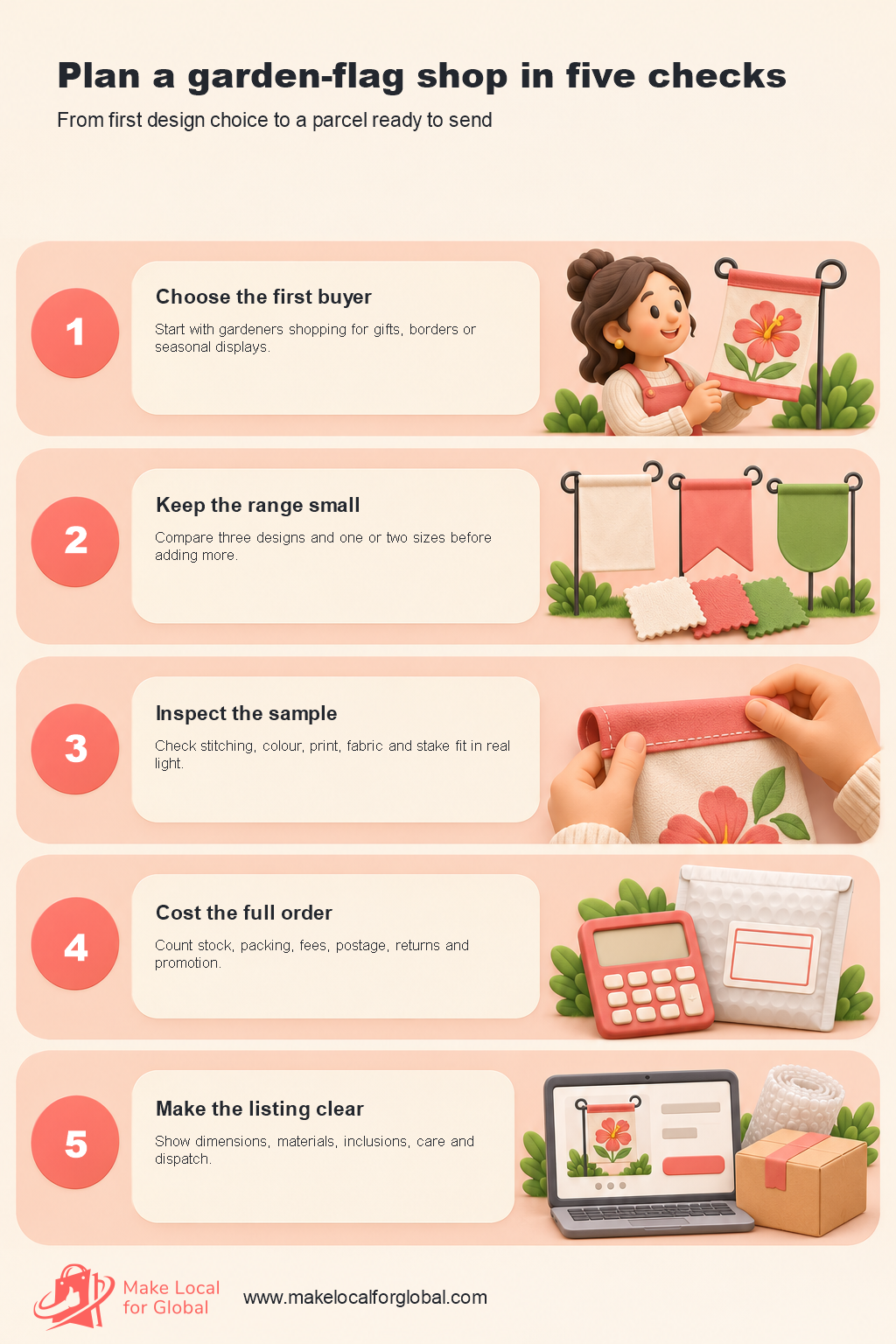
Days 1–4: define the first buyer and product. Interview potential buyers, review the garden flags they already see in shops, write down the display use and objections, and choose three design directions. Make a rights note for each design. Establish a simple cost sheet before you request a quotation.
Days 5–9: brief suppliers and request samples. Send a specification with finished size, artwork safe area, fabric, print sides, sleeve, edge finish, accessories and packing. Ask the supplier to identify minimum order, unit price by quantity, sample fee, lead time, freight terms, colour proofing and safety documentation. Do not place the first bulk order until the sample passes your checks.
Days 10–15: inspect and test the sample. Measure it, photograph it, inspect seams and sleeve fit, compare the print to the proof and follow the supported care instructions. Pack it with and without the stand, measure the parcels and check current postage. Ask an unfamiliar person to explain what is included using only your photographs and draft listing.
Days 16–21: decide the economics and channel. Calculate the contribution at full price and under likely discounts. Estimate fixed costs and the order volume needed to cover them. Choose one primary sales channel, create product records and SKUs, write dispatch, return and contact information, and confirm tax and product responsibilities that apply to your business.
Days 22–26: prepare pages and operations. Photograph the real sample on the stand, flat, close-up, reverse and beside a size reference. Write distinct descriptions for each design. Check mobile page layout, payment, stock tracking, confirmation emails, label printing and the packing checklist. Make a test order if your platform allows a safe test mode.
Days 27–30: open a small launch and learn. Publish the collection, tell a relevant audience, answer questions and record the point at which potential buyers hesitate. Check the first parcels after dispatch and ask customers for specific feedback. Reorder only when you understand the costs, quality and demand well enough to justify the cash.
No, but you must make the choice obvious. A flag-only offer can be lighter to ship and useful for a buyer who already owns a compatible stand. A bundle may suit a gift buyer or first-time owner. State whether the stand is included near the price, show the sleeve and compatibility information, and check the packed cost before offering both versions.
Choose based on the sample, likely display angle and price the buyer will accept. A single-sided print may be lighter and less costly, with a different appearance at the back. A double-sided construction can make the design easier to read from multiple directions but may add material, production time and parcel weight. Photograph the actual reverse and describe the build accurately.
There is no universal amount. Base it on the supplier minimum, landed cost, time to reorder, expected demand, storage and the cash you can afford to leave in stock. Prefer a small mixed run or sample batch where available. A minimum order that ties up money you need for packaging and customer service is too large for a first test.
Possibly, but check the tool’s commercial-use terms and review the result for copied or recognisable protected material, inaccurate details, odd edges and print problems. Keep a human-editable source file and inspect a physical sample. Do not assume a generated image is automatically free of rights concerns or suitable for textile production.
Show finished measurements, scale, the reverse, the sleeve, the stand inclusion and the real print quality. Keep colours representative, state care instructions and dispatch expectations, and make return information easy to find. Use customer questions and complaints to find wording that led to the wrong expectation.
Each has trade-offs. Seasonal designs can give customers a reason to change a display, but sales windows and reorder deadlines may be short. Evergreen florals, birds or simple garden motifs can remain relevant longer, although they still need distinct reasons to choose them. A small range can include one seasonal test alongside designs you can offer throughout the year.
For a related outdoor-product planning example, read how to sell garden arches online. The product and shipping profile are different, but the same discipline applies: choose a buyer, verify the real item, price the full order and describe what arrives.
A garden-flag shop can be manageable when the first offer is clear. Choose a buyer you can describe, create a handful of original designs, check the finished sample, price every part of an order and show the real product at a useful scale. Explain dimensions, materials, print sides, stand inclusion, care and dispatch before a buyer has to ask.
Then observe what happens. Keep track of which image earns a click, which question delays a purchase, which design sells and which cost changes the contribution. Use that information to improve one part of the range at a time. A tested, well-explained small collection is a stronger base for expansion than a large catalogue built before you know what customers value.
Review the setup options, then get in touch if you would like to talk through your product range and sales goals.
PREFERRED SOURCE
Like what you’re reading? Add Make Local for Global as a preferred source on Google to see more of our articles when you search.

Build your online presence without having to figure out everything yourself.