
READY TO SELL Grill Thermometers ONLINE?
Get a store built for you in 5 days, plus training and support to help you start, run, and grow your Alternative business.

Learn how to sell grill thermometers online: compare lid gauges, grate probes and wireless monitors, check fit and supplier evidence, price each packed order and test demand.

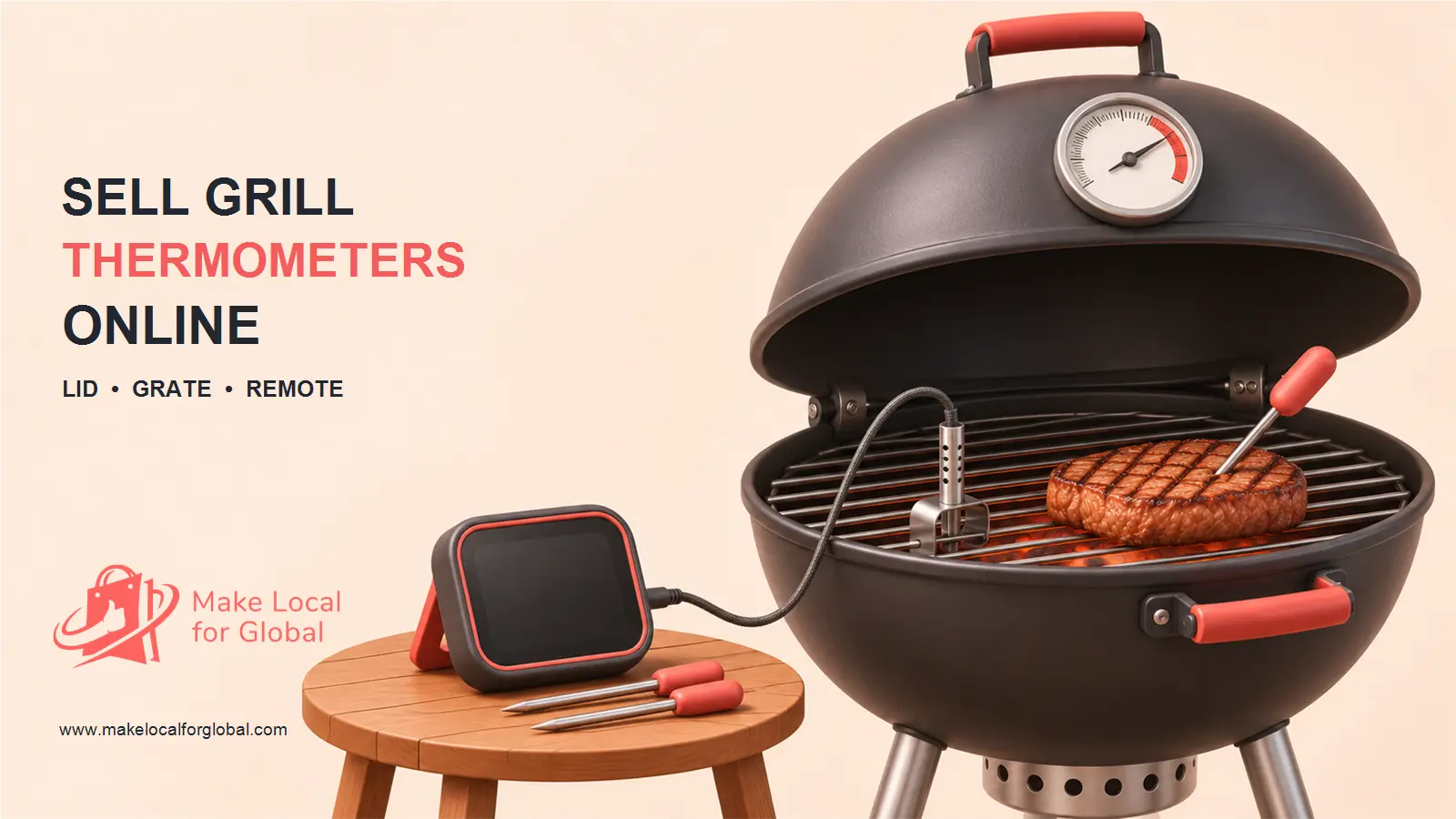
A barbecue thermometer can be a small dial on a lid, a probe clipped at grate height, or a wireless monitor that follows several readings through a long cook. Those tools look similar in a supplier catalogue, but they answer different questions. A seller who names the reading, fit and limits clearly gives a buyer a better reason to choose one model over another.
To sell grill thermometers online, choose a barbecue buyer, decide whether the range measures grill air, food temperature or both, check samples and model compatibility, then price the complete packed order. This article focuses on BBQ and smoker use. Our food thermometer guide covers kitchen and food-service models, so use that page for general probe selection and food-contact claims.
Keep those use cases distinct in titles, photos and internal links. A lid gauge is not a substitute for a probe placed beside the cooking surface, and a grill-air probe does not tell a cook the centre temperature of food. Each product page should state exactly where its sensor measures.
Compare a target buyer, model choice, first order size and unresolved supplier questions before you commit cash.
A person who replaces a broken lid dial has a compatibility question. A charcoal cook may want a grate-level reading that is less affected by the lid sensor’s position. Someone tending a smoker for several hours may prefer alarms and remote monitoring. A shop serving all three needs can carry more than one type, but should explain the difference plainly.
Replacement buyers often arrive with a grill make, model, generation or part number. They want to know whether a dial fits the existing hole, bezel and lid. A photograph of a circular gauge does not prove compatibility. Record the exact model list supplied by the manufacturer, ask what information the buyer should check and show any exclusions beside the buy button.
Weber’s replacement listings, for example, name grill families and identify cases where a different shape is needed. Treat that as a reminder to verify each part against the actual grill model. Do not copy one maker’s fit list to another brand. Check current manufacturer records and tell shoppers to use their grill’s serial or model number when a fit remains uncertain: Weber’s thermometer replacement range.
Many home cooks want a quick check of the grill space or a simple way to tell when the barbecue is heating. A lid dial may be easy to read without batteries. Its position and the gap between the sensor and the cooking surface affect what it reports, so explain it as a lid reading rather than a universal temperature for every grate position.
Some buyers want a clip-on probe at grate height. It can report conditions nearer to the food, provided the probe placement, clip and cable suit the grill. Ask where the sensor tip sits, how far the probe extends, what temperature range the maker supports and whether the cable must avoid direct flame or a lid pinch point.
People cooking for several hours may care about alarms, several probe channels, battery life, display legibility in daylight and the way a receiver connects to a phone. They need to know whether an app uses Bluetooth nearby, a home Wi-Fi connection or both. A “wireless” headline is too broad if the device only sends data across a short line-of-sight range.
ThermoWorks’ Signals page is one example of a multi-channel BBQ monitor that combines cooking probes and an air probe, with a standalone display and app connections. Its specifications describe its own model, not a category standard. Use manufacturer product pages to see which details buyers need to compare, then cite the exact model you actually stock: ThermoWorks Signals product details.
Build a range around a measurement job, not a row of screens that differ only in colour. A useful first catalogue might contain one replacement dial family, a clip-on grate probe and one wired or wireless monitor for longer cooks. Add a food probe only if you can explain how it differs from the grill-air sensor and link it to a separate use case.

| Type | Typical use | Buyer must check | Seller’s evidence |
|---|---|---|---|
| Lid-mounted dial | A visible reading from the grill lid | Hole, thread, bezel, scale and exact grill model | Manufacturer fit list and part number |
| Grate-level ambient probe | Monitoring air near the cooking surface | Clip position, probe length, cable routing and limits | Instructions for placement, safe temperature range and care |
| Wired alarm monitor | Following one or more readings at the grill | Probe count, cable length, alarm controls and display | Exact contents, operating guide and warranty |
| Wireless system | Remote alerts during longer cooks | Bluetooth, Wi-Fi, phone support and signal limits | Radio declarations, app details, battery and connection terms |
| Food probe | Measuring inside food, if the product is made for it | Food-contact part, cleaning and intended use | Materials, care instructions and stated use |
Product categories are examples. Follow the exact model documentation.
Keep the categories clear in filters and navigation. Use “grill temperature” for the lid or ambient reading and “food temperature” for an internal probe, where those terms match the model. If one kit includes both, list each sensor and what it measures. The buyer should not have to decode a vague phrase such as “BBQ temperature kit”.
If you are planning a broader barbecue range, compare the role of a thermometer with nearby offers in our guides to grilling accessories and grilling mats. A thermometer records a condition; a mat changes the cooking surface. Keep the product pages and their claims separate.
Start with a lead product that fits a specific customer need. A replacement-dial range can begin with only the part numbers you can document. A new-gadget shop could test one ambient clip probe and a two-channel monitor. A premium long-cook offer might add more channels and remote features. Do not buy every model a wholesaler puts in a catalogue before you know who will use it.
An entry choice could be one simple compatible dial. A main choice might pair an ambient probe with a receiver. An advanced model could add extra channels, remote alerts or a longer-supported app. Each price step should add a feature that a buyer can name. More probes are not a benefit if the customer only needs one grate reading.
For each product, write down the barbecue, cook duration, sensor location and buyer question it serves. Then compare the model with its nearest alternative. If the only difference is a cosmetic colour and you cannot keep both in stock reliably, postpone that variation. Use the space for a clearer explanation, a replacement probe or a fitting guide.
Work out the cash tied up in each model, including spare parts and packaging. A dozen versions of a dial can create dead stock if they fit different grills. Ask the supplier about reorder quantities and product changes before ordering. For electronic products, establish how customers get replacement probes, batteries, chargers or firmware support.
Use a small test quantity where the supplier permits it. Keep a reserve for replacements if a product has delicate cables or multiple connectors, but do not assume the first batch represents every production lot. A simple inventory sheet should record the supplier code, device version, compatibility list, cost, units received, units sold and unresolved customer issues.
You might buy from a UK distributor, import from a manufacturer, sell approved replacement parts or assemble a bundle with a probe clip and storage case. Each route changes the paperwork and support work. A low unit quote can be outweighed by missing manuals, unclear compatibility, costly returns or no supply of replacement leads.
Request the manufacturer, model, part number, intended measurement, sensor type, operating range, stated tolerance, resolution, response time and limits on probe or cable temperature. Ask for the exact box contents, product and packed dimensions, weight, instructions, cleaning method, storage advice, warranty terms and approved replacement components.
For a wireless model, ask for its radio frequency, compatible phone operating systems, app name, network requirements, range test conditions, battery type, charging method and software support policy. Do not accept “works with all phones” without the maker’s current compatibility details. Ask who handles app updates, account access and data privacy questions if the monitor depends on an online service.
Check whether the supplier has named the party responsible for placing goods on the UK market. If you import the product or sell it under your own brand, your obligations can differ from those of a retailer buying from a UK wholesaler. Keep the declaration, test reports, labels and written supplier answers with the exact SKU. A general brochure for a family of devices may not cover the model in your parcel.
| Route | What you control | Questions to ask | Risk to cost |
|---|---|---|---|
| UK distributor | Selection, product page, price and service | Can it provide the exact declaration and replacement parts? | Stock availability and distributor price changes |
| Direct manufacturer | More options for specification or pack format | Who imports, what are minimums, and who handles faults? | Freight, duty, assessment and longer cash cycle |
| Approved replacement parts | Fit guide and model-specific listing | Which grill versions match, and what exclusions apply? | Many small stock lines and compatibility returns |
| Bundle builder | Probe, clip, receiver and presentation combination | Can every component be sourced and tracked separately? | Picking time, stock mismatch and updated photos |
| Supplier-dispatched orders | Page, support and customer promise | Can you test the parcel, stock feed and return route? | Supplier postage, service delays and less pack control |
Ask for a sample of the exact sale model, not a near match from the same brand. Save a dated copy of the current specification and note when the supplier changes a cable, screen, probe connector, manual or included accessory. A product change may require a new photograph, description, cost or test.
Unbox the sample yourself and compare its contents with the order confirmation and manufacturer page. Take a photograph of the model number, packaging label, connector, probe and manual. The sample gives you a chance to catch an incomplete pack or a mismatch before a buyer receives it.

Do not use an improvised test that exposes a probe beyond its stated range. Do not call a comparison a calibration certificate. If the maker allows an ice or boiling-water check, follow its method and record the conditions. A barbecue environment can differ from a laboratory test, so describe what you verified and what you did not.
Turn findings into useful product-page facts. If the cable is shorter than expected, state the measured length. If the sensor sits a set distance from the tip, show that position in a diagram. If a dial fits only named models, publish the exact list and ask customers to check their grill information before ordering.
A mechanical dial, battery-powered display, rechargeable monitor and radio-connected system may fall under different product rules. Your role depends on how the goods enter the market, your location, product type and destination. A retailer should check the supplier’s evidence. An importer or own-brand seller can carry added duties.
The Office for Product Safety and Standards says businesses making, importing, distributing or selling consumer goods in the UK have product safety responsibilities. Great Britain and Northern Ireland do not follow identical rules for every product. Start with current GOV.UK product safety advice and check the exact model and role with the regulator or a qualified adviser.
For electronic goods, ask the manufacturer or importer which regulations apply and request the relevant declaration of conformity, technical evidence, traceability details, labels and user instructions. A CE or UKCA mark in a photograph is not a substitute for model-specific paperwork. Rules vary by product and market. Never add or promise a mark based on appearance alone.
Where a product uses radio equipment, check the current Radio Equipment Regulations guidance for Great Britain or Northern Ireland as relevant. The government’s Great Britain guide describes added importer checks, including documentation, conformity and importer identification. Read the current Radio Equipment Regulations guidance before importing or relabelling a connected thermometer.
Electrical equipment can bring producer-responsibility duties under WEEE rules. Whether a business is a producer depends on its activity, including importing and selling a product under its own brand. Retailers selling household electrical goods have take-back obligations or need to join an approved alternative scheme. Check EEE producer responsibilities and retailer and distributor responsibilities.
Battery rules can apply when a thermometer includes, or is sold with, batteries. An importer may count as a battery producer if it is first to make batteries available in the UK market. Review the current waste battery producer guidance and confirm which party registers or pays for the relevant obligations.
For online sales, give the required product, trader, delivery, payment and cancellation information before checkout. GOV.UK explains distance-selling cancellation rights, including the usual 14-day period for customers to tell a seller they wish to cancel after delivery, with return and refund rules that apply afterward. Read current returns and refund guidance. Faulty or misdescribed goods have separate protections.
This overview helps you identify questions for the supplier. It is not a legal determination for a particular product or seller. Keep the model, market, importer, declaration and instructions together. Do not assume that a UK wholesaler’s delivery removes your duty to take care when you list and sell the goods.
Build the price from a real quote and one packed sample. Include the purchase price, inbound freight, duty where relevant, protective packaging, payment or marketplace fees, delivery, expected returns, warranty handling and the promotion spend you want each order to support. Add a realistic value for the time spent answering compatibility questions and resolving technical support issues.
Here is an illustrative calculation for a simple wired monitor sold by a non-VAT-registered UK seller. All amounts are assumptions, not supplier quotes, typical margins or a prediction. Replace them with current costs for the exact SKU and service plan.
| Cost per order | Illustrative amount | How to replace it |
|---|---|---|
| Wired grill monitor and probe | £22.00 | Supplier invoice for the exact model |
| Inbound delivery and handling | £1.40 | Allocate shipment and import costs per saleable unit |
| Protective packaging | £1.20 | Pack and weigh one order |
| Payment or marketplace charges | £5.80 | Check the current plan, category and order amount |
| Tracked postage | £3.80 | Measure the finished parcel and request a current rate |
| Returns and fault allowance | £2.10 | Update from real returns, replacements and support time |
| Paid customer acquisition | £3.50 | Divide test spend by attributed paid orders |
| Total variable cost | £39.80 | £22.00 + £1.40 + £1.20 + £5.80 + £3.80 + £2.10 + £3.50 |
Illustrative only. Confirm platform charges, tax treatment and shipping quotes before setting a selling price.
At a £54.00 selling price, the arithmetic is £54.00 less £39.80, which leaves £14.20 contribution before fixed overhead, owner pay, tax and omitted costs. It is not net profit. A higher return rate or paid-ad cost could shrink the contribution quickly, and a lower sale price changes the result pound for pound.
Use the fee schedule for the exact marketplace, plan and fulfilment method. A percentage fee, fixed transaction charge, payment processing and advertising can apply together. Test full price, a likely promotion and a bundle price. Do not use one platform’s fee as a stand-in for another.
For a VAT-registered business, sales VAT and allowable input VAT alter the calculation. The example assumes no VAT registration and uses simplified cost amounts. Model the figures with your accountant or HMRC’s current guidance. Set a replacement allowance for faulty screens, damaged probe leads and return postage based on supplier terms and actual outcomes, not a hopeful guess.
Use a worksheet before choosing a price. Our physical product pricing guide can help organise the inputs. Keep the quote date, seller fees and parcel dimensions next to the SKU, then rerun the calculation when a supplier or carrier changes its terms.
Start with the model and measurement type. A replacement product might be called “Lid thermometer for [verified grill model list]”. A clip probe might be “Grate-level ambient probe with [verified clip and cable details]”. A multi-probe monitor should state the channel count, included probes and connection method. Replace each bracket with facts from the actual product record.
Use a short description to say who the product suits and what problem it solves. For example: “This clip-on ambient probe lets you monitor the air beside the cooking grate on supported grills. The kit includes one receiver, one probe, one clip and a 1.2 m lead. Follow the model instructions for probe placement and keep the lead clear of direct flame.” Replace the count and measurement with your own sample and documentation.
For a lid gauge, provide a short compatibility path: locate the grill model or serial number, compare it with your published fit list and contact the seller before ordering if it is absent. Do not tell a shopper that “most grills” fit unless the maker proves that claim. If there are two gauge shapes or threads, show a side-by-side photograph with dimensions and part references.
Research terms such as “grill thermometer”, “BBQ temperature gauge”, “grate probe for smoker” and “replacement lid thermometer” against the real product. Different words point to different models. Include the phrase that helps a buyer understand the fit and use, not every variant in one title.
Write a specific heading for each product type, a short factual meta description and a caption that clarifies the photo. A store category could explain the distinction between a grill-air sensor and a food probe, then link to individual models. Search engines choose their own snippets, so write accurate summaries rather than promising a particular result layout or rank.
Build helpful supporting pages around questions you can answer with evidence: how to identify a grill model, where a maker says to place a grate probe, what a wireless range claim means and which spare lead fits a receiver. Link each resource to the relevant product. Do not copy competitor descriptions or use a “best accuracy” claim without a defined test and current proof.
Use one lead image with every included part visible against a plain, warm background. Add close views of the probe tip, connector, cable entry point, clip and product label. For a replacement gauge, include the mounting thread, bezel and scale. A lifestyle image can show the product on a barbecue, but keep a separate clear image of the exact sale kit.

Do not add a phone screen full of invented app details. Do not place a probe where the manufacturer forbids it or depict a device exposed to flame. Keep a scale reference honest and make clear whether batteries, clips or cases appear in the box. If a photo uses a non-sale grill as an example, caption it as an illustration and keep the compatibility list factual.
Use descriptive image alt text, such as “Wireless BBQ monitor connected to a grate-level probe beside a kettle grill”. Alt text should describe the visible scene. It is not a place to repeat the full search phrase or add a list of keywords.
A marketplace gives access to existing searches and product comparison, but its current fees, rules and delivery metrics affect your cost. A standalone shop gives you control over product education and compatibility checks, but you have to bring visitors. The best first channel depends on the buyer’s habits, your ability to answer fit questions and the margin available after fulfilment.
Before choosing, read the channel’s current policies for electronics, battery shipping, returns, warranties, restricted claims and images. Check whether customers can ask a question before checkout. For replacement dials, a contact route can prevent the wrong-part order. For connected devices, make phone and app compatibility information easy to find.
Choose one question: will charcoal cooks respond to a clear comparison of lid and grate readings, or will replacement buyers click a model-specific fit guide? Make one page or campaign for that question. Set a spending cap you can afford to lose, use a trackable link and record visits, product-page clicks, compatibility questions, basket actions, orders, returns and contribution.
Change one major factor at a time where possible. If you change the image, title, price and audience in one go, the result does not show which change mattered. A click is a signal to investigate, not proof of profitable demand. Compare the test’s actual cost per paid order with your contribution figure.
Useful content can answer common buyer questions before they reach checkout. Show how to identify a grill model, explain the difference between an ambient reading and a food reading, or demonstrate what arrives in a specific package. Get permission before using customer images and do not invent a review, testimonial or laboratory result.
Make a pick list for each kit and give every component a SKU. If you assemble a receiver with two probes, record whether the probes are interchangeable and track their stock separately if they can be reordered alone. Save the exact product page and instructions for each version so a support answer matches what the customer bought.
Pack screens and probe connectors so they cannot move against one another. Protect the pointed end, secure long leads without tight bends and stop the cable from being pinched in the box. Test the parcel against your carrier’s size and weight bands. A protective case may improve storage but does not replace suitable transit packaging.
State dispatch times you can meet. If a supplier sends orders for you, place a test order to your address and check the parcel, tracking notice, stock accuracy, included manual and return route. Keep enough stock information to stop a sale when a model is unavailable or a product notice affects a batch.
Prepare answers for common support questions: how to identify a compatible gauge, where a probe should sit, how to pair a device, what the warranty covers and where to find replacement parts. Do not advise a customer to open a sealed electrical unit or modify a probe unless the manufacturer’s instructions support that step. Escalate safety complaints and suspected faults to the supplier. Preserve the order, model and batch records.
Customers comparing a full outdoor setup may be researching the barbecue itself too. Our barbecue grill range article covers choosing and presenting the main cooking equipment, leaving this page to explain the temperature tools that work alongside it.
Publish a returns route that explains the customer’s statutory rights, the address or process for a return and how you handle a faulty or misdescribed device. A blanket “no returns once opened” statement may misstate online consumer rights. Use current GOV.UK guidance and obtain legal advice for a difficult case.
The first month can test fit, buying intent and operations without a large order. Do not launch just to meet a calendar date. If a declaration, sample, warranty term or landed cost remains unknown, use the time to get an answer rather than accepting risk.
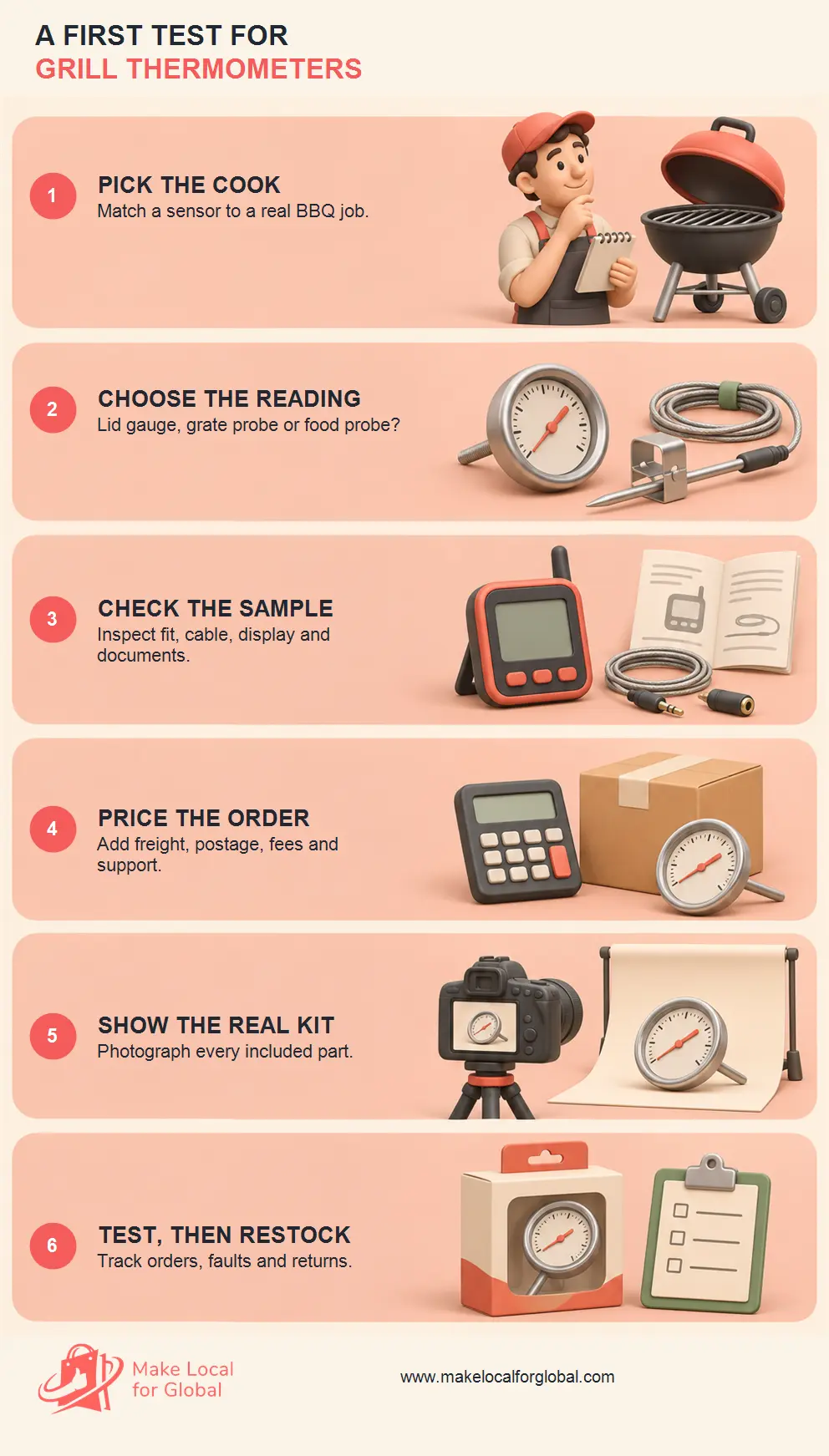
Compare a replacement-dial buyer, a casual griller and a long-cook customer. Write down the reading each needs, how they identify a suitable model and what evidence would help them trust a listing. Review questions on competing product pages as research prompts. Speak with potential buyers about the grill and tools they use now, not only about which product photo they like.
End the week with one lead buyer and one test product. If you cannot describe what it measures and why the buyer needs it, gather more information before asking a supplier for bulk pricing.
Ask suppliers for exact model records, compatibility, declarations, instructions, warranty terms, replacement parts and reorder quantities. Order the sale sample. Check the screen, probe, cable, connector, clip or mounting parts against the documentation. Save photographs and written answers. Identify who imports the goods and which product-safety and producer-responsibility rules apply to the intended destination.
Create a sheet for model, batch, supplier, fit list, declared range, tested condition, packaging, cost and open questions. Record a “not checked” result as well as a pass. That makes it easier to see whether a claim still needs evidence.
Pack the actual sample, measure the parcel and get a delivery quote. Enter the product, freight, duty, packaging, fees, returns allowance and promotion amount into the cost model. Work out the contribution at your planned price and a likely promotion. Confirm tax treatment with current guidance or an accountant.
Photograph the exact contents. Write the product title, model fit, probe placement, connection method, dimensions, warranty, delivery and returns information. Ask someone who has not seen the product to explain what it measures and what arrives in the box. Rewrite any line they misunderstand.
Open the listing after checkout, stock, support and dispatch are ready. Use one channel and one trackable campaign. Record relevant product-page visits, questions, baskets, paid orders, contribution, fault reports and returns. Review which model information people needed before buying and update the page where the same question recurs.
At the end, choose to reorder, revise the fit information, change the offer or stop. A small test that reveals a compatibility problem is useful if it prevents a larger batch of wrong-part returns. Do not increase the order because a post received likes or a product page had views.
Put the unit cost, delivery, fees, support time and likely returns in one calculation before you add another model.
Examples include a lid-mounted dial, a grate-level ambient probe, a wired alarm monitor, a wireless multi-channel system and a separate food probe. Choose according to the reading and grill use the customer needs. Explain each sensor’s location and job in the listing.
No. A grill thermometer usually measures the lid or air near the grate. A food probe is designed to measure inside food. A device can support both types of probe, but the product page should explain which included sensor does which job. For food-only models, see our food thermometer range article.
Use the manufacturer’s current fit list, part number and notes about the hole, thread or gauge shape. Ask the customer to confirm the exact grill model or serial number. Do not rely on a photograph or a broad “universal” claim without written evidence.
Match its model and contents to the order. Check the display, probe, connectors, cable, clip or mounting parts and follow the maker’s stated test method. Record the conditions and do not exceed its temperature limits or present your check as an independent certification.
Yes, after checking the exact model’s product documents, radio requirements, phone and app support, battery information, warranty and importer details. Requirements vary by product and market. Read current guidance for Great Britain or Northern Ireland before placing goods on sale.
It depends on the type of product, applicable regulations and market. Some electronic or radio products have conformity requirements; a simple dial may be different. Ask the supplier for the declarations and model-specific evidence, then check current official rules. Do not infer a marking requirement from another thermometer.
Start with a quantity supported by a tested sample, a real cost model and evidence of buyer interest. Keep a smaller range if each model fits different grill families or needs different app support. Confirm the reorder time and minimum quantity before you choose the first order.
Show the full kit, probe tip, cable entry, clip or mounting thread, display, label and packaging. Add a barbecue context photo when it accurately shows the intended placement. Keep one image on the actual sale contents and state whether any grill or phone is just a prop.
Ask for the model, batch, probe used, location, test method and conditions. Follow the maker’s support instructions, record the complaint and contact the supplier where needed. If the report raises a safety concern, pause affected stock while you assess it and follow current reporting guidance.
A useful grill thermometer range starts with a clear reading and a buyer who needs it. Verify fit and sample details, check the supplier record, account for the full parcel cost and show the exact product in the listing. Use buyer questions and paid orders to decide what to stock next.
If the product documents, landed cost or fulfilment plan remain unclear, hold the stock decision until you can answer those points. A smaller test can show whether buyers want a replacement dial, a grate probe or remote monitoring without filling shelves with models you cannot explain.
Give visitors a clear product page, verified fit information and an easy way to ask about a model.
PREFERRED SOURCE
Like what you’re reading? Add Make Local for Global as a preferred source on Google to see more of our articles when you search.




Build your online presence without having to figure out everything yourself.