

READY TO SELL Grilling Mats ONLINE?
Get a store built for you in 5 days, plus training and support to help you start, run, and grow your Alternative business.

Learn how to sell grilling mats online: choose a clear buyer, check food-contact evidence, inspect supplier samples, price packed orders and build a useful product page.


A grilling mat looks simple until you try to sell one well. Buyers want to know whether it fits their barbecue, what it is made from, what food it suits, how hot it can get, how to clean it and whether it will arrive flat and ready to use. Your job as a seller is to answer those questions with evidence rather than broad promises.
This guide is for a UK-based beginner planning to sell reusable mats for outdoor grills. It covers choosing a clear customer, building a small range, checking suppliers and product information, setting a realistic price, presenting the product online and learning from the first orders. It does not replace product-specific legal advice. A mat’s safe use depends on its materials, construction, intended food contact, the barbecue and the manufacturer’s instructions. Do not infer a safe temperature or food-contact status from a supplier’s headline or another seller’s listing.
If you are still deciding whether this product belongs in your shop, begin with the B2C Launch Assessment. Write down the buyer, use case and evidence you need before you pay for stock.
Define the buyer, use case and evidence you need. Then test the product and its costs before ordering stock.
Grilling mats are reusable sheets or shaped surfaces placed on a cooking grate to help keep smaller pieces of food from falling between the bars. They may be marketed for vegetables, delicate fish, smaller portions or easier clean-up. Designs differ. A flat mat, perforated sheet, mesh-like liner and thick reusable cooking surface are not interchangeable products, even if a marketplace groups them under the same search phrase.
A mat is an accessory, not a replacement for a barbecue, cooking grate, thermometer or food-safety practice. It does not make food cook more evenly by itself, guarantee that food will not stick, prevent flare-ups, make an unsafe grill safe or eliminate cleaning. Some styles can change direct contact with the flame and the way heat reaches the food. The manufacturer’s stated purpose, material and use instructions therefore matter to the product description.
Avoid casually calling every item a “BBQ mat”. Customers may use that phrase for a grill cooking mat, a protective mat placed beneath a barbecue, a patio floor protector, a grill cover or a disposable foil tray. Use plain language near the top of your listing: this is a reusable cooking mat for a barbecue grate. If the product is instead designed to protect a surface under a barbecue, treat it as a different product with different checks and images.
The best opportunity is usually not “a mat that works for every grill”. It is a clear product for a particular task, with dimensions, compatible use and care information that a buyer can verify before ordering.
Before choosing suppliers, decide who you expect to serve. A small independent shop can struggle if it launches a generic mat against a large catalogue of nearly identical listings. It can be more useful to solve one narrow problem and explain it well.
Possible customer groups include:
These are hypotheses, not proof of demand. Speak to prospective customers, review questions and complaints on relevant products, and see which questions appear repeatedly. Ask what they cook, what grill they use, what they currently find inconvenient and which details they need before trusting a cooking surface. Do not copy another seller’s product claims or assume that a review describes the full market.
You can test demand before committing to a large order. Create a simple product concept, show the intended size and use, and ask likely buyers which version they would choose. If you collect email interest, explain what you are collecting and how you will use it. A few positive comments are a starting signal, not a sales forecast. Record who responded, what they said and what they would actually pay.
Choose one primary use case for your first listing. “For smaller vegetables on a compatible barbecue grate” is more useful than a claim that it is suitable for every food, every grill and every temperature. The wording must be confirmed by the manufacturer’s intended use and the documentation you receive.
Avoid launching a dozen variations before you know what the buyer values. A practical first range might have one principal mat and one meaningful variation, such as a different verified size or a multi-pack. Keep a note beside each option explaining which customer question it answers. If you cannot explain why an option exists, it may add inventory complexity without helping the buyer.
| Range choice | Buyer question it answers | Evidence to collect |
|---|---|---|
| Single mat | Can I try one before buying more? | Exact usable dimensions, package contents, care and use instructions |
| Two-piece set | Can I cook two groups of food or keep a spare? | Whether both pieces are identical, combined dimensions and packaging size |
| Different shape | Does it fit my grate layout? | Measured shape, corner radius if relevant and fit guidance from the maker |
| Perforated design | Does this version suit a different cooking task? | Intended use, hole pattern, material details and any limitations |
| Storage sleeve or pouch | Can I store it cleanly after use? | What the pouch is made from and whether it is supplied in every pack |
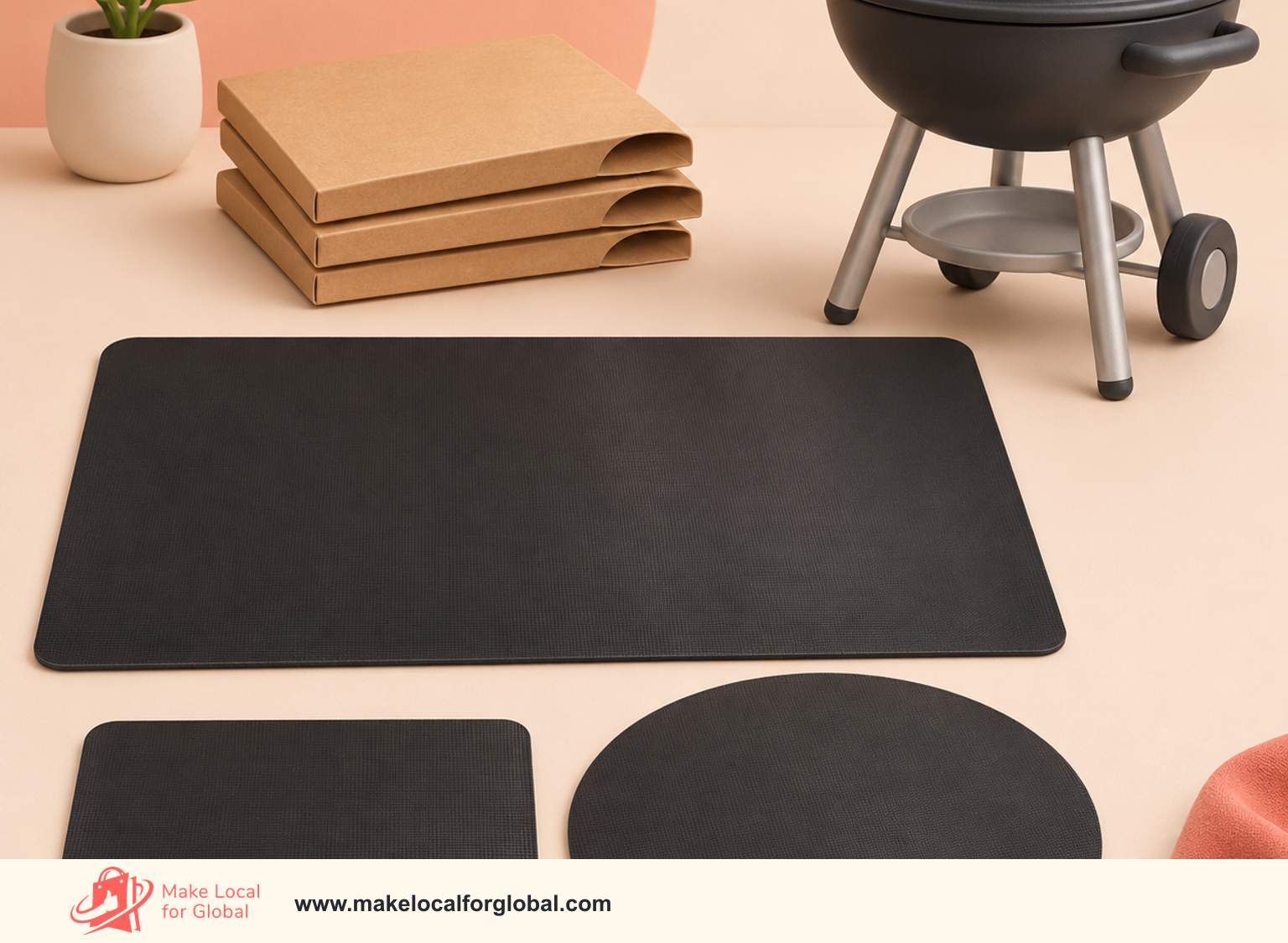
Do not invent a “family size” or “large grill” category without defining its measurements. A customer needs the actual dimensions and a clear explanation of how to measure the grate. If a manufacturer gives a nominal size, compare it with a physical sample and state whether that measurement includes a border or usable cooking area.
Keep a product matrix for each SKU. Record supplier part number, materials, thickness if relevant, dimensions, colour, pack quantity, care instructions, declared temperature range, intended food-contact conditions, package contents, carton quantity, lead time and evidence source. Date supplier documents and note which version of the product they describe. This avoids using one sample’s information for a later production run that has changed.
If you offer a bundle, make the bundle useful rather than just adding items. A set of two identical mats may suit repeat use, while a mat plus storage pouch could address a real storage concern if the pouch is supplied and its role is clear. Avoid adding unrelated tools to inflate the price. Each extra item needs its own quality, safety and returns checks.
For a first range, compare the total cost and control involved in three routes: a UK wholesaler, a manufacturer or trading company abroad, and private-label production. A local wholesaler may offer a smaller minimum order and easier replenishment. Direct import could provide more control over dimensions and packaging, but it adds supplier verification, shipping, import administration and responsibility for checking the product and its claims. Private label gives you a distinct presentation but does not make the underlying product safer or remove your responsibilities.
Ask a supplier for a written specification, product photographs of the actual version, material details, instructions, traceability information, relevant test or conformity documents, production lead time, minimum order, defect policy and change-control process. Ask who manufactured the goods and who is responsible for the documents. If a supplier answers only with a broad certificate, ask which model, material, production site and intended use it covers.
Do not treat a logo on a report as proof that every product in a catalogue has been assessed. Check the issuing organisation, report number, scope, date, sample identification and any stated limitations. If a document is in another language, obtain a reliable translation before relying on it. A factory audit may tell you about a site; it does not, by itself, establish that the mat is suitable for food contact or barbecue use.
Order a sample from the same version and supply route you plan to sell. Keep a labelled sample, take dated photographs and compare the first production batch with the approved sample. For a larger order, agree what happens if materials, surface finish, dimensions or packaging change. Ask the supplier to notify you before substituting a material or moving production.
If you import into Great Britain or Northern Ireland, check the rules that apply to your role, location, product and supply route. The UK Government’s product safety advice for businesses explains that businesses in the supply chain have responsibilities, including product safety, traceability and action when a product may be unsafe. Requirements can differ between Great Britain and Northern Ireland. Do not assume that a supplier’s overseas approval alone settles your UK obligations.
Because a grilling mat is intended to contact food, obtain evidence that applies to the exact product and intended use. Ask what material touches the food, whether there are layers or coatings, what food types and contact conditions are covered, and how the stated use limits were established. A generic statement such as “food grade” is not enough detail for you to describe the product confidently.
Food-contact rules are not one single certificate. The UK’s food contact materials regulations set out the regulatory framework for relevant materials. Food Standards Scotland explains the general framework for food contact materials, including kitchenware. The detailed requirements depend on the material and market. Plastic materials in scope of the relevant plastics rules can have specific documentation and supporting-information requirements; see the applicable provisions of Regulation 10/2011 and confirm which rules apply to your product and territory.
Use these sources as a route to ask better questions, not as a shortcut to a legal conclusion. A small retailer, importer, manufacturer and distributor can have different obligations. Great Britain and Northern Ireland may follow different arrangements for some product rules. If you will import, rebrand or make a safety claim, ask a qualified product compliance adviser to review your specific product and role before committing to a commercial order.
Your product page should use claims that the evidence supports. Do not write “non-toxic”, “chemical-free”, “completely safe”, “certified” or “works with all food” unless the evidence and applicable rules support the exact wording. Avoid turning a test result for a material sample into a claim that the finished article has been independently approved for every grill and cooking condition.
Ask the supplier to explain cleaning and end-of-life guidance too. A dishwasher claim, for example, should not be added simply because the material seems washable. The instructions should state the cleaning method that has been evaluated for the product. If the mat can be cut to fit, confirm whether cutting is allowed, how to avoid exposed layers and whether the supplier’s evidence remains applicable after modification. If cutting is not approved, say so clearly.
Keep the documentation with the product record. If a customer asks what the mat is made from or how it should be used, you should be able to answer from the specification, instructions and supporting evidence rather than memory.
Sample checking is not a substitute for laboratory assessment or supplier evidence. It is a way to spot obvious inconsistencies, poor finishing and unclear information before you accept stock. Follow the maker’s instructions; do not deliberately expose a sample to an unapproved temperature or use it with food until the product’s intended use is adequately supported.
Start with identity and dimensions. Compare the part number, shape, colour, finish and package contents with the supplier’s specification. Measure the mat in several places and record both the edge-to-edge size and any usable area the supplier defines. Note whether the sample arrives flat, curled or creased, and whether the package protected it from damage. Photograph both sides, edges, labels, instructions and packaging.
Inspect the surface, edges and finish under good light. Look for cuts, pinholes, delamination, rough edges, uneven coating, trapped debris, exposed reinforcement or strong persistent odour. These observations do not prove a material is safe or unsafe, but defects and unexplained variation are reasons to pause and ask the supplier. Do not “fix” an uncertain product by trimming, coating or relabelling it yourself.
Check that instructions identify the product and explain the permitted use, preparation, placement, cleaning, storage and any warnings. They should not contradict the supplier’s technical information. If a temperature limit is stated, record the exact value and what the supplier says it means. A mat may be affected by direct flame, a hot spot, an empty grill or prolonged heating; do not simplify the instruction to “heat resistant” without the supporting context.
Look at how the item sits on a representative cooking grate only if this is within the supplied instructions and your handling is safe. Compare its dimensions with the intended surface. It should not obstruct vents or be represented as covering a specific grill unless the compatibility is verified. Use a product-specific test plan reviewed against the manufacturer’s instructions. Never improvise a high-temperature or food-contact test and then claim that it confirms compliance.
Keep a sample checklist with pass, fail or needs clarification for each point. Ask the supplier to resolve each “needs clarification” before you approve bulk production. Save their written responses and any replacement documents alongside the sample photos.

The supplier’s unit price is only one part of the cost. Add inbound freight, duty or import charges where applicable, packaging, pick and pack, payment processing, marketplace fees, delivery, returns allowance and customer acquisition. If you fulfil orders yourself, include a reasonable value for your time. If you pay for storage or a fulfilment service, use the actual quote rather than a guess.
Here is an illustrative single-order calculation. These figures are examples only, not a recommended retail price or a market quote. Replace every line with your own supplier, channel and courier numbers before setting a price.
| Example cost per order | Amount |
|---|---|
| Mat and inbound freight allocation | £4.20 |
| Protective sleeve and outer packaging | £0.55 |
| Pick and pack | £1.20 |
| Outbound delivery contribution | £2.50 |
| Payment and marketplace fees estimate | £2.10 |
| Returns and damage allowance | £0.65 |
| Customer acquisition allocation | £1.50 |
| Total variable cost used in this example | £12.70 |

At a hypothetical £24.99 selling price, £24.99 minus £12.70 leaves £12.29 before fixed overheads, tax and any VAT treatment. That £12.29 is not net profit. It is a contribution figure under this simplified example. It still needs to cover website and software costs, insurance, accounting, product photography, samples, compliance work, storage, unsold stock and your own time. The price and each cost line should be revisited if delivery is free, the marketplace fee is percentage-based, the order is returned or advertising gets more expensive.
If the numbers only work when you ignore returns, charge an implausibly high price or assume free labour, change the product, pack size or sales channel before buying a large quantity. Compare what happens at lower and higher order volumes. Bulk freight may reduce the unit allocation but tie up cash and increase the risk of holding slow stock.
VAT treatment matters. As of the date of this article, the UK VAT registration threshold is £90,000 of taxable turnover, with rules for a previous twelve-month period and expected turnover in the next 30 days. Read HMRC’s current VAT threshold guidance and take advice for your circumstances. If you become VAT-registered, model VAT correctly in both your price and your costs; do not simply add the VAT rate to a retail price without considering customers, input tax and channel display requirements.
If you import packaged products, check whether packaging Extended Producer Responsibility reporting applies to your business. The thresholds and responsibilities depend on business size, UK establishment, turnover and packaging tonnage. Use GOV.UK’s EPR packaging guidance rather than relying on a supplier’s assumption that packaging obligations are handled elsewhere.
Add supplier, packaging, delivery, fees and returns to see what remains before fixed overheads and tax.
Order quantity should follow evidence and cash capacity, not the supplier’s preferred minimum alone. Ask for a quote at several volumes and compare the landed cost, lead time, storage requirement, defect terms and cash tied up. A lower unit price is not automatically the better decision if it leaves you with too many mats to sell before a product revision or seasonal change.
Set a maximum test quantity you can afford to hold. Include the cost of samples, freight, import charges, testing or advice, packaging and product photography. Preserve enough cash for fulfilment and refunds after the first orders. Keep a reserve for stock replenishment if the product works; spending every pound on the first shipment can make a successful test difficult to scale.
Ask whether the supplier can replenish the same specification. A first order that sells well is not a reliable basis for growth if the next batch has different material, dimensions or packaging. Agree a written re-order process and require notice of product changes. Record lead times from order confirmation to stock you can actually sell, not only the factory production estimate.
If you plan to sell through several channels, divide inventory carefully. A marketplace listing, your own store and a local retailer should not all promise the same final unit. Use stock controls that prevent overselling and update availability when an order is placed, cancelled or returned.
Your product title should identify the product and a meaningful verified detail. Do not cram every search phrase into one title. A title might name a reusable grilling mat and its measured size or pack quantity, if those details are confirmed. Use “BBQ” naturally where buyers use it, but clarify that the item is intended for cooking on a grate rather than placing under the barbecue.
The opening lines should say what it is, what cooking task it is designed for and how to check fit. Make the material, exact dimensions, number of pieces, care instructions and package contents easy to find. State the intended barbecue types only when supported. If compatibility is not established for a named grill, tell customers to compare the dimensions with their cooking grate and follow the mat instructions.
Useful product details include:
Do not hide limitations in a long paragraph or put a contradictory claim in a promotional badge. If the instruction says to keep the mat away from direct flame, make that visible near the use guidance. Do not promise a particular cooking result, grill compatibility or food-contact performance unless you can support it.
Use original photographs of the product you actually sell. Show the mat flat, its texture, edges, actual scale beside a ruler, packaging and a realistic compatible grill setup. If you use a lifestyle image, identify any props that are not included. Avoid adding text directly over the mat or food where it obscures the product. The product page should make size and material easier to judge, not more mysterious.
For search, write for a buyer comparing solutions. Use the primary phrase in the page title, URL and a relevant heading where natural. Include related terms such as barbecue cooking mat or reusable grill mat only when they describe the product. Google does not need repeated exact phrases in every heading. Helpful, accurate product information and a distinct answer to the buyer’s question matter more than a keyword density target.
The meta description should summarise the specific help available on the page, not promise a guaranteed result. The social image should use the product-specific branded cover, with a short readable headline and clean space around the exact MLFG logo. Keep headings descriptive and use them to organise actual decisions, such as supplier checks, pricing and listing information.
The mat may arrive folded or rolled, so photograph it in the condition you expect a buyer to receive and use it. If the manufacturer says to store it flat, show a suitable storage approach only if that reflects the supplied instructions. Do not make a tight roll look like an approved storage method unless the manufacturer allows it.
Choose packaging that protects the material from crease damage, dirt and punctures without adding unnecessary bulk. Test the actual packed parcel: measure length, width and depth, weigh it, and compare those figures with courier or marketplace bands. A thin item can still incur a higher shipping cost if an oversized sleeve pushes it into another parcel category.
Include the supplied instruction sheet or make sure the customer can access the correct version online. Do not replace the manufacturer’s safety guidance with your own shorter card if that removes a limitation. If you add a thank-you card, keep it separate from warnings and avoid claiming that the product is safe for uses the instructions do not cover.
Before dispatch, check that the correct size and quantity are packed, the product is clean and undamaged, the instructions match the SKU and the package is labelled correctly. For imported or own-brand stock, confirm that required business or traceability information is present for the product and market. The exact requirements depend on the item and your role, so use product-specific compliance advice when necessary.
Your own store gives you more control over product education and customer data, but you must bring visitors to it and manage the full customer journey. A marketplace may provide existing search traffic, but it brings fees, listing rules, price competition and a need to differentiate beyond a generic mat. A local garden, outdoor-cooking or camping retailer can give useful feedback, though its margin and order requirements will affect your wholesale price.
Start with one main sales channel and a simple backup. Measure listing visits, add-to-cart rate, conversion, average order value, returns, delivery issues and questions before adding more channels. Compare contribution per completed order rather than gross sales. If a marketplace sends more orders but its fees and advertising consume the margin, the channel may not be helping the business.
Cross-sell only when it is useful. Someone buying a mat could also be researching grill covers, tongs or other barbecue accessories. A sensible bundle might offer a verified two-pack or a related tool that has been checked and costed. Do not create a bundle that makes the mat look more compatible or safer than it is.
For distance sales to UK consumers, provide clear information before checkout on the total price, delivery arrangements and cancellation rights. GOV.UK summarises the rules for online and distance selling, including information a seller must provide and the usual 14-day cancellation period for many online purchases. Check how the rules apply to your product and business, and explain your returns process in plain language. Do not label a normal change-of-mind return as a product fault or make customers search for basic terms.
If you sell wholesale, prepare a concise line sheet with verified dimensions, materials, pack sizes, case quantity, lead time, wholesale price, recommended retail price if appropriate, barcodes and product documents available to the buyer. Make the wholesale offer sustainable after retailer margin, shipping and damaged-stock allowance.
Grilling mats are relatively light, but packaging volume, bending and contamination can still create returns. Record which carrier service and package format you tested. Ask the supplier whether the product should be shipped flat, rolled or protected with a rigid insert. Use the guidance that applies to the specific mat rather than assuming that one packing method works for every material.
Create a simple returns log. Record reason, SKU, batch, condition, customer comment and whether the issue is a product defect, mismatch in expectations, delivery damage or a fit problem. Look for patterns. Repeated “smaller than expected” returns point to unclear dimensions or an unhelpful image. Repeated damage may point to packaging. A smell or finish complaint needs a supplier conversation and perhaps a pause in sales, not a copy edit alone.
Set a process for a potential safety complaint. Capture the order and product details, stop selling affected stock while you investigate where appropriate, inform the supplier and seek competent advice. Product safety responsibilities may require action beyond refunding one customer. Use the official OPSS guidance linked above to understand the reporting and traceability route for your role.
Keep batch and supplier records so that you can identify which customers received which version if a quality problem appears. Record purchase date, batch or lot mark, quantity, supplier, product changes, documents and any corrective action. Simple records can save time when a supplier asks for evidence or a buyer reports a problem.
Trust comes from useful specifics. Tell a buyer the exact mat size, what is included, which instruction sheet applies and how to ask a question. If you do not know whether a mat works with a particular grill, say that the buyer should compare the dimensions and verify compatibility with the manufacturer. It is better to lose one unsuitable sale than create a costly return or a risky expectation.
Use customer questions to improve the listing. If several people ask whether a mat can touch a flame, move the relevant limitation into the product description and image captions. If they ask whether it can be washed in a dishwasher, ask the supplier for product-specific instructions and evidence before answering. Do not treat a customer’s successful use as proof that the method is approved for all batches.
Ask for reviews after the customer has had a fair chance to receive and inspect the product. Do not offer a reward only for positive reviews or suppress negative feedback. If a review reveals a possible defect or safety concern, follow up through your support process and investigate the product record.
The following schedule is a working sequence, not a guarantee that every supplier or compliance review can be completed in a month. Move the launch date if evidence, samples or advice are incomplete.

| Period | Work | Decision to make |
|---|---|---|
| Days 1–5 | Interview likely buyers; review competitor listings and questions; define one use case | Is there a specific problem and buyer worth testing? |
| Days 6–10 | Shortlist suppliers; request specifications, documents, prices and samples | Does any supplier provide enough product-specific evidence? |
| Days 11–15 | Inspect and measure samples; clarify instructions and limitations | Does the sample match the specification and intended use? |
| Days 16–20 | Build the landed-cost model; compare channel fees and pack sizes | Can the order contribute after delivery, fees and returns? |
| Days 21–25 | Prepare product photos, listing, policies, packaging and support responses | Can a buyer understand and use the offer from the page? |
| Days 26–30 | Place a controlled test order or open a small, compliant launch | What will you measure before placing the next order? |
Before placing the first commercial order, confirm that your evidence covers the exact product, your role and the intended market. If anything material remains unclear, delay the order and resolve it. The timetable is a planning aid, not a reason to skip a supplier document, legal check or sample review.
For the first 30 days of sales, review performance weekly. Track visits, conversion, channel fees, advertising, dispatch time, customer questions, returns and stock remaining. Set a reorder point based on actual lead time and demand variability. If there are too few orders to draw a conclusion, extend the test rather than declaring success or failure from one weekend.
Ask which item, material, use conditions, production site and market the evidence covers. If the details do not match your mat, pause and get the correct information.
Use the exact limits and placement instructions from the manufacturer. Do not write “fits every barbecue” or “withstands any heat” because a competitor does.
Make clear that it is a cooking surface for a barbecue grate if that is the intended product. Distinguish it from an under-grill patio protector, grill liner or disposable tray.
Calculate cash tied up, storage, replenishment risk and the cost of a product revision. A lower unit price does not recover money from stock that does not sell.
State exact measurements, pack quantity and how to compare them with a grate. Do not rely on vague labels such as small, standard or family size.
Include marketplace fees, payment processing, packaging, shipping, fulfilment, refunds and customer acquisition in the order model. Recalculate each channel separately.
Confirm that images show the exact product version and do not imply included accessories or uses that are not supported. Take your own sample photos wherever possible.
A cooking mat sits on a grate and contacts food. A protective mat below a barbecue has a different job. Use the correct product page, product images and safety information.
If the instructions prohibit direct flame or restrict a cleaning method, state that near the relevant use information. Clear limitations help buyers choose correctly.
No. Construction and materials vary by product and supplier. Ask for the exact material and any coating or reinforcement details, then confirm that the documentation applies to the model you intend to sell.
Only use a temperature limit that is documented for the exact product and explained in context. Confirm whether it applies to continuous use, a particular placement or another condition. Do not convert a supplier’s vague “heat resistant” claim into a number.
That depends on the manufacturer’s instructions and construction. Do not advise cutting unless the supplier explicitly permits it and explains how to do it without affecting the product’s intended performance or evidence.
Start with the smallest range that covers a proven buyer need. One size plus one clearly useful variation is easier to explain, photograph, stock and cost than many similar SKUs.
Compare landed cost, evidence, minimum order, lead time, support, traceability and your responsibilities. A lower factory quote may create more work and risk. Choose a route you can verify and replenish.
Use verified dimensions and the manufacturer’s compatibility guidance. If the supplier has not tested or approved a named model, do not claim compatibility. Encourage the buyer to compare the usable mat dimensions with the cooking surface and follow the instructions.
Show the real product, both sides, texture, edges, measured scale, package contents and a representative permitted use. Keep props separate from what is included and make the size visible without text covering the product.
Record the SKU, batch, order and details. For a possible safety issue, investigate promptly, contact the supplier and seek competent advice. Pause sales of affected stock where appropriate while you determine what happened.
No. It is a simplified illustration using invented costs. Replace each line with your own quotes and include fixed expenses, tax and VAT treatment as applicable. Contribution after variable costs is not net profit.
Build a one-page product brief before you ask for a commercial quote. State the buyer, cooking task, intended grill surface, size options, materials to verify, evidence needed, target landed cost and launch channel. Ask each supplier the same questions so you can compare answers rather than just prices.
Then order a sample, inspect it against its documents and calculate the packed order. If the product cannot be described clearly, supported with appropriate evidence and sold at a viable contribution, revise the offer before you invest in stock. If it can, start with a controlled test and improve the range from actual customer questions and order data.
Compare ecommerce plans or speak with MLFG about the product range, order flow and launch budget you have worked through.
PREFERRED SOURCE
Like what you’re reading? Add Make Local for Global as a preferred source on Google to see more of our articles when you search.

Build your online presence without having to figure out everything yourself.