

READY TO SELL barbecue grills ONLINE?
Get a store built for you in 5 days, plus training and support to help you start, run, and grow your Alternative business.

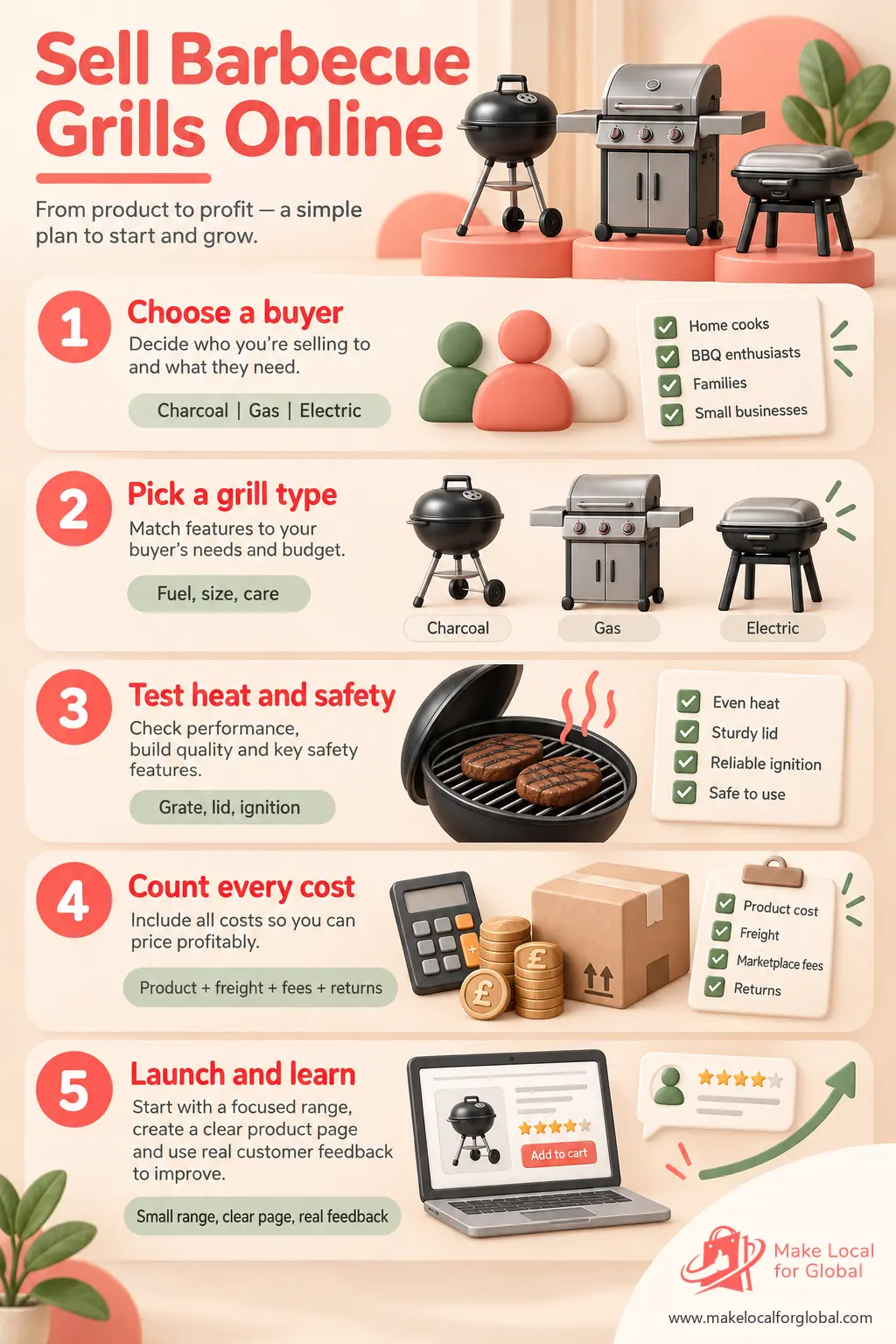
A practical guide to selling barbecue grills online, from choosing a buyer and comparing charcoal, gas and electric models to testing samples, pricing every cost and launching a focused range.


Barbecue grills can sell well as garden equipment, balcony cooking gear, outdoor gifts or a focused food-and-leisure range. The hard part is not finding a grill shape. It is choosing a buyer, proving the product is safe, pricing the delivered order and showing enough detail for a customer to buy with confidence.
Start with one clear use case. Compare charcoal, gas and electric models, test samples before a larger order, and build a product page that answers questions about fuel, size, cooking area, care, delivery and returns. If you are comparing another focused product category, see our guide to selling ballet flats online.

A customer buying a compact electric grill for a balcony has a different brief from a family choosing a wheeled gas barbecue for a garden. A charcoal enthusiast may care more about airflow and cooking control than quick set-up.
Write three short product concepts, each aimed at one buyer. For example: “a compact electric grill for flats with a small outdoor space”, “a two-burner gas grill for family meals” and “a portable charcoal kettle for weekend cooks”.
Show the concepts to ten likely buyers in local groups, at a food event or through a small landing page. Ask which model they would choose, what they would need to know before paying and what price feels plausible. Record repeated questions rather than counting polite likes.
MLFG can help shape a product idea into a focused shop structure, customer path and practical launch plan.
Fuel type shapes the buying decision, the product page, the packaging and the support questions you will receive. Choose the first type from the buyer evidence rather than from the model you happen to find first.
Charcoal grills suit buyers who enjoy hands-on cooking and smoky flavour. Check the grate material, lid fit, vent movement, ash collection, wheel stability and the surface temperature near handles. Small kettle formats can be easier to store and ship than large cart models.
Gas grills sell on speed and control. Ask for burner output, ignition type, hose and regulator details, compatible cylinder guidance, cooking area, grease management and spare-part support. A gas product brings extra compliance work, so supplier paperwork matters from the first sample.
Electric grills can suit balconies and small patios where an open flame is not appropriate. Confirm the voltage, wattage, plug, cable length, heat range, water-resistance information and cleaning method. A sample must be checked for safe heat behaviour, not judged from a product photograph.
Portable models can open a lower-price test, yet hinges, handles and latches take more wear. Built-in grills need careful installation information and are harder to ship. Pellet and smart grills may need more customer support, components and after-sales knowledge than a first range can carry.
A three-level range gives buyers a simple choice and lets you learn which features earn attention. Keep the first range narrow enough to inspect, photograph, pack and support.
| Range level | Example grill | Buyer reason | What to prove |
|---|---|---|---|
| Entry | Compact electric grill | Small footprint and simple start | Heat behaviour, cable, cleaning and packed size |
| Core | Two-burner gas grill | Family meals and temperature control | Burners, ignition, hose, regulator and grease tray |
| Premium | Lidded charcoal or pellet grill | Cooking control and outdoor hosting | Build quality, airflow, parts and delivery protection |
Illustrative range structure. Replace each example with the product details and tests from your own supplier.
Make the range gap visible in the names and photographs. If the only change is a colour change, customers may not see why the price moves. Show cooking area, packed dimensions, weight, fuel, included parts, cover compatibility and the type of food each model suits.
List every bundle item, warranty position and delivery weight. A bundle should make set-up, care or storage easier. It should not hide the price of the main grill.
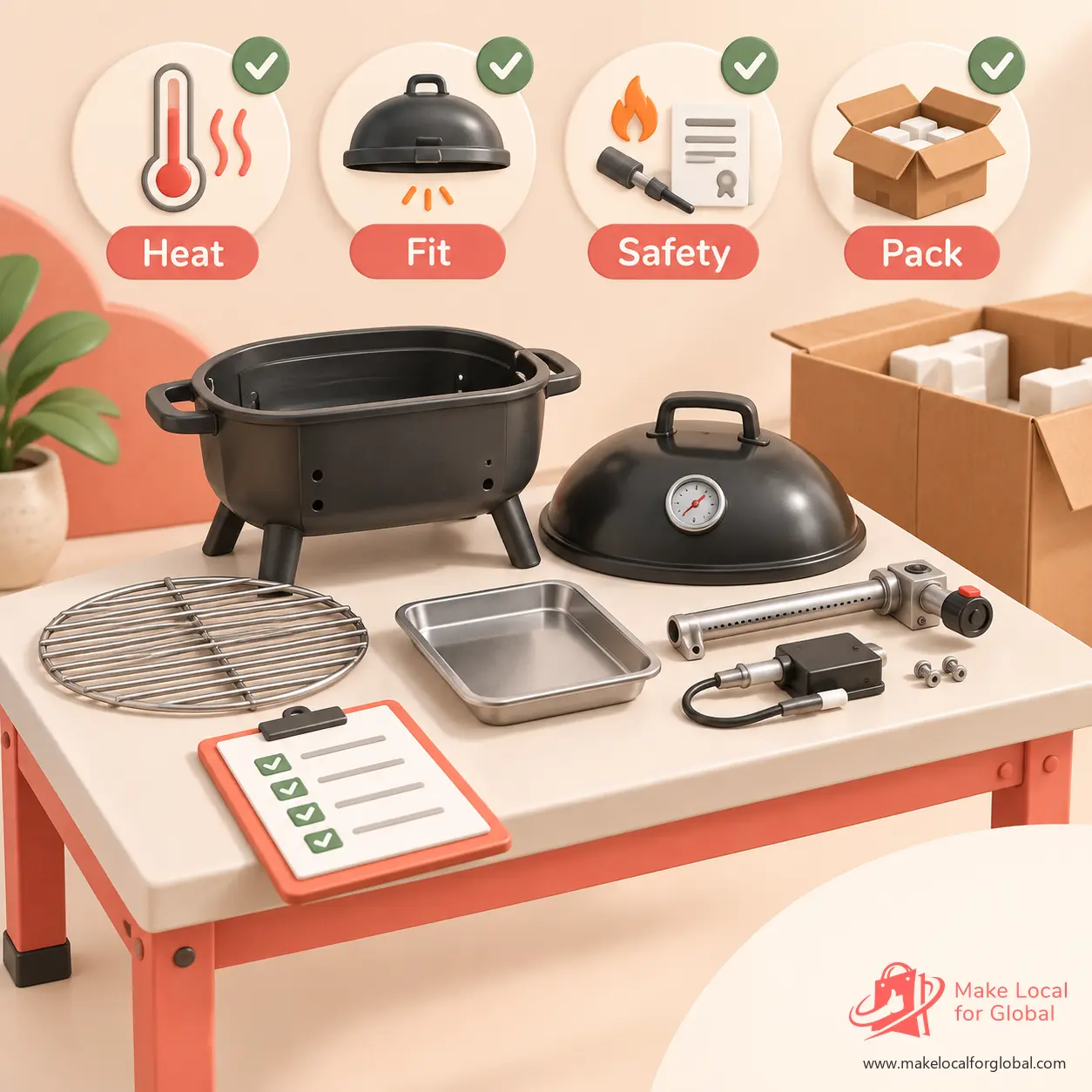
Ask suppliers for a sample before a pallet or container order. Keep the sample, packaging, instructions, labels and supplier messages together in one product file.
Photograph each check. These records help you write accurate listings, answer buyer questions and trace a problem back to a model or batch.
Product rules vary by fuel and destination. A seller who imports a grill may carry producer or importer duties, not just retail duties. Get product-specific advice before placing a commercial order.
For England, Scotland and Wales, GOV.UK says the General Product Safety Regulations 2005 require consumer products to be safe in normal and reasonably foreseeable use. The GB guidance covers producer and distributor duties, traceability and action when a product is unsafe.
Northern Ireland has a separate product-safety route. GOV.UK states that the EU General Product Safety Regulation applies there from 13 December 2024. If you sell into Northern Ireland, check the NI product-safety guidance and the role of the responsible economic operator for your supply chain.
The Health and Safety Executive says gas appliance suppliers, including retailers and mail-order traders, can be affected by the Gas Appliances (Safety) Regulations 1995. Electric grills sit within electrical product safety rules that cover marking, labelling, instructions and safety information.
Keep the applicable declarations, test reports, English instructions, warnings, model identifiers and supplier records. Do not copy a safety mark from another model. Ask a qualified product-safety adviser when the supply chain or destination is unclear.
OPSS published statutory guidelines on disposable barbecues on 14 August 2026. The guidance says disposable barbecues cannot be made available for sale at the current time in response to wildfire and environmental conditions. Focus the first range on reusable grills and check the latest official position before listing any disposable product.
The factory price is one line in the cost stack. Count inbound freight, duty where applicable, inspection, packaging, storage, payment fees, delivery subsidy, returns, damage and customer acquisition.
| Illustrative line | Amount | Assumption |
|---|---|---|
| Customer price | £229.00 | One core gas grill, VAT treatment not included |
| Product cost | -£110.00 | Supplier price for one unit |
| Inbound freight and import allowance | -£18.00 | Share of a small shipment |
| Packaging and protection | -£12.00 | Carton, corner protection and tape |
| Customer delivery subsidy | -£15.00 | Seller pays part of tracked delivery |
| Payment fee | -£3.64 | 1.5% plus 20p on £229, based on Stripe standard UK card pricing checked 14 September 2026 |
| Returns and damage allowance | -£8.00 | Planning allowance, not a promise of actual loss |
| Contribution before marketing and overhead | £62.36 | £229 minus the lines above |
Illustration only. Figures exclude VAT, staff time, storage, tax and fixed business costs. Contribution is not net profit. Replace each line with your own quote and sales-channel fees.
If a £20 customer-acquisition test produces one order, the contribution falls to £42.36 before fixed costs. That tells you how much room remains for support, content, software, tax and profit. Run the same calculation for entry and premium models before committing to stock.
MLFG can help organise your offer, pricing assumptions and online store plan so you can see the work behind each sale.
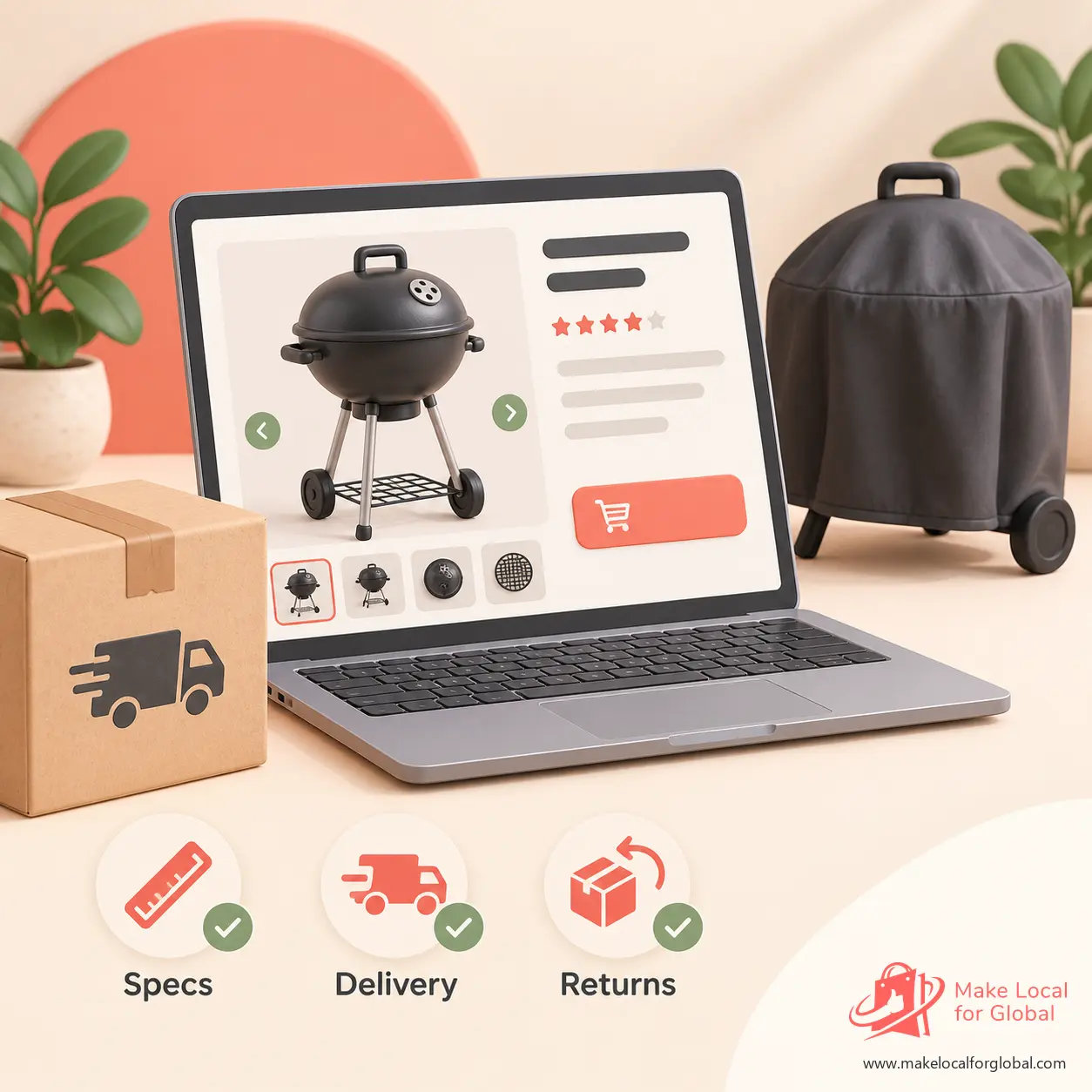
A grill page should help the buyer decide if the product fits the space, cooking habit and budget. Use one clear product name, then put the practical facts near the top.
Write claims from your sample records or the manufacturer’s documents. Avoid vague phrases such as “restaurant quality” unless you can explain the material, test or warranty behind the claim.
Grills are bulky, heavy and prone to dents, bent panels, broken knobs and scratched finishes. Measure the packed carton and weigh a finished parcel before setting a delivery price.
For online orders, GOV.UK says customers can cancel within 14 days of receiving most goods, then have another 14 days to return them. A refund is due within 14 days of receiving the item back, subject to the rules on use, damage and exceptions. Read the online and distance selling guidance and returns and refunds guidance, then publish a clear returns process and check how a bulky grill will come back before launch.
An owned online shop gives you space for safety information, delivery rules, spare parts and a full product comparison. A marketplace can help you test search demand, yet its listing, transaction, payment and advertising costs need a place in your cost sheet. Local garden events and food markets can help you watch how shoppers handle the product and what they ask.
Turn repeated buyer questions into short demonstrations. Show the packed size beside a suitcase, the grate beside a dinner plate, the lid thermometer in use and the cleaning steps after one meal. Link each demonstration to the model it actually shows.
| Week | Actions | Observation to record |
|---|---|---|
| Week 1 | Choose one buyer, write three concepts, speak to ten likely buyers and shortlist suppliers. | Repeated needs, price reactions and fuel preference |
| Week 2 | Order or inspect samples, run assembly, heat, stability, label and packaging checks. | Faults, missing documents, packing damage and support questions |
| Week 3 | Set the entry, core and premium offer, photograph the product and write the page, delivery and returns copy. | Page questions, cost per packed unit and delivery quote |
| Week 4 | Launch a small range, run one content test and one paid or local demand test, then speak to every early buyer. | Visits, enquiries, add-to-basket actions, orders, returns and objections |
Use the results to improve the range. Do not buy more stock until the product, cost and support evidence make sense together.
It can suit a focused shop with a clear buyer and strong product information. The category brings bulky delivery, product-safety and after-sales work, so test one small range before buying a large quantity.
Start with the type that matches the clearest customer need and the supplier paperwork you can verify. Electric models may suit small spaces, gas models can sell on speed and control, and charcoal models can suit hands-on outdoor cooks.
There is no single figure. Your first budget needs to cover samples, testing, stock, freight, packaging, storage, images, site work, payment fees, returns and a demand test. The worked example above gives you a way to build your own budget.
You can import products when the supply chain and product rules are met. Your duties may change if you manufacture, import or distribute the item. Gas and electric models need close attention to documents, markings, instructions and traceability. Get product-specific advice before sale.
Show fuel, cooking area, dimensions, weight, materials, heat controls, included parts, packed size, care, delivery, warranty, spare parts and returns. Use photographs that show the product open, closed, packed and in a realistic space.
Pick one barbecue grill buyer, write three product concepts and ask ten people what they would need to know before ordering. Then obtain a sample, test the full cost and build the first page around facts you can prove.
MLFG can help with the website, structure and practical steps behind a focused online product business.
PREFERRED SOURCE
Like what you’re reading? Add Make Local for Global as a preferred source on Google to see more of our articles when you search.

Build your online presence without having to figure out everything yourself.