

READY TO SELL crystal jewellery ONLINE?
Get a store built for you in 5 days, plus training and support to help you start, run, and grow your Alternative business.

Learn how to sell crystal jewellery online with a focused range, supplier checks, a complete order-cost example, accurate product pages and a practical 30-day test.

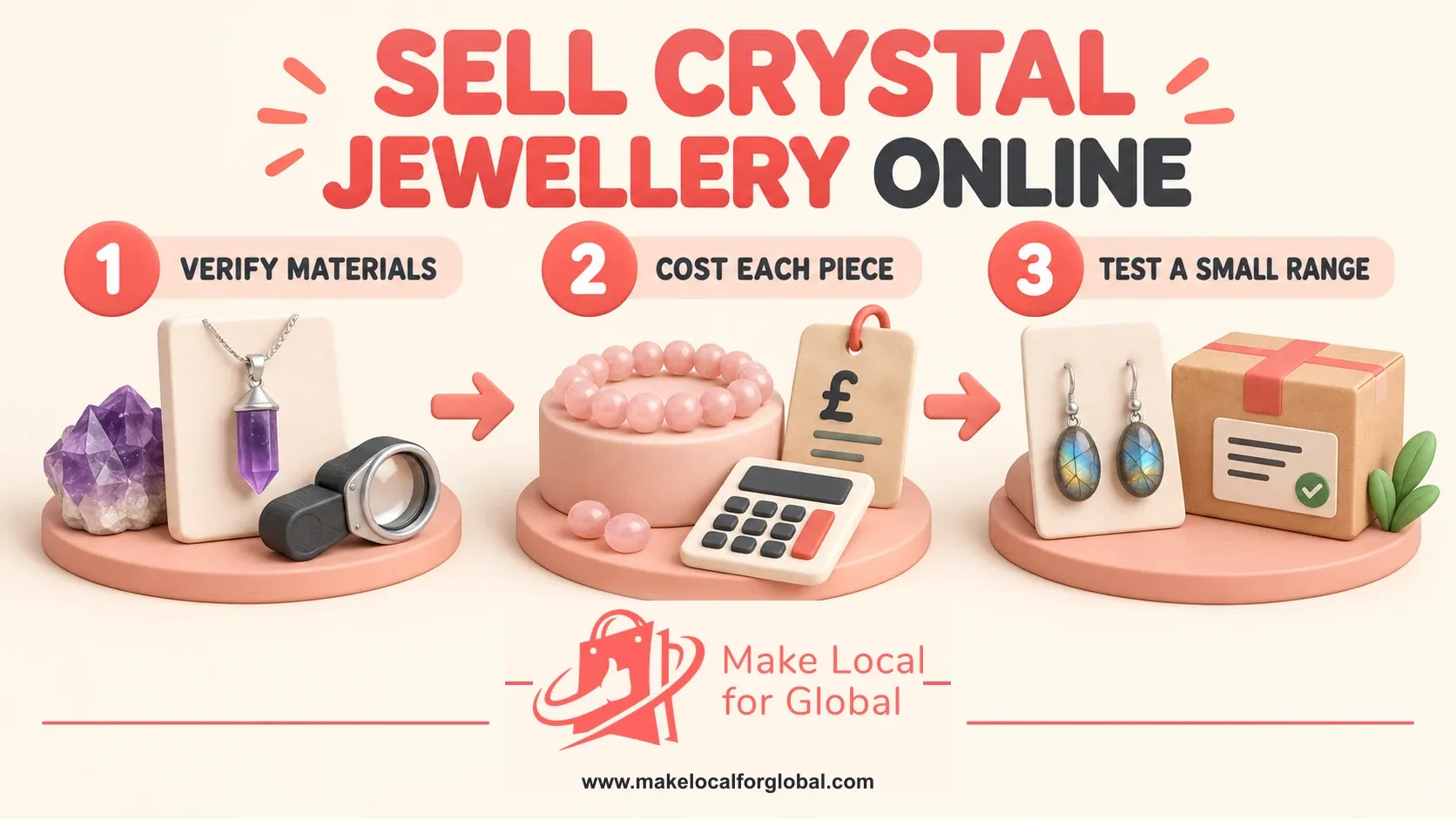
Crystal jewellery can be sold as colourful everyday accessories, meaningful gifts or a focused stone collection. A strong first shop starts with a clear buyer, truthful material details and a small range that you can inspect and cost properly.
This plan covers product choices, supplier checks, UK selling points, pricing, product pages, fulfilment and a 30-day test. It is for new sellers who want to test demand before ordering a large amount of stock.
Use the free business tools to check the idea, choose a buyer and shape a first offer before spending on stock.
“Crystal jewellery” is too broad to guide a first order. Pick one audience and buying moment. For example, a gift buyer may want an attractive necklace with clear materials and ready-to-gift packaging. A festival customer may value bold colour and adjustable sizing. Someone shopping for a specific stone may care about accurate identification and care advice.
Write a one-line offer before contacting suppliers: “I sell colourful, clearly described crystal pendants as ready-to-gift presents for people who want an individual piece without guessing about the metal or stone.” This sentence helps you decide which items, photos and details belong on the shop.
Look at questions in relevant craft forums, marketplace reviews and search suggestions. Record the exact phrases customers use, such as “amethyst pendant on sterling silver chain” or “adjustable crystal bracelet”. Treat marketplace listings as examples of product presentation, not proof that sales or profit are high.
Start with six to ten designs rather than dozens of stones and styles. Use a clear entry, core and gift option: a simple bracelet, a better-finished necklace and a boxed set. Keep the range connected by a shared metal colour, palette or gifting idea so the shop feels easy to browse.
| Product group | Why it may fit | Details to verify |
|---|---|---|
| Bead bracelets | Simple sizing and several colour options from one design | Bead diameter, string or elastic type, finished wrist size and stretch recovery |
| Stone pendants | Giftable focal pieces with room for clear stone education | Stone identity, dimensions, treatment information, bail and chain metal |
| Drop earrings | Small parcel size and visible colour in photos | Pair weight, post or hook material, fastening security and length |
| Gift sets | One coordinated offer can lift order value | Each piece’s materials, box size, weight and replacement cost |
Use the table to shortlist samples. The best opening group depends on your buyer and verified supply.
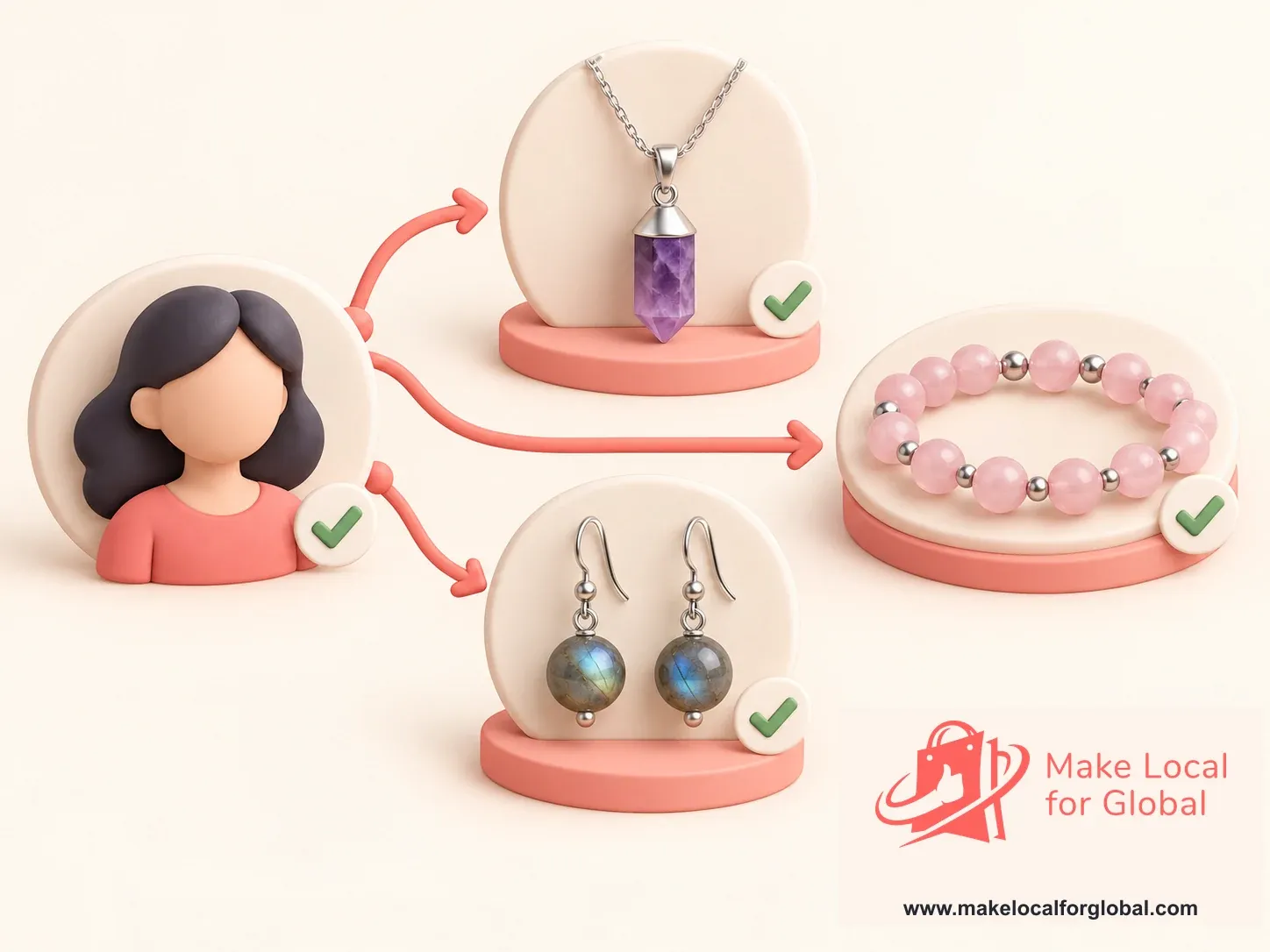
“Crystal” can refer to many different stones and decorative materials. Ask the supplier for the material name, whether it is natural, lab-created, imitation, dyed, coated or otherwise treated, and whether special care is needed. Do not rely on a colour name or a supplier photograph as proof of stone identity.
Gem treatments can change appearance and care needs. The Gemological Institute of America explains examples such as dyes and coatings in its gem treatment reference. Use supplier documentation that relates to the batch you buy; ask a qualified gemmologist or laboratory when a higher-value claim needs checking.
Compare a UK wholesaler, a maker who produces to order and a small-batch importer. A wholesaler may offer lower per-piece prices with a minimum order. A maker may support a more recognisable design, but lead times and repeat-stock availability can vary. Importing can widen the choice and add freight, customs and longer replenishment times.
Request a paid sample set before a bulk order. Ask for the minimum order quantity by design and colour, sample cost, production time, stock consistency, metal specifications, packaging, defect process and written information about stone treatments. Keep the answers and invoices with the batch records.
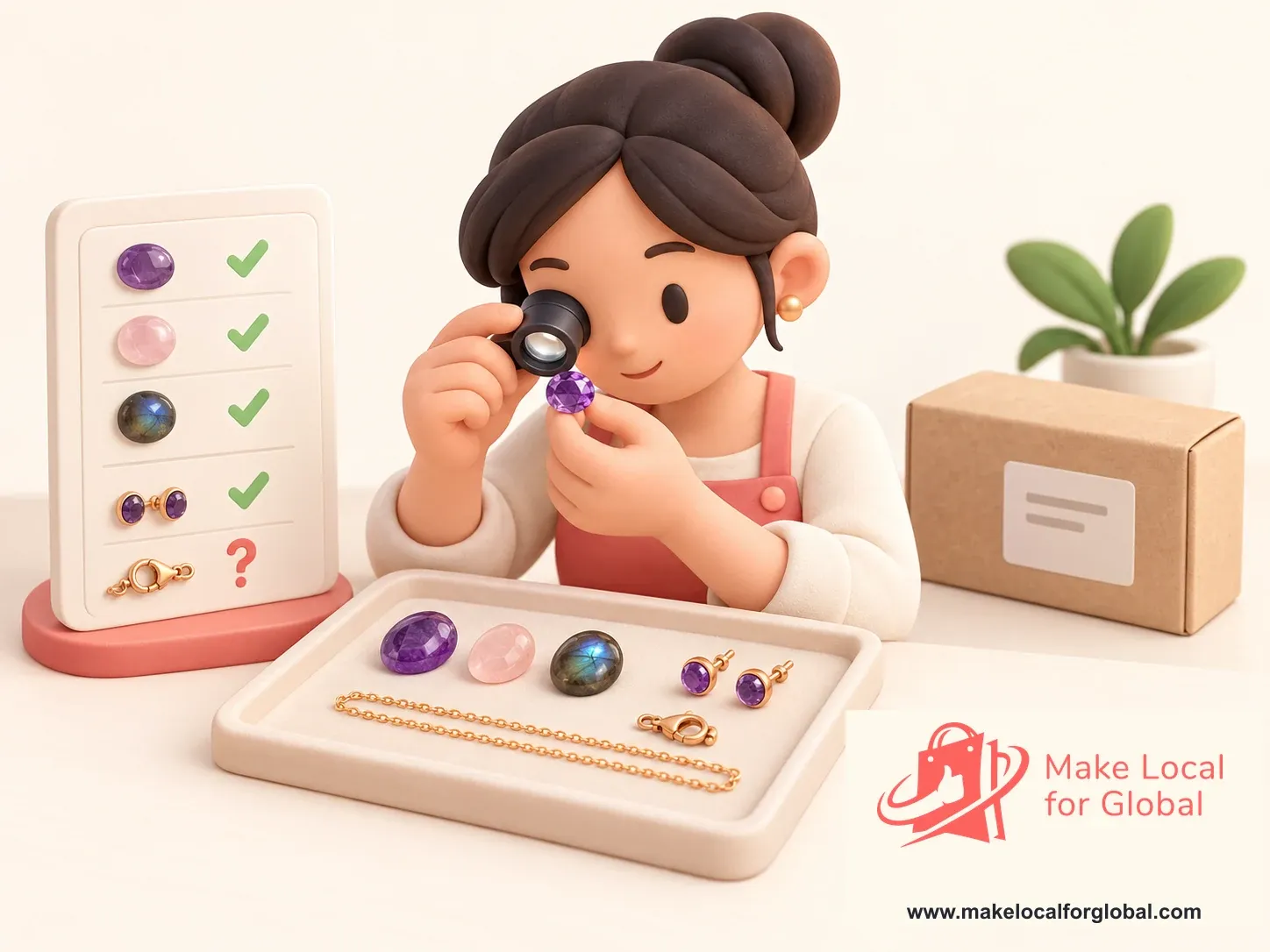
A low wholesale price does not show what one sale contributes. Estimate the costs attached to a typical order, then compare the result with the price customers see. The example below is illustrative, excludes VAT and assumes one necklace per order. Replace every figure with your own supplier, carrier and payment-provider charges.
| Cost for one necklace order | Illustrative amount |
|---|---|
| Pendant, chain and inbound freight allocation | £8.40 |
| Gift box, pouch and protective mailer | £1.20 |
| Payment fee assumption (2.5% of £32 plus 25p) | £1.05 |
| Tracked postage | £3.50 |
| Returns and damage allowance | £1.00 |
| Customer acquisition allowance | £3.00 |
| Total variable cost | £18.15 |
| Selling price | £32.00 |
| Contribution before fixed costs, tax and owner pay | £13.85 |
Calculation: £32.00 − (£8.40 + £1.20 + £1.05 + £3.50 + £1.00 + £3.00) = £13.85. This is contribution, not net profit. VAT, platform subscriptions, photography, insurance, unsold stock, tax and owner pay are not included.
Check that the price still works when a promotion reduces the selling amount or when a buyer orders several items and postage changes. A bundle can share a mailer and delivery charge, but its product and packing costs rise too. Track actual fees and return reasons after launch and update the calculation.
Compare an online shop setup with your budget and needs. Review the current options before choosing a plan.
Use a title that names the piece, main stone and metal where verified, such as “Rose quartz bead bracelet, 6 mm beads, adjustable 16–19 cm”. The first lines should say who it suits, what arrives and any relevant material notes.

Photograph the complete item, a close view of the setting, the fastening and the piece beside a ruler. Use a neutral background and consistent daylight. A short video can show how a pendant moves or how an adjustable bracelet closes. Add alt text that says what the image shows, rather than repeating the product keyword in every image.
If you plan a stone-led range, see the separate amethyst jewellery selling article for a narrower purple-stone offer. Keep this page broader: explain how to build and check a mixed crystal jewellery range.
UK distance-selling rules require key business and product information before an order, plus information on cancellation rights. For many online goods, customers can cancel up to 14 days after delivery. Read the current GOV.UK online and distance selling guidance and set out your own delivery, cancellation and returns process in plain language. There are exceptions, and rights for faulty goods are separate.
If you describe an item as gold, silver, platinum or palladium, check the UK hallmarking rules and weight thresholds first. The official hallmarking summary lists exemptions for items below 1 g gold, 7.78 g silver, 0.5 g platinum and 1 g palladium. Mixed pieces and descriptions can need closer review, so ask an Assay Office if you are unsure.
Ask suppliers for evidence about metal composition and skin-contact components. Avoid broad “hypoallergenic” or “nickel-free” wording without reliable test documentation for the exact product. Great Britain and Northern Ireland can have different product-rule routes; check current official requirements for the market where you will sell.
Keep crystal jewellery descriptions focused on design, colour, craft, symbolism or personal meaning. Do not claim that a stone treats anxiety, pain or another medical condition unless you have the evidence and approvals required for that claim. The ASA and CAP advice on crystal therapy advertising explains that treatment claims need strong clinical evidence.
Keep necklaces from tangling by fastening them through a card slot or wrapping the chain separately. Put earrings in a firm card or box so the posts do not press through the mailer. Cushion pendants against knocks, then use an outer mailer that resists crushing and moisture.
Photograph the packed order for your own dispatch records. Use tracked postage when the order value or buyer expectation justifies it, and state dispatch times honestly. Set aside a small returns allowance in your cost sheet; log whether a return came from sizing, colour, material expectations, damage or a gift arriving late.
Start with the phrases that match the product and buyer: “crystal jewellery gift set”, “natural stone pendant necklace”, “adjustable crystal bracelet” or “amethyst earrings on sterling silver”. Use only terms that match the item. Build a separate page for each real product group; do not create near-identical pages that differ only by a stone name.
Keep the first month focused on evidence. Your aim is to learn which buyer, design and information earn genuine interest, then decide whether to reorder.

It can suit a small online shop if you can source pieces with reliable material details, photograph them clearly and price each order after delivery and selling costs. Test interest with a narrow range before committing to a large order.
Buy samples first. If they pass inspection, start with a quantity you can afford to hold and replenish, based on the minimum order and lead time. The right number depends on supplier terms and your budget; there is no guaranteed stock level that produces sales.
Avoid claims that crystals treat or prevent illness unless you can meet the evidence and advertising requirements. You can describe colour, style, gifting and personal symbolism without presenting these as medical effects.
Name the piece, verified stone and metal, dimensions, fastening, what is included, care notes, dispatch time and returns information. Add photos that show scale and construction from more than one angle.
Hallmarking can apply when an item is described as precious metal and is above the UK exemption weight. Check the official guidance for the metal, weight, construction and market before describing or selling the piece as gold, silver, platinum or palladium.
Get help planning an online shop that matches your products, budget and next step. Ask MLFG about a setup that suits your business.
PREFERRED SOURCE
Like what you’re reading? Add Make Local for Global as a preferred source on Google to see more of our articles when you search.

Build your online presence without having to figure out everything yourself.