READY TO SELL Gym weights ONLINE?
Get a store built for you in 5 days, plus training and support to help you start, run, and grow your Alternative business.

Learn how to choose a gym weights range, check product samples, price heavy parcels, write clearer product pages and plan a controlled first launch.


Gym weights look simple in a product photo. The business behind them depends on details customers cannot check on a screen: the true weight of each piece, the feel of a grip, the fit between plates and bars, and whether the parcel can be delivered without damage.
To sell gym weights online, start with one type of buyer and a small range, test every model, publish exact specifications, then price the complete order including heavy-parcel delivery, packaging, payment fees, returns and marketing. A focused catalogue makes it easier to explain what each set includes and gives you useful evidence before you commit to deeper stock.
Product weights, parcel rules and product details all affect how a shop should be set up. MLFG can discuss the ecommerce structure for a small product range.
“Gym weights” can mean a pair of light neoprene dumbbells, a cast-iron plate set, a rack of fixed dumbbells or a heavy adjustable system. Those products attract different buyers, need different storage and create very different delivery costs. A shop that starts with all of them risks tying money up in stock before it knows which customer it can serve well.
Write a one-sentence description of the first buyer. For example: “People building a compact strength-training corner at home who want an adjustable set and a clear explanation of what fits in the box.” Another possible buyer could be a small personal-training studio that needs matching pairs, repeatable specifications and a trade reorder route.
Speak with a few likely buyers before ordering stock. Ask what they already own, where it will be used, which item they last bought, what they found unclear and what they would need to compare two offers. Record the words they use. A compliment about a product image is weak evidence; a request for the exact set, weight increments, delivery charge or stock date points to a real buying question.
Set a budget for the first test. Treat it as money you can afford to have tied up until the stock sells or can be returned to the supplier. A survey with 100 casual responses does not cancel the risk of a costly order. A small sample purchase and a measured sales test will tell you more about actual packaging, customer questions and delivery economics.
List the product families before you approach wholesalers. Write down their size, material, weight range, likely parcel dimensions and compatibility needs. This makes supplier conversations more precise and helps you avoid products that look alike in a catalogue but answer different customer needs.
Fixed dumbbells are supplied as individual units or matching pairs. Customers need to know which. State whether the displayed weight is per dumbbell or for the pair, show both pieces in the main product image and repeat the unit count in the option label. If a product is a pair of 5 kg dumbbells, say that each one weighs 5 kg. Do not leave “5 kg set” open to two interpretations.
Possible materials include cast iron, rubber-coated metal, neoprene or vinyl-coated designs. The finish affects touch, cleaning, odour, noise and likely floor marking. Avoid broad claims such as “floor safe” or “silent”. Describe the observed finish and direct a buyer to use suitable floor protection when required.
Fixed sets are simple to photograph and use. A progression bundle can group several pairs, but the extra weight raises the shipping charge and packing time. Start with a short list of increments supported by supplier availability and buyer feedback. A long weight ladder is no proof of demand; stock only increments with a clear role.
Adjustable dumbbells save space by changing plates on a handle. The buyer needs to see the adjustment parts, maximum load per handle, minimum and maximum configurations, plate count, handle length, grip diameter and locking method. If the plates can be added in more than one arrangement, show the permitted combinations and the total weight for each. A clear contents diagram can prevent a customer from assuming that the maximum advertised weight applies to each dumbbell.
Plate sets may be sold with a short bar, long bar, collars or storage rack. List which are included. Check whether plates use a standard or Olympic bore and state its measured diameter from the verified specification. “Fits most bars” is too loose to guide a purchase. Ask the customer to compare the figure with their own bar before ordering.
Kettlebell ranges can be cast iron, coated metal or competition-style designs. Buyers compare handle clearance, handle surface, base stability, body dimensions and how the weight is marked. Photograph the handle opening beside a ruler where it matters; a front-on beauty shot cannot answer whether a customer can grip the handle comfortably.
Weight vests and ankle weights introduce fit and fastening questions. Show the adjustment range, closure, pocket or plate layout, material and care guidance. List the number of weights included and explain how they are distributed. Do not suggest a particular load suits every person.
Small add-ons such as collars, storage trays or replacement plates can support repeat purchases. Keep the main range narrow at first. For other training products, link to selling gym mats online and selling gym bags online when the buyer is assembling a broader home-training setup.

Choose a small collection that lets a customer make a useful comparison without scrolling through near-identical listings. A three-level offer can work when every step changes something that matters: the amount of weight, space used, finish, included parts or storage. It does not need to be a cheap, middle and expensive version of the same set.
An illustrative range might have:
Give each listing a distinct role. The first option could make a simple trial purchase possible. The progression offer could serve a buyer who wants the next weight ready. The adjustable set should justify its higher price through its tested range and compact storage. A studio offer should make quantities and freight clear rather than hiding a trade order inside a consumer bundle.
Bundles are useful when they reduce a real choice problem. A “first strength set” might contain one pair of dumbbells and a storage tray. A plate set could include the correct collars and a compatible bar. Before publishing either offer, check every part, total mass, parcel measurements, retail packaging and replacement cost. Compare bundle price with the sum of individual prices and explain any saving or convenience accurately.
Do not add unrelated items just to raise the basket total. A mat, bottle or gym bag is a separate product decision; it may belong as an optional cross-sell. Compare delivery and customer expectations on the bundled order first. An extra low-cost item can push a parcel into a new size band, so its effect on the carrier charge may outweigh its purchase price.
| Range option |
|---|
| D |
| – |
| – |
| – |
| F |
| W |
| W |
| P |
| W |
| Q |
| A |
| W |
| P |
| K |
| W |
| W |
| S |
| C |
| S |
Separate interest in home fitness from interest in your exact offer. Search for questions people ask about the precise item: fixed versus adjustable, plate compatibility, finish, storage, delivery and what comes in the set. Reviews and public forum posts can reveal information gaps, but they do not establish market size or predict your sales.
Make a short comparison sheet with three or four products you could actually source. Include the proposed selling price, delivery charge, contents, dimensions, specification evidence and one product photo. Ask likely buyers to choose one and tell you what would prevent them from ordering. Keep the question neutral. “Which of these would you choose at these prices?” is more useful than “Would you buy my great new set?”
A small listing test can expose weak details before a large purchase. Publish a page only when you can supply the goods within the stated terms. Send a limited amount of relevant traffic and set a spending cap before starting a paid campaign. Watch product-page visits, option selections, add-to-basket actions, checkout starts, completed orders and questions. The sequence gives more information than total page views alone.
If people click a 20 kg adjustable set but ask whether that figure is per dumbbell, the offer needs clearer weight information. If they reach checkout then leave after seeing delivery, review the parcel dimensions, courier choice and price display. If they view the page but ignore the product, test a more suitable buyer or range. Change one material item at a time so you can tell what affected the result.
Decide in advance what evidence would justify a reorder. It could be a set number of paid orders at a contribution level you accept, repeat inquiries from a defined group or reliable sales from one channel. Set a maximum stock value and a review date. Do not turn a few sales from friends into proof of wider demand.
Possible suppliers include UK fitness-equipment wholesalers, specialist distributors, manufacturers and import agents. Each route changes lead time, order size, product access, communication and your responsibilities. A domestic supplier may simplify replenishment. A direct import may give you more design choice, but you need to understand shipping, customs, product documentation, batch traceability and the duties that apply to your role.
Ask for a full written specification for each exact model, not a general catalogue description. Request product and packed dimensions, item weight, materials, coatings, bore and handle measurements, included parts, cleaning instructions, declared tolerances, warranty terms, defect process, stock location, lead time and shipping charges. For an adjustable set, ask for an itemised list and a diagram showing each permitted combination.
Ask which tests or checks support each safety, durability or material claim. A certificate for a different model or a broad supplier statement does not prove the item in your sample meets the same claims. Record the supplier name, legal entity, item code, date, batch or lot reference, invoice and specification version. Keep those records with your purchase and sample notes.
Check trade terms before ordering: minimum order, deposit, balance date, carriage, damaged-goods process, shortages, backorders, cancellation and restocking terms. Ask whether you can order a sample without committing to a larger purchase. Check whether the product photos may be used in your shop and whether any manufacturer wording has restrictions. Your own photographs of the actual stock are usually more useful to a buyer comparing grip, finish and included parts.
For branded equipment, buy through a source that can demonstrate its supply chain. Verify model numbers, labels and packaging against the brand owner’s own information. Do not use a recognised manufacturer’s name or photograph to describe an unbranded alternative. If you sell under your own label or import directly, clarify which product-safety and labelling tasks apply to your role before ordering commercial quantities.
Order samples of every model and variation you plan to sell. One sample from a supplier does not prove that all later batches match it, so record the date, item code and visible batch marking. Use a checklist that someone else could follow. Keep photographs of the label, overall product, critical measurements and any defect.
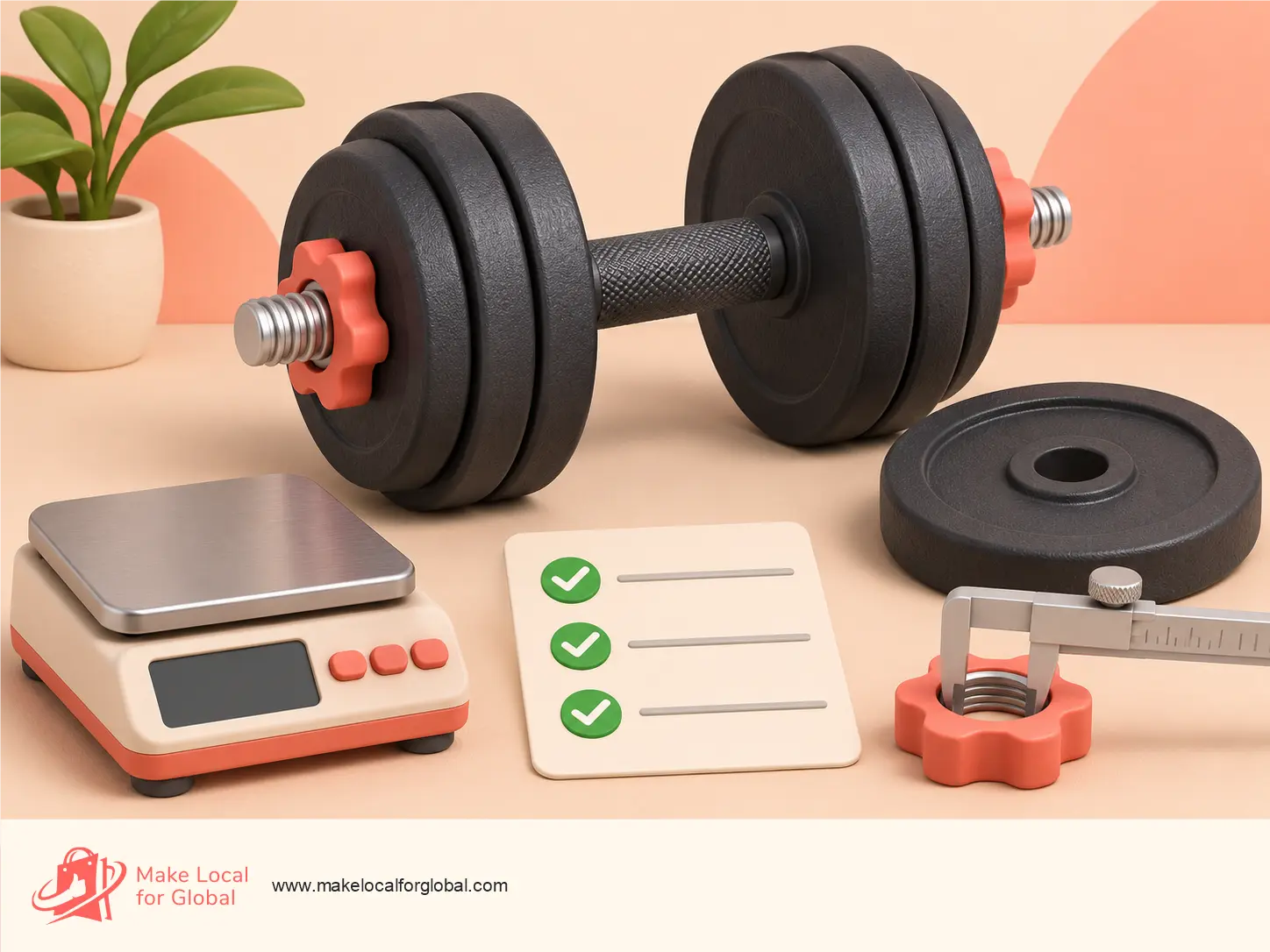
Use suitable calibrated or trade-appropriate weighing equipment for commercial checks. Record the weight of each piece and compare it with the supplier’s specification. Do not silently relabel a product if it differs. Ask the supplier for its declared tolerance and how it handles out-of-spec items. For a set, total the parts and compare the assembled configurations with the advertised maximum.
Measure bar diameter, plate bore, handle length, grip diameter and the size of the complete set. Check the threaded section and collar travel on adjustable models. Assemble and disassemble the product several times using the supplier’s instructions. The collars should engage as described and remain secure during the product’s normal intended handling. Do not conduct risky strength trials or invent a load test without a safe procedure and suitable equipment.
Inspect coating for cracks, chips, exposed metal, sharp edges, loose material, strong residue or inconsistent finish. Check welds, handles, grips, fasteners and seams. Turn a kettlebell over to inspect the base and check whether it rocks on a flat surface. Look at the whole circumference of each plate, not only the front that will appear in a listing photo.
For soft-covered weights, inspect stitching, seams, closures, fabric, odour and any labels. Fasten and release the closure repeatedly. Check whether the filling shifts or leaks. Do not claim that a material is washable, skin-safe, non-slip or suitable for a particular activity unless the supplier’s instructions or testing support that wording.
Make sure the sample includes every listed component. Match the number of plates and collars against the packing list. If the set includes a storage stand or instructions, check the correct model and fixings. Photograph the parts laid out clearly so your future product page can mirror the actual box contents.
Record each check as pass, fail or follow-up needed. If a sample fails, send the supplier the evidence and ask for a replacement or written explanation. Do not use a failed sample as the listing model. Repeat the relevant checks on the corrected sample. Set a receiving check for commercial stock too, since a product can change between sample and delivery.
A low unit cost can look attractive until a parcel is weighed and measured. Heavy products create substantial inbound freight, packing needs and customer-delivery costs. Some carrier prices depend on both weight and parcel size; postcode, service, collection and insurance can affect the amount. Weigh and measure a packed sample, then check a current rate for the actual route and service. Never use the unboxed item dimensions as the delivery estimate.
Use a cost sheet for each SKU and bundle. Include the selling price, product cost, inbound freight allocation, import charges if relevant, payment or marketplace charges, packaging, pick-and-pack time, carrier label, expected return or damage cost and paid customer-acquisition cost. State whether your prices include VAT and use a treatment suited to your registration status. A seller who is VAT registered should not treat the full customer payment as revenue before considering output VAT and eligible input VAT with qualified accounting advice.
The figures below are illustrative only. They are not a supplier quote, carrier tariff or target margin. Assume a non-VAT-registered seller offers a pair for £34.00 and charges the customer £5.00 delivery. Order income is £39.00. The parcel is a tested weight band and the seller uses these estimates:
| Cost line |
|---|
| H |
| – |
| – |
| – |
| D |
| £ |
| S |
| I |
| £ |
| D |
| O |
| £ |
| C |
| C |
| £ |
| C |
| P |
| £ |
| A |
| D |
| £ |
| R |
| C |
| £ |
| U |
| P |
| £ |
| T |
| * |
| * |
| * |
| * |
| * |
| * |
The £7.80 is contribution after these listed variable costs; it is not net profit. It still needs to cover fixed costs such as the website, storage, insurance, accountancy, software, equipment and business overhead. It excludes tax and any owner time not counted in the pick-and-pack allowance. Replace every estimate with your actual figures before pricing.
If the seller offers free delivery, order income falls from £39.00 to £34.00; the carrier still costs £6.70. The contribution would fall to £2.80 if all other costs stayed the same. A higher basket threshold may work, but only when adding products raises contribution more than it raises packing, parcel and fee costs. Run the calculation for one item, a pair of pairs and a heavier bundle separately.
Choose the contribution you need from each order after variable costs. Set a minimum price for each delivery zone and parcel type. If a discount crosses that floor, stop and check the underlying costs. A cheaper carton, different carrier service, less expensive acquisition source or an adjusted bundle may help. A price cut cannot repair a product whose freight already consumes most of the sale amount.
Keep a sensitivity sheet for carrier price increases, damage rate, advertising cost and supplier carriage. Change one assumption to see which products have little room for error. If a 50p increase in delivery turns a modest contribution negative, the item may need a higher retail price, a minimum basket, a local collection option or removal from the range.
A 20 kg set may travel in one parcel or several, depending on its dimensions and the carrier rules. Splitting can make handling easier but may create more labels, carton cost and risk that one part arrives before another. Ask carriers about maximum single-piece weight, longest side, girth, service area, collection, tracking, compensation and prohibited packaging. Check these limits directly before each service change. A label offered at marketplace checkout does not prove that a carrier will accept the parcel.
For each shipping profile, record packed weight, dimensions, destination zones, standard and tracked rate, dispatch cut-off and handling charge. Recheck the packed parcel with a scale and tape after the final packing material is added. A 1 cm or 500 g change can affect the price band. If the item moves into a different band, update the shipping rule before an underpriced order comes through.
Decide whether the buyer sees a delivery charge per product, at basket level or as a quoted freight option for larger sets. Show the total before payment and state the dispatch estimate in plain terms. If you offer local collection, explain the location, appointment process and confirmation steps. Set an honest service area. A low-price national offer that excludes remote postcodes at checkout can frustrate customers and create abandoned baskets.
For returns, calculate who pays for return carriage in each situation and how the item will travel back. Heavy goods can cost much more to return than they cost to send. Make the returns process accessible before checkout, but do not use high return costs to conceal statutory rights. Keep a process for damaged parcels: photos of the outer carton and item, carrier claim steps, replacement stock and customer updates.
A buyer should not need to message you to learn whether the item is one dumbbell or a pair, how much each piece weighs or whether plates fit a bar. Put the key facts near the title and price. Use a table for specifications, a short opening paragraph for intended buyer and an itemised contents list for sets.
An illustrative title might read: “Rubber-coated fixed dumbbell pair, 5 kg each, knurled steel grip”. The opening can state who the pair suits, exactly what arrives and the verified dimensions. Replace each example detail with the sample’s real measurements. Do not use “heavy duty”, “commercial grade”, “silent” or “floor safe” as decoration; each is a claim that needs evidence and context.
For adjustable dumbbells, explain the maximum weight per handle and what parts are needed to reach it. State if the weight includes the handle or plates only. Show the increment sequence with a simple table. For a plate bundle, identify the bore, number of each plate, collar type, bar compatibility, overall mass and what is not included.
Photograph each product from a front angle, side angle and close-up. Use a ruler or scale for dimensions, a clear shot of the label and one image of all bundle contents laid out. Keep images of a display set separate from photos of the shipped contents. If a pictured rack is not included, label it as a separate accessory or leave it out.
Start with the language you saw in buyer questions and product specifications. Phrases might include “5 kg dumbbell pair”, “adjustable dumbbells for a small home gym”, “weight plates 50 mm bore” or “cast iron kettlebell dimensions”. Treat them as examples, not a list to repeat in every paragraph. A page should focus on one offer and a small set of useful attributes.
Give each product its own title, description and option labels. Use a weight attribute, material, shape or compatibility where buyers compare those details. Avoid creating multiple near-identical pages that differ only by reordered keywords. A category page can explain the range and link to products; an individual listing should answer the exact purchase question for that SKU.
Useful supporting articles can explain adjustable-set combinations, a buyer’s first weight comparison or how to measure a packed order for delivery. Link between them when the reader is likely to need the next answer. This gym-weights article should remain distinct from the wider fitness equipment selling guide, the adjustable dumbbells article and the broader Product To Sell collection. Keep its focus on weights, their specifications and the costly parcel decision.
Use descriptive page titles and meta descriptions that tell a searcher what the page helps them decide. A product page can mention material and weight; a comparison page can focus on plate fit or storage. Add internal links with descriptive anchor text rather than generic “click here”. Monitor search impressions, page visits, product option selections and orders in your available analytics. A ranking position alone does not show whether a visitor found the right set.
A marketplace can introduce products to people already searching there. Its fees, listing rules, returns workflow, parcel restrictions and advertising options differ by site and account. Before placing stock, calculate the total fee on the actual order value, including any delivery charge where the platform includes it in the fee calculation. Read current seller terms; a fee remembered from another seller or an old blog post may no longer apply.
Your own online shop gives you more control over categories, specifications, shipping profiles and the customer experience. You need to bring relevant visitors, keep product information current and maintain checkout and support. A specialist retailer may start on one marketplace to learn the questions customers ask, then build a website when repeat orders and range structure justify that work. Some sellers use both and need stock counts synced to avoid selling the same final set twice.
Local gyms, personal trainers and clubs may offer a way to test studio orders. Ask first, present a written list of models and delivery terms, and record whether each contact leads to a sample request, quote or paid order. A one-off conversation is not proof of a repeat channel. For a more general view of selling training products, see the related pages about gym mats and gym bags.
Keep the launch channel count small. Each channel has its own listing rules, message handling and fee structure. Get one product set, checkout and dispatch process working first. Add a second channel when there is enough time to maintain accurate stock and answer its customers. Keep a record of which channel generated the order and what costs were involved.
Talk through the product pages, delivery information and shop structure your customers need before they buy.
Gym weights need useful photographs more than large slogans. The buyer is judging shape, scale, surface, parts and included quantity. Photograph stock you have inspected. Use a plain warm or neutral background, tidy light and room around the product. Show a pair as a pair. For an adjustable kit, lay out every component once and take a second photograph of the assembled product.
Add close-ups where they answer a question: handle grip, plate bore, collar thread, coating, label or packaging. Place a ruler next to a measurement if it helps, and keep the reading visible. A photo of a product beside a person can give context, though the measured specification should remain in the text. Do not use an image that implies a bar, rack or plate count that the order does not include.
Use infographics only when they make a decision easier. A short “check the bore, bar and collar” diagram can help a buyer compare compatibility. Keep type large, lines short and each label separate from product detail. Use one clear title panel, generous spacing and a limited number of annotations. Do not run text across dark plates or place captions over the handle. At thumbnail size, the cover should remain readable without relying on tiny labels.
The image set for this article uses a separate text layer over generated product scenes. The real MLFG logo remains an unchanged asset. In your own product photography, use the same principle: keep branding distinct from product information and do not let decorative elements compete with the item being sold.
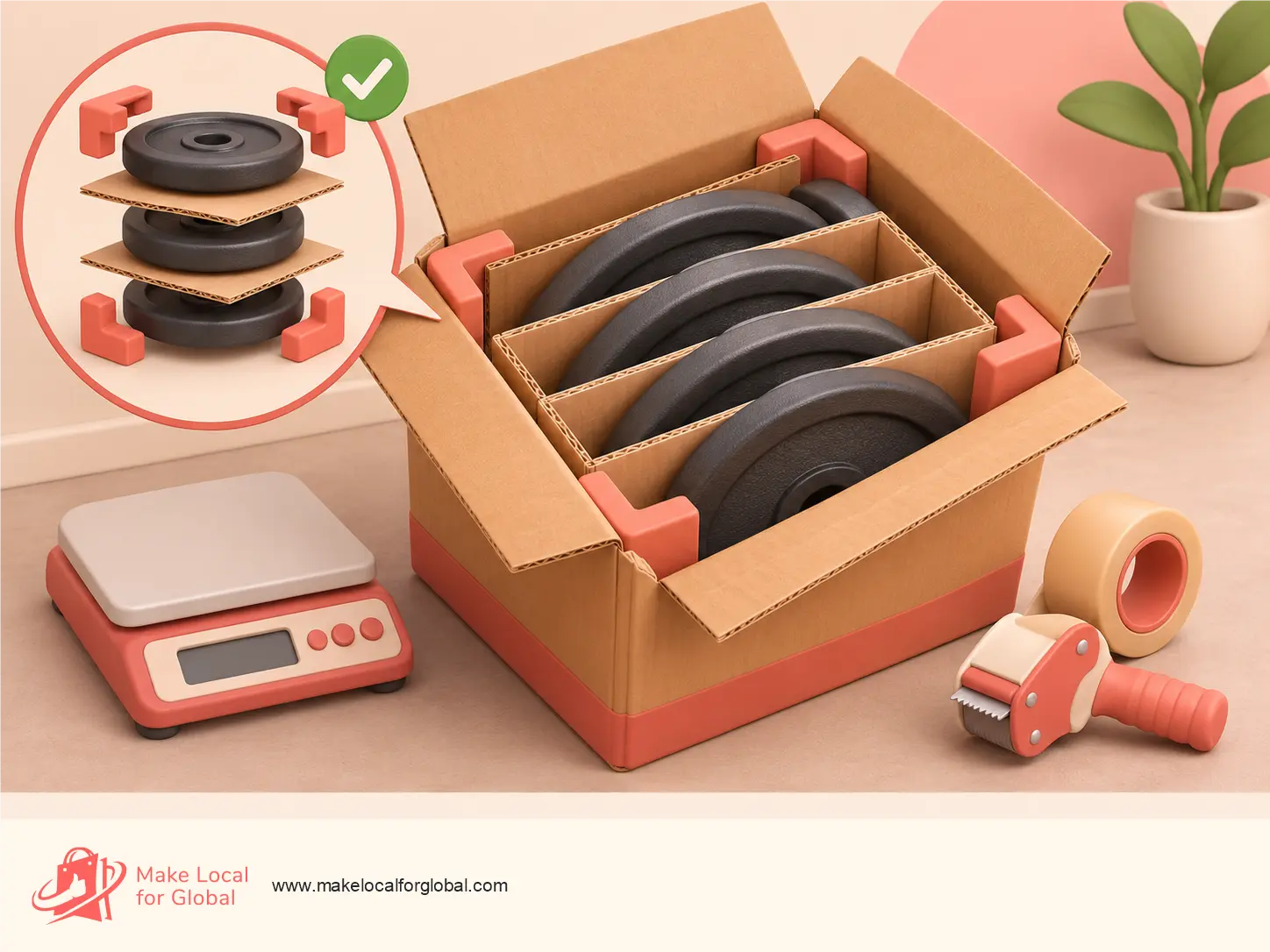
Packing has to stop both the equipment and the equipment’s edges from moving. A set that rattles can damage its own finish, split the carton or arrive with missing components. A box that barely fits may fail at the seam. Choose cartons rated for the packed load from a supplier that provides relevant specifications. Test a packed sample before putting it into your standard operation.
Separate metal parts with suitable dividers or protective sleeves. Cover collars and threaded ends so they cannot punch through the box. Keep plates from striking one another. Use corner protection and fill voids without leaving heavy pieces free to travel. Put a small parts list inside and check the count against the order before sealing. Reinforce seams with tape intended for parcel use, following the carton maker’s guidance.
Pack one sample exactly as a customer order, then measure and weigh it. Handle it through a safe, controlled packing check. Do not perform unsafe drops from height. Inspect the carton after the carrier’s normal handling simulation or ask a packaging supplier for a suitable test method. Record the carton type, divider layout and packed dimensions so repeat orders follow the same method.
Photograph the parcel before it leaves, particularly for higher-value sets. Add tracking when the service supports it. Store the label, order number, parcel measurements and any carrier collection record together. If damage occurs, the photos and packing record help you identify whether the issue came from the product, the carton or carrier handling. Use that evidence to change one part of the process.
Give each product and variation a stable SKU. Record the supplier code, batch or lot details where available, quantity received, sample check, purchase cost, storage location, quantity sold and quantity reserved. A spreadsheet may be adequate for a short range, as long as someone updates it after each order and return.
Set a reorder point based on actual sales and supplier lead time. If an item takes six weeks to arrive and you sell two per week, a stock alert at zero is too late. Use the sales record, current stock, confirmed incoming quantity and cash available to set a realistic reorder date. Compare sales across variations before buying another full assortment.
When a return arrives, identify the reason: change of mind, wrong option, damage, incorrect item, missing part or defect. Inspect the goods before returning them to sale. Record whether packaging can be reused and whether the item needs a new sample check. For recurring fit questions, revise the page. For repeated finish defects, raise the issue with the supplier and set affected stock aside during the assessment.
Keep a short weekly report: orders per SKU, contribution per order, average carrier cost, late dispatches, damage claims, returns and customer questions. These measures show if a product needs better information, a different packing method or less stock. Do not treat revenue by itself as a signal to reorder; high sales with negative contribution can use cash without building a viable range.
Product rules depend on what you sell, whether you manufacture, import, distribute or resell it, and where the buyer is. This section is a starting point, not legal advice. Check current official guidance for the exact model, seller role and territory before you launch.
The Office for Product Safety and Standards says businesses making, importing, distributing or selling consumer products in the UK are responsible for product safety and relevant labelling. Its guidance describes the General Product Safety Regulations 2005 in Great Britain and notes that the EU General Product Safety Regulation applies in Northern Ireland from 13 December 2024. Read the GOV.UK product safety advice for businesses and the specific guidance for your product before taking on an import or own-brand role.
Keep supplier identity, model references, invoices, specification versions, batch details and product instructions. Check any warnings, traceability details or label information required for your exact item. Do not rely on a supplier’s generic statement if it does not identify the model you plan to sell. Ask a competent product-safety adviser or Trading Standards when the role or documentation is unclear.
Weights and measures guidance can apply to specified packaged goods sold by declared quantity. GOV.UK describes packaged goods as goods sold sealed, between 5 g and 25 kg or 5 ml and 25 litres, and the same weight or volume as other products of the same type. It explains minimum and average systems and the records and equipment related to those systems. That does not mean every dumbbell listing automatically uses the average system. Check whether your packaging, declared quantity and selling arrangement fall within the rules. Read the packaged goods guidance and ask Trading Standards about your case. Use suitable equipment for any commercial weight checks; the equipment and records guidance says domestic scales cannot be used for weighing goods intended for sale under its packaged-goods regime.
Online consumer contracts require clear pre-purchase information, including the trader, goods, total price, delivery and cancellation terms. Many online goods purchases give consumers a 14-day cancellation period after receiving the goods, subject to the rules and exceptions. Faulty goods have separate rights. Read the current Consumer Contracts Regulations guidance and Consumer Rights Act information before writing your policy. Do not write “no returns” as a blanket term.
Extended producer responsibility for packaging has thresholds and role-specific tests. The current GOV.UK check says that a UK business may be an obligated producer if it carries out a listed packaging activity, supplies or imports more than 25 tonnes of packaging in the previous year and has worldwide annual turnover of at least £1 million. Group, brand-owner and activity rules can affect the result. Shipping boxes alone does not automatically obligate a small seller; use the official EPR checker and the small-producer guidance to assess the current thresholds.
If you import, classification, customs duty and VAT depend on the goods and circumstances. Do not guess a commodity code from a similar product. Use the official UK Trade Tariff tool or obtain specialist customs advice. Check insurance, storage and home-business conditions with your insurer and landlord or mortgage provider where relevant.
Write the buyer statement, shortlist a small number of products and record the decision each one serves. Speak with likely customers and collect their questions. Set a stock cap, sample budget and paid-test limit. Check whether the whole range can fit the available storage space and whether the heaviest item can be handled safely.
Contact suppliers with a standard question list. Compare cost, lead time, minimum quantity, model-specific documents and sample terms. Order samples that cover every material and mechanism. Record weight, dimensions, bore, grip, finish, assembly and packaging checks. Reject or query a model that does not meet its declared specification.
Pack a sample order and price the actual carrier route. Add product cost, inbound freight, packaging, payment or marketplace fees, postage, returns, acquisition and labour to the cost sheet. Write one page for each offer with clear unit count, total contents, measurements, material, compatibility and delivery. Photograph the inspected goods and test checkout on a phone.
Publish the opening range when stock, product details, return information and dispatch process are ready. Send it to a defined group or run a capped campaign. Track orders and contribution by SKU, questions, delivery time, damage and returns. Compare results with the decision you wrote in Week 1.
At the end of the month, pick one change. It might be a clearer per-dumbbell weight label, a revised parcel price, a smaller range or an updated compatibility diagram. Record the date and the measure you expect to move. Review again after a suitable volume of orders; a single result can be unusual.
It can produce a contribution when the product price covers stock, inbound freight, packaging, delivery, selling fees, returns and customer acquisition. Heavy parcels leave little room for errors. Build a model from your own supplier and carrier quotes; revenue alone does not show whether an order is worthwhile.
Start with products requested by a defined buyer and supported by clear supplier information. A pair of fixed dumbbells, a compact adjustable set or a small plate bundle may suit different shops. Choose the option you can test, describe and ship within your budget.
Fixed pairs are simple to list and easy to compare, though a customer may need several pairs to progress. Adjustable sets use fewer storage spaces but need precise combination, maximum-load and included-parts information. Test assembly, adjustment and packing before deciding which fits your buyer.
State whether the stated number is per dumbbell, per pair or for a full set. Give the quantity and unit. For adjustable products, explain whether the maximum includes the handle and show the configurations supported by the maker’s specification.
Pack the exact set, measure the carton and weigh it. Use current carrier rates for the destination and service, and check parcel limits before offering that service. Include packaging and any split-parcel cost in your order model.
There is no single answer for every product and seller role. Check general product-safety guidance, packaged-goods requirements where relevant, consumer-contract information, import duties and packaging obligations. The applicable rules may differ for Great Britain and Northern Ireland.
Ask the supplier for permission and any channel restrictions. Check every image and statement against the exact stock you will ship. Your own photographs can show the real finish, label, dimensions and bundle contents, which helps prevent a mismatch between a catalogue image and the order.
Make the offer easier to understand. Show the exact contents, measurements, compatibility, delivery price and returns route. Serve one buyer with a clear short range, respond to product questions and use actual order costs when you decide what to restock.
A useful first range is small enough to test and specific enough to describe accurately. Confirm who it serves, inspect each sample, show what is included, price the packed parcel and keep a contribution record after every order. Those checks help you decide whether to reorder, change the offer or stop before more cash is tied up in stock.
If you need support planning a shop around these products, see MLFG’s ecommerce website design service or contact the team. For more product-specific selling ideas, browse the Product To Sell articles.
Discuss your range, product details and shipping setup with Make Local for Global.
PREFERRED SOURCE
Like what you’re reading? Add Make Local for Global as a preferred source on Google to see more of our articles when you search.

Build your online presence without having to figure out everything yourself.