

READY TO SELL acrylic shelving ONLINE?
Get a store built for you in 5 days, plus training and support to help you start, run, and grow your Alternative business.

A practical guide to selling acrylic shelving online: choose a niche angle, offer the right sizes and mounting options, reduce returns with clear weight guidance, and build a shop that converts.


Acrylic shelving sells for the same reason people buy clear organisers: it makes a space feel calmer without making it feel smaller.
It’s practical, it looks modern, and it works in almost every room – from bathrooms and kitchens to boutiques and beauty studios.
If you want to sell acrylic shelving online as a small business, your advantage isn’t just having a clear shelf.
Your advantage is helping buyers choose the right thickness, size, mounting style, and use case – and making your shop feel trustworthy enough that they don’t worry about it cracking, sagging, or arriving scratched.
Acrylic shelving is a “small upgrade” that makes a room feel more finished.
That’s a lovely place to be as a seller, because customers are often willing to spend when the product solves a practical issue and also looks good.
You’ll see a few clear buyer groups, and each one shops slightly differently.
Your product pages should speak to these use cases with photos and clear guidance.
These are the sorts of searches you can turn into headings, collections, and FAQs.
The common thread is trust and practicality.
People want to know it will hold what they need and still look good.
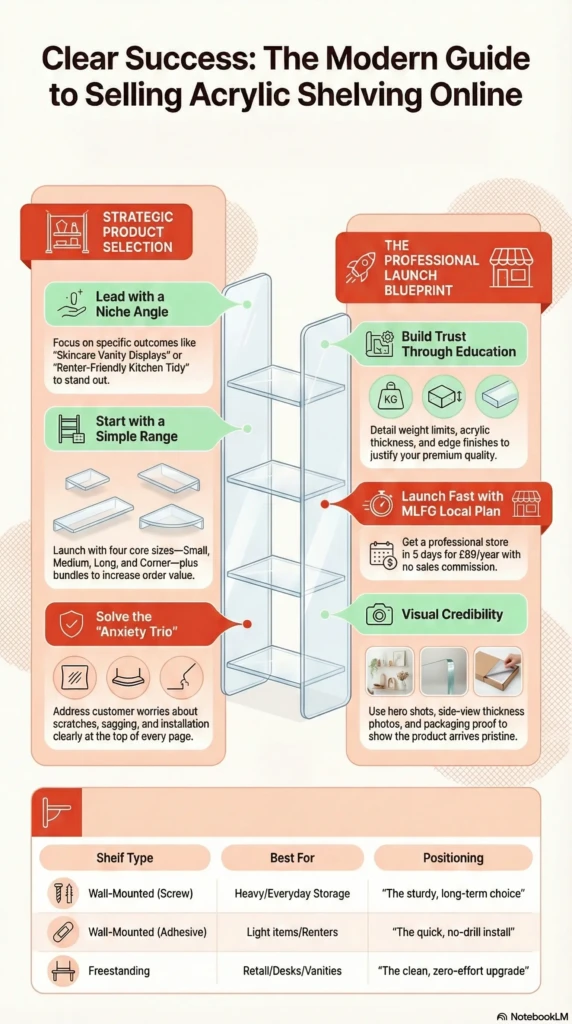
Acrylic shelving can be sold as generic homeware.
Or you can position it as a solution for a specific type of buyer and make your marketing ten times easier.
Pick one as your lead message and build your first collection around it.
You can still sell other uses, but your shop will feel stronger when it has a clear “this is what we’re best at”.
Acrylic shelving looks simple, but buyers have questions.
If you answer them clearly, you win.
Wall-mounted acrylic shelving is best for saving space and creating a floating look.
Freestanding shelving is best for desks, counters, and retail displays, and often appeals to renters or people who don’t want to drill.
This is where customers can get nervous.
Be clear about what’s included and what it’s designed for.
A confident, honest explanation reduces complaints.
This is the “quality feel” part of the sale.
Customers often don’t know what thickness means, so explain it simply.
Most people don’t know what size they need until you show them.
Include clear measurements and use cases like:
This kind of guidance is what makes your shop feel helpful instead of generic.
If you offer 40 sizes on day one, you’ll spend your life packing the wrong thing.
Start with a small range that covers common needs.
Bundles are your easiest way to increase order value without more marketing effort.
Even if you don’t sell care products, include care guidance as part of the product experience.
Customers will compare acrylic shelves quickly.
So you need your pricing to feel justified with quality signals and clarity.
Customers like choice, but they like it to be simple.
Customers are worried about three things: scratches, sagging, and installation.
Your product page should answer those within the first few scrolls.
People want proof the shelf will arrive looking good.
This table makes your shop feel organised and reduces customer messages.
| Shelf type | Best for | Pros | Cons | How to position it |
|---|---|---|---|---|
| Wall-mounted (screw) | Bathrooms, kitchens, everyday storage | Strong, stable, neat floating look | Requires drilling | “The best long-term, sturdy option” |
| Wall-mounted (adhesive) | Light items in renter-friendly spaces | No drill, quick install | Lower weight capacity, needs clear guidance | “Best for light display and tidy storage” |
| Corner shelf | Small bathrooms, awkward spaces | Uses wasted space, looks tidy | Limited surface area | “The neat fix for tight spaces” |
| Freestanding display shelf | Retail counters, desks, vanities | No install, easy repositioning | Takes surface space | “A clean display upgrade with zero drilling” |
Acrylic scratches easily.
That’s not a reason not to sell it – it’s a reason to package it properly.
Also include a simple installation card and a care card.
It reduces messages and makes your shop feel more professional.
Most acrylic shelf returns happen because the buyer expected it to hold more weight, fit a different space, or install differently.
Clear measurements, weight guidance, and mounting instructions prevent those issues before checkout.
Acrylic shelving is visual, so your marketing should be visual too.
Show transformations: before and after, clutter to calm.
These topics attract people who are already motivated to buy.
One good channel done consistently will outperform four channels done half-heartedly.
You can sell acrylic shelving on marketplaces, but you’ll often be compared on price without space to explain thickness, mounting, and quality, which are the exact things customers need to understand to buy confidently.
Your own ecommerce shop gives you the advantage of better product education, clearer bundles, and a smoother checkout experience.
Make Local for Global offers a done-for-you ecommerce setup for small sellers who want a shop that works without the tech headaches.
You can book a free consultation to map out your shelf range and product pages, or Get your website for £99/year and get an online shop built to sell.
Weight capacity depends on acrylic thickness, shelf depth, mounting method, and how the weight is distributed, so the best approach is to give clear guidance for each shelf size and mounting style and to explain that evenly spread weight is safer than one heavy item placed at the front edge.
Acrylic can be lighter and less prone to shattering than glass, which many buyers prefer for bathrooms and family homes, but it can scratch more easily, so selling it well means showing your protective packaging and giving simple cleaning advice to keep it looking clear.
Most buyers do best using a soft microfibre cloth and gentle cleaning products rather than harsh chemicals or abrasive sponges, and including a simple care card helps customers keep shelves looking new and reduces complaints about clouding or fine scratches.
Drilled shelves are usually the most secure option for heavier items and long-term use, while no-drill options can work well for lighter storage and renter-friendly setups, so guiding customers based on what they plan to store is the easiest way to prevent wrong purchases.
Some acrylic can discolour over time depending on material quality, light exposure, and heat, so it helps to describe your material quality clearly and recommend avoiding prolonged direct heat or strong sunlight exposure where possible, especially for shelves near windows.
PREFERRED SOURCE
Like what you’re reading? Add Make Local for Global as a preferred source on Google to see more of our articles when you search.

Build your online presence without having to figure out everything yourself.