READY TO SELL advent calendars ONLINE?
Get a store built for you in 5 days, plus training and support to help you start, run, and grow your Alternative business.

A practical guide to selling advent calendars online: choose a clear niche, price for time and packaging, use pre-orders to plan stock, ship safely, and launch a shop that handles deadlines and bundles.


Advent calendars sell because they turn a normal December into a daily little moment.
That might sound fluffy, but it’s exactly why this product is so powerful: people aren’t buying “24 items”. They’re buying anticipation, routine, and that tiny dopamine hit of opening something each day.
If you want to sell advent calendars online as a small business, you need two things: a clear niche and a smooth ordering experience, because customers are buying on a deadline and they hate uncertainty.
This guide shows you how to build a real advent calendar business – from picking a winning theme and pricing it properly, to packaging, fulfilment, and marketing that doesn’t rely on panic discounts.
Advent calendars are one of the rare ecommerce products with built-in urgency.
The buying window is short, the demand is predictable, and customers are willing to spend more when the calendar feels special.
They also create natural repeat customers: if someone loves your calendar this year, they’ll come back next year – and they’ll tell friends.
Different buyers want different experiences, so your niche matters.
Your job is to decide which group you’re serving first.
Trying to serve everyone usually creates a calendar that feels generic and gets compared on price.
These phrases are useful for your headings, categories, and FAQs.
Notice the pattern: niche, price, and “not chocolate”.
That’s your opportunity as a small seller.
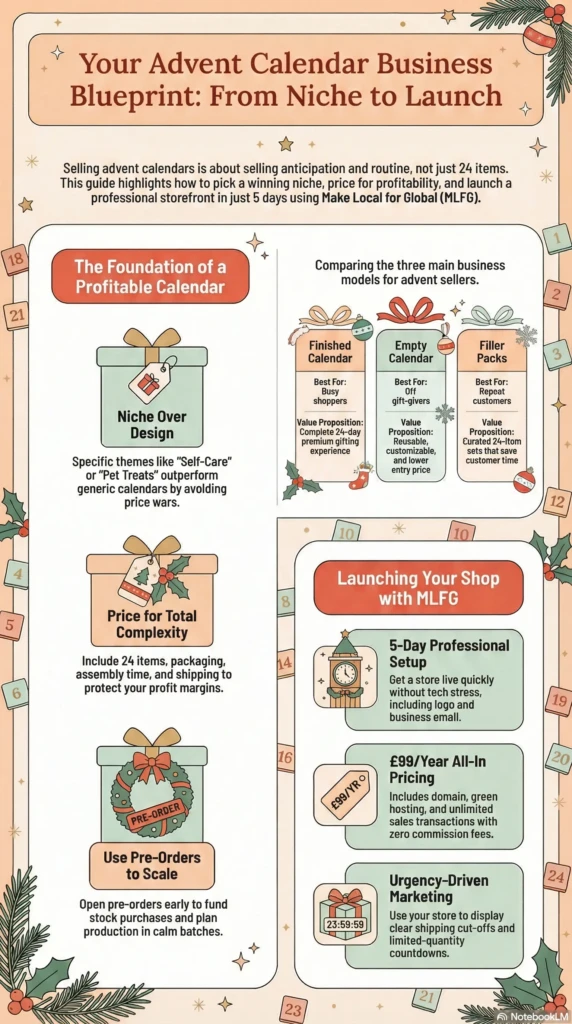
Advent calendars only sell well when the theme feels specific and exciting.
“A bit of everything” usually flops because it doesn’t give customers a clear reason to choose you.
Pick a niche that matches what you can source consistently and package reliably.
There are two main business models here.
This is the most straightforward to sell because it’s a complete product.
It also commands higher prices because you’re doing the curation and the packaging work.
This is great for people who want to customise but don’t want to shop for 24 separate items.
Filler packs also allow repeat purchases and upsells.
A strong approach is to offer both: a finished calendar plus optional refill or filler packs.
Customers don’t just buy what’s inside.
They buy the experience of opening it every day.
If you want higher prices, focus on presentation and guidance.
A tiny printed card can make a calendar feel like a proper product rather than a pile of bits.
Advent calendar buyers are often shopping under time pressure.
Keep choices limited and clear.
Too many variants create indecision and increase packing errors.
Advent calendars are labour-heavy.
If you price them like a normal product, you’ll hate your life by mid-November.
Price for time, packaging, and complexity.
Two tiers is usually enough.
This lets you serve more budgets without running 10 different production lines.
If you’re making calendars yourself, pre-orders can save your cash flow and your sanity.
You can offer:
Pre-orders also help you buy stock with confidence and reduce leftover inventory.
Advent calendars are emotional purchases, but customers still need specifics.
They want to know three things: what it is, when it arrives, and whether it’ll feel worth it.
Customers need to see it’s real and well-made.
This table helps customers choose quickly and helps you position both offers.
| Option | What the customer gets | Why it sells | Your main challenge | Best for |
|---|---|---|---|---|
| Finished advent calendar | A complete 24-day experience, ready to gift | Convenient, premium feel, higher perceived value | Assembly time and stock planning | Gift buyers, busy shoppers, “just sort it for me” customers |
| Empty calendar | A refillable calendar structure | Reusable, customisable, lower entry price | Explaining how to use and fill it | DIY gift givers, families, repeat seasonal shoppers |
| Filler pack | A curated set of 24 items (or themed mini sets) | Saves time, feels curated, easy add-on | Quality control and consistent item sizing | Customers who want custom with less effort |
Advent calendars create pressure because everyone wants delivery “before December”.
You win by being organised and upfront.
Start from the latest date customers need it in hand, then work backwards.
This keeps you from building calendars at midnight while panicking.
Advent calendars can crush easily, especially drawer-style packaging.
Damage complaints are expensive, so treat packaging as part of the product.
Returns depend on what you sell inside.
Be clear about returns for opened items, sealed items, and custom calendars, and keep the tone calm and fair.
Advent calendars can look like a discount war online.
You don’t need to join it.
Small sellers win by being specific, limited, and well-presented.
These topics naturally lead into your product pages and bundles.
You can sell on marketplaces, but you’ll be compared on price and buried among big brands.
Your own ecommerce shop is the best long-term move because you can control your storytelling, pre-orders, bundle options, and deadlines in a way marketplaces don’t support well.
Make Local for Global offers a done-for-you ecommerce setup built for small sellers who want a proper online shop without wrestling with tech.
You can book a free consultation to plan your calendar niche and launch schedule, or Get your website for £99/year and get your shop ready for pre-orders and peak season.
If you’re making or assembling calendars yourself, it’s smart to plan and source stock months ahead and open pre-orders early enough that you can batch-produce calmly, because customers often start shopping well before December and your best sales usually come when people still feel organised rather than panicked.
The best-selling advent calendars usually have a clear theme and a clear buyer – like self-care for adults, activity calendars for kids, or niche favourites like tea, candles, stationery, or pets – because customers can instantly understand why it’s for them and why it’s better than a generic calendar.
Price it to cover the full cost of 24 items, packaging, assembly time, and shipping materials, then add enough margin to make the work worthwhile, because underpricing advent calendars is the fastest way to end up exhausted, late on dispatch, and resentful by mid-season.
Pre-orders work brilliantly for advent calendars because they help fund stock purchases, give you predictable demand, and let you plan production in batches, and customers are usually happy to pre-order as long as you give clear dispatch dates and stick to them.
Use sturdy outer packaging with padding, protect corners, prevent internal movement, and be clear about delivery timelines and tracking, because customers care about the unboxing experience and damage complaints can wipe out your margin quickly.
PREFERRED SOURCE
Like what you’re reading? Add Make Local for Global as a preferred source on Google to see more of our articles when you search.

Build your online presence without having to figure out everything yourself.