

READY TO SELL Ankle boots ONLINE?
Get a store built for you in 5 days, plus training and support to help you start, run, and grow your Alternative business.

A practical guide to selling ankle boots online, including what to stock, how to price for profit, and how to build a shop customers trust.


Selling ankle boots sounds straightforward until you try to do it “for everyone”.
That’s when you end up with ten similar pairs, no clear audience, and a shop that feels like a random aisle in a discount warehouse.
If you want to Sell ankle boots as a proper business, the trick is focus.
Pick a customer, pick a style lane, make buying easy, and then deliver a good experience so people come back for their second pair.
This guide covers the full picture: what to stock, how to source, pricing that actually makes money, product pages that convert, and marketing that doesn’t require you to live on social media.
It’s written for UK sellers starting small – side hustle, first business, or a brand you want to grow properly.
“Ankle boots” includes everything from sleek Chelsea boots to chunky lace-ups and western styles.
If your shop tries to sell all of it, shoppers won’t know what you’re best at.
They’ll also compare you to giant retailers, which is not where a new small business wants to be.

Decide who you’re selling to and what problem you’re solving for them.
None of these audiences are “better”.
But each one changes what you stock, how you describe it, how you photograph it, and what makes them trust you.
A good niche is simple enough to say in one sentence.
If you want the simplest starting point for a new shop, “everyday Chelsea boots and chunky comfort boots” is a strong duo.
They’re popular, practical, and easy to market with real outfits.
When people shop for ankle boots, they’re usually trying to solve a specific outfit problem.
They want boots that work with their wardrobe and lifestyle.
Your product range should feel like you’ve already edited the choices for them.
If you’re new, don’t launch with 60 boots.
Launch with 10 to 18 strong options that cover the basics, plus a couple of “statement” styles.
Here’s a sensible starter structure:
This range is small enough to manage, but broad enough that shoppers can find “their” boot.

Price tiers help customers choose quickly.
They also help you make better margins without pushing people into the most expensive pair.
Even if you only carry one tier at the start, build your brand language as if tiers exist.
It makes your shop feel intentional, not accidental.

People love ankle boots but hate choosing.
A simple comparison helps them buy faster and reduces returns.
| Boot style | Best for | Why people buy it | What to be honest about |
|---|---|---|---|
| Chelsea boot | Everyday wear, easy outfits | Slip-on, timeless, works with jeans and dresses | Fit around the ankle can vary, note if narrow or roomy |
| Chunky sole boot | Comfort, grip, trend-led looks | Feels supportive, adds height, good for autumn and winter | Heavier on the foot, mention weight feel and platform height |
| Low heel smart boot | Work outfits, smarter styling | Polished look without a tall heel | Heel shape affects comfort, describe stability and footbed feel |
| Lace-up boot | Adjustable fit, walking, layered outfits | Secure fit, supportive, great with socks | Takes longer to put on, note ankle height and tongue padding |
| Western-inspired ankle boot | Fashion styling and statement outfits | Instant outfit upgrade, looks intentional | Toe shape can feel narrow, be clear about fit and break-in |
When you Sell ankle boots online, your biggest risk is quality issues that trigger returns.
Returns are part of fashion, but you don’t want returns because soles split or zips fail.
That’s a brand killer.
If you’re starting out, wholesaling is often the least stressful way to launch.
Then you can move into private label once you know what your customers actually buy and return less.
Ankle boots look fine in photos even when the build quality is poor.
So you need a checklist you can apply consistently.
Order samples and wear them around your home for a few days.
Not because you’re trying to do a marathon in them.
Because you’re testing comfort, rubbing points, and whether they still look good after real use.
Boot shoppers love the idea of waterproof ankle boots.
But waterproof is a specific promise, and it can backfire if customers expect wellies.
A safer approach is to describe honestly:
That keeps expectations realistic and reduces angry emails in February.
With footwear, it’s easy to price based on what competitors charge.
That can be a trap.
Your costs might be different, your returns rate might be higher at first, and your packaging and shipping can eat margin quickly.
Build your pricing from the ground up.
If you ignore returns in your pricing, you’ll feel like you’re selling a lot and earning very little.
Footwear businesses live or die by managing that reality calmly.
Boot shoppers often buy “the boot plus the care”.
Even if you don’t want a huge accessories section, a few add-ons help profit and customer results.
Offer them as a simple “recommended with” section rather than a hard sell.
Discounting footwear can work, but don’t train customers to wait for sales.
If you want an early launch offer, use a limited, specific promotion:
That keeps the brand feeling premium and intentional.

When someone buys ankle boots online, they’re guessing two things.
How they’ll look, and how they’ll feel.
Your product page should reduce guessing.

A good boot listing isn’t a poem.
It’s a helpful guide.
Include these sections on every product page:
Fit notes are especially important if you want to Sell ankle boots successfully.
They reduce returns, and they make you feel trustworthy.
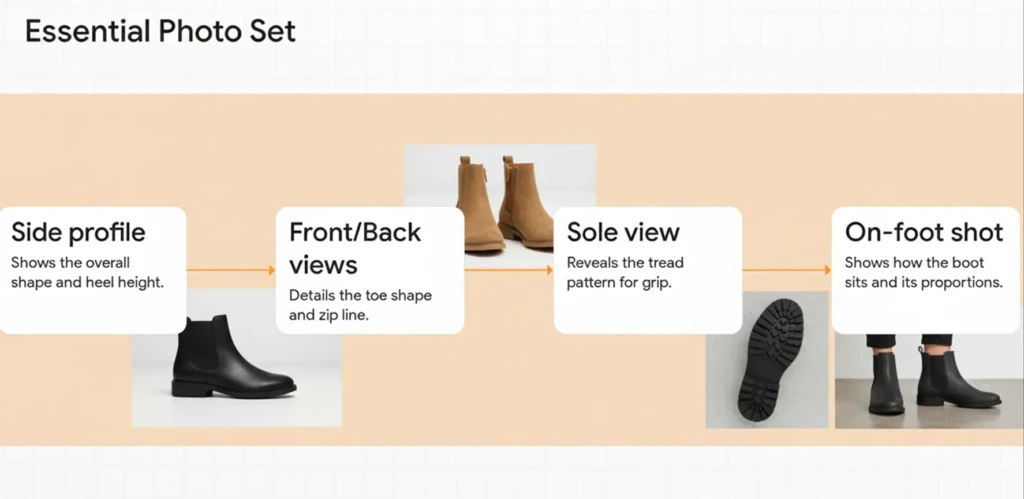
Footwear shoppers zoom in.
They want to see texture, shape, and how the boot sits.
A strong photo set includes:
If you can add a short video, even better.
Walking a few steps and showing flexibility answers comfort questions fast.
Generic size charts don’t help much with boots.
People want reassurance.
Add guidance like:
This kind of honesty feels like customer service before purchase.
It’s one of the simplest ways to lower return rates.
Footwear is not the easiest category operationally.
That’s not bad news.
It just means you need a basic system, not vibes.
Boots should arrive looking new.
That means no crushed boxes, scuffed toes, or loose boots rattling in an outer carton.
It doesn’t need to be luxury.
It needs to feel considered.
Customers don’t mind waiting a couple of days if you’re clear.
They hate uncertainty.
Put these details where customers can’t miss them:
Boots will be returned sometimes for fit.
That’s normal.
The goal is to make the process clear so customers feel safe buying.
Good policies are:
If you can offer exchanges smoothly, do it.
Many customers don’t want a refund.
They want the right size.
Ankle boots usually peak in autumn and winter.
But you can sell year-round if your range and content support it.
Examples:
Instead of trying to fight seasonality, use it.
Plan small drops that give you marketing moments.
Boot marketing works best when it’s practical.
People don’t just want a pretty boot photo.
They want to see how it fits into real outfits and real weather.
If you’re starting, a simple combo is:
You don’t need to do everything.
Pick what you can sustain.
If you’re stuck on what to post, use formats that answer buying questions.
Don’t overcomplicate it.
Consistency is what builds trust.
To Sell ankle boots through your website, you want pages that match real searches.
These are the kinds of questions people type when they’re close to a purchase:
Write helpful articles that genuinely answer these.
Then link naturally to the relevant boots in your shop.
This brings in customers without you having to post every day.
Fashion shoppers are cautious with new websites.
Your job is to make your shop feel safe and easy to buy from.
People like curated selections.
Create small collections such as:
This makes your shop feel like it has taste and intention.
It also increases basket size because shoppers browse within a theme.

If you’re excited about products and styling but not about building a website, you’re normal.
A good ecommerce site has a lot of small moving parts: product structure, shipping rules, payments, and pages that build trust.
Make Local for Global offers a fully done-for-you shop setup designed for small sellers and side hustlers.
You can book a free consultation to talk through your boot niche and the best way to present your range.
Or, if you want to get moving, Get your website for £99/year and have your shop set up without the stress.
Returns are part of footwear, but you can reduce them a lot with clarity.
The goal is not to blame the customer.
The goal is to help the right customer buy the right boot the first time.
Pick a small set of phrases and use them on every listing.
Consistency makes your shop easier to trust.
For ankle boots, these are the measurements customers care about most:
That last one is huge.
People with slimmer ankles worry boots will gape.
People with wider ankles worry they won’t zip up.
If you can provide ankle opening measurements, you’ll reduce returns and increase confidence.
Some boots soften quickly, some take time, some should feel comfortable immediately.
Tell customers what to expect.
It prevents the “these are too stiff” return that happens after a five-minute try-on.
Once you have proof of what sells, it’s tempting to expand fast.
That’s also how people tie up cash in stock that sits.
Use simple signals:
Then expand in the direction customers are already pulling you.
If everyone asks for wide fit, add more wide fit.
If everyone buys black Chelsea boots, offer two versions: classic and chunky.
New colourways, new materials, new heel shapes, new collections.
Pick one change, test it, learn from it, then do the next.
This keeps your stock manageable and your brand coherent.
Boots aren’t a weekly purchase for most people.
But you can still create repeat customers through:
Repeat business is what makes your marketing cheaper over time.
It can be, especially if you focus on a niche and don’t try to beat giant retailers at their own game.
Ankle boots sell well when your shop helps customers choose with fit notes, clear photos, and honest expectations.
Trust is your advantage as a small business.
Classic Chelsea boots and comfortable chunky sole boots tend to be reliable sellers because they’re versatile and practical.
Work-ready low heel boots also do well if you present them clearly for office outfits.
The best sellers in your shop will depend on your niche and audience.
Price from your total costs, including shipping, packaging, payment fees, and an allowance for returns.
Then use tiers and add-ons to lift order value.
If you only make a tiny margin per pair, the business will feel exhausting fast.
Be specific about fit and measurements, show the boot from every angle, and include honest notes about ankle opening and toe shape.
Returns drop when customers feel you’ve guided them, not just sold to them.
A website makes you look more established, lets you control your brand, and gives you a place to publish sizing and styling content that brings in search traffic.
If you don’t want to build it yourself, you can book a free consultation or Get your website for £99/year with Make Local for Global.
Start with 10 to 18 well-chosen options so your shop feels curated rather than chaotic.
A small range is easier to photograph, describe properly, and manage for sizes and returns.
You can expand once you know what sells and what fits your customers best.
If you want to Sell ankle boots successfully, don’t try to be the biggest shop online.
Be the most helpful shop for a specific kind of customer, with a range that feels edited and a buying experience that feels safe.
That’s how small ecommerce brands win – steadily, profitably, and without losing their minds.
PREFERRED SOURCE
Like what you’re reading? Add Make Local for Global as a preferred source on Google to see more of our articles when you search.

Build your online presence without having to figure out everything yourself.