

Make Local for Global Logo

READY TO SELL architectural lighting ONLINE?

Get a store built for you in 5 days, plus training and support to help you start, run, and grow your Alternative business.

How to sell architectural lighting online and build a premium design business

A detailed guide to selling architectural lighting online – pick a niche, build room packs, explain lighting specs in plain English, create product pages that reduce installation anxiety, and market with before-and-after transformations.

Make Local for Global

Table of content

Architectural lighting is one of the rare product categories where customers will happily pay more – if you make them feel confident.

They’re not buying “a light”. They’re buying a room that feels calmer, more expensive, more usable, and more intentional.

Good architectural lighting fixes the stuff people complain about without realising it’s lighting: harsh glare, dark corners, kitchens that feel flat, bathrooms that look dull, and hallways that feel like tunnels.

But it’s also a category that creates anxiety. Buyers worry about cut-out sizes, IP ratings, dimmers, colour temperature, drivers, and whether the finish will look cheap when it’s installed.

If you want to sell architectural lighting online, your main advantage is clarity. Most sellers either overwhelm customers with jargon or give so little information buyers don’t trust them. Your job is to sit in the middle: clear, specific, and helpful.

This guide shows you how to sell architectural lighting online in the UK – from choosing a niche and product range to writing product pages, reducing returns, marketing “before and after” transformations, and building a shop that converts while you sleep.

Choose your niche before you choose products

“Architectural lighting” is a massive category. If you list everything, you’ll look like a generic electrical wholesaler, and you’ll compete on price.

A niche lets you compete on expertise and trust instead.

Profitable niches in architectural lighting

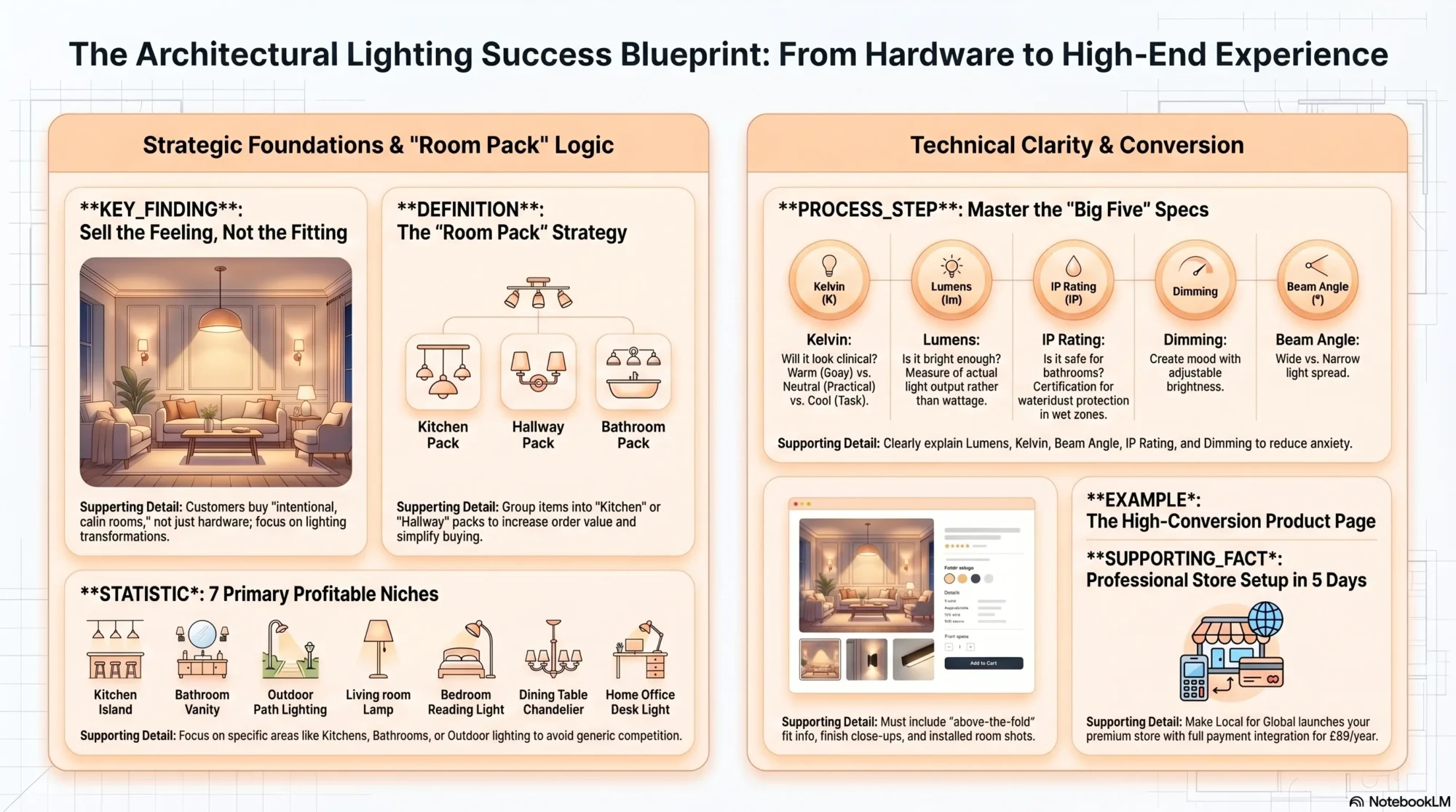
  • Modern residential upgrades: downlights, wall lights, track – aimed at homeowners renovating.
  • Kitchen and open-plan zones: downlights, under-cabinet strips, pendants, linear lighting.
  • Bathroom and wet-zone lighting: IP-rated downlights, mirror lighting, shower-safe fittings.
  • Outdoor architectural lighting: up/down wall lights, step lights, spike lights, façade lighting (IP rating is everything).
  • Design-led minimal: fewer products, better finishes, premium positioning.
  • Commercial basics done well: reliable products, consistent specs, multipacks, repeat buyers.

If you’re starting out, modern residential upgrades or kitchen/open-plan zones are usually the easiest because you can create simple “room packs” and your marketing can focus on obvious transformations.

Tip: Your shop will sell more if it feels like it was designed for real home projects: “Kitchen pack”, “Hallway pack”, “Bathroom pack” – instead of a random list of fittings.

Decide who you’re selling to

Architectural lighting customers fall into a few groups. If you pick a primary one, your content becomes much easier to write.

  • Homeowners renovating: want simple choices and reassurance.
  • Interior design lovers: care about finish, glare control, and light quality.
  • Landlords and property refreshers: want reliable upgrades at a sensible price.
  • Small businesses: cafés, salons, studios – want the “premium feel” without guessing.
  • Electricians and trades: want clear specs, availability, and repeatable models.

You can serve all of them, but your shop should speak to one group first. That’s how you feel specialist, not generic.

Understand what buyers are actually afraid of

Lighting returns usually happen because the buyer bought the wrong specification, not because the product is “bad”.

If you reduce fear and confusion, you reduce returns and increase conversion.

The most common buyer worries

  • “Will it fit?” Cut-out size, depth, driver size, cable access.
  • “Will it be bright enough?” Lumens confusion and unrealistic expectations.
  • “Will it look warm or cold?” Colour temperature confusion.
  • “Will it glare?” Downlights can be harsh if beam and placement are wrong.
  • “Will it work with my dimmer?” Compatibility is a real issue if you’re vague.
  • “Is it safe for the bathroom/outdoors?” IP ratings and zone suitability.
  • “Will it look cheap?” Finish, trim quality, and how it sits in the ceiling/wall.

Your product pages and guides should answer these questions directly. When buyers feel safe, they buy quickly.
What to sell: build a curated range that makes choosing easy

Lighting shops fail when they offer too much choice with no guidance.

You don’t need 40 downlights. You need a few great ones with clear use cases.

A starter range that works for most new sellers

  • Hero indoor downlight: your default choice for hallways, kitchens, living spaces.
  • Bathroom-rated downlight: clearly positioned for bathrooms and wet zones.
  • Exterior up/down wall light: your curb-appeal marketing hero.
  • Under-cabinet lighting: a kitchen upsell that makes sense.
  • Optional add-on: a simple track light kit for flexible spaces.

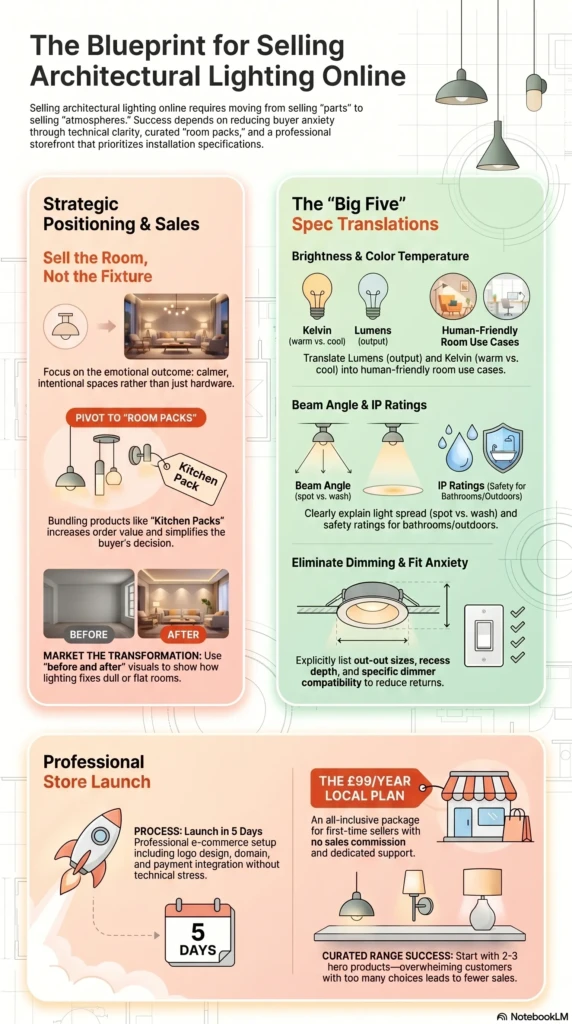
Why “room packs” sell better than single units

Most people are not buying one downlight. They’re buying 6, 8, 10, or 12.

When you sell packs, you:

  • Increase average order value
  • Make buying feel easier
  • Reduce shopping around
  • Become the “trusted supplier” for a project

Example room packs you can sell

  • Hallway pack: 6 downlights in warm white, wide beam.
  • Kitchen pack: 8 downlights in neutral white, medium beam.
  • Bathroom pack: 4 IP-rated downlights plus a mirror light (if you stock it).
  • Outdoor entrance pack: 2 up/down wall lights.
OfferBest forWhat buyers wantWhat you must make clear
Indoor downlight (single + packs)Hallways, kitchens, living areasBright enough, not harshCut-out size, depth, lumens, beam angle, dimming
Bathroom-rated downlightBathrooms and wet zonesSafe and suitableIP rating, bathroom zone guidance, dimming
Exterior up/down wall lightPorches, entrances, patiosCurb appeal and reliabilityIP rating, beam spread, finish durability, install notes
Under-cabinet stripsKitchens and worktopsBetter task lightingLength, driver/transformer, connectors, dimming

Explain specs like a human: the “big five” buyers must understand

Specs are where you win or lose in lighting.

But you don’t need to make customers feel stupid. You need to translate.

1) Brightness (lumens): “Is it bright enough?”

Lumens are the actual light output. Wattage is not a reliable guide anymore because LEDs vary.

Help buyers with simple benchmarks:

  • Lower lumens can be fine for ambience and hallways.
  • Medium lumens work for general room lighting.
  • Higher lumens are better for kitchens, task lighting, and rooms with dark finishes.

Don’t give guarantees like “perfect for every kitchen”. Kitchens vary. Instead, guide them to a sensible choice and suggest using packs and zones.

2) Colour temperature (Kelvin): “Will it look cosy or clinical?”

This is the biggest source of regret purchases.

Use plain language and a simple table or graphic on your site.

  • Warm white: cosy, flattering, best for living rooms and bedrooms.
  • Neutral white: clean and practical, best for kitchens and bathrooms.
  • Cool white: bright and crisp, best for specific work areas where you want high clarity.

Also explain a truth most shops ignore: mixing colour temperatures in an open-plan space can make a room feel “wrong”. Encourage customers to keep it consistent within a line of sight.

3) Beam angle: “Will it spotlight or light the whole room?”

Beam angle controls how focused the light is.

Too narrow can create spotty pools of light and harsh shadows. Too wide can feel flat if you’re trying to highlight features.

  • Narrow beam: feature lighting, artwork, architectural highlights.
  • Medium beam: general lighting with a little control.
  • Wide beam: even wash of light for general rooms and hallways.

4) IP rating: “Can I use this in a bathroom or outside?”

IP ratings tell you how protected a fitting is against dust and water.

Buyers don’t want to decode it. They want a simple rule:

  • Bathroom and outdoor fittings must have the correct IP rating for the location.
  • Outdoor wall lights should be clearly labelled as outdoor rated.
  • Bathroom lights should be clearly labelled as suitable for the intended zone.

Do not invent zone suitability. Provide factual guidance and keep a safety note that installation should be handled by a qualified electrician.

5) Dimming: “Will it work with my dimmer?”

Dimming is where vague product pages cause returns.

If it’s dimmable, say what kind of dimming and what driver is included.

If compatibility varies, be honest and recommend confirming with an electrician.

Tip: Put a short “Dimming and compatibility” block on every product page. If you hide it, you’ll get returns from customers who assumed.

Product pages that convert: the architecture lighting listing template

A great lighting product page is basically a guided decision.

It should make a customer think: “This is exactly what I need and I can trust it.”

Above-the-fold essentials (what must be visible immediately)

  • Best for: “Kitchen downlights”, “Hallway pack”, “Outdoor entrance”.
  • Key specs: lumens, colour temperature, beam angle, IP rating, dimming.
  • Fit info: cut-out size and recess depth for downlights.
  • Finish: matte black, white, brushed nickel, etc.
  • Pack options: single, 4-pack, 6-pack, 10-pack.

The “fit and install” section (reduces anxiety)

  • Cut-out size (mm)
  • Required recess depth (mm)
  • Driver included or not (be explicit)
  • Connector type (if relevant)
  • Any special notes like insulation considerations (only if you can state them accurately)

The “light quality” section (prevents disappointment)

  • Colour temperature explained in one sentence
  • Beam angle described as “wide wash” or “focused”
  • Suggested room use cases
  • Simple note about keeping colour temperature consistent in open-plan spaces

The “what’s in the box” section (reduces complaints)

  • Number of fittings
  • Driver(s)
  • Mounting hardware
  • Instructions

Safety note

Keep this simple and responsible:

  • “Installation should be carried out by a qualified electrician.”

How to price architectural lighting without becoming a discount shop

Lighting buyers will pay for reliability, finish quality, and clarity.

If you try to be cheapest, you’ll compete with giant retailers and your margins will vanish.

Build a pricing ladder that makes sense

  • Entry: standard indoor downlight in a basic finish, sold in packs.
  • Main: better finish, better light quality, dimmable options.
  • Premium: outdoor-rated architectural pieces and statement wall lights.
  • Bundles: room packs that simplify buying.

Why packs protect your margin

Packs reduce per-unit handling and create a “project purchase” mindset.

Customers stop comparing your single unit price and start thinking, “This solves my whole hallway.”

Photography that actually sells lighting

Lighting is difficult because the product is the effect.

So you need two kinds of images: the fixture and the result.

Minimum photo set for each product

  • Clean product photo (finish and form)
  • Close-up of finish texture (matte vs gloss matters)
  • Installed room shot (shows vibe)
  • Beam effect shot on wall (for up/down and feature lights)
  • Diagram image with key dimensions and cut-out size

Show “warm vs neutral” if you can

This is one of the highest-converting bits of content in lighting.

Even a simple side-by-side photo helps buyers choose and reduces regret.

Tip: For downlights, one photo showing glare control (how recessed the LED is) can justify premium pricing. People hate harsh glare, even if they can’t explain why.

Reduce returns with one “start here” buyer guide

Architectural lighting stores should not rely on customers already knowing what they need.

Your easiest win is a single guide page that answers the questions that cause returns.

Your buyer guide should cover

  • Warm vs neutral vs cool, with room suggestions
  • Beam angle basics
  • IP rating basics for bathrooms and outdoors
  • Downlight fit: cut-out size and depth
  • Dimming: what “dimmable” really means

This guide becomes:

  • A sales tool
  • A support tool
  • An SEO magnet
  • A trust builder

Marketing architectural lighting without sounding like an electrical catalogue

Your marketing should focus on transformation, not part numbers.

People want a better home. Show them what better lighting does.

Marketing angles that work

  • Kitchen glow-up: brighter worktops, warmer evenings, less flat lighting.
  • Hallway upgrade: no more dark tunnel vibe.
  • Bathroom clarity: practical light that doesn’t feel harsh.
  • Curb appeal: entrance lighting that makes a house look premium.
  • Feature lighting: highlight art, shelves, textured walls.

Content ideas that convert

  • Before/after room lighting photos
  • Short videos demonstrating warm vs neutral
  • “How many downlights do I need?” guidance post (keep it general)
  • Outdoor up/down beam effect clips
  • Kitchen under-cabinet “night mode” reels

SEO searches to use naturally

  • “Architectural downlights”
  • “Kitchen downlight pack”
  • “Bathroom downlights IP rated”
  • “Outdoor up down wall light”
  • “Warm white vs neutral white lighting”

Build an online shop that makes lighting easy to buy

Lighting sites should be organised by projects, not just product types.

Most buyers think: “I’m renovating the kitchen” – not “I’d like a recessed luminaire.”

What your shop needs on day one

  • Shop by room: kitchen, bathroom, hallway, outdoor
  • Shop by project packs: 4-pack, 6-pack, 10-pack
  • Filters: colour temperature, beam angle, finish, IP rating
  • Clear diagrams and fit info on every downlight
  • A “Start here” buyer guide
  • Clear delivery and returns info

Done-for-you ecommerce can save you weeks

Architectural lighting needs solid structure: product specs, filters, bundles, and clear page layouts.

Make Local for Global sets up your ecommerce shop for you, so you can launch without getting stuck in technical setup.

You can book a free consultation to plan your niche, room packs, and product page templates.

Or choose the simple option to Get your website for £99/year.

Tip: Put packs first on your category pages. People doing renovations don’t want to add 10 single items to basket one by one.

How to get your first 80 customers in architectural lighting

This is a higher value category. You don’t need huge volume to build a strong business.

Step 1: Start with two hero products

  • A hero indoor downlight (sold in packs)
  • A hero outdoor up/down wall light

Make their product pages flawless and build your marketing around them.

Step 2: Create one buyer guide

One helpful guide page will reduce returns and bring organic traffic.

Step 3: Build room packs

Packs increase order value and make buying simpler. They are your profit engine.

Step 4: Market transformations

Before/after content is your best salesperson. Use it consistently.

Step 5: Collect reviews that mention clarity

Lighting buyers love reviews that say “exactly as described” and “easy to choose”. Those reviews convert future customers.

Common mistakes when selling architectural lighting online

These are the errors that cause returns and slow growth.

Hiding cut-out size and recess depth

Downlight buyers need fit information first. Put it near the top.

Using vague terms like “warm light” with no Kelvin number

Always include a Kelvin value. It reduces confusion.

Listing “dimmable” with no compatibility info

Be clear about what dimming method is supported and what’s included.

Not showing installed photos

Architectural lighting sells through the effect. Product-only photos are not enough.

Too many products at launch

Curated ranges sell better. Expand once you understand what your customers actually buy.

FAQ: architectural lighting

Does architectural lighting sell well online?

Yes. Renovations and home upgrades drive steady demand, and buyers will pay for quality and guidance. It sells best when your site makes specs easy to understand and offers room-based packs.

What should I sell first?

Start with one reliable indoor downlight sold in packs, one bathroom-rated option, and one outdoor architectural wall light. Add under-cabinet lighting as a logical kitchen upsell.

How do I reduce returns?

Make cut-out size, recess depth, IP rating, colour temperature, beam angle, and dimming compatibility obvious. Most returns happen when buyers choose the wrong specification.

How should I market architectural lighting?

Market transformations: kitchen glow-ups, hallway upgrades, bathroom clarity, and curb appeal. Short guides explaining warm vs neutral and beam angles convert very well.

Do I need a website to sell architectural lighting?

You can sell on marketplaces, but a website helps you organise by room, offer packs, and build trust with guides and installed photos. A done-for-you ecommerce setup helps you launch faster and look premium.

A sensible next step

If you want to sell architectural lighting properly, keep your range curated, sell room packs, and build your site around clear buyer guidance.

If you want a professional ecommerce shop without the setup headache, Get your website for £99/year.

And if you want help structuring your categories, packs, filters, and product page templates to reduce returns and increase conversion, book a free consultation.

Lighting is one of the easiest ways to make a space feel expensive. If you can help customers choose confidently, you can build a premium business with surprisingly steady demand.

PREFERRED SOURCE

Keep finding us on Google

Like what you’re reading? Add Make Local for Global as a preferred source on Google to see more of our articles when you search.

Newsletter Form in Blog

Sign up for our
FREE ecommerce newsletters!


By providing your email, you agree to our Privacy and Cookie Policy, as well as our Terms and Conditions.


DOWNLOAD FREE GUIDE
ebookmockup 1

How to sell architectural lighting Online

Join 5,000+ others who downloaded
Blog to PDF Form
No spam, Unsubscribe any time.

Ready to Start Your Online Business?

Build your online presence without having to figure out everything yourself.
DOWNLOAD FREE GUIDE

How to sell architectural lighting online

A simple plan to get your first steady online orders
ebookmockup 1
  • What to do first (so you don't waste time)
  • How to price and present your architectural lighting
  • How to get traffic and turn it into orders
  • Join 5,000+ others who downloaded this
Blog to PDF Form
No spam, Unsubscribe any time.

Start Selling

architectural lighting

Withing 5 days

You’ve read the guide. Now see if you qualify for a done-for-you online store for architectural lighting sellers.
Find out if this is right for you in under 60 seconds.
  • No tech skills neeed
  • Store ready in 5 days
Qualifying / Questionnaire Form
  • Step 1
  • Step 2
  • Step 3
  • Step 4
  • Step 5

Answer a few quick questions and I’ll point you in the right direction.