

READY TO SELL animal care products ONLINE?
Get a store built for you in 5 days, plus training and support to help you start, run, and grow your Alternative business.

A detailed guide to selling animal care products online, covering niche selection, routine-based product ranges, bundle building, responsible messaging, product page templates, content marketing, fulfilment best practices and repeat-buyer tactics.

Animal care products are one of the most reliable ecommerce categories you can build around, because pet owners don’t treat these purchases as “nice to have”.
They treat them as part of caring for a living creature they love, which means demand is steadier than many trend-led products.
But it also means trust matters more than almost anything else you’ll sell online.
If you want to sell animal care products successfully, you need to be clear about species, clear about how to use products safely, and smart about building routines that lead to repeat orders.
Animal care products are the everyday items that keep pets clean, comfortable, healthy-looking, and easier to live with.
They include grooming, hygiene, home cleaning, coat and paw care, and routine maintenance like dental and ear care.
Most of these products don’t sell once. They sell repeatedly, because pets don’t stop shedding, muddy paws don’t stop happening, and bedding doesn’t stay fresh forever.
The challenge is that pet care is sensitive.
Owners worry about safety, ingredients, scent, and whether something will irritate their pet.
If your product pages are vague or hypey, you’ll get returns, complaints, and one-star reviews quickly.
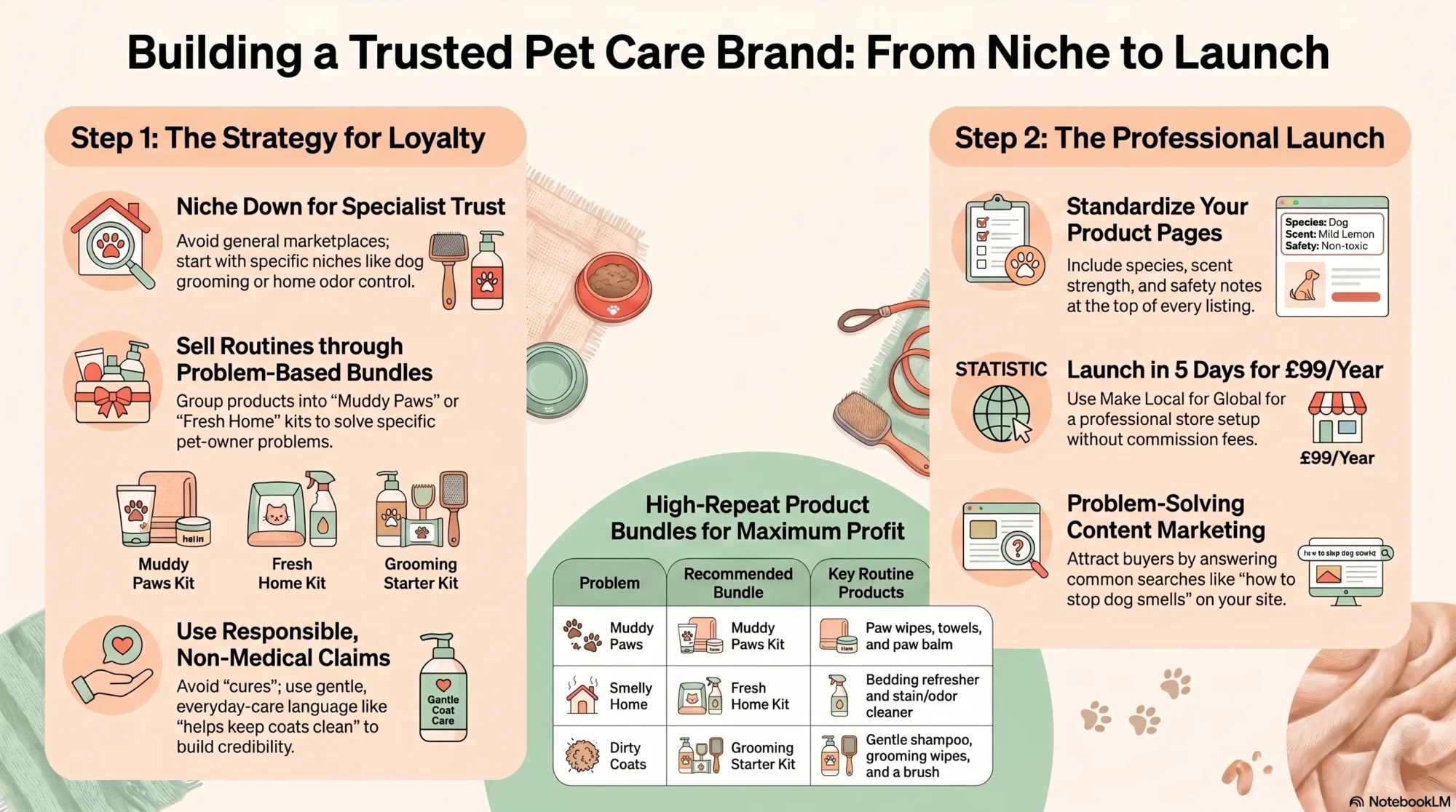
“Animal care products” is huge.
If you try to sell everything for every animal from day one, your shop will feel like a random marketplace, not a trusted place to buy from.
Start with a niche that you can explain confidently, then expand once you have steady sales.
Start with dog grooming and “fresh home” products.
They have strong demand, obvious problems to solve, and they lend themselves to bundles and content.
You can add cat-specific lines later once your store structure is working.

Pet owners are rightly cautious.
They’ve seen products that claim miracles and then either do nothing or cause irritation.
Your brand can stand out by being calm, clear and responsible.
Don’t use language that implies you are treating health conditions.
Avoid words like “cure”, “treat”, or anything that suggests a medical outcome.
Instead, use responsible everyday-care language:
If a customer is dealing with persistent skin issues, ear infections, or other health concerns, it’s responsible to suggest they speak to a vet.
That doesn’t hurt sales. It builds trust.
Pet owners often buy based on what a product doesn’t contain.
Some want fragrance-free. Some want lightly scented. Some can’t stand anything strong.
Make scent strength obvious:
Then describe it like a normal person: “a light clean scent that doesn’t linger” is more useful than perfume-style language.
For wipes, shampoos and cleaners, include basic safety notes clearly:
This reduces complaints and also makes your shop feel more professional.
Pet care becomes profitable when you sell routines, not random bits.
Routines are what create repeat buying.
If you’re starting with dogs and cats, a sensible range is 10 – 15 products that cover the most common needs.
Your shop should naturally guide most customers into core products and bundles, because that’s where profitability and loyalty live.
| Problem customers want solved | Products that fit | What to say on the listing | Common mistake to prevent |
|---|---|---|---|
| Muddy paws and rainy-day mess | Paw wipes, towel, paw balm-style care | “Quick clean after walks, gentle on paws” | Not stating dog-only vs multi-pet suitability |
| Smelly bedding and “pet home smell” | Bedding refresher, stain and odour cleaner | “Freshens fabrics between washes” | Overpromising that one spray solves everything |
| Shedding fur everywhere | Brushes, deshedding tools, grooming gloves | “Helps manage loose hair as part of a routine” | Not explaining coat types and gentle use |
| Teeth and breath routine | Dental kit, dental wipes, chews (if sold) | “Beginner-friendly dental routine support” | Making strong health claims instead of routine guidance |
| Sensitive skin worries | Fragrance-free shampoo, gentle wipes | “Mild, simple ingredients, patch test recommended” | Not being transparent about ingredients and scent |
Bundles work in animal care because they match real life.
Pet owners don’t want to figure out a whole routine from scratch.
They want you to hand them the basics.
The difference between “nice idea” and “best seller” is naming the bundle around a problem.
“Fresh home kit” sells better than “bundle 1”.
In this category, your goal is not one big sale.
Your goal is a customer who reorders every month or two.
People don’t mind paying slightly more when they feel confident the product is safe and the shop is reliable.
Most issues in pet care come from confusion.
Wrong species, wrong expectations, unclear use instructions.
Your product pages should remove doubt.
Pet owners buy confidence.
Photos are proof.
People rarely search for your brand name at first.
They search for the problem they’re dealing with right now.
This is why content marketing works so well in pet care.
Each piece of content should recommend a simple kit or shortlist of products.
If content doesn’t lead to a product decision, it won’t drive sales.
Many animal care products are liquids, sprays, or wipe tubs.
If they leak in transit, customers won’t forgive you, even if the product is great.
Also include a simple routine card in bundles.
It reduces misuse, increases satisfaction, and makes your brand feel thoughtful.
Pet owners need to find the right product fast.
Your shop structure should make that easy.
If you’re building a shop with lots of categories, bundles and repeat-buy products, ecommerce setup can become the thing that slows you down.
Make Local for Global offers a done-for-you ecommerce setup that’s simple, affordable, and built for small sellers who want a professional shop without wrestling with tech.
If you want to plan your store structure and bundles, you can book a free consultation.
If you want your store set up quickly and cleanly, you can Get your website for £99/year.
Yes, because many items are repeat-buy and pet owners tend to stay loyal once they find products that suit their pet, but you need clear species guidance and responsible claims to build trust.
Routine products like wipes, gentle shampoos, brushes and odour control items often sell best because they solve frequent everyday problems, and starter kits sell well because they remove decision fatigue for new pet owners.
Make species and use instructions obvious, describe scent strength honestly, be transparent about ingredients for sensitive products, and add simple safety guidance like patch testing, because most complaints come from confusion or unrealistic expectations.
Yes, because bundles feel like a ready-made routine and increase order value naturally, especially when you name them by the problem they solve, like “muddy paws kit” or “fresh home kit”.
Compete by being more helpful and more focused: specialise in a niche, organise your shop by problems, provide clearer product pages, and create routine-led kits that feel easier than buying single items one by one.
If you want to launch quickly and sensibly, build around one animal and one set of problems first.
Animal care products sell when pet owners feel safe, informed and looked after.
Be clear about species, keep claims responsible, sell routines through bundles, and you’ll build a repeat-buy business that grows steadily.
PREFERRED SOURCE
Like what you’re reading? Add Make Local for Global as a preferred source on Google to see more of our articles when you search.

Build your online presence without having to figure out everything yourself.