

READY TO SELL Artisanal candles ONLINE?
Get a store built for you in 5 days, plus training and support to help you start, run, and grow your Alternative business.

A practical, down-to-earth guide to making, pricing, and selling artisanal candles online – plus how to launch a proper ecommerce site without tech headaches.

Selling artisanal candles looks simple from the outside.
Melt wax, add a nice scent, pour it in a jar, take a photo, post it online.
Then reality shows up: tunnelling, smoky wicks, “why doesn’t it smell like the sample?”, and a market that’s packed with people who also bought a pouring pot last weekend.
Still, candles are one of the best small product businesses you can start.
They’re giftable, repeatable, easy to ship, and they fit into people’s daily rituals in a way most products don’t.
This guide is here to help you sell artisanal candles with a bit more confidence and a lot less guessing.

“Handmade candles” is not a niche.
It’s a category.
If you want steady sales, you need a clear reason someone should buy from you instead of the 47 other candle shops they saw this week.
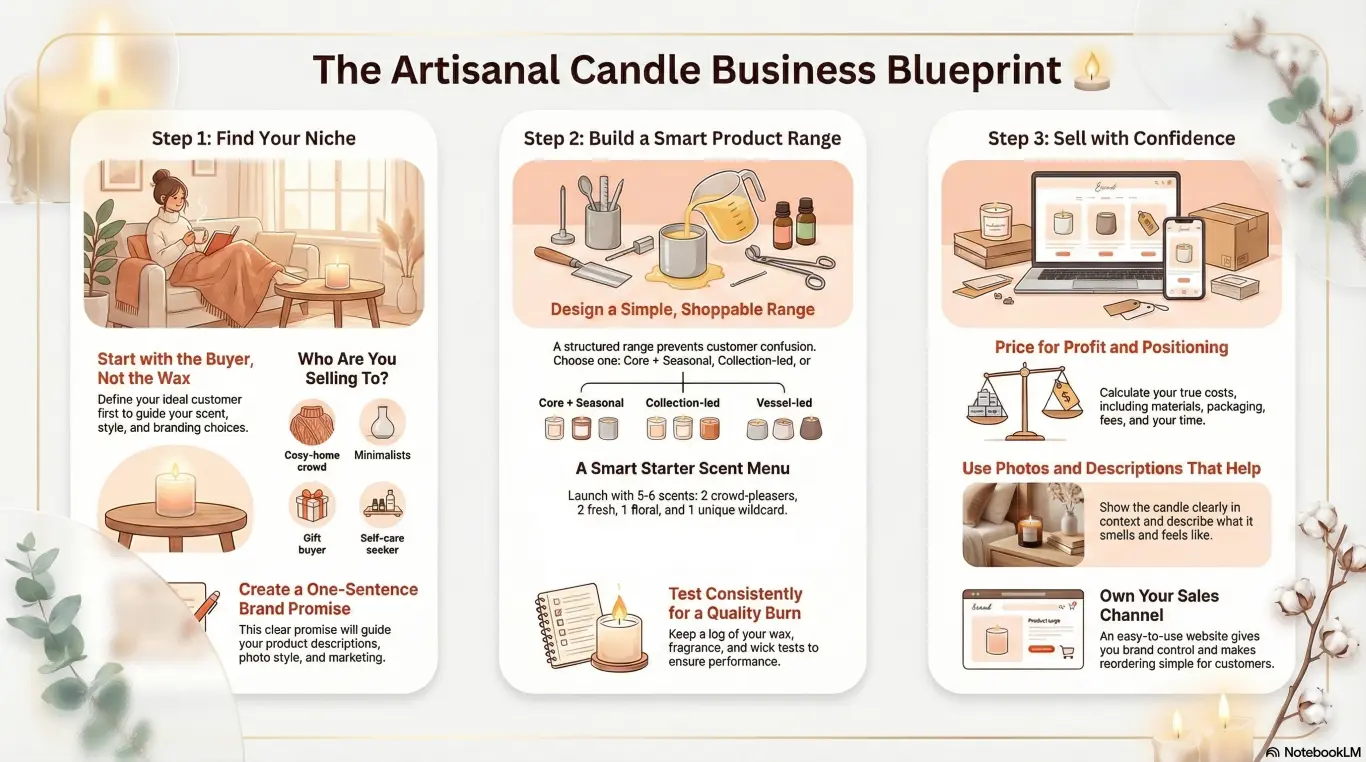
Most beginners choose a wax first and a customer second.
Flip it.
Ask: who’s this for, and what are they trying to feel?
Choose one main buyer type to lead with.
You can sell to others too, but your messaging should feel focused.
Customers don’t buy “a candle”. They buy what the candle does for their space.
Write a one-sentence promise you can repeat everywhere.
This promise becomes your product descriptions, your photo style, and your marketing angles.
Tip: If your shop could swap its logo with any other candle brand and still make sense, your niche is too broad. Tighten the promise.
A messy range kills sales because customers can’t decide.
A simple structure makes buying feel easy and confident.
Here are three range shapes that work well for artisanal candles:
Start small. Sell out. Restock.
It’s better than launching with 24 scents and quietly resenting your own inventory.
Your first sale might come from a pretty photo.
Your second sale comes from performance.
That means scent throw, burn quality, and consistency.
When you’re starting out, it’s tempting to do everything.
Lavender, vanilla, oud, sea salt, pumpkin spice, “fresh linen”, and something you made up called “moonlit library”.
Here’s the honest truth: your range doesn’t need to be clever.
It needs to be shop-able.

A good beginner scent strategy:
Then add seasonal scents as limited runs.
Seasonal drops give you marketing moments without forcing you to permanently stock everything.
Wick choice is where most new candle sellers stumble.
Not because it’s impossible, but because it’s fiddly and it takes testing.
Wicks affect:
If you change wax, fragrance load, vessel width, or even dye, you may need to adjust the wick.
This is why a tight range is your friend.
Testing doesn’t need to be complicated.
It needs to be consistent.
Create a basic test log and stick to it.
You’re aiming for a candle that performs well in normal homes, not a lab-perfect burn that only works in perfect conditions.
Candle buyers have wildly different expectations.
Some want a gentle background scent. Others want their entire home to smell like a hotel lobby in 30 seconds.
Be clear in your product descriptions:
This reduces complaints and refunds, and it makes customers trust you.
Tip: Add a “scent mood” line to every candle: “Warm and cosy”, “Fresh and bright”, “Soft and calming”. It helps customers choose without overthinking.

Candles are a home fragrance product, and that comes with responsibility.
Give clear care instructions, and avoid making medical claims about scent benefits.
Keep your language grounded in experience, not promises:
Your product inserts and listings should include basic candle safety, trimming guidance, and burn time recommendations.
This isn’t just about being careful – it’s part of a premium customer experience.

If your pricing is shaky, everything else becomes stressful.
You’ll feel guilty spending on packaging, reluctant to run ads, and annoyed at every “discount?” message.
Pricing is not just maths. It’s positioning.
You need a clear cost breakdown, even if you’re starting small.
Include:
Once you know your cost, you can price confidently instead of guessing.
A tiered range helps customers self-select.
It also helps you improve your average order value without awkward upselling.
Even if you only launch with the signature jar, keep the tier plan in mind.
Discounting can work, but it can also train customers to wait.
Bundles are often a better move because they feel like value, not desperation.
Bundles also help with gifting – and candles are a gift category whether you plan for it or not.

You can have the best candles in the world and still struggle online if your presentation feels unclear or untrustworthy.
People can’t smell through a screen, so your job is to make the buying decision easy.
You don’t need gold foil.
You need consistency.
Pick:
Consistency makes a small brand feel established.
That’s what customers are looking for.
Most candle photos focus on vibes and forget the basics.
Vibes matter, but clarity matters more.
Get these shots for every candle:
Use natural daylight near a window and keep your background consistent.
That alone can make your shop look ten times more professional.
A good product description answers questions and reduces doubt.
It doesn’t waffle.
Include:
Also add one honest line that sets expectations:
Honesty sells because it builds trust.
Candle shopping gets overwhelming fast.
A simple guide page can boost conversions because it reduces decision fatigue.
You can organise it by:
Keep it short and practical.
The goal is to help someone pick a candle in under a minute.
You can sell candles in a few places: marketplaces, social platforms, local events, and your own website.
Each has a role, but your own website is where you build a real business.
Marketplaces can help you get early sales, but they can also push you into price competition.
Your own website gives you control over:
If you want repeat customers, your own shop matters.
| Channel | Best for | Pros | Cons |
|---|---|---|---|
| Your own website | Building a brand and repeat sales | Control, better storytelling, email list, bundles | You must drive traffic and build trust |
| Marketplaces | Early exposure and quick testing | Built-in shoppers, easier discovery | Price pressure, less brand control |
| Instagram or TikTok | Storytelling and product demos | Visual, personal, great for building trust | Consistency required, trends can distract |
| Local markets and pop-ups | Fast feedback and loyal local buyers | People can smell in person, easier to upsell sets | Time-heavy, stock transport, weather risk |
Candle buyers love reordering.
They find a scent they like, then they want it again in six weeks.
Your own site makes reordering simple, and it lets you suggest:
That’s how candle brands grow without constantly chasing new customers.

Setting up an online shop is rarely “just a quick weekend job”.
It’s product pages, shipping settings, payment setup, design choices, and all the bits that make a site feel safe to buy from.
If you’d rather focus on making and selling, Make Local for Global can build your ecommerce site for you.
You can book a free consultation and talk through your candle range and what your shop needs.
Or you can Get your website for £99/year and move from “planning” to “selling”.
Tip: Your website doesn’t need to be perfect. It needs to be clear, trustworthy, and easy to buy from. You can polish as you go.

Candle marketing is easier than most product categories because it’s naturally visual and emotional.
The trick is to keep it simple and repeatable.
If you try to do everything, you’ll do nothing consistently.
Choose one main channel and one supporting channel.
Consistency beats intensity.
Two good posts a week for six months beats ten posts in one week and then disappearing.
People buy candles when they can imagine them in their life.
Give them that picture.
Make these formats once, then repeat them with different scents.
That’s how you keep marketing sustainable.
Email is boring in the best way.
You’re not fighting an algorithm. You’re talking to people who already like what you do.
Simple emails that work for candle sellers:
Keep emails short, human, and useful.
And always include a clear way to shop.
Don’t aim for viral.
Aim for the first 20 customers who genuinely love your candles.
Those customers give you:
This is how “small candle hobby” becomes “steady small business”.

Candles are fragile, but they’re also one of the nicest products to unbox when it’s done well.
Your packaging and customer care are part of the product.
Premium does not mean expensive.
It means intentional.
People remember the feeling of opening the box.
That feeling is what makes them reorder.
Handmade businesses win trust by being clear.
Put these details where customers can find them quickly:
A simple, calm policy reduces customer anxiety.
And anxious customers don’t buy.
Candles and heat are not best friends.
If you sell through summer, think ahead:
It’s not about panic. It’s about being prepared and transparent.
If someone messages “Which scent is best for a small bedroom?”, that’s not an interruption.
It’s a sale trying to happen.
Create quick responses you can copy and tweak:
Then take the best questions and turn them into FAQ entries and product page lines.
Your customers will tell you what to write, if you listen.
It can be, especially because candles are giftable and people reorder scents they love.
The key is to avoid competing purely on price by having a clear niche, a consistent range, and product pages that make choosing easy.
If your brand feels focused and trustworthy, you’ll find your customers.
In most shops, warm cosy scents and fresh clean scents tend to do well because they suit lots of homes.
Think of your range as a balance: a few crowd-pleasers plus one signature scent that feels like you.
Seasonal limited editions can also drive bursts of sales without bloating your permanent stock.
Start with your real costs, including packaging, shipping materials, and payment fees.
Then price for a profit that makes the work worth it.
Tiered options and bundles help you increase order value without needing constant discounts.
Focus beats novelty.
Stand out by being the candle brand for a specific person and a specific mood, with a tight range that’s easy to shop.
Consistent visuals, clear descriptions, and a reliable burn experience will do more than gimmicks ever will.
A website makes it easier for people to buy without messaging you, and it helps you build a business you control.
It also supports reorders, bundles, and email marketing – which are gold for candle brands.
If you don’t want to build it yourself, you can book a free consultation with Make Local for Global, or Get your website for £99/year and get set up without the tech stress.
If you want momentum, keep it practical.
Here’s a plan you can actually follow.
Selling artisanal candles isn’t about being the loudest brand online.
It’s about making a product that performs, presenting it clearly, and giving customers a calm, trustworthy way to buy and reorder.

PREFERRED SOURCE
Like what you’re reading? Add Make Local for Global as a preferred source on Google to see more of our articles when you search.

Build your online presence without having to figure out everything yourself.