

READY TO SELL bike accessories ONLINE?
Get a store built for you in 5 days, plus training and support to help you start, run, and grow your Alternative business.

Learn how to choose bike accessories for a focused online range, test fit and quality, calculate full order costs and run a practical 30-day launch.


Bicycle accessories can give a small shop a useful starting point: many are compact, easy to explain and naturally grouped around a type of ride. The hard part is choosing products that fit real bikes, arrive in good condition and leave enough contribution after delivery, fees and returns.
A sensible first range is built around one rider and one job. Start with a few compatible products, test samples on real bikes, and calculate the full cost of each order before placing a larger stock order.
Make Local for Global helps small businesses present products online and give customers a clear route to enquire or buy.
“Bike accessories” covers products with different buyers, fit questions and price points. A commuter who rides after work has different priorities from a touring cyclist carrying luggage or a parent setting up a child’s first bike.
Pick one group to test first. Write down where they ride, what problem keeps appearing, what bike equipment they already own, and what they would need to check before buying. This makes your product pages and sample tests more precise.

These are starting points, not fixed rules. Ask potential customers what they ride and what they have bought recently. A short local survey, a small pre-order interest page or conversations at a cycling group can reveal which problem is worth testing. Do not treat likes as proof that people will pay.
A small shop does not need every accessory category on day one. Begin with a core item, a related add-on and one higher-value option. Each product should make sense to the same type of rider and share a clear buying reason.
| Range role | Example | Question to answer |
|---|---|---|
| Entry | Compact bell or reflective ankle band | Does it solve a simple, easy-to-show need? |
| Core | Front and rear light set | Can you explain fit, use and included parts clearly? |
| Higher value | Water-resistant pannier with a matching rack strap | Can the added value be seen in materials, capacity or mounting? |
| Bundle | Commuter visibility set with lights and reflective bands | Does the set save the customer a choice without hiding the price? |
Examples are product-planning prompts, not claims about a specific model.
A bundle works when the items solve related needs and fit together. A light set with a spare mounting strap may be practical; a random mix of a bell, bottle and phone holder may be harder to justify.
Show the contents, individual prices and bundle price. Keep each component available on its own if customers have different equipment. Check whether a bundle needs a larger parcel, extra packing or a different postage band before advertising a saving.
Request samples before committing to a minimum order. Ask suppliers for product dimensions, materials, compatible fittings, instructions, care notes, replacement-part availability and the process for handling faults. For lights or powered accessories, ask for the exact battery type, charging details and relevant product documentation.
Test a sample on more than one suitable bike setup. A handlebar strap that fits one bar may slip or fail to close on another. A pannier hook may not match every rack. Make the limits visible in the listing instead of relying on a vague “fits most bikes” claim.

If a product fails, pause the order and ask the supplier for a remedy or an updated sample. Keep a copy of the exchange and the product documentation. If you sell protective equipment, give that category a separate safety and compliance review; the earlier MLFG article on selling bicycle helmets online covers the extra trust and product-information questions that come with helmets.
A product that looks profitable at wholesale can leave little contribution after fulfilment. Add the purchase price, inbound freight, packaging, payment and marketplace fees, outbound delivery, a returns or fault allowance, and any paid customer acquisition cost.
Consider this illustrative example for one light set sold for £39.99 with standard delivery included. The shop is assumed not to be VAT registered, and the figures are placeholders rather than supplier quotes.
| Per-order item | Illustrative cost |
|---|---|
| Light set purchase price | £14.50 |
| Share of inbound delivery | £1.50 |
| Protective packaging | £1.30 |
| Payment and selling fees | £1.60 |
| Outbound postage | £3.50 |
| Returns and fault allowance | £1.50 |
| Customer acquisition cost | £3.00 |
| Total variable cost | £26.90 |
| Selling price | £39.99 |
| Contribution before overheads | £13.09 |
Illustrative arithmetic: £39.99 − £26.90 = £13.09 per order. Replace every estimate with your own quote and actual fee. This is not net profit; it excludes fixed costs, tax and any VAT due.
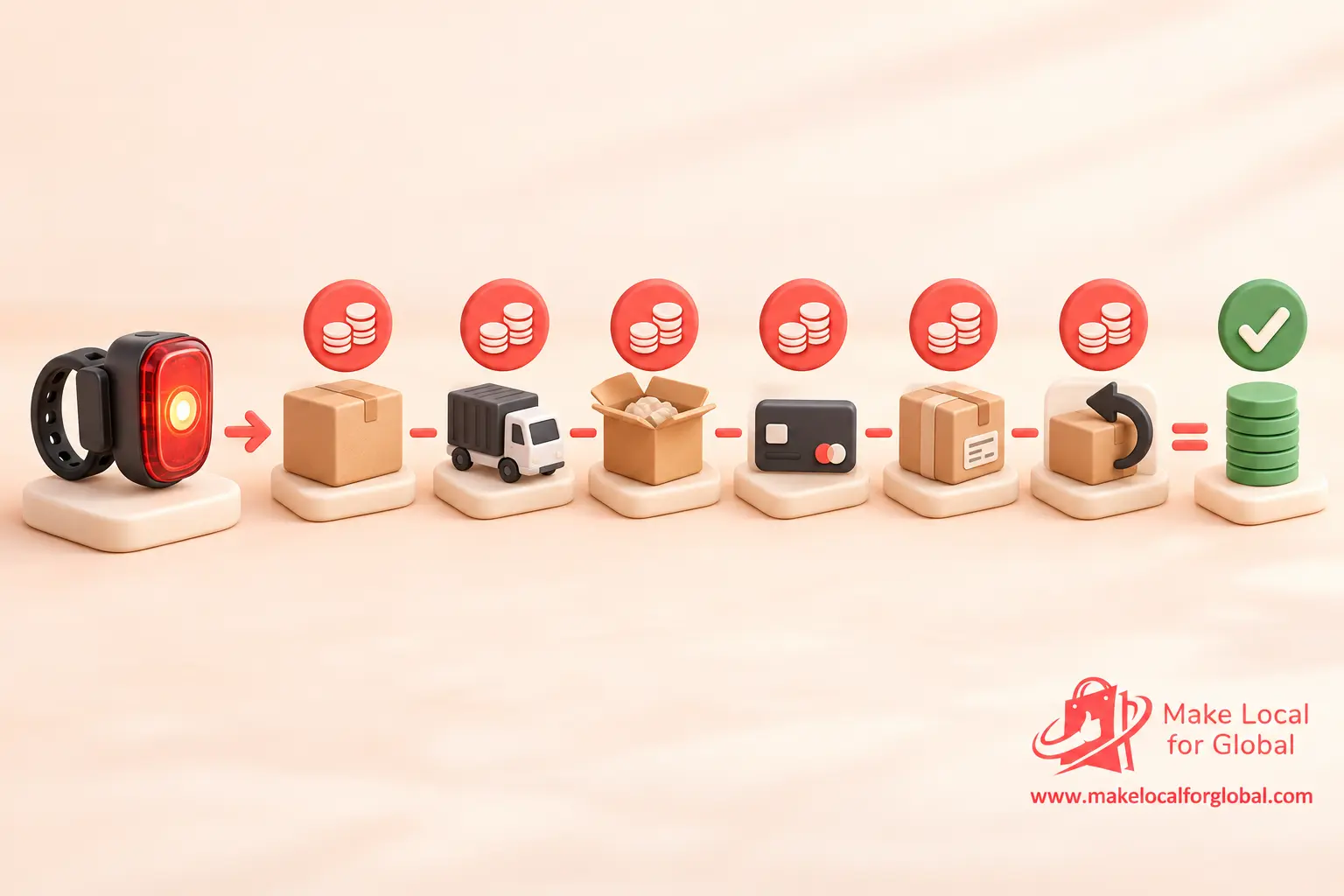
Run the same calculation for a bundle and for a return. If shipping two products pushes the parcel into a higher band, the bundle may cost more to send. If a returned light cannot be resold as new, the allowance needs to reflect that risk.
VAT treatment depends on the business and its circumstances. Check current HMRC guidance before setting prices or deciding whether to register. A contribution figure is a decision aid, not a promise of profit.
A well-structured online shop can show compatible products, product details and a direct route for customer questions.
Accessory buyers need more than a flattering photograph. They need to know what arrives, what bike it fits, how it attaches and which measurements to check. Add clear photos from more than one angle, a scale reference and a close-up of the fitting.
Title: “Water-resistant rear pannier, 18 litre, rack-hook fitting” is more useful than “Premium Cycle Bag”.
Description: State the intended use, outer material, capacity, dimensions, colour, closure, included straps, care advice and what is not included. Explain how the rack hooks adjust and ask buyers to compare their rack width and rail shape with the product measurements.
Photos: Show the bag open, closed, attached to a compatible rack, beside a common scale reference and with the included parts laid out. A short demonstration can show how a buckle closes without implying waterproof performance that has not been tested.
Useful questions: “Will this fit my rack?”, “What is the stated capacity?”, “Are mounting straps included?” and “How do I clean it?” Add answers from the supplier documentation and your sample check.
Use precise compatibility language. If the supplier lists specific rack types, repeat the verified list and name known exclusions. Avoid “fits all” unless you can support that statement.
A marketplace can provide an existing search audience, but fees, listing rules and competition affect the order calculation. Your own shop gives more control over product education and bundles, but you need a plan to bring likely buyers to each product page. Many small sellers test on one marketplace and one focused shop page rather than opening every channel at once.
Rules depend on what you sell, where it is supplied and your role as maker, importer, distributor or retailer. Keep supplier identity, product specifications, warnings, instructions and batch details together so you can answer a customer or respond to a safety concern.
For Great Britain, the Office for Product Safety and Standards explains duties under the General Product Safety Regulations 2005. Northern Ireland follows a different regime: the UK guidance notes that EU Regulation 2023/988 replaced those regulations there from 13 December 2024. Check the rules for your role and destination market before selling.
For bicycle lights and reflectors, the GOV.UK guidance on pedal-cycle lighting in Great Britain explains what a cycle used between sunset and sunrise must carry, including a white front light, a red rear light and reflectors. It says lights do not have to be fitted at the point a bicycle is sold, but lights that are fitted must meet the applicable rules. Do not describe a light as road compliant without checking its exact model and evidence.
Online orders to consumers have cancellation and information rules. Read the current GOV.UK distance-selling guidance and the product-specific rules for the places you serve. Make your business contact details, delivery timing, cancellation process and returns information easy to find.
Packaging obligations can depend on turnover, tonnage and packaging activity. GOV.UK sets out the current conditions for small producers under packaging EPR; check whether your business meets them rather than assuming a small parcel seller is exempt.
Pack accessories so they cannot rub against one another or damage a bike frame in transit. Protect light lenses, separate metal fittings from soft goods, and include the supplier’s instructions where appropriate. Trial-pack the largest item in your proposed range and measure the finished parcel before choosing a postage service.
Keep a simple record of product code, supplier batch, order date, dispatch date and reported fault. For returns, ask what did not fit or what was unclear. Repeat reasons such as “strap too short” or “rack hook incompatible” point to a specification problem, not a customer problem.
A short test can show whether the chosen rider group recognises the problem and whether the numbers work. Keep the first test narrow enough to learn from each question and order.
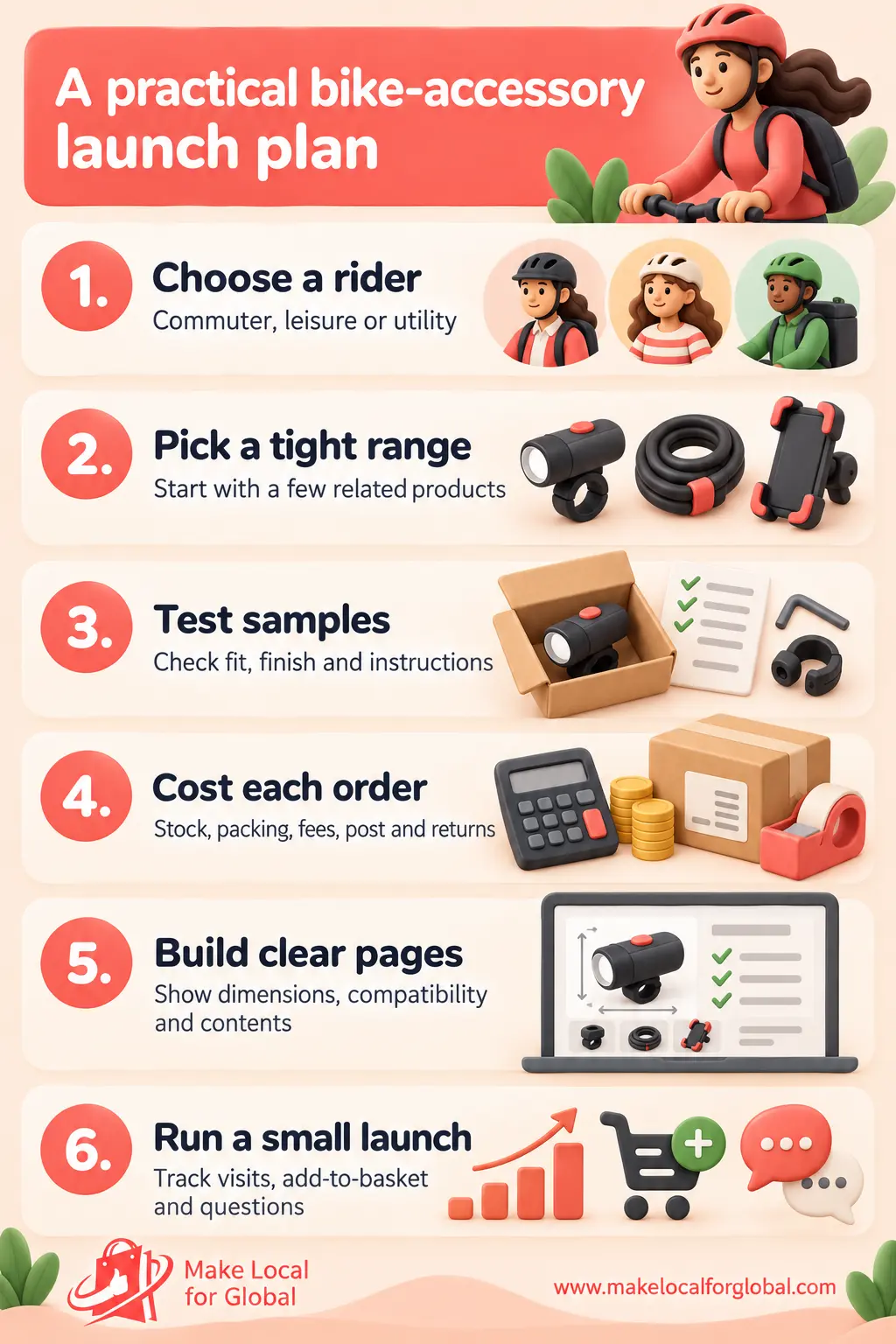
Choose one rider group and list three recurring accessory needs. Contact suppliers for samples and written specifications. Record the questions you still need answered.
Check sample fit, fastening, finish and instructions. Measure the packed parcel. Fill in the cost table with real quotes, fee rates and a returns allowance. Drop any item whose claims or contribution cannot be supported.
Prepare clear product photos, specifications, compatibility notes and delivery information. Ask two or three likely buyers to find the dimensions, included items and return route without help. Fix the page wherever they hesitate.
Send a small, relevant audience to the product pages. Record visits, questions, baskets, orders, fulfilment time and contribution. Decide whether to keep the range, revise the page, change the product or stop the test. Set the next stock order from observed demand and cash available, not from clicks alone.
Choose a small group that fits one rider and one use case, such as commuter lights with reflective accessories or touring bags with repair items. Test fit and calculate a complete shipped-order cost before expanding.
Not every accessory has size variants, but straps, bags, mounts and clothing can depend on measurements. Start with models whose fit can be described and checked, and name any limits on the page.
Yes, but check the exact model, instructions and claims before listing it. Great Britain has requirements for lights and reflectors on cycles used after dark; Northern Ireland rules and market duties should be checked separately.
There is no single figure. Your starting budget depends on sample costs, minimum order quantities, delivery, packaging, platform fees and how long cash is tied up in stock. Test the arithmetic with supplier quotes before committing.
A marketplace can bring existing search traffic but charges fees and sets listing rules. Your own website gives you room to explain compatibility and connect product guides to listings, but you need a way to attract suitable visitors. Compare the full cost and learning value of each channel.
Start with one rider group, a small set of compatible accessories and a cost sheet based on real figures. Clear measurements, honest limits and useful sample checks can help customers choose with fewer surprises.
Make Local for Global works with small businesses on website design and online presentation. Get in touch to discuss what your shop needs.
PREFERRED SOURCE
Like what you’re reading? Add Make Local for Global as a preferred source on Google to see more of our articles when you search.

Build your online presence without having to figure out everything yourself.