READY TO SELL Car Seats ONLINE?
Get a store built for you in 5 days, plus training and support to help you start, run, and grow your Alternative business.

Learn how to sell car seats online with new stock, approval checks, vehicle-fit details and a clear plan for delivery costs.


To sell car seats online, start with new, traceable products and build each listing around its exact approval label, child height or weight range, fitting instructions and vehicle compatibility information. Add the packed delivery cost before you set a price.
Parents and carers need clear facts before buying a child restraint. A listing that promises universal fit or leaves the approval details unclear can create safety concerns, costly returns and lost trust. Make the product evidence easy to check, then test the parcel you plan to send.
Compare likely buyers, supplier terms and the cost of a small first range.
“Car seat” can mean an infant carrier, a convertible restraint or a high-back booster. Start with one buyer and use case. A new parent choosing a first seat may need different information from a grandparent fitting a restraint across two cars.
Speak with five likely buyers before you approach a wholesaler. Ask what information they could not find last time, which vehicle details they know and what made them contact a retailer. Use the answers to choose the first seat type and the questions your product page must answer.
A focused range is easier to check than a catalogue of near-identical seats. Compare a few new models whose documents, supply route and customer fit information you can verify. The table is a planning example: the manufacturer’s age, height, weight and use limits take priority for each item.
| Range role | Possible product | Checks before listing | First stock decision |
|---|---|---|---|
| Entry | One new infant carrier model | Approval label, height range, base options and vehicle list | Sample one model and finish |
| Core | One convertible child seat | Approved orientation, height or weight limits, fitting route | Use as the main comparison product |
| Add-on | One high-back booster model | Approved size range, belt path and vehicle guidance | Add after supplier and fit checks pass |
Illustrative range only. Confirm approval, intended use and compatibility for the exact model and market.
Buy through the manufacturer or a traceable distributor. Ask for the exact model code, approval information, product manual, batch or serial identification, named importer where relevant, warranty terms and the process for product alerts or recalls. Confirm that the stock and paperwork cover the same model and destination market.

GOV.UK explains that approved height-based seats carry an E mark in a circle with R129, and approved weight-based seats carry an E mark in a circle with ECE R44. Check the label on the actual product and ask the supplier to resolve any mismatch before creating a listing. Read the current GOV.UK child car seat rules.
Product safety duties depend on your role in the supply chain and where you sell. The Office for Product Safety and Standards provides separate guidance for Great Britain and Northern Ireland. Its business overview explains records, product information and action when a safety issue appears. Ask a product-safety adviser about importing, own-brand products or a market outside Great Britain.
The Office for Product Safety and Standards advises consumers not to buy second-hand baby car seats: a crash or damage may compromise structural integrity without visible signs. That makes used stock a poor foundation for a safety-led shop. Read its second-hand product guidance and avoid marketing a used seat as safe on the strength of a seller’s memory or a clean exterior.
Set a written rule for customer returns and damaged parcels. Record the model and item identification, inspect a returned product against the maker’s condition requirements, and ask the manufacturer for advice when the item’s history or integrity is uncertain. Do not put a doubtful seat back into saleable stock.
A restraint can be approved and still be unsuitable for a particular vehicle or seating position. Ask suppliers for the current compatibility list and the manufacturer’s fitting route. Point shoppers to the vehicle handbook, the child seat manual and any official fit checker for the exact model.

For useful examples of adjacent product research, compare the range-planning work in MLFG’s earlier articles on selling baby swings online and selling car organisers online. Each product needs its own evidence and fit checks.
Car seats are bulky parcels, so weigh and measure the boxed product before setting a delivery charge. Include supplier cost, inbound freight, outer packaging, carrier charges, payment fees, customer acquisition and a reserve for returns or transit damage.
| Illustrative order at £349.99 | Cost |
|---|---|
| New seat and inbound freight share | £192.00 |
| Protective packaging | £8.00 |
| Seller-paid delivery | £16.00 |
| Example payment fee | £6.10 |
| Returns and damage reserve | £18.00 |
| Customer acquisition test | £20.00 |
| Total variable costs | £260.10 |
| Contribution before overheads, labour and tax | £89.89 |
Illustration only for a seller not registered for VAT: £349.99 less £260.10 = £89.89 contribution before fixed costs, labour and tax. Replace estimates with supplier, carrier and payment-provider quotes. This is not a profit forecast.
Payment fees vary by provider and account terms. A VAT-registered seller needs to calculate the sale and reclaimable input VAT under their own setup. Speak with an accountant about VAT, import duty and tax treatment before you set the live price.
Record the approved range, fit details, parcel measurements and first order costs in one brief.
Use the exact brand and model name, then add the approved size range where that wording matches the product label. Make the first screen answer the main purchase questions:
Do not claim a seat fits every car or every child. Do not promise a safety outcome. If the buyer’s vehicle is not listed, refer them to the manufacturer rather than guessing. Keep the listing, manual link and support script in sync when the supplier changes a model or document.
Keep the manufacturer’s box and protective pieces in the condition required for safe transport. Ask the supplier how the seat should be stored and shipped, then pack a sample order in the same outer carton you will use for customers. Measure the finished parcel and confirm the carrier accepts its size and weight.

Write down the parcel dimensions, carrier service, collection cost and tracking process. Check how the carrier handles a damaged box and what evidence you need from the customer. The rules for online orders include information about price, delivery and cancellation rights; read the current GOV.UK distance-selling guidance before publishing returns terms.
A marketplace can help you test one product listing beside similar offers, with platform fees and customer-service rules included in the sums. Your own shop gives space for a vehicle-fit explanation, model comparison and manufacturer documentation. Start with one primary channel and record product views, fit questions, completed orders, delivery costs and return reasons.
Build search content around genuine questions such as “R129 child car seat height range”, “ISOFIX car seat compatible with [vehicle model]” or “how wide is [exact seat model]”. Use the precise manufacturer wording, keep any fit result current and link related support content to the exact product it describes.
For more product-range ideas, browse the Product To Sell library. Keep car-seat details separate from other baby products and car accessories so shoppers can find the safety information they need.
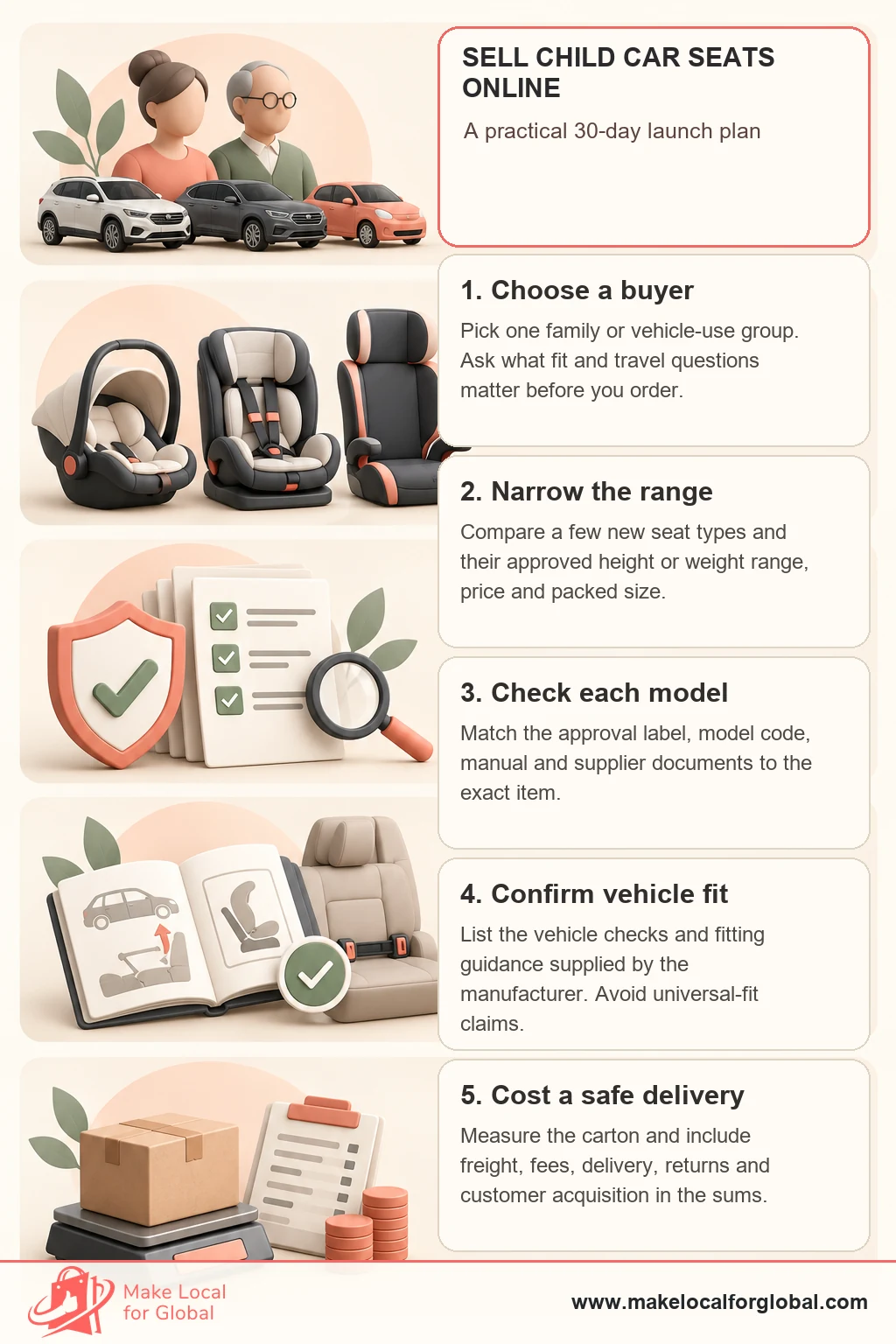
At day 30, use buyer questions and order records to decide whether the range or the product information needs work. Do not increase stock to solve an approval gap or a fit question you have not answered.
OPSS consumer guidance warns against buying second-hand baby car seats since damage from an accident may not be visible. A new-stock range with traceable supplier records is a safer basis for a retailer. Ask a product-safety adviser before considering used items.
GOV.UK identifies an E mark in a circle with R129 for approved height-based seats and an E mark in a circle with ECE R44 for approved weight-based seats. Check the exact product label and current rules for the market where you sell.
No. Use the seat manufacturer’s compatibility information and the vehicle handbook for the exact model and seating position. Send shoppers to the manufacturer if the vehicle is not listed.
Describe the installation steps only from the current manual and avoid broad promises. Link to the maker’s fitting material and suggest a qualified fitting check when the customer needs individual help.
Include the measured carton, carrier service, collection or fulfilment fees, outer packaging and a reserve for returns or damage. Recheck the quote when the carton, carrier or service changes.
Turn the approved product details, supplier records, vehicle information and delivery quote into a clear shop plan. MLFG’s website brief can help organise the pages and information a shop needs. For help planning the next step, contact MLFG.
PREFERRED SOURCE
Like what you’re reading? Add Make Local for Global as a preferred source on Google to see more of our articles when you search.

Build your online presence without having to figure out everything yourself.