READY TO SELL Dog Jackets ONLINE?
Get a store built for you in 5 days, plus training and support to help you start, run, and grow your Alternative business.

Learn how to choose a focused dog jacket range, check fit in motion, test samples, price each order and build product pages that reduce sizing uncertainty.

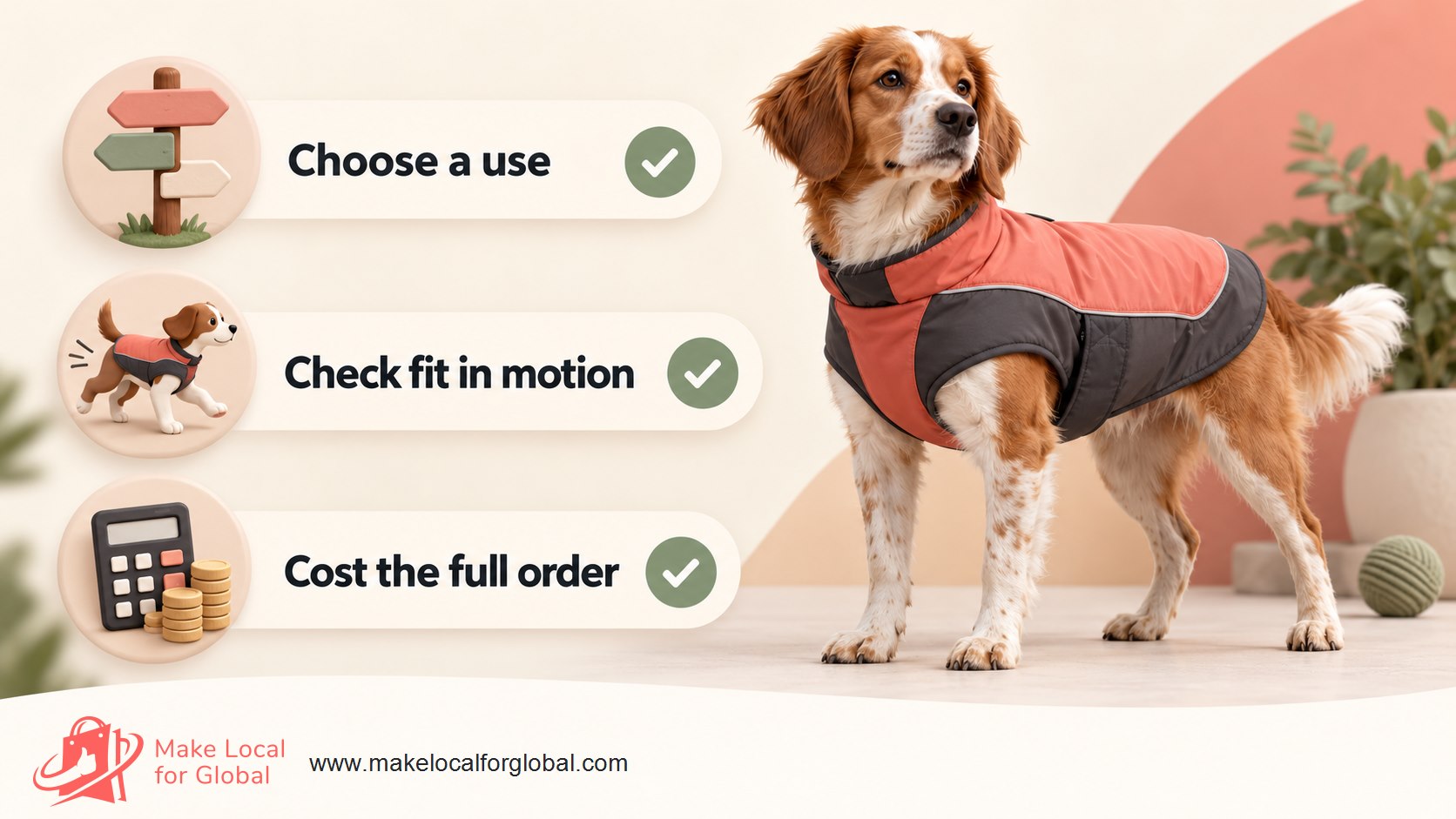
Selling dog jackets online rewards clear product decisions more than a large catalogue. A buyer wants to know what kind of jacket it is, how it should fit, whether it suits the walk they have in mind, how to care for it and what happens if the size is wrong. A useful shop answers those questions with measurements, honest product evidence and a straightforward returns process.
To sell dog jackets online, begin with one customer group and one use case, then choose a small set of jacket types you can sample and explain well. Fit each sample against the maker's measurement chart, check movement, verify every material and product claim, calculate the full order cost and photograph the details that help a buyer choose. Use the first launch to learn which sizes, features and questions deserve more stock.
Give dog owners useful size details, product photographs and delivery information before they choose a jacket.
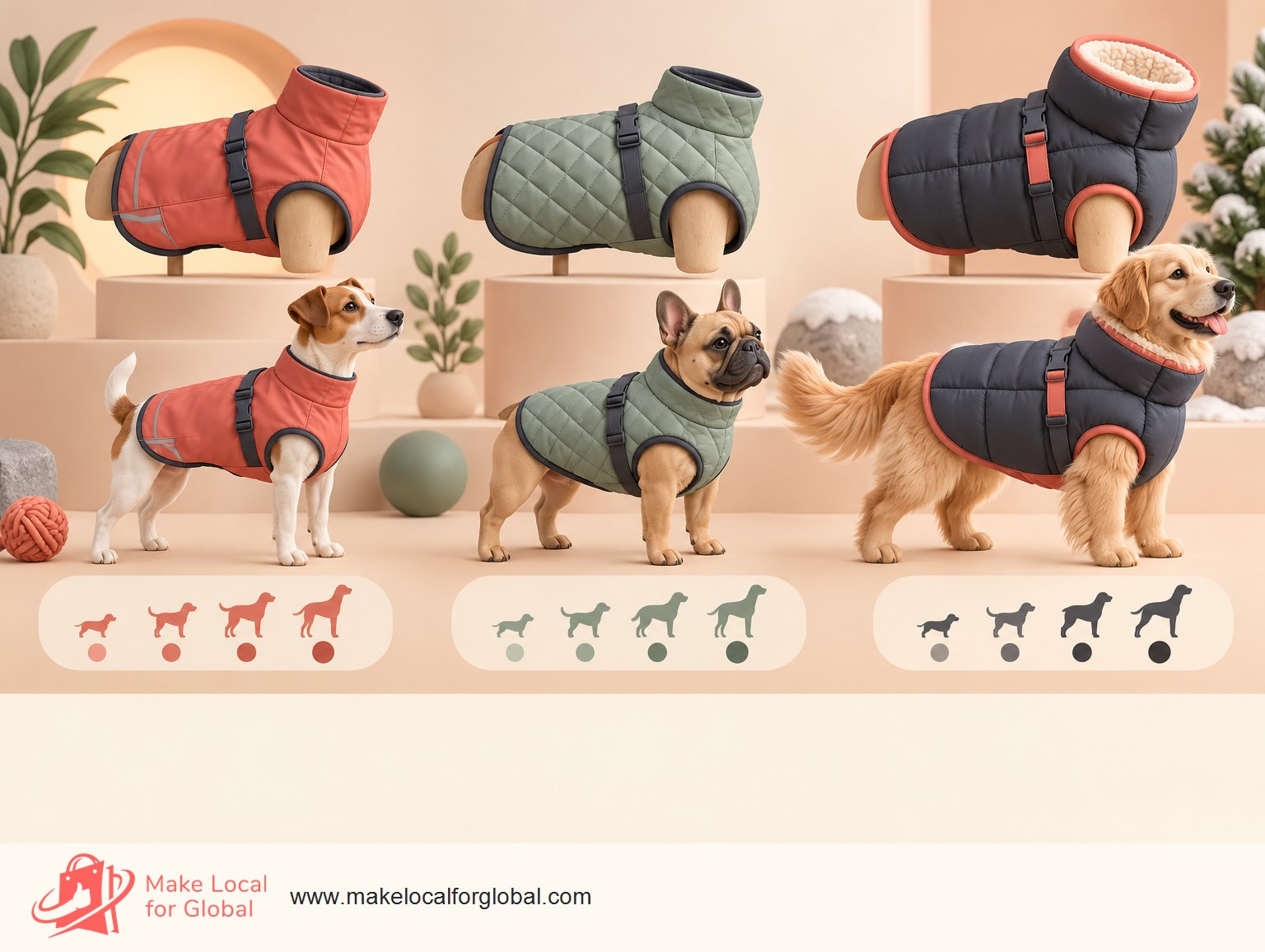
The phrase “dog jacket” covers several different garments. A light shell, a quilted everyday coat and a thick insulated layer do not solve the same problem. Buyers can become unsure when a listing calls every item a winter coat, raincoat and all-weather jacket at once.
Start by defining the job each product has been tested to do. This keeps the range focused and stops your copy from promising more than the sample can show.
A shell jacket may provide a light outer layer, with its weather protection depending on the face fabric, seams, closures and test evidence. An insulated coat adds fill or a thicker lining for cooler conditions. A softshell may combine stretch and a closer fit. A fleece-lined garment adds warmth but may hold moisture differently from a thin shell.
Raincoats are a narrower category centred on keeping water off the dog's coat. Dog life jackets are buoyancy products with separate construction and safety considerations. Sweaters are usually knitted or fleece layers, and dog boots cover the paws. Decide whether the store will sell jackets only or a broader clothing range, then name each product according to its main use.
The distinction matters for search and for returns. A person searching for a waterproof dog raincoat expects tested water protection. A customer looking for an insulated jacket may be comparing lining, coverage and ease of fastening. Product names should answer that intent without blending categories to collect extra clicks.
For related product planning, read MLFG's pages on selling dog raincoats online, selling dog sweaters online, selling dog life jackets online and selling dog harnesses online. Use these as separate offers if your supplier can support distinct specifications and sizing.
Use cases might include a light layer for brisk walks, an insulated garment for cold-weather outings, a close-fitting softshell for active movement or a reflective style for low-light visibility. These are starting points for product selection, not proof of warmth, weather resistance or visibility performance.
Write a one-sentence position for the first range: “We sell [type of dog jacket] for [specific owner or activity] who need [verified feature].” For example, a shop could focus on simple, easy-fastening jackets for urban dog owners, with size instructions and clear photographs of the lead opening. That promise is more useful than “coats for every dog”.
List what the sample must prove before the claim appears in the listing. A water-resistant finish needs a supplier specification and an agreed test method. A reflective panel should be shown in the correct light and described without implying certification. “Fits most breeds” is not a test result; a chart tied to the product's own measurements is better evidence.
Dog owners do not all shop for the same reason. Some want a garment for a short-coated dog, some want an easy layer for a daily routine, and others care most about style, packability, fastening or cleaning. Build a picture of the customer by asking what they already do and what frustrates them, rather than asking whether they like your idea.
Choose a primary buyer for the first test and two secondary situations to keep in view. A narrow first audience makes it easier to choose jacket features, photos and search phrases.
| Buyer situation | What the person may need to know | What your test can learn |
|---|---|---|
| Owner of a short-coated or small dog | Coverage, fit around the chest, ease of putting it on | Which measurements and fastening steps cause uncertainty |
| Owner who walks in changeable weather | Layer type, care instructions, packing and drying | Whether shell or insulation matters most in the chosen segment |
| Style-led gift buyer | Colours, sizing help, exchange process and packaging | Whether gifting demand justifies gift options or a broad colour range |
Treat these as hypotheses, not facts about all owners or breeds. Speak to people who match one situation, ask what they have purchased, and record the words they use for the problem. A person who says “the coat twists when my dog runs” has given you a more useful lead than a survey response that says “nice colours”.
Interview 8 to 12 dog owners from the same audience. Ask what they bought last season, which size they chose, what they returned or stopped using and what they check before paying. Avoid leading questions such as “Would you buy my jacket?” People are often polite; past actions and current workarounds are better evidence.
Build a simple landing page for one clear product family. Show a real sample or accurate prototype, state the proposed price range and explain the fit information you plan to provide. Measure visits, email sign-ups, requests for size advice and checkout starts. Do not take pre-orders if you cannot meet the promised delivery date and refund obligations.
Check search suggestions and marketplace listings for phrases such as “dog jacket with lead opening”, “warm dog coat size guide” or “reflective dog jacket”. These phrases can suggest questions to answer; their presence does not prove demand or sales volume. Record the date and location of checks; search results change.
Look at competing offers for differences you can verify: the number of measurements in the chart, jacket length, belly coverage, fastening type, washing instructions, availability of replacement straps and the quality of product photographs. Avoid copying their claims, product descriptions or images. A competitor's review count is not proof that its products perform as described.
Use a decision rule before spending on inventory. For example, move to sample testing only if at least six interviewed owners describe the same unresolved fit or product-information problem, or if a small landing-page test attracts a defined number of relevant sign-ups. Choose the threshold before you run the test so you do not reinterpret weak results as success.
An opening range should be broad enough to test a real customer need and narrow enough to measure. A large size and colour matrix ties up cash in combinations you cannot yet predict. Start with one construction, a limited set of colours and the smallest size run that still fits the body measurements you intend to serve.
For a small launch, consider one everyday shell and one warmer jacket from a supplier whose patterns, size charts and care instructions you can verify. If budget only supports one style, choose the style that best answers the strongest buyer problem. A distinct product family should have a clear reason to exist, such as an easy-on fastening or a longer back panel.
Avoid launching ten colours of one untested pattern. Three colours across eight sizes create 24 stock combinations before you add a second style. A single colour across six sizes creates six. The leaner version lets you see whether the fit and demand merit expansion.
Use names that tell the buyer the practical distinction. “City Shell” and “Quilted Layer” may work if the product details support those descriptions. Names such as “Arctic Pro” can imply a temperature rating or technical performance that the product may not have.
Do not use breed names as the only sizing method. Dogs of one breed can differ in chest, back length, neck and body shape. A product chart should tell the buyer which points to measure, how to hold the tape, whether the dog should stand naturally and how to interpret a result between sizes.
Keep the first matrix tied to evidence from the sample fit sessions and supplier chart. If a supplier offers six sizes but the sample shows the smallest two sizes share a pattern that pulls at the chest, pause those sizes and ask for a revised pattern or a clear fit note. Do not buy a size run only on the strength of a standard factory pack.
Use colour to make stock easier to manage. One core neutral plus one visible accent can support a coherent launch. Photograph every colour accurately in daylight and note that screens vary; never use a colour swatch as the only evidence of the actual fabric.
Ask whether the supplier can repeat the same pattern, fabric, colour and measurements in a later production run. Check the lead time and minimum order quantity for repeat orders, not only the first order. If the supplier changes fabric mills or fit blocks between runs, your size chart and product photography may no longer describe the replacement stock.
Set reorder triggers before launch. A simple rule might be: reorder only when a size sells through at the expected rate, fit-related returns remain below a chosen threshold and the contribution after delivery and payment costs is positive. The threshold belongs to your own plan; it is not a universal dog-apparel benchmark.
The word “jacket” does not tell a buyer what the garment feels like or how it should be cared for. Ask the supplier for the exact fabric, lining, fill, closure and trim details. Keep product copy tied to that record.
An outer shell may be woven polyester, nylon or another material. The fibre name alone does not describe how the material behaves. Construction, coating, seam treatment and care can change the way a garment handles moisture, friction and washing.
Insulation may be a synthetic fill, fleece or another lining. Ask for the material specification, fill weight if available and how the lining is attached. Do not translate a fill weight into a warmth rating unless the supplier supplies a credible basis and the product has been tested under the conditions you plan to claim.
Stretch fabrics can help a closer fit, but recovery after repeated movement and washing matters. Ribbed or elastic sections may feel different on a dog with a broad chest or deep body. Request a complete fabric composition and construction sheet, then inspect the sample for pilling, seam distortion and trapped loose threads.
Check the neck opening, front leg openings, belly panel, back length, closures and lead access. A garment may look attractive on a hanger yet pull across the shoulder, rub at the armpit or leave a closure pressing against the dog's body. A leash opening should line up with the collar or walking gear described in the listing.
Try each fastening several times with the sample laid flat and on the dog. Zips need a protective guard if the design requires one. Hook-and-loop tape should not catch on the coat or become clogged after repeated use. Snaps, toggles and elastic should remain secure and should not create small detachable parts that can be swallowed if they come loose.
Examine the inside as carefully as the outside. Seams that sit against skin, scratchy labels, exposed elastic and rough edges can make a dog resist wearing the jacket. Check that any label can be moved or removed safely without damaging construction, and include clear care information.
Reflective details can be a useful design feature, but do not call a jacket “high visibility” or “safety certified” without evidence that supports the term. Photograph reflective material under a sensible lighting setup and explain exactly where it appears. A bright colour is not the same thing as tested visibility performance.
Supplier selection affects fit consistency, quality control, legal responsibilities, stock reliability and the claims you can make. Request written answers and save them with the product's specification. A supplier call is useful, but a message or document gives you a record to compare against the sample and later batches.
Ask for the following before placing an order:
Ask who is responsible for checking the product before shipment, what defects they record and how they classify a garment that is safe but does not match the agreed size tolerances. Ask for permission to commission independent checks if your risk assessment calls for them.
Buying wholesale from a UK distributor can simplify small orders and communication, though the available patterns and margins may be limited. A private-label supplier may offer more control over colour and branding but can require higher minimums and more documentation. Local sewing or small-batch production may allow closer pattern development, but capacity and unit costs can be higher.
Direct importing can reduce a quoted unit cost while increasing responsibility for the import process, product records, shipping, duty and possible delays. Do not compare a factory price with a UK wholesale price as if they were the same cost. Build a landed-cost estimate from the actual quote and confirm tax, freight, customs and handling charges with a qualified source.
Order one approved pre-production sample and sign off the measurements, fabric and construction before production. If the approved sample differs from the bulk run, record the problem and resolve it before shipping or sale. A supplier's catalogue photo is not approval of the item you will receive.
Fit is one of the biggest sources of customer uncertainty in dog clothing. A chart that gives only weight or breed is weak: dogs with the same weight can have different proportions. Measure the dog and compare those measurements with the exact jacket, not a general chart from another maker.
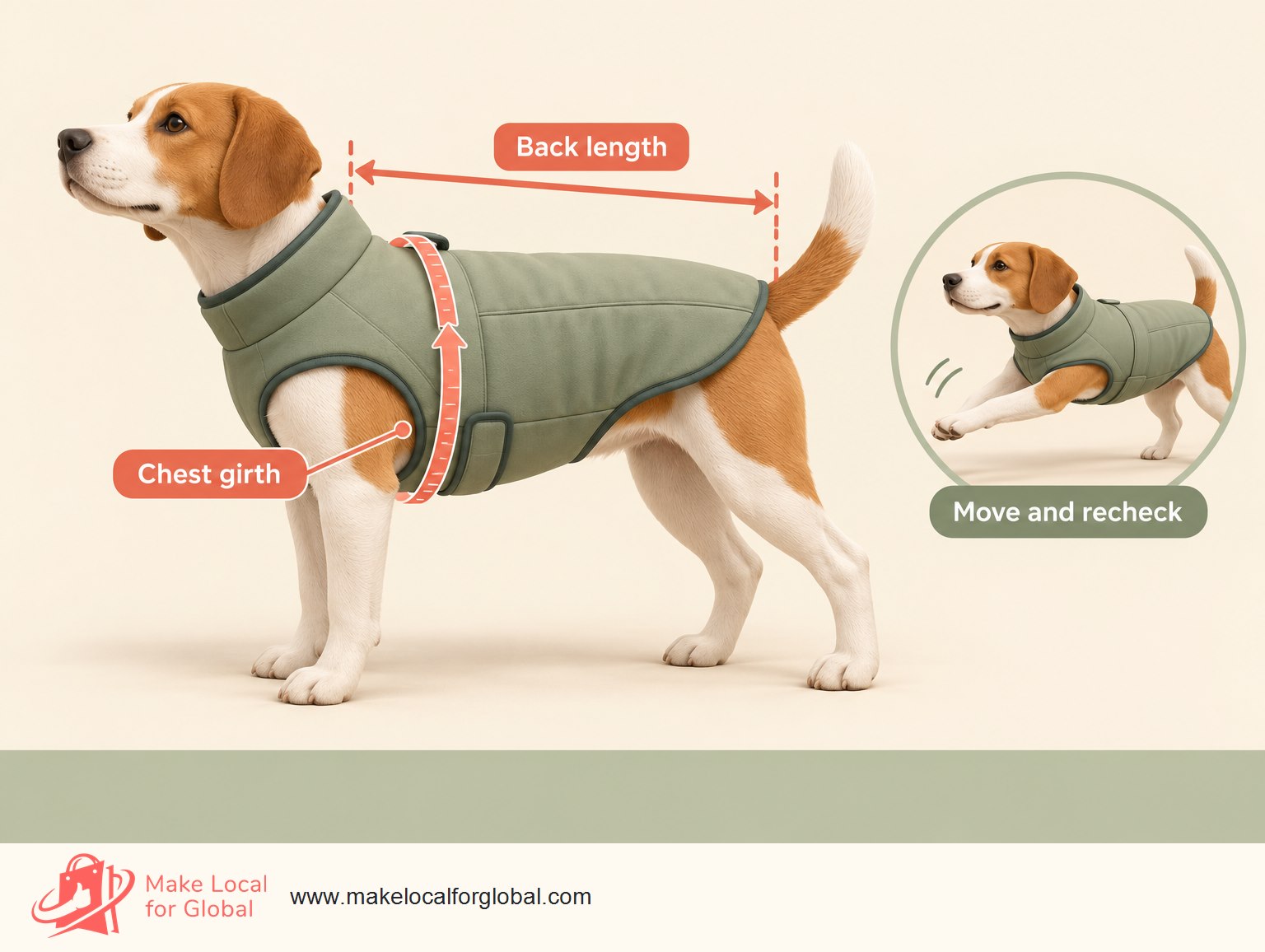
For a dog measurement session, use a flexible tape, keep it flat against the coat and avoid pulling it tight. Record the dog's chest girth at the widest part of the rib cage, the back length from the base of the neck to the base of the tail, and the neck measurement if the garment uses a close neck opening. Use the supplier's measurement instructions where they differ; the brand chart controls the recommendation for its own style.
Ruffwear's Sun Shower sizing information uses chest girth around the widest part of the rib cage. That is one manufacturer's model-specific instruction, not a universal substitute for checking your supplier's chart. Link to the exact chart for each jacket and state whether the table refers to dog body measurements or garment dimensions.
Measure more than one dog shape if the range is intended to serve different body types. A deep-chested dog, a broad-fronted dog and a long-backed dog can expose different fit issues. Use only dogs whose owners have agreed to the session, keep it short and stop if a dog shows distress or discomfort. Never force a dog to wear a sample for a photo.
Compare the garment's finished dimensions with the manufacturer's tolerances. Record the model, size, measurement point, tape method and date. Keep the dog's actual measures private; use anonymised fit notes for product development.
Observe the dog standing, walking, turning, sitting and reaching the front legs forward. Check whether the jacket rotates, pulls across the shoulders, bunches behind the front legs, covers the tail base or blocks the lead opening. Use a short, calm fitting session rather than an extended wear trial.
Run a finger around the neck and leg openings to check for obvious pressure or loose edges, while following the maker's fit guidance. Check the belly panel for coverage and clearance during toileting. A fit that looks good when the dog is still may shift as soon as it moves.
Document a fit issue in precise terms: “size M strap reaches its end on a 52 cm chest” is actionable. “M feels small” is not. Send the written observation, photographs and garment measurements to the supplier, then agree which pattern or chart will change before you list the product.
Publish a size guide with a labelled diagram, step-by-step measuring instructions and an example that uses a fictional dog measurement. Add a “between sizes” note only if the supplier has confirmed how the pattern behaves. Do not simply advise every customer to size up; extra length or a loose neck can cause a new fit problem.
State the model dog's measurements and the size shown beside each product image, with owner consent. If the photo uses a mannequin, say so and provide its measurements. Keep the instructions visible near the size selector, not only in a footer or separate policy page.
A sample checklist helps compare suppliers and catches issues before a bulk order. Use the same checklist for each style and keep the result with the supplier's specification. A nice first impression should not replace repeatable checks.
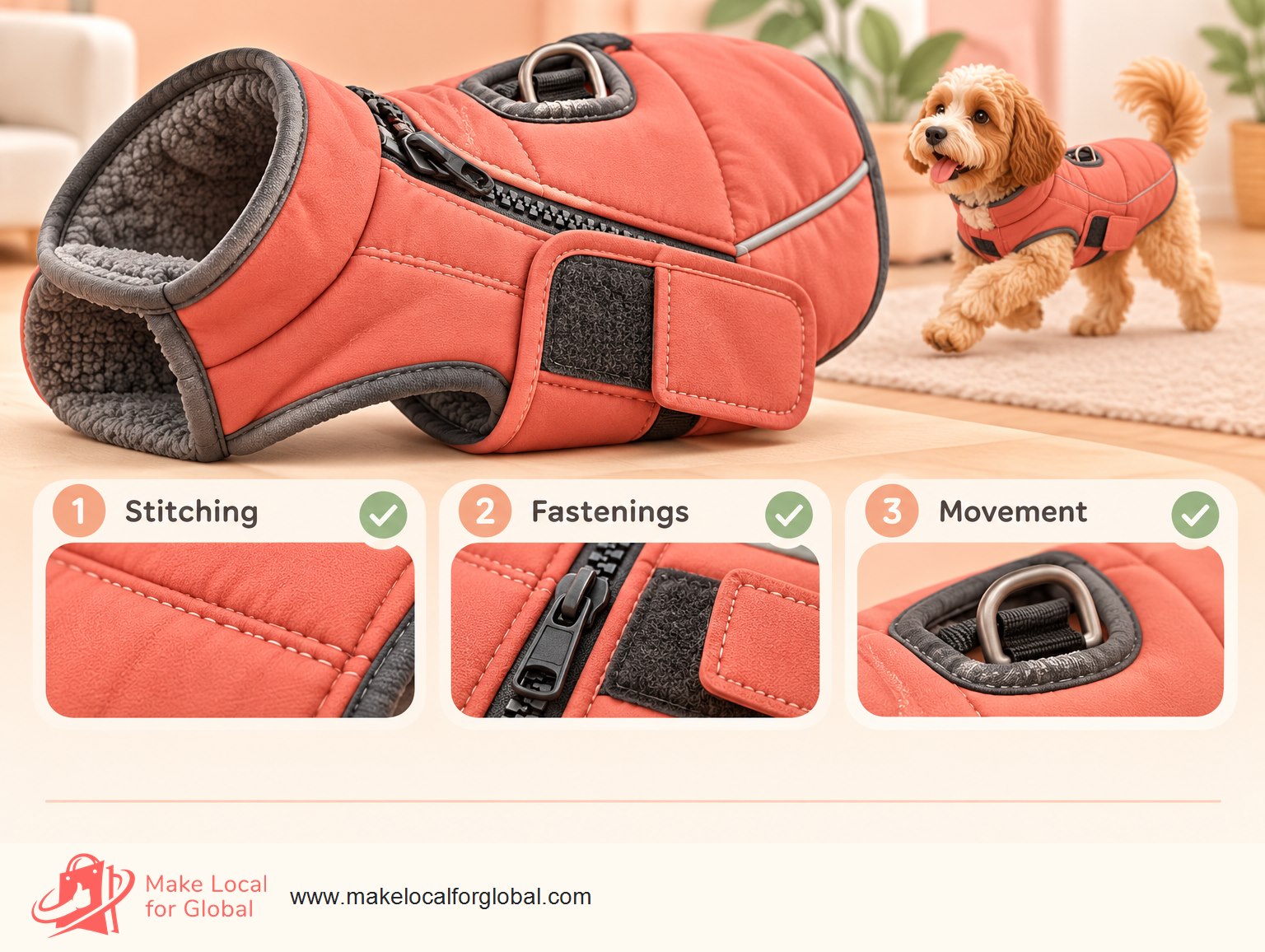
Do not test sharp hardware, detachable parts or skin-contact materials on a dog in a way that could expose it to avoidable risk. Some checks belong on a work surface or through a qualified laboratory. Ask the supplier what testing has already been done and whether the report covers the exact material and construction in your product.
Write the pass criteria before evaluating the sample. For example, a size passes if each key measurement is within the supplier's agreed tolerance, the closure stays secure through the planned handling test and the jacket does not rotate during the agreed fit movements. A claim passes only when its test evidence matches the exact model and wording.
Classify each issue as a minor correction, a pattern revision or a stop-sale risk. A loose decorative thread may be a minor correction. A zip that opens during movement or a sharp edge near the skin could require a design change. Do not sell a product while a material safety concern remains unresolved.
Retest the revised sample, not just the supplier's promise that it has been fixed. Keep dated photos, notes and the final approved sample. A clear record makes the next quality check faster and gives you a starting point if a customer reports a problem.
A dog jacket's unit cost is only one part of the cost of an order. A buyer may order one jacket, then ask for an exchange or return when the fit is uncertain. Your selling price has to leave enough contribution after the relevant costs, before overhead and tax.
The figures below are illustrative, not supplier quotes or a recommended market price. This example assumes the seller is not VAT-registered, the buyer pays £39.95 including delivery, and the seller's payment fee is modelled at 2.5% plus £0.20. Replace every figure with your own invoice, platform terms and carrier rate.
| Cost or receipt | Illustrative amount |
|---|---|
| Customer payment | £39.95 |
| Jacket purchase cost | £12.40 |
| Inbound freight allocation | £1.20 |
| Mailer and packing materials | £0.75 |
| Tracked delivery paid by seller | £3.65 |
| Payment fee (2.5% of £39.95 + £0.20) | £1.20 |
| Returns and replacement allowance (3.5% of payment) | £1.40 |
| Contribution before marketing and overhead | £19.35 |
Arithmetic: £39.95 minus £12.40 minus £1.20 minus £0.75 minus £3.65 minus £1.20 minus £1.40 = £19.35. That is a contribution estimate, not net profit. It does not include advertising, website costs, staff time, storage, insurance, professional advice, unsold stock, tax or your own labour.
The 3.5% allowance in this example is an assumption for planning, not an observed returns rate. Use your real return and exchange data when you have enough orders. Keep a separate estimate for return postage, inspection, cleaning, repacking, markdown or disposal where your policy and legal obligations allow those costs to arise.
If you register for VAT or must register, rebuild the calculation using the correct VAT treatment for the sale, purchase and fees. VAT is not a flat cost you can ignore; eligibility to reclaim input VAT depends on your position and records. Ask HMRC or a qualified accountant about your circumstances. Check import VAT and customs charges with the relevant authority or a customs professional before importing.
A size exchange may require a second parcel, a replacement jacket and staff time. Decide which parts you charge for under your lawful policy, then include the expected cost in your model. Do not assume every customer pays return postage, and do not use a restocking charge that conflicts with statutory rights.
Paid acquisition can consume the margin quickly. If your contribution before advertising is £19.35, an ad cost of £12 per first order leaves £7.35 before overhead and tax. If the cost per acquired customer rises to £20, that first order is already negative on this simplified calculation. Track contribution per order alongside revenue.
Test bundle economics only when the products solve a real need. A jacket plus a storage bag may increase order value, but a “winter kit” that includes products the buyer does not need can create extra return questions. Show each item and its price separately, then compare the bundle's total fulfilment and payment costs.
Set a minimum price that covers the planned product and order costs with an agreed contribution. Then compare that price with customer responses and competing offers. If buyers consistently reject the price, investigate the product, trust evidence, delivery or audience before cutting it without analysis.
Use a simple spreadsheet with assumptions in separate cells: unit cost, inbound freight per unit, packaging, carrier charge, platform/payment fee, return allowance, discount and paid traffic. Change one assumption at a time to see which cost has the largest effect. Keep a dated copy of supplier quotes and platform fee terms.
The MLFG Margin Lab can help a seller structure a margin calculation. Use your own verified figures and seek professional tax or import advice for questions outside a basic retail model.
Model product cost, freight, payment fees, delivery and returns before committing to a larger size run.
A strong product page gives a buyer enough evidence to choose a style and size without sending a support message for every basic detail. Each product should have its own accurate specifications, photos and care guidance. A generic paragraph reused across all jackets increases uncertainty.
Use the product type and its verified distinction in the title. Examples include “Quilted dog jacket with lead opening” or “Lightweight dog shell jacket in coral”. Avoid piling synonyms into the title or repeating “warm waterproof winter dog coat” when you have not proved each claim.
An SEO title can differ from the product name while staying clear. A page about the range might target “sell dog jackets online”, while an individual product listing should target the model's own product and feature. Do not add a claim to a title just to chase a keyword.
Put a short sizing instruction above or beside the selector: “Measure chest girth at the widest part and back length from neck base to tail base, then compare both with this jacket's chart.” Link the chart and explain whether the numbers describe the dog's body or the garment. Include a between-sizes answer only if your tests support it.
Add a measurement diagram, fit notes, the size worn by the photographed dog and the dog's actual measurements. Include at least one side view, one view of the underside or belly panel, one closure detail and one lead opening. Add a short movement clip if it can be filmed safely and accurately.
List the outer material, lining or fill, fastening type, care instructions, coverage, country of origin where required, available sizes, garment weight if measured and what is included in the parcel. State the presence of reflective panels, pockets, leash openings or adjustment points only if the model has them.
Explain limits. A warm lining does not establish a temperature rating. A water-repellent finish does not establish waterproofing. If you have no test evidence for a performance claim, use a factual description of the material or construction instead of the claim.
Add delivery, dispatch estimates, return steps, cancellation information and a working contact route near purchase details. Present total price, any delivery fee and relevant taxes clearly before checkout. Keep the policy language consistent across the listing, checkout and confirmation email.
Describe the product and purpose of each image without repeating the same keyword. For example, “Side view of a dog wearing the quilted jacket, showing chest coverage and front-leg opening” is useful. A diagram's alt text should describe the measurements it explains. Decorative images can have empty alt text where appropriate; the featured image still needs a concise description if it conveys information.
Compress the images without making the fabric texture or label details unreadable. Use a consistent crop for product cards and full-size views for close inspection. A buyer should not have to guess the thickness, lining or closure from an attractive lifestyle image alone.
A standalone store gives more control over sizing pages, cross-links, email sign-up and product education. A marketplace can expose the offer to shoppers already browsing pet products, though its fees, rules and seller controls need careful review. The right first channel is the one where you can present the product accurately and measure the cost of reaching the buyer.
Start with one primary channel and one supporting discovery route. For example, use a simple online store as the source of product facts and a small number of short social posts or search-focused articles to reach relevant buyers. Avoid opening every account before you have photos, stock data, delivery terms and customer service capacity.
Before listing on a marketplace, read its current policies for prohibited claims, product safety, returns, image requirements and fees. Platform policies change; save the date and source of the information you use. Never assume a marketplace's approval replaces your legal responsibilities as a seller or importer.
Plan content around practical buyer questions: how to measure a dog for a jacket, what a lead opening is for, how to clean the fabric, what to photograph in a fit test, and how a shell differs from a padded coat. Answer each question directly and link to the relevant product page without turning every post into an advert.
Use one main search phrase for the article or category page and related phrases naturally in headings, descriptions and image alt text. Searchers may use “dog coat”, “dog jacket”, “winter dog coat”, “dog coat with lead opening” or a particular fit concern. Do not force all of those phrases into one title or every paragraph.
Give each page a distinct search purpose. A “sell dog jackets online” article should help a seller source, test, price and market a range. A category page should help a buyer compare products. A product page should describe one jacket and its size options. This separation reduces overlap and makes internal links more useful.
Link between related MLFG product guides where the connection helps the reader. The dog-boots guide can inform a seller building a complementary walking range; the raincoat and sweater guides cover separate garments. Link to a real page with descriptive anchor text. Avoid repeating the same exact-match anchor in every section.
Write a fresh meta description that describes this article's specific benefit, and a page title that matches search intent. Keep metadata accurate and readable. Use a relevant featured image and article-specific social title and description instead of copying the same text to every product topic. Search engines decide whether to show a supplied snippet; good metadata is useful context, not a promise of ranking.
Track search impressions, clicks, landing-page behaviour, size-guide use, questions, add-to-basket rate, conversion and returns. A rise in impressions with few clicks may suggest a title or snippet mismatch. Plenty of clicks with few orders may point to unclear fit, poor photos, delivery cost or low trust. Change one important page element at a time and record the date.
Dog jackets take up more storage space than small accessories. Keep stock clean, dry and protected from dust, odour, sunlight and moisture. Store sizes and colours in clearly labelled bins; scan or record each pick so a customer does not receive the wrong size.
Use packaging that protects the jacket while avoiding an oversized parcel. Record packed dimensions and weight for each size; larger coats can cross a carrier's pricing threshold. Add the care and fit card only if it repeats accurate instructions and does not conflict with the garment label.
Before launch, walk through a sample order from payment to dispatch. Check confirmation email, stock decrement, packing slip, shipping label, tracking update and customer service address. Set a realistic dispatch promise based on normal operating capacity, not the fastest supplier estimate.
Create a return and exchange workflow. Record the order, issue, size selected, measurement guidance used, product condition and resolution. Separate fit exchanges from defects or missing details; the causes call for different fixes. Review returns by style and size monthly. A cluster in one size can indicate a chart problem, a pattern issue, or a mismatch between the pictured dog and product.
Online customers have statutory cancellation rights for most goods. GOV.UK's distance-selling guidance says sellers must tell customers they can cancel up to 14 days after delivery and provide required pre-contract information. The returns and refunds guidance explains that customers have 14 days to notify a cancellation, another 14 days to return the item and sellers must refund within 14 days of receiving it back. Check the current rules and exceptions for your business, and distinguish a change-of-mind return from a faulty or misdescribed product.
When a returned jacket arrives, inspect it consistently. Record whether tags, straps or packaging are missing and whether the item shows use beyond handling needed to assess it. Do not make a blanket “no returns after trying on” rule without checking consumer law. If a product may be unsafe, stop sale of the affected batch and seek appropriate advice.
The person selling a product is part of the safety chain. If you import or place a jacket on the market under your own name, your responsibilities may be different from those of a retailer reselling a UK product. Keep supplier documents, product identity, batch details, inspection records and customer complaints in one accessible file.
The Office for Product Safety and Standards business guidance says businesses making, importing, distributing or selling consumer products must assess product safety and follow relevant labelling rules. In Great Britain, the General Product Safety Regulations 2005 guidance covers general safety duties. Northern Ireland applies the EU General Product Safety Regulation from 13 December 2024. Confirm which requirements apply to your supply route and sales territory.
For Great Britain, Annex V item 41 of assimilated Regulation (EU) No 1007/2011, applied through the Textile Products (Labelling and Fibre Composition) Regulations 2012, lists animal clothing among products for which fibre-content labelling or marking is not mandatory. This narrow exemption is not a reason to hide composition or make unclear claims. Provide accurate material information to help buyers choose and care for the garment. Article 12 separately requires the phrase “Contains non-textile parts of animal origin” for textile products that contain such parts. Ask Trading Standards or a qualified adviser about a product with mixed or animal-origin materials, and check the rules for every territory where you sell.
Keep claims plain and supportable. “Polyester outer fabric with quilted lining” is a product statement if the supplier's record confirms it. “Keeps dogs safe in all weather” is broad and difficult to substantiate. Avoid claiming that a jacket treats a condition, prevents injury or works at a specific temperature without a reliable and relevant basis.
Create a basic incident plan: identify the supplier and batch, pause affected listings, retain customer orders and complaint records, contact the supplier and get qualified advice on any report to authorities or customer notice. The official safety guidance describes record keeping, corrective action and recalls; read the current guidance before launch.
Write short, helpful replies for common fit and care questions. Ask for the dog's chest and back measurements, the model and size, and a photo only if the customer chooses to provide one. Treat customer photos and measurements as personal information: collect only what you need, explain how you use it and do not reuse it in marketing without separate permission.
For an uncertain fit, send the exact chart and measuring instructions rather than guessing a size from breed or weight. If the measurements fall near a boundary, explain the maker's guidance and the relevant return process. Do not guarantee a fit you cannot confirm.
Prepare a complaint process that separates fit advice, delayed delivery, quality defects and safety concerns. A defect report should capture order number, batch or product code, description, photos if offered, date and resolution. Escalate a potential safety issue instead of treating it as a normal return.
After a resolved issue, improve the page if the same question appears repeatedly. If three buyers ask whether the lead opening suits their walking setup, show the opening clearly and state what you have verified. Customer service conversations can reveal gaps in the product page, though one person's experience should not be presented as a universal result.
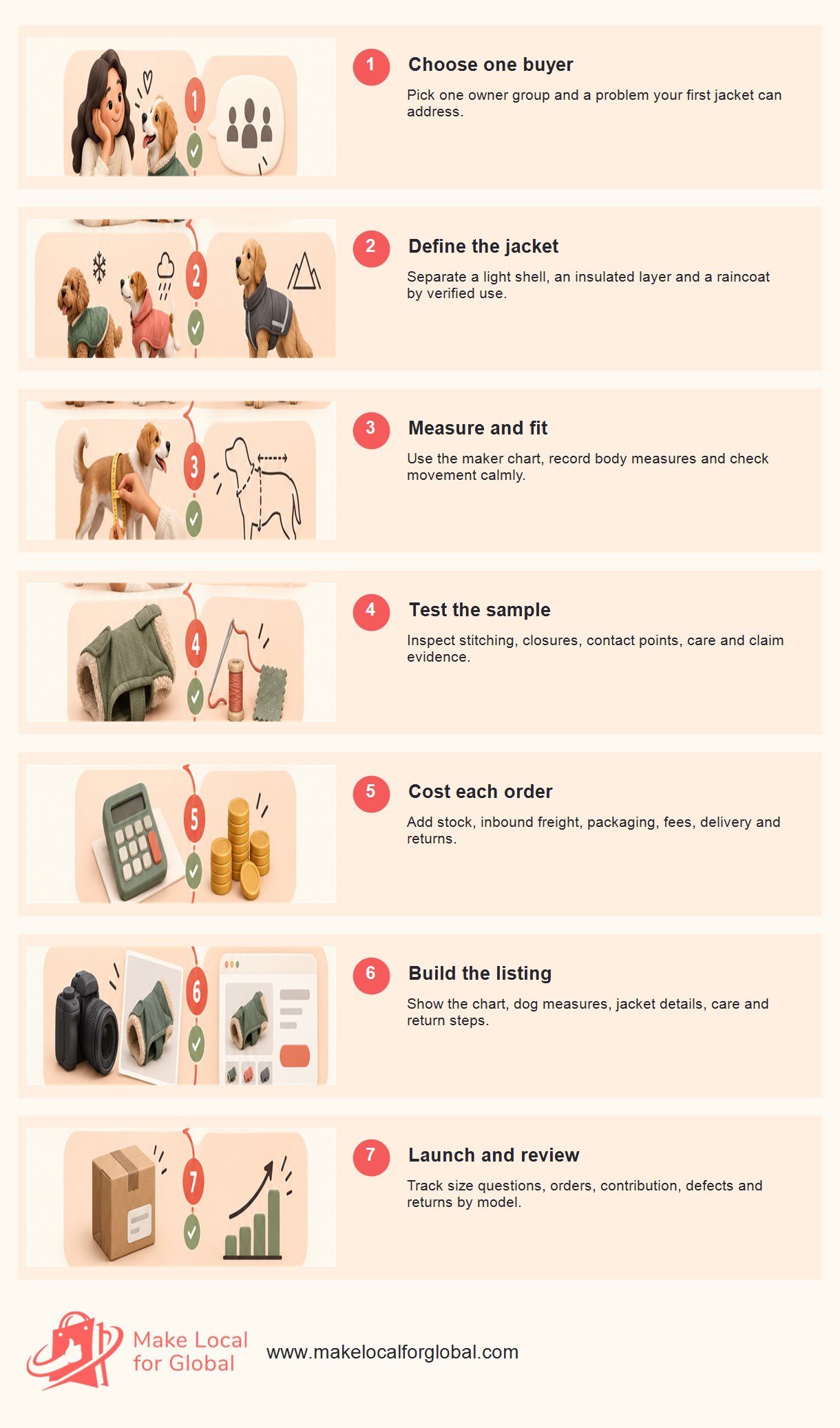
Choose the primary buyer and write the one-sentence product position. Speak with at least eight owners who match the audience. Record actual past purchases, reasons for returns, fit worries and preferred fastening or care features. Do not treat positive feedback as an order commitment.
Review search phrases and competing listings, noting the date, geography and product differences. Define one decision threshold for proceeding to samples, such as a set number of repeated problems or qualified page sign-ups. If responses point to different needs, narrow the audience or test one need at a time.
Send the supplier checklist to two or three candidates. Compare exact measurements, materials, lead times, sample cost, minimums, quality records and repeat-order terms. Order a sample from the strongest candidate and keep the purchase and shipping records.
Write the measurement protocol and quality checklist before the sample arrives. Prepare a simple tracker with size, garment dimensions, construction notes, movement observations and any question to send back to the maker. Set a pass, revise or reject decision date.
Measure the sample and conduct brief, consented fitting sessions with suitable dogs. Stop if the garment causes distress. Review each closure, lead opening, contact point and care instruction. Send precise feedback to the supplier and wait for a corrected sample if needed.
Build a cost model using current supplier and carrier quotes. Add a return allowance as a labelled assumption, not an asserted industry rate. Draft the product page with the size chart, model measurements, fabric, care, delivery, returns and clear photos. Ask two people unfamiliar with the product to use the page and narrate where they hesitate.
Release a limited quantity or collect interest without taking payment until fulfilment is ready. Use a small defined marketing test and record the spend. Track visits, size questions, chart interactions, add-to-basket actions, orders, cancellations and returns.
At the end of the week, compare results with the decision rule you wrote in week one. If the page attracts attention but no orders, review price, product evidence and delivery presentation. If one size produces repeated questions, improve the chart before buying more. If there is little relevant interest, revise the customer or use case before ordering a wider range.
The launch is a learning cycle. Keep every claim, measurement and cost connected to evidence. Expand only after the product's fit, customer response and per-order contribution support the next purchase.
There is no single start-up figure. Your costs depend on sample and minimum order charges, size and colour quantities, freight, packaging, selling channel, photography and the cash you reserve for exchanges or refunds. Build a low, expected and high-cost plan from written quotes, then test the smallest stock commitment that can answer a real buyer question.
Choose sizes after measuring samples and reviewing the exact supplier chart against your intended customer group. Keep the opening range small and record demand and fit questions by size. Do not select sizes from breed names alone or assume that one dog's measurements apply to every dog of that breed.
No. Some jackets are designed as light shells or insulated layers, while a raincoat is usually sold around water protection. Check each product's construction and test evidence, name it according to its main verified use and link to a separate raincoat listing if you stock both.
Use that claim only if you have evidence that supports the exact fabric, seams and completed garment. Ask the supplier for the test method and report that apply to the model you sell. A coating description or a splash test at home does not prove that the complete garment is waterproof.
For Great Britain, Annex V item 41 of assimilated Regulation (EU) No 1007/2011 lists animal clothing among products for which fibre-content labelling or marking is not mandatory. The separate 2012 UK regulations provide for its enforcement. This is a specific labelling exemption; it does not remove general safety, accurate-description or consumer obligations. Check your exact product and route with Trading Standards, especially if it includes animal-origin components.
Follow the maker's instructions for the exact design. A useful guide can show chest girth, back length and neck measurement where relevant, mark each point on a dog diagram and state whether figures refer to the dog or garment. Include a between-sizes note only when you have evidence to support it.
Put measuring instructions beside the size selector, show actual measurements for the model dog, photograph the jacket from useful angles and make the exchange process easy to find. Track return reasons by style and size, then fix the chart or pattern when the same issue repeats.
Yes, if the marketplace accepts the product and your listing meets its current rules. Check fees, return policies, claim restrictions, image requirements and product-safety expectations before you list. Keep your own source records and customer-service process; a platform listing does not transfer every seller responsibility.
Personalisation can make a product distinct but adds production steps, spelling checks and delivery lead time. Test one small option only after the base fit and fulfilment process work. Tell buyers what can be personalised, how they approve the details, when production starts and whether any cancellation exception applies to the custom-made item under current consumer rules.
Choose the channel where your target owners already look for the product and where you can show fit evidence. A marketplace may help with discovery; a standalone store gives more control over detailed size content and cross-links. Test one channel with a defined budget and compare contribution after fees rather than visits alone.
Start with as few models and variants as needed to test the customer problem. One style across a limited, evidence-based size range may be enough. Add another fabric or warmth level only when buyer feedback, stock performance and supplier quality support the extra complexity.
Pause sale of the affected item or batch while you assess the issue, retain records and contact the supplier. Follow the current official product-safety guidance and seek Trading Standards or specialist advice on corrective action, reporting and customer communication. Do not treat a potential safety concern as a routine fit return.
A good first dog-jacket range is one you can describe, fit, test and restock with confidence. Keep the offer narrow, publish the exact measurements and care details, and price the full order rather than the garment alone. Give buyers clear product evidence and a fair route to ask for help.
Use early orders to find patterns in size choices, fit questions, delivery and returns. Improve the chart or sample where the evidence points to a problem. Add stock when the next size or style answers a need customers have shown, and keep your product claims linked to current supplier records and test results.
For help testing assumptions before a larger purchase, use MLFG's Business Idea Stress Test. To plan a clear product page and online shop, visit MLFG website design or contact the team.
Set a decision threshold for customer evidence, sample fit and per-order contribution before your next stock purchase.
PREFERRED SOURCE
Like what you’re reading? Add Make Local for Global as a preferred source on Google to see more of our articles when you search.

Build your online presence without having to figure out everything yourself.