


READY TO SELL Ceiling fans ONLINE?
Get a store built for you in 5 days, plus training and support to help you start, run, and grow your Alternative business.

Learn how to choose a focused ceiling fan range, check supplier records and room-fit details, price delivery and returns, and prepare a safer, better-informed online launch.


A ceiling fan looks simple in a product photo. Selling one well is harder: the buyer must know whether it suits the room, the ceiling height, the electrical setup, their preferred controls and the parcel route. A wrong fit can mean a bulky return, damaged stock or a safety problem.
If you want to sell ceiling fans online, begin with a narrow range that you can describe and support accurately. Pick one buyer group, compare a small number of fan types, inspect real samples, price every part of delivery and verify the product records before you place a commercial order. This article gives you a practical route from first demand check to a measured launch.
A clear online shop makes product choices, delivery terms and support routes easier for a buyer to find. Start with the pages and sales flow your first range needs.
“People who need a fan” is too broad to guide a first order. A buyer in a small flat may need a low-profile unit and a clear minimum ceiling-height check. A homeowner replacing a bedroom fitting may care about quiet operation, a light kit and a wall or remote control. A landlord or property manager may value spare parts, repeat availability and a simple replacement process. An interior designer may care about finish consistency, dimensions and the ability to order samples.
Write a one-sentence customer definition before contacting suppliers. For example: “We serve homeowners furnishing medium-sized bedrooms who want a quiet-looking, reversible fan with a light, a remote and clear room-fit information.” This statement rules out products that do not suit the customer. It gives you a basis for checking enquiries and returns later.
List three possible groups, then speak with a few people from each. Ask what room they plan to use, what they already tried, what stopped them from buying, what they need to measure and what information they would want before paying. Do not start by asking whether they “like” a fan. Compliments do not show purchase intent.
Look for repeated details. If several flat owners mention low ceilings, that points to flush-mount or short-drop options and a fit guide. If bedroom shoppers keep asking about humming or light quality, those questions belong in the sample test and product copy. If trade buyers ask whether a model will still be available in six months, supplier continuity may matter more than a new colour.
Search phrases can reveal how customers describe the need. Compare phrases such as “low ceiling fan with light”, “quiet bedroom ceiling fan”, “ceiling fan for small room” and “ceiling fan without light”. Record the questions that appear on retailer pages, forums and search suggestions. Treat that information as question discovery, not proof that a phrase will deliver sales.
Test a specific offer. Put up a simple landing page showing one intended product, the kind of room it suits, expected delivery timing and a way to register interest. You can run a small local advert or share it with a relevant homeowner or renovation group, following each group’s rules. Track qualified enquiries, sample requests, email sign-ups and actual pre-orders only when you can meet the legal and fulfilment duties attached to taking payment.
Set a decision rule before the test. For example, you might decide to order samples only after 12 qualified enquiries from your target area and at least five people ask for the same product configuration. This is a planning threshold, not a universal benchmark. The point is to decide what evidence would change your next step, then record what happened rather than explaining away weak interest.
Ceiling fans vary by mounting arrangement, blade span, motor, light, control and finish. A first range does not need a version of every feature. Each model adds more product records, samples, stock decisions, photos, spare-parts questions and possible return reasons. Start with options that solve a buyer problem you have already heard more than once.

| Range choice | Who may value it | What your listing must explain |
|---|---|---|
| Flush or low-profile mount | People with lower ceilings or limited drop space | Total drop, blade span, room-fit checks and the installation requirements listed by the maker |
| Downrod mount | Rooms where extra clearance from a sloped or high ceiling is needed | Included downrod length, compatible alternatives and the height after installation |
| Fan with integrated light | Buyers replacing a central room light and fan together | Light output and colour settings where verified, whether the source is replaceable, and control compatibility |
| Fan without light | Buyers with separate lighting who prefer a simpler fitting | What is included, the finish and the exact control method |
| Smart or remote control | Customers who want speed, direction or light controls from a handset or app | Included controller, app or network requirements, compatibility, warranty and what still works if the network is unavailable |
Use each exact model’s instructions and measured specifications. The table describes selling choices, not installation approval.
Mounting style changes how far the fan hangs below the ceiling. A close-to-ceiling design can help in some low rooms; a downrod can give a fan more separation from a high ceiling. Neither label tells a buyer by itself whether a product is suitable. Record the fan’s full height, the blade span, the downrod length in the box and any allowed options from the manufacturer’s documentation.
Do not publish a room-size chart as if it is a guarantee. A room’s layout, ceiling height, furniture, airflow expectations and the product instructions all matter. If a supplier gives a room-area range, attribute it to that model’s published guidance and say how the maker calculated it. If the maker does not provide a defensible rule, provide dimensions and refer the buyer to a qualified installer for room-specific advice.
Check whether the model is suitable for flat or sloped ceilings, what bracket is supplied, and which downrods are approved for it. Never infer that two visually similar fans use interchangeable brackets, rods or blades. A wrong part can affect fit, balance or safe use.
Suppliers may describe a fan as AC or DC and make claims about speed selection, noise, energy use or control. Ask for the rated input power at each speed, the test conditions, the technical data sheet and the report that supports any comparative claim. A motor label alone does not prove the fan is quieter or cheaper to run than another model.
If you publish a yearly running-cost illustration, state the assumed wattage, hours per day, days per year and electricity price. A sample calculation is: 30 watts × 5 hours × 180 days ÷ 1,000 = 27 kilowatt-hours. Multiply that by the reader’s own unit rate to estimate use cost. This is an illustration, not a promise of savings, and the rated test value may not match every use pattern.
A light kit creates extra details to check: source type, replaceability, dimming method, colour setting, control pairing and whether a remote operates both fan and light. Ask suppliers for the exact component specification and product instructions. Do not call a light “dimmable” unless the included or specified control actually supports that function.
Some products offer reverse rotation for seasonal airflow preferences. Confirm which control changes direction, whether the fan must be stopped first and what the manufacturer says it is intended to do. Use precise, restrained wording; do not promise a room will heat or cool by a set amount.
Finish names need evidence too. A “walnut” appearance may be a printed surface rather than solid timber. State the actual material and coating, colour variation and care notes supplied by the maker. Photograph the actual finish in natural and indoor light so a buyer can judge the tone before ordering.
Choose one lead configuration, one lower-price alternative and, only if demand supports it, one higher-spec option. A low-profile fan with remote control may be the lead item; a no-light model may serve people with separate lighting; a premium finish or integrated light may be a later test. The exact set depends on your buyer evidence.
A product ladder should help a customer make a decision, not pressure them to buy more. Explain who each option fits. If a more expensive model adds a longer rod, a different motor or a replaceable light source, spell out the practical change and its limits. If the only difference is finish, show the finishes clearly and do not imply that one works better.
Every variation has a stock-keeping unit, price, image, specification and stock count. Too many combinations can create errors such as a buyer receiving the wrong blade colour or controller. A two-model launch with two finishes may be easier to manage than six motors each paired with four colours and several downrods.
Build a variant sheet with columns for model code, mounting style, blade span, total drop, light, motor, controls, finish, carton size, carton weight, included parts, supplier lead time and spare-parts availability. Keep the supplier’s exact model identifier beside your own SKU. That link is useful for product records, purchase orders and support queries.
Record supplier lead time and add a buffer for customs, quality checks and seasonal congestion where relevant. A simple reorder point is average weekly sales multiplied by weeks of supply needed, plus a safety buffer. If you sell three fans per week and replenishment takes four weeks, four weeks of expected demand is 12 units before adding a buffer. Use your observed sales and actual lead-time history to set the number.
Do not reorder from revenue alone. Check how much cash remains after supplier payments, refunds, marketplace settlement timing, tax and customer-acquisition costs. A product can sell regularly and still strain cash if replacement stock must be paid for before earlier sales settle.
Potential sources include UK wholesalers, specialist lighting or electrical distributors, direct manufacturers and import agents. A UK-based supplier can reduce some delivery and communication friction, but a local address does not automatically prove product compliance or traceability. An overseas factory may offer a broader range or branding options; it may leave you with more checks, import paperwork, minimum order exposure and responsibility as the first business placing the goods on the UK market.
Compare landed terms, not just unit prices. Request the commercial invoice basis, incoterms, freight estimate, customs classification and who is importer of record. Ask who handles a damaged delivery, the route for returns to the factory, whether spare parts can be supplied, what production changes require a new sample and how long the model will remain available.
Request records for the exact fan, light, controller and power supply configuration you intend to sell. Ask for the Declaration of Conformity, supporting technical file or a clear route to access it, test reports, instructions, label artwork, manufacturer details, importer details where relevant, model and batch identifiers, warranty terms and a list of included parts. Verify that the model code on every record matches the product and packaging.
A certificate image sent over chat is not enough to settle the question. Check the issuer, product description, report number, date, standard or regulation stated and whether the report covers the exact version. If the supplier will not identify a model or produce a credible evidence trail, pause the order. Ask a competent product-compliance professional for advice if you cannot judge the records.
For a supplier comparison, score response quality, evidence consistency, sample quality, commercial terms, delivery performance, spare-parts support and return handling. A low quotation with missing model records can cost more than a higher quotation from a supplier who can answer specific questions clearly.
Write down the sample model and finish, expected parts, carton condition, surface marks you will reject, dimensions to measure and paperwork required. Agree how the supplier will identify approved samples and how it will notify you before substitutions. Keep dated photos and an inspection record with the model code. A written standard gives both sides a shared reference if a later batch differs.
Inspect physical samples before a commercial order. A desk-level inspection cannot certify electrical safety, but it can catch missing parts, poor finish, misleading dimensions, confusing documentation and avoidable packing failures. Use a qualified electrical product test provider for work that needs technical measurement or compliance assessment.

Open the carton with a camera running. Compare the parts against the list: motor assembly, blades, bracket, rod or rods, control, light parts, fasteners and instructions. Note whether each part has a clear identifier and whether the instruction sheet is in the languages needed for your customers. Take photos of the packaging and internal protection before removing the contents.
Check that the physical label shows the expected model and traceability details and that it does not conflict with the documents. Keep the outer carton for a sample parcel test. If your business imports or sells under its own brand, confirm what details must appear on the product or packaging with a product-safety specialist before sale.
Measure the blade span, total drop, carton length, width and height, and packed weight. Compare your numbers with the maker’s specification. Small differences can arise from measurement method, but a mismatch large enough to change a room-fit decision needs a supplier answer before the page goes live.
Check the finish in daylight and warm indoor light. Compare all finish samples at the same time. Photograph the fan from the angle a buyer will see after installation, then capture the control, light, bracket and included parts separately. Use an annotated diagram for dimensions, not an edited photo that makes the fan appear shorter or wider.
Do not connect a mains-powered fan yourself unless you are qualified and the test is part of your professional role. Arrange a competent person or test provider to assess the sample under the maker’s procedures. Ask them to report observable operating noise, vibration, control response, light functions and any fault or overheating concern. Retain the test record with the model and sample date.
Make a separate non-electrical check of what customers can see: remote buttons are labelled, the instruction sequence is legible, part bags are identified and finish quality is consistent. If the remote needs pairing, check whether the instructions explain it in clear, non-technical language. Customer confusion often begins with a small omission in the box rather than a major product defect.
A fan’s wholesale price is only one line in the order cost. Include the cost to bring it to your stock location, packaging, pick and pack, payment or marketplace fees, delivery, damage and return allowances, customer acquisition and support. Separate recurring costs from one-off setup costs, then calculate the contribution per order before deciding whether a price can support the business.
Here is an illustrative model for one fan. The figures are invented for arithmetic practice, not current supplier quotations or a suggested retail price. Assume the fan costs £68, inbound freight and duty allocated per unit are £12, outer packaging £4, pick and pack £5, payment fee £5.40, outbound delivery £11, returns and damage reserve £7 and acquisition cost £14. This gives a variable cost of £126.40.
| Cost per order | Illustrative amount | How to replace it |
|---|---|---|
| Fan purchase cost | £68.00 | Use the actual unit invoice price |
| Inbound freight and duty allocation | £12.00 | Divide shipment cost and applicable import charges across sellable units |
| Outer packaging | £4.00 | Include tape, void fill and any protective carton |
| Pick and pack | £5.00 | Use your own labour time or fulfilment invoice |
| Payment fee | £5.40 | Apply the provider’s current percentage and fixed fee to the selling price |
| Outbound delivery | £11.00 | Use the packed dimensions, weight, destination and service |
| Returns and damage reserve | £7.00 | Estimate from actual refund, replacement and reverse-freight records |
| Customer acquisition | £14.00 | Divide campaign spend by attributed first orders |
| Total variable cost | £126.40 | Sum each line; revise after real orders |
Illustrative figures only. Replace each amount with your business’s evidence before buying or pricing stock.
If the selling price is £179.99, subtracting £126.40 leaves £53.59 contribution before fixed overhead, tax and owner pay. If a 20% VAT-registered seller’s consumer price includes VAT, the net sale before VAT is about £149.99. Under the same simplified assumptions, the contribution becomes about £23.59 before fixed overhead, tax and owner pay. Your actual VAT treatment, recoverable input VAT, fees and costs may change the result; ask an accountant to check your model.
This example shows why a margin calculation based on wholesale price alone can mislead. Check the payment fee against the customer price, and decide whether any fee is charged on delivery or tax too. Calculate at several prices and test whether customers accept the offer before placing a large order. A lower price can lift conversion and still reduce cash left per order.
Contribution is the selling price, net of any applicable output VAT, less variable costs tied to the sale. It helps show what remains to pay fixed costs. Net profit comes after all operating expenses, including rent, software, insurance, accounting, storage, testing, staff, business rates and finance costs. Neither figure is the same as cash in the bank: stock purchases can consume cash before the product sells.
Use a spreadsheet with a row per model and a column per cost. Record the date and source beside each supplier price, fee schedule and carrier quote. Revisit the model when actual delivery, breakage or return costs differ from assumptions. Keep a reserve for refunds and replacements rather than counting all incoming cash as available to spend.
A carton can be charged by volumetric size as well as physical weight. Measure the packed box after adding the actual protection. Ask carriers how they classify long or oversize parcels, what service includes a safe return journey and how they handle claims for concealed damage. Use the exact packed dimensions in your quote request.
Decide whether delivery is included in the displayed price, charged separately or free above a threshold. State the delivery area, service level, estimated dispatch time and any extra charge before checkout. Avoid a “free delivery” promise that you funded by overlooking the cost in your margin model.
Ceiling fans are electrical equipment. The obligations that apply depend on what the product is, where it is placed on the market and what role your business has. A retailer buying a compliant product from a UK supplier can have different duties from the business importing a product for the first time, changing its brand or selling an altered unit. Get advice on the actual model and your business route before an order crosses into saleable stock.
Great Britain and Northern Ireland do not always follow the same routes for conformity marking and product rules. GOV.UK guidance explains the [Electrical Equipment (Safety) Regulations for Great Britain](https://www.gov.uk/government/publications/electrical-equipment-safety-regulations-2016/electrical-equipment-safety-regulations-2016-great-britain) and [Northern Ireland](https://www.gov.uk/government/publications/electrical-equipment-safety-regulations-2016/electrical-equipment-safety-regulations-2016-northern-ireland). Check the latest guidance for the territory where you will sell; do not rely on a supplier’s generic “UK compliant” statement.
Electrical equipment in scope can need technical documentation, a Declaration of Conformity, traceability details, instructions and a suitable conformity marking. The [GOV.UK RoHS guidance](https://www.gov.uk/guidance/rohs-compliance-and-guidance) sets out documentation and operator duties for in-scope electrical and electronic equipment. Ask a product-safety professional to confirm what applies to your product, role and sales territory. Keep model records together and do not sell a unit if you have reason to think it is unsafe or non-compliant.
Product-specific scope matters for energy-related rules. A fan category or product description does not automatically settle whether an ecodesign or energy-labelling measure applies. Check the current [UK guidance on placing energy-related products on the market](https://www.gov.uk/guidance/placing-energy-related-products-on-the-uk-market) and identify the exact product group and model scope before making energy-label claims. If the product is in scope, verify required documentation, registration and label information with the regulator or a qualified adviser.
There is a practical warning in the UK product safety system: a [mounted ceiling fan product safety report](https://assets.publishing.service.gov.uk/media/68d41ad5b6c608ff9421b2cc/2508-0035-product-safety-report-mounted-ceiling-fan.pdf) recorded missing valid documentation and other product-information failures alongside an electric-shock risk assessment. It is one report about one product, not evidence that every ceiling fan is unsafe. It shows why matching the model, documents, label and instructions matters before sale.
Electrical and electronic equipment can bring producer and distributor duties under the WEEE rules. The [GOV.UK WEEE guidance for manufacturers, importers and distributors](https://www.gov.uk/guidance/regulations-waste-electrical-and-electronic-equipment) describes producer registration and distributor takeback duties. Retailers selling a new item may need to provide free takeback for an old like-for-like item or use the permitted alternative route. Check which route applies to your business, sales channel and territory, and put the customer information where buyers can find it.
Online consumer sales have separate obligations. The official [distance-selling guidance](https://www.gov.uk/online-and-distance-selling-for-businesses/distance-selling) covers information that must be shown before a sale, including the seller’s identity, product details, total price, delivery costs and cancellation rights. The [returns and refunds guidance](https://www.gov.uk/accepting-returns-and-giving-refunds) explains that faulty goods have rights separate from a buyer simply changing their mind. Draft your terms with qualified advice; do not copy another shop’s policy.
For VAT, the current registration threshold shown by HMRC is £90,000 of taxable turnover, with registration required in some other circumstances too, such as expecting to exceed the threshold in the next 30 days. Check the live VAT threshold guidance and ask an accountant how VAT affects your price, import charges and cost recovery. Thresholds and rules can change.
This section is a starting point for a compliance conversation, not legal advice. Before importing or rebranding a fan, get a written review of applicable electrical safety, EMC, RoHS, WEEE, energy-related, packaging and consumer requirements for the exact configuration and territory. A supplier’s documents can support your checks; they do not remove your own duties. For a related example of product and supplier checks in a powered category, read how to sell curling irons online.
Once your product, price and buyer are clear, map the product page, stock records, enquiry route and fulfilment steps before your first paid campaign.
A ceiling-fan page should help a buyer decide whether the model suits their room and whether they can arrange a safe installation. Put the model name, mounting style, blade span, total drop, included controls, light details, finish, carton contents, warranty and delivery information in clear places. State which facts come from the manufacturer and which you measured yourself.
A useful title could read: “52-inch Low-Profile Ceiling Fan with Light and Remote, Matte White, Model ABC-52”. Use only details confirmed for the exact item. If “52-inch” is the blade span, explain that clearly in specifications. Do not add an energy rating, room size or noise adjective unless you can support it.
Lead with the room problem and the product’s relevant facts: “A low-profile fan for buyers checking a close ceiling fit. It has a 132 cm blade span, integrated light and handheld remote. Confirm the installed height and room suitability with the manufacturer’s instructions and a qualified installer before purchase.” Replace these sample dimensions with the actual product records. Avoid unsupported claims such as “silent”, “best”, “for any room” or “cuts bills”.
Add a specification block listing model, finish and material, blade span, installed drop, mounting style, motor type, rated power, speed settings, reverse function, light details, controller, compatibility, carton size, packed weight, what is in the box and warranty. If a detail is not confirmed, say you are checking it or leave it out rather than guessing.
Show the actual fan in a room, then include close views of its finish, controller, light, mounting hardware and labels where appropriate. Add a dimension diagram showing how you measured blade span and drop. Use a scale reference or measured text rather than relying on perspective. Keep the same colour balance across variants so a customer can compare them.
Do not let a styled room image obscure what ships in the carton. A staged scene may include furniture, bulbs or accessories that are not included. Caption the image or add a separate box-contents panel. If the image is illustrative rather than a photograph of the exact stock, label it clearly and include accurate product photography before the product is available to order.
Make clear whether installation is included, who is qualified to install the product and what room or ceiling checks the buyer should discuss with that person. Publish the maker’s installation guide and the support contact. Do not encourage buyers to connect, alter or repair a mains appliance themselves. If a customer reports a wobble, smell, sparking, unusual heat or electrical fault, tell them to stop using the item if safe to do so and contact a qualified professional and your support team.
A marketplace may make a first listing easier to test with existing shoppers, though fees, listing rules and category requirements affect contribution. Your own shop gives you more control over the product explanation, customer data and follow-up, but you must attract visits and handle the whole buying journey. A small local showroom or installer partnership can give people a way to see finish and scale. Compare channels on total cost, customer fit, returns handling and the support load they create.
Start with one channel where you can answer the common questions quickly. Create a landing page with a measured range, delivery policy, returns information, support details and a clear model comparison. Use a separate tracked link for each campaign so you know whether a visit came from search, a renovation newsletter, a social post or an installer referral.
Useful pages can answer questions that belong before the product page: how to measure a ceiling fan’s drop, what information to check for a low ceiling, what the carton dimensions mean for delivery, and what to ask an installer about a sloped ceiling. Keep each answer accurate, cite the product documentation or public authority where needed, and link to the exact models that fit the question. Do not produce near-identical pages that swap one keyword.
Ask customers and installers which question they had to resolve before buying. Turn a recurring question into a short page, a useful diagram or a comparison. Update the page when a model changes. Search performance takes time and depends on many factors; do not promise yourself a ranking based on an exact-match phrase.
Test a small budget against one specific buyer need, such as low-profile fans with verified dimensions. The advert should match the landing page and stock available. Track cost per qualified visit, add-to-basket rate, checkout completion, contribution after ad spend and returns. Stop or revise a campaign if it attracts clicks but no buyer questions or orders.
Try a local partnership with a lighting shop, electrician or interior designer only where both parties agree on responsibilities and claims. Ask whether the partner wants a sample, a trade price or a referral fee, then include those costs and the support expectations in your calculation. Do not imply that a professional endorses product safety unless you have permission and evidence for that statement.
Ceiling fans combine long blades, a motor housing, controls and small fittings in one parcel. Packaging needs to stop parts moving, keep blades straight and protect the finish. Do not rely on a thin retail box when the carrier may stack, sort or turn the parcel. Confirm whether the fan is packed for parcel distribution or needs an outer shipper. For another example of costing and testing a fragile boxed range, see the candle jars selling checklist.

Pack one complete fan exactly as you plan to ship it. Photograph each internal layer and record the packed measurements and weight. Use a carrier or packaging specialist to choose an appropriate test method; do not improvise a destructive test on a live electrical product. Inspect for blade marks, chipped finish, compressed inserts, opened parts bags and instruction sheets that have shifted into the motor assembly.
Check the box can be carried safely by the courier and the intended customer. Add an external label and handling information that matches your carrier’s rules. If the parcel is awkward, discuss two-person delivery or another service before accepting orders. Make the delivery arrangement visible at checkout.
Record the reason for each return: unsuitable drop, colour difference, damaged blade, missing remote, changed mind, delivery delay or reported fault. Use a standard form with model and batch identifier, carton photos, customer description and the action taken. This helps you distinguish a copy problem from a packaging problem or recurring product issue.
Set a safe quarantine process for an electrical product returned with a fault report. Do not put it back into saleable stock until the issue is assessed by a competent person and the product’s status is clear. Keep the customer informed and follow consumer law. Work out reverse-carriage and replacement costs in advance so support staff do not have to negotiate a new rule for each case.
Ask whether the supplier can supply replacement remotes, blades, light modules, brackets and compatible rods for the expected period. Do not promise ongoing parts availability until you have a written supply commitment and a way to fulfil it. Record each support query by model code and batch. If the same question appears repeatedly, add a clear answer to the page or manual rather than leaving customers to guess.
Track more than sales. Useful measures include qualified product-page visits, questions per model, conversion rate, average delivery cost, damage rate, fit-related return rate, days from order to dispatch, contribution after promotion and stock cover. Review these weekly during the first month. Small samples can be noisy, so write down the number of visits or orders behind each percentage.
Do not treat a single sale as evidence that the range is proven. A fan could sell because a customer already knows the model, because a campaign reached one warm contact or because the market has a short seasonal peak. Combine orders with enquiry quality, customer feedback, return reasons and supplier reliability before widening the range. Large, bulky goods need early freight checks too; compare your process with the cot mattress sizing and delivery checklist.
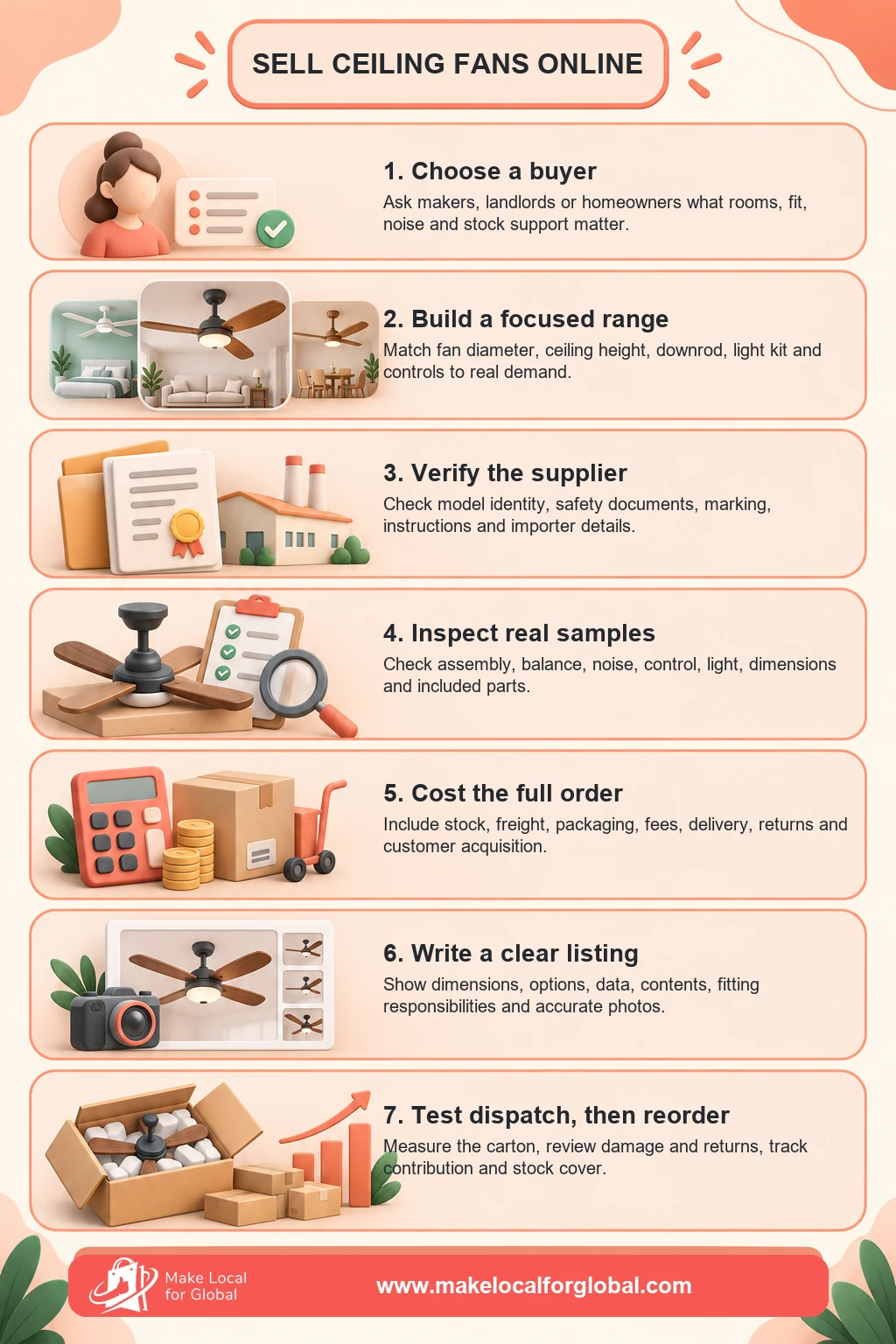
| Period | Work to complete | Evidence to save | Decision |
|---|---|---|---|
| Days 1–7 | Interview target buyers, list room-fit questions and compare search language | Interview notes, repeated needs, enquiry records | Select one buyer and a first product problem |
| Days 8–14 | Request supplier quotations, model records, carton data and samples | Model-code comparison, document list, supplier replies | Reject suppliers or order a small set of samples |
| Days 15–21 | Inspect fit information, sample finish, parts, carton and technical records; ask a competent provider for relevant checks | Sample photos, measurement sheet, test report and cost model | Approve, request changes or stop the candidate model |
| Days 22–30 | Build a product page, publish policies, test checkout and delivery; invite a small qualified audience | Page QA, customer questions, delivery quote, campaign spend and order data | Reorder, revise the offer or keep testing without widening stock |
Timing depends on sample and testing lead times. Do not compress product safety checks to meet a calendar date.
It can be, but the result depends on sourcing, freight, delivery, fees, customer acquisition, returns, compliance work and overhead. Build a model per product before ordering, then replace assumptions with actual figures. Do not treat gross margin as net profit.
Start with the configuration that matches a repeated buyer need and that you can verify, explain and support. A low-profile model, a fan with a light or a remote-controlled model may suit different buyers. The right choice comes from customer evidence and the exact product records, not a general bestseller claim.
A small first range is easier to inspect and support. One to three distinct models can be enough to test a buyer group, provided the choices answer real needs. Keep finish and control variants limited until you know which combinations attract orders and manageable returns.
You may be able to, but importing or putting a product under your brand can make your business responsible for duties that do not apply in the same way to a retailer reselling a UK-sourced item. Have a competent product-safety adviser review model records, marking, technical documentation, WEEE producer obligations, territory and consumer information before you order stock.
There is no single answer for every model, but spare-part access can affect repairs, customer satisfaction and the life of the product. Ask suppliers what parts they can provide, at what cost and for how long. State only the availability you can support.
Measure the actual carton, test the packaging route, describe room fit and included parts accurately, and record return reasons by model. Improve the cause you can control, then compare return and damage rates over enough orders to avoid reacting to one unusual case.
Do not provide DIY mains-wiring advice. Refer customers to the exact product instructions and a suitably qualified installer. Explain what the seller supplies and what the customer must arrange before checkout.
Show the delivery price, service area, parcel constraints, expected dispatch time, estimated arrival window and what happens if the carton arrives damaged. Use carrier quotes for the packaged dimensions and explain any appointment or access requirement before payment.
Use actual sales pace, supplier lead time, cash availability and safety stock. Review returns, damage and margin before reordering. If a product sells but repeatedly arrives damaged or creates fit-related refunds, fix those problems before committing to more units.
Before buying stock, write down the buyer, the room need and the exact fan configuration you plan to test. Ask two suppliers for the same model records, full cost and sample terms. Measure the sample and carton, get professional help with applicable electrical checks and calculate contribution using the channel and delivery service you intend to use.
Keep the launch narrow. A useful first range is one you can explain, deliver, support and learn from. Expand only after customer questions, completed orders, return reasons and cash flow point to a clear next choice.
Make the product facts, checkout and support route clear before inviting buyers to order. If you need help shaping that launch, speak with Make Local for Global about the next practical step.
PREFERRED SOURCE
Like what you’re reading? Add Make Local for Global as a preferred source on Google to see more of our articles when you search.

Build your online presence without having to figure out everything yourself.