

READY TO SELL Curling irons ONLINE?
Get a store built for you in 5 days, plus training and support to help you start, run, and grow your Alternative business.

Learn how to sell curling irons online, compare tool types, check samples and compliance records, price complete orders and build a careful launch plan.


A curling iron can look simple on a product page: a heated barrel, a handle and a cord. For an online seller, the real offer includes the tool type, barrel size, heat controls, plug, safety paperwork, returns process and the cost of getting a bulky or delicate electrical item to the buyer. A listing that explains those details can help a shopper choose the right tool and reduce avoidable questions.
Start with one buyer and a small, checked range. Learn the distinctions between clamp tongs, wands and automatic curlers. Ask suppliers for model-specific compliance documents, test samples and calculate the complete order cost before buying stock. This UK-focused article gives a practical route from product selection to launch. Requirements can vary between Great Britain, Northern Ireland and overseas markets, so check the rules for the place where each item will be sold.
Choose a buyer, a product range and the store information customers need before ordering a heated electrical product.
People searching for a curling iron may want a quick morning routine, a tool for travel, a gift, a salon-style result at home or a replacement for an older appliance. These shoppers do not all need the same barrel, weight, controls or price point. A beginner may value a clear temperature display and simple controls. A frequent traveller may ask about voltage, plug type, dimensions and storage. A professional stylist may focus on construction, duty cycle, repair support and consistent heat.
Write a short buyer hypothesis before contacting suppliers. For example: “Adults with thick, long hair want a medium-barrel clamp tong with several clearly shown heat settings and a heat-resistant stand.” Keep it specific enough to guide a sample order. It is a question to test, not evidence of demand. Ask potential buyers what tool they currently use, what frustrates them, how they decide on barrel size and which specifications they check before paying.
Look at completed sales where a platform makes that information available, search phrases, product reviews and questions on established retailer pages. Record the tool type, diameter, controls, cord details, included accessories, price and shipping. Separate buyer complaints about a model from general hair-care opinions. A few loud reviews do not establish the needs of every customer.
Try a low-cost demand test before taking a large minimum order. Show a product comparison page or a proposed range to a small group of likely buyers. Ask them to pick a model and explain why. Record whether they ask first about heat range, barrel dimensions, plug compatibility, warranty, delivery or returns. Repeated questions reveal which product information needs to appear near the top of the page.
Set a learning target for the test, such as collecting five useful product questions or getting a small number of qualified email sign-ups from people who match the intended buyer. Do not treat likes as purchase intent. Keep a written note of what the test can and cannot tell you. If the audience is unclear, narrow the buyer before expanding the catalogue.
“Curling iron” is used loosely in shops. A clamp tong holds a section of hair against a heated barrel. A wand has no clamp and relies on the user wrapping a strand around the barrel. An automatic curler draws or winds a section into a chamber. A multi-styler can use interchangeable barrels or attachments. Explain the actual mechanism in each listing so a buyer knows what will arrive.

Barrel diameter influences the curl shape, but hair length, technique and product design matter too. Do not promise an exact result from diameter alone. Ask a manufacturer for the measured barrel size and whether the measurement describes the heated barrel, the widest point or an interchangeable attachment. Photograph a ruler next to the barrel only if the ruler does not obscure the product.
Surface descriptions must match supplier evidence. Ceramic, tourmaline, titanium and coated metal are not interchangeable labels. Ask what material forms the barrel, what the coating contains, how thick it is and how the maker supports claims about heat distribution or durability. Avoid claims such as “damage-free” or “frizz-free” unless the wording is substantiated and legally suitable.
Build a compact first range rather than buying every diameter and colour. One option could serve a first-time buyer, one could suit a distinct hair length or styling preference, and one could offer a travel or interchangeable-attachment format. Keep models separate when their instructions, plug, voltage, warranty or accessories differ. A neat range is easier to photograph, stock and explain.
| Tool format | Buyer question | Details to verify |
|---|---|---|
| Clamp tong | How does the clamp open and release? | Barrel size, clamp, stand, controls and cord swivel |
| Wand | How is hair held and protected during use? | Barrel shape, tip, glove inclusion and instructions |
| Automatic curler | How is a section inserted and released? | Chamber size, direction control, timer and cleaning steps |
| Multi-styler | Which attachments are in the package? | Compatibility, attachment count, storage and replacement access |
Confirm each specification against the exact model supplied, not a similar product in a catalogue.
Check handle shape, balance, grip, button position, display visibility, cord length, swivel, stand, cool tip, lock and storage case. These are not universal requirements. They are facts that can help a shopper compare actual models. Ask whether the packaging shown in a supplier image is included and whether the manufacturer permits reuse of product photos.
Possible sources include a UK wholesaler, a manufacturer, an authorised distributor, a private-label producer or a fulfilment supplier. The route affects the minimum order, documentation, delivery time, repair options and who handles a safety issue. Buying from a marketplace listing does not by itself prove that the seller is authorised or that the product is compliant for the market you intend to serve.
Ask for the legal name and address of the manufacturer and the relevant importer or responsible business. Request the exact model identifier, product label, instruction booklet, declaration of conformity, test reports and any applicable UKCA or CE information. Check that the documents identify the model being offered, the relevant standards or regulations and the party responsible for the declaration. A logo image in a sales email is not a substitute for a product file.
Ask the supplier what changes if you place the product under your own name or brand. Rebranding, importing and selling products directly can change your responsibilities. Keep correspondence, invoices, batch references and the copies of documents supplied with the stock. Obtain suitable legal or compliance advice before placing a product on the market when the role or paperwork is unclear.
Order samples from the actual production model and inspect several units if the first sample passes. Match the model code on the appliance, packaging and documents. Check the plug and fuse for the target region, cable condition, strain relief, controls, display, cool tip, stand, supplied glove or mat, instructions and packaging. Note defects with photographs and send the supplier a written report before agreeing a larger order.

A visual check is not an electrical safety test. Do not open a mains appliance or improvise a test that could expose a person to live parts or heat. Use a competent laboratory or qualified professional for testing that requires technical equipment. Agree the test scope, acceptance limits and who pays for a failed batch in writing.
Run the sample according to its instructions in a suitable controlled setting. Observe whether the controls work as described, the display is legible, the cord moves without pulling the unit, the stand keeps the heated barrel away from the surface and the included accessories match the page. Record time, ambient conditions and model number. Stop if there is smoke, unusual smell, sparking, crackling, damage or abnormal heat at the plug or cable.
Ask about defect rates, batch traceability, spare parts, repair routes, recall cooperation and notification times for a product change. Clarify who owns customer support for a fault and how replacement units are checked. A low unit price can be outweighed by weak records, long replacement times or a supplier who cannot connect a complaint to a batch.
Calculate the money left after all costs that vary with an order. Use a realistic price from your own research, then add the landed product cost, packaging, delivery paid by the seller, payment or platform fees, a returns and faults allowance, advertising cost per sale and your labour. Add regular overhead when you assess whether the business as a whole can work.
The figures below are illustrative only. They are not supplier quotes or a promise of a selling price. Assume one tong sells for £34.99 including any applicable VAT, the small seller is not VAT registered, and the order travels to a UK buyer. Fees vary by platform and payment plan, so the 6% fee line is only a model input.
| Example per order | Amount |
|---|---|
| Customer payment | £34.99 |
| Tool landed cost (£13.50 unit + £2.00 inbound freight allocation) | £15.50 |
| Protective outer packaging | £1.20 |
| Outbound delivery paid by seller | £3.50 |
| Illustrative selling/payment fee at 6% of £34.99 | £2.10 |
| Returns and faults allowance | £1.50 |
| Advertising spend attributed to the order | £4.00 |
| Illustrative contribution before labour and overhead | £7.19 |
Arithmetic: £34.99 minus £15.50, £1.20, £3.50, £2.10, £1.50 and £4.00 = £7.19. Recheck VAT, fee basis, delivery and refund treatment for the actual order.
Contribution is not net profit. It has not paid for the seller’s time, storage, insurance, subscriptions, professional advice, income tax or corporation tax. If the customer pays delivery separately, the amount collected and the amount paid to the carrier still belong in the calculation. If a product is returned opened or faulty, the actual loss may be more than the allowance.
Calculate three scenarios: a full-price order, a discounted order and a return or replacement. For a discount, recalculate the fee if it is charged on the discounted amount. For a return, include refund, non-refundable fees if applicable, inspection time, repackaging, delivery and the chance that the appliance cannot be resold as new. A price that only works before returns can leave too little cash for service recovery.
Ask suppliers for the unit price at several order quantities, freight terms, sample cost, customs and duty responsibility, payment charges, carton dimensions and defect replacement terms. The cheapest unit may need a higher order quantity and more working capital. Compare the full landed cost and stock risk, not the headline price alone.
Map the selling price, fulfilment steps and store costs for a small first range before committing to a large order.
Use a title that names the tool type and the verified distinguishing detail. For example, “25 mm clamp curling tong with adjustable temperature” is clearer than “Salon luxury styling iron”. Include the brand and model when accurate. Do not use another company’s registered brand as a search lure for a generic product.
Open with the product’s format and intended use in plain language. Then list barrel diameter, heated length, material or coating as documented, available heat settings, maximum temperature if supported, warm-up time if verified, power rating, voltage range, plug type, cord length, weight and included accessories. State which details are measured and which come from the manufacturer.
Describe compatibility carefully. For international buyers, distinguish voltage input from plug shape. A travel adapter does not change the appliance’s voltage. Do not claim “worldwide voltage” unless the exact unit label and manufacturer documents confirm the supported input range. Set delivery destinations based on compliance, carrier and returns coverage.
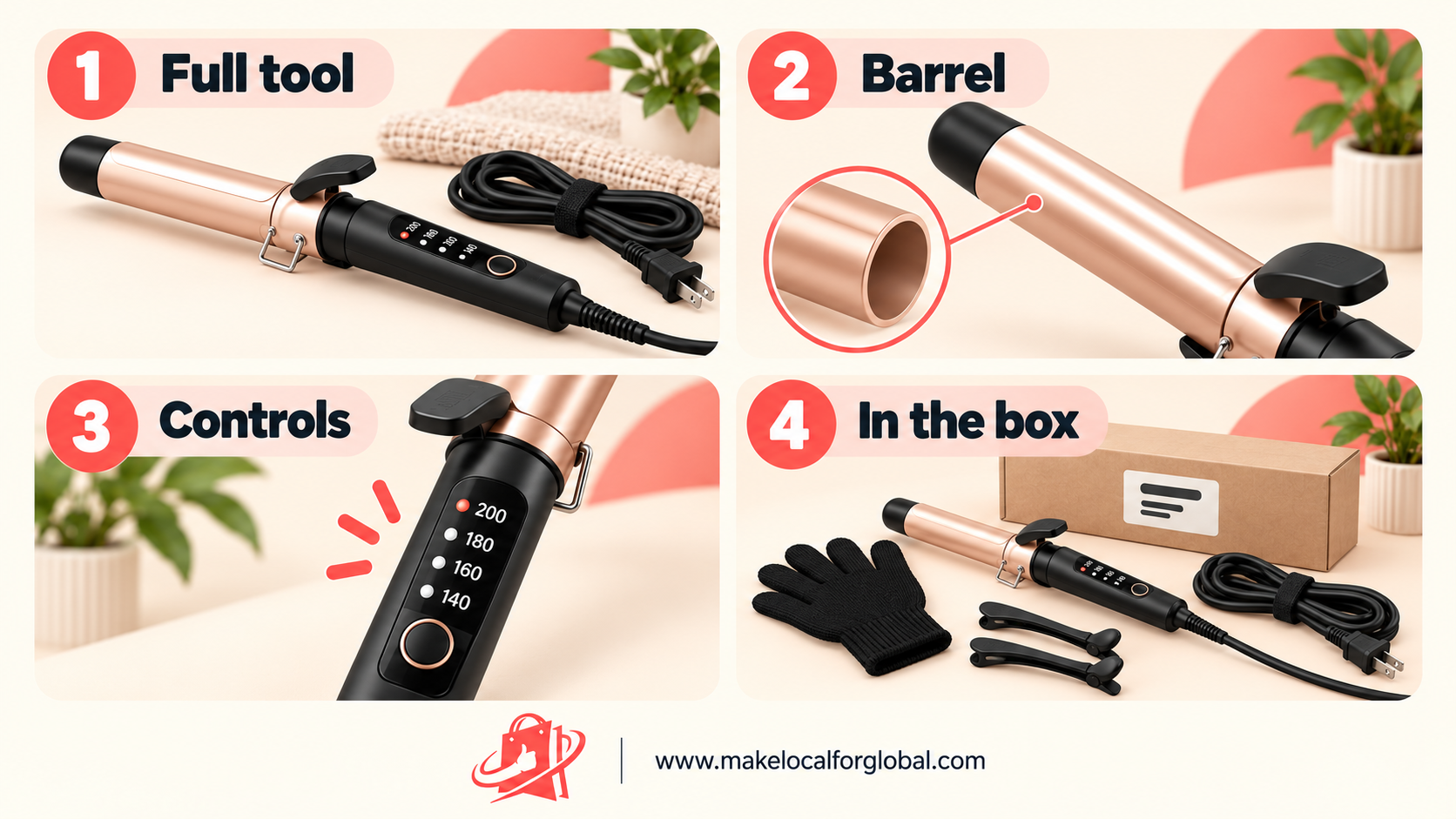
Photograph the real stock against a clean background. Include a full-tool view, the barrel and tip, control panel, plug, cable entry, stand, model label, packaging and accessories. Add a scale reference for size if it helps. Show the package contents laid out clearly. Do not replace key images with a rendering that hides the actual plug or changes the included parts.
Write alt text that describes the visible image for a person who cannot see it. “Black and rose-gold clamp curling tong showing its barrel and temperature controls” is more useful than a string of search phrases. Give every product variant its own images when a colour or attachment changes the item. Compress large files without making the plug label or small controls unreadable.
Add a comparison table for models with different formats or diameters. Keep the choices few and comparable. Put buyer-facing differences in the table, such as clamp versus wand, barrel measurement, control type, cord length and attachments. Avoid making an unverified “best for all hair” claim. If you make suggestions based on hair length or technique, label them as a starting point and link to the manufacturer’s directions.
Include honest delivery, warranty and returns details near the purchase decision. Say who handles a repair request, how a customer contacts you and what happens to an opened appliance. Do not replace a consumer’s legal rights with a short “no returns” line. Ask a solicitor or Trading Standards for advice on the exact distance-selling terms, hygiene claim or exception before relying on one.
Electrical appliances sold in Great Britain must meet the product-safety rules that apply to the product. Read the Office for Product Safety and Standards’ guidance for the Electrical Equipment (Safety) Regulations 2016, which covers manufacturers, authorised representatives, importers and distributors. Which duties apply depends on your role, the product and where it is placed on the market. Northern Ireland has separate guidance. Do not treat a supplier’s statement as a substitute for checking your own role.
Keep a file by model and batch: supplier, invoices, product identifiers, label photographs, instructions, declarations, test reports, complaints, returns and corrective actions. Ask how a supplier will notify you if a component, factory, model number or production process changes. A file that connects a customer complaint to stock on hand supports a faster investigation.
Do not place a product on sale if its identity or safety documents do not match. Pause the listing, hold the stock and ask the supplier or a competent product-safety specialist for the missing evidence. Avoid adding a label or removing an existing one without understanding the legal consequences. A private-label project may place added obligations on the brand owner.
Electrical tools fall within the broad class of electrical and electronic equipment covered by WEEE rules. The current GOV.UK retailer and distributor guidance says the rules apply whether products are sold directly, online, by mail order or by phone. A retailer may need to provide free take-back for a like-for-like old appliance, use a permitted take-back scheme and give customers written information. Producer registration or reporting can apply when you manufacture, rebrand or import equipment. Check current rules and thresholds with the regulator or compliance scheme before you launch.
Keep product claims factual. Describe an automatic shut-off feature only if the model has it and the instructions explain how it behaves. Electrical Safety First’s hair tongs and straighteners advice notes that these tools create high heat and gives use and storage precautions. Do not call a tool “safe” as a blanket guarantee. Explain the manufacturer’s warning and care instructions, and do not encourage a customer to use a heated tool near water or leave it plugged in. A retailer’s product page is not a replacement for the manual.
Check trademark and image rights. Use supplier media only when the supplier grants permission for the intended channel and territory. Avoid copying a competitor’s copy, instructions or product photography. Keep your own photographs, written descriptions and brand assets in a controlled folder.
A marketplace can offer existing product searches and transaction tools, but its rules, commissions, listing formats and return process change. A direct online shop gives you more control over range presentation, customer questions and email permission. A social channel can introduce a demonstration or comparison, but it still needs a clear route to accurate product specifications and a safe checkout.
Compare each channel on buyer intent, policy fit, fee calculation, delivery expectations, review system, advertising access, returns handling and access to customer data. Read current seller terms before listing heated electrical products. Check whether the platform restricts certain claims, requires product identifiers or sets a particular response time for safety complaints.
Use a narrow first launch. Put one clamp tong and one wand side by side if sample checks support both. Create a comparison page, answer common questions in a short demonstration that follows the manual and link to a detailed specification page. Avoid implying that every hair type will get the same result. Demonstrations should show the actual model and disclose any styling products, heat settings or editing that affect the result. See how MLFG presents hair dryers as an online product category for an example of a focused store offer.
Search content can target specific buyer questions: “clamp curling tong or wand”, “curling iron barrel diameter explained”, “what to check in a curling tong product listing” and “how to compare travel curling irons”. Keep the content helpful and accurate. Link from a comparison article to the relevant product page, then show related models where the differences are meaningful. Do not publish multiple nearly identical pages that change only one keyword. The MLFG articles on selling beauty products and selling makeup brushes offer adjacent product-category examples for planning a focused catalogue.
Run one small acquisition test at a time. Set a spending limit and review date. Track product-page visits, specification views, questions, add-to-basket actions, completed sales, cancellations, returns, support time and contribution. If visitors leave after seeing the delivery price, review the delivered total and shipping promise. If they ask the same question repeatedly, improve the page before raising the promotion budget.
Use product reviews carefully. Ask verified buyers for an honest review after the order arrives. Do not offer a reward only for a positive review or edit a customer’s comments. Investigate repeated concerns about barrel damage, missing accessories, heating behaviour or packaging and connect them to the relevant batch.
Use packaging that protects the appliance, plug, controls and original retail box. Fill empty space so the tool cannot move. Secure the cord with a reusable tie or the supplied band without bending it sharply. Keep small attachments together in a labelled pouch. Test one packed sample through your chosen carrier’s size and weight limits before setting a shipping price.
Do not promise that a parcel is insured or tracked unless the service actually covers the item value and product type. Check carrier terms for batteries in cordless models, restricted goods, compensation limits, delivery evidence and international destinations. Save dispatch receipts, tracking, order number and the product batch reference.
Write a return inspection checklist before the first sale. Record whether the correct model and accessories came back, the outer package condition, serial or batch code, visible damage, signs of use and the customer’s reported fault. Do not plug in a returned appliance that may be damaged. Isolate it until a competent person can assess it under a suitable procedure.
Separate a change-of-mind return from a fault report in your records. Follow the law and marketplace terms for refunds and consumer rights. If the same fault appears in more than one unit, stop dispatching the affected batch while you investigate. Contact the supplier, preserve evidence and follow any recall or reporting process that applies.
For a cordless product, confirm whether it includes a lithium battery, its watt-hour rating, packing requirements and the carrier’s current restrictions. Do not place a loose spare battery in a parcel without checking the rules. International shipping can have different paperwork and carrier limits from domestic delivery.
Give every model and colour a stock code that matches the supplier model and your own listing. Record the quantity received, batch or lot, storage location, inspection status and units sold. Keep a separate status for sample, released stock, held stock, returned stock and units waiting for supplier review. Do not mix an unchecked return into new saleable inventory.
Set a reorder point from actual lead time, confirmed sales and cash available. A supplier’s quoted lead time may not include production, freight, customs processing or a delayed inspection. A small business may prefer a lower stock depth and a clear “back in stock” notice over buying a large quantity before the range is proven.
Prepare support answers for heat settings, voltage, plug, included attachments, care, shipping and returns. Base every answer on the exact model documentation. When a customer reports damage, burning smell, sparking, an unusually hot plug or a control fault, advise them to stop use and unplug if safe, then follow the manufacturer and legal incident process. Do not troubleshoot a live appliance over chat.
Set a response owner and a record template. Capture order number, model, batch, date, customer description, photographs supplied voluntarily, action taken and outcome. Limit access to customer data and retain it only as long as the business needs and law allow. A structured log can reveal whether a complaint concerns one supplier batch, one carrier or a confusing instruction.
Week 1: define the buyer and compare products. Choose one customer group, review completed transactions and note the questions buyers ask. Compare a small set of clamp, wand or automatic models. Request model identifiers, documents, packaging details, order minimums and total landed quotes before choosing a sample.
Week 2: inspect samples and the paperwork. Match each sample to its documents and packaging. Record dimensions, controls, plug, cord, accessories and instructions. Use competent electrical testing where required. Pause any model with incomplete or inconsistent evidence. Decide which range items pass and which should be dropped.
Week 3: build the listing and fulfilment routine. Photograph real units, write exact specifications and compare the delivered price with the full cost model. Create a test package. Draft returns, warranty and WEEE customer information with appropriate advice. Ask someone unfamiliar with the product to find the plug, model, barrel size and return route on the page.
Week 4: run a small sales test. Publish a narrow range on one chosen channel, then share one useful comparison or demonstration. Set a spend limit. Track qualified visits, questions, sales, delivery cost, returns, support time and contribution. Review the results before placing the next stock order.

At the review, keep the decisions tied to evidence. If shoppers compare barrel size but cannot choose, improve the comparison table. If buyers ask about heat settings, move that information higher. If a sample fails or its records do not match, pause the model. If delivery or returns costs erase contribution, change the offer or the delivery terms before trying to scale orders.
A low price can hide weak product records, missing accessories, uncertain plug standards or high freight. Compare the landed cost, batch quality, evidence, support terms and replacement process for the exact model.
Listings can accidentally merge details from two similar tools. Match each number and feature to the model label and manufacturer document. Remove claims that you cannot confirm.
A sample that switches on has not proved compliance. Use the right documents and competent tests for the product and your role. Keep the evidence linked to the item code and batch.
Check the appliance label and supplier file for the intended country. A plug adapter does not convert voltage. Limit destinations until you can support the local requirements, carrier rules and returns.
A seller cannot guarantee a result that depends on hair, technique and heat use. Describe verified features and point buyers to the manufacturer’s instructions. Do not turn a styling claim into a health or safety promise.
Electrical product obligations can apply to online retailers. Check whether your business must provide take-back information, join a scheme or register as a producer. Set up the process before accepting orders.
A product may appear profitable until a return, delivery loss or repeated support question consumes the margin. Model full-price, discounted and returned orders before selecting the customer price.
Choose a model for a defined buyer and a simple use case. Compare a clamp tong or wand whose sample, documents, plug and support route you can check. Start with a small quantity and record the questions customers ask before adding more formats.
You need suitable evidence that the product meets applicable rules and a quality process matched to your sourcing model. A visual sample inspection is not a formal electrical test. Ask a qualified testing provider or product-safety adviser what checks and records apply to the exact model and role.
Possibly, but importing or rebranding can change the legal duties attached to the product. Before ordering, confirm the manufacturer, importer or producer responsibilities, technical documents, labels, instructions, traceability and post-sale process for Great Britain, Northern Ireland or each export market.
State the type, model, barrel dimensions, documented material, controls, heat settings, electrical input, plug, cord length, weight, accessories, instructions, delivery, warranty contact and return route. Use photographs of the exact product and its model label.
No. A travel adapter changes plug compatibility, not the appliance’s electrical input. Check the label and model documentation for the supported voltage and frequency, then verify destination rules and carrier terms before offering international delivery.
UK WEEE rules can apply to distributors selling electrical products online. Retailers may need to offer free take-back for a like-for-like old item or use the Distributor Takeback Scheme and give customers written information. Producer obligations can apply when you manufacture, import or sell under your own brand. Check current regulator guidance for your business circumstances.
Show the real model and plug, explain how the clamp or wand works, list measured barrel size and display the accessories in the box. Put delivery and returns information near checkout. Review return reasons and revise the page when buyers misunderstand a feature.
There is no reliable fixed amount. It depends on purchase price, shipping, selling fees, advertising, returns, faults, tax status, labour and overhead. Use your own quotations and test orders in a full-cost worksheet. The example in this page is illustrative, not a profit forecast.
Tell the customer to stop using the product and unplug it if that can be done safely. Do not ask them to open the appliance or continue testing it. Record the model, batch, symptoms and order; hold related stock while you assess the issue; contact the supplier and follow applicable reporting or recall steps.
Pick a buyer, compare a small number of tool types and confirm the model-specific paperwork before buying stock. Inspect samples safely, photograph the exact product, calculate costs through returns and explain the specifications in plain language. Check current electrical safety, consumer and WEEE duties for your role and sales destination. Use the first month to learn from real product questions and order outcomes.
Browse the Product To Sell collection for other product ideas. Review MLFG store plans if a direct shop fits your first range and service plan.
Present the model details, delivery terms and customer support route in one clear place, then improve the range from buyer feedback.
PREFERRED SOURCE
Like what you’re reading? Add Make Local for Global as a preferred source on Google to see more of our articles when you search.

Build your online presence without having to figure out everything yourself.