

READY TO SELL beauty products ONLINE?
Get a store built for you in 5 days, plus training and support to help you start, run, and grow your Alternative business.

Learn how to sell beauty products online with a clear selling route, UK cosmetics checks, full-order pricing, product-page examples and a measured 30-day launch plan.

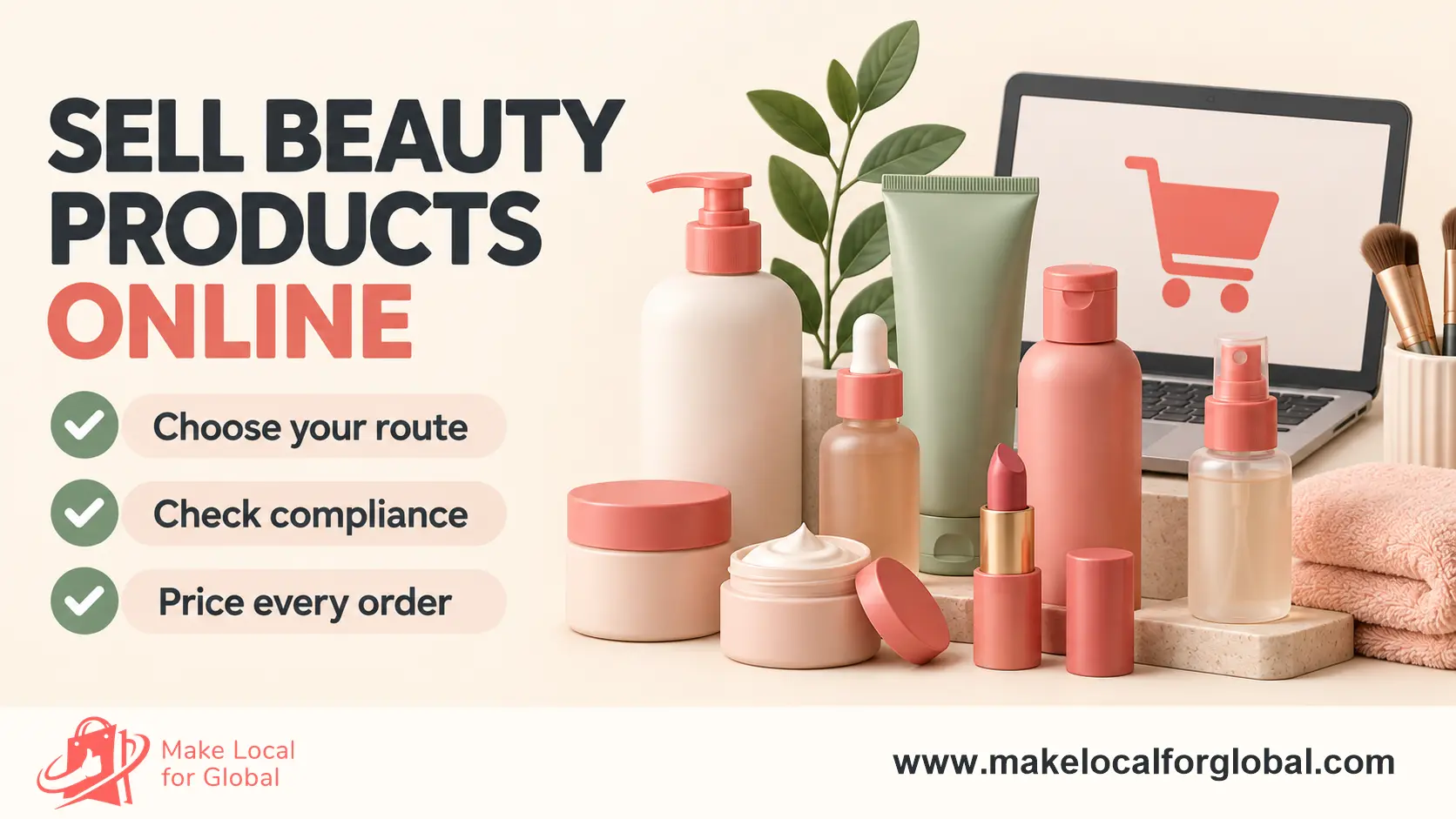
Beauty products can win repeat orders, but a shop cannot run on attractive packaging alone. Buyers need clear shade, texture, size, ingredients and delivery information. Sellers need to know who is responsible for product safety before any listing goes live.
Start with one customer and a small set of products that serve a real routine. Decide whether you will resell finished stock, put your name on a manufacturer’s formula, or make products yourself. That choice shapes your budget, checks and launch date.
Make Local for Global can set up clear product collections, useful product pages and a checkout for your beauty range. Product compliance remains your responsibility.
“Beauty products” covers skincare, colour cosmetics, hair care, bath products, tools and gifts. A new shop that lists a little of everything gives buyers no reason to choose it. Pick a routine, need or occasion that you can explain in one sentence.
Ask five likely customers to choose between two sample ranges. Record what they ask before showing prices: shade, scent, skin feel, ingredients, how long the product lasts or how it arrives. Their questions tell you what belongs on each product page.
The route changes both control and legal duties. A finished product from an established supplier can be a sensible first test. Your own label gives more brand control, but it is not a shortcut around cosmetics rules. Making a formula adds production, testing and documentation work.
| Route | What you control | First questions |
|---|---|---|
| Resell finished stock | Range, presentation and customer service | Who is the Responsible Person? Is the stock labelled for your market? Are batches traceable? |
| Private label | Brand, packaging and often some formula choices | Who will act as Responsible Person? Who holds the safety file? Who checks claims and notifications? |
| Make products | Formula, production and full brand experience | Who will assess safety? How will you document production, stability, labelling and notification? |

Ask suppliers for a written account of their role, not a vague “fully compliant” sentence. Importing into Great Britain or selling a product under your own name can change your role. The Office for Product Safety and Standards guidance for Great Britain explains when a manufacturer, importer, distributor or appointed business is the Responsible Person.
Four to six listings are enough to test a focused shop. Give each item a job. For a body-care shop, that might be an everyday wash, a matching lotion, one fragrance-free option and a two-product gift set. Do not buy six scents of a product nobody has tried yet.
Build bundles from products that work together. A “night routine” with an unfamiliar active ingredient may need more explanation than a wash-and-lotion pair. If you plan a lotion-led range, the existing MLFG body lotion selling article covers texture, scent and reorder paths in more depth.
For cosmetics sold to consumers in Great Britain, the Responsible Person must see that the product is safe, the Product Information File is maintained, a qualified safety assessment is completed, required labelling is present, and the product is notified before it reaches consumers. These are not optional tasks that a shop design can solve. Read the current GOV.UK cosmetics guidance for the duties that fit your role.

Keep the supplier’s written answers with product, batch and purchase records. If a package or product page lacks required information, resolve that before launch. Cosmetic obligations differ between Great Britain, Northern Ireland and other markets, so check the rules for each destination before expanding delivery.
Describe what you can substantiate: texture, finish, scent, colour, size and intended cosmetic use. Avoid casual promises to cure eczema, treat acne or reverse a medical condition. The Responsible Person needs evidence for marketing claims, as the OPSS guidance states. Check proposed copy against approved supplier wording.
A beauty buyer should be able to compare sizes, shades, ingredients, delivery and returns without sending a message. MLFG can help structure those pages and collections once your product information is ready.
Buy production-like samples from the batch or manufacturer you expect to use. A sample that feels pleasant in your hand is not enough. The test is whether the product description, packaging and delivery promise stay true across ordinary orders.
Do not treat a home trial as a substitute for a formal cosmetic safety assessment. It is a check of the customer experience and your sales claims.
A small beauty item can appear profitable until packing, delivery, payment fees and damaged-stock allowance are included. Use your supplier and courier quotes for a real decision. The example below is hypothetical, in pounds, and assumes the seller is not VAT-registered; it is not a market price or profit promise.
| 250 ml lotion order | Illustrative amount | Why it counts |
|---|---|---|
| Selling price paid by customer | £18.00 | Single item, standard delivery included |
| Finished product and inbound freight | £5.20 | Landed unit cost, not the supplier headline price |
| Postal box, seal and packing materials | £0.85 | Packed for a leak test |
| Outbound delivery | £3.10 | Actual service chosen for the parcel |
| Payment fee assumption | £0.60 | Replace with your provider’s current rate |
| Returns and damage allowance | £0.55 | Budget for normal service problems |
| Customer acquisition allowance | £2.00 | Content, samples or paid promotion, if used |
| Contribution before overhead and tax | £5.70 | £18.00 minus £12.30 of variable costs |
Illustration only. These are invented planning figures, not supplier quotes. Contribution is not net profit. Add fixed costs, wages, tax and any VAT treatment relevant to your business.
A two-item parcel can spread delivery across more revenue, but only if both items fit safely and the bundle discount leaves contribution. Run the arithmetic again for a gift set and for a returned order. Check current payment-provider terms and your own fulfilment quotes before setting the live price.
A beauty buyer cannot smell, touch or swatch the product through a screen. Your page must close that gap honestly. Put the purchase facts near the price: size, shade or scent, texture, full ingredient information, use, warnings, delivery and returns.

Title: Everyday Body Lotion, Fragrance-Free, 250 ml. First sentence: A light body lotion for customers who prefer no added fragrance, with a pump bottle for daily use. Then describe the actual texture, amount used per application, ingredient list, directions, packaging and who should ask a question before buying. Use wording that matches the approved product information.
A good product title helps search and selection. MLFG’s product-page search preview guide gives a wider method you can adapt to beauty variants.
Caps loosen, glass breaks and gift cartons crush. Test your real packed order: upright and sideways storage, a short shake test and a parcel sent through the intended carrier. Use a seal or protective wrap that suits the product, then note what survived and what needs changing. Check carrier restrictions for any product that may be treated as a liquid, aerosol or flammable item.
Show delivery costs, dispatch timing, contact details and cancellation information before checkout. GOV.UK’s distance-selling guidance sets out information online sellers must provide. Its returns guidance describes the normal 14-day cancellation route and the exception for sealed goods that cannot be returned for health or hygiene reasons once opened. Do not call every beauty item “non-returnable”, and do not refuse a remedy for faulty goods.
Start with searches that describe a choice, not vague popularity claims. “Fragrance-free body lotion 250 ml”, “warm rose lip colour swatch” and “giftable hand care set” reveal the information a buyer needs. Use those phrases only where they truthfully describe your stock.
Choose one channel you can maintain and one small content test. A shop site remains the place to hold complete product details, policies and checkout. A social post can introduce the product and send interested buyers there.
| Week | Actions | Evidence to record |
|---|---|---|
| 1: buyer and route | Pick a routine and customer, compare two range ideas, name your sourcing route, request supplier documents. | Five customer questions, supplier role and any missing compliance evidence. |
| 2: samples and costs | Test product, shade or scent, packaging and a posted parcel. Build single-item and bundle cost sheets. | Sample faults, packed weight, landed cost, delivery quote and contribution. |
| 3: shop and pages | Create a small collection, complete product information, policies and checkout test. | Questions still unanswered, mobile-page issues and checkout failures. |
| 4: quiet launch | Share useful demonstrations, gather real feedback and review orders before buying more stock. | Visits, product views, questions, orders, returns and reasons for no sale. |

If the compliance documents are missing in week four, delay that product rather than hiding the gap. You can still prepare the shop, photographs and customer research. If buyers repeatedly ask the same question, update the page before adding a new scent or shade.
Yes. You can resell finished products from suppliers. Check the Responsible Person, correct market labelling, batch details, claims and your own duties as a distributor or importer before listing them.
No. A cosmetic product still needs the required safety and product records. Agree in writing who is the Responsible Person and who holds each document before paying for branded packaging.
There is no fixed number. Four to six clear listings can test a routine without tying cash up in many shades or scents. Two strong products and one sensible bundle can work as a first collection.
No. Online cancellation rules and faulty-goods rights still apply. A hygiene exception can apply to sealed goods once unsealed after delivery; describe the rule accurately for each product and check official guidance.
The first good move is not a large order. It is a clear buyer, a compliant product, a tested parcel and a costed listing that answers real questions. Start small, learn from the first orders and expand only when the evidence supports it.
Bring your product list, approved information and delivery plan. Make Local for Global can help turn them into an organised online shop with product pages built for buying decisions.
PREFERRED SOURCE
Like what you’re reading? Add Make Local for Global as a preferred source on Google to see more of our articles when you search.


Build your online presence without having to figure out everything yourself.