

READY TO SELL clothing racks ONLINE?
Get a store built for you in 5 days, plus training and support to help you start, run, and grow your Alternative business.

A practical guide to selling clothing racks online: choose a buyer-led range, check samples, price bulky delivery, create clear listings and test demand in 30 days.


Clothing racks look simple until a buyer asks how much weight they hold, whether they fit a small room, or what delivery costs. A focused range with clear measurements and tested parts gives shoppers better reasons to buy and gives you fewer avoidable returns.
Start with a clear offer, useful product pages and a route for customers to ask questions.
A clothing rail can serve a fashion boutique, market trader, wardrobe organiser or dancewear seller. Each buyer values different details. A boutique may want a neat finish and a display-ready shape. A market seller may need quick assembly and a rail that folds into a car. A home organiser may care most about width, stability and whether the rack rolls across a floor.
Pick one primary customer for your first launch. Write down where they will use the rail, what they will hang on it and what problem makes them look for one. That decision helps you select a sensible first range instead of listing every style a supplier offers.
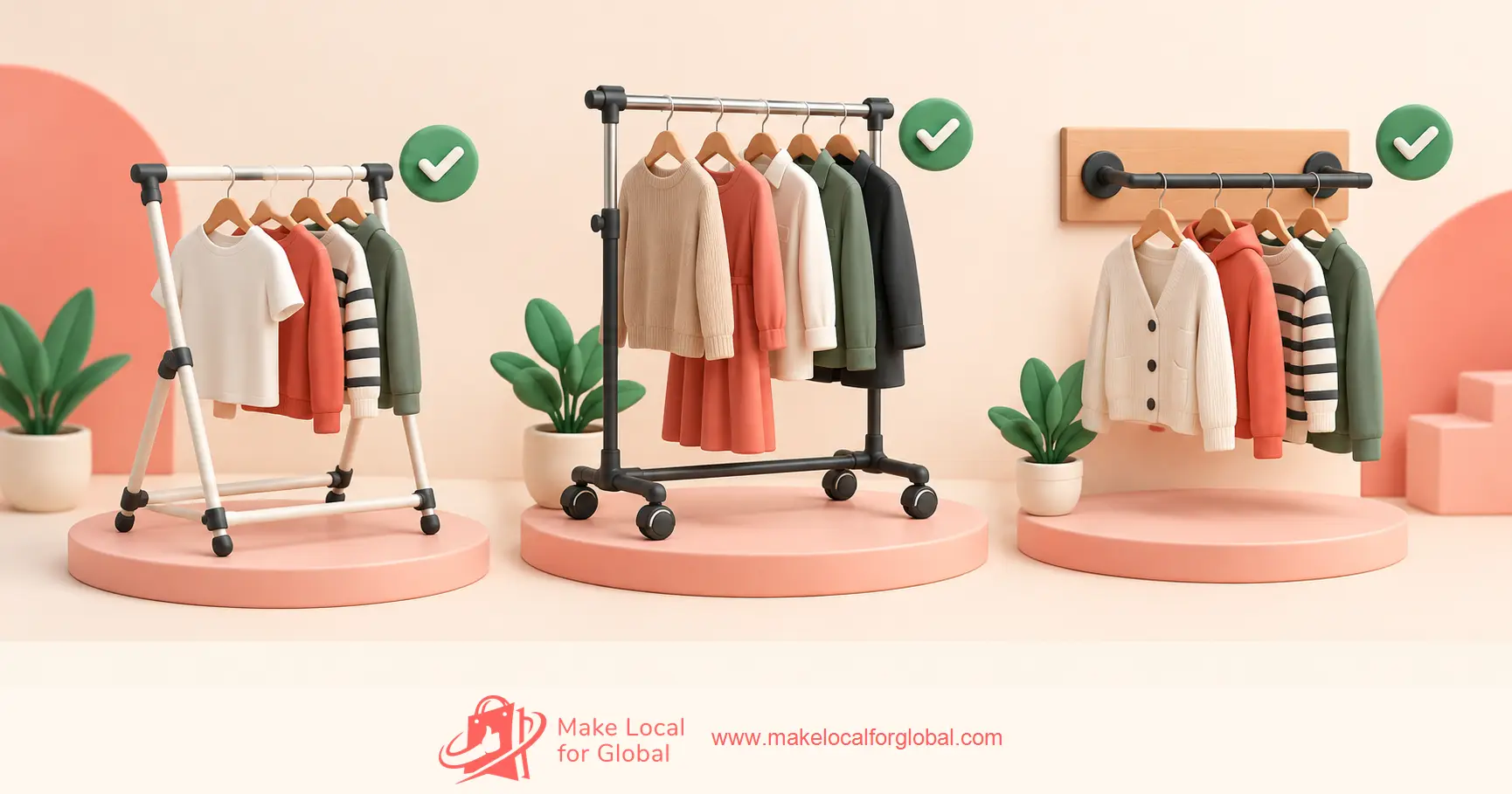
Start with two or three designs that solve distinct needs. Avoid several near-identical rails unless shoppers can quickly see why each costs more.
| Rack type | Good first customer | Details to compare |
|---|---|---|
| Folding garment rail | Market and event sellers | Folded size, locking joints, set-up time and carry weight |
| Adjustable rail with castors | Home storage and stock rooms | Height settings, wheel locks, rail width and stated load |
| Boutique display rail | Independent clothing shops | Finish, base footprint, assembly and replacement parts |
| Wall-mounted rail | Small studios and compact rooms | Fixings, wall type, projection and installation guidance |
Use this as a range-planning guide. Confirm each product’s own specification with its supplier.
Order a sample and assemble it as a customer would. Look for sharp edges, loose joints, uneven feet, rough welds and parts that do not line up. Roll castors over the floor type your buyer is likely to use, then test the wheel locks. Add garments evenly and check for wobble. Follow the supplier’s stated load limit; do not publish a capacity based on a quick test.

Ask for material details, assembly instructions, spare-part availability and written test or load information. Keep the supplier’s product identifiers and batch details with your purchase records. In Great Britain, businesses have product safety responsibilities; Northern Ireland follows a separate framework. Read the current GOV.UK product safety advice for businesses and check the rules that apply to your product and sales location.
Clothing racks can be awkward to ship even when the parts are light. Measure the packed carton, weigh it and get carrier quotes for the parcel size you will actually send. Check surcharges, remote-area rates, collection fees, damage claims and delivery lead times. If a rail ships flat-packed, show the buyer its assembled and packed dimensions.
| Illustrative order calculation | Amount |
|---|---|
| Product price | £79.00 |
| Delivery charged | £10.00 |
| Total revenue before VAT treatment | £89.00 |
| Rack purchase cost | −£31.00 |
| Inbound freight and handling | −£4.00 |
| Protective packaging | −£7.00 |
| Carrier cost | −£18.00 |
| Payment fee allowance | −£4.10 |
| Marketing and returns allowance | −£8.00 |
| Contribution before overheads and tax | £16.90 |
Illustrative only. Replace each figure with your own quotes and fee schedule. VAT treatment, overheads and tax are not included.
Price a few delivery zones and decide whether shipping is included in the product price or shown at checkout. Explain the delivery method before checkout. UK online and distance-selling guidance asks businesses to provide clear product, price, delivery and cancellation information; review the current GOV.UK online and distance-selling rules for your situation.
Build a clear product offer and give buyers the details they need before checkout.
Show the rack assembled, folded or flat-packed, and in a room that gives a sense of scale. Use a plain background for the main product view. Add close-ups of the joint, castor lock, finish and fixing points. A diagram with width, height and depth helps buyers judge fit. State what is included, what tools are needed and whether garments or wall fixings are shown for illustration only.

Put the main benefit in the title, then use the description to cover dimensions, materials, assembly, care, delivery and returns. Use only verified capacity or safety claims. As one example of why product-level checking matters, IKEA lists its RIGGA rail as 111 cm wide and gives a maximum load of 35 kg. Those figures describe that specific model; they are not a general standard for clothing rails. Check the exact supplier model before writing your own claims.
Think about adjacent ranges only when they serve the same customer. A boutique adding larger furniture can learn from our guide to selling bed frames online and its advice on large-item delivery. A dancewear seller may find ideas in building a costed ballet tutu range. Browse more practical guides in the Product To Sell article collection.
Use a short test to learn which rack and message earns real interest. Keep the first order small enough that you can review the results and adjust the offer.

They can be, but margin depends on purchase price, parcel size, packaging, payment fees, returns and customer acquisition. Cost the complete delivered order before placing a large stock order.
Choose the type that fits a clear customer need. A folding rail can suit event sellers; an adjustable rail with locked castors may suit storage users. Verify the specific model’s details with its supplier.
Check joints, finish, feet, castors, wheel locks, assembly instructions and packaging. Request written specifications and load information, and record the exact model tested.
Measure and weigh the packed unit, protect metal ends and moving parts, and quote with carriers using the final carton size. Make packed and assembled dimensions visible before checkout.
Include clear photos, dimensions, materials, assembly details, verified load information, included parts, delivery costs, lead times and returns information. Use claims supported by the exact supplier specification.
Turn your first product idea into a focused online offer with a clear path for customers.
PREFERRED SOURCE
Like what you’re reading? Add Make Local for Global as a preferred source on Google to see more of our articles when you search.

Build your online presence without having to figure out everything yourself.