

READY TO SELL coffee makers ONLINE?
Get a store built for you in 5 days, plus training and support to help you start, run, and grow your Alternative business.

Learn how to choose a coffee-maker niche, check suppliers and samples, price the full order, meet relevant UK requirements and build a product page customers can use.

A coffee maker can be a compact pour-over brewer, a filter machine, a capsule unit or an espresso system. Those products look similar in a category search, yet they ask for different stock, supplier evidence, spare parts, customer support and shipping plans. A new seller does not need a catalogue full of every brewing method. A clear first range built for one buyer is easier to test and explain.
To sell coffee makers online, choose one type of buyer and brewing setup, confirm what the machine does, then compare samples and documents before ordering stock. Record the exact model, accessories, plug, instructions, water-contact parts, service route and carton dimensions. Work out the contribution from each delivered order, show practical specifications on the product page and keep a record of questions, faults and returns. Start with a small range and let evidence guide the next order.
A useful store makes it easy to answer three customer questions: Will this brewer fit my kitchen and routine? What do I need to use and clean it? Who will help if a part is missing or the machine stops working? Build the range, buying process and support around those questions.
Turn your chosen brewer and buyer into a clear online offer. Explore MLFG’s online selling guidance and get help with your next step.
The phrase “coffee maker” covers products with different price points, user routines and risk profiles. Some use mains electricity and heat water. Others are manual brewers with no power cable. A shop that groups them without clear categories can leave buyers unsure which one suits their use.
| Product type | Main components | Useful first checks | Range implication |
|---|---|---|---|
| Pour-over set | Dripper, filter, server or mug | Material, filter size, stability and cleaning | Small parcel; often sold as a set |
| French press | Glass or metal jug, plunger, mesh | Glass protection, mesh fit, replacement glass | Fragile parts and spare plungers matter |
| Filter coffee machine | Water tank, heater, filter basket, carafe | Leak checks, brew cycle, hot plate, carafe fit | Electrical safety and careful packaging |
| Capsule machine | Pump, pod chamber, water tank, drip tray | Pod compatibility, cleaning, descaling and noise | Compatibility wording and pod ecosystem matter |
| Espresso machine | Pump, boiler or thermoblock, group head, portafilter | Pressure claims, temperature control, seals and support | Higher price, more parts and more service questions |
| Bean-to-cup machine | Grinder, brew group, hopper, water circuit | Grind adjustment, cleaning, burr access and repair route | Larger carton, more moving parts and support time |
| Cold brew brewer | Vessel, filter or infuser, lid | Vessel capacity, seal, filter removal and cleaning | Often non-electric, but glass and food-contact evidence remain relevant |
Compare the documented specifications and sample performance for each exact model.
Use the table to set page categories and supplier questions. It is not a performance ranking. A brewer that suits a small flat may be wrong for a family kitchen or a workplace with frequent use. A French press can be a good first item for a manual-brewing niche; an espresso machine can suit a seller who can explain setup and support its parts.
Describe each model by its brewing method and the work a buyer must do. If it is a machine for ground coffee, state that clearly. If it needs a capsule or a specific filter, name the format and confirm compatibility from the maker’s documentation. Do not imply that pods, baskets or accessories are interchangeable when the maker has not confirmed that.
A mains-powered brewer adds product-safety and end-of-life responsibilities that a manual glass dripper may not have. A kettle, grinder or milk frother can be an adjacent item, but treat each as its own product with its own evidence and fulfilment plan.
“People who like coffee” is too broad to shape a first order. Start with one setting and a repeatable purchase reason. A small kitchen, a home office, a shared studio, a gift buyer and a coffee enthusiast may all ask about the same brewer for different reasons.
A buyer with limited counter space may care about width, height with the lid open, cord position, storage and cleaning. Photograph the brewer beside a familiar-size object only when the comparison is honest. Give its dimensions in millimetres and state whether the measurement includes a handle, drip tray or open lid.
A shared room may need a carafe that serves more than one person, a washable reusable filter, a clear water-level indicator or an easy way to replace worn parts. Ask buyers how many drinks they make in a session and who handles cleaning. Do not call a household model suitable for an office or commercial kitchen without evidence from the manufacturer.
A gift buyer may need a box that arrives presentable, a clear explanation of what is in the set and confidence that the receiver can use it without extra purchases. Show the machine, included accessories, instruction language, plug type and consumables. If the product is not supplied with coffee, filters or capsules, say so before checkout.
Some buyers already own a grinder and want a brewer that matches a method. They may compare filter sizes, basket shape, pour control, carafe material or spare parts. A seller could connect this range with the site’s guides to coffee grinders and coffee roasters, but should keep the machines and the ingredients or accessories clearly separated.
Speak with five to ten people who match one of these uses. Ask what they currently use, what they dislike about it, what they need to measure before buying, which parts they replace and what would make them return a machine. Record their exact questions. Do not treat polite interest from friends as a sales forecast.
A useful first range can contain one manual product, one straightforward filter machine and one upgrade model only if each serves a named buyer. Too many styles, colours, plug versions and bundles can tie up cash before you know which offer is understood.
Set a range ladder around buyer needs rather than price alone. An entry item could be a basic filter brewer with few controls. A core option might add a thermal carafe, a larger water tank or a timed start when those features are documented and have been tested. A higher-priced product could be an espresso or bean-to-cup model with a stronger service and spare-parts plan.
For each proposed SKU, write a one-line specification:
Keep colour choices to what your supplier can repeat consistently. A polished finish can look different under warm and cool lighting. Photograph the production sample under steady light and describe the surface accurately. Do not promise a particular shade or texture when the maker supplies uncontrolled batches.
Consider a bundle only when the items work together and the total package has been checked. A machine plus the right filter papers, cleaning brush or replacement jug can solve a clear buyer problem. Include each item in the box checklist, landed-cost calculation, product photographs and returns procedure. If the bundle contains a third-party accessory, confirm compatibility in writing.
Manual brewers may give a new seller a smaller parcel and fewer electrical support questions. Mains-powered machines can have a higher selling price, but the seller must account for safety records, fragile parts, return freight and customer assistance. Compare the whole order and service model rather than using retail price as the only selection rule.

Use a simple research sequence before you send a deposit. First, select one buyer and brewing method. Then review product pages and customer questions in that narrow category. Note recurring concerns such as carafe breakage, compatible filters, machine height, noise, cleaning, water capacity and replacement-part availability.
Create a one-page product concept with a genuine sample or a supplier-approved image. Include the intended use, verified specifications, what is in the box, delivery estimate and an indicative price. Ask potential customers to explain what remains unclear. If they repeatedly ask about a feature your supplier cannot document, that issue belongs in the supplier conversation before it becomes a listing claim.
A small test can measure qualified interest without taking payment for unavailable stock. Invite local coffee groups, home-office workers or gift buyers to review the concept. Ask which of two product types they would choose and what evidence they need to place an order. Record the number of people, their buyer fit, the questions asked and the date of the test.
If you collect email interest, explain what messages people will receive and follow the consent rules for your mailing list. Do not use an informal poll as proof that a product will sell at a given volume. It is a signal to compare with supplier terms, sample quality and the cost model.
You can test a product page with separate sections for filter, capsule and espresso models. Watch which specifications people open, where they leave the page and which questions reach support. A small test helps identify information gaps; it does not promise a future sales result.
A new seller can buy from a UK wholesaler, resell a maker’s brand, import finished goods, use a distributor or commission a private-label model. Each route changes the records you receive and the work you must complete before selling.
A domestic wholesaler may offer lower minimum order quantities and a simpler replenishment route. Ask whether the wholesaler is authorised to distribute the brand and whether it will supply current safety records, instructions, warranty terms and spare parts. A low purchase price has little value if the product arrives without traceability or the supplier cannot resolve a batch issue.
An established brand may provide product photography, manuals and support contacts. Confirm that you have permission to use its images and that they show the current model. Read the reseller terms for marketplace restrictions, warranty handling, advertised-price rules, territory limits and requirements for describing compatible consumables.
Importing can add control over packaging or model choice, but it can change your legal role. A UK business bringing an electrical appliance into the UK from outside the UK may be an importer. A business selling a product under its own brand or making a modification that affects compliance may take on manufacturer obligations. Obtain specialist guidance before you place a private-label order.
A drop-ship supplier should be assessed as carefully as a stock supplier. Ask where the appliance ships from, who appears on the package, who is responsible for product support, how returns work and how a recall would reach your customer. Confirm that images, descriptions, plug type and model in the supplier feed match the item that will ship.
Compare routes using a written scorecard: product evidence, model continuity, minimum order, landed cost, spare parts, warranty process, delivery reliability, carton quality, communication and traceability. Keep the answer and supporting file beside the product record. If a supplier cannot provide an answer, mark it unresolved and pause that model until you have enough evidence.
Request a current specification for each exact model, not a brochure for a family of similar machines. The document should identify the model and version, materials, electrical rating, plug, accessories, carton configuration, instructions, cleaning directions and warranty process.
For an electric machine, ask for the applicable declaration of conformity and the technical or test documents that support it. Ask which regulations and markets the records cover, who is named as manufacturer and importer, and which production batch the evidence relates to. A logo or printed mark on a carton does not replace the underlying documents.
For parts that contact water or brewed coffee, request supplier records for the carafe, tank, filter basket, seals, tubing and any internal coating. Ask what material each part uses, what conditions of use were assessed and which documentation supports food-contact compliance for the intended market. A statement about one plastic component does not cover every part of the water path.
Ask for the model’s warranty duration and remedy, how a buyer contacts the service team, which parts the seller can order and the typical lead time for a replacement carafe or filter basket. Ask whether the maker offers repair instructions or authorised service locations. Write down any exclusion that affects routine use, such as a requirement to descale at a specified interval.
Request a pre-production sample from the same supplier and factory that will make the sale stock. Ask for carton drop or transit information, a sample of the manual and photos of the data plate. Confirm that serial or batch numbers can be traced to an invoice and production date. Keep email answers with the model’s evidence file.
Do not accept a supplier’s assurance as a substitute for checking the records. If a declaration lists a related model number, ask the maker to confirm in writing that the tested model uses the same design and materials. If the answer is vague, ask for the model-specific supporting file before you commit cash.
A sample check is not a laboratory conformity assessment. It can show whether the item you received matches its specification and reveal common faults before you accept stock. Use a clean, safe workspace and follow the manufacturer’s instructions. Do not dismantle a mains appliance. Have electrical testing performed by a competent person using a suitable method.
Start with the delivery. Photograph the outer carton, cushioning, seals and any damage. Compare the packing list with the box contents. Check the model, colour, plug, manual, carafe, filter basket, drip tray, measuring scoop and any supplied cleaning tool. Record missing pieces by model and supplier batch.
Inspect the unplugged machine. Look for cracked housings, loose controls, sharp edges, unstable feet, damaged cable insulation, a loose plug, bent pins, poor strain relief, leaks or residue. Check that removable parts seat correctly and that the carafe lid, basket and reservoir fit without force. Record a defect with a photo and a short description.
For a water-based test, follow the maker’s first-use procedure and use the recommended water amount. Place the machine on a dry, level surface away from the edge. Watch the tank, seals, base and counter for leaks. Run only the normal brew cycle described in the manual. Stop if you smell burning, see arcing, hear unusual electrical noise or notice a damaged cable.
For each cycle, record the starting water quantity, selected mode, time to finish, volume collected, any spill, hot-plate behaviour and whether the machine switches off as described. Repeat the same process on several cycles after the recommended cleaning or cool-down steps. The purpose is to see if the sample behaves consistently, not to invent a universal brew-quality score.
Check the carafe at the point where a buyer will pour. Look for drips, awkward lid removal, a handle that warms, poor visibility of the remaining coffee or an unstable base. For an insulated jug, follow the maker’s test protocol and document your own observation. Do not claim heat retention for a fixed number of hours without a measured method and suitable evidence.
For a capsule product, confirm which capsule formats the maker names. Test loading and ejection using the specified capsules, then record whether the drip tray and used-capsule container are easy to remove. Say “works with all pods” only when the supplier has evidence for every named format and the exact machine version.
For an espresso machine, check the parts named in the manual: water tank fit, portafilter lock, steam wand movement, drip tray removal and cleaning access. Make a note of the warm-up and operating instructions from the maker. Do not publish a pressure, temperature or extraction claim based on an uncalibrated home test. Any performance statement should match a verified method, exact model and realistic conditions.
Clean the brewer as the manual directs. Check whether normal cleaning needs a tool, a replacement filter or a descaling agent that is not in the box. Record the time and steps required. A short phone video of setup and cleanup can show where a new buyer might hesitate, and can guide your product page or support answer.
Use the same checklist for the next sample and retain the approved reference unit. The record should include date, supplier, SKU, sample size, photos, measurements, cycle notes, defects, corrective action and the person who approved it. If the supplier changes a pump, cable, seal, plastic, carafe or factory, request fresh evidence and inspect a new sample.

Mains-powered coffee makers are electrical equipment. The seller’s role depends on where the product was made, where it is sold, who placed it on the market and whether the seller changed or rebranded it. Great Britain and Northern Ireland use related but distinct product rules. A distributor must not treat a printed CE or UKCA mark as the whole compliance check.
For Great Britain, read the Electrical Equipment (Safety) Regulations 2016 business guidance. It sets out the duties for manufacturers, importers and distributors, including relevant documents, marking, instructions and action when equipment is believed not to conform. For Northern Ireland, use the separate NI section linked from the OPSS electrical equipment guidance page.
Check the exact market path before a listing is activated. CE marking can be accepted for many electrical products placed on the GB market under current recognition rules; NI has its own CE and, in some cases, CE plus UKNI requirements. A supplier’s old statement may not explain which conformity process applies to your product. If you sell into more than one territory, ask an adviser who understands the relevant product rules to check your evidence.
The product, packaging or accompanying information should identify the relevant maker and importer where required, give the model or batch reference and include usable safety instructions. For a coffee maker, buyers need to know how to fill, operate, clean and descale it, which parts become hot, how to manage the cable and what to do if the machine is damaged. Instructions supplied for another country or plug version may not suit your UK offer.
Keep invoices, model references, batch data, supplier contacts, declarations, instructions, complaints and corrective actions in a retrievable file. If a safety concern appears, pause affected listings, isolate matching stock and contact the supplier and relevant authority for the right response. A clear record helps you identify which customers and units may be affected.
A coffee maker has parts that touch water, coffee or the brewed drink. Depending on its design, those can include a tank, tube, valve, boiler lining, filter basket, carafe, seal and serving surface. The statement “food safe” is not useful on its own. Ask for material identity, supplier evidence and conditions of use for each relevant part.
Food-contact rules cover materials and articles intended to touch food or drink, and can include kitchen equipment. The Food Standards Agency’s food-contact materials guidance explains requirements for England, Northern Ireland and Wales. Food Standards Scotland’s business guidance covers Great Britain material requirements and regulated categories. Northern Ireland may follow separate EU-aligned detail, so check the relevant current guidance for that market.
Request declarations or test records that identify the model or component, material, intended contact conditions and supplier. Ask whether the records cover repeated use, hot water, cleaning agents and the period of contact expected in a normal brew cycle. A generic certificate for a raw plastic pellet may not show that the finished tank, seal or tubing is suitable in the assembled machine.
Inspect for an unusual odour, residue, visible damage or a surface that is difficult to clean, then record what you observe. Sensory checks do not establish chemical compliance. Do not claim a component is BPA-free, toxin-free or safe for all drinks without model-specific evidence and a clear definition of the claim.
If you import or private-label the machine, establish who is responsible for placing the finished food-contact article on the market and what records you must keep. Get specialist advice for unusual coatings, recycled materials or components with a complex supply chain. Add care information that tells the buyer which parts can go in a dishwasher only when the maker supports that instruction.
If you sell a new household electrical machine, retailer duties can apply even when you sell online. GOV.UK’s electrical waste guidance for retailers and distributors explains the one-for-one take-back route or the alternative arrangements for online sellers, and the information to show customers on the website. Check whether the Distributor Take Back Scheme is suitable for your business and record the service you provide.
If you make a machine under your own brand, import electrical equipment commercially into the UK or sell directly from outside the UK, you may meet the WEEE producer definition. Read the producer responsibility guidance and check registration, reporting and compliance scheme duties for your business size and role. Do not assume the maker or fulfilment partner has completed these duties for you; ask for evidence and a written responsibility split.
RoHS rules restrict specified hazardous substances in electrical and electronic equipment. The current GOV.UK RoHS guidance explains duties for operators across GB and NI. Ask a maker or importer for the relevant declaration and technical records, then keep them with the product file. A distributor should not offer stock after receiving credible information that it may be non-compliant.
Be precise with environmental wording. “Recyclable” can depend on the material, location and collection route. “Energy-saving” needs a comparison and a defensible basis. The crossed-out wheelie bin symbol does not mean a buyer can place the appliance in household rubbish. Explain the store’s take-back or disposal information using the current scheme’s approved wording.
Use a spreadsheet for each SKU and bundle. Separate purchase price, freight, customs charges where relevant, receiving, packaging, payment fees, outbound delivery, returns, replacement parts and customer acquisition. Keep fixed costs such as software, insurance, accountant fees and workspace separate so you do not confuse per-order contribution with profit.
Here is an illustrative VAT-registered example for a £119.99 customer price. The standard VAT rate is 20% for most goods; see HMRC’s current VAT rate guidance. The exact VAT treatment depends on the seller and product, so use your own accountant’s guidance. The product and order costs below are example values, not supplier quotes.
| Order item | Illustrative amount | Working note |
|---|---|---|
| Customer price including VAT | £119.99 | Assumed price paid at checkout |
| Revenue excluding 20% VAT | £99.99 | £119.99 ÷ 1.2, rounded to pennies |
| Machine and included parts | £40.00 | Example landed purchase price before sales costs |
| Inbound freight and receiving | £7.00 | Allocated per saleable unit |
| Protective packaging | £3.00 | Box inserts and outer carton |
| Payment fee | £3.20 | Example 2.5% of £119.99 plus £0.20 |
| Outbound delivery | £6.50 | Example tracked parcel price |
| Return or damage provision | £5.00 | Seller’s planning allowance, not a promised rate |
| Customer acquisition | £9.00 | Example cost per acquired order |
| Contribution before fixed costs and tax | £26.29 | £99.99 less the cost lines above |
Illustrative figures only. Replace these assumptions with supplier, carrier, payment and return data from your own business.
The £26.29 is not net profit. It is the amount left before fixed overheads, owner pay, finance, tax, warranty claims above the allowance and any cost not included in the table. The example assumes eligible input VAT is handled correctly in the bookkeeping and excludes recoverable VAT from the listed costs. If the seller is not VAT registered, has different fee terms or cannot reclaim input VAT, the calculation changes.
For a manual brewer that sells at £34.99, the parcel cost may represent a larger share of the price. For an espresso machine, a high purchase price and costly return shipment can absorb contribution quickly. Model at least a low, expected and high case for delivery, return rate, damaged cartons and customer acquisition before setting the advertised price.
Use a consistent formula:
> Net selling revenue − landed product cost − payment and channel fees − packaging − delivery subsidy − expected returns and warranty cost − customer acquisition = contribution before fixed costs.
Test price with the buyer’s alternatives and the evidence you can show. A low price cannot repair an unclear specification or weak service plan. If your price needs a long bundle description to justify it, simplify the range or improve the practical value rather than adding unrelated accessories.
Start with a product title that names the brewing method, model family and a verifiable use. For example: “Compact filter coffee maker with 1.2-litre tank and reusable basket” is more useful than “The ultimate coffee experience” when those exact specifications are confirmed. Never copy the supplier’s marketing claim without checking the model and version.
Put the most decision-ready facts near the top: method, dimensions, capacity, wattage, plug, required coffee format, included parts, cleaning, warranty contact and dispatch estimate. State whether the listed volume describes the tank, carafe or cups used in a supplier’s test. If a manufacturer defines a “cup” as a smaller serving than a household mug, explain the measurement method or give the millilitres.
A strong specification table can include:
Photography should help a buyer inspect what they will receive. Show front, side, back, data plate where appropriate, open tank, filter basket, carafe, controls, plug, accessories and carton protection. Keep the colour consistent with the actual unit. A lifestyle image can show the machine on a kitchen counter, yet a set of functional details should answer the questions that a styled image cannot.
Use captions for practical guidance rather than restating the image. Show the width, depth and height reference. Identify the removable filter and the parts that need cleaning. If you show a cup beside the carafe, do not imply that the cup is included. Label the images so a screen reader user can understand what each one explains.
Write the product description in the buyer’s language. Instead of an unsupported “barista quality” phrase, say what the customer gets: a removable tank, a glass carafe, a reusable basket, a stated timer function or a supplied manual. Explain which items are sold separately. Add an FAQ about compatible consumables and a link to the manufacturer’s cleaning instructions when it is available.

Research queries around product form and buyer task: filter coffee machine with reusable basket, compact coffee maker dimensions, coffee machine with glass carafe, capsule machine compatible pods, espresso machine spare parts, coffee maker cleaning instructions. Use the phrases only where the page answers them. Do not repeat “sell coffee makers online” in every heading or image label.
Build a small cluster of related pages rather than publishing near-duplicate pages for every phrase. A category page can explain how the brewer types differ. Separate product pages should cover the exact models you carry. A support page can answer cleaning, filter replacement and descaling questions. This creates clearer navigation for the buyer and gives search engines distinct information to evaluate.
Publish useful original content from your sample work: a filter-size check, a photo guide to parts, a comparison of manual and electric brewing effort, or a care checklist for a carafe. Make clear which sample you used and what your test can and cannot prove. Avoid copying manufacturer manuals or competitor descriptions; link to the official instructions for a model-specific step.
Use descriptive filenames and alt text for product images. A helpful alt description states what the image shows, such as “white filter coffee maker with removable tank, basket and glass carafe”. Do not place keywords in every alt field if the image does not contain that subject. The article’s illustrations should clarify range choice, sample checks, page details and a launch plan.
For related MLFG examples, see coffee grinders, coffee roasters, ceramic mugs and milk frothers. Link them when the reader needs adjacent range context, not as a repeated list in every section.
A marketplace can put a product in front of shoppers who already search for coffee machines, though its fees, listing rules, returns workflow and product-document requests must fit the margin. Read the current seller terms and category rules before listing. Keep your own inventory and support records aligned with marketplace orders.
A direct ecommerce store gives you more control over specifications, bundles and support pages. It requires you to bring relevant visitors to the product page and maintain checkout, payment, privacy and delivery information. A hybrid route can use marketplace demand discovery and a direct store for detailed model comparisons, but it must follow each channel’s customer and link policies.
Choose one main channel to test first. Check the whole buyer path on a phone: select a machine, compare its specifications, see delivery cost, pay, receive confirmation and locate support. Use a real test order if your systems allow it, then refund it correctly and verify that inventory returns to the right state.
If you want help planning a new online store, review MLFG’s online selling options and store FAQs. Check the current package and support details before you choose a service.
Use your product and fulfilment figures to test whether each coffee maker can support a workable offer. Explore the free business apps and selling resources.
Coffee makers combine hard plastic, metal, glass and small removable parts. A box that looks tidy on a shelf can fail in a courier network. Ask the supplier how the appliance was tested for transport and inspect several cartons before approving the order. A product that arrives with a cracked carafe can cost the seller the parcel, refund, reshipment and support time.
Use a snug inner fit with protective material around the glass carafe, lid, controls and protruding handles. Keep accessories from moving into the housing. Place the manual where it stays dry and readable. Check whether the manufacturer’s packaging can serve as the outer shipping carton or needs a second box, corner protection or a fitted insert.
Run a practical packing check: shake the sealed carton gently, look for internal movement, open it and record whether the parts stayed in place. For a larger stock order, request transit testing evidence or ask a qualified packaging partner for a test plan. A home shake test can reveal loose packing; it does not establish courier-drop performance.
Measure the packed carton and weigh it with every included part. A machine can move into a more expensive parcel band once the outer box adds a few centimetres. Include dimensional weight, insurance, remote-area surcharges, signature options and return-label costs when they apply. A carrier quote based on the bare machine weight will understate the cost.
Store each model on a shelf that protects the carton from damp, crush pressure and falling stock. Keep the batch or serial reference visible in your inventory record. When a return arrives, quarantine it until someone checks electrical and water safety, condition, accessories and resale status. Do not put an opened electrical machine back into sellable stock without the right inspection.
Before checkout, give the customer the business name and contact details, full price and taxes, payment options, delivery cost and estimate, cancellation information and the terms that apply. GOV.UK’s online and distance selling guidance for businesses sets out information to provide before an order. The returns and refunds guidance covers distance-sale cancellation and faults.
Do not write a blanket “no returns” rule for a machine sold to a consumer online. Buyers have statutory rights for faulty or misdescribed goods, and most distance purchases have a cancellation period. Follow current guidance for the way the customer handled the product, any reduction in value and the refund timeline. Ask a qualified adviser if the product’s condition or the law’s application is unclear.
Plan a support flow for common questions: missing part, poor first brew, water leak, damaged carafe, power fault, cleaning, capsule fit and descaling. Ask for order number, model, batch or serial reference and a clear description. For electrical symptoms, advise the customer to stop using the machine and unplug it when it is safe to do so; route the report to the maker or a competent service contact. Do not ask a customer to open the appliance.
Track every report by category, model, supplier batch and outcome. A cluster of leaking tanks or cracked carafes can point to a supplier, packing or fulfilment issue. Keep the affected unit aside and ask the supplier for an investigation. If a safety risk is suspected, follow the applicable reporting and withdrawal or recall process.
A coffee maker can remain in a home for years, so the service experience can shape the buyer’s view long after delivery. Ask suppliers which carafes, filters, seals, baskets, water tanks and descaling products are available, and whether parts have a separate SKU. Record whether the part is replaceable by the user or must be fitted by an authorised repairer.
Link every product to its maker’s current manual and support page. Keep a copy of instructions with the exact model file in case the link changes. If your supplier stops carrying a model, archive the page or state that it is discontinued; do not leave an old compatibility guide that sends buyers to an unavailable accessory.
Set a reorder trigger from actual lead time, minimum order and sales variability. If the supplier needs six weeks to replenish, review stock earlier than a supplier with a short domestic lead time. Keep a small reserve for replacements if the maker supports it. Compare the value of a replacement carafe or control part with the cost of sending a complete new machine.
Separate new stock, opened returns, service parts and goods with a safety hold. Record the status clearly so a packing assistant cannot send a returned unit as new. Use first-in, first-out only when the model and packaging remain the same; electrical products can have revision changes that make a newer batch materially unlike an older one.
Start with a useful page, a set of real product images and a few content pieces that answer buyer objections. A short comparison can explain who may prefer a manual press, filter machine or capsule unit. A setup video can show tank removal and first cleaning. A product-page diagram can label the parts and box contents.
Choose one promotion at a time: search ads for a high-intent model phrase, a relevant local coffee community, a gift campaign or a partnership with a workplace supplier. Set a modest spend cap and a stop condition before the test begins. Track qualified page visits, specification views, add-to-basket rate, orders, paid acquisition cost, cancellations, support time and returns.
Do not judge a machine only by click-through rate. A page can attract interest and still lose buyers if the dimensions, compatibility or delivery time are unclear. Read customer questions alongside the numbers. If visitors ask the same compatibility question, put a verified answer nearer the product title or add a clear chart.
Encourage honest post-purchase feedback after the customer has had a fair chance to use the machine. Do not exchange rewards for a positive review or remove negative feedback from your own store. Use repeated feedback to improve the page, sample acceptance checklist and supplier conversation.
Review sales and service data by SKU, not only by total store revenue. Useful measures include units sold, contribution per order, days of stock cover, return reason, transit damage, missing-part reports, support contacts per order, warranty cost and time to resolve an issue.
Compare actual cost to the forecast. If delivery rises, packaging consumes more time or returns take longer to process than expected, update the price model. Check whether the supplier’s next batch matches your approved sample. A sales increase can create a cash gap if you must pay the supplier before marketplace or card funds arrive.
Keep a monthly model review. For each product, decide to reorder, revise the listing, ask for corrective action, test a replacement model or stop carrying it. Write down the evidence behind the decision. A transparent “do not reorder until the carafe defect is resolved” note can prevent a rushed purchase later.
If a customer issue indicates a safety risk, treat that as a product-control matter, not a marketing statistic. Follow supplier and authority advice, retain relevant records and pause affected stock if required. Keep customer information secure and collect only the details needed to answer the order or safety question.
Use a launch checklist that names an owner and an evidence file for each step. If a requirement has no owner or supporting record, pause that model and ask what must be confirmed before sale.
Pick one setting such as a small kitchen, shared office or manual-brewing niche. Speak with likely buyers and collect their questions. Compare a small number of current product pages and record the features, cleaning steps, dimensions and spares they explain. Write the one-line product specification and a go/no-go rule for supplier evidence.
Ask for the exact model documents, component information, manual, plug details, warranty contact, spare-parts list, carton dimensions and MOQ. Order the sample. Photograph the received carton and contents. Check the water path, plug, carafe, filter fit, cleaning steps and repeat cycles using a consistent log. Stop if the supplier cannot resolve a document or safety question.
Enter the purchase, freight, packaging, payment, delivery, return and promotion costs in a per-order sheet. Compare a low and expected contribution case. Decide whether to sell the machine alone or with a compatible accessory. Prepare the page with model-specific facts, useful photos, care information, warranty contact and returns terms. Ask a few target buyers to find one missing detail.
Place a small stock order only after the documents and sample checks are acceptable. Prepare carton protection, a packing checklist, support answers and a return-inspection process. Test checkout on a phone and confirm that the customer receives delivery and support information. Set a small promotional limit and review qualified visits, contribution, product questions, damage and cancellation reasons at the end of the test.
At day 30, decide what to change. A successful test may support a reorder, but it can just as usefully show that buyers prefer a different brewing format, need clearer capacity definitions or ask for spare carafes. Use the observed information to choose the next product action.
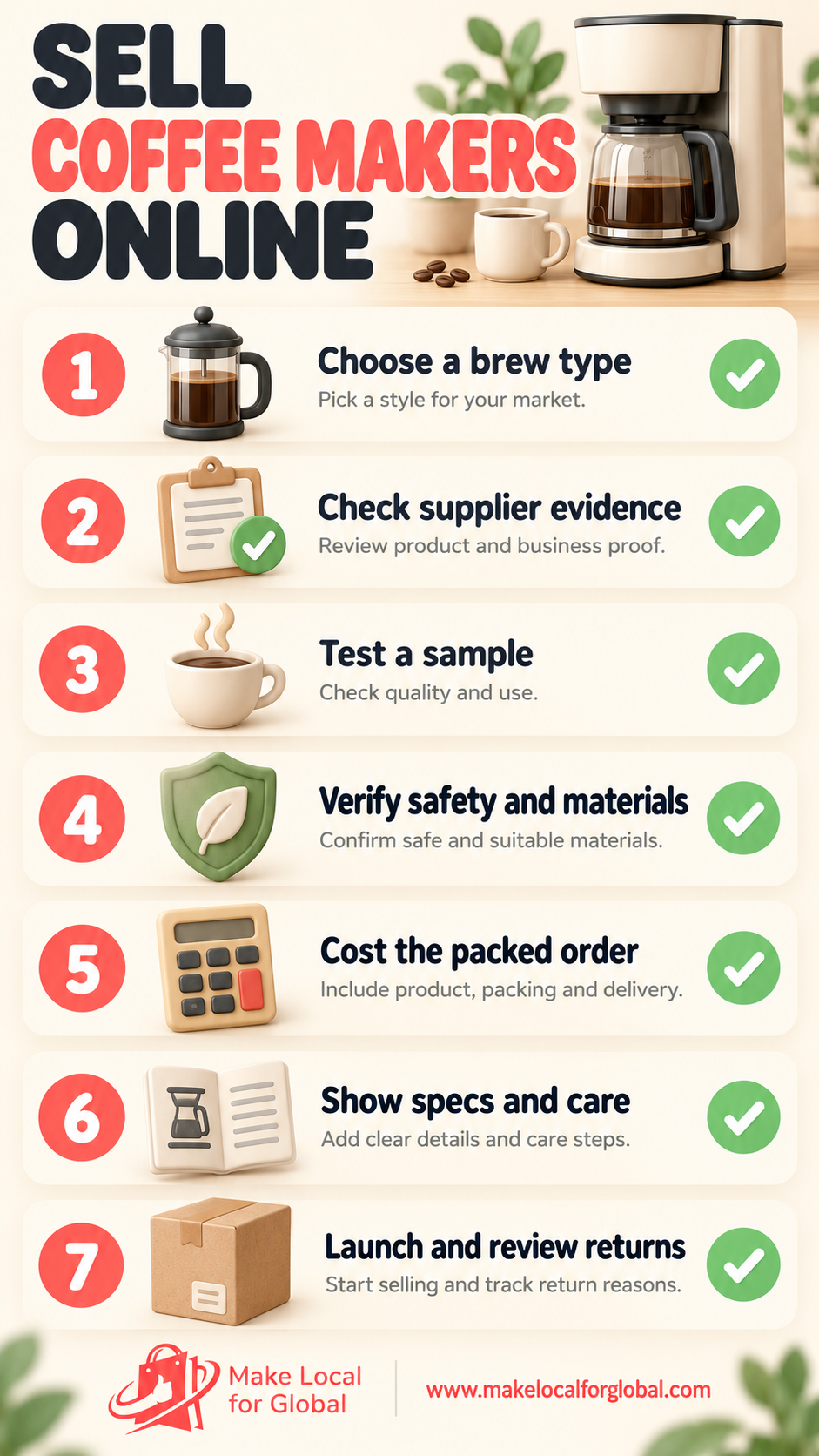
Choose the product type that matches a buyer group you can reach and support. A manual brewer can involve fewer electrical checks; a filter machine or espresso model brings more documentation, shipping and service work. Compare the whole offer before ordering.
You can sell an imported appliance only after checking your role and the product’s applicable safety, conformity, traceability and market duties. Ask for model-specific documents and specialist advice before placing the commercial order. The seller’s responsibilities can change when it imports, rebrands or modifies a machine.
Check the model, plug, cable, supplied parts, tank and carafe fit, leaks, normal brew cycle, cleaning process and carton protection. Follow the manual and keep a dated record. A sample check does not replace required conformity evidence or lab testing.
Name only formats the machine maker confirms for that model. State whether filters or capsules are included and list a clear model reference for replacement parts. Avoid “universal” wording without proof for each format.
Use the smallest quantity that meets a supplier’s terms and lets you serve the tested buyer group. Account for the size of the carton, cash tied up, return reserve, reorder lead time and parts support. Do not split an order evenly across styles without buyer evidence.
Online buyers have rights for faulty or misdescribed goods, and most distance purchases carry a cancellation period. Set out your process and follow current GOV.UK guidance. Do not rely on a blanket no-return rule.
WEEE retailer and producer duties can apply to electrical products sold online. Check the retailer take-back rules and whether you have producer duties from importing, private labelling or direct overseas sales. Publish the required customer information and document the route you use.
Show the brewing method, exact model, compatible coffee format, tank or carafe capacity, dimensions, power rating, plug, included parts, cleaning directions, warranty contact, delivery estimate and returns information. Use photos that show the actual machine and its components.
A useful coffee-maker launch begins with a defined use, a sample that passes your own documented checks, supplier records that match the model and a cost sheet that accounts for delivery and returns. The product page should show what the buyer receives and how to look after it.
Keep the range small until sales, questions, damage reports and contribution give you evidence for a reorder. If you want help setting up a store for the first product, review the online selling options or contact the team with your launch questions.
When your checks are recorded, choose the next action for your store. Explore selling guidance or contact MLFG with a question about your plan.
PREFERRED SOURCE
Like what you’re reading? Add Make Local for Global as a preferred source on Google to see more of our articles when you search.

Build your online presence without having to figure out everything yourself.