

READY TO SELL cat trees ONLINE?
Get a store built for you in 5 days, plus training and support to help you start, run, and grow your Alternative business.

Learn how to sell cat trees online: choose a focused range, inspect samples, check product safety, cost bulky delivery and prepare clear product pages.


A cat tree looks like a simple piece of furniture, but it asks a new seller to solve several linked problems: will it fit the room, remain stable during normal use, arrive without broken panels, and be straightforward to assemble? Product photos can make towers look alike. A reliable first range needs clear dimensions, model-specific checks, realistic freight costs and a support plan for missing parts.
To sell cat trees online, choose a buyer and a space the product is intended to suit, then compare a small number of designs by footprint, height, materials, assembly, stability and replacement parts. Obtain a production sample and the records that identify its exact model. Build the landed cost around the packed carton and delivery method, not the assembled display unit. Give buyers enough detail to judge fit before checkout.
A shop can serve indoor-cat owners in small flats, households with more than one cat, buyers replacing a worn scratching tower, or people looking for a den with raised resting places. Those groups share an interest in cat furniture, but they do not all need the same size, texture or price. A focused offer gives each model a reason to exist.
Use the product, room measurements and delivery needs to shape a clear first offer. Start with MLFG’s online selling resources.
“Cat tree” can refer to a compact scratching post with one perch, a tower with platforms and a cubby, a wide multi-post structure, or modular furniture assembled from separate parts. Some models combine a scratch post with a bed or hammock. Some are freestanding; some instructions describe a wall anchor or ceiling tension pole. Their materials, assembly steps and parcel requirements can differ substantially.
Start by writing down what each model contains. List the base, uprights, platform boards, fasteners, fabric, sisal or other scratch surface, removable cushions, hanging toys, assembly tools and instructions. Separate items supplied in the carton from accessories sold separately. Ask the supplier to identify the exact model and production version for each photograph, quote and document.
A climbing structure is not interchangeable with a scratching post. The latter can be a single vertical or angled scratch surface. A cat tree combines more furniture parts and may give a cat several routes up and down. Explain that distinction in the shop and connect readers who want a smaller scratch-only item to the site’s cat scratching post selling guide.
| Product format | Main parts | First checks | Range use |
|---|---|---|---|
| Compact scratch-and-perch | Base, one post, one small platform | Base footprint, post attachment, scratch material | Small room or first test item |
| Mid-height tower | Several posts, platforms, often a cubby | Joint security, access between levels, carton size | Core indoor-cat option |
| Wide multi-post tree | Broad base, multiple uprights and resting areas | Base flatness, fastener access, assembly accuracy | Larger room or multiple resting positions |
| Tree with hammock or bed | Frame, fabric seat, attachment hardware | Fabric tension, attachment wear, washing instructions | Comfort-focused option when parts can be replaced |
| Modular cat furniture | Separate platforms, posts and connectors | Compatibility, parts list, repeat supply and assembly | Add-on range only with tested interchangeability |
| Wall-fixed climbing set | Shelves, steps, wall hardware | Wall type, fixings, fitting instructions and installer needs | Specialist offer with clear installation scope |
Compare the documented specifications and sample performance for each exact model.
Use the format names as navigation aids rather than claims about a cat’s behaviour. A broad base does not prove that a product is stable in every room or under every use pattern. Ask the supplier what the design is intended for and keep descriptions tied to evidence for the exact model.
“Cat owners” is too broad to guide a first purchase. Think about the available floor space, ceiling height, number of cats, likely delivery route and the buyer’s capacity to assemble a large item. A person in a rented flat may prefer a freestanding product with a small footprint. A multi-cat household may ask for more than one resting platform. A buyer replacing an old tower could want a similar footprint and replacement cushions.
Ask how much floor space a buyer can spare and whether the unit must fit beside a sofa, window or radiator. Record the full base width and depth rather than measuring only the narrowest post. Show a top-down footprint drawing and the assembled height. Where a ceiling pole or wall fixing is involved, state the manufacturer’s installation conditions and avoid implying that every wall or ceiling is suitable.
Some buyers prioritise a higher perch; others want a low step-up route or a covered place to rest. Ask whether the buyer is replacing a familiar layout or furnishing a new home. Do not describe a product as suitable for “all cats” or a particular body weight without a credible basis from the manufacturer. A buyer should be able to compare the actual platform and cubby measurements with their own cat’s needs.
A cat tree that fits the room may still be difficult to bring through a stairwell, doorway or lift. Ask the supplier for packed-carton length, width, height and weight. Put those details beside the delivery description, and tell buyers if the parcel is kerbside, room-of-choice, or requires two people to carry. Confirm the carrier’s real service limits before selling the option.
A gift buyer may not know which style will fit the home. Clear dimensions, colour photographs, what is in the box and the return process help reduce guesswork. A replacement purchase may depend on a familiar spare post, cushion or fastener. Record whether a future component can actually be reordered before promoting a product as repairable.
Speak with five to ten people who match the intended buyer group. Ask what tower they use now, where it sits, what is difficult to clean or assemble, what wears first and what measurements matter before ordering. Record what people say in their own words. Friendly comments are not a forecast; repeated questions show what the product page and sample checks need to cover.
The first range might include a compact model, a mid-height tower and a larger multi-post design, but only when each serves a different use. Three models that differ only by colour may be three stock risks without giving the buyer a clearer choice. A short range makes it easier to check the supplier, photograph each version and identify the model involved in a return.
Create a product specification for every proposed SKU. Record the name, supplier model code, colour, assembled dimensions, base footprint, carton dimensions, product weight, packed weight, materials, included parts, fasteners, assembly steps, cleaning instructions and replacement component codes. Note if two model variations use a different supplier or construction, even when they look alike in a catalogue.
Set an entry, core and premium option only where the product changes are verifiable. An entry model may have fewer platforms and a simpler build. A core model may add a cubby or more resting positions. A higher-priced version may have larger dimensions, replaceable fabric elements or a parts supply agreement. Do not describe a product as “premium” on appearance alone; explain the construction or included service that supports the price.
Offer colour choices only when the supplier can repeat them and when each variant can be identified in stock and support records. Fabric shades can appear different in warm indoor light and on a phone display. Photograph each available colour when possible. If a photograph is a supplier sample, label it as such and check that it matches the orderable version.
A bundle can solve a clear problem if it includes compatible spare sisal posts, fasteners, a replacement cushion or a cleaning brush. Check that the parts fit the model and that the supplier will continue to supply them. Give each component a stock code, show it in the bundle image, list it in the carton contents, and include its cost and packed weight in the order model. A bundle with unrelated toys can raise the price without improving the buyer’s ability to use or maintain the tower.
Use the site’s cat beds guide for a separate rest-focused range and its cat toys guide for standalone play products. Keep a cat tree page about the structure, access, materials, assembly and replacement parts rather than trying to make it rank for every pet accessory.

Before paying a deposit, compare a small sample of products that serve one room and buyer situation. Read current listings to see which dimensions, assembly details and carton information are supplied. Note questions that appear in reviews, support forums or product Q&A, but treat them as clues rather than proof of the whole market. Repeated questions about wobble, missing screws, material shedding or replacement parts can inform the supplier interview.
Create a one-page concept for the intended range. Include one genuine sample photograph or a supplier-approved image, the assembled dimensions, packed carton size, materials, what is included, indicative delivery charge and a price hypothesis. Ask potential buyers to find the information they need before deciding whether the product could fit their home. Record their questions and level of interest rather than asking for a simple yes or no.
Test the sales proposition without accepting payment for stock that is not available. A landing page, local buyer interview or small advert test can help reveal whether customers understand the model and delivery terms. Set a limit for any promotion, state the expected delivery date accurately and make the next decision depend on what you observe. A click or message does not establish that the product will sell profitably.
A useful test compares two offers that differ in one clear way, such as compact footprint versus more platforms, or a tower alone versus a compatible spare-post bundle. Keep the audience, period and offer information as consistent as possible. Count qualified enquiries, the room-size questions people ask, the delivery charge reactions and the specifications they open. Do not test a bundle and a large price change at the same time if you want to learn which change affected interest.
If buyers repeatedly ask whether the product can be fixed to a wall or whether it suits a large cat, go back to the supplier and get a model-specific answer. Do not fill gaps with assumptions. An unresolved safety, installation or load claim belongs in the pre-order check list, not in a persuasive product description.
A seller can buy from a UK wholesaler, resell a recognised brand, import a finished product, commission private-label furniture, or work with a manufacturer to create a modular range. Each route changes the records, minimum order, stock risk, product control and customer support work. Compare the whole route rather than selecting by unit price alone.
A local wholesaler may let a new seller start with a smaller order and may make replacement parts easier to obtain. Ask if it is authorised to supply the brand, which models are currently available, how often the range changes, and who handles warranty issues. Request current product specifications, carton measurements, materials, assembly instructions, batch identification and a named contact for a safety concern.
Bringing goods into the UK or selling them under your own brand can make your business an importer or producer under product-safety rules. Ask who is identified as the manufacturer, who is responsible for product records, what batch marking is used, and what changes to packaging or instructions are permitted. Confirm duties for the market you intend to serve before placing an order. Great Britain and Northern Ireland have different general product-safety rules; the Office for Product Safety and Standards sets out the GB position and separate NI guidance.
If an overseas supplier sends a product directly to a customer, confirm who appears on the package and invoice, where the return goes, who pays return freight, how damaged parts are replaced, and how a product concern would be traced to other orders. A drop-ship arrangement does not remove the seller’s need to describe the product accurately or provide a working customer support route.
A local maker may offer custom sizes or colours, but a short lead time claim needs evidence from actual production. Ask how they record timber, board and fabric substitutions, which fasteners they use, how they inspect joints and whether they can reproduce a replacement part. Agree what happens if a supplier changes the design after you approved a sample.
For all routes, agree in writing the exact model, finish, included items, minimum order, deposit, production time, packaging standard, defect process and ownership of photography. Save dated copies beside the product record. The sample, records and purchase order should identify the same model version.
Request a dated product specification for each exact model. It should identify the model and the supplier, assembled dimensions, packed dimensions, weight, materials, included parts, fastener type, assembly process and cleaning instructions. Ask what test or inspection supports any claim about stability, maximum recommended cat size, washable fabric, scratch resistance or load capacity.
Ask for clear photographs of the underside of the base, each post connection, the platform fasteners, cubby joins, seams, wall hardware if supplied, labels and packed carton. A front image cannot show whether the base is flat, if fastener holes align, or if the box protects the corners. Request instructions as a digital file before you order and compare them with the sample carton.
Ask the supplier to tell you how production parts are checked, how a batch is identified and whether replacement pieces can be bought separately. A tree with a damaged platform should not require a customer to return an entire large unit if a safe replacement part can solve the issue. Record replacement prices, freight and expected availability before using “spares available” in a product listing.
For a wall-mounted design, request a precise parts list and instructions for the intended wall types. Clarify if the included screws and plugs match the listed substrate, or if customers must obtain suitable fixings. Avoid implying that the unit can attach to plasterboard, masonry or timber without the maker’s stated conditions. For a freestanding structure, describe a wall strap as included only when the exact SKU contains it.
Review the supplier’s documents before you pay for the production order. A certificate for an unrelated model, a catalogue page with no version code, or a supplier assurance with no material or traceability details does not answer the question for the product you plan to sell. Keep any unresolved item visible and pause that model until the supplier closes it with evidence.
Photograph the carton before opening it. Record the delivery date, visible damage, product code and batch reference. Keep the packaging long enough to compare its protection with the condition of the tower after assembly. If the product arrives with cracked panels, crushed corners or loose parts, send clear photographs to the supplier and ask how the production pack should prevent the damage.
Check the contents against the supplier’s list. Count posts, platforms, cubby panels, washers, bolts, screws, tools and instructions. Note whether a fastener has the right length and whether threaded inserts sit flush. Match each part to the diagram rather than guessing from a photograph. A missing bolt can make the unit unusable; an extra bolt may indicate that the parts list or packing process needs clarification.
Assemble the sample using the supplied instructions, the intended floor surface and the tools named by the maker. Record the time, confusing steps and whether holes align without forcing parts. Do not substitute a stronger screw or drill new holes without approval, since changing fasteners can affect the structure and the future repeatability of the product.
Inspect the base, uprights, platforms, cubby, hammock or bed attachment. Check for splinters, rough edges, exposed staples, sharp corners, loose stitching, adhesive residue, unstable feet, poorly finished holes and gaps that could catch a paw. Run a hand along the exposed edges and seams. Do not let a cat use the test unit until it is fully assembled and any concern has been resolved.
Check how the assembled structure sits on a level floor. Follow the supplier’s instructions for any stability check and repeat it in the same way for each sample. Observe movement when you apply gentle hand pressure at the points specified by the maker; do not claim that this is a formal load test. Watch for rocking, lifting feet, loose joints or bending platforms. If the instructions call for a wall attachment, test only in the stated installation conditions.
Check scratch posts by looking at how sisal ends are fixed, how tightly it is wound and whether the edges begin to unwind after repeated hand contact. Inspect fabric joins and removable cushions. Ask the supplier for care guidance and check whether the cushion cover can be cleaned in the stated way. Do not wash a fabric piece or expose the product to moisture outside the maker’s instructions.
Record every issue with a photo, date, model code and batch. Agree an acceptance checklist with the supplier before placing an order. A repeat sample or factory correction may be needed if holes misalign, the base rocks, parts are missing or materials differ from the approved version. Keep the sample until the first delivered order has been checked against it.

In Great Britain, the General Product Safety Regulations 2005 apply to consumer products and require them to be safe in normal or reasonably foreseeable use. In Northern Ireland, the EU General Product Safety Regulation 2023/988 has applied since 13 December 2024. A seller who makes or imports products has duties that can include keeping a risk assessment, product records and safety information. Check the rules for each market you intend to serve and get advice on your specific role.
A cat tree is not automatically required to carry a CE or UKCA mark by virtue of being a consumer product. Add a mark to packaging only when a specific regulation for the exact product requires it and the correct assessment has been completed. A cat tree with electrical lighting, powered movement or another regulated feature may be covered by additional product rules. Treat each added feature as a separate compliance question.
Give buyers relevant warnings and assembly information with the product. If a model has a wall strap, ceiling pole, recommended floor surface or specific assembly sequence, use the manufacturer’s wording where accurate and make the instructions available before purchase. Tell the customer if the product is not intended for outdoor use or if a certain fixing method is excluded. Keep the model identity and the party responsible for the product clear.
The UK product-safety guidance asks producers and importers to provide information that lets consumers use products safely and to retain traceability. Keep the supplier’s legal name, your own product code, batch or production reference, order date, sample record, issue log and corrective action. If a credible safety concern appears after sale, stop dispatching affected stock until you have assessed it, contact the supplier and follow the relevant authority’s reporting process.
Do not confuse a supplier’s sample check with an independent risk assessment or a laboratory test. Your inspection can find assembly gaps, broken parts and mismatches in materials. It cannot prove every product is safe under every foreseeable use. Ask the manufacturer for evidence that fits the claim and seek product-safety advice where a risk or obligation is unclear.
Cat trees often cost more to ship than their product weight suggests. A long carton can be charged by volumetric size, need a two-person handling service, or fall outside a parcel carrier’s normal limit. Request quotes using the packed carton dimensions and weight. Include the collection area, destination zones, delivery speed, remote area surcharge, fuel or bulky-item charge and failed-delivery fee.
A product in a box can still arrive with chipped corners or crushed platforms. Ask the supplier for a packed sample, then check how each board and post is separated, cushioned and held in place. Photograph the inside layers. Confirm whether the outer carton has handholds, a two-person lift marking or orientation instructions when needed. Never use a small parcel price based on an assembled photograph.
Decide how the carrier hands the order to the customer. A parcel left outside, a kerbside pallet and a room-of-choice service are different offers. State the service area, access restrictions, expected dispatch time and whether the buyer must be at home. Ask the carrier how an oversized item is classified and how a damaged or refused delivery is recorded.
Work out a return route before listing the item. A customer may have to dismantle the product, retain parts and re-pack a large carton. Give accurate return instructions and do not present a policy that removes statutory rights. Check who covers the cost where the product is faulty or misdescribed, and compare the cost of a replacement part against a full return shipment.
Keep evidence of packaging and transit damage. Record which model was sent, carrier, carton condition, photographs, issue type, refund or replacement and supplier response. If one part repeatedly arrives damaged, add protection at that part rather than increasing packaging everywhere without a diagnosis.
Price the complete delivered order. Unit price is only one line. Include inbound freight, duty or customs charges where applicable, receiving time, storage, protective packaging, payment fees, outbound delivery, discounts, customer acquisition and an allowance for damage, returns or replacement parts. Include the actual packed size in the carrier quote.
| Order item | Illustrative amount | Working note |
|---|---|---|
| Customer price including VAT | £149.99 | Example checkout price |
| Revenue excluding 20% VAT | £124.99 | £149.99 ÷ 1.2, rounded |
| Cat tree and included parts | £44.00 | Example landed purchase cost before sales costs |
| Inbound freight and receiving | £11.50 | Allocated cost per saleable unit |
| Protective packaging | £7.00 | Outer carton and corner or edge protection |
| Payment fee | £3.95 | Example 2.5% of £149.99 plus £0.20 |
| Bulky outbound delivery | £16.00 | Illustrative quote only; get a carrier rate for the carton |
| Return or damage provision | £8.00 | Seller planning allowance, not an expected rate |
| Customer acquisition | £12.00 | Example paid acquisition cost |
| Contribution before fixed costs and tax | £22.54 | £124.99 less the cost lines above |
Illustrative figures only. Replace these assumptions with supplier, carrier, payment and return data from your own business.
This example assumes a VAT-registered seller charging 20% VAT on a standard-rated product and uses made-up costs to show the arithmetic. It is not a recommended price or profit promise. A non-registered seller should model the actual revenue and VAT treatment for their position; an adviser can confirm how recoverable input VAT affects their costs. Replace each cost with an invoice, supplier quote or measured result before ordering stock.
The £16 delivery line may be too low for an island, remote postcode, two-person service or room-of-choice delivery. Compare a standard bulky service with a specialist carrier and model each one. If the delivery charge is separate at checkout, include the payment fee on that amount and check whether buyers still understand the total. Free delivery is still a cost paid by the seller.
Check how the price reacts to a damaged panel, a replacement post, a return shipment or a discount. If one replacement part costs £12 to ship, a small advertised margin can disappear. Run a lower-price scenario, a normal-price scenario and a case where one order requires extra support. Decide the minimum contribution per order that can cover fixed costs such as software, storage, insurance and bookkeeping.
Packaging producer responsibility may apply to some businesses that supply or import packaging. The current GOV.UK check explains who must assess their role and the small and large producer thresholds. Track packaging weights and activities from the start; do not assume a small first order settles whether later reporting rules apply.
The page should help a buyer decide whether the model fits the cat’s room, the delivery route and the person’s ability to assemble it. Start with a product name that identifies the format, height range only when measured, material and key included feature. Add the model code and a clear image showing the full assembled structure.
Write a concise description of what it does and what comes in the box. Avoid generic phrases such as “perfect for every cat”. Explain the number of platforms, whether a cubby is included, what material covers each scratch post, if cushions are removable, and whether any wall strap or hardware is included. If a toy or cushion is pictured but sold separately, label that clearly beside the image and price.
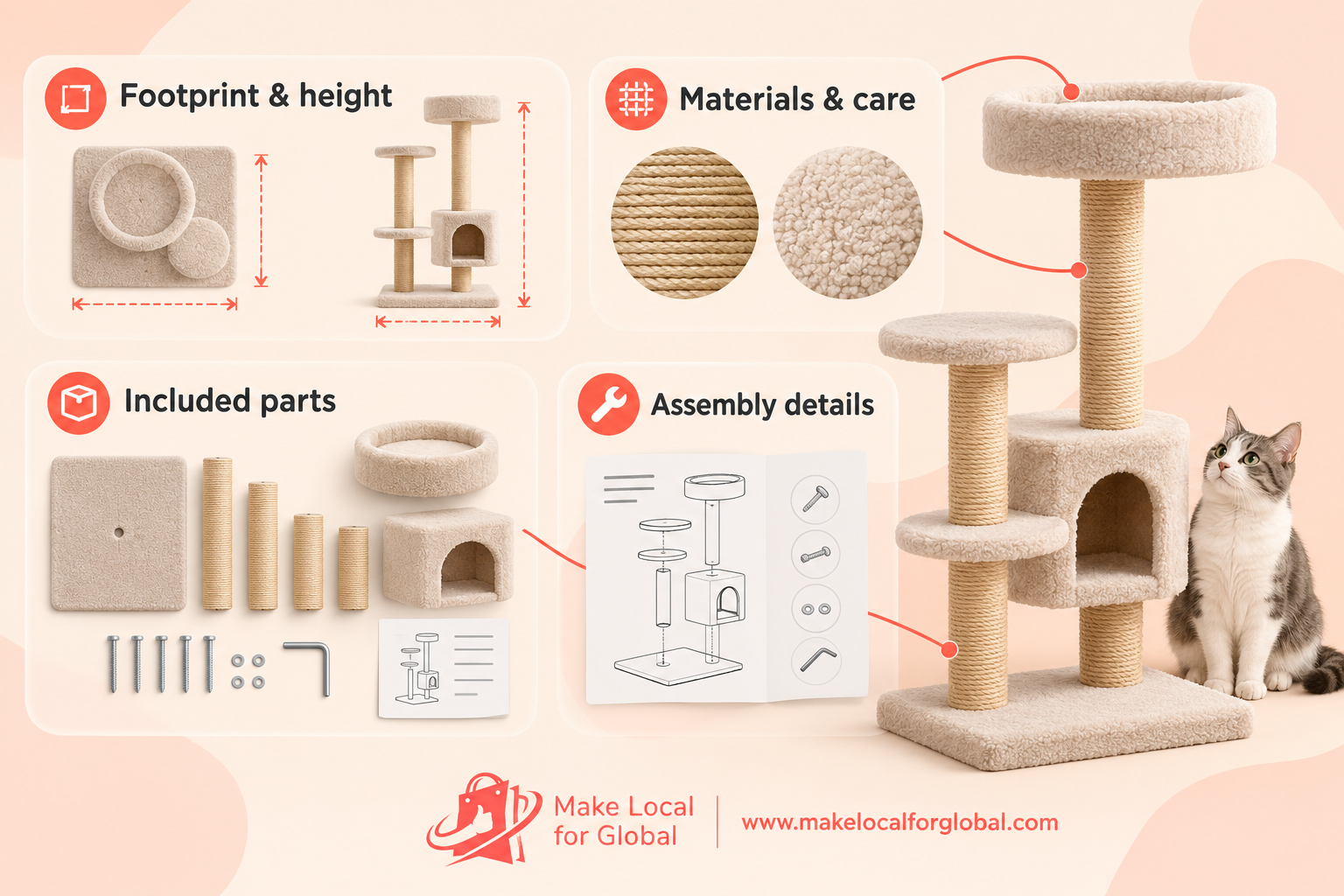
Include the total height, base width and depth, largest platform measurements, cubby opening, carton dimensions and packed weight. State if dimensions are measured from the widest points and whether a hanging toy adds length. Add a top-down footprint image and give the customer one real comparison, such as the size of a doorway or a room corner, only when the comparison is measured accurately.
Use material names provided by the manufacturer. “Natural sisal”, “engineered board”, “solid wood” and “plush fabric” describe different products. Do not substitute “solid timber” for a wood-composite panel. Describe cleaning instructions as stated by the maker and say which covers can be removed and washed only when that is verified.
A helpful product data section can include:
Photograph the real sample from the front, side and rear. Show the underside of the base and how a post joins a platform. Include a photo of the carton only if the same packaging will ship. A clean white background can show details, but a room scene helps a buyer judge footprint and scale. Do not digitally widen platforms, remove a support column or use a cat to imply a weight capacity.
Use the main phrase “sell cat trees online” naturally in the title, opening and page address. Supporting phrases can include “cat tree dimensions”, “cat tree for small flats”, “cat tree assembly”, “cat tree replacement posts” and “cat tower delivery”, where each phrase matches something the page actually answers. Avoid repeating the same phrase in every heading.
Give each model a distinct title based on its verified features. A useful title might read “Mid-height cat tree with cubby and sisal posts, model CT-210”. The product description can answer: how much floor space does it use, how high is the tallest perch, what material covers the posts, can the cushion be removed, what parts are included and how will it arrive?
Write support content that solves a specific task: how to measure a room for a cat tree, how to assemble this model, what arrives in the carton, how to care for the scratch surface, which replacement post fits, or how bulky delivery works. Link from each help page to the exact model or part discussed. Keep advice separate from unsupported claims about cat health or behaviour.
Link to related products with a clear purpose. A buyer comparing climbing furniture with collars can use the site’s cat collars guide, but the collar page should not be inserted into a paragraph about tower assembly. Link to the cat-bed guide in a section about replacing a resting place, and link to the cat-scratching-post guide when explaining the product distinction. Relevant links give the reader a next step without blurring the purpose of this page.
Measure search performance by the page’s actual questions and product interest. Search impressions and clicks can show whether the title and page match the query. Product enquiries, fit questions, basket additions, purchases, delivery refusals, damage and returns tell you whether the offer works after the click. A ranking position alone does not pay the carrier invoice.
An owned shop lets you explain dimensions, delivery and assembly in detail. It requires you to attract visits, answer questions and manage payments, orders, customer data and returns. Marketplace listings may offer existing buyer traffic, but review category restrictions, listing standards, referral fees, delivery expectations and return processes before uploading a bulky unit.
A local pet shop can give buyers a chance to see a sample and may let you learn which dimensions they ask about. Agree the wholesale price, packaging, delivery responsibility and payment terms. Keep the product label, instructions and part list with the stock. A local demonstration does not replace written safety information or a clear online page.
Social media can show scale, assembly stages and material details through short demonstrations. Film the unit being assembled by following its instructions, show the packed carton and give the product code. Do not stage a cat jumping onto a unit that has not been checked, or claim that a demonstration proves a load limit. Link the clip to the product page that includes the full delivery terms.
Start with one channel you can serve well. Track gross sales, net revenue, delivery cost, payment fees, returns, replacement parts and support time by SKU and channel. A channel with more visitors may produce lower contribution if it charges high fulfilment fees or generates more damage. Keep the decision tied to completed orders and service records.
Price the cat tree with its packed carton, fulfilment, payment fees and support allowance. Use MLFG’s free business apps to organise your figures.
Decide whether the first offer will be made to order, held in a small local stock, or fulfilled by a supplier. Each method changes the promise you can make at checkout. A made-to-order unit needs a reliable production and dispatch estimate. A stocked unit needs dry, secure storage with enough room to inspect long cartons. Supplier dispatch needs clear rules for packing, tracking, damaged deliveries and returns.
Start with one or two models and keep each supplier version separate in your records. A colour change, new fabric, different post diameter or revised fastener can make an old spare incompatible. Give every sellable version an internal SKU and retain the supplier’s model code. Photograph the label and carton marks when stock arrives.
Ask whether the supplier can provide replacement platforms, posts, hammock covers, cushions and fasteners individually. Record each part code, price, lead time, minimum order and shipping cost. A small stock of commonly needed parts can be cheaper and quicker than returning a whole tower, but keep only compatible parts and make that compatibility explicit to buyers.
Use a simple stock sheet with opening quantity, received units, saleable units, damaged units, reserved orders and spare parts. Reconcile it after each delivery and sale. If the supplier changes a component, quarantine the new batch until its model identity and sample changes are clear. Do not merge visibly different versions under one listing merely to simplify stock keeping.
Before dispatch, match the order to the exact SKU and finish. Check the outer carton, model label, included instructions and any warning information. Record the carrier label and tracking number. If the shipment uses a two-person or appointment service, confirm that the customer’s contact details and delivery window are passed on correctly.
For direct supplier fulfilment, request evidence of the same checks from the supplier and agree how they report a missing component or damaged carton. Make clear which business answers the customer. A buyer should not have to guess whether to contact your shop, a marketplace or a distant factory.
Keep records proportionate and useful: order number, supplier batch, dispatch date, carrier, delivery status, complaint type, photos and resolution. These details can help you identify a recurring carton failure or fastener issue. Keep personal information only as long as your legal and business needs require, and limit access to people who need it.
Large furniture creates practical questions after checkout. Tell buyers how the tower will arrive, whether assembly is required, how to contact you about missing parts, what to photograph when a parcel is damaged and how a return is arranged. Put the key delivery and returns information near the purchase button and on the full policy page.
UK distance-selling rules give consumers 14 days after receiving goods to tell a trader they wish to cancel, followed by 14 days to return them. There are exceptions, and the buyer’s responsibility for return costs depends on what was disclosed before purchase and the circumstances. Faulty or misdescribed goods have separate rights. Check the current GOV.UK online and distance selling guidance and returns and refunds guidance before setting your policy.
Do not treat an opened carton as automatic proof that a buyer has lost cancellation rights. Give practical instructions for keeping parts together and arranging a bulky collection. State who books the carrier, what packaging is needed, the collection area and how you handle a product that arrives damaged. Get legal advice if a disputed return or product fault raises a question about your obligations.
Build a support checklist for common issues:
Reply with a clear next step and a realistic time. Do not ask a customer to keep using a product where a structural part is loose or broken. Log the issue for the supplier and pause the affected stock if the pattern suggests a safety concern.
Show what a buyer needs to assess: the real footprint, overall height, attachment points, covered materials, parts in the carton and assembly sequence. A short video can begin with the unopened package, move through the manufacturer’s assembly steps and end with the finished unit beside a familiar piece of furniture. Use the same SKU and version that appears on the product page.
Create a measured diagram with height, base depth and width, platform dimensions, cubby opening and carton size. Label the units and state whether a measurement includes a hanging toy or overhanging bed. A close-up of the fixing or sisal edge is more useful than another generic lifestyle photograph. Show a real room scale without making unverified claims about the cat’s health or preferences.
Useful launch content may include a guide to measuring a room corner, a clear assembly checklist, an explanation of freestanding versus wall-fixed designs and instructions for finding the correct spare part. Link each item to the model it describes. The website’s cat beds guide can support a discussion of resting spaces. The cat toys guide serves readers considering a separate enrichment-product range. Keep this page focused on cat-tree selection and selling.
Ask an existing buyer for feedback about dimensions, assembly and delivery after the order is complete. Do not condition a review request on a positive rating. Use repeated questions to improve the listing. If several customers ask whether the cubby fits a particular size of cat, add the measured opening and avoid promising a fit you have not verified.
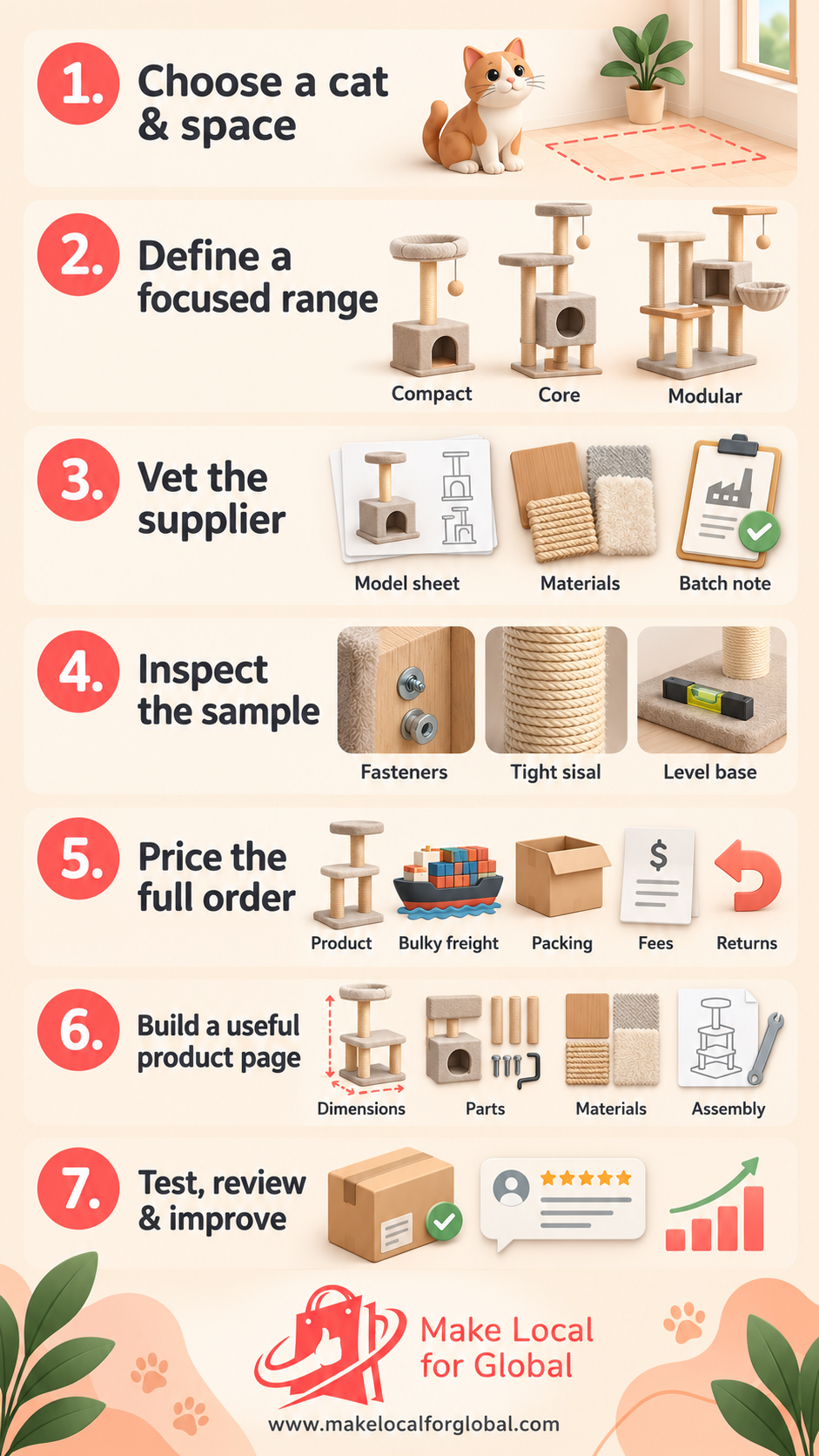
Select a narrow first range. Ask for model-specific specifications, production identity, material details, current instructions, safety information, spare-part availability and packed carton measurements. Check the supplier’s answers against a sample and resolve gaps before committing to a production quantity.
Photograph the carton, check every supplied component and assemble the sample according to its instructions. Record fit, finish, stability observations and any mismatch with the listing data. Request carrier quotes with the real carton size, then replace the illustrative figures in your cost model with current supplier, payment and delivery prices.
Write the product page using measured dimensions and verified materials. Add images of the complete product, footprint, parts and packaging. Publish clear delivery, returns, assembly and spare-part information. Prepare an order checklist and a customer-support route for damaged or missing components.
Order a quantity that matches your cash position, storage and ability to handle returns. Keep the approved sample and compare delivered units to it. Inspect cartons before dispatch and record any change in version, finish, instructions or parts. Pause a batch if a mismatch affects fit or safe assembly.
Open the listing on one channel. Share a measured demonstration and a link to the full product page. Reply to fit and delivery questions using the model’s real dimensions. Capture each question, time to answer, order outcome and any reason a buyer abandons checkout.
Compare visits, enquiries, orders, delivery cost, contribution, damage, returns and support hours. Ask whether the model attracted the buyer you intended, whether the carrier quote matched the invoice and whether a replacement part would have prevented a full return. Continue, revise or stop the model based on records, not a single social post or a few early visits.
| Checkpoint | Evidence to review | Decision it supports |
|---|---|---|
| Product fit | Search queries, room measurements asked, size-related returns | Change dimensions or range mix |
| Unit economics | Net revenue, landed cost, fulfilment invoice, fees and support | Adjust price, delivery method or supplier |
| Packaging | Carton photos, damage location, carrier claim outcome | Improve protection or change service |
| Assembly | Missing parts, misaligned holes, repeated customer questions | Revise instructions or pause the batch |
| Spare parts | Requests, supplier lead time, shipping cost and compatibility | Hold a small compatible parts stock |
| Channel | Completed orders, fees, return rate and service time | Keep or change the sales channel |
Compare the documented specifications and sample performance for each exact model.
Not always. A scratching post may be a single scratch surface, whereas a cat tree can combine posts with platforms, resting areas or a cubby. Describe the parts included in the exact product and link to a separate scratching-post range when the customer needs a simpler item.
There is no fixed number. A small, clearly differentiated range is easier to sample, cost, store and support than many near-identical options. Choose each design to answer a distinct space or feature need, then add variants only when customer and order data support them.
Measure the assembled height, widest base dimensions, platform and cubby openings, overhangs and packed carton. Include the required wall or ceiling installation conditions if applicable. Make clear which measurements are product dimensions and which describe packaging.
Do not assume that a mark applies to a standard cat tree. Check the specific product rules for the exact design and intended markets. Electrical or other regulated features can change which rules apply. The seller or importer should verify obligations with suitable official guidance or an adviser.
Add product and inbound costs, packaging, payment fees, actual outbound delivery, expected support and a reasonable allowance for returns or damage. Model the full customer price and tax treatment for your business. Obtain a quote using the packed carton dimensions rather than guessing from product weight.
Consider it where the supplier can provide verified compatible parts and customer requests justify the holding cost. Keep part codes and compatible model versions clear. A fastener, post or cushion from another model may look similar but fail to fit.
Ask them to stop using the affected unit until you understand the issue. Record the product version, batch, photos and order details, contact the supplier and decide on a remedy that fits the customer’s legal rights. If similar reports appear, pause dispatch of the affected stock during the investigation.
Yes, if the offer clearly describes the included fittings, intended wall types, installation steps and any required customer-supplied hardware. Do not imply that one fixing suits every wall. Where installation needs specialist knowledge, state the limits of your instructions and ask the maker for precise specifications.
Give the packed or assembled item dimensions as relevant, service area, dispatch estimate, appointment or kerbside details, access limits, delivery fee and what to do if the carton arrives damaged. Confirm that the actual carrier service accepts the carton size and weight.
Start with the practical resources on how to sell online and the site’s free business apps. For a question about the site or its support, use the contact page.
A cat tree can be an attractive product, yet the business depends on details outside the hero image: room fit, supplier consistency, assembly, bulky delivery, return handling and replacement parts. Check those details on the exact model before paying for stock. Build the price from real carton quotes and actual costs, show buyers what arrives, and keep a traceable record of each version.
Begin with a narrow range and a tested sample. Explain measurements and installation plainly, use images that match the version in the box, and review complaints and carrier invoices after launch. If the product, delivery and service still leave a viable contribution, you have evidence for the next order. If not, revise the model or the offer before taking on more stock.
After checking the sample and delivery costs, decide whether to test a small order or revise the offer. Find practical selling resources or contact MLFG.
PREFERRED SOURCE
Like what you’re reading? Add Make Local for Global as a preferred source on Google to see more of our articles when you search.

Build your online presence without having to figure out everything yourself.