

Assess customer need, differentiation, contribution margin, fulfilment, demand evidence and testability before you launch a product.


A product is viable when a specific customer has a meaningful reason to buy it, the offer is different enough to choose, one realistic sale leaves enough contribution, fulfilment can keep the promise and the riskiest assumptions can be tested before a large commitment. An attractive product photo or encouraging comment is not enough.
This guide shows how to assess product viability for ecommerce using six evidence areas: customer need, the gap between your product and current alternatives, contribution margin, fulfilment practicality, demand evidence and testability. The free Product Viability Assessment organises those checks into a score and a focused validation plan.
Quick answer: do not ask whether people like the product. Ask whether the intended buyer recognises the need, chooses the difference, accepts the real price and completes a meaningful action while you can deliver the order safely and profitably.
Score six practical evidence areas and receive your strongest signal, biggest gap and three next actions.
Product viability is the strength of the commercial and operational evidence behind one product. It is narrower than deciding whether you want to run a business and more specific than choosing a business model. A viable product has a plausible route from a real customer problem to a repeatable order that can be supplied at the expected quality, time and cost.
Viability is not a permanent label. A product that is weak today may become testable after the customer is narrowed, the design changes, a better supplier is found or the price is corrected. A promising product can become less viable if delivery costs increase or evidence shows that buyers prefer an alternative. Treat the assessment as a dated evidence record.
Start with one identifiable buyer and one situation. “Anyone who wants to be organised” is difficult to research. “UK market traders who need weather-resistant price labels that can be changed quickly” provides a group, setting and practical problem. Describe what the customer does now, how often the need appears and what happens when it is unresolved.
A frequent or costly problem is easier to prioritise than a mild preference, but products can also serve identity, convenience, enjoyment or gifting. The essential point is specificity. Interview people who match the intended buyer and ask about recent behaviour. Do not begin by explaining the product. Ask them to describe the last time the situation occurred and what they used instead.

Your product does not compete with an empty shelf. The buyer may already use a competitor, a manual workaround, a general-purpose item or no product at all. Record why that alternative remains acceptable and where it causes friction. A meaningful gap may be better fit, easier use, trustworthy materials, faster UK delivery, clearer sizing, a stronger bundle or a design for an underserved situation.
“Higher quality” is not yet a difference. Make it observable. For example, “the liner can be removed and washed without detaching the straps” can be demonstrated and tested. Compare at least three alternatives on total price, delivery, proof, returns, support and the job the customer is trying to complete. Read negative reviews carefully, but confirm whether the complaint also matters to your chosen buyer.
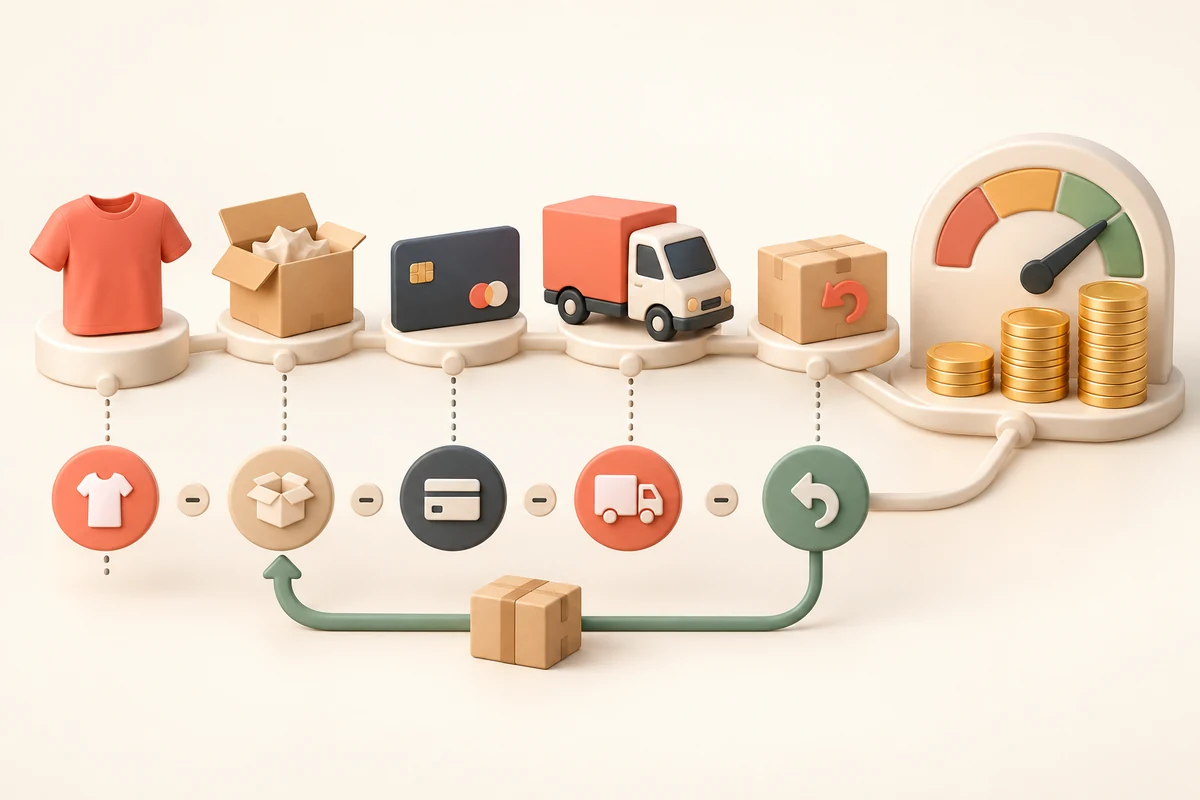
Contribution is the customer price minus the variable costs created by the order. Include the product, packaging, payment fee, outward delivery, expected returns or replacements and a realistic acquisition cost. If you import or manufacture, include freight, duty and other landed costs where applicable. VAT treatment can also affect the calculation, so obtain qualified advice for your circumstances.
| Order item | Example | How to verify it |
|---|---|---|
| Customer price | £38.00 | Show the real price in the test |
| Product and inbound cost | −£12.00 | Use a current written quote and sample shipment |
| Packaging | −£1.80 | Pack and weigh the real product |
| Payment fee | −£1.20 | Check the current provider calculation |
| Delivery | −£4.50 | Buy a representative shipment |
| Returns allowance | −£2.00 | Use cautious product-specific assumptions |
| Customer acquisition | −£7.50 | Use a bounded channel test |
| Contribution | £9.00 | Stress-test costs and price |
The £9 in this example still has to support fixed costs, administration, software, insurance, samples, tax and the founder’s time. It is not the same as profit. Increase uncertain costs by 10 or 15 per cent and ask whether the product still has room to operate. If the answer depends on the cheapest possible delivery or unusually low advertising cost, the evidence is fragile.
Place a sample order through the route a customer will use. Measure production, dispatch and delivery. Inspect the item, packaging and instructions. Test tracking messages and rehearse a late, damaged or incorrect order. For digital products, test payment, access, download, compatibility and account recovery on a different device. A supplier catalogue, prototype or successful personal delivery does not prove that the full process is repeatable.
Write the promise before the process. If the page says dispatch within two days, identify who completes every step and what happens during busy periods. If personalisation is offered, include proofing, customer corrections and production errors. If returns are difficult because an item is large, fragile or custom-made, understand both the operational cost and the customer information required.
Evidence becomes stronger as the buyer gives up more. A compliment costs nothing. A detailed interview costs time. A price-visible waitlist asks for attention and contact details. A sample request, deposit, pre-order or paid pilot asks for more meaningful commitment. Use the strongest ethical test that fits the product’s stage and be clear about what is available and when.
Business.gov.uk recommends going beyond friends and family, researching representative customers and competitors, and learning what buyers may be willing to pay. Its guidance on testing and validating a business idea also explains the role of a minimum viable version. Record who saw the offer, the price, the channel and the action. A conversion rate without audience quality can mislead.

Do not build the whole product to test one uncertain assumption. If the customer problem is unclear, interview representative buyers. If the difference is unclear, compare two propositions with the same audience. If willingness to pay is unknown, use a transparent deposit or small paid pilot. If fulfilment is uncertain, run sample orders before promotion. Define the evidence that will justify the next investment before the test begins.
The assessment scores all six areas and turns the weakest signal into a focused validation action.
Each area receives 0, 2 or 4 points. Four points means there is comparatively strong evidence, such as a specific buyer with a frequent problem, a demonstrated gap, a realistic cost model, an end-to-end sample, paid commitment or a bounded paid experiment. Two points means there is a plausible route with an important estimate or untested step. Zero means the area is mostly assumption.
The maximum is 24. The result also identifies the strongest signal and biggest gap, then provides a three-step validation plan. The bands are “Ready to test”, “Promising with gaps” and “Needs more evidence”. None predicts success. A high score supports a controlled test, not a large stock order. A middle score suggests resolving the weakest assumption. A low score shows where research is cheaper than premature production.
Interpretation rule: prioritise the weakest area that could overturn the product decision. Improving an already strong area may feel productive while leaving the real risk untouched.
| Week | Focus | Evidence | Decision |
|---|---|---|---|
| 1 | Need and alternatives | Five customer conversations and three genuine alternatives | Narrow the buyer and problem |
| 2 | Cost and supply | Current quotes, packed weight and one complete order calculation | Set a test price and cost ceiling |
| 3 | Sample and promise | Product inspection, delivery timing and return rehearsal | Correct quality or fulfilment gaps |
| 4 | Buyer action | One price-visible offer with a defined commitment target | Continue, change one variable or stop |
Keep an evidence log with dates and sources. Separate observations from interpretations. “Four of 25 qualified visitors placed a refundable £5 deposit after seeing £38 and a ten-day delivery estimate” is an observation. “Customers love it” is an interpretation. The observation can be compared with another test and used to improve the cost, offer or audience.
Keep the evidence that supports each score in one place. For customer need, save interview notes with the participant type, date and recent situation discussed. For the alternative gap, capture competitor pages, prices and reviews on the date you checked them. For margin, keep supplier quotations, packed weights, courier estimates and the calculation version used for the test price. For fulfilment, photograph the sample, record dispatch and arrival times, and note any support or return rehearsal.
Demand evidence needs the same context. Record the page or message shown, audience source, price, delivery statement, number of qualified visitors and actions taken. Ten deposits from a discount community may not predict behaviour from your intended full-price customer. A weak result is still useful when the conditions are documented because it tells you which audience, promise or price was actually tested.
Add a confidence label to each important number. A completed sample shipment is verified evidence. A current written supplier quotation is stronger than a remembered catalogue figure, but it can still change. An estimate copied from a general article is weak until it is replaced with a product-specific quote. Labelling the quality of an input prevents a precise-looking spreadsheet from creating false confidence.
A decision gate states what must be true before more money is released. For example: “Do not order 100 units until the final sample passes the quality checklist, complete landed cost remains below £14, and ten representative customers place refundable £5 deposits after seeing a £39 selling price.” The figures are illustrative, but the structure is useful. It connects product, economics and demand instead of allowing one strong signal to hide two weak ones.
At the review date, make one of three decisions. Continue when the required evidence appears and the next commitment remains proportionate. Change one important variable when the result points to a specific audience, product, price or delivery issue. Stop that route when a safety, supply, demand or contribution problem cannot be resolved within the limit. A stopped product test can protect far more money than it cost.
Repeat the assessment when one of the inputs materially changes. A new supplier can improve lead time while changing cost or traceability. A redesigned product can strengthen differentiation while introducing a new quality check. A different audience can respond to the need but reject the original price. Keep previous results rather than overwriting them so you can see which evidence changed the decision and which assumptions have remained unresolved.
Commercial evidence does not prove legal or safety readiness. GOV.UK states that businesses making, importing, distributing or selling consumer products are responsible for ensuring products are safe and for following relevant labelling requirements. Product-specific rules can apply, and responsibilities may differ between Great Britain and Northern Ireland. Review the current product safety advice for businesses and obtain specialist guidance where needed.
Keep supplier and technical records, confirm instructions and warnings, and understand what action would be required if a safety issue appeared. Online sellers should also provide clear business, product, price, payment and delivery information before purchase. Read the current GOV.UK guidance for online and distance selling and the rules on returns and refunds.
Important: the assessment and this guide are educational. They are not legal, financial, tax, safety or product-compliance advice.
A higher score means the current answers contain stronger evidence across the six areas. It does not establish a universal threshold for success. Use the result to decide whether a small test is justified and which gap should be resolved first.
No fixed number proves viability. Five full-price orders from representative customers can teach more than fifty heavily discounted purchases from friends. Consider buyer quality, price, contribution, fulfilment, objections and repeat behaviour together.
Yes, but label evidence honestly. Customer interviews, alternative research, concept tests and supplier quotes can reduce uncertainty before a finished product exists. A prototype, sample and meaningful buyer commitment provide stronger later-stage evidence.
No. A spreadsheet cannot prove demand, differentiation, safety or delivery quality. Margin is one necessary area. It becomes more useful when the underlying costs have been verified with real quotes and test orders.
Set the stop or review rule before the experiment. Stop or change the route when the required evidence does not appear within the agreed time and budget, when safe or compliant supply cannot be established, or when realistic economics do not support the offer.
Find your strongest signal, expose the biggest gap and receive a practical validation plan before investing more.
Need to discuss the evidence before building a store? Contact Make Local for Global. If you are still choosing what kind of business to run, start with our guide to choosing an ecommerce business.
PREFERRED SOURCE
Like what you’re reading? Add Make Local for Global as a preferred source on Google to see more of our articles when you search.






















Build your online presence without having to figure out everything yourself.