

READY TO SELL Denim Jeans ONLINE?
Get a store built for you in 5 days, plus training and support to help you start, run, and grow your Alternative business.

Plan a denim range with garment measurements, tested samples, checked fibre information, a full-cost price and a useful first product page.


Denim jeans look simple on a rail. Online, they create a detailed buying decision: a shopper must judge the cut, rise, waist, leg length, fabric feel, wash and likely fit from a screen. For a new seller, the task is to make those facts clear before stock is ordered, not to offer every wash and size at once.
To sell denim jeans online, start with one type of buyer and a focused fit range. Ask suppliers for garments you can measure, check fibre and care information against product records, test the parcel and calculate the full cost of each pair. Then build a product page that describes the actual garment rather than relying on a generic size label.
This plan is for new denim jeans sold to consumers. It covers wholesale resale, private label and small made-to-order collections. If you sell branded resale products, keep proof of genuine sourcing and follow the brand owner’s rules for images and marks. If a product or claim falls under extra rules in a destination market, get product-specific advice before taking orders.
Shape the first denim range before committing to stock
Compare fit options, size depth, stock exposure and a first buyer test before placing an order.
“Jeans for everyone” is not a useful first buying brief. It asks you to compete across price, fit, style, size availability and delivery without telling a shopper why your shop exists. A narrower offer gives you a better basis for choosing samples, writing product pages and judging early enquiries.
Pick a buyer group by a problem they already want to solve. Examples include people who struggle to find a longer inseam, shoppers seeking a particular leg shape, buyers replacing a reliable everyday pair, or customers looking for a carefully sourced selvedge or workwear style. These are possible directions, not proof of demand. Talk with people who fit the brief before buying a collection.
Write a one-sentence buyer note. For example: “We serve people who want straight-leg jeans with a higher rise and a choice of two inseams, with garment measurements that make online comparison easier.” A second shop may focus on wide-leg denim for buyers who want a loose fit through the thigh. A third might sell one locally made selvedge style with a documented fabric origin. Each sentence points to different suppliers, samples and product photography.
Ask interviewees about a recent purchase rather than whether they like your idea. What did they buy last time? Which measurement or fit detail was hard to find? What did they return, and why? Which product photograph helped them judge the cut? How much did delivery add? What did they expect the garment to feel like after washing? Keep the answer in the person’s words, then record which product decision it could change.
Do not treat compliments, social likes or broad search interest as a sales forecast. A useful signal is a person completing a buying-related action: asking for a measurement sheet, signing up to hear about a named fit, requesting a sample appointment or placing a lawful order for stock you can supply. Pick a small test and a decision rule before spending on ads or committing to a minimum order.
Search terms often name the cut, rise, length or fabric detail. Try phrases such as “straight-leg jeans with a high rise”, “petite inseam jeans”, “wide-leg jeans with stretch”, “raw denim jeans” and “jeans size chart”. Compare the phrases with questions on retailer product pages, customer reviews and search suggestions. Record the wording without copying another shop’s product copy.
Use the findings to make a short list of questions to validate with likely buyers. Ask which two cuts they would compare, what garment measurement would help them decide and what detail makes them leave a product page. A test landing page could show two sample fits, the actual size range you can supply and a clear enquiry form. Keep the test honest: say when images are concept art, distinguish an enquiry from an order and state a delivery estimate only when a supplier has confirmed it.
Set a threshold for the next action. You might choose to order a sample after 10 qualified enquiries mention the same fit issue, or after five people request the same waist and inseam combination. Those figures are planning examples, not industry benchmarks. If the evidence is weaker, ask what was unclear or test a different cut before increasing the stock commitment.
Jeans have many possible combinations: fit, rise, leg shape, waist size, inseam, wash, fabric blend and trim. Adding every option creates product variants that must be photographed, described, counted, packed and replenished. Build a range around buyer needs, then widen it only when orders and customer questions justify the added work.
Use a short list of fit names and describe what each name means in measurements. Straight, slim, tapered, bootcut, wide and relaxed are not fully standardised labels. One supplier’s relaxed cut may fit closer than another supplier’s regular cut. Include front rise, back rise, thigh, knee, leg opening and inseam figures for each style, measured at the garment.
Rise describes the vertical distance from the crotch seam to the top of the waistband. A high-rise pair and a mid-rise pair can have similar waist measurements yet sit differently on the body. State how the rise is measured and show a front and side image. A side photograph with the waistband position visible can answer questions a flat product image cannot.
Leg shape needs more than a label. Explain where the leg is narrowest, whether it tapers from knee to hem and the leg-opening measurement. For a wide-leg style, show the width at the hem and a side view of the full silhouette. For a bootcut pair, describe the point at which the leg begins to widen. Ask your supplier for the pattern or graded spec sheet so the description matches the garment.
Inseam matters to shoppers who want a particular break at the shoe or who have trouble finding their length. A single “regular” label may not explain whether the hem will reach the ankle or shoe. Offer lengths only where the maker can grade and check them consistently. If you begin with one length, show the actual inside-leg measurement and the model’s height and chosen size in photographs.
Choose a hero fit, one alternative and, where evidence supports it, a second wash or fabric option. A smaller opening range can be easier to inspect, photograph and keep in stock. One example might be a straight fit in a dark rinse and mid-blue wash, with two inseams. Another might be one wide-leg cut in three waist sizes for a sample test, with made-to-order production only when lead times and customer terms are clear.
Use a variant grid before agreeing to an order. The simple calculation is:
Number of fits × waist options × inseam options × washes = possible stock-keeping units.
For example, 3 fits × 5 waist options × 3 inseams × 3 washes gives 135 possible variants. If the supplier requires a minimum of four pairs per variant, the opening commitment could reach 540 pairs. That arithmetic explains why an attractive catalogue can create a large cash and stock risk. Recheck the supplier’s actual minimums, since a “minimum per order” may differ from a minimum per style, colour or size.
Do not hide a small range by giving it an oversized number of names. A customer should understand which product will suit them, what changes between choices and what each pair costs. If two fits are hard to distinguish in photographs, either improve the evidence or pause one option.
An entry pair can use a simpler wash or fewer trim details; the garment still needs the same fit accuracy, seam checks and honest fabric description. A core pair should answer the need you heard most often. A higher-priced pair might use a different fabric weight, a documented selvedge edge, a specific construction detail or a local repair offer. Explain the concrete change and show evidence for it.
Do not use a higher price tier as a synonym for “better”. A heavier fabric may feel firm and need a different break-in period; some shoppers want soft stretch denim. A clean dark wash can suit one wardrobe; another shopper prefers a worn finish. Describe the material and construction, then let the buyer decide which attributes matter to them.
Bundles can work when each item has a clear purpose. A spare button kit, belt or denim-care product may fit the same customer need, but the seller must verify suitability, packing and supplier terms. A free alteration voucher needs a real process with a provider, clear eligibility and a way to honour it after the order. Do not advertise a service until the business can deliver it.
Give each style and variant a code. A stock record might contain supplier code, fit name, wash, fabric composition, waist label, measured waist, inseam, batch or production lot, purchase date, quantity, cost and shelf or bin location. Keep the supplier’s code next to your own SKU so a support question can be traced to the right garment.
Separate units that are ready to sell from samples, returns awaiting inspection and pairs with a defect. Count sizes at a fixed time each week. Reconcile online stock with the physical rack before a promotion. If a customer can order a size that has already sold, the shop needs a clear backorder or refund path and a truthful delivery estimate.
Set a reorder point from your actual sales pace and confirmed replenishment time. If a waist size sells two pairs a week and a restock takes five weeks from approved purchase to checked delivery, five weeks of expected demand is ten pairs before adding a buffer. The buffer depends on the supplier’s history, production time, cash limit and the season. Review the figure after each order instead of treating the first estimate as permanent.
Fit-related returns often begin with a mismatch between a shopper’s expectation and the garment’s true dimensions. Clothing size labels are not a substitute for a measurement guide. A seller who measures each approved sample and uses the same method for all variants can give a customer a better comparison point.
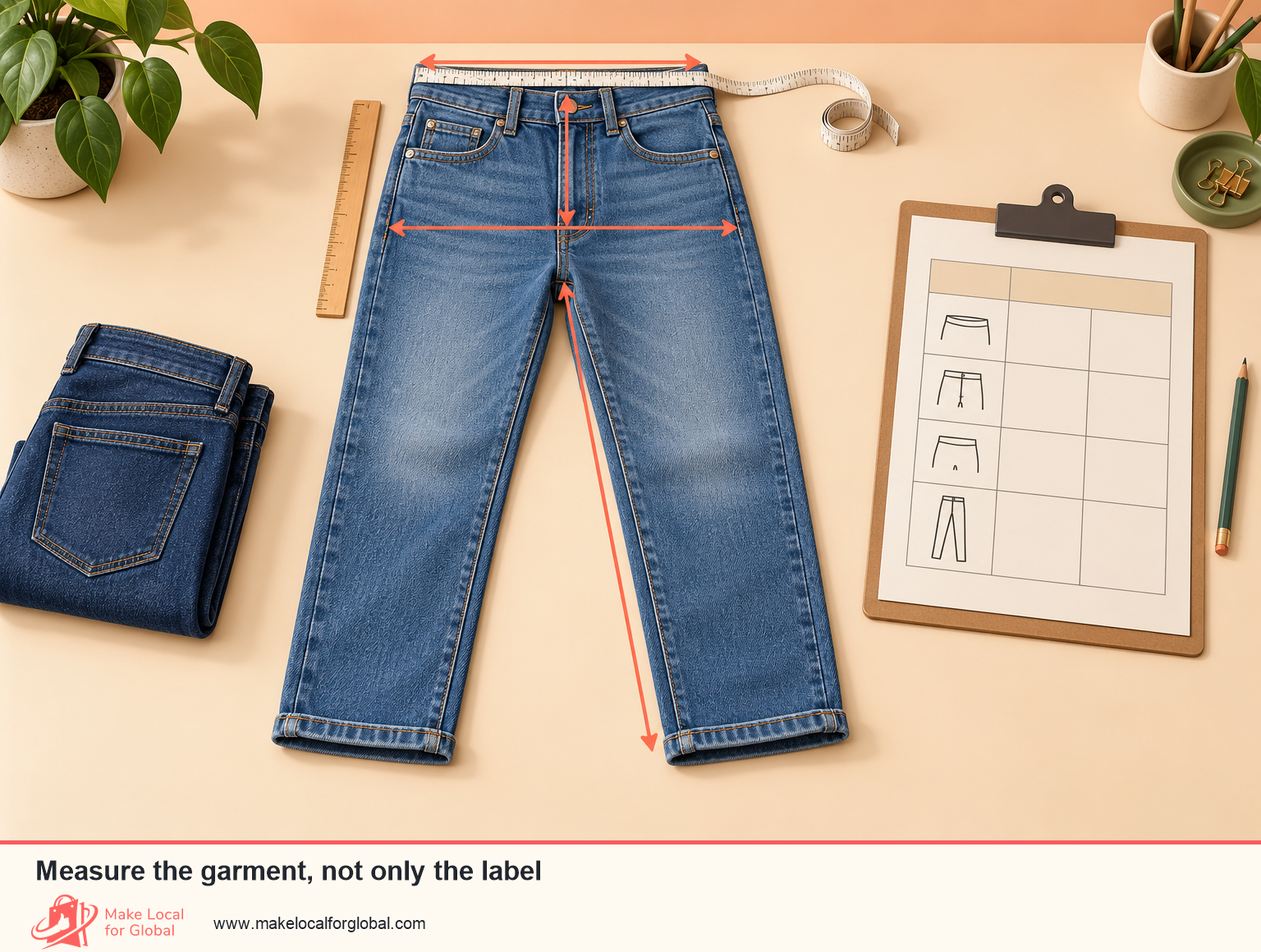
Use a flat, level surface and a soft tape. Fasten the waistband and smooth the garment without stretching it. Record the measurement method beside each figure. If the supplier’s own spec sheet uses a different method, keep both the supplier figure and your sample check in the record until you resolve the mismatch.
For a waist measurement, lay the waistband flat and measure straight across from one side to the other. Some shops present the result as half-waist; others double it for a garment circumference. State which one appears in the size chart. Do not call a half-waist measurement a full waist. If the waistband is curved, follow the garment’s actual edge and note where the tape begins and ends.
Measure the front rise from the crotch seam to the top edge of the waistband at centre front. Measure the back rise from the same crotch point to the centre back waistband. Measure the hip at a stated distance below the top edge, then give that distance. A “hip” number without a measurement point is hard to reproduce.
Measure thigh width at a fixed distance below the crotch seam. Record knee width and leg opening at the hem. Measure inseam from the crotch seam down the inside leg to the hem. Measure outseam from the top edge of the waistband down the side seam. Put all measurements in one unit, usually centimetres, and round them consistently.
Repeat the measurements on more than one pair from the same size if the batch allows. If one pair differs from the approved sample, do not average it away without a reason. Photograph the process and compare the result with the agreed tolerance. A technical designer or garment technologist can help define a spec sheet if a new brand is placing a production order.
Garment measurements do not map directly to a person’s body size. Denim can be rigid, stretch, washed or cut with shaping, so two pairs with the same label can feel different. Tell buyers to compare a favourite pair that fits them well with your garment chart. Give a simple method: lay the reference pair flat, smooth it without pulling, measure the same points and compare the numbers.
State whether fabric has stretch and quote the supplier’s composition. Do not promise that a specific percentage of elastane creates a particular fit for every body. A stretch fabric may recover differently after wear and washing. Ask the supplier for test information, and compare the sample before writing copy about give, recovery or movement.
Use body-size guidance only when the supplier provides a clear, tested chart or when a competent fit team has developed one. Label the chart “body measurements” if it refers to a person, and “garment measurements” if it refers to the pair. Do not mix the two in the same column. A person whose waist is 80 cm does not necessarily need jeans with an 80 cm garment waistband; cut and wearing ease matter.
Include a short note for shoppers between sizes. It can direct them to check the measured garment chart, read fabric and fit notes, or contact the shop with a question. Avoid automatic advice such as “size up” except when the maker’s evidence supports it. The right decision may vary by fit, fabric and preference.
Take front, back, side and detail photographs of the actual approved sample. Keep lighting and camera distance consistent across fits. A close-up can show weave, stitching, pocket depth, button, rivets and hem. A folded shot helps shoppers see thickness, but it cannot replace a full-length image.
Where a model is used, list height, waist or hip measurements where the model has agreed to share them, the size worn and the fit the model reports. Use multiple model shapes when the range intends to serve a wider fit group and the samples exist in those sizes. Avoid relying on one model image to imply that all customers will experience the same fit.
Show wash colour in daylight and a neutral indoor setting when possible. Photograph the exact jeans, not a similar pair from a supplier’s catalogue. State that screens can display colour differently. Do not use filters that make a dark wash appear mid-blue or erase a worn finish.
For a product with a visible selvedge edge or special construction, photograph that detail. Explain where the feature appears on the garment and what the supplier can substantiate. A decorative image is not enough for a claim about origin, method or fibre content.
Potential supply routes include a domestic wholesaler, a specialist denim distributor, a direct manufacturer, a private-label factory, a local maker or authenticated resale stock. Each route changes the minimum order, product control, paperwork, price and time needed to replenish. Compare written terms and sample quality rather than selecting on the catalogue price alone.
Wholesale resale can let a new seller test a known garment without funding a full production run. Ask whether the seller is authorised to supply the product, what proof of authenticity accompanies branded stock and whether the supplier permits the product images and brand names you plan to use. Keep invoices and product identifiers. Do not assume that a low price proves a product is genuine.
Private label gives more say over cut, wash, labels and packaging. It can require a tech pack, pattern work, fit approvals, lab dips, graded sizes, production minimums and longer payment commitments. A factory quotation should state what development work costs, which samples are included, who owns patterns, what changes require a new sample and how an approved garment will be identified in production.
A small maker or local sewing studio may offer a low initial quantity or closer communication. Check the actual weekly capacity, lead time, fabric availability and ability to repeat the fit across a size range. A small first batch still needs stable measurements and product records. Ask what happens if the fabric or trim is no longer available.
Authenticated resale or vintage jeans carry another kind of work: each garment may be a one-off. Record the item condition, measured waist and inseam, visible wear, alterations, repair, wash and any smell or damage that affects resale. Photograph the exact pair. Do not group one-off garments under a size label that implies identical stock.
Ask for a current line sheet, wholesale price, minimum order quantity, size run, fabric composition, garment measurements, grading rules, care information, production location and lead time. Request packed dimensions and weight for delivery costing. Ask whether price changes with wash, fabric, trim, size or quantity.
Ask how production lots are identified and how a defect is reported. Confirm the supplier’s process for approving a sample, checking production, replacing faulty pairs and handling a fabric or trim substitution. Agree who pays for shipping when a batch does not match the approved reference. Keep the answer in writing.
For a branded product, request clear evidence that the supplier is entitled to sell it. For an environmental or fibre claim, ask for documents that identify the exact product, material, facility or shipment. A broad certificate with no link to the pair you are buying may not support the claim you plan to make.
For overseas orders, request a commercial invoice and a clear shipping term. Confirm who arranges import, who pays duty and import VAT, which party is importer of record and which information will appear on the customs paperwork. Use the UK Trade Tariff to investigate the commodity code and relevant duty or VAT treatment for the actual garment. A jeans code can depend on details such as fibre, garment type and construction. Do not copy another seller’s code without checking.
The place where a supplier has an office does not prove where a garment was made or that an environmental claim is correct. Keep the manufacturer’s name, country of manufacture, product code, batch record and purchase evidence together. Those details help when a customer asks a question or an authority requests records.
Order a sample in the intended fabric, wash, size and trim before committing to production. If the supplier offers only a showroom sample, ask whether it came from the current factory and material lot. Write its style code and sample date on your inspection sheet. Photograph it in a consistent setup.
Record the front and back rise, waist, hip, thigh, knee, leg opening, inseam and outseam. Add fabric composition, care instructions, weight if supplied, stretch information, wash, button and zip type, pocket construction, stitch colour, hem and label details. Compare these points with the product page and purchase order.
Set a tolerance with the supplier in advance. A written tolerance should specify which measurement, how it is taken and what happens when a production pair falls outside it. “Sizes may vary slightly” is vague. If the maker cannot explain its measurement process, request a technician’s review before accepting a bulk run.
Do not approve a sample from photographs alone when hand feel, stretch, colour, seam finish or shrinkage can change the customer experience. Keep a signed or clearly identified approved sample for comparison. Store it away from sale stock and record any later changes.
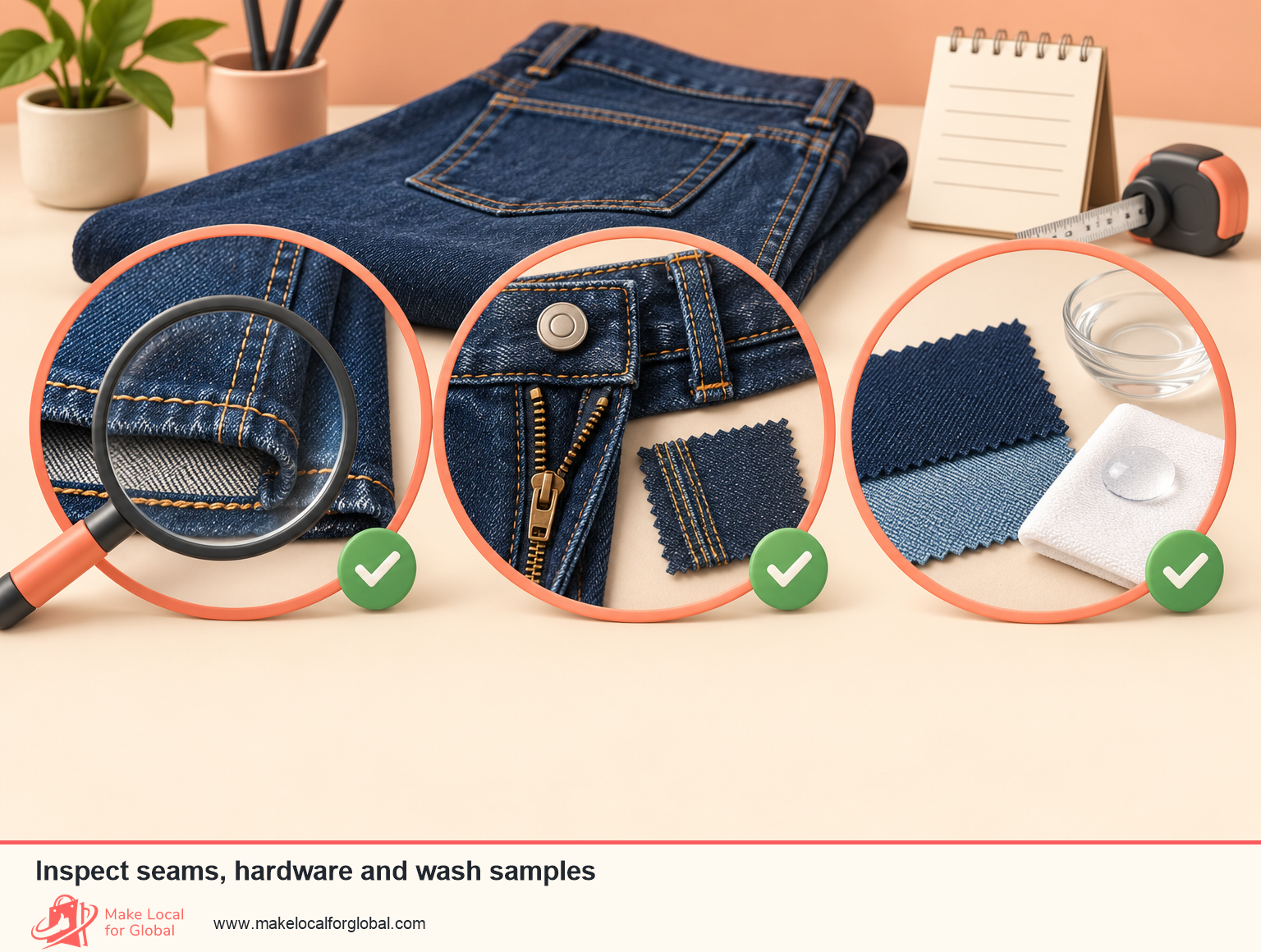
A denim pair needs checks across fabric, seams, hardware, labels and finishing. Write the inspection sequence down and use the same sequence for each sample. If a check requires laboratory equipment or specialist knowledge, use a competent textile-testing provider rather than describing a home observation as a formal test.
Look at the fabric under good light. Note visible snags, holes, uneven colour, unwanted marks, strong odour, twisting seams and areas with a different hand feel. Move the fabric gently at the knee and seat to notice how it behaves, but do not pull hard enough to damage the sample.
Inspect pocket corners, belt loops, fly, crotch seam, side seam and hem. These points receive wear or strain. Look for loose threads, skipped stitches, uneven seam allowance, exposed raw edges or a sharp rivet that could catch skin or damage another garment. Photograph a defect next to a scale and describe its location.
Fasten and open the zip several times. Check that the button is securely attached and that the fly lies flat. Inspect the waistband joins, belt loops and pocket bags. A trim that looks correct in a product image may be a different finish on the production pair, so compare it with the purchase-order specification.
Some denim products are sold as raw, rinsed, stonewashed, garment-dyed or otherwise finished. Ask the supplier to define the wash method and confirm what is accurate for that particular pair. Do not claim a technique simply on the strength of a catalogue description. Record which treatment was used and what the buyer should expect from the fabric.
Read the supplier’s care instructions before running a wash check. Photograph and measure the sample before washing, follow the stated temperature, cycle and drying method, then repeat the same measurements. Record any change in length, waist, shape, surface or colour. This is a comparative sample check, not a certified textile test.
If you want to make a claim about shrinkage, colourfastness or fabric performance, ask a qualified laboratory or the supplier for an appropriate test report. A single home wash is not enough evidence for a broad statement about every production batch. Keep the test method, report date and model reference with the product records.
Dark indigo may release some dye in use or care. State the supplier’s care instructions accurately and ask how the approved wash was tested. Do not promise that a pair will never transfer colour or shrink if you do not have evidence for that exact claim. If a sample shows a result that differs from the supplier description, pause the listing and request clarification.
Ask the supplier for fibre percentages for each textile component that needs to be declared. Check the waistband label, hang tag, product record and listing agree. If a garment uses separate components with different fibre contents, the applicable rules may require those contents to be shown separately. Do not infer a fibre composition from the look or feel of a fabric.
The GOV.UK textile labelling guidance says textile labels must show fibre content and marks the guidance as applying to England, Scotland and Wales. Requirements for Northern Ireland and other destinations need a separate check. Keep the supplier’s composition statement and update the listing if the fabric changes.
Care information should reflect the maker’s instructions and any tests you have. Do not rewrite “wash at 30 degrees” as “wash hot” to make it sound convenient. If the care label is missing, unclear or inconsistent with the product record, ask the supplier to correct the issue before you list the pair.
If you sell children's clothing, branded goods, recycled fibres or garments with a special treatment, check whether extra rules, evidence or claims review applies. The general product-safety baseline is explained in the Office for Product Safety and Standards guidance for Great Britain. Northern Ireland follows a separate product-safety system. Do not use a general denim article as a substitute for product-specific compliance advice.
Terms such as “organic”, “recycled”, “responsibly made”, “low impact” or “made locally” can change a shopper’s view of a product. Use them only when the supplier evidence supports the exact garment and the claim says what it refers to. A product name or green graphic can suggest a claim even when the description is more cautious.
The CMA’s fashion retail guidance on environmental claims advises businesses to describe fabric properties clearly, state relevant percentages and hold evidence for claims. If a pair contains 20% recycled cotton and 80% other fibres, do not call the full garment “recycled cotton jeans” in a way that implies the whole product uses recycled content. Put the percentage near the claim and keep the evidence.
“Made in” claims need the right origin evidence. A UK brand name does not by itself prove that a pair was sewn in the UK. Ask where the fabric was made, where it was cut and sewn, and which stages support the statement you plan to publish. When a claim refers to one part of the supply chain, name that stage rather than implying the whole garment has the same origin.
If a supplier advertises a certification, verify that the certificate is current, applies to the named facility or material and covers the product or order you are buying. Keep a copy and note how it relates to each SKU. If the paperwork does not support a claim, remove the claim from product names, filters, tags, adverts and packaging.
The wholesale price is only one line in the product model. Include inbound shipping, import costs where relevant, packaging, payment or marketplace fees, delivery subsidy, return handling, customer acquisition and the seller’s time. Make a separate model for each fit or supply route if the cost changes.
The following illustration assumes a seller is not VAT-registered, charges £48 for a pair and subsidises standard UK delivery. The £1.50 payment fee is a planning assumption, not a quoted provider rate. The return reserve is modelled as a 10% return likelihood multiplied by £36 of unrecoverable costs for each return. Replace every figure with your own supplier quote, channel rate and customer-service history.
| Cost per order | Illustrative amount |
|---|---|
| Customer price received | £48.00 |
| Pair purchased from supplier | £15.00 |
| Share of inbound freight and handling | £1.50 |
| Mailer, label and packing material | £0.75 |
| Payment fee assumption | £1.50 |
| Seller-paid outbound delivery | £3.50 |
| Return-cost reserve: 10% × £36 | £3.60 |
| Customer-acquisition allowance | £5.00 |
| Total listed variable costs | £30.85 |
| Contribution before fixed overheads | £17.15 |
The arithmetic is £48.00 minus £30.85, which leaves £17.15 before fixed overheads, tax, owner pay, unsold stock, software, photography, rent or other business costs. This is contribution, not net profit. It does not prove the price will sell or that the assumptions will hold.
If the buyer pays delivery separately, change the price and fee lines. If a pair is returned in resalable condition, some cost may be recovered; if it is marked, altered or out of season, the loss can be larger. Record actual reasons and outcomes by fit and size. Do not use the same return reserve for every style if their results differ.
VAT treatment changes the model. A VAT-registered shop should model taxable sales and recoverable input VAT on the right basis, rather than subtracting a gross retail price from VAT-inclusive supplier costs. Check the current HMRC VAT thresholds and registration rules and speak with an accountant if the treatment is unclear.
For imported stock, add freight, customs duty, import VAT, brokerage or clearance charges and any inspection cost. Confirm which charges are included in a supplier’s quote and which arise at delivery. Do not estimate duty from a different garment’s code. Use the actual material and construction when checking the tariff.
Compare your offer with garments serving the same buyer and use. A pair made from a different weight or fit may not be a direct comparator. Note what the price includes: material, finish, alterations, delivery, return terms, warranty or repair. Keep a dated research sheet so the team knows when a competitor’s price was observed.
A discount reduces the amount available to cover costs. If a £48 pair is reduced to £40, the eight-pound reduction comes out of contribution except where another cost changes. A free-delivery promotion has a cost too. Model both the standard and offer price before advertising them.
If you offer a multi-buy, calculate the order as a whole. Two pairs in one parcel may reduce packaging and delivery per pair, but they can raise the customer’s return value if fit is uncertain. State how a refund works when only one item from a bundle comes back and make the checkout terms clear.
Keep margin targets separate from sales targets. A high order count can still consume cash if stock is paid for before marketplace settlement, refunds or tax. Review cash required for the next supplier payment, not only the revenue graph.
Check the fit, records and full order cost
Bring sample measurements, supplier evidence, packaging and returns into one launch review.
The product page is where the buyer checks whether the pair is likely to suit them. Put fit and garment measurements close to the size selector. Let a shopper compare products without opening several tabs to find the fabric, wash, care or dispatch information.
Use the fit and product name early. For example: “High-Rise Straight-Leg Jeans in Rinse Indigo” tells more than “Classic Jeans”. Add the style or collection name only if it helps identify the item. Avoid repeating the same keyword phrase in every heading or description.
Start the description with the intended fit, the main garment measurements available, the fabric composition and the colour or wash. A product page can explain who may prefer the cut without claiming it will suit every body. Mention the model’s height and size if you have permission and the information is accurate.
Use a compact specification area for: fit, rise, fabric composition, stretch information, measured waist or garment chart, available inseams, leg opening, wash, pocket layout, closure, care, country-of-origin statement where supported, what is included, dispatch estimate and return route. Use the supplier record for each detail.
A sample opening might read: “Straight-leg jeans in a mid-blue wash, with a measured 74 cm garment waist on size 28 and a 78 cm inseam. The fabric is 99% cotton and 1% elastane according to the garment specification. Compare the garment chart with a pair you own; see the care label before washing.” This is an example of structure, not a specification for a real product.
Show the actual pair from front, back and side. Add a close-up of the fabric, stitching, waistband and pocket. A flat measurement diagram can help a shopper compare the garment with a pair at home. Use captions for points that are not clear from the photograph, such as where the inseam begins.
If each pair is a one-off, photograph every item or make its one-off nature clear. If you use a supplier’s image, confirm permission and verify that it shows the version being sold. Do not put a different wash, button or fit in the image and rely on a text disclaimer to correct the impression.
Use size filters that match the variants you actually hold. If a waist or inseam is out of stock, do not leave it appearing available. Explain whether a size is ready to dispatch, being made to order or on backorder, and state the expected wait before checkout.
Place common questions beside the purchase decision. How is waist measured? Which size does the model wear? Does the fabric stretch? Are the jeans pre-washed? What is the inseam? How should the buyer care for the pair? What delivery service is used? How do returns work? Answer from checked product facts.
Give every fit page a distinct title, description and useful text. Search engines and shoppers should be able to distinguish a high-rise straight pair from a relaxed tapered pair. Use natural terms that match the product, then add synonyms only when they accurately describe the item. Keep the page readable instead of repeating “sell denim jeans online” as a phrase.
Link from a size explanation to a measurement chart; link from a fabric claim to the evidence or care information that explains it. Add related reading where it helps the shopper, such as our guide to selling business suits online for another size-led clothing range. The article on selling baby clothes online offers a separate example of handling garment labels and fit information. For a smaller size-specific accessory, see how to sell bike gloves online.
If a customer asks how a style compares with a previous collection, link the older page only if it remains accurate. Do not keep an outdated size chart live without a label and explanation. Use descriptive link text that names the destination rather than “click here”.
Track search impressions, product-page visits, size-chart use, size-selector changes, add-to-basket actions, completed orders, fit questions and returns. A high click count with repeated “what size should I buy?” messages can point to a weak fit chart. Review the results by style and by waist or inseam option when the volume permits.
Most jeans can be shipped as a parcel, but packaging still affects presentation, damage, postage and returns. Fold the pair the same way for each order, protect metal trims from rubbing against fabric and use a mailer that fits without forcing the garment. Test the packed parcel on the carrier service you plan to offer.
Record the packed dimensions and weight for each shipping method. Check the carrier’s size limits, collection timing, tracking and claims process. If customers outside the UK can order, review the actual destination, duty treatment, delivery time and return route before enabling that market.
Publish a realistic dispatch window based on stock location and supplier lead time. Distinguish dispatch from delivery. If a pair is made after the order, state the expected production and shipping time clearly and update the buyer if it changes. Do not use a delivery promise that depends on an unconfirmed production slot.
Create a returns process before the first order. Tell customers how to request a return, how long the parcel may take to arrive, whether they need to use a label, where a refund update appears and how exchanges work. Online sales of standard garments are covered by distance-selling information and cancellation rules. GOV.UK explains a 14-day cancellation period after delivery for many online consumer purchases in its distance selling guidance for businesses. Check the current rules and any exception that applies to a specific product or order.
Jeans are tried on to judge fit. State that customers should handle them as they could in a shop, keep tags attached during fitting and contact the shop if there is a fault. Do not write a blanket rule that removes consumer rights. For a personalised or altered pair, get advice about the exact exception and disclose terms before payment; do not assume every made-to-order garment is exempt.
When a return arrives, record the SKU, condition, reason, packaging, wash or alteration state, refund date and whether the pair can return to sellable stock. Keep fit feedback separate from quality defects. If several customers report a shorter inseam than the chart, measure the current batch and pause the affected size if the record is wrong.
Prepare support replies for measurement questions, order tracking, wash care, missing labels, colour mismatch and returns. Ask for the order number and relevant photos only when needed. Use the information to improve the page or supplier checklist rather than repeating a generic reply.

An owned online shop gives you control over the size chart, product information and customer relationship. A marketplace can bring shoppers who are already browsing clothing, but it may set rules for listings, fees, returns, branding and customer communication. Compare the current terms for the exact channel and country before relying on a channel fee in your cost model.
Do not launch on every social and marketplace channel at once. Choose one primary checkout route and one way to attract likely buyers. Check that stock counts, price, delivery terms and return information match across listings. A spreadsheet can help in a small launch; a larger catalogue may need a stock system that updates each channel.
Create a short test campaign for one fit and one wash. A useful offer names the pair, shows the true product, explains measurements and sends the shopper to the exact page. Use one landing page and track the source, spend, questions, basket actions and orders. If you change the price, headline and image at the same time, it becomes harder to tell which change mattered.
Try an organic content sequence based on real questions: how to measure jeans flat, how rise changes the fit, what a garment wash means, how to compare inseams and what to check on the care label. Photograph the actual sample and link to the relevant product or measurement page. Do not present supplier catalogue imagery as a test result from your own stock.
Paid search or social ads can test a specific audience and product, but set a spending limit and a stop point before the campaign begins. Calculate the break-even customer-acquisition cost from contribution, not from retail price. If a pair leaves £17.15 contribution before fixed overheads in the illustration above, an acquisition cost near that amount would use nearly all of that contribution. Replace the example with the shop’s own figures.
Collect email sign-ups only with clear permission and a working unsubscribe route. A size restock notification should refer to the chosen product and not silently enrol a shopper in unrelated promotions. Keep consent records and follow current data-protection and electronic-marketing requirements.
The calendar below assumes the supplier can provide samples in time. If fabric development, testing or shipping takes longer, extend the plan. A date on a spreadsheet should never decide whether a pair is ready for customers.
| Period | Work to complete | Evidence to save | Decision |
|---|---|---|---|
| Days 1 to 7 | Interview likely buyers, review search wording and choose one fit need | Notes, repeated questions, proposed size chart | Select a buyer and a narrow range brief |
| Days 8 to 14 | Compare suppliers, request records and order the sample | Quotes, fabric details, lead times, sample tracking | Reject weak options or move one sample forward |
| Days 15 to 21 | Measure the pair, inspect construction, review labels and test the parcel | Measurement sheet, photos, label copy, cost model | Approve, ask for a correction or stop the style |
| Days 22 to 30 | Build the page, check checkout and run a bounded launch test | Page QA, enquiry log, spend, order and return data | Reorder, revise the page or test another fit |
Write the buyer note and list the assumptions behind it. Speak with a small number of people who match the target. Ask about real purchases, fit issues, disliked returns and preferred measurements. Review competitor pages to see what they disclose and which details are hard to find.
Choose a testable range with no more options than you can explain. Decide which first pair is the hero product, what information buyers need and what result will make you contact a supplier for a sample. Do not order stock based on a general statement such as “denim always sells”.
Send the same question list to each supplier. Compare minimums, price, garment chart, fibre data, care label, production time, packed weight, payment terms, return process and evidence for claims. Ask what changes after the sample is approved and how the supplier notifies you.
Choose one sample that matches the buyer brief. Record the style code and expected specifications. If the supplier cannot provide the composition or dimensions you need for a truthful product page, pause the order or choose a different source.
Measure the sample with a second person following the same instructions. Compare the result with the supplier’s chart and the approved tolerance. Inspect seams, trim, pockets, labels and wash. Follow the stated care method for any comparative wash check, then record the result without turning it into a universal performance claim.
Get the packed parcel ready and request a carrier quote. Put purchase cost, inbound freight, packaging, selling fees, delivery, return allowance, payment fees and a test acquisition cost into the model. Rework the proposed price if it only makes sense when returns or delivery cost nothing.
Use accurate sample images and a measurement chart with the method explained. Check the product title, variant selector, price, stock, care, label information, dispatch estimate, returns and contact route on a phone and desktop. Ask a few target shoppers to locate the inseam, choose a fit and explain the delivery terms without help.
Run a small test with a clear budget and stop rule. Record visits, size-chart use, questions, orders, delivery outcomes, returns and contribution. Review the evidence before ordering more. If shoppers repeatedly ask about rise or the available inseam, change the page or the range before scaling stock.

It can be, but the result depends on product cost, fit range, return rate, channel fees, delivery, customer acquisition and unsold stock. Build a full cost model for each pair, then replace assumptions with observed order and return data. The retail price alone does not show the amount left for overheads or owner pay.
Start with one clear fit and an alternative only when your buyer evidence or supply offer supports it. Each added cut creates more samples, product copy, images, stock options and size questions. You can add a second fit after you can distinguish it clearly and fund its full size run.
Offer the size options your supplier can grade and check reliably, and be clear about what is in stock. A smaller set of sizes is not a reason to hide availability or use an inaccurate chart. If you plan to expand the range, test buyer demand and production tolerance first.
Measure an approved garment, state the method, show front and side photos, include rise and inseam information and explain how shoppers can compare a pair they own. Record return reasons by style and size. Use the pattern in that evidence to adjust the chart or the product.
Garment measurements describe the pair laid flat or measured as a finished item. Body measurements describe a person. The two are not interchangeable, since cut, stretch and ease affect how the pair fits. Label each chart clearly and do not combine the two types without explanation.
GOV.UK guidance for England, Scotland and Wales says textile labels must show fibre content. Check the rules that apply to Northern Ireland and any other market separately. Ask your supplier for exact percentages and compare the paperwork with the garment label and product page.
Use a specific claim only when evidence supports the product and the wording makes the relevant material or percentage clear. A pair with a small proportion of recycled fibre should not be presented as though the whole garment is recycled. Check the CMA’s fashion guidance and retain supplier documentation.
Check that the supplier is authorised to sell the product and keep invoices and product identifiers. Confirm that your use of the brand name and images follows the supplier agreement and the brand owner’s rules. Ask a qualified adviser about a specific resale or trademark concern.
Measure the waist, rise, hip, thigh, knee, leg opening and inseam. Review fabric, stitching, pocket construction, zip, button, rivets, label, wash and care instructions. Compare the sample with supplier records and an agreed tolerance, then resolve any mismatch before production.
Include the pair, inbound freight, customs charges where relevant, packaging, payment or marketplace fees, delivery subsidy, returns, customer acquisition and the cost of support. Add the tax treatment that applies to the business. Keep contribution separate from fixed overheads and net profit.
Online consumer purchases commonly include a cancellation period, and GOV.UK sets out the distance-selling rules for businesses. Apply the current law to the order and jurisdiction. Do not use store wording that removes rights that apply to a customer’s purchase.
It can reduce unsold stock, but the product needs a confirmed production slot, clear measurements, realistic dispatch timing and accurate cancellation terms. Explain what is customised and what remains standard. Check the legal treatment of the exact item with a qualified adviser before relying on an exception.
Before placing a stock order, write down the buyer, fit, wash and size options you want to test. Request the same product records from each supplier, measure one sample, review its labels and calculate the cost after fulfilment and returns. Use accurate photos and a clear chart to show what the shopper will receive.
A useful first range is one you can describe, restock and support without guessing. Track fit questions and return reasons by variant. Add another cut or wash only when the evidence and cash plan support it.
Review the jeans page before taking orders
Check garment measurements, fabric details, images, delivery terms and the returns route.
PREFERRED SOURCE
Like what you’re reading? Add Make Local for Global as a preferred source on Google to see more of our articles when you search.

Build your online presence without having to figure out everything yourself.