

READY TO SELL Dog Kennels ONLINE?
Get a store built for you in 5 days, plus training and support to help you start, run, and grow your Alternative business.

Plan a dog kennel range with practical sizing checks, supplier inspections, full delivery costs, clear product pages and UK selling considerations.

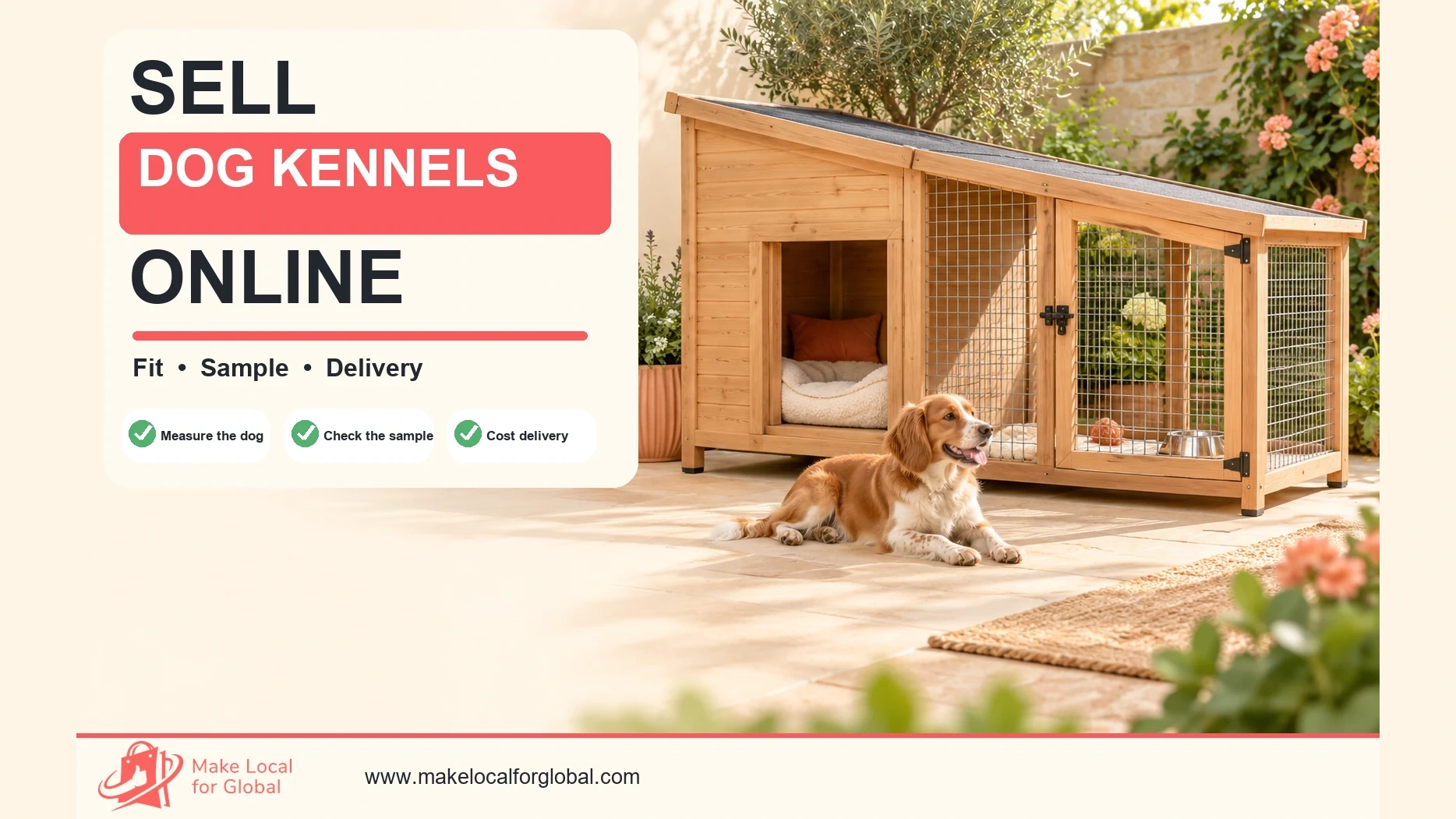
Outdoor dog kennels are large, practical purchases. Buyers need to judge whether a shelter suits their dog, fits their garden, stands up to local weather and can be delivered to their address. A seller who answers those questions with clear measurements, honest product evidence and a workable delivery plan has a stronger starting point than one listing a single photograph and a vague size label.
This article focuses on domestic outdoor kennel houses and kennel-and-run products sold to dog owners. It does not treat a domestic dog house as a boarding facility, transport crate or a substitute for care and supervision. Start by choosing a narrow buyer and product type, then check samples, calculate the full order cost and publish specifications that match the product in the parcel.
Choose your dog-kennel offer before you order stock
Compare kennel types, dog-fit measurements, sample evidence and full delivered costs.
“Dog kennel” can mean several different products. Search results mix outdoor shelter boxes, enclosed runs, portable fabric pens, indoor crates, vehicle cages and licensed boarding premises. They solve different problems and carry different expectations. Choose one meaning for the first range and state it in the page title, product photographs and specifications.
A kennel house is an outdoor shelter, often built from timber or plastic, with a roof and enclosed sleeping area. Some models have a removable or hinged roof, raised feet, a door flap or an insulated sleeping box. Buyers normally need the inside dimensions, entrance size, material, roof construction, floor arrangement and care instructions.
A kennel-and-run combines a sheltered area with an enclosed exercise or access space. The run may be made with timber framing and welded mesh, metal panels, or a mix of materials. The run changes the parcel dimensions and the buyer’s installation needs. Show the sleeping compartment and the usable run area separately so the buyer does not mistake total footprint for sleeping space.
A crate or travel cage is a different category. It is designed for controlled indoor use or transport, with its own fit, ventilation, restraint and vehicle-compatibility questions. Do not place crate products under an outdoor dog-house listing simply to collect broader searches. A boarding kennel is a premises used to care for dogs for payment. In England, businesses offering boarding need a local-council licence, and the licence conditions apply to that activity. These rules are not a domestic garden-kennel sizing chart.
Write a buyer note before contacting suppliers. For example: “A household with a medium dog wants a weather-sheltered rest space beside a secure garden run, has a level patio, and can accept a pallet delivery.” That statement is useful and identifies the animal, intended use, installation site, likely product format and delivery constraints.
Possible groups include dog owners seeking a garden shelter, households needing a kennel-and-run combination, rural property owners wanting a secure outdoor enclosure, or breeders and boarding operators buying commercial equipment. The last group may have different legal and professional requirements, so do not assume one consumer product will suit them. For a first online range, a direct-to-consumer use case is often simpler to describe and photograph.
Ask potential buyers about the decision they are trying to make. Do they need a sleeping box, a covered resting area, an enclosed run, a replacement roof, or a kennel that can be moved? What dog size do they have? What is the ground surface? Can a delivery vehicle reach the property? Which point makes them hesitate: fit, weather, assembly, cleaning, security, price or returns?
Use conversations as directional feedback, not proof of demand. Keep a short record of each response, the product type discussed and the buyer’s next action. If someone says they would buy, ask which dimensions, delivery date and total price they would accept. A specific answer is more informative than a general compliment.
Start with a few choices that change a real buying decision. A first range might include two kennel-house sizes and one kennel-and-run option, if supplier samples and shipping costs support all three. Another seller may start with one core kennel and offer a roof or floor variation. The right choice depends on the buyer conversations, product costs and how many variants the supplier can consistently make.
Useful differences include internal sleeping-area dimensions, doorway width and height, overall footprint, roof type, floor design, material, finish, run length and whether assembly is required. A size name such as “large” is not enough. Explain whether a dimension is internal or external, and state the measurement points. An external width can be much larger than the usable floor space once walls and dividers are counted.
Build a comparison table for the store team before creating product pages. Include product code, material, overall footprint, internal sleeping area, entrance size, roof dimensions, package dimensions, packed weight, assembly time from the supplier’s verified instructions, and the dogs or use cases the maker says the unit suits. Keep measurements in millimetres or centimetres, use one consistent unit system, and convert only after checking the original specification.
Do not infer a dog’s suitable kennel size from breed alone. Dogs of the same breed vary in height, body length, coat, age, mobility and behaviour. Give the buyer a practical measurement method and encourage them to compare the dog with the product’s actual usable interior. If a supplier publishes a fit recommendation, attribute it to that supplier and test whether the recommendation matches the physical sample.
An entry product can have a simpler finish or smaller footprint, but it still needs to meet your safety, quality and accuracy checks. A core product should address the needs most often raised by target buyers. A higher-spec option may add a larger run, upgraded roof, removable floor or more durable hardware. Name the benefit plainly and show the cost gap. Avoid adding a feature only to make a price tier look premium.
A simple bundle could pair a kennel house with a compatible run extension, roof cover, replacement fixings or care kit. Verify compatibility and explain which pieces are included. Do not bundle a dog bed, heater or chewable accessory with a product only after you have checked its fit and suitability. Avoid implying that an outdoor shelter alone keeps every dog warm or safe in all conditions.
Use a low-cost research sequence. Review search suggestions and questions in relevant communities, but treat them as leads rather than market-size evidence. Speak with a small group of target owners. Ask a garden-centre or local pet retailer what questions buyers ask, if you have a legitimate reason to approach them. Compare competitor product pages for the information they disclose, not just their advertised price.
Then show a proposed range sheet to likely buyers. Include a real drawing or supplier sample photograph, exact dimensions, delivery approach and indicative total price. Ask what they would compare it with and what information is missing. Record whether people ask about sleeping-area size, run security, timber treatment, assembly, maintenance or access for delivery. These repeated questions can shape both the range and the page.
Do not take payment for a product you cannot supply on the stated terms. If you test a waitlist or enquiry form, describe the test accurately and do not present a concept image as a product photograph. If a supplier offers made-to-order production, confirm lead times, cancellation terms and production capacity before listing stock as available.
Fit is central to the purchase and a frequent source of avoidable disappointment. Ask the buyer to measure the dog and compare those measurements with the internal dimensions of the shelter. The exact calculation depends on the dog’s posture and intended use, so avoid promising fit based on a single weight band.
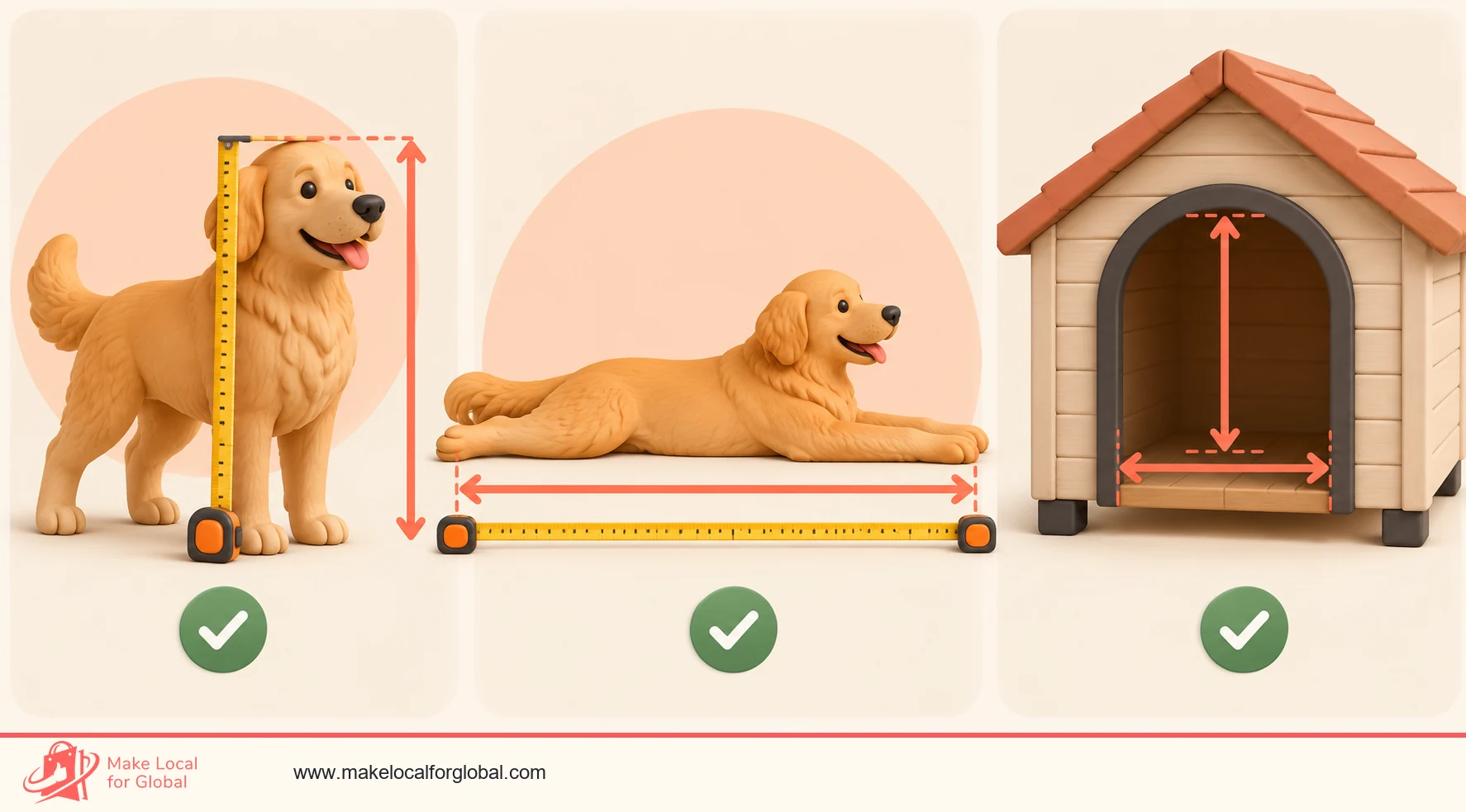
Ask the owner to measure the dog as it stands naturally on a level surface. Record the dog’s height from the ground to the top of the head or ears, depending on the product’s entry design, and record shoulder height separately if relevant. Measure body length from chest to rump. For lying space, measure the dog stretched out in a comfortable position. Take each measurement more than once and use the larger reliable result.
Then compare those figures with the product’s usable internal floor area and entrance. A dog needs to enter without striking the top or sides, turn as intended and lie comfortably. A sleeping box with a small entrance may have adequate interior length but still be awkward for a tall or broad dog. Show the entrance width and height as standalone specifications, not buried in a diagram.
Use a simple callout on the page: “Measure your dog; compare these figures with the internal sleeping-area dimensions and doorway. If your dog is between sizes, check with us before ordering.” This is more useful than a generic breed list. If you provide a size chart, state who made the recommendation and how it was tested.
For a combined product, show a plan view with the sleeping box, threshold and run labelled. Give the dimensions of each part and the overall footprint. A large total footprint can still contain a compact sleeping area. Buyers need to know where the dog rests, how the dog accesses the run and whether a divider can be opened or removed.
Do not claim that an outdoor kennel makes long periods alone acceptable. A product listing should describe the enclosure, not endorse neglect or a particular daily routine. Dogs need suitable care, an environment appropriate to their condition and opportunities for normal behaviour. Owners should select and use housing as part of a broader care plan.
If you use “small”, “medium” and “large”, treat those as navigation labels only. Place the measurements next to the label. Define whether the stated dimensions are product dimensions, sleeping-space dimensions or package dimensions. State if the roof overhang is included. Clarify that tolerances apply if the maker’s production process creates small measurement variation, and state the actual tolerance in the product specification.
Photograph a measuring tape in the sample image, but do not use a forced perspective that makes a small kennel appear spacious. A top-down diagram helps explain the layout. Include a familiar reference object only when it does not distort scale. Showing a dog beside the product can help with context, but it cannot replace measured specifications.
Timber, plastic and metal are common materials, with some products combining them. Each has trade-offs in weight, repair, maintenance, ventilation, insulation, surface finish, packaging and weather exposure. Do not claim a material is weatherproof, chew-proof, non-toxic or maintenance-free without product evidence supporting that exact statement.
Timber can be repairable and visually familiar in a garden. The product’s performance depends on the wood species, grade, thickness, joinery, roof cover, floor support, finish, drainage and ongoing care. Request the timber species and treatment details. Ask whether the treatment is intended for the product’s use and whether the finished surfaces may be chewed or licked. The supplier should give clear product-specific instructions; do not substitute a general garden-paint recommendation.
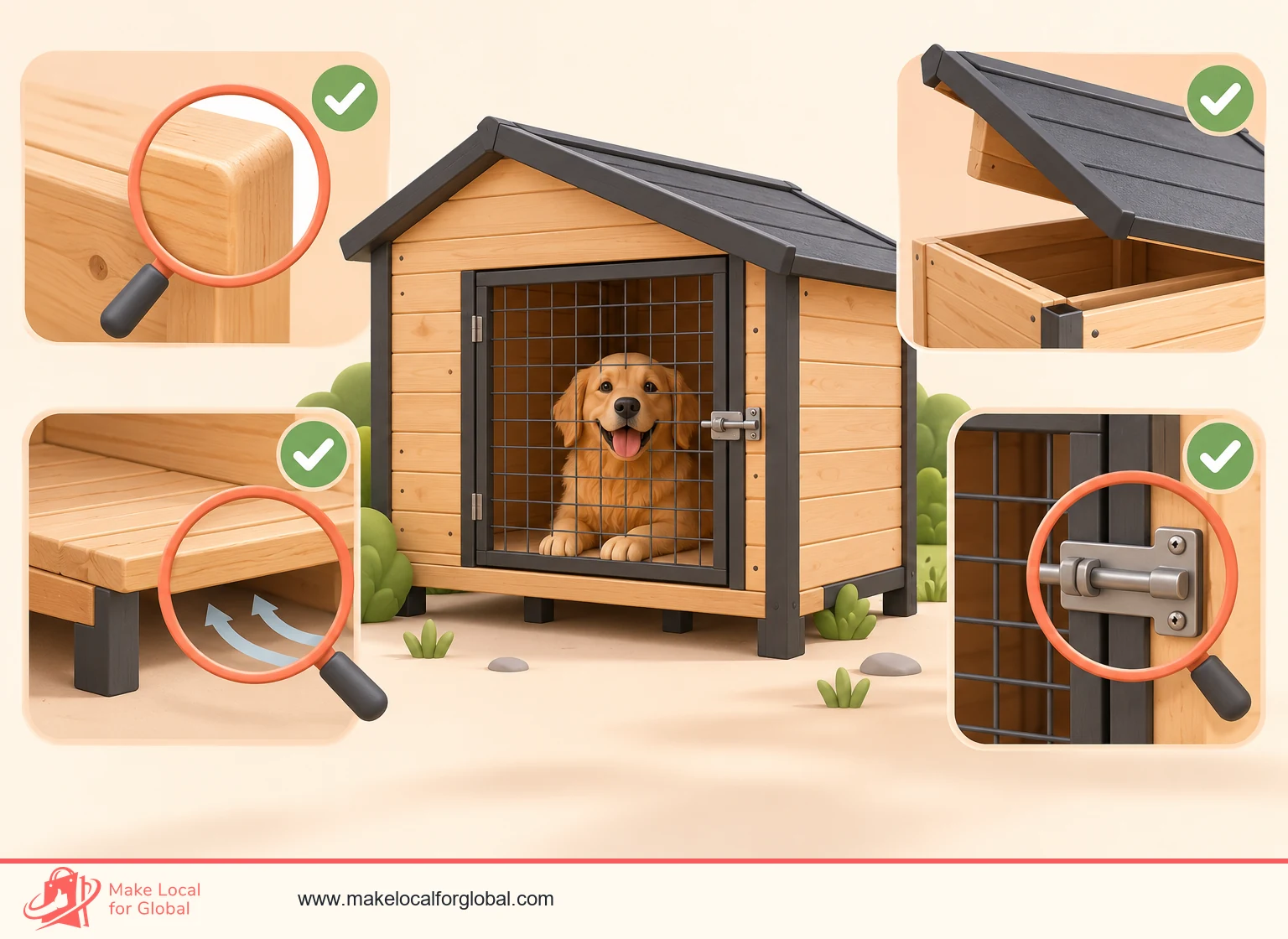
Inspect corners, screw positions, splinters, exposed fasteners, gaps, door edges and the underside. Check whether the floor is raised off the ground, whether water can pool, how the roof sheds rain and whether the roof can be removed for cleaning. A strong marketing claim needs a test or supplier record behind it. If the maker says a coating is water-based or animal-safe, request the technical sheet or written confirmation and preserve it with the batch file.
Plastic can be lighter and easier to wipe, but the resin type, wall thickness, joint design, UV exposure and replacement-parts availability matter. Check how panels lock together, whether the floor flexes under the intended load, how the roof attaches and how air moves through the design. Ask the supplier about outdoor exposure and care limits. A colour photo alone cannot show wall thickness or fastening strength.
For a run, examine wire diameter, weld consistency, coating, frame joints, gate alignment, latch security and sharp ends. Measure the clear gap between wires and compare it with the intended dog and use. The product should not create obvious entrapment, escape or injury risks. Ask who specifies the mesh and which inspection method is used. Never describe a mesh gauge or coating as a safety certification without relevant supplier evidence.
A sloped roof can shed water, but the actual panel overlap, fixings and edge protection matter. A removable roof can aid cleaning and inspection, though hinges or lift-off panels must remain stable in ordinary use. A solid floor may be easier to sweep, but it needs a suitable surface and drainage approach for the product’s intended location. A mesh floor may create discomfort or injury risks if the design is unsuitable. Inspect the finished product with the supplier’s instructions in hand.
Ventilation should be described from the actual design. A covered sleeping compartment needs airflow without large openings that defeat the intended shelter. Avoid asserting a temperature range without a relevant supporting test. A kennel is not a climate-controlled space. State any limits around weather exposure and explain that owners must choose a suitable location and monitor their dog.
Possible sourcing routes include a UK maker, a domestic wholesaler, an overseas manufacturer, a private-label supplier or a made-to-order workshop. A local maker may permit closer inspection and easier design feedback, but capacity, consistency and delivery cost still need checking. An importer may offer a broader catalogue, though the business should understand its legal role and evidence duties. No route removes the need to verify product quality.
Request a written specification for every model and option. Ask for material details, finish or treatment, assembly instructions, hardware list, packaging dimensions, packed weight, spare-parts policy, production lead time, defect process and warranty terms. Ask how the maker identifies batches and how design or material changes are communicated.
If the product is imported, clarify who is the manufacturer, importer, distributor and responsible UK contact where applicable. Confirm which documents support the product’s safety and claims. Ask the supplier to identify any relevant legislation or standards they rely on, then check those references independently. A supplier’s statement that a product is “compliant” is not a substitute for seeing the evidence.
Keep dated copies of quotes, drawings, technical sheets, emails, sample photographs and approved specification versions. Tie each record to the product code and revision. If the supplier changes mesh, roof covering, coating or timber thickness, request a revised sample or written technical review before accepting the changed goods.
Open the package and record its condition before assembly. Photograph every side, the packing materials, labels, hardware and instructions. Compare the sample with the drawing and purchase order. Count the fixings. Check that the pieces are labelled clearly and that the instruction sequence matches the contents.
Assemble the unit using the supplied tools and directions. Record the time, missing steps, unclear diagrams, misaligned holes and any need for extra tools. Do not add unapproved parts to make the sample work. A product that requires improvised repairs before first use has a supplier or design problem to resolve.
Run a repeatable inspection checklist. Look at cut edges, timber splinters, exposed screws, loose staples, sharp mesh ends, coating flakes, gaps, door travel, latch engagement, roof fit, floor support and stability on a level base. Open and close the door repeatedly. Lift the roof in the way described by the instructions. Use a safe, controlled water-shedding check if relevant, then record where water enters or pools. Do not put a live animal in an unverified test product.
Test cleanability. Remove the roof or access panel and reach corners with the recommended cleaning method. Check whether urine or wash water could collect in inaccessible joints. Ask the supplier which cleaners are permitted. Strong disinfectants or pressure washing may damage coatings and joints; do not recommend them without product guidance.
One sample can reveal a poor drawing or assembly issue, but it cannot prove repeat consistency. For a higher order, inspect more samples or request a pre-shipment inspection based on a written checklist. The number and method should reflect purchase quantity, defect history, risk and budget. Record the acceptance criteria before the inspection so you do not negotiate them after finding a problem.
Create a defect log that records the batch, item, photograph, issue, severity, likely cause, supplier response and corrective action. If the same defect appears more than once, pause the next order until the supplier explains the cause and verifies the correction. A record helps with customer support, recall decisions and supplier conversations.
Plan the sample, bulky parcel and first sales test
Bring fit checks, sample inspection, delivery costs and a launch measure into one practical plan.
Large garden products can look profitable when sellers compare retail price only with factory price. The actual unit economics include more than the kennel itself. Add inbound transport, customs or import charges where applicable, packaging, storage, handling, bulky delivery, payment fees, damage allowance, returns, customer-service time and advertising. Work from actual supplier and carrier quotes whenever possible.
The following numbers are a made-up example to show the method. They are not supplier quotations, recommended prices or sales data. The example assumes a single timber kennel-and-run order sold to a UK customer. Figures are stated excluding recoverable VAT, and the business is assumed to be VAT-registered and entitled to recover input VAT; a seller’s own VAT position may differ.
| Cost or revenue | Illustrative amount |
|---|---|
| Customer price before VAT | £720.00 |
| Product cost from supplier | £280.00 |
| Inbound freight and handling | £55.00 |
| Protective packaging and inserts | £22.00 |
| Outbound bulky delivery paid by seller | £92.00 |
| Payment processing allowance | £18.00 |
| Damage and returns reserve | £36.00 |
| Advertising cost attributed to this order | £48.00 |
| Contribution before overhead and tax | £169.00 |
Arithmetic: £720 less £280, £55, £22, £92, £18, £36 and £48 equals £169. That is a contribution estimate, not net profit. It does not include website costs, insurance, wages, storage rent, accounting, income tax or corporation tax. A delivery surcharge or failed delivery could reduce it. If a return requires collection and repacking, the cost may be much higher than the allowance shown.
Build three cases: expected, lower conversion with higher advertising cost, and an adverse case with a damaged return or failed delivery. Note which inputs are quoted and which are assumptions. If contribution becomes too small in the adverse case, adjust the range, negotiate the freight, charge for a service transparently or test demand before ordering stock. Show delivery costs before checkout.
Use a spreadsheet to show the transaction both before and after VAT according to your own registration and recovery position. Do not treat VAT collected from a customer as business revenue. If you sell through a marketplace, check its current fee schedule and any promoted-listing charges. Calculate payment fees against the amount the platform actually charges, including delivery or tax where relevant.
Check the price of the nearest alternatives, but do not copy their pricing without matching the product, specification, service and delivery terms. A cheap listing may exclude delivery, show a smaller house, have different materials or lack an included run. Keep a dated screenshot or URL note when using a competitor price for internal planning. Remove stale figures from public copy.
The fulfilment plan is part of the product. A customer who cannot receive, move or assemble a large kennel may cancel, refuse delivery or leave a poor review. Confirm how the product ships: parcel carrier, two-person service, pallet network, supplier vehicle or local installation. The correct option depends on packed size, weight, delivery area and access.
Get package length, width, height and weight for each variant. Ask whether a pallet or liftgate is used, whether the driver will bring the goods beyond the kerb, what happens if no one is available, and which postcodes are excluded or surcharged. State what the carrier can and cannot do. “Free delivery” can be misleading if it applies only to a narrow region or a customer must arrange extra handling.
Ask buyers whether the vehicle can reach their road and whether the package can pass through the gate, side path, door or shared access. A large run panel may be longer than the available route even when the garden has ample space. Publish package dimensions when useful, plus the number of people or tools the manufacturer recommends for handling and assembly.
Check the carrier’s damage process and evidence deadline before the first sale. Give the customer a simple inspection instruction: check the package when it arrives, photograph visible damage and contact the seller through the stated route. Do not tell customers to refuse every damaged-looking parcel; carrier procedures differ. Verify the actual policy with the contracted service.
Inspect how roofs, mesh, timber panels and hardware are separated. Protect corners and long edges. Prevent panels from rubbing together. Keep small fixings in a sealed, labelled bag secured inside the package. Include a packing list so a buyer can spot missing pieces before assembly.
Ask whether the packaging protects against rain during transit and temporary storage. A wet package may not mean the product is damaged, but the instructions should explain how to dry and inspect components before assembly. Do not claim recyclable or plastic-free packaging when the actual shipment does not support that statement. If components are shipped separately, explain how the customer can confirm that all packages have arrived.
Test the instructions with someone who did not design the product. Record which step causes confusion, what tools are needed and whether the parts are labelled. Ask the supplier to revise unclear diagrams. Include a support contact on the instructions or product page. If a product requires drilling, cutting or other user work, state that clearly and provide accurate safety guidance from the manufacturer.
For an installation service, define the service area, ground preparation, access requirements, waste removal, price and appointment process. Do not list installation as included if it is only available in selected areas. A clear choice between delivery-only and paid installation can help the customer compare the total cost.
The product page should let a buyer understand the actual product without guessing. Use a direct title such as “Timber Dog Kennel with Covered Run, 180 × 120 cm”. If the size measurements refer to the outside, label them as external. Avoid repeating a keyword mechanically in every heading.
Place these details in a visible specification panel:
Write a short opening that says what is included and who the product may suit, using only supported facts. Follow with plain descriptions of the sleeping area, run, materials, assembly, delivery and care. A bullet list is easier to scan than a paragraph containing every dimension.
Use images of your own inspected sample where possible. Photograph the whole product from front and side, the interior, the doorway, the raised floor, roof construction, latch, mesh joins, packing contents and product label. Include a simple size diagram with arrow endpoints. Keep the camera level enough that perspective does not conceal depth or distort the entrance.
If the supplier supplied a product image, get permission and check it against the current revision. A product photo with a different roof, colour, latch or run panel can mislead buyers. Label a rendering as a visualisation if it is not a photograph of the item. Use a dog image to suggest a particular size only after measuring and testing that configuration.
Add accessible alternative text that describes the information or object in the image, such as “Timber dog kennel and attached covered run viewed from the front”. Do not cram several search phrases into alt text. Captions can identify a feature or measurement where that helps the reader. Check that the image remains legible on a phone.
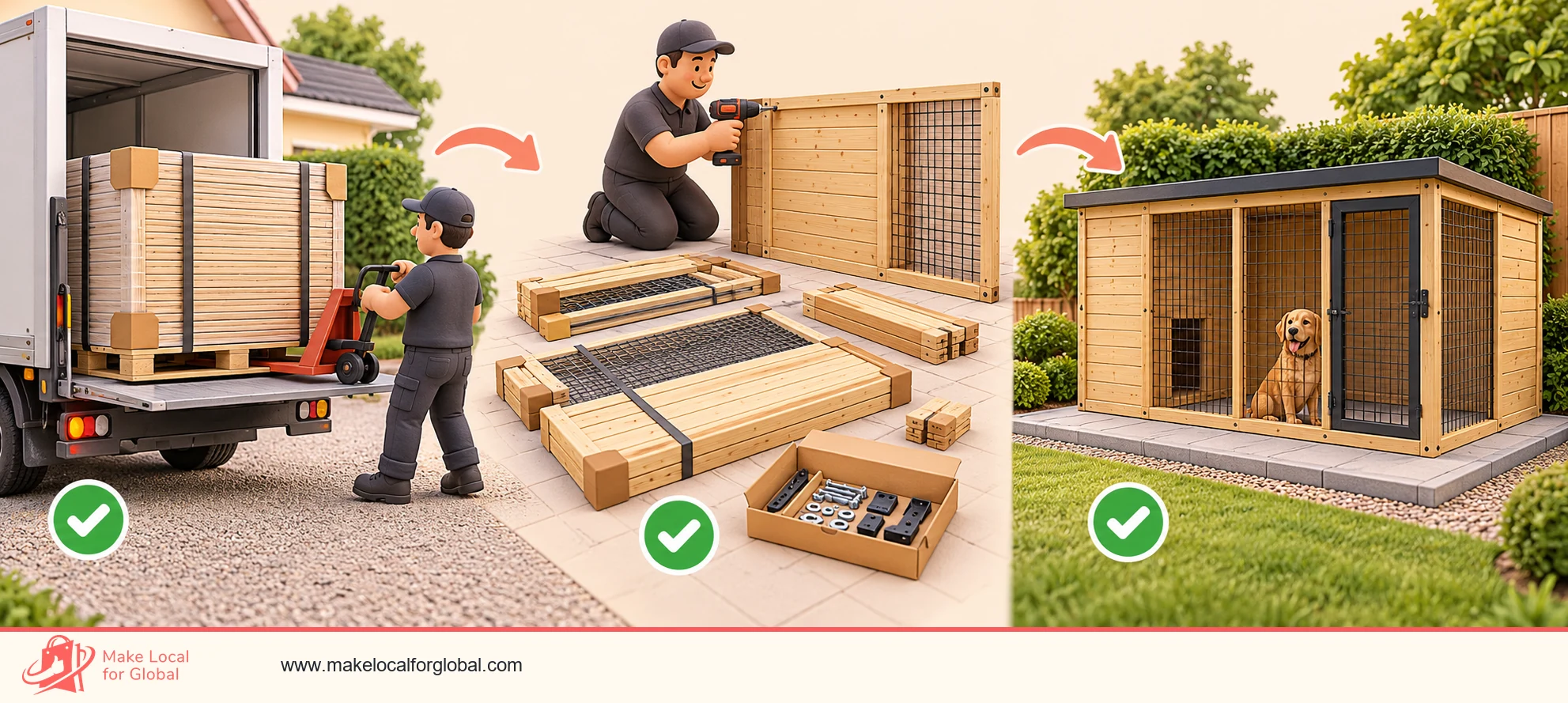
Put common answers near the options or a concise FAQ: Is the displayed size internal or external? Is the run included? Does the roof lift off? Is a floor included? Does the kennel arrive assembled? How many parcels arrive? Will the driver carry it into the garden? What surface is required? Which areas are excluded from delivery? How should the timber be maintained? Can replacement parts be bought?
Do not invent a quick answer for a supplier-dependent question. If the information is not confirmed, ask the supplier before listing the item. Save the written response and update the page if the specification changes.
Rules depend on what you make, import and sell, where the customer is based, and the product’s design and claims. This section is an operational checklist, not legal advice. Get advice from the relevant Trading Standards service or a qualified adviser if the product’s status or duties are unclear.
The UK Office for Product Safety and Standards says businesses that make, import, distribute or sell consumer products are responsible for safety. Its guidance says the General Product Safety Regulations 2005 apply in Great Britain, and the EU General Product Safety Regulation applies in Northern Ireland from 13 December 2024. Product-specific requirements can apply too. Check the current official guidance for the actual model and market before listing it: GOV.UK product safety advice for businesses.
Manufacturers and importers need to demonstrate compliance with relevant requirements. Official guidance discusses risk reduction, technical records, labelling, safe-use instructions and traceability. Keep supplier identity, product and batch references, purchase records, inspection results, technical files, complaint records and corrective actions together. Review the primary GOV.UK advice for manufacturers and importers for your role.
Do not assume a kennel is exempt from safety duties on that account. A product can injure a pet or a person through sharp mesh, unstable panels, pinch points, a falling roof, toxic coatings, poor instructions or an unsafe installation. Write down the foreseeable uses and misuses you considered, and record how the sample check addressed each risk.
The Animal Welfare Act 2006 places duties on the person responsible for an animal to meet its needs, including a suitable environment, normal behaviour and protection from pain, suffering, injury and disease. See section 9 of the Act. A seller of a kennel product should describe the product accurately and avoid implying that it alone meets every welfare need.
Do not use boarding-kennel dimensions as a domestic product recommendation. The England guidance for licensed dog boarding is about licensed boarding premises, with conditions for the premises and dogs in that setting. It is not a universal sizing rule for a household shelter. If you sell to boarding businesses, check their licensing context and local authority requirements separately.
Avoid promises such as “keeps every dog warm”, “escape-proof”, “chew-proof” or “safe in any weather”. State what was tested and the limits of the test. A shelter may provide cover from some conditions yet still require a suitable site, care and monitoring by the owner. Make claims proportionate to evidence.
For UK distance sales, tell consumers key information before checkout, including the trader’s identity and contact details, product description, total price, delivery arrangement and cancellation rights. Read the current GOV.UK online and distance selling guidance. It says online customers must be told they can cancel up to 14 days after delivery for most goods, with exceptions applying to particular products.
The GOV.UK returns and refunds guidance explains the cancellation and refund timing for distance purchases. Set out a clear return route, the address, who arranges large-item collection and how the customer should protect the item for its return. Do not charge a blanket restocking fee that conflicts with consumer rights. Get advice on how the rules apply to an assembled or used kennel and what remedy applies if the product is faulty.
If the product is made to order or personalised, do not assume that automatically removes all cancellation rights. Confirm whether an exception applies to the specific product and explain the position before the customer places an order. Faulty-goods rights still need separate consideration.
A dedicated store gives you room for comparison pages, delivery details, care instructions and enquiry forms. A marketplace can put the product beside existing alternatives, but listing rules, fees, delivery promises and customer-service expectations vary. Read the current platform rules and fee pages before choosing. A large item may be difficult to sell profitably if the channel’s delivery settings do not match the carrier service.
Start with the channel where you can present accurate dimensions, options and shipping information. Create one complete core listing before copying it into multiple channels. Keep a master specification sheet so changes are reflected everywhere. If a platform truncates a description, keep the critical fit, delivery and included-items details near the top.
Potential searches include “outdoor dog kennel with run”, “timber dog kennel dimensions”, “large dog kennel for garden”, “dog kennel delivery UK” and “flat pack dog kennel”. These are research ideas, not confirmed search-volume claims. Check current search suggestions and Search Console data if available before allocating a budget.
Create supporting pages that answer a real question: how to measure a dog for an outdoor shelter, what dimensions on a kennel page mean, how flat-pack delivery works, what to check on a timber sample, and how to compare a kennel house with a kennel-and-run. Link to the relevant product page. Avoid creating near-duplicate pages that repeat the same copy with only a size name changed.
For broader product research, compare your category plan with other practical Product To Sell ideas. Related MLFG articles such as selling camping gear online and selling dog sweaters online offer different product examples; do not reuse their product assumptions for kennel specifications.
Choose one question to test: does the buyer respond more to internal dimensions, covered-run convenience, verified timber details or delivery clarity? Use the same offer and audience when comparing two page versions or adverts. Record impressions, qualified visits, product-page interactions, enquiries, add-to-basket actions, delivery-area failures, completed orders and reasons for abandonment.
Set a spending limit before the test. Stop if a safety, fit or delivery problem appears. A low number of clicks cannot confirm the offer is wrong if the audience is narrow or the test had little exposure. Write down what the result can and cannot tell you, then choose a next experiment.
Large products tie up more cash and space than small accessories. Decide whether the first order will be stocked, dropshipped from a supplier, or made to order. Each arrangement needs a clear promise. If a supplier ships direct, confirm who checks the parcel, includes the right instructions, responds to damage claims and manages returns. Your customer still needs a clear seller contact.
For stocked products, set minimum and reorder levels by variant. Use actual lead-time history and supplier capacity rather than an optimistic date. A roof or run panel that is out of stock can make a complete bundle unusable, so track compatible components together. Keep replacement fixings and service parts available where the supplier can support them.
Create response templates for common questions, but leave space for product-specific facts. Ask for order number, photos of the package label, affected component and damage before dispatching a replacement. Do not make customers repeat information across multiple contacts. Set an internal response target and track unresolved cases.
For returns, plan collection costs and storage. A fully assembled kennel may not fit the original packaging. Tell the customer how to prepare the product for collection, but do not imply that packaging condition removes statutory rights. Inspect returned products safely, record missing parts and decide whether they can be resold, repaired or must be disposed of. Update the reserve in the unit-economics model from actual return data.
Monitor complaints by batch and symptom. A pattern of roof leaks, bent mesh, missing parts or unclear instructions should trigger a supplier review. Pause affected listings if there is a credible safety concern during investigation. Follow the relevant reporting and corrective-action duties in current product-safety guidance.
Use the first month to answer a small set of product and delivery questions. The plan assumes a seller can contact suppliers and a small group of prospective customers. Move the weeks if supplier samples or transport take longer. Do not rush a safety check just to match a calendar.
Write a one-sentence buyer profile and choose whether the first offer is a kennel house or kennel-and-run. Interview five to eight dog owners who match the intended buyer as a small discovery exercise, not a representative survey. Ask about dog measurements, garden layout, current solution, buying objections and acceptable delivery arrangements. Record the answers without assuming that stated interest equals a sale.
Build a comparison sheet from supplier specifications and current competitor pages. Separate internal dimensions, external dimensions, run size, materials, assembly, delivery terms and care instructions. Contact at least two suppliers if possible. Ask each for a sample, current drawings, batch traceability, packaging details, spare parts, production lead time and evidence behind safety or weather claims.
At the end of the week, write down the largest unknowns. If no supplier can explain the product’s construction or delivery plan, do not solve that gap with sales copy.
Assemble the sample with the supplied instructions. Photograph each test, log defects and ask a second person to assemble it without coaching. Check edges, joints, floor support, mesh, latch, roof fit, packaging and cleanability. Ask the supplier to resolve any issue that could affect safety, fit or assembly before you request an order quote.
Get written freight and delivery quotes for each variant and destination area. Add packaging, fees, handling, damage allowance, customer acquisition and return collection to the unit-cost sheet. Compare expected and adverse cases. If the order is only viable when no parcel is damaged and every delivery succeeds, revise the offer or run a lower-risk test.
Decide the opening range. Keep the number of variants small enough that each page can show the correct dimensions and each stocked component can be tracked. Identify which options are incompatible and remove them from the same selector.
Write one page from the verified specification, with internal and external measurements labelled. Show what is included, what is optional, delivery method, package size, lead time, assembly requirements, care limits, returns information and support contact. Use accurate photographs of the sample and a labelled size diagram.
Ask a few target buyers to complete a task: choose the right size, find out whether a run is included, locate the delivery restrictions and explain how they would prepare for the parcel. Observe where they stop or ask for help. Fix those points before buying traffic.
Review the product-safety file and consumer information. Check that the claims, instructions, product labels and customer-service route match the supplier evidence. Confirm the product’s availability before selecting an in-stock or made-to-order status.
Send a small amount of relevant traffic to the product page or invite a limited group to enquire. Set a budget and stop conditions. Track page visits, measurement-guide use, product option selections, delivery quote requests, baskets, orders, customer questions and the reasons people leave. Use a distinct campaign link for each source so the results are interpretable.
After the test, compare the outcomes with your initial assumptions. Did buyers understand internal measurements? Did delivery access block orders? Did a particular question recur? Did the actual fulfilment cost match the quote? Decide whether to improve the page, change the product, negotiate the carrier, adjust the price or stop the test.
If the sample passes, the page is accurate and the delivery process works, place a measured first order rather than scaling from clicks alone. Keep a record of what you will inspect on arrival and how you will pause sales if a defect appears.
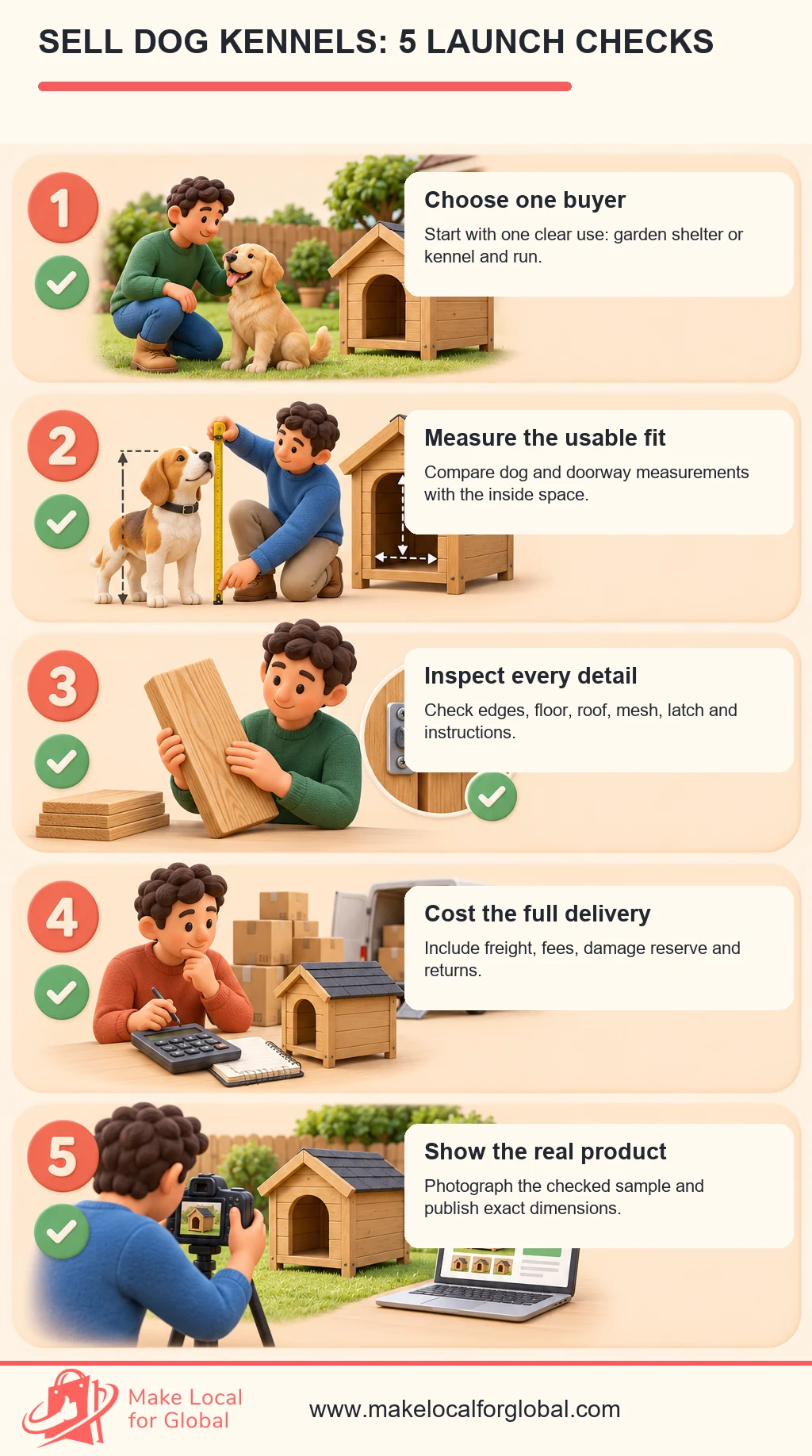
Check the kennel listing before opening orders
Review internal and external dimensions, materials, run contents, care, images, delivery and returns before taking orders.
No. Here, a dog kennel means an outdoor shelter or shelter with a run. A crate is a separate product, often used indoors or for transport, with different fit and use considerations. State the product type in the listing so buyers do not confuse them.
There is no fixed number. Start with the fewest options that meet distinct buyer needs and that you can inspect, explain, stock and deliver reliably. Each size needs clear internal and external dimensions. Add another option only when buyer evidence and supplier control support it.
Breed alone is not a reliable fit measurement. Dogs vary in body size and shape. Ask buyers to measure the dog and compare the result with the actual sleeping-area and entrance dimensions. If you publish a size chart, identify the source and state its limits.
Do not assume a single domestic sizing rule. Requirements for licensed boarding premises are a different context from a household outdoor shelter. Give accurate dimensions, avoid presenting boarding rules as a domestic product chart and seek qualified advice if your product is intended for a regulated setting.
Inspect the cut edges, joints, fixings, floor, roof, door, latch, coating, mesh and packaging. Assemble it using the supplied instructions, check stability, record unclear steps and test cleaning access. Follow the supplier’s advice on water exposure and care. Keep written evidence for claims on the product page.
Only if the intended buyer needs that format and you can verify its layout, security, delivery and assembly. Show the sleeping area and run dimensions separately. State which panels and roof sections are included, and explain the required ground and access conditions.
Get the package dimensions and weight, then confirm carrier type, delivery area, access limits, kerbside or room-of-choice service, failed-delivery fees and damage reporting steps. Publish the limits before checkout. Test packaging and assembly instructions with the actual sample.
Apply the consumer-rights rules to the specific facts and product condition. Explain the return route and collection process in advance, and obtain legal guidance where needed. Do not state a blanket rule that removes cancellation or faulty-goods rights.
Only make claims supported by product-specific evidence, and define the tested conditions. Avoid absolute promises. A product’s suitability depends on design, installation, maintenance and conditions at the home, and the owner must monitor the dog.
Track qualified page visits, measurement questions, delivery quote requests, product selections, basket actions, orders, delivery failures, damage, returns and customer-service time. Add the full cost for each order before deciding whether to expand the range.
PREFERRED SOURCE
Like what you’re reading? Add Make Local for Global as a preferred source on Google to see more of our articles when you search.

Build your online presence without having to figure out everything yourself.