


READY TO SELL Drinking glasses ONLINE?
Get a store built for you in 5 days, plus training and support to help you start, run, and grow your Alternative business.

Choose a focused drinking-glass range, check the exact material and finish, price a protected UK parcel and build product pages that set clear expectations.

A drinking glass is easy to photograph and easy to underestimate. The sale price may look attractive until you add protective packaging, pick-and-pack time, courier restrictions, breakage and the cost of replacing a damaged set.
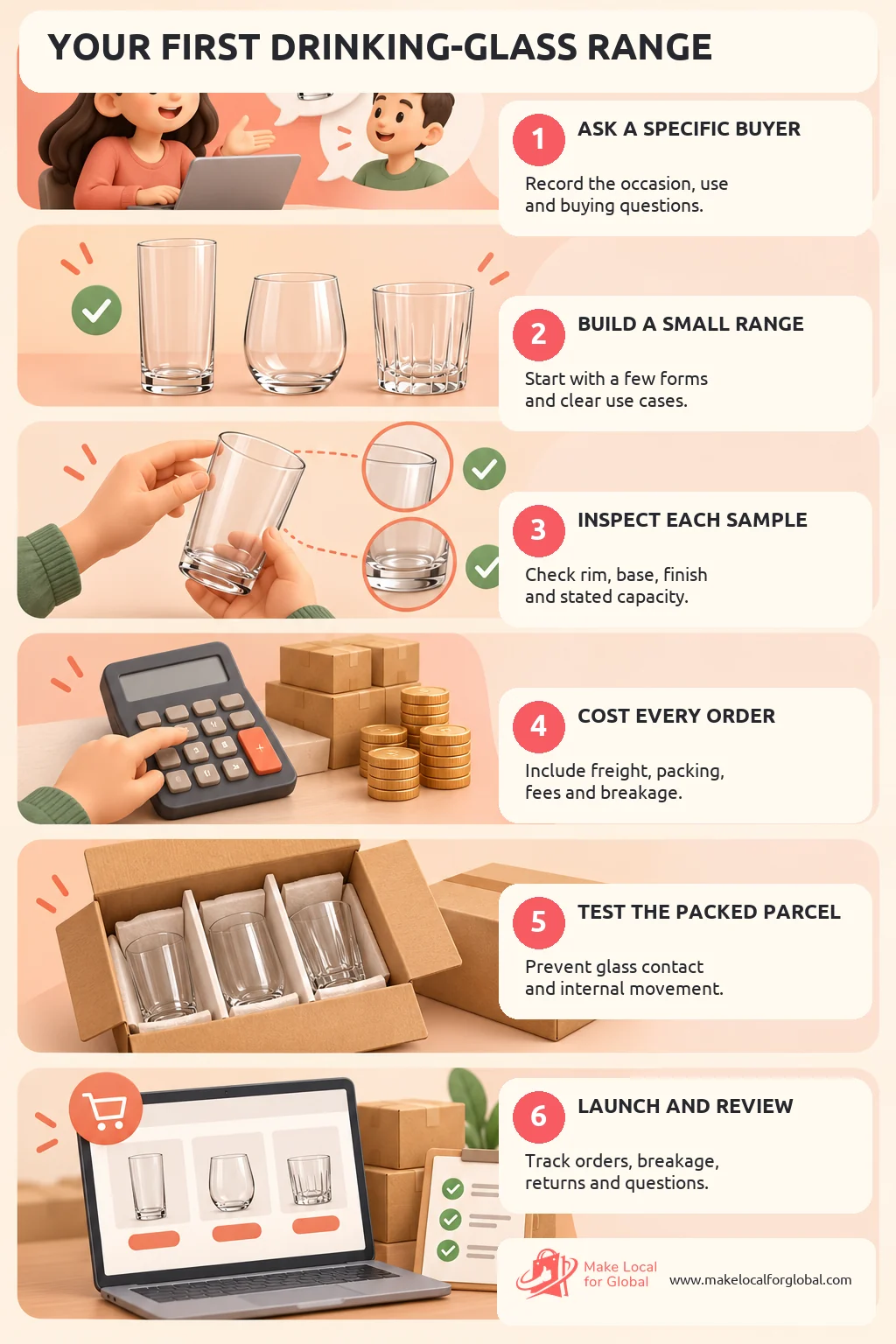
To sell drinking glasses online with a sensible first range, choose a specific buyer and drinking occasion, inspect the exact samples, publish verified dimensions and capacity, then cost the packed order rather than the glass alone. Begin with a small set of shapes you can explain and protect in transit. Add colours, finishes and bundles only after customer questions and order data point to a clear reason.
This practical plan covers product selection, supplier checks, product-safety responsibilities, a worked UK cost example, useful product-page details and a careful first-month launch.
Test the glassware idea before buying a case
Gather buyer evidence about the occasion, set size and questions that should shape your first offer.
“Glassware for everyone” gives a new shop little direction. A better starting point names the person, the drink or setting, and the decision the product helps them make. A household replacing everyday tumblers needs a different range from a cocktail hobbyist, a wedding-gift buyer or a café that needs a repeatable supply of stackable glasses.
Write one sentence for each audience you might serve. For example: “We help people setting up a small home bar choose a few durable, clearly measured glasses for their usual drinks.” This is a hypothesis to check with real people, not a description to publish before you have evidence.
| Buyer group | Purchase occasion | Questions to ask before choosing stock |
|---|---|---|
| Households | Replacing chipped everyday glasses or buying a matching set | What size fits the cupboard and dishwasher? How many are needed? |
| Home-bar owners | Building a compact cocktail or spirits set | Which drinks do they make, and what shapes do they actually use? |
| Gift shoppers | Weddings, housewarmings, birthdays or seasonal presents | Do they need gift packaging, a note, a receipt-free parcel or a delivery date? |
| Small hospitality businesses | Replenishing glasses for a café, bar or event space | How many are used each week? Are replacements available in the same model? |
| Craft and design buyers | Looking for a particular handmade, coloured or etched style | Which variation is genuinely handmade, and what variation is normal? |
Talk with a few people from each group. Ask what they bought last time, what went wrong, which details they checked, how they store glasses and what made them delay a purchase. Ask to see the product page they used if they can share it. Specific past behaviour is more useful than “Would you buy this?”
Record repeated needs in the language people use. One buyer may say “short whisky glass”, another “rocks glass”; someone else may search for “large water tumbler”. Note these phrases without treating them as proof of search volume or sales. They can inform headings, filters and product copy after you confirm they match your stock.
Create a small offer page or a simple survey showing a real sample, a likely set size, a price range you can support and an honest delivery estimate. Ask people to choose between a few distinct options, such as a stackable everyday tumbler set, a cocktail pair or a gift box. Track the option they select and the question that stops them from ordering.
For a local test, speak with a small number of potential buyers at a craft market, homeware group or hospitality contact. Do not use a poll result as a substitute for a paid order. A useful signal may be a request for a quotation, a sample request, a buyer asking for a repeat supply arrangement or a deposit taken under terms you are equipped to honour.
Set a decision rule before the test. You might decide to request samples from suppliers only if several target buyers ask for the same shape and at least a few want a price or delivery date. Your threshold depends on the amount of money at risk. Write it down, record the result and choose what happens next: order samples, refine the offer or drop the idea.
The test should compare a specific offer, not abstract interest in “glassware”. A landing page with three clearly described choices gives more useful evidence than a page with twenty unrelated styles. If the response is mixed, ask what information was missing before you add another product.
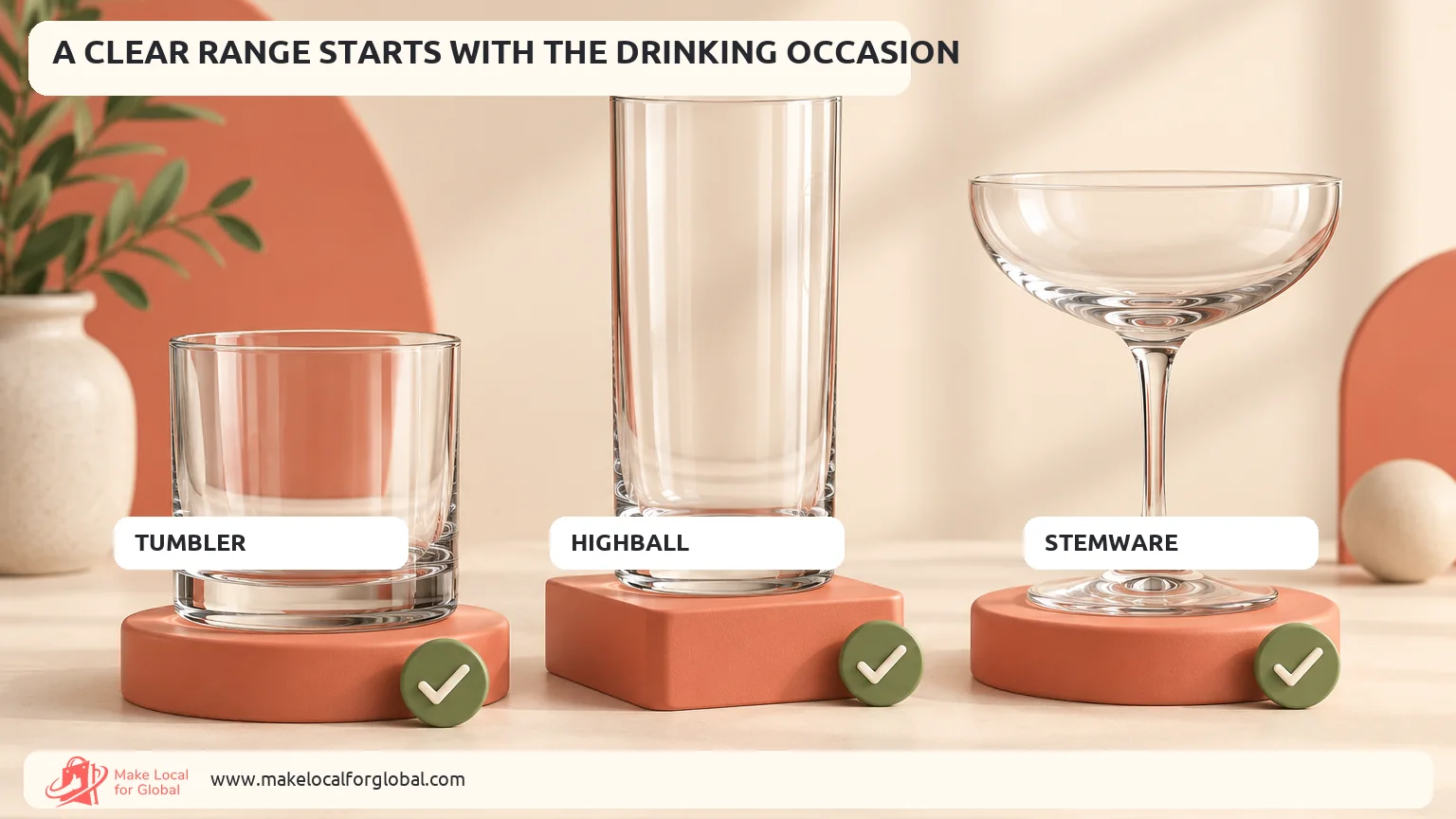
Drinking glasses come in familiar forms, but form alone does not tell a buyer who should choose them. Explain the job of each shape using measured details and a grounded use case. Avoid promising that a shape improves flavour or keeps a drink cold when the supplier cannot provide reliable evidence for the exact design and its limits.
| Type | Likely use to test | Details a product listing should verify |
|---|---|---|
| Short tumbler | Water, soft drinks, spirits or everyday use | Usable capacity, rim width, height, base width, weight and set count |
| Highball or tall glass | Long mixed drinks, water or soft drinks | Height, capacity to brim and practical serving capacity, if supplied |
| Stemmed wine glass | Wine service or a table setting | Bowl and stem measurements, capacity, care guidance and packed height |
| Coupe or cocktail glass | Cocktails, desserts or a gift set | Capacity, bowl width, stem height and what the supplier says about use |
| Beer glass | A particular beer style, pub setting or home bar | Capacity, shape, case quantity and whether the model is consistent across batches |
| Small tasting glass | Specialist tasting, sampling or a gift bundle | Exact capacity, intended use, food-contact documentation and care instructions |
Use the table as a way to ask supplier questions, not as a claim that every buyer uses a particular glass for a particular drink. Your own interviews may show that the strongest first offer is a sturdy everyday set or a small cocktail pair rather than a broad bar collection.
Choose one lead product, one alternative that answers a different need, and perhaps one giftable bundle if buyers ask for it. A useful first range might contain a four-piece short tumbler set, a six-piece everyday set and a pair of stemmed glasses. Those quantities are examples only. Compare supplier minimums, carton arrangements, cupboard space and customer preferences before setting your real options.
Every variant multiplies work. A glass in four colours, two sizes and three set quantities can create twenty-four product combinations. Each needs accurate images, inventory, packaging details, returns handling and a clear stock record. Launch with fewer combinations, then add only the ones supported by demand and supplier consistency.
Singles can work for replacement purchases or higher-priced specialist pieces, but the postage may be high relative to the basket value. Pairs may suit a gift or a small home bar. Larger sets can spread packaging and delivery costs over more items, yet they increase parcel weight, carton size and the financial impact of breakage.
Compare the net contribution of a single, pair and set using actual packing and delivery quotes. Ask suppliers whether a set arrives as a boxed retail unit or loose pieces in a master carton. A branded gift box may improve presentation but may not protect the glass well enough for parcel delivery. If you use an outer shipping carton, cost it separately.
Bundles should solve a clear task. A “starter bar” bundle might combine two glass shapes only if customers want those drinks and the pieces can be packed safely together. A gift bundle might include a card or protective gift box. Do not add a bottle opener, coaster or other item merely to make the listing appear larger; each extra product adds sourcing, stock and parcel requirements.
Ask the supplier for the commercial name and actual material specification of each model. “Crystal”, “crystalline”, “crystal-style” and “glass” are not interchangeable descriptions. Ask the manufacturer to confirm the composition and intended use in writing. If a piece is lead crystal, do not market it as lead-free. If the description is unclear, pause the listing and ask a product-compliance specialist to review the documentation.
The UK Government’s lead guidance for the public notes lead crystal glass among kitchen items that may be a source of exposure, with leaching more likely for acidic contents. That is a reason to verify composition and intended use, not to make a health claim about a particular glass. Get model-specific food-contact evidence before sale, particularly for imported or decorative products.
Clear, coloured, etched, painted, printed and gold-rimmed finishes each need separate checks. Ask which parts contact the mouth or drink, how decoration is applied, what care instructions apply and whether the supplier has tested the finished model. A clear tumbler and a coloured or decorated version from the same catalogue may not share the same finish or care limits.
Do not infer dishwasher, freezer, microwave or hot-drink suitability from the word “glass”. Thermal shock, decoration and the shape or thickness can affect use. State only what the manufacturer supports for the exact model. If a seller’s sample has been put through a dishwasher as an informal observation, that does not prove a defined number of commercial wash cycles or justify a broad durability claim.
For handmade products, confirm what “handmade” means. Ask which stages are manual, how much variation in dimensions or colour is expected, and what level of bubbles, waves or marks is accepted. Photograph the actual finish and set a written grading standard with the maker. Explain ordinary variation to buyers without using it to excuse chips, cracks, sharp edges or a glass that rocks on a flat surface.
Possible sources include UK glassware wholesalers, specialist hospitality distributors, makers, importers and overseas manufacturers. A UK address may make communication or replenishment easier, but it does not prove that a product is safe or that records cover the exact model. An overseas quotation may offer more choices; it can add import, customs, payment, quality and packaging work.
Send the same short specification to each potential supplier. Include the intended use, target range, sample quantity, expected first order, destination, target delivery window, material or finish, packaging format and the model identifiers you need recorded. Ask for a price that separates the product cost from tooling, printing, freight and other charges.
Ask these questions before placing a commercial order:
Ask for the evidence that matches the product you will sell. A report for a different model, factory or finish may not cover your version. Check the document title, issuer, test date, product description, model number, material, intended use and any conditions. A generic logo or a one-line “food safe” message is not a substitute for a relevant evidence trail.
If you import or sell under your own brand, check the legal duties that apply to your role and destination market before paying for stock. Do not assume the supplier will take responsibility for every UK obligation. For uncertainty about food-contact compliance, speak with the Food Standards Agency, your local authority or a competent product-safety professional before selling.
Give every supplier and product a reference in a simple spreadsheet. Keep the supplier’s company details, purchase order, invoices, model and batch codes, product photos, sample notes, food-contact documents, packaging specification, delivery record and email about any substitution. Save the date and version of each document.
Set a rule for substitutions. A supplier should not silently switch a model, finish, glass composition, carton or factory. Ask for written notice and a new sample if a change can affect food contact, capacity, appearance, stability or packaging. Record whether you approve the change and which batch first used it.
For a maker or small wholesaler, discuss realistic lead times and what happens if a colour or shape is unavailable. A product range built around a single model that cannot be replenished may turn into a customer-support problem. Confirm the supplier’s returns address and who pays for defective stock before the first bulk order.
Order one sample of each exact model and finish. If the production process can vary, request more than one from the same batch. Record the model code, date, supplier and parcel condition as soon as it arrives. Keep at least one reference sample or clear photographs of the approved version.

Use a written inspection sheet so you do not rely on memory. Measure the height, rim diameter, base diameter and weight with consistent tools. Measure the capacity using the same method for every sample and state whether the number refers to capacity to the brim or the supplier’s recommended serving level. Do not fill to a guessed line and present it as the official volume.
Check the rim under good light. Look for chips, sharp edges, uneven joins, visible cracks and roughness. Inspect the base and foot for wobble on a flat surface. Look through the glass for bubbles, waves, scratches, cloudy areas or colour differences, then compare each feature with the supplier’s written quality standard. Record cosmetic variation separately from faults that could affect safe use.
Check the glass after washing it according to the manufacturer’s instructions. Look for clouding, print or coating changes, trapped residue and any new rough areas. Do not use a dishwasher, freezer or hot liquid test beyond the maker’s stated conditions. An informal sample check does not replace laboratory or regulatory assessment where your product or claims call for it.
Inspect the retail box and shipping carton separately. Does the glass move inside its retail packaging? Is there protection above the rim and below the base? Does the box crush when handled? Can the retail box itself survive an outer parcel route? A display package may look polished on a shelf yet provide too little protection for courier handling.
Photograph the approved sample from several angles with a ruler or scale in at least one frame. Photograph any marks or variation you accept. Keep original images and supplier documents together so you can compare future deliveries and answer a buyer accurately.
Write down what you accept and reject. Your standard might name the accepted glass code, dimensions within supplier tolerances, acceptable cosmetic variation, decoration position, carton contents and documentation. Ask the supplier to acknowledge it before production. If a measurement tolerance is missing, agree a value with the maker rather than inventing one after stock arrives.
Inspect incoming cartons by a repeatable sample plan. Count the number of cartons, compare model codes and check visible damage before signing where possible. Open a planned sample of cartons and record the number of pieces checked, defects, photographs and action. For larger orders or higher-risk products, seek qualified inspection advice before choosing a sample size.
Set a stop rule. If you find a chipped rim, an unexplained model change, an unsupported “lead-free” claim or missing food-contact records, hold the affected stock and do not list or dispatch it until the issue is resolved. Keep a record of who made the decision and the evidence used. This is more useful than trying to clear questionable stock with a discount.
This section is a starting point for UK sellers, not a product-specific legal opinion. The rules can depend on where the product is placed on the market, what it is made from, how it is used and whether you manufacture, import, brand or distribute it. Check the current guidance for the nation and supply-chain role that applies to you.
Drinking glasses are articles intended to contact food or drink. Ask for evidence that the finished glass, decoration and any coating are suitable for the stated use. The Business Companion food-contact materials guide, reviewed in December 2025, explains food-contact material expectations for England and Wales and lists relevant legislation. Where the supplier’s evidence is unclear, contact the relevant authority or a qualified adviser rather than relying on a generic supplier statement.
Do not confuse a wine-glass-and-fork symbol or a food-contact statement with proof that every use is suitable. The declared use should match the beverage, temperature, washing method and conditions you tell customers about. Keep records for the exact model and finish.
For general consumer safety in Great Britain, the Office for Product Safety and Standards guidance describes duties for producers, importers and distributors under the General Product Safety Regulations 2005. In Northern Ireland, the EU General Product Safety Regulation has applied since 13 December 2024; see the UK Government’s guidance for NI and EU markets. The role and record-keeping duties vary, so check which route covers your product and sales territory.
Retain supplier and batch records so you can trace what you sold. Keep a way to receive product-safety complaints, investigate reported injuries or quality concerns, contact buyers if corrective action is needed and notify the relevant authority when the rules require it. Do not sell a product with a chipped edge or crack as a cosmetic second; first obtain a competent review of safety and give the buyer accurate information.
If you sell lead crystal, do not label it as lead-free or suggest that acidic drinks are suitable without current model-specific advice and evidence. The Government’s lead guidance points out that lead may be present in lead crystal and that leaching is more likely with acidic contents. Keep the product description, care note and warnings consistent with the maker’s instructions and applicable requirements.
The box used to protect glasses has a cost and a material weight. Keep a simple record of cardboard, paper, plastic film, moulded inserts and other packaging by material and weight per product. This helps you assess your packaging footprint and respond if your business becomes subject to reporting rules.
The current GOV.UK EPR packaging check, updated in August 2026, sets thresholds based on turnover and packaging tonnage and explains how producer status can depend on activities such as importing packaged goods or placing products into packaging. Small-producer guidance describes registration and reporting duties for businesses that meet the threshold. Do not assume that “small shop” means “no packaging duties”; check the latest rules against your group structure, turnover and packaging weight.
If the range includes decorative gift packaging or you ship a set inside an extra branded box, include both layers in your packaging record and cost model. Packaging choices affect damage, postage size, waste, unboxing and any applicable producer duties. Choose packaging that protects the glass. Make a recyclability, plastic-free or lower-impact claim only when you can substantiate it precisely.
A low unit price is not a selling price. Glass is bulky for its value, and the parcel after protection may weigh or measure much more than the product. Obtain quotes using the packed carton’s dimensions, weight, destination mix, collection method, fuel or remote-area charges and compensation terms.
The example below is illustrative only. It assumes a UK seller that is not VAT registered, a six-piece set sold for £42, and a domestic standard parcel. Replace each line with supplier invoices, carrier quotes and platform terms. The figures are not market averages or a promise of profit.
| Cost per order | Illustrative amount | What to verify |
|---|---|---|
| Six-glass set, including allocated inbound freight | £12.00 | Unit quotation, carton count, currency, duty and delivery to your premises |
| Protective inner packaging and outer carton | £3.20 | Real material cost per packed set, including tape and inserts |
| Pick and pack time | £1.60 | Minutes per order multiplied by a fair hourly cost |
| Customer delivery | £4.60 | Carrier quote for the packed dimensions and service area |
| Payment or marketplace charges | £2.10 | Current fee basis, fixed charge, advertising and refund treatment |
| Customer acquisition allowance | £4.00 | Actual paid cost per acquired order, or an explicit test assumption |
| Damage and return reserve | £2.80 | Your observed loss per shipped order, updated as evidence builds |
| Total variable cost | £30.30 | Add the lines above |
| Example selling price | £42.00 | A real target price to test with buyers |
| Contribution before overheads and tax | £11.70 | £42.00 minus £30.30 |
Contribution is the amount left after the listed variable costs. It is not net profit. Rent, software, insurance, owner time not counted in pick-and-pack, accounting, samples, photography, tax, breakage above the reserve and unsold stock still need consideration. If a discount reduces the sale price by £5, contribution in this example falls from £11.70 to £6.70, before any change in advertising or delivery.
The £2.80 reserve needs a method, not a guess hidden in the sheet. Until you have orders, mark it as an assumption and use a cautious scenario. After each period, divide actual costs for breakage, refunds, replacement postage and carrier claims by the number of delivered orders. Keep the reasons separate: poor product, weak inner packing, carton damage, customer preference or courier handling need different fixes.
If you are VAT registered, do not treat the customer price as sales revenue. Rebuild the example using the applicable VAT treatment for the product and the reclaimable VAT on each expense. HMRC says the UK registration threshold is £90,000 of taxable turnover, with a separate test when you expect to exceed the threshold in the next 30 days; read the current GOV.UK VAT registration guidance. Seek an accountant’s advice if your sourcing, imports or sales across UK territories make the calculation unclear.
Suppose one glass breaks in a six-piece set. Decide before launch whether you can send one replacement glass, replace the whole set, refund part of the order or ask the supplier for a compatible spare. The right route depends on product availability, customer rights, the original batch and whether a replacement can be packed safely at a sensible cost.
Record the cost of the remedy. It may include the replacement piece, picking, a new protective box, delivery and time spent resolving the problem. If you sell only full sets and the supplier does not offer spares, each single-piece breakage may require a full set replacement. That can change the margin more than a small change in wholesale price.
Ask the supplier about replacement-piece availability and model continuity. Keep a small reserve of individual glasses only if the supplier can provide a reliable matching model and your own storage can protect them. A replacement from a later batch can vary in tint, weight or shape, so compare it with the original before dispatch.
Price the complete parcel, not only the glasses
Add the set, inbound freight, protective packaging, delivery, fees and a measured damage allowance.
The product page should help a buyer decide whether the set fits the intended use, cupboard, table and delivery expectations. Put the model, set count, verified dimensions and capacity near the top. Use simple language and avoid unverified claims such as “unbreakable”, “commercial grade”, “lead-free”, “dishwasher safe” or “perfect for every drink”.
A useful title names the form or use and the set quantity if known. For example, after verifying the sample: “Clear stackable water tumblers, set of 6, 320 ml”. Use a capacity only when it is true for your exact product. If you sell a model for a specialised drink, name it only when the maker and your own range support that use.
Use a short opening description to state what is included, what the buyer might use it for and the main measurement. Then use a specification list for details such as glass type, finish, height, rim width, base width, capacity, set contents, care instructions, country of origin where known and the carton contents. Make the product page and order confirmation agree on quantity and colour.
If capacity is measured to the brim, say so. A serving volume may be smaller. A customer choosing shelf or cabinet space needs external dimensions, not just volume. Photograph a ruler beside the sample and state the dimensions in millimetres or centimetres, using a consistent format.
Use sharp images of the real product from front, side, rim and base. Include a hand or familiar object only as a scale cue and do not let it hide the shape. Photograph every finish you sell under similar lighting. Clear glass needs a background or lighting setup that shows its edge without creating a false colour cast.
For sets, show the number of pieces and how the glasses arrive. Include a photograph of the packaging and, if it is sold as a gift, the actual gift box. Do not use a decorative AI image as if it proves the exact pattern, printed mark, included contents or packaging. An illustration can explain a concept; product images should represent the product a buyer will receive.
Use descriptive alt text for meaningful images. “Six clear short tumblers on a table” says more than “drinking glass online”. If the image is purely decorative, do not repeat the same key phrase in every alt field. Name files before upload with plain descriptive terms such as clear-tumbler-set-six-front.webp.
Tell customers whether a glass is stackable only when the shape and supplier guidance support that statement. Show the stack in a stable, safe way and explain any height increase. Do not demonstrate nesting glassware if the pieces become stuck, chip easily or have no manufacturer guidance for stacking.
Care details should match the maker’s documentation. State dishwasher suitability only for the exact model and, where the instructions specify, the rack, cycle or temperature conditions. If a coloured, etched or gilded version needs hand washing, show that variant’s care instruction beside its option rather than burying it in a general footer.
Show the dispatch window, delivery price, parcel service or service range, and whether a signature or safe-place option is available. Be direct about any limitation in the carrier’s compensation. For example, Evri’s current non-compensation list includes glassware; do not describe the parcel as fully covered under that service. Carrier terms change, so check the policy before each launch and when you change service.
Use your own product photography and actual box dimensions for postage calculations. If a gift note, separate invoice or scheduled delivery is offered, test the process before publishing it. A feature that cannot be fulfilled reliably can create negative reviews and more support work than it brings in sales.
Choose one clear search intent, such as selling a particular type of glass set or explaining how to start a glassware shop. Place the main phrase naturally in the title, opening, one relevant heading and meta description where it fits. Use related words only when they describe products you truly offer: tumblers, highball glasses, cocktail glasses, stemware, glass sets or barware.
Build useful category pages for range distinctions such as everyday tumblers, cocktail glasses and gift sets if the catalogue supports them. Give each page a reason to exist. A category with two identical products and near-duplicate text adds little for a visitor. Use filters only for attributes shoppers understand, such as set quantity, glass type, finish and capacity.
Write product descriptions that give buyers information they cannot get from a repeated supplier paragraph. Add a short buying comparison or care page if customers repeatedly ask the same question. Connect those pages with relevant internal links. For more related selling ideas, see our guides to cocktail glasses, beer mugs and coffee mugs. The dinnerware sets guide is useful when planning a broader tableware range.
Write a short article or video around a real buyer question: how to measure a cabinet for glasses, how to choose a set quantity, what the seller has checked on the sample, or how the parcel is packed. Include your own sample measurements and process. Do not claim that a specific glass keeps a drink colder, changes its taste or survives drops without reliable evidence for that exact product.
A standalone shop gives you room for a detailed product page, a comparison between sets, care information and a clear support route. It asks you to bring the visitors yourself. A marketplace may provide existing shopper traffic, but fees, listing standards, customer-data access, advertising options, payment timing and compensation rules vary. Read the current terms before committing.
Compare each sales route using the same example order. Include the listing or monthly charge, transaction commission, payment fee, paid promotion, refund treatment, shipping label cost and the time it takes to manage an order. The UK Small Business Commissioner’s marketplace guide advises businesses to review terms and fees, which can change. Fill in current fees from the platform’s own schedule rather than relying on another seller’s old screenshot.
For a first marketing test, pick one buyer group and one offer. A homeware email list may suit a coordinated everyday set; local event planners may have a reason to request a breakage-resistant packing plan and a repeat quote. A small paid search or social test can compare two product-page messages, but set a spending cap and pause it if the visits do not answer a useful question.
Measure qualified visits, add-to-cart events, checkout starts, completed orders, questions, delivery costs, damage reports and returns. Record the dates, campaign, audience, product variant and spend. A high click count with no checkout may point to unclear price, delivery or product details. A few sales are not enough to prove long-term demand, so review several signals together.
Use an email sign-up only with clear consent and a privacy notice. A launch list can ask whether someone wants stock updates for a specific product. Do not add contacts from a market form to a marketing list without the right permission. Keep product notifications distinct from unrelated promotions.
If selling to hospitality buyers, ask whether they prefer a sample, case quotation or recurring supply. State the case quantity, lead time, breakage process and reorder code in writing. A venue may value reliable replenishment more than a broad consumer-style colour selection. Start with one or two local prospects and note the actual purchasing process before building a wholesale page.
Packaging is part of the product offer. It protects a fragile item, affects the postage band, shapes the unboxing and can decide whether a returned set is resellable. A box that looks large enough on a desk can still leave movement around the rim or base. Test the real packed configuration with the same outer carton and materials used for paid orders.

Wrap each glass or use a tested protective sleeve. Keep glasses from touching one another, the box walls or hard inserts. Use dividers that do not press on a stem or rim. Protect the top and bottom of each piece, then fill gaps so the contents cannot shift. For a gift box inside a shipping carton, protect the gift box separately; do not assume the retail packaging alone is parcel-ready.
Royal Mail’s fragile-item packing guidance recommends a strong box, dividers for multiple items and at least 5 cm of cushioning around each fragile item. Check the chosen carrier’s current instructions and adapt the design to the size and shape of your set. A carrier may still exclude fragile products from compensation even where its packing advice is followed.
Test several parcels, not only one. Pack the sample exactly as a customer order, close and seal the carton, then check whether any glass moves when you gently tilt it. Inspect for pressure marks, rattling and exposed corners. A controlled drop or vibration test can help you find weak areas, but it is not a formal certification or a guarantee against every carrier event. For larger volume, ask a packaging supplier or test laboratory to recommend an appropriate test plan.
Weigh and measure the sealed parcel. Ask the carrier for the rate and compensation terms for that actual size, weight and destination. Keep a photograph of the packed state, materials list, parcel label and proof of handover for each shipment. If the buyer reports damage, ask for photographs of the outer carton, inner packing and affected glass before arranging a remedy, and keep the response fair and within legal timeframes.
Make a packing checklist for each SKU: check order quantity and finish; inspect each glass under good light; remove dust or residues according to supplier guidance; wrap or sleeve each piece; insert dividers; fill voids; check that nothing moves; close the box; verify recipient and carrier label; record the parcel weight. The checklist helps spot a weak packing step before hundreds of orders repeat it.
Keep packaging material out of the rim and inside of a glass. Use clean storage shelves and protect stock from dust, moisture and accidental knocks. If you reuse shipping cartons, inspect them for soft corners, crushed flutes, old labels or moisture before use. A box that has already travelled may not retain the same strength.
Write an order process that starts when payment arrives and ends after the parcel is delivered or resolved. Set a realistic dispatch estimate based on the time required to inspect and pack glassware. Keep a small buffer for busy periods and supplier delays. If a set is temporarily unavailable, state the new dispatch date and contact affected customers rather than leaving the order unexplained.
Create a damage-response checklist. Ask the customer to stop handling broken glass, keep children and pets clear and photograph the package only if safe. Arrange collection or disposal guidance carefully and do not ask the customer to return dangerous shards. Check the order, batch record, packaging photograph, carrier event and any earlier claims. Record the remedy and the probable cause.
Do not assume a “fragile” label transfers your consumer obligations to the courier. UK online customers usually have a cancellation right for a limited period even when a product is not faulty. GOV.UK explains that a customer can tell you within 14 days of receiving an online order that they wish to cancel, with another 14 days to return it. The seller must refund standard delivery in the circumstances described by the official returns guidance. Check whether a specific exception applies to your product and situation rather than writing a blanket “no returns on glass” policy.
Faulty, damaged or not-as-described goods are a separate matter from a change-of-mind cancellation. Keep the return and refund process clear. If the buyer reports a chip, crack, wrong finish or missing piece, offer the appropriate route under consumer law and your terms. Do not charge a restocking fee that removes a consumer’s legal rights.
Ask for the order number, batch or product code, a concise description and clear images where safe to obtain. Do not make evidence requests so burdensome that a genuine customer cannot get help. Review damage rates by SKU, packaging version, carrier, route and carton size. If one configuration fails repeatedly, pause it and check the cause before increasing stock.
Store returned items separately until inspected. Do not return a chipped or cracked glass to sellable stock. A clean, unopened set may be resalable after you check the packaging and contents, subject to consumer law and the handling that occurred. Record whether the item is new, opened, damaged or written off, and update inventory accordingly.
The calendar below assumes you can obtain samples within the month. If a supplier or compliance check takes longer, extend the schedule. Do not compress food-contact or safety checks to meet an arbitrary launch date.
| Period | Work | Evidence to keep | Decision at the end |
|---|---|---|---|
| Days 1–7 | Interview target buyers, compare their occasions and record the questions they ask | Notes, phrase list, chosen audience and test offer | Pick one customer group and one glassware problem |
| Days 8–14 | Contact suppliers, request matching quotations, records, samples and carton data | Supplier comparison, model codes, documents and sample invoice | Reject incomplete suppliers or order a limited sample set |
| Days 15–21 | Measure and inspect samples, confirm care claims, test retail and parcel packaging, calculate costs | Sample form, photographs, packed dimensions, carrier terms and cost sheet | Approve, request changes or stop each candidate model |
| Days 22–30 | Publish one clear offer, test checkout and support steps, invite a small relevant audience | Page QA, enquiry log, campaign spend, orders and damage reports | Reorder, revise the offer or collect more evidence before widening the range |
At the end of each week, write down the evidence and one decision. If customers like a colour but do not want the set quantity, test a smaller pack rather than ordering a new finish. If the postage quote breaks the margin, compare a different box design or a higher basket offer before raising the product price. If the packaging fails, fix and re-test it before sending more parcels.
It can be, but the result depends on the set price, sourcing, packed size, delivery, platform costs, advertising, breakage, refunds and overheads. Build a per-order model and label estimates as assumptions. Replace them with actual invoices and delivery outcomes as soon as orders arrive. Contribution after variable costs is not net profit.
Start with a shape that solves a repeated buyer need and that you can source, describe and pack reliably. Everyday tumblers, a small cocktail pair or a specific hospitality glass can each be a sensible candidate. Choose after buyer conversations, sample inspection and parcel costing rather than guessing a bestseller.
A small range is easier to inspect, photograph, store and support. One lead model and one distinct alternative may be enough for a first test. Add a colour, finish or set quantity only when buyer evidence and supplier consistency justify the extra stock and page work.
Do not list them until you have confirmed the composition, intended use and food-contact documentation for the exact model. Do not call lead crystal lead-free. Seek competent product-compliance advice on the applicable UK rules and any care or consumer information required for the product.
Use that description only when the manufacturer’s documentation supports it for the exact glass and finish. Follow any cycle, temperature or placement conditions. A short informal wash test is not enough to support a broad durability promise.
No. Ask what evidence supports the statement, whether it covers the exact model and decoration, and what use conditions were assessed. Keep a copy with the supplier, batch and product records. If the evidence is unclear, get advice before sale.
Ask the maker for its measurement method, then check a sample with a consistent method. Distinguish capacity to the brim from a serving volume. Add the dimensions and set count to the product page so buyers can compare the glass with their storage and intended use.
Protect each piece, use dividers where needed, cushion all sides and prevent contact with other glasses or the outer carton. Test the complete parcel and confirm the courier’s current packing and compensation conditions. A “fragile” sticker alone does not protect the product or guarantee a claim.
Policies vary by service and change over time. Check the live exclusions, packaging requirements and claims process before choosing a carrier. Evri’s current UK guidance lists glassware among items excluded from compensation, so do not assume optional cover applies to a glass parcel.
Respond quickly and keep the customer safe. Request reasonable photographs of the carton and packing if safe, check the batch and parcel record, then offer the correct remedy under consumer law and your published terms. Record the cause and cost so you can improve the product or packing process.
Online buyers usually have a time-limited cancellation right, and faulty or damaged goods have separate protections. GOV.UK explains the standard 14-day notification period and refund rules. Check whether any narrow exception applies before you set a returns policy; “glassware is non-returnable” is not a safe blanket rule.
That can help customers replace one piece, but only if the model remains available and you can identify matching versions. Compare the replacement unit cost and safe single-piece postage with the customer benefit. Keep a separate stock record for spare pieces.
Use the sales pace, supplier lead time, cash available and delivery reliability from your own records. Review margin, customer questions, breakage, returns and stock age before placing another order. A product that sells but arrives damaged may need a packaging change before it needs more units.
Write down the customer, the occasion and the one glass set you plan to test. Ask suppliers for model-specific documents, samples, carton measurements and a clear answer about how a damaged or defective order is handled. Measure the sample, test the full parcel, check the carrier’s glass policy and replace each illustrative figure in the cost model with a real quote.
Keep the initial range small enough to explain and service. Use clear photographs, exact measurements, truthful care information and a visible returns route. Review the first questions and orders each week. Expand only when buyer evidence, supplier consistency, safe packaging and the numbers support the next choice.
Review the first glassware offer before widening it
Check the product facts, buyer page, packaging and order route before adding another model.
PREFERRED SOURCE
Like what you’re reading? Add Make Local for Global as a preferred source on Google to see more of our articles when you search.

Build your online presence without having to figure out everything yourself.


