

READY TO SELL Drum Kits ONLINE?
Get a store built for you in 5 days, plus training and support to help you start, run, and grow your Alternative business.

Choose acoustic or electronic drum kits, check suppliers and components, price multi-box delivery and write product pages that explain exactly what buyers receive.


Drum kits are exciting products, but they are bulky, component-heavy and easy to describe badly. A buyer may see a photograph of a complete set and assume the cymbals, stands, pedal and drum throne are included, then receive only a shell pack. A first-time seller can prevent that kind of disappointment by making the configuration, condition, sound and delivery plan clear before taking payment.
If you want to sell drum kits online, begin with one buyer and one playing situation. A parent buying a first kit for a young learner needs different guidance from a gigging drummer replacing a shell pack or a flat-dweller looking for an electronic practice setup. Build a small offer around the buyer’s actual space, experience and budget, test each component, and price the full order after freight and return handling.
This article focuses on acoustic drum kits, electronic kits and the bundles around them. It explains how to choose an opening range, source and inspect stock, describe what is included, protect heavy parcels, and work through UK sales and product responsibilities. The examples and prices are planning illustrations, not forecasts of demand or profit.
“Drummers” is too broad a first audience. A beginner setting up in a box room, a school music department, a home-recording musician and a working drummer buying replacement components have different needs. A clear buyer gives you a better range, product page and shipping promise.
Start by speaking to people who can describe the purchase in context. Ask what they play now, where the kit will sit, who else shares the room, whether they need to move it, and what equipment they already own. Ask a teacher, tutor or rehearsal-room operator what first-time buyers commonly overlook. Record only the information needed for the decision; retain personal details only with a clear business reason.
Listen for specific barriers. A learner may not know what a “shell pack” excludes. A parent may be unsure whether a junior kit will still fit a growing child. A flat-dweller may assume electronic pads make no noise. A rehearsal space may care more about repeatable hardware, a spare snare and fast replacement parts than a beginner lesson module.
Turn the conversations into a short offer statement. For example: “A first acoustic kit for an older child or adult beginner, with the snare, cymbals, stands, kick pedal and throne listed separately from the shell configuration.” Or: “A compact electronic set for home practice, with the module, pads, rack, mains adaptor and headphones explained, plus a clear note that kick-pedal and throne inclusion depends on the model.” These statements make it easier to spot missing pieces before you buy inventory.
Create a one-page comparison of two or three plausible kits and ask potential customers which one they would choose and why. Show the actual components, dimensions, weight, intended player and delivered price. Do not ask only whether they like the colour. Ask them to identify what they think is included, what they still need to buy, and what would make them abandon checkout.
For a local test, borrow or display one sample with permission and invite a small number of beginners to set it up using the instructions. Record the time, missing steps, confusing parts and questions. A short demonstration at a music lesson, rehearsal venue or community event can expose setup problems that a polished product photograph hides.
You can publish a clear waitlist page or run a small, time-limited enquiry campaign before ordering stock. Tell people whether the product is available now, a proposed range or a preorder, and state the likely dispatch date accurately. Do not accept payment for a product that is not ready on an invented delivery promise. A click, like or survey vote is a signal to investigate, not proof that a drum kit will sell.
Check the kit idea before ordering stock
Organise early evidence about the buyer, the kit and the questions your first test still needs to answer.
Acoustic and electronic kits serve related but different use cases. An acoustic kit creates sound through drum heads and cymbals. An electronic kit uses pads and a sound module, usually with headphones or an amplifier. An electronic set can support quieter practice, but the sticks, pedal and rack still create mechanical noise and vibration. Never promise silent practice.
| Kit type | Good first customer | What the buyer gets | Questions to answer on the page |
|---|---|---|---|
| Full acoustic starter kit | New player with a suitable room or practice space | Drums, hardware and often cymbals in one package | Does the bundle include a snare, cymbals, stands, pedal, throne and sticks? |
| Acoustic shell pack | Player who already owns compatible hardware | Drum shells and the included mounting parts | Which drums, hoops, tom holders and legs are in the box? Which hardware must be bought separately? |
| Compact or junior acoustic kit | Younger learner, smaller room or portable setup | Smaller shells and a reduced footprint | What age or height range did the maker specify? What does “compact” mean in dimensions? |
| Electronic kit | Home practice, shared rooms or headphone use | Pads, rack, module and specified cables or pedals | Which pads are dual-zone? Are kick pedal, throne, headphones and sticks included? |
| Electronic expansion pack | Existing owner adding pads or cymbals | A defined set of extra pads, arms or cables | Which module inputs and rack parts are required for compatibility? |

These labels are not universal package guarantees. A “starter kit” from one seller may include a complete set of cymbals and hardware; another listing may use the word for a shell pack. Put the included-items list beside the price and repeat key exclusions near the add-to-basket button.
An acoustic kit can be played without a powered module, and a buyer can hear the exact drums and cymbals. It takes up space, needs tuning and can be loud enough to disturb other people. Heads and cymbals are wear items. A listing should show the kit assembled, state its measured footprint where possible, and avoid treating a practice pad or mute as a soundproofing solution.
Electronic kits make headphone practice possible and can offer metronomes, built-in sounds and recording connections. They need an electrical connection and may depend on a module’s compatibility, available inputs and firmware. Rubber or mesh pads vary by model and playing response. The low thump from a kick pedal can travel through a floor, so a seller should be precise about the model’s noise-reduction claims and distinguish a manufacturer’s tested feature from an informal promise.
Use manufacturer product pages to verify details. Yamaha’s UK page for the RYDEEN, for example, describes it as a five-piece shell pack and lists two bass-drum size variations and included tom clamps. Roland’s TD-07DMK page lists pads, cymbals, a drum stand and module; its specifications state that the kick pedal and drum throne are not included. Those are useful examples of why a retailer should transcribe the exact bundle rather than rely on a generic “complete kit” label. Specifications and pack contents can change, so check the model in stock before publishing a listing.
Electronic practice kits can reduce the sound of the drum itself compared with acoustic drums, but they do not remove stick impact, pedal movement or vibration through a floor. Describe the pads, kick trigger and any included mat by their actual function. Make a “silent,” “noise-free” or “apartment proof” claim only when evidence supports the precise wording and its limits are clear.
For acoustic buyers, show how a lower-volume practice arrangement differs from the full cymbal and drum configuration. A mute set can reduce the acoustic output, but the player still strikes the kit and the feel may differ from normal heads and cymbals. State what is sold as a separate accessory.
A useful opening range needs enough choice to serve a real distinction in buyer need, but not so many near-duplicates that stock and support become hard to manage. Start with a small number of configurations and write down the reason each one exists.
An entry offer might be a compact acoustic set or a basic electronic kit for a learner with limited floor space. A core offer could add a more complete hardware package, a better-defined cymbal selection or an electronic module with features the target customer asked for. An upgrade can focus on a shell pack, improved cymbals, extra pads or a hardware upgrade for a player who already owns the basics.
Do not label a more expensive version “pro” on price alone. Name the actual improvement: shell sizes, included hardware, pad zones, cymbal alloy or manufacturing specification, module inputs, warranty, finish or setup support. If the supplier’s documentation does not support a claim, leave it out.
A useful beginner package can include a kit, cymbals, stands, kick pedal, snare stand, hi-hat stand, throne, drum key and sticks. The product page must identify each included piece and note which components are model-specific. If sticks or a throne are absent, say so. If the buyer needs headphones or an amplifier for an electronic set, show compatible choices and their extra cost.
Bundles should solve a setup problem, not hide a discount. A “first lesson” bundle might pair a kit with a throne, sticks, drum key and ear protection, if those items are appropriate and clearly specified. A home-practice bundle could add compatible headphones, a mat and an instrument cable. A replacement bundle might combine heads and a tuning key. Check compatibility, stock and package weight for every combination.
Avoid bundling cheap extras that the buyer may not use just to raise the ticket. Explain why the pieces go together, show the total and compare it with purchasing them separately only when the separate prices are current and accurate. Check the legal treatment of bundle claims and promotional prices in the markets where you sell.
Accessories can make the first kit easier to use and can create repeat orders, but they add fit questions. Organise them by kit compatibility and task: drum heads by size and type, cymbal stands by required height and boom, pedals by drive style and chain compatibility, sticks by diameter and tip shape, and electronic cables by connection type.
Show the measurement or model number a buyer needs before ordering. For an electronic pad, list the input type and the modules you have confirmed. For a head, specify diameter and whether it is a batter or resonant head. For a cymbal stand, show folded length and the maximum height if a buyer has a restricted practice space.
Use a consistent naming system such as “5-piece acoustic shell pack, 22-inch bass drum” or “compact electronic kit with module, rack and three mesh tom pads.” Add the manufacturer’s model code. Use plain words in the navigation and search fields, not a retailer’s internal code as the only name. When two kits differ only in colour, make that variation clear without creating a duplicate-looking page with a different component list.
Drum kits can be sold through authorised distribution, wholesale, direct relationships with makers or carefully managed second-hand and refurbished stock. Each route carries different cash, warranty, documentation and quality responsibilities. Start with a route that lets you verify what you are selling and obtain replacement parts.
Before placing a wholesale order, ask for the exact model and component list, current product specifications, carton count, packed dimensions, gross weights, lead times, minimum order quantities, spare-part availability and warranty process. Ask whether cymbals, pedals, stands, throne, sticks and mains adaptor are included in that particular SKU. Request current photographs and written confirmation of finish, sizes and any included accessories.
Ask how damage in transit is reported, what evidence the supplier requires and how quickly a replacement part can be sent. Find out whether a kit ships as one heavy carton or several boxes. Confirm whether carton labels identify the full set and whether the consignment can be split in transit. A low unit price may not help if replacements, freight or claim handling consume the contribution.
If you import equipment, confirm who is the importer of record, which safety documents apply, what product markings and traceability information are supplied, and which UK producer-responsibility tasks apply to your business. Do not assume a marketplace listing, factory certificate or supplier email proves that a product meets every requirement for the destination market. Ask a competent product-compliance specialist or trading standards service when you cannot establish the correct position.
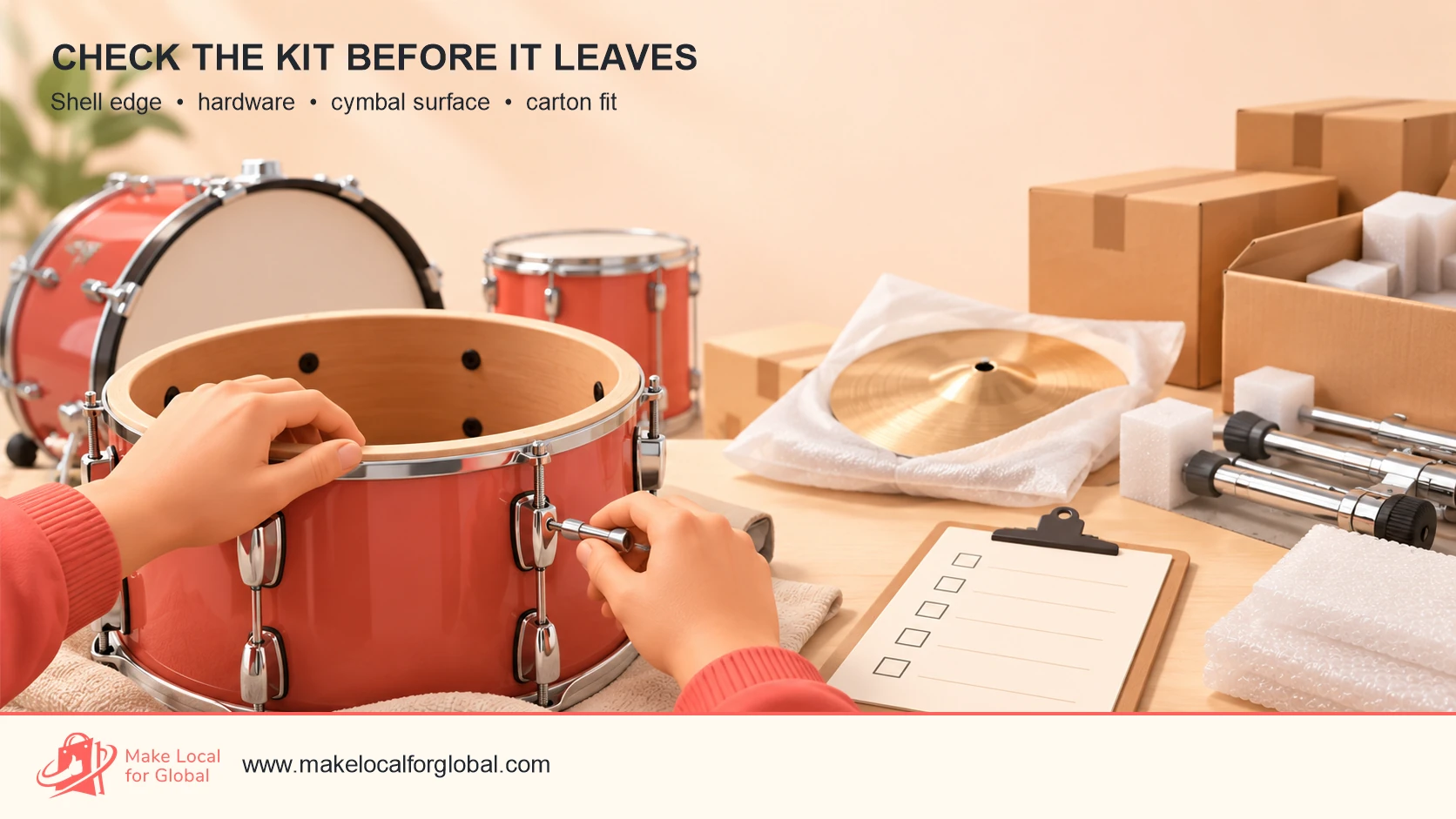
Use a written receiving checklist. On shells, look for cracks, dents, warped hoops, lifting wrap, loose hardware, damaged bearing edges and uneven seating. Check that lugs turn cleanly and that rods thread without binding. Place a head on the shell and inspect whether it sits evenly before you judge tuning. A seller does not need to promise a professional studio setup, but the buyer should not receive a visibly damaged drum or missing component.
Inspect cymbals for edge cracks, keyholing around the centre hole, chips and transport damage. Check stands for bent tubes, missing sleeves, clamps that slip and feet that do not sit evenly. Operate each pedal through its travel and look at springs, hinges and beaters. Confirm the snare wires and throw-off move smoothly. For a used kit, record marks, replaced heads, missing parts and any repairs in the listing photographs and condition notes.
Test an assembled sample on a stable surface. Tune each drum within the maker’s guidance and play a short, consistent pattern so you can hear loose rattles or inconsistent response. Recheck the tom mounts and stand clamps after playing. If a component is supplied new but has cosmetic packaging damage, define exactly what is affected and avoid describing it as unopened or pristine.
Connect every supplied pad, cymbal, pedal, module, cable and mains adaptor. Confirm that each pad triggers the correct sound and zone, that the hi-hat pedal responds across its range, and that the kick trigger does not move under normal playing. Check the headphones or output connection only if they are part of the sale. Test USB, Bluetooth or recording features only when the product documentation supports them and you have a compatible device.
Record the firmware or module version for your own service notes. Confirm whether an expansion cymbal needs a separate arm, cable or trigger input. Keep the original manual, setup guide and mains adaptor details with the kit. When a returned electronic kit comes back, do not mix its cables or adaptors with another model until you have checked the labels and tested the complete set again.
Inspect every delivery for carton damage and obvious missing boxes. For large repeated orders, inspect one complete kit before releasing the rest for sale, then use a documented spot-check plan based on risk, prior defect rates and supplier changes. Increase checks when the model, factory, carton design or supplier changes, or when a customer reports the same fault twice.
Photograph serial numbers and any carton damage before unboxing, following the supplier’s and carrier’s claims process. Keep a record of which components belong to which set. That helps you trace whether a missing part came from packing, supplier fulfilment or a mixed-up return.
An instrument’s purchase price is only one part of the order cost. A drum kit may need several cartons, manual handling, protective packaging, a specialist carrier, a larger return collection and more customer support than a compact product. Cost one exact configuration and one delivery zone before you set the visible price.
The following is an illustrative cash-cost model for a seller who is not VAT registered. It assumes a £479 customer price, a complete acoustic beginner kit and UK delivery. The costs are hypothetical placeholders, not supplier quotes or market averages. Replace them with invoices, current platform terms and carrier prices before using the model.
| Cost for one order | Illustrative amount |
|---|---|
| Kit purchase from supplier | £225 |
| Inbound freight allocated to this kit | £18 |
| Protective cartons and packing materials | £12 |
| Outbound multi-parcel delivery | £42 |
| Payment and marketplace charges | £13 |
| Returns and transit-damage allowance | £20 |
| Customer acquisition test allocation | £25 |
| Total variable cash cost | £355 |
| Customer price (not VAT registered in this example) | £479 |
| Contribution before fixed costs and owner pay | £124 |
The arithmetic is £479 less £355 = £124. This is contribution, not net profit. It does not pay for rent, insurance, software, accounting, storage, tax, finance costs, unsold inventory or the owner’s time. A return that cannot be resold at full price can cost more than the £20 allowance. Use the allowance as a working assumption and update it with actual return and damage data.
The carrier amount needs a real quotation for the packed cartons, postcode, collection method and service level. Do not estimate from the assembled kit’s weight alone. Several parcels can trigger separate charges and multiple labels. Include surcharges and insurance when applicable. Check fees against the actual payment provider and marketplace plan; they may change.

If you register for VAT, rebuild the example using VAT-exclusive sales and costs, input VAT recovery where eligible, the correct VAT treatment for each item and your accountant’s guidance. GOV.UK currently says the standard registration threshold is taxable turnover above £90,000 in a rolling 12-month period, or expected to exceed that amount in the next 30 days. Turnover covers the business’s taxable supplies, not just drum kits. Check the current rule before making a decision.
When comparing other sellers, compare like with like: model code, shell sizes, cymbals, stands, pedal, throne, delivery, warranty and condition. A lower price may be a shell pack, a used set, a kit with fewer components or a collection-only listing. Record the date and source of any public price you use for a comparison. Do not treat a visible competitor price as proof that the product is selling or that the competitor is profitable.
Set an entry price that can cover its order costs without depending on a bundle upgrade every time. Place your core configuration where a buyer can see why the included parts justify the total. Price accessories on their own as well, so a player with existing hardware can choose a shell pack without paying for duplicate stands.
Cost the first order before you set price
Enter verified kit, inbound freight, carton, delivery and other order assumptions in a structured cost model.
The page must answer four questions quickly: which kit is this, who is it suitable for, what is included and what will it cost to receive? A customer should not have to email you to find out whether a snare stand, cymbals or kick pedal comes with the model in the main photograph.
For acoustic kits, list the maker and model, number and sizes of shells, shell material only when verified, finish, head condition if used, included mounting hardware, cymbals, stands, pedals, throne, sticks and drum key. Give the assembled footprint and packed carton count if the supplier provides them. For junior or compact models, use the maker’s age guidance and measured sizes; do not infer suitability from a product name alone.
For electronic kits, list each pad, zone support, cymbal, kick trigger, module, rack, cables, adaptor, pedals and supplied accessories. State whether the throne, kick pedal, headphones or amplifier are excluded. Name any software or app only if it is included or the seller has confirmed the current compatibility. Say what is needed to hear the kit and whether the buyer needs headphones or an amplifier.
Use a clear contents list such as “Included: five shells, tom holders, snare stand, hi-hat stand, one straight cymbal stand, kick pedal, cymbal pack and drum throne.” Follow it with “Not included: sticks and headphones.” If the bundle changes by colour or model code, make separate contents lists rather than relying on a shared description that may be wrong for one option.
Use one photograph of the complete assembled kit, one of the component layout, close-ups of the lugs or pad surfaces, and a picture of each carton if delivery size affects the buyer. Add a short sound or playing clip recorded with the actual model and state how it was recorded. For an electronic kit, show the module display and the whole rack, not only a close crop of the snare pad.
Never use a manufacturer’s studio photograph to imply that a customer receives components absent from the SKU. If you use a room image or scale mock-up, add a label that tells the buyer it is illustrative and link the contents list directly beside it. For second-hand goods, photograph the actual set under even light and show scratches, marks, missing parts and repaired areas.
Demonstrate setup in a short video. Show the number of boxes, how the major parts connect, the approximate setup space and the supplied instructions. Avoid claims such as “perfect for every drummer.” Describe a reasonable use case and let the buyer judge fit.
For each kit, tell the buyer what else they need to get started and whether assembly is required. A buyer may need a drum throne, sticks, tuning key or compatible kick pedal for an acoustic kit. An electronic model may need headphones, an amp, a powered speaker, a mat or an adapter for a particular connection. Keep these as separate recommendations and mark them as optional or required accurately.
Give a simple setup guide or link to the manufacturer’s current instructions. Do not promise that a product works with every phone, laptop or recording platform. List the connection you tested and the exact model or operating system only if relevant. Keep advice distinct from the manufacturer’s warranty terms.
A drum kit should arrive complete, with fragile parts protected and each parcel easy to reconcile. Before you add free delivery, measure the largest packed cartons and weigh them. Ask the carrier for prices using the real postcode and service level. Check collection access, delivery restrictions, tracking, insurance, signature, damage-report deadlines and the process for missing parcels.
Separate cymbals from hard metal hardware and protect each cymbal from edge knocks. Immobilise stands and rods so they cannot punch through the carton. Protect shell edges, lugs, hoops and finish from movement. Put small hardware in a sealed labelled bag inside a fixed compartment, not loose between shells. Keep the kick pedal, clamps and other metal pieces away from drumheads and cymbal surfaces.
Use cartons rated for the actual mass and handling conditions. Fill empty space so parts cannot shift, but do not place pressure on a head, hoop or cymbal bell. Use corner protection around shells and double-wall packaging where the carrier or supplier recommends it. Test a sample pack by moving and gently tilting it before dispatch, then inspect the kit after a trial delivery if you can.
For a kit shipped in multiple cartons, label every box with the order reference and a sequence such as “1 of 4”. Put the contents list inside the main box and retain a copy in your dispatch record. Send the buyer the parcel count and tracking links together. If one parcel is delayed, the customer can see that the order is split instead of assuming the whole order is lost.
State whether the carrier delivers to the door, a ground-floor entrance, a room of choice or a kerbside location. Do not imply installation or room placement when the service does not include it. Explain whether an adult must be present and whether the buyer needs help moving the cartons. Avoid asking customers to lift an unsafe load on their own.
Show the expected dispatch window and any longer lead time before checkout. Keep made-to-order and preorder terms separate from stock-ready products. If a kit is delayed, contact the buyer with the current options and follow the contract and consumer rules. Update the product page when a supplier changes lead time rather than leaving an outdated promise in search snippets.
Agree with the carrier and supplier how a damaged or incomplete kit is documented. Ask for photographs of all carton faces, labels and the damaged component. Keep the packaging until you have the evidence needed for a claim. Decide whether replacement components, a collection or a full return is most practical and who coordinates each step.
A return label for a compact accessory will not necessarily cover a four-carton drum kit. Price the return process separately and make the instructions clear. A buyer should not be sent between the seller, supplier and carrier with no owner for the problem. Record the reason, missing component and final cost so repeated issues can lead to a supplier or packaging change.
An own-store page gives you control over bundles, product comparisons, service information and customer questions. It means you need to attract visitors and explain why a buyer should trust a specialist seller. A marketplace can put a listing in front of shoppers already browsing instruments, but its policies, fees, returns process and listing formats vary. Read current terms before you commit, and never copy a fee from an old spreadsheet.
If you plan to stock cables, monitors or other sound equipment alongside drums, MLFG’s UK guide to selling audio equipment online covers the broader category. The older musical-instrument online shop article is another reference for organising a specialist shop; check current platform details separately.
For a first range, choose one primary route and one small acquisition test. You might publish a comparison page on your shop, share a setup clip with a local music teacher or ask a rehearsal venue to display a QR card for a demonstration. If you use paid ads, set a small budget and a specific question: do buyers click a complete acoustic bundle more often than a shell pack at the same total delivered price? Avoid treating impressions as orders.
Write supporting pages around buying questions that your product descriptions cannot answer in full. Useful topics include:
Link each page to the relevant products and include the model-specific details that help a buyer choose. Use the phrase “sell drum kits online” naturally in the main article title, opening and one heading where it fits. Use specific product terms and model names on relevant pages, not the same title and meta description across every kit.
Short demonstrations can answer important purchase questions. Film a kit being assembled, show a cymbal and shell close-up, compare a compact and standard footprint, or explain a shell pack contents list. Capture the actual product and add captions for viewers who watch without sound. Ask a teacher or experienced player to review technical claims before publishing them.
Make delivery, included parts, compatibility, warranty and returns easy to find. Offer a direct question route for pre-purchase help, and answer with the model code rather than a vague reassurance. Use a clear stock status and avoid showing a kit as ready for dispatch when you cannot source all its parts.
Keep descriptions, images and stock records connected to the SKU. When a supplier changes a cymbal pack or a model’s included pedal, update the main image, specifications, order confirmation and picking checklist. A clear buying experience is more useful than a large catalogue with uncertain contents.
Rules depend on what the product is, where you sell it and what role your business has. A standard acoustic kit is not electrical equipment, but an electronic kit includes electrical components. Importing or selling a product under your own brand can create additional responsibilities. The notes below are UK-focused and are not a substitute for product-specific advice from a competent compliance professional.
The Office for Product Safety and Standards says UK businesses that make, import, distribute or sell consumer products are responsible for product safety and labelling requirements. Its guidance describes the General Product Safety Regulations 2005 for Great Britain and notes that the EU General Product Safety Regulation applies in Northern Ireland from 13 December 2024. Confirm the applicable rules for your location and sales route before listing goods.
For an electronic kit, determine which electrical and electromagnetic compatibility rules apply to the module, adaptor and other supplied equipment. Great Britain’s Electrical Equipment (Safety) Regulations guidance sets out manufacturer and importer duties, including conformity assessment, technical documentation, a declaration of conformity and applicable marking. Current guidance allows qualifying CE-marked products to be placed on the GB market when they meet the relevant requirements; Northern Ireland and sales into the EU can have different requirements. Do not apply or claim a mark yourself based only on a supplier’s unspecific statement.
Obtain the correct documents for the exact model and market. Keep records that link the SKU to its manufacturer, importer, test or conformity documents, serial or batch traceability and current instructions. If a customer reports an electric fault, stop selling affected stock whereas you assess the risk and follow the product-safety reporting and recall process that applies.
The UK WEEE rules cover electrical and electronic equipment sold online and in person. A retailer has distributor duties, including providing a free route for customers to dispose of old household electrical equipment when they buy a new equivalent item, or joining the applicable Distributor Take Back Scheme. The website must tell customers which route is available and how to use it.
If you manufacture and sell electronic kits under your brand, import EEE commercially into the UK or otherwise meet the producer definition, you may have annual registration and reporting duties. GOV.UK states that a small producer placing less than five tonnes of EEE on the UK market can register directly with its environmental regulator; larger amounts require a producer compliance scheme. Check the current guidance for your business role, product category and territory rather than assuming the supplier is the only responsible party.
If the kit includes batteries, check separate battery producer and take-back obligations. The GOV.UK retailer guidance says a seller supplying 32kg or more of portable batteries per year must offer free take-back. A kit’s included battery weight and any separately supplied batteries need to be recorded correctly. Packaging producer-responsibility rules can apply according to business size and activity; confirm current thresholds and reporting duties before you expand.
Give customers the information they need before ordering: seller identity, main product characteristics, total price, delivery charges, payment method, dispatch timing and cancellation process. GOV.UK says online customers usually have 14 days from receiving goods to tell the seller they wish to cancel, followed by another 14 days to return them. The customer’s legal rights for faulty or misdescribed goods remain relevant. Do not write “no returns” as a blanket policy for online consumer orders.
If selling used or refurbished kits, state the condition and any known faults in the product description. Take photographs of the exact product. A customer’s right to cancel an online order is separate from their rights when goods are faulty or not as described. Follow the statutory rules for any deduction related to handling beyond what is necessary to inspect the goods; get advice if you are unsure how they apply to a particular return.
GOV.UK currently lists £90,000 as the VAT registration threshold based on taxable turnover over the last 12 months, or an expectation that taxable turnover will exceed it in the next 30 days. The amount applies to the business’s taxable turnover, not only to this product category. Check whether you need to register, whether voluntary registration suits your circumstances and how your prices and input VAT should be handled with an accountant.
If you sell to Northern Ireland, the EU or other international destinations, check local product, consumer, tax and producer-responsibility rules. A product that is properly marketed in Great Britain may not meet every requirement elsewhere. Show the delivery territory and any import charges before the buyer pays.
A 30-day plan should produce evidence and a ready-to-buy listing, not a promise of sales. Keep a simple log with dates, sample sizes, price assumptions, customer questions and next actions.

Check launch readiness before you take orders
Review the first product, customer page and fulfilment steps before you widen the range.
A customer may need cymbals, stands, pedal and throne that are not in the photographed bundle. Put the contents list beside the price, use an image that reflects the SKU and say what is excluded.
The carrier needs packed carton dimensions and weights. Measure each parcel in the form it will be collected, then calculate service and surcharge costs for the actual destination.
Pads and a module can support headphone use, but impact, pedals and floor vibration remain. Describe the model’s actual features and state the limitations in plain words.
Acoustic shells, cymbals, hardware and electronic trigger systems have different failure points. Use separate checklists and include model-specific tests.
A bare shell pack and a fully bundled beginner set are not comparable. Compare included hardware, condition, delivery, warranty and total buyer setup cost before positioning your offer.
A multi-carton instrument can be expensive to collect and difficult to reconcile. Decide the evidence, carrier, replacement-part and refund steps before the first order.
Yes, if you can identify a buyer, verify the product and fulfilment route, explain the exact kit contents and price the full delivered order. Begin with one sample and a small range rather than buying a large catalogue before testing demand.
A drum kit can refer to different bundles. A shell pack usually focuses on the drums and may exclude cymbals, stands, pedal and throne. Check the manufacturer’s current component list and publish your own included and excluded items clearly.
Choose based on the first buyer’s space, noise needs, playing preference and budget. Acoustic kits need suitable practice space and tuning. Electronic kits can be used with headphones, but they need an electrical connection and still create mechanical impact noise and vibration.
It depends on the model and customer. A beginner may need drums, cymbals, stands, kick pedal, throne, sticks and drum key. An electronic setup may need a module, rack, cables and mains adaptor, with the pedal, throne, headphones or amp sold separately. State exactly what the customer receives.
Add the supplier price, inbound freight, packaging, outbound delivery, platform and payment charges, expected returns or damage costs, acquisition spending and any other variable costs. Compare that with the selling price and account for fixed overhead, owner time, tax and unsold stock separately.
Use cartons sized and rated for the actual packed weight. Protect shell edges and cymbal surfaces, immobilise stands and hardware, seal small parts in labelled bags and mark every parcel with the order reference and sequence. Test a sample package and confirm the carrier’s handling and claim process.
Show the exact assembled kit, the component layout, details of shells or pads, included hardware, carton count and any cosmetic marks on used stock. A short setup or sound demonstration can help, provided it shows the model being sold and does not suggest extra components are included.
Electrical equipment safety and related rules can apply to electronic kits, their modules and supplied mains adaptors. Your responsibilities depend on whether you manufacture, import, distribute or sell the product and on where you place it on the market. Check current official guidance for the exact model and territory.
Online customers usually have a 14-day period after delivery to notify the seller that they are cancelling, then another 14 days to return the goods. Faulty or misdescribed goods have separate statutory protections. Give the buyer accurate cancellation information and do not use a blanket “no returns” statement.
Yes, but show the actual kit, list the exact included parts and describe marks, repairs, replaced heads and known faults. Test moving parts and electronic components, photograph the condition and pack it to prevent further damage. Keep the return and consumer-rights process clear.
There is no single best model for every seller. A compact acoustic set, a clearly specified electronic kit or a shell pack for experienced players may each suit a different audience. Select the option that matches your buyer evidence, supplier access, service ability and full order costs.
Base the first order on supplier minimums, cash available, storage, delivery capability and demand evidence. A sample and a small number of confirmed configurations can expose listing, packing and support issues before a larger stock commitment.
PREFERRED SOURCE
Like what you’re reading? Add Make Local for Global as a preferred source on Google to see more of our articles when you search.

Build your online presence without having to figure out everything yourself.