

READY TO SELL Full-Face Helmets ONLINE?
Get a store built for you in 5 days, plus training and support to help you start, run, and grow your Alternative business.

Learn how to sell full-face motorcycle helmets online, from checking UK road-use approval and sizing information to building a focused range, pricing orders and handling returns.


A full-face motorcycle helmet is a high-consideration product. A buyer needs confidence that the model is correctly approved for its intended use, that the fit advice is useful, and that the helmet they receive matches the photographs and product record. For a new seller, stock choice and product information matter as much as the helmet’s colour or headline price.
This article focuses on full-face helmets for motorcycle and moped riders, with UK road use as the primary market. Cycling, downhill, karting, snow-sport and industrial helmets follow different product requirements and must not be mixed into the same listing. If you sell outside Great Britain, check the destination market’s rules before sourcing or shipping.
You do not need a large size-and-colour matrix to test the category. Start with a defined rider, a traceable supplier, approved product evidence, clear sizing information, a returns process that respects customer rights, and a price that includes the cost of careful packing and support.
Compare supplier evidence, sample quality and the rider questions your first listing needs to answer.
“Full-face helmet” covers a range of use cases. A commuter may prioritise everyday ventilation, comfort in rain and practical visor care. A touring rider may look for stable fit over longer journeys, a sun visor or quieter-feeling design. A track rider may focus on a particular approval, shell shape, visor system and supplier’s stated track-use suitability. These are different shopping contexts, not promises about what a particular model does.
Choose one primary customer before you select stock. For a first test, you might focus on road riders looking for a plain, current full-face helmet with a clear visor and straightforward replacement parts. Another shop may serve touring riders who value a compatible pinlock-style insert, if that component is genuinely supplied or sold separately and described accurately. Keep the first offer narrow enough that you can explain every item in it.
Speak with people who have recently bought a helmet. Ask which information they checked before visiting a shop, what made them trust the model and retailer, how they chose a size, what they found confusing about the visor or fastener, and what they did when a product did not fit. Ask about their actual last purchase, not whether they like your idea. Do not ask a rider to share sensitive health details or encourage them to wear a helmet that has been in a crash.
Record useful answers in a simple sheet: buyer type, stated use, helmet types considered, fit questions that matter, preferred sales channel, budget band, reason for rejecting a listing, and whether the person would try the helmet in a physical shop. The last point matters. Some customers will not buy a helmet online without trying it on; others may buy from a retailer they already trust and know how to contact.
Look for questions that repeat across retailer reviews and rider forums, but treat comments as leads for research rather than verified defect rates. A complaint about visor fogging might involve a different model, visor, insert, weather or maintenance routine. A comment about wind noise is subjective and can depend on the rider’s motorcycle and posture. Use review themes to decide what to ask a supplier and what details to explain, not to make claims about another brand.
Test demand without taking orders for stock you cannot supply. You can compare two accurate landing-page concepts, ask likely buyers to join a stock notification list, or take the proposed specification to a local riding group for feedback. State clearly that the item is not yet available. Do not use a false countdown, invented stock level or made-up review to make an early test appear successful.
Agree a decision rule before you spend. One small test could require a defined number of conversations, several specific questions about size and approval, and evidence that buyers will consider the planned price. There is no response count that guarantees sales. The useful result is a better choice about whether to order a sample, revise the customer focus or stop.
A conventional full-face helmet has a fixed chin bar and a visor in front of the face. A modular or flip-front helmet has a movable chin section. Some designs can be used with the chin bar raised when their approval and manufacturer instructions permit that use. Describe the protection in each position only as the exact product’s approval and documentation support it.
Other product differences include shell shape, shell material, shell-size count, liner construction, ventilation layout, closure type, visor mechanism, sun visor, speaker pockets, removable comfort padding and supplied accessories. The names and descriptions vary between brands. Ask the supplier for exact model specifications and write down which features are confirmed on each SKU.
The material label alone does not tell a buyer everything about fit, protection, weight or durability. Fibreglass, composite and thermoplastic descriptions can be used differently by sellers, and marketing terms such as “carbon” or “race” do not prove a model’s performance. Only publish composition, weights and features that the manufacturer documents for the exact model and size.
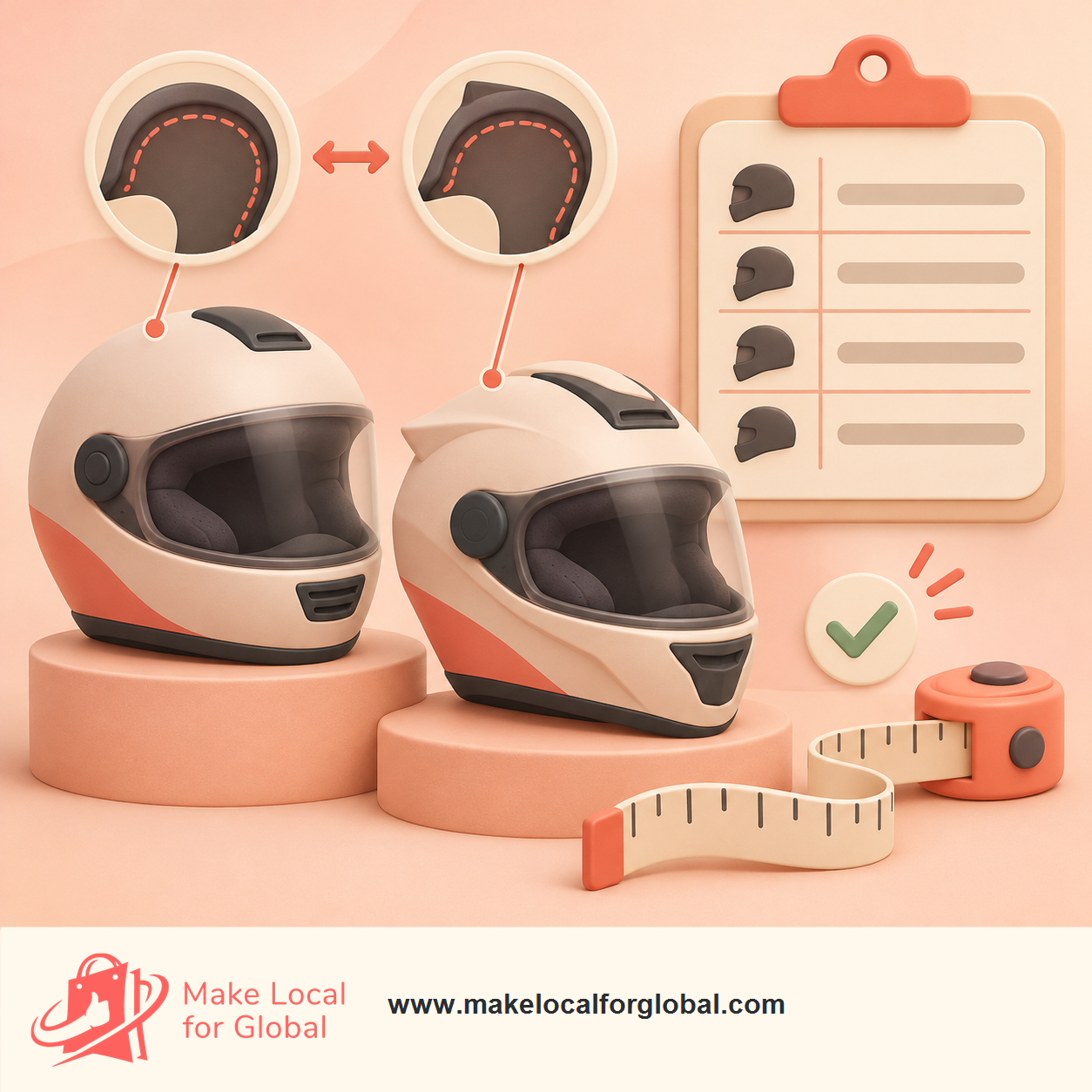
Helmet fit varies between models and head shapes. The same numerical size can feel different across brands. A size chart is a starting reference, not a substitute for the manufacturer’s fitting instructions or trying the helmet on. Your product page should show how to measure and explain where the buyer can get help if measurements fall between sizes.
An opening range often works better with one carefully checked model in a small set of sizes than with several unrelated designs. Keep a record of the cost of each size and colour, expected sell-through, restock lead time and likely exchange demand. Consider the tie-up of cash before adding multiple graphics, shell sizes, clear and tinted visors, spare liners and accessories.
An entry, core and premium ladder is useful only when each step has a real, verified reason. For example, differences might include the manufacturer’s shell construction, included visor feature, certified approval variant, parts availability or warranty terms. Do not create a “premium” tier by changing the colour name or using a larger crossed-out price. Compare the whole product and support offer, not adjectives.
| Range choice | Verify before you list | What it changes for the seller |
|---|---|---|
| Fixed chin bar or modular front | Model documentation, approved configuration and instructions for use | Determines accurate product description and the customer questions you must answer |
| Shell construction | Manufacturer’s exact material statement and applicable model data | Affects the feature comparison; material words alone do not establish performance |
| Size and shell count | Brand size chart, measurement method and which sizes share a shell | Affects stock depth, fit support, exchanges and storage |
| Visor | Supplied colour, approval, light-transmission note and compatible replacements | Changes road-use suitability, spare-part support and returns questions |
| Closure | Exact fastener type and instructions in the manual | Helps the buyer understand use; do not imply one style suits every rider |
| Accessories | Which items are in the box and which are optional | Prevents disappointment and disputed “included” items |
| Colour or graphic | Actual SKU, finish, current availability and product images | Adds inventory choices and can create slow-moving variants |
Use bundles only where they solve an actual need. A helmet with a compatible visor cleaner might make a practical gift set if the cleaner is suitable for the visor coating and included in the price. A spare visor, anti-fog insert, balaclava or intercom kit must be compatible with the model and described as included or optional. Do not bundle a visor or replacement part from another range based only on visual similarity.
Before sourcing, create a product matrix with brand, model, SKU, size, colour, approval information, shell material, stated weight, closure, visor reference, box contents, manual revision, supplier, batch or traceability data, quote, minimum order, lead time and warranty contact. Add a column for the source of each claim and the date you checked it. This matrix becomes the single reference for product pages, customer service and later reorders.
You could source from a UK distributor, an authorised dealer, a manufacturer or a sourcing partner. A low unit quote is not enough to choose a supplier. Helmets are protective equipment, and a wrong, counterfeit or incorrectly described model can expose a rider to serious harm and leave the seller with product-safety obligations.
Ask for the legal business name, trading address, manufacturer, exact model and product code. Request written confirmation of the country or region for which the helmet is intended, the approval basis, the product label and the evidence that covers the exact model and its configuration. A generic certificate for a family of products may not show that a specific colour, shell, size or modular configuration is covered. Ask the supplier to explain any gap in writing.
For helmets intended for UK road use, check the current GOV.UK requirements and the marking on the real product. UK guidance lists BS 6658:1985 with a BSI Kitemark, UNECE Regulation 22.05, UNECE Regulation 22.06, and qualifying EEA standards with an equivalent mark. Do not treat a decorative “ECE”, “DOT”, “CE” or “approved” graphic on a listing as evidence. Compare the actual label and paperwork, and seek competent compliance advice when the model or route to market is unclear.
UNECE Regulation 22.06 is the later helmet type-approval standard. The UK has allowed retailers to continue selling helmets approved to 22.05, according to the Department for Transport’s SHARP programme. That does not make every old or used helmet suitable for resale, and a seller should verify stock age, condition, approval and provenance. Describe a helmet as 22.06-approved only when the exact model carries the relevant approval evidence.
Ask how the supplier prevents substitution and how it identifies stock by batch or production record. Clarify what happens if the factory changes the shell, liner, visor, fastener, label or packaging. Agree how a recall or safety notice will reach you and which party will help identify affected units. Keep invoices and written responses with the model record rather than in a supplier’s chat thread that may later disappear.
If you import helmets yourself or sell under your own brand, check the legal role your business takes before ordering. UK product-safety guidance says businesses that make, import, distribute or sell consumer products have responsibilities for safety and labelling. Duties can differ for Great Britain and Northern Ireland. Get advice suited to your exact sourcing model, product, claims and destination market.
Ask the supplier for:
Compare suppliers on document quality, consistency, speed of support, traceability, minimum order, delivery terms, exchange handling and total cost. Treat unresolved approval or product-identity questions as a stop signal. A low quote should not outweigh a missing model record or a supplier who refuses to show the product label.
Order a sample through the normal channel with its retail packaging, labels, manual and supplied accessories. Record the date and supplier, then compare the sample against the written model details. Photograph the external label, inside label, chin strap, buckle, visor, vents, liner, packaging and manual. Keep copies with the matching invoice and approval papers.
An unboxing inspection can catch mismatched SKUs, cosmetic damage, missing parts or unclear documentation. It cannot establish that a helmet passed a type approval test. Do not cut, drill, crush, impact-test, dismantle or otherwise damage a helmet in an informal home inspection. Do not present an improvised test as proof of protective performance.
Check the shell for visible cracks, deep scratches, deformation, loose fittings, sharp edges, uneven finish or signs of repair. Inspect the visor for cracks, distortion, scratches, fit and smooth movement. Test the retention fastener only as described by the manufacturer, and check that the strap and adjustment components are present and appear undamaged. Any concern should go to the manufacturer or a qualified inspection route. Do not sell the sample as new after a questionable check.
Review the manual for a clear explanation of fit, fastening, cleaning, visor care, storage, replacement parts and what to do after an impact. Make sure the actual product label, box, manual and supplier documents refer to the same model. A QR code should lead to the maker’s stated support or instructions, not an unrelated or expired page.
Ask several riders who are familiar with helmet fitting to review the size information, if appropriate. Do not ask them to ride in a helmet that has not been verified or to judge impact protection. A useful review asks whether the measuring instructions are understandable, whether the product page gives enough model information, and which questions remain unanswered. Keep the final fit and use advice consistent with the manufacturer’s documentation.
Check how returned stock will be handled. A helmet may be tried on indoors, but each return still needs inspection under a written policy. Ask the supplier whether it can be resold as new after opening, how to handle broken seals, and what packaging or hygiene requirements apply. A seller should not relabel an opened or damaged item as new without a defensible process and accurate disclosure.
Your sample checklist can include: model and size match; approval label and supplied documents match; box contents complete; visor clear and undamaged; strap and fastener intact; vents and moving pieces operate as the manual says; liner is clean and seated correctly; manual version readable; photos match the actual SKU; and packaging protects the helmet from movement and pressure. Record a pass, fail or “supplier clarification needed” for each check.
Helmet approvals and road-use rules are product-specific. For Great Britain, GOV.UK states which standards apply to motorcycle helmets worn on UK roads and provides marking guidance. Its information includes the 22.05 and 22.06 UNECE standards and BS 6658:1985 with the BSI Kitemark. Link the official page near the relevant explanation and check it again before a later edit.
The road-use rule is not a shortcut for every helmet category. Motorcycle, moped, pedal-cycle, downhill, kart, snow-sport and industrial head protection do not share one approval. A listing should name the intended use from the manufacturer’s record. Do not position a cycling helmet as a motorcycle helmet or use road approval language for a model that is intended for another sport.
The label and certification marks must be genuine and tied to the exact model. Do not digitally add a mark to your product photo, redraw an approval label or rely on an image from a different size or colour. A customer should be able to inspect the real marking on the supplied item. If you suspect a counterfeit, pause the listing, preserve the packaging and supplier evidence, and contact the responsible supplier or enforcement authority.
Visors need their own accurate description. GOV.UK explains that visors and goggles need to meet applicable standards and that tinted visors with less than 50% visible-light transmission cannot legally be used on the road. Some are marked for daytime use only. Do not describe a dark visor as an all-condition road visor. State the exact visor included and its use restrictions from the maker’s approved information.
SHARP is a Department for Transport consumer information and rating programme. It provides star ratings for assessed helmets; it is not a substitute for the helmet’s type approval and does not rate every model. If you mention a SHARP result, confirm the exact model and variant in the current database, link the result and explain it as a consumer comparison rather than a guarantee of injury outcome.
Product-safety rules in Great Britain and Northern Ireland can differ. The Office for Product Safety and Standards says the General Product Safety Regulations 2005 apply in Great Britain and that Regulation (EU) 2023/988 on general product safety applies in Northern Ireland from 13 December 2024. A business importing or selling across the UK should check which product rules, labels, traceability and responsible-person details apply in its route to market.
GOV.UK product-safety advice says businesses that make, import, distribute or sell consumer products in the UK are responsible for safety and relevant labelling. Keep product records, stop supply when a credible safety issue arises, and follow the relevant notification and corrective-action process. The seller’s obligations depend on role and facts; this article is an orientation, not a compliance opinion for a particular business.
Online selling brings information duties and consumer rights too. Before checkout, give clear business details, model information, total price, delivery terms, return and cancellation information, and the information required for the sale. Government guidance explains online and distance selling. Its consumer returns page describes cancellation and faulty-goods rights. Do not write “helmets cannot be returned” as a blanket rule. Check the current rules and get advice on any hygiene, opened-packaging or safety issue before restricting a buyer’s rights.
Create a simple incident plan before you publish. If a buyer reports a damaged shell, loose strap or suspected approval mismatch, record the model, SKU, batch, order date, photos and description of what occurred. Do not encourage the customer to keep riding in the helmet. Escalate the report to the manufacturer or importer, pause affected stock when the facts indicate a possible risk, and follow current regulator guidance. Keep the complaint and any corrective action with the product file.
A supplier’s quoted unit cost is only one part of the decision. Add freight, import costs when relevant, protective packaging, delivery, payment or marketplace fees, expected exchanges and returns, customer acquisition and damage or replacement allowance. A helmet’s parcel size and value can make the carrier, packaging and return route more costly than a small accessory.
Here is an illustrative example for a helmet sold at £149.99 by a seller buying from a UK distributor. It assumes the seller pays standard delivery, is not VAT registered, and uses an example payment fee of 2.9% plus 30 pence. Replace every figure with actual quotations. The model excludes import duties on the assumption of domestic sourcing.
| Per-order cost | Illustrative amount |
|---|---|
| Helmet purchase cost | £75.00 |
| Inbound delivery allocated per unit | £5.00 |
| Protective outer packaging and fill | £4.50 |
| Delivery to the customer | £6.00 |
| Payment fee estimate at 2.9% + £0.30 | £4.65 |
| Exchange, return and damage allowance | £3.50 |
| Customer acquisition allocated to this order | £7.00 |
| Total variable cost in this example | £105.65 |
| Example selling price | £149.99 |
| Amount left before overheads and tax | £44.34 |
The fee calculation is £149.99 × 0.029 + £0.30 = £4.65 when rounded to the nearest penny. The variable cost sum is £75.00 + £5.00 + £4.50 + £6.00 + £4.65 + £3.50 + £7.00 = £105.65. Subtracting that from £149.99 leaves £44.34 before rent, website costs, insurance, compliance advice, wages, tax, stock that does not sell and other fixed expenses. It is a contribution estimate, not net profit.
The return allowance is a planning figure averaged across orders, not an amount to charge an individual customer. A return may require inspection, repacking or a decision that an item cannot be sold as new. A faulty helmet may have replacement, shipping and investigation costs. Use your own return data when it exists, and do not use this estimate to reduce statutory rights.
VAT changes the cash and revenue calculation. A VAT-registered seller should calculate the relevant treatment for the product, sales channel and transaction, and account for recoverable input tax correctly. A non-registered seller should use actual costs paid, including VAT where it cannot be recovered. Confirm the treatment with an accountant if unsure.
Compare prices only after matching the model, approval, size, visor, accessories, warranty, delivery and return support. A £99 helmet and a £160 helmet may not be equivalent offers. Claim that the higher price provides better protection only when the evidence supports the exact comparison. Explain factual differences that matter to the buyer and let them judge value.
Run at least three price scenarios with current costs. Check the effect of a 10% discount, free delivery, a paid advertisement, and a return rate above your estimate. If a promotion erases the contribution, adjust the offer, channel or supplier before launch. Do not cut protective packaging or the time needed to verify a return to preserve a headline margin.
Use the B2C Pricing Lab to compare fees, delivery and allowances using your own figures. The UK physical product pricing guide and product pricing guide explain how to build a price from costs. A calculator can organise assumptions; it cannot confirm your tax treatment or predict demand.

Test your price against product, packing, delivery, fees and exchanges before you choose the size range.
A helmet product page should identify the manufacturer, exact model, intended use, approval information, available sizes and colours, visor configuration, box contents, warranty route and delivery terms. Keep the product title readable. For example: “Brand Model X Full-Face Motorcycle Helmet, Matte Black, Size M” is more useful than “Ultimate Pro Race Helmet”. Use that example only when its facts match your actual stock.
Place the size guide close to the size selector. Explain the manufacturer’s measurement method, how to compare the result with its chart and where to request assistance. State that size labels are model-specific. Do not invent a fit guarantee or promise that a centimetre measurement alone will identify a correct fit. Link to the manual’s fitting instructions when the manufacturer permits it.
Show the approval information for the exact item and make the product marking visible in at least one supporting image where possible. Keep certification marks out of marketing graphics except when shown as part of a true photograph of the actual helmet. Avoid showing a visor or accessory that is not supplied without a label such as “shown for illustration; sold separately”.
Useful product images include: a clean three-quarter view, a rear view showing vents, a photograph of the inside and retention strap, a close view of the visor and label, and a photograph of the actual box contents. A size comparison may help, but it must not suggest that the helmet shown is a model or colour that the buyer cannot order. Keep image text brief and repeat details in accessible page copy.
Use a table to make variants easy to compare. Keep headings specific, such as “Included visor”, “Closure”, “Available sizes” and “Approval evidence”. Use only verified data. Do not publish a row of empty adjectives like “premium”, “ultimate” or “elite” in place of specifications.
Write a description with a short lead, then the verified detail. Example structure:
Do not promise “maximum protection”, “crash-proof”, “the safest helmet” or a guaranteed outcome after a collision. Avoid unsubstantiated claims about noise, aerodynamics, comfort, ventilation or performance. If the manufacturer supplies a supported claim, check that it applies to the exact variant and present it in context. No helmet removes crash risk.
Give the customer a pre-dispatch contact route for fit questions. Common questions include whether the helmet is suitable for their motorcycle, how to choose a size, whether the visor is road-legal at night, whether an anti-fog insert is included, how to find replacement parts and how to handle a return. Answer from product documents, not guesswork.
A marketplace may bring existing shoppers but can place your helmet beside products with unclear approval data and competing prices. Read its current rules for protective equipment, listing claims, prohibited goods, fulfilment, returns and documentation. A marketplace listing approval is not the same as product-safety verification.
A store you control makes it easier to offer model comparison, fit guidance, supplier transparency and support. You will need to attract qualified visitors, keep product records accurate, make returns and delivery terms visible, and answer questions without delay. Keep the first catalogue focused, then expand when sizing and exchange data show which variants are needed.
A physical fitting partner or local retailer can complement an online store. If a partner offers try-on support, agree exactly who handles payment, data, stock, fitting questions and returns. Claim an appointment or service only after it has been confirmed. A partnership can reduce fit uncertainty for some buyers, but it adds a coordination and stock-control task.
For dispatch, use the manufacturer’s retail packaging inside a strong outer carton with enough protection to prevent movement. Do not put tape, labels or courier stickers directly over product labels, approval marks, visor surfaces or packaging information a customer needs. Keep an unboxing photo and record parcel dimensions and weight for each common SKU.
Ask the carrier how it handles high-value parcels, loss claims, signature service, delivery attempts and customer returns. Confirm cover limits and any exclusions before you advertise “insured delivery”. Keep the carrier’s terms with the order record. A promised arrival date should reflect the service you purchased and the stock you actually hold.
If you use a fulfilment partner, ask how they record model, size, colour, batch and returns. Agree what happens when a parcel is damaged or a return has broken packaging. They should not place a returned helmet back into saleable stock automatically. Decide who inspects it, what evidence is retained and how a possible defect is escalated.
Keep high-value helmets secure and dry. Store stock in a way that protects the shell, visor, retention strap and packaging from crushing, moisture, heat and unnecessary handling. Use shelf labels that make size and colour clear. A pick-check should compare the order with the SKU and the product label before sealing the parcel.
Returns should follow consumer law and your published terms. Give the required cancellation information before purchase and make the process easy to find. Check a returned product under a consistent written procedure. If it shows impact, damage, contamination, missing parts or a broken seal, quarantine it and ask the manufacturer or supplier how to assess it. Do not resell a questionable item as new.
Useful search topics can include “how to choose a motorcycle helmet size”, “full-face helmet visor types”, “motorcycle helmet 22.06 explained”, “how to check helmet approval markings” and “what comes with this helmet model”. Make sure every factual answer links to a reliable manufacturer or official source. Do not create pages that repeat the product title without answering a distinct rider question.
For product pages, use one specific topic per model and variant. A guide about selling motorcycle helmets targets a different intent from a page for a particular model. Use natural terms in the product title, headings and description without repeating the same phrase in every paragraph. Write accurate meta descriptions and image alternative text that describes the image rather than stuffing keywords.
A short video can show the visor opening, fastener operation or box contents, if you demonstrate the exact model and follow the manual. Do not show an unapproved use mode, an unsafe ride or a modified helmet. Add captions so the information remains accessible without sound, and provide a written summary of relevant details.
Test one campaign at a time. A useful launch test could compare a model-specific fit article with a generic category ad, or test whether buyers respond to a transparent approval-and-sizing page. Track qualified product-page visits, fit questions, size selections, completed orders, return reasons, delivery damage and contribution after acquisition cost. Likes and video views alone do not show a profitable order.
Email customers order updates and dispatch information. If you send marketing emails, collect consent and provide the required unsubscribe route. A post-purchase message can tell the customer where to find the manufacturer’s manual and how to contact you about a fit question. Do not give instructions that conflict with the maker’s guidance.
Use the product itself in photography and promotion. Avoid copying another retailer’s pictures, using a logo or model number that does not belong to your stock, or digitally altering approval labels. Make discounts clear, show the terms, and do not use a crossed-out reference price that you cannot substantiate.
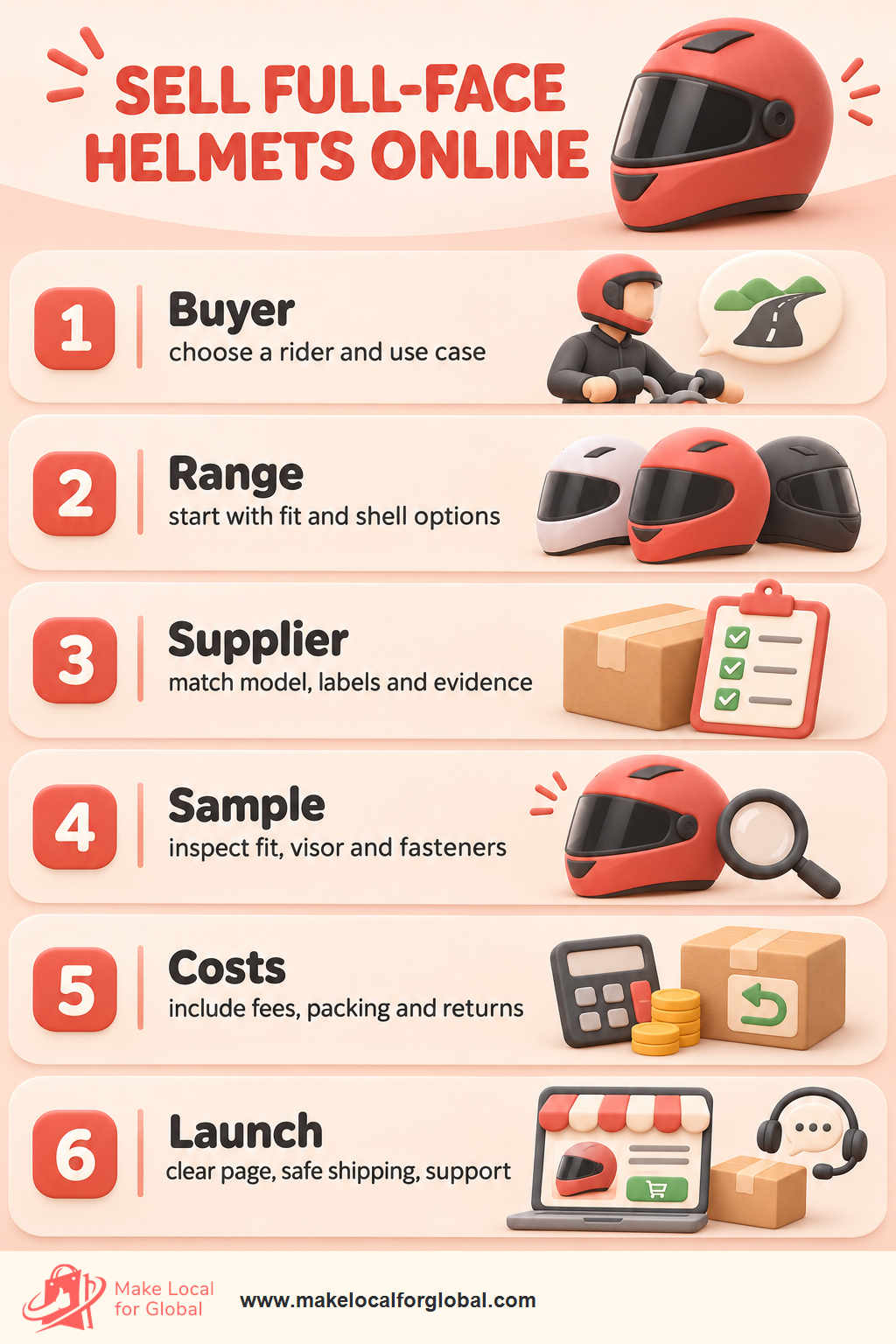
Choose one buyer context and write down the decision the customer needs to make. Review questions from recent helmet buyers, compare a few verified product types and list the support information that is missing. Set a test budget and decide what evidence is needed before you order a sample.
Make a one-page brief with the intended road-use category, planned price range, customer channel, size guidance needs and the supplier documents you will require. Add a stop condition for counterfeit concerns, mismatched labels or unclear approval evidence. Hold off on a bulk order until those questions are resolved.
Send the same model-specific questions to several sellers or distributors. Ask for exact SKUs, approval data, current photos, size charts, box contents, invoices, warranty route and recall process. Store answers with the supplier quote and record the date.
Compare the full landed price and commercial terms. Note whether the quote includes freight, taxes, inspection, sample cost, return shipping and replacement parts. Mark unanswered safety questions as unresolved rather than treating them as a lower supplier score.
Order one sample from the shortlisted source. Match the helmet and labels to the documents, photograph the product, check supplied parts and read the manual. Use a qualified route for any question that requires technical assessment. Do not damage or informally impact-test the sample.
Build the cost model with real quotes. Include stock, inbound freight, protective packaging, carrier, fees, returns and acquisition cost. Compare full-price and promotion scenarios, then decide whether the planned offer leaves enough contribution to provide service and handle an exchange.
Write the model-specific page, place the manufacturer’s fit guide near the size selector, show approval information accurately, list box contents and prepare real photographs. Check that the product title, stock-keeping unit, images, invoice and dispatch record refer to the same model.
Pack a sample parcel and confirm the carrier’s size, value and claim rules. Write an exchange process, a returned-product inspection checklist and a safety-complaint escalation path. Make sure customers can find your support contact before and after purchase.
Publish only after supplier evidence, stock identity, price, product page, carrier route, returns terms and support process are ready. Begin with a quantity your cashflow can carry. Do not display inventory you do not hold or promise a dispatch date that the supplier has not confirmed.
Review orders, fit questions, size exchanges, delivery damage, cost per acquired customer and contribution each week. Keep safety concerns separate from ordinary comments. If a complaint suggests a possible risk, investigate it at once and consider whether affected stock should be paused.
At the end of the month, continue, change one supported part of the offer and test again, or stop. Record why. If a size sells out faster than others, confirm demand and restock time before adding a broad size run. A small test should improve your next decision, even when the best decision is not to proceed.
Choosing a supplier by price alone. A low quote cannot make up for uncertain model identity, missing approval information or no recall support. Compare the records and total cost before the unit price.
Treating a logo as proof. A mark in a catalogue image can be copied or belong to another model. Check the real product label and paperwork for the SKU you plan to sell.
Mixing helmet categories. Motorcycle, cycling, kart and other helmets have different intended uses and standards. Keep each category and its claims separate.
Making fit sound universal. A chart is brand and model specific. Explain how to measure and direct the buyer to the maker’s instructions rather than promising that a size will suit every head shape.
Using a photograph of a different model. Visors, vents, fasteners, liners and accessories vary. Photograph the stock or use assets approved for the exact SKU.
Calling every tinted visor road legal. Light transmission and daytime-only restrictions matter. State the manufacturer’s information and link to current official guidance.
Using a single price as the whole margin. Shipping, returns, payment fees, advertising and damaged packaging change the amount left. Calculate from actual invoices and update the model.
Reselling a questionable return as new. A helmet can have impact or handling damage that is difficult to see. Use a written inspection route and quarantine items with unresolved condition concerns.
Assuming an approved listing proves compliance. Platform review does not replace the seller’s duty to check the actual product, documentation and role in the supply chain.
Promising protection from injury. Approval and SHARP information should be described accurately. Do not promise a crash outcome or say that a helmet removes risk.
You can explore the category, but it requires careful sourcing and clear fit information. Start with one traceable model, verify its approval and instructions, inspect a sample, understand exchanges and returns, and calculate the whole order cost before buying a wider size range.
GOV.UK lists BS 6658:1985 with a BSI Kitemark, UNECE Regulation 22.05, UNECE Regulation 22.06 and qualifying EEA standards carrying an equivalent mark. Check the current official requirements and the exact product label. A claim on a supplier page is not enough to verify a model.
No. The Department for Transport’s SHARP programme says the UK allowed retailers to continue selling helmets approved to 22.05, though 22.06 is the later standard and supply of 22.05 helmets has declined. Verify the approval and provenance of every item, and explain the exact approval on your listing.
Only describe the exact model and configuration supported by its approval and manufacturer instructions. Some modular helmets have specific rules for riding with the chin bar raised or lowered. Do not assume that every mode is approved for road use.
Provide the maker’s current measurement method and size chart near the size selector. Explain that fit varies by model and that a chart is guidance. Offer a support route for questions and do not substitute your own size recommendations for the manufacturer’s fit instructions.
You may offer compatible visors when the exact part and intended use are clear. GOV.UK states that visors transmitting less than 50% of visible light cannot legally be used on the road and notes that some are marked “Daytime Use Only”. Check the specific visor’s approval and restrictions before describing it.
No. SHARP is a consumer information programme that rates assessed helmets from one to five stars. It is separate from the helmet’s type approval, and not every model has a SHARP rating. Confirm the exact model in the SHARP database before mentioning its result.
Set a clear, lawful returns policy and explain it before purchase. Online cancellation and faulty-goods rights may apply, and a blanket “no returns” statement can be wrong. Inspect every return and do not resell an item as new if its condition, seal or safety is uncertain.
Ask for the exact model and SKU, approval information, real label photographs, manufacturer details, manual, size chart, box contents, batch traceability, warranty, recall process and return terms. Request written answers and keep them with your invoice and sample record.
Costs vary with supplier, model, sizes, stock depth, freight, packaging, website, marketplace fees, carrier, returns and promotion. Use the worked example above only to structure a model. Replace its figures with actual quotes and keep one-off set-up costs separate from per-order costs.
Show the exact model from several angles, the real label and strap, the visor, box contents, available colours and packaging. Use approved images for each SKU and explain which accessories are sold separately. Keep the size instructions in readable text, not only inside an image.
Record the model, size, batch information, order date, photos and description of what happened. Advise the customer not to continue using a helmet they believe is damaged, contact the responsible supplier or manufacturer, and follow your legal and product-safety duties. Consider pausing sales of affected stock until the concern is assessed.
Do not combine cycling helmets with motorcycle helmets in one product listing or approval description. The intended activity, safety standards and customer information differ. Create a separate category and verify the appropriate requirements for that product.
Selling full-face motorcycle helmets online starts with a traceable product and a buyer who can understand its intended use, approval, fit information and return route. Keep the first range focused, use the actual sample in your images, protect it properly in transit and track the cost and outcome of each order. Add sizes and accessories when customer evidence and reliable supply support the decision.
If you are preparing your first ecommerce shop, compare the Make Local for Global store plans and use the Product To Sell articles to explore adjacent product ideas. Ask questions about your setup through the MLFG contact page.
Set up a focused online store with accurate model pages, clear delivery information and a customer support route.
Check the current requirements for your exact product, business role and destination market before placing stock on sale.
PREFERRED SOURCE
Like what you’re reading? Add Make Local for Global as a preferred source on Google to see more of our articles when you search.

Build your online presence without having to figure out everything yourself.